Showing posts with label The Royal Oak. Show all posts

Tuesday, 16 September 2025

Outside Chorlton's Royal Oak with Thomas Kelsey

This is another of those pictures of the old Royal Oak in Chorlton I have never seen before, and it features Thomas Kelsey whose family ran the pub from 1895.

It was sent to me yesterday by Kelsey Broome, who added, "Hi Andrew, I have just come across your post on the Chorlton Facebook group with the photo of Thomas Kelsey outside the Royal Oak.* 

I hope you don't mind me getting in touch. Thomas Kelsey was my great Grandfather, and this is how I came to be named Kelsey.

Thomas Kelsey had two daughters Mamie (my grandmother) and Freda (my Great Aunty). My Great Aunty Freda is still alive and has just turned 90. We have photos of the Royal Oak when it was owned by George Henry Kelsey. Hope this photo that I have enclosed is of interest."

And of course, it is not only “of interest” but quite exciting and very unique, because there are only a handful of pictures of the old pub, and most of those only show a detail of the building.

The Royal Oak was originally a beer shop which dated back to the early part of the 19th century and consisted of little more than four rooms.

But the OS maps for 1894 and 1907 show that it had been enlarged and the 1911 census return records that there were eight rooms. All of which may have the work of George Kelsey, who was the landlord by 1895

Nor is that all because George Kelsey appears to have been more than just a publican because a sign in another picture from 1902, announces that he was also in the business of “CABS, HANSOMS” and offered a LIVERY STATION.”

And before that was working in the Glass House on Regent Road by 1881 when he was 18 years old while his parents had run a beer shop just off Regent Road.

Our picture shows his son Thomas, staring out from the car.

Thomas was born in 1893 in Salford and his parents ran the Duke of York pub at 186 Regent Road, before moving in 1895 to the Royal Oak here in Chorlton.

In an earlier picture dating from 1902, Thomas was photographed standing outside the pub, so this is a nice companion to that earlier image.

And Kelsey’s picture has much to offer.
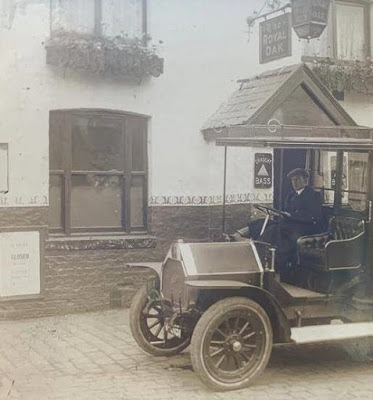
It starts with the building to the right, which was a block of apartments, originally owned by the Renshaw family and predates 1832.  It was demolished to make way for the present Royal Oak, possibly in the 1930s.

And in front of that building is the large billboard for the Pavilion, which was our own music hall and cinema, and was located on the corner of Wilbraham Road now occupied by the Morrison’s petrol station.

The Pavilion, which also was known as The Chorlton Theatre and Winter Gardens, dates from 1904 and closed by 1924, all of which fixes our image sometime between those two dates.**

And there is more, because behind the car there is sometime detail of the pub, with that poster which includes the word closed, which in turn might just provide us with a date for the closure of the old pub and might just push the date of the new one back into the 1920s.

So yes, Kelsey’s picture is a wonderful addition to out knowledge of Chorlton’s past.

Location; Chorlton-cum-Hardy

Picture, the Royal Oak, and Thomas Kelsey, date unknown, from the collection of Kelsey Broome

*That lost picture of the Royal Oak in 1902 with young Thomas Kelsey, https://chorltonhistory.blogspot.com/2019/09/that-lost-picture-of-royal-oak-in-1902.html

**The Chorlton Theatre and Winter Gardens, https://chorltonhistory.blogspot.com/search/label/Chorlton%20Theatre%20and%20Winter%20Gardens

Monday, 28 April 2025

New pubs for old and a disappointed confectioner

I rather think there must have been something in the air in the early months of 1907.

In the February there were two applications in front of the annual licensing meeting for the city of Manchester for new pubs in Chorlton.  Well I say new but in both cases they were for the demolition of existing buildings and their replacement with new ones.

The licensing records for the city are a wonderful treasure trove and I have to say I have trawled them over the years.  Sadly our own records only appear after 1904 when we were incorporated into Manchester and for the records of 19th century Chorlton you have to look elsewhere.

But for today thinking of the 1907 debate on new pub build the details are all here and it makes fascinating reading.

Now we had plenty of places.  Some like the Greyhound, the Bowling Green Hotel, Horse and Jockey, and Royal Oak could trace their history back to the beginning of the 19th century if not earlier, while  the Beech appeared at the beginning of the last century.  Others like the Travellers Rest and Black Horse along with countless unnamed ones were really just beer houses and surfaced and disappeared during the 19th century. Most had very short lives and more than likely existed as a part of a family strategy to make ends meet, opening when things were tight and closing when the family fortunes improved.

The exception is the Travellers Rest at the bottom of Beech Road which was opened in the late 1830s ran through to the early years of the 20th century and for most of that time was run by the Nixon family who could claim to be one of our well established families.  Samuel Nixon senior ran the Greyhound over the Mersey, his son and daughter in law ran the Travellers Rest and their son and grandson ran the stationers and newsagents on Beech Road.

Beer houses had come into existence with the Beer Act in 1830 and were designed to break the hold of the gin shops by permitting individuals to brew and sell beer for the price of a two guinea license.  In some cases like the Black Horse at Lane End and the beer shop run by Brownhill the wheelwright they were closed down when they continued to flout the license.

All of which brings me back to February of 1907. The Royal Oak had been selling beer since at least the 1830s and was the last beer house on the way out of the township to Manchester.  As such it was well placed to cater for farm labourers and the passing trade to and from the city and in its time had seen its fair share of unruly behaviour and worse from its customers.  But it was just a small house and I guess George Henry Kelsey could see the potential.  After all he had managed to get 800 residents to sign a petition “in favour of the new scheme.”* On top of which he was prepared to close his pub, the Sir Ralph Abercrombie in Great Ancoats-street for a newly built Royal Oak.

But the views of 800 residents were caught light in the balance when set against “several owners of property near the Royal Oak who were against the rebuilding.”  And Mr Kelsey may well have judged the wind when one of the licensing committee referred to the 800 as “the poor deluded people” who “in many cases because they were attracted by the prospect of a new building in place of a tumble down structure.”

There may have been more but it has been lost in time and the application was withdrawn but not after a sarcastic exchange where the committee man remarked that the applicant in withdrawing was “a very wise man” to which the reply was “I am sure I feel very gratified by that statement.”

And the same “tide in the affairs of men” was running equally against the tenant of the Bowling Green who wanted to reduce "from 1,335 feet to 1,126 feet the drinking area of the house and to have three rooms instead of ten” by demolishing the old building and putting up a new one.

It was a proposal which was not met with much enthusiasm, foundering on the official line that “there were too many licenses in old Chorlton already."  So I remain surprised that they decided to “visit the place and form our own conclusions on the spot.”

And equally surprised that within the year the old 18th century building was torn down and replaced by a new one.

The politics and workings of the committee remain a mystery to me and looking at previous decisions by earlier bodies the same holds true.

So back in 1893 when the responsibility for granting a license was with JPs, the session granted an application from a Mr Thomas Barrows of 46 Beech Road for an off wine and spirit license was successful while that of Charles Prince Hill confectioner of 28 Wilbraham Road was turned down.  He had wanted a license “to sell beer not to be consumed on the premises” and it was “not his intention to carry on a jug trade, but merely to serve families bottled beer.  The neighbourhood had increased largely and the license would be a great boon.”**

The opposition was limited to a local resident and another from Manchester Road who represented the British Women’s Temperance Association.  So in all “of the 4,700 persons in Chorlton-cum-Hardy only two had come forward to oppose the application.”  And the application was refused.

Perhaps it was because there were two businesses almost directly opposite selling alcohol or that it would be a change of direction for the 31 year old confectioner who had been on Wilbraham Road from at least 1891.


Now in time I might pursue Mr Hill who was still there in his confectioners in 1903 but had moved on by 1909 and it might be that he was successful elsewhere.

*Manchester Guardian February 8 1907
**Manchester Guardian August 23 1893

Pictures; from the collection of Tony Walker

Monday, 3 February 2025

That lost picture of the Royal Oak in 1902 with young Thomas Kelsey

This is a picture of the old Royal Oak I have never seen before.

The caption gives a date of 1902 and refers to “the boy Thomas Kelsey, son of the landlord of the inn at the time.”

Now it is very unusual to be able to name a person in a Chorlton photograph from the early 20th century.

Usually we are just presented with a sea of faces whose identities are lost in time.

But this is different.

Thomas was born in 1893 in Salford and his parents ran the Duke of York pub at 186 Regent Road, before moving in 1895 to the Royal Oak here in Chorlton.

The pub trade ran deep in the family, Thomas’s father was working in the Glass House on Regent Road by 1881 when he was 18 years old and his parents had run a beer shop just off Regent Road.

But what makes this picture all the more interesting is the detail which it reveals about the pub.

The Royal Oak was originally a beer shop which dated back to the early 1830s and consisted of little more than four rooms.

But what intrigues me is the building behind which seems to have been added on by the 1890s.

The OS map for 1894 and 1907 show that pub had been enlarged and the 1911 census return records that there were eight rooms.

Nor is that all because George Kelsey appears to have been more than just a publican because the sign to our right announces that he was also in the business of “CABS, HANSOMS” and offered a LIVERY STATION.”

By 1921 the secondary business had morphed in "Kelsey Brothers" with Thomas describing himself as a "motor mechanic", a job he was still doing in 1939, by which time he was living with his wife Muriel and daughter at 6 Rippenden Avenue.

And  the premise had relocated to  what had been Renshaw's Buildings which had once been entirely residential but at some time the front had been converted into a garage.

This building was demolished sometime in the late 1920s or early 1930s and replaced by the present Royal Oak Pub, but in one picture the name Kelsey Brothers appears over the garage.


His father and family were still in the old Royal Oak serving up beer and cheer in 1921.

And like so much of the early 20th century the Kelsey family have progressed with the times, so while George Kelsey had run a beer shop his son had moved into the "motor trade" and his granddaughter was a clerk dealing with W

That said there is that finger print just below the sign, now that would be a real detective story.

Picture, the Royal Oak, 1902, m50447, courtesy of Manchester Libraries, Information and Archives, Manchester City Council, http://images.manchester.gov.uk/index.php?session=pass and Barlow Moor Road circa 1920s from the collection of Rita Bishop


Sunday, 30 June 2024

Poems and Pictures ……… a special event ........ at the Royal Oak .........

I knew I would enjoy the launch of "Poems by Lindy and Pictures by Peter" at the Royal Oak today. 


They told me they had “invited Manchester’s top literary artists to come together for an afternoon of spoken word and poetry in celebration of their new book of poems and pictures but despite, working before on projects,  up till now, they have never collaborated on a book which has produced so much wow".

Adding "the idea of illustrating stories is not new and the very first illustrated books were published in 1461 by the cleric and printer, Albrecht Pfister, who was born around 1420 in Bamberg.

What’s unique to this book is the vivid imagination of Peter’s startling images set against the raw emotion created by Lindy’s poetry". 

And the event was a success with over 40 people attending with a host of poets who offered up a mix of the funny, the serious and the poignant.

Now I confess I never wrote down the names of all those who performed, but Peter and Lindy will put me straight and I hope will also come back with not only the names but the details of their books of verse.


Leaving me just to say looking around at the audience they like me had a good time and of course to say that "Poems by Lindy and Pictures by Peter"  is available  from www.pubbooks.co.uk  and Chorlton Bookshop.


And Lindy tells me "Thanks,  Andrew for attending our event and taking these great pictures. 

Other poets taking part were: Pauline Omoboye , Alice Spencer , Amanda Nicholson, Pinbadge, Melanie Neads, Steve Smythe , Lynn Walton - what a great mix of poets and poems and it was wonderful to see so many people there, including other local poets and members of our lively'. Chorlton Arts scene".


Location; The Royal Oak Function Room,

Pictures, the event, 2024, from the collection of Andrew Simpson


Tuesday, 17 October 2023

The lost building on Barlow Moor Road ……….

No matter how much you uncover about the story of Chorlton, there is always something new.

1927
So, a while ago Kelsey Broome sent me a photograph of the old Royal Oak on Barlow Moor Road, which I had never seen before.

The pub dates from the early 19th century and was demolished sometime in the 1920s for the Royal Oak we know today.

This much I knew, but had never been able to pin down exactly when this happened.

I had always thought it must be in the late 1920s, and after a tour of the upstairs began to think it might have crossed over into the next decade.

But as so often happens a new bit of the jigsaw falls into place, which in this case was delivered by Bill Sumner, who provided me with this aerial picture of the new Royal Oak, with the magic date of 1927, which narrows down its construction.

1907
More so because there had been efforts during the early 20th century to get permission to replace the old pub with a new one.

But Bill’s picture just threw up another mystery which is the large building to right of the pub, behind the bank.

It is a substantial building, which is absent from the OS map of 1907, and has disappeared by 1952.

At present the only clue might be a reference in 1911 to a Frank Johnson at 21a Barlow Moor Road, who was a furniture dealer.

But that is it, and I will have to wait till I can get into Central Ref and look through the directories for the period from 1911 through to 1952 which might just of up some answers.

That said someone might know.

We shall see.

Location; Chorlton

Pictures; Barlow Moor Road, 1927, Britain from the Air, EPWO, 17618, detail from the OS map of Manchester, 1907

Saturday, 1 August 2020

Chorlton proudly serving ……

Classic Pub Food …….. and some very nice flowers


Location; Chorlton


Picture; The Royal Oak, 2020, from the collection of Andrew Simpson

Friday, 17 August 2018

OK .... you come in ........ The Royal Oak after its make over

Now the Royal Oak was an impressive place when it first opened sometime in the 1930s.

And after a quarter of million pound refurbishment it is again.

The grand opening is at 7 this evening, but as you do I got a sneak preview this afternoon courtesy of Christine the landlady.

The money has gone on new windows, a state of the art cellar and revamped sound and visual system along with new furnishings and much more.

I am the first to admit that my photographs are a bit amateurish but they will be the first to be seen on the blog and beyond.

So with that in mind I wish Christine, her family and the staff all the best tonight along with the owners Green King.

The present pub, stands just a few yards from the original Royal Oak which opened its door in the early 19th century and served the local farm labourers and itinerant traders who made their way into Chorlton from the city.

And for those who want to know more, it would have been the first pub the Sunday travelers encountered on their walk from Manchester into our township.


Location; Chorlton

Pictures; The Royal Oak, August 2018, from the collection of Andrew Simpson

Monday, 13 March 2017

So what did the Royal Oak in Chorlton look like in 1935?

Now this is an appeal for pictures of the Royal Oak in Chorlton.

The Royal Oak, 2011
There will be a fair few of the pub today but I am interested in ones that go back a couple of decades.

And the real find will be any of the inside before it became one large room and better still any around the time it opened in the late 1920s.

I say the 1920s but I can’t be exactly sure and it might just date from the early part of the next decade.

There had been attempts as early as the beginning of the 20th century to convert the small beer house which carried the name of the Royal Oak into a grander pub but these all fell in the face of opposition from the Temperance lobby.*

And it has to be said that the Old Royal Oak did have its dodgy moments.
Chris, the landlady on the right and Shelly,  2017

In the middle of the 1830s two men were convicted of robbing a carter after having got him drunk in the pub, and a little over twenty years later the Manchester Guardian reported on drunken gangs from Manchester assembling at the pub and causing a serious nuisance.**

There are a few pictures of this Royal Oak which stood just a little to the left of the present pub.

It was a small property in the shadow of Renshaw’s Buildings which occupied the site of the present Royal Oak.

Renshaw’s Buildings date from around 1832 and were a set of twelve one up one down houses stretching back from Barlow Moor Road into the present car park, and the old kerb stone which fronted the eastern side is still visible today.

The book on Chorlton's pubs and bars due out in mid 2017
The Buildings were still there in the early 1920s but were demolished sometime during that decade or just a little later..

The new pub which stood on the site was until the late 1950s the last to be built in Chorlton and with the closure of the Feather’s has again become the last purpose built public house in the township.

Its interior reflected that recognition that this bit of Chorlton was well heeled and more than a little up market compared to Old Chorlton which occupied the area around the village green and Beech Road.

And a bit of that grandeur is still there to see in the upstairs function room which retains its period panelling and fixtures.

So the hunt is on to find pictures of the new Royal Oak and along the way fix the date of its opening.

All of which will feature in the new book on Chorlton pubs.  And before anyone mutters that I have revealed all there is to know about the Royal Oak be rest assured Chris the landlady offered up a walk round the bits of the pub unseen by the customers and adding more than a few tales to keep me going.

The book will follow the same format as Manchester Pubs, City Centre which came out at Christmas, and as you do we took a picture of Chris and her daughter Shelly reading a copy.

Painting; the Royal Oak © 2011 Peter Topping, Paintings from Pictures,
Web: www.paintingsfrompictures.co.uk

Pictures; interior of Royal Oak, 2017, © 2016 Peter Topping

Location; Chorlton

*The Royal Oak, https://chorltonhistory.blogspot.co.uk/search/label/The%20Royal%20Oak

**The Story of Chorlton-cum-Hardy, Andrew Simpson, 2012

***A new book on Manchester Pubs, https://chorltonhistory.blogspot.co.uk/search/label/A%20new%20book%20on%20Manchester%20Pubs

Monday, 21 December 2015

Outside the Royal Oak earlier today ........... remembering Renshaw's Buildings and that other pub

Now I just couldn’t resist running Andy Robertson’s picture of the Royal Oak taken today in the December sunshine.

The pub has a long history dating back to the 1830s when it was a modest establishment which was the first pub the Sunday trade out from Manchester would happen on.*

Back then it was situated a little further along the road.

The present pub was built in the 1920s and stands on a block of cottages called Renshaw’s Buildings which date from before 1832.**

And as I have written about both the old Royal Oak and Renshaw’s Buildings I shall leave it at that.

So I shall just point to the old brewery sign picked out in the sun.

Picture; The Royal Oak, December, 2015, from the collection of Andrew Simpson

*The Royal Oak, http://chorltonhistory.blogspot.co.uk/search/label/The%20Royal%20Oak 

** Renshaw's Buildings in Martledge, http://chorltonhistory.blogspot.co.uk/2015/09/renshaws-buildings-in-martledge.html

Friday, 6 January 2012

The Royal Oak .... the painting and its history


Now the collaboration between local artist Peter Topping and me is well under way. He paints pictures of Chorlton and I tell the story behind the pictures.

The Royal Oak on Barlow Moor Road is one of our biggest pubs. It was built in the late 1920s and replaced a smaller beer shop of the same name which had been in business from before the mid 19th century.

The second Royal Oak was at the centre of “New Chorlton” which was that part of our township which had developed in the 40 years before the pub was built. It was a mix of tall terraced houses for the “middling sort” along with shops and the railway station.

I suppose it perfectly reflected this new Chorlton. The building is a large solid block with white facing stone and when new there were glazed tiles and coloured glass, which complimented the entrance columns. And then there was that staircase which greeted customers as they walked in. It was wider than most staircases that could be found in private homes and grander than that of the Lloyds or the Oaks which specialized in the cemetery trade.

The Royal Oak remains a landmark, but equally impressive in its way would have been the building torn down to make way for the pub. This was Renshaws Buildings which had stood on the same site from the early 1830s. They were one of the first blocks of brick built cottages in the township, may have been one up one downs and were built by one of our local farmers.
By the beginning of the last century part at least of the buildings had been converted into a cycle shop and later a garage. Today all that remains is the thin strip of pavement and kerb stone which ran the length of the block.

The original Royal Oak was a little west of the present pub and was much frequented by our farm labourers and the Sunday trade which made their way from the city to drink amongst the fields. Not as notorious as the Black Horse at Lane End it could still boast robberies and saw riotous mobs from Manchester disturb the peace. These and tales from Renshaws Buildings can be found in my new book http://chorltonhistory.blogspot.com/search/label/Chorlton%20the%20Book and will appear during, the new year on the blog.

Peter’s pictures hang in a number of venues across Chorlton and can also be seen on his facebook site Paintings from Pictures https://www.facebook.com/paintingsfrompictures

Picture © Peter Topping 2011 http://www.paintingsfrompictures.co.uk .