Showing posts with label The Harland Family. Show all posts

Sunday, 6 October 2019

Edwin Norman Harland, born in Sidcup and emigrated to Canada and the case of Dr Crippen

The young Edwin
Now, I always find it a privilege when friends take the time to write for the blog and so I was especially pleased when Jean added another chapter in the story of her family.

Unlike my uncle, Harold Morris the milkman, whose whole life was, spent living a stone's throw away from the house in Welling where he was born; his uncle was to live out his life
in Canada, thousands of miles away.*

Edwin Norman Harland (a younger brother of Maud, Harold's mother) was born in Sidcup in 1882.

His great-grandfather, William Harland, had been a brickmaker working in places such as Loampit Hill, Lewisham, and Whitewall Creek, near Rochester, where he was to die in 1832 as one of England's first victims of cholera- leaving a widow and several young children to be cared for by his eldest son, also a brickmaker.

Making bricks circa 1870
One of these children, aged eight at the time of his father's death, was Richard Harland.

He struggled to make good and in time became a Master Brickmaker, founding his Camden Brickworks on Whitehorse Hill, Chislehurst, in the 1860s.

Edwin was named after his uncle, Edwin Harland, whose own brickworks (Harland Brothers) were in Sidcup, where Harland Avenue is today and where young Edwin's father, George, had worked until his early death at the age of 35.

Young Edwin had undoubtedly inherited his dark, good looks from his grandmother: Eleanor Cooper, Mrs Page.

Maud
Unusually for a Harland, Edwin was destined not to become a brickmaker.

It is not known when he chose to follow this different path, but by 1901, when aged 17, he had become a Railway Booking Clerk in Mottingham, close to Eltham where his widowed mother, Annie Page, had opened a baker's shop in what today is known as Footscray Road.

At the same time, 1901, a young Devon girl -Maud Mary Westcott- was working as a general servant to the Read family at No. 73 West Chislehurst Park, Eltham.

By now, Edwin was using not his first name but his second: Norman.

“Norman” and Maud were to marry in January 1905.  He was 22 and she was 24.

They were to have two sons: Lloyd George (born in 1906) and Ronald Norman (born in 1907).

Maud and Edwin, 1905
It would seem that by 1910 they may well have been having dreams of a better life for their sons, perhaps in Canada, with a land grant that would enable Norman to become a farmer working his own land.

In July 1910, another couple had plans for a new life in Canada.

They were an American physician Hawley Crippen and his lover, Ethel La Neve, who fled England after the circumstances of Dr Crippen's wife's death in London, gave cause for questioning.

Hawley and Ethel embarked for Canada at Antwerp, sailing on the SS Montrose; but they were recognised on board and, by means of the Montrose's wireless apparatus, the police were alerted and the couple arrested upon arrival.

This was the first time that Marconi’s wireless technology had been utilised at sea in this way, the couple's arrest making history. The value of wireless for life-saving purposes became so great that soon British ships of large size and carrying passengers were being equipped with the apparatus; and it was the summoning of vessels to the sinking Titanic in 1912 that brought home to the world the importance of wireless communication.

By 1914 nearly a thousand British merchant ships were using wireless. It was in that year that the Montrose was wrecked on the Goodwin Sands. With the outbreak of war, she had been sold to the Admiralty for use as a blockship at Dover, but she broke loose from her moorings during a gale, drifted out to sea and was lost.

By 1911, a year after Dr Crippen and his lover had fled from Antwerp in the Montrose,  Norman and Maud, with their two young sons (Lloyd aged 5 and Ronald aged 3) had made up their minds to seek a new life in Canada.  Joining the Montrose at Liverpool, they arrived safely at New Brunswick on 27 March.

The ship's log records show that their destination was Winnipeg, and that Norman's intention was to be a farm labourer.   Ten years later, Norman and his family were living in the municipality of North Star, in the district of North Battleford, Saskatchewan.

In Canada
Now aged 39, Norman's occupation was given as Farmer.  His two sons, Lloyd and Ronald, were now aged 15 and 13.

What happened next is best left to Carol, Norman's great-granddaughter....

Story © Jean Gammons

Pictures; from the collection of Carol Spencer, Edwin's great granddaughter


* The Harland Family, http://chorltonhistory.blogspot.co.uk/search/label/The%20Harland%20Family

Saturday, 27 August 2016

The young bride from 73 West Chislehurst Park, Eltham, living a new life with her family in the Canada of the 1900s

Now I am in reflective mood and have returned to stories of those who left Britain to start new lives in Canada and even further afield in Australia and New Zealand.

Maud and Edwin and the boys 1909
So here is the first of three from Carol Spencer some of whose family left south east England for the wide expanses of Canada just before the Great War.*

"Edwin Norman Harland along with his wife, Maude Mary Harland and two sons Lloyd and Ron set sail for Canada on the Montrose out of Liverpool, England.  They were heading for a better life in which free land was promised.

At that time to encourage settlers 160 acres of land was offered with a few conditions. First you must pay $10. Next a home must be built in the first year and 10 acres ploughed. Lastly you must live on the land for at least 6 months of the year for three years.

It really sounded so simple and easy to become a landowner!

Who could resist when owning land in Britain was almost an impossibility!

The family landed in St. John, New Brunswick in late March of 1912.  It was still winter in Canada.

They went to a restaurant for a meal and were really looking forward to it after the long voyage on the boat.

The restaurant served the best tea Maude had ever tasted and she asked the waitress what it was.

In Canada in 1912
Orange Pekoe became her tea of choice ever after.

The waitress was very friendly and struck up a conversation with them asking about their plans.  They were planning on heading west to Manitoba in hopes of finding work and possibly learning a little about Canadian life.

She gave them some excellent advice. The little boys, ages 3 and 5, were dressed in their best short pants and socks made of cotton.  She advised them to purchase long woollen underwear and heavier outer clothing otherwise they would freeze on their way west.  Clothing was upgraded and they were very grateful for the advice.

The train was boarded along with their settler’s effects which were few.  Maude did bring a few treasures with her.

A large brass bed warmer, which her great grandchildren always thought was a banjo minus the strings, a cut glass dish which was a wedding gift and her grandmothers  silver-plated bean pot.

They travelled by train for 3 days to Winnipeg, Manitoba.  Once in Manitoba work was readily available on farms.  Edwin got work as a farmhand and Maude became the housekeeper and cook for two bachelor farmers.  Edwin got on well as there was someone there to instruct him.

Maude was on her own and had to learn to cook many things in a new way.  Things were not the same as in Britain.  Two items in particular caused many trials.  Yeast for bread was dry not the same as home.  It needed to be soaked to make yeast sponge before mixing into the flour.

Maud
This was unknown to Maude and several batches of bread were mixed and buried when they would not rise!! Only to later rise out of the ground when the sun warmed them sufficiently!!

Being a very proud, independent woman, she had difficult time asking for help.  Pies were another experience.  They were made from dried fruit and unless soaked beforehand, would not work.

After dismal failure of turning out hard shells with fruit rattling around inside Maude waited for an opportunity to watch and learn.  She had acquired a hired girl and told the girl she should go ahead and make the pies and Maude would prepare the vegetables.

Maude kept a sharp eye on the girl and discovered her mistake while saving her pride."

© Carol Spencer, 2013

Pictures; courtesy of Carol Spencer

*The Harland Family, http://chorltonhistory.blogspot.co.uk/search/label/The%20Harland%20Family


Wednesday, 24 December 2014

Far from Eltham in the cold winters of Canada .......... the story of one family in the 1900s

The continuing story of one family who left south east London for Canada in 1913, told by Carol Spencer.*

The family in 193 with two unknown chilldren
"The first summer was spent in a tent until they got a log home constructed.

This was a small home with a kitchen, living room and two tiny bedrooms on the end.  It was about 20 feet by 8 feet in size with a cellar underneath. The roof was covered with sod lifted from the ground near the house.

The logs were chinked with mud and straw to block the cold winds in winter.  Later the inside walls would be covered with first newspapers and brown paper whichever was available.

Eventually Maude was able to add wallpaper and decorate but that was far into the future.  A wood cook stove in the kitchen and a heater in the living room provided heat.  Apple boxes and any wooden crates were used for storage and shelving as they became available.


The cellar was a dugout hole which you entered by a trap door in the kitchen.  This was used to store the winter’s supply of vegetables and canned food Maude processed in the summer and fall.  The first year the garden was a disaster.

Edwin, one of his sons and an unknown girl
Not having ever gardened Maude chose the spot where they had removed the sod(top soil) to make the roof. It seemed wise as it save plowing up the grass.  Unfortunately all the nutrients plants need to grow are in the top soil. Her garden was extremely poor.

As well there were many berries growing wild around them some right at their door.  These berries were saskatoons and blueberries and very plentiful through July and August.  A bachelor came by and told them that the saskatoons were poisonous never let the boys eat them.

This incorrect information was most unfortunate as fresh fruit was hard to come by and these berries could easily have been canned and used all the next winter.  They were a great addition to their diet in following years.

Edwin would supplement their diet hunting rabbits, prairie chickens, ducks, geese and deer.  This supplied meat when they had no pigs or cattle to butcher.

Chickens were also raised to supply eggs as well.

Supplies such as tea, coffee, flour and sugar had to be purchased at the local store, Red Cross Store and Post Office.

It was about 5 miles away and when families were short of cash things could be purchased on credit.  Very few luxuries such as candy or bought bread were bought.

The first year was very hard and lonesome.  Maude thought there must be a bridge nearby as she could hear hooves pounding of a bridge quite often.

Maud
This sound turned out to be the sound of a prairie chicken flapping its wings in a mating ritual not a bridge at all.

They had to clear a certain number of acres of land and with all the stones and trees this was very hard work.

They managed to do this and Edwin used the stones to build fences, reminiscent of England’s, around his farmyard.

Things remained difficult over the years and many jobs were taken on to supplement their income.

Norman became a well-digger and dug many wells throughout the area.  He and his boys were also very musical and they played at any local dances often for $1 or nothing.

He also became a justice of the peace as many of the other homesteaders were unable to speak or read English.  He would help them with legal papers and letters.

Maude became a midwife in the area and delivered many of the babies as there was no doctor or hospital closer than 30 miles away.

She took on the job of caretaker at the school that was built and was proud of the desk she received as payment, a proper piece of furniture.

Maude and Edwin became good friends with their new neighbors a gentleman from Germany with a teenage daughter and son.  These people could not speak English and Maude taught Nanny English using the Sears mail order catalogue.  This family remained close friends over the years."

© Carol Spencer, 2013

Pictures; courtesy of Carol Spencer

*The Harland Family, http://chorltonhistory.blogspot.co.uk/search/label/The%20Harland%20Family

Next; a success in Canada, new farms and a growing family

Tuesday, 23 December 2014

The family from south east London who did good in Canada in the early 20th century

This is the last for a while of stories about Edwin and Maud Harland who left south east London for Canada in 1913.

The family in 1913
It was written by Carol Spencer who is a descendant of the couple.

"Edwin managed to prove up his homestead and was very proud when his two sons procured homesteads next to him as they came of age.

His farm never grew very much larger. He managed to have a small herd of 7-10 cattle of which he was extremely proud too.

They had to work off the farm during the First World War and moved down to Lashburn which was about 40 miles south of the homestead at Red Cross.

While there Edwin worked for local farmers and dug wells.

He also built them a small home in the village.  Maude worked at the hospital as a cook and the boys attended school.  About 1919 they moved back to the homestead.

Tired of the hard life on the farm and all the neighbors and family having moved away to better land and prospects near Frenchman Butte, Maude decided to leave and move to the village of Frenchman Butte.


The family today
Edwin could not leave his dream even though it did not have a good future and stayed on the homestead.

He remained there until about 1960 when he fell ill and was cared for by his eldest son Lloyd until his death in 1970.

Edwin is buried at the Fort Pitt Church, Fort Pitt, Saskatchewan only a few miles south of his
homestead in Red Cross.

His eldest son, Lloyd and his sons and grandsons have brought Edwin’s dream to fruition as they run a large successful cattle ranch at Fort Pitt to this day.

Edwin and Maude gave so much to all the family in offering them opportunities they may never have had had they not been brave enough to take a chance themselves in 1912."

*The Harland Family, http://chorltonhistory.blogspot.co.uk/search/label/The%20Harland%20Family

© Carol Spencer, 2013

Pictures; from the collection of Carol Spencer

Monday, 22 December 2014

The Harland family of Saskatchewan, and a search for two young people

Now I have come to know the Harland family.*

They left south east London for a new life in Canada in 1912 and were one of that country’s success stories.

The early years were hard and they began life in Canada in a tent but with hard work and I guess a bit of luck they succeeded in carving out a decent life for themselves on a number of different farms across the country.

The story was written by Carol Spencer who is one of their descendants and will be featured on the blog through June and July.

Along with the story Carol supplied me with a series of photographs and it is one of these that has drawn me in and led me off on a trail of investigation.

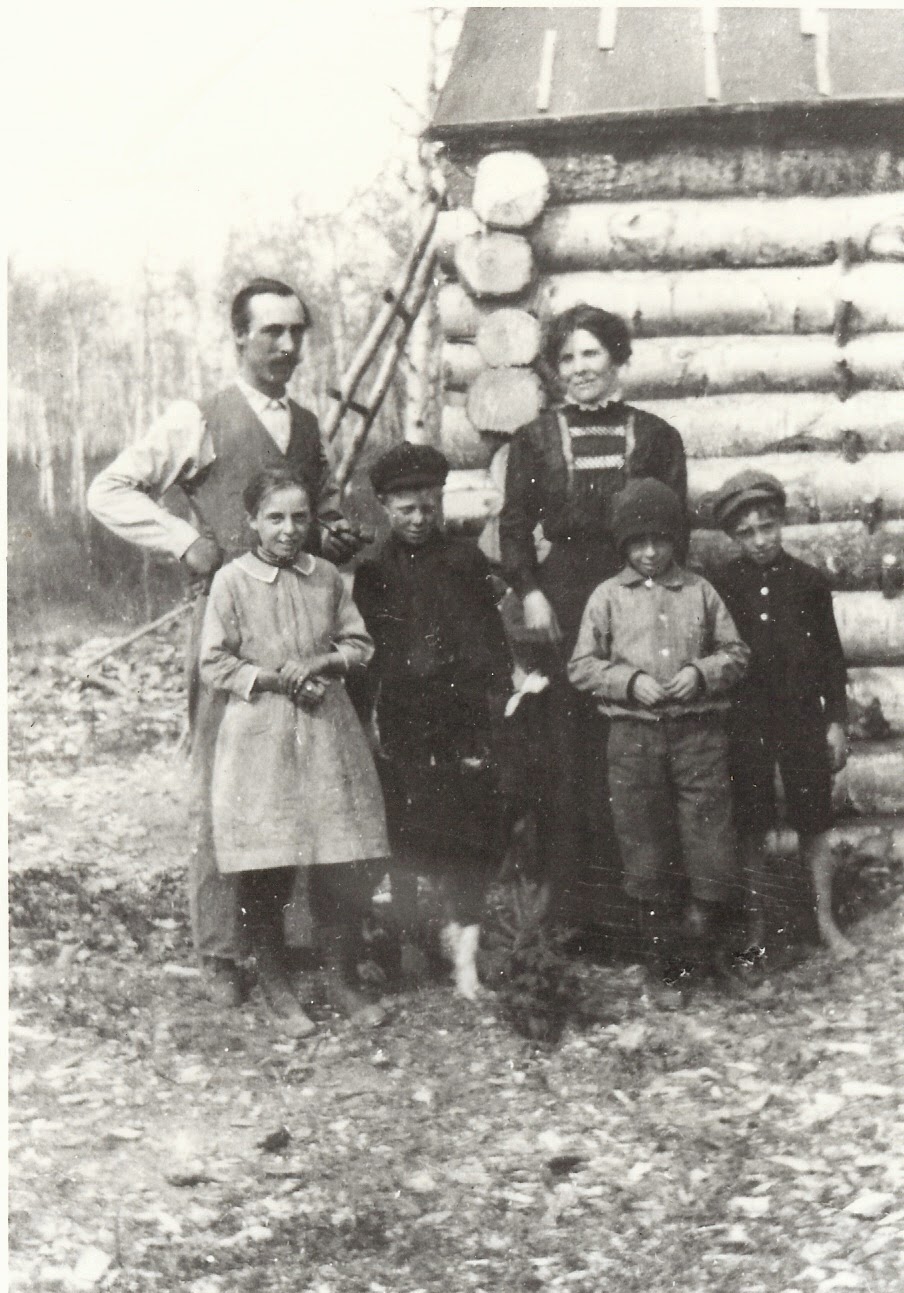
At first glance there is nothing unusual about the image.  Edwin and Maud are pictured with their two barefooted sons beside a log cabin sometime in 1913.

But it is the other two young people who interest me.  They are unknown and of course might just be friends or the children of neighbours.

But they could also be British Home Children employed on the farm.  Now I don’t usually do speculation but in this instance I am tempted to run with the idea.

The Harland farm near Frenchman Butte in northwest Saskatchewan was not a large one and “things remained difficult over the years and many jobs were taken on to supplement their income.  

Edwin became a well-digger and dug many wells throughout the area.”**

Even so  so I guess it is a possibility that they did from time to time take on labour and that the two staring out at us were also from Britain.

But I doubt we will ever know, my friend Jean has promised to ask Carol and it may just be that a document or letter referring to a British child might turn up.

And that of course raises an exciting avenue of research which might spin off into discovering who these two were or at least the names of children employed by the Harland’s.

That said I am at the limits of my knowledge and will have to explore the extent to which BHC were engaged in this part of Canada and who were the most likely charities to settle young people here in the first decade of the 20th century.

All of which may or may not help us with discovering the identities of the two young people, and with history being what it is it is just as likely that they were friends of the family in which case it has all been a bit of a wasted journey.

Well we shall see.

Pictures; courtesy of Carol Spencer


The Harland Family, http://chorltonhistory.blogspot.co.uk/search/label/The%20Harland%20Family

**Carol Spencer, Edwin Norman Harland 

Sunday, 21 December 2014

From south east London to Canada in 1913 part 2

This is the continuing story of Edwin and Maud Harland who left their home in south east London for Canada.*

Edwin as a young man
The story was written by Carol Spencer a direct descendant

"In the spring of 1913 Edwin set out to find his own piece of land.  They went on to Saskatoon and he made a couple of expeditions out to find the land of his dreams.

He travelled up to Carrot River area but was sure there were not enough trees.  (Carrot River is one of the richest farm areas in our province).  Next he checked out Red Cross District in Northwestern Saskatchewan.

Carrot River has rich, flat prairie land with lots of water.  Red Cross has many trees and rocky soil.  To Edwin the choice was clear!  Red Cross had trees for firewood and many rocks to build with.

Unfortunately rocks were not used much for building and trees needed to be removed before plowing.  His lack of farm experience left them in a difficult, tough life style.

The train line had reached Edam by this time and Edwin again loaded his family and belongings on the train and headed to northwest Saskatchewan to claim his homestead.

Maud with one of her sons to the right
Once in Edam a wagon and horses were purchased and all their belongings were loaded on to it and off to the claim they headed.  It was about a 60 mile journey and would take 2-3 days.

The road was a dirt trail of wagon ruts that required them to cross the Turtle River over which there was no bridge.

To Edwin it looked quite shallow and narrow.  He had Maude drive the wagon across then realized he was still on the wrong side of the river.  Being fairly athletic he decided he could very likely just jump the river and rejoin his family.

It was quite cool and the water was very cold as the ice had just thawed.  He backed up and took a running leap his long coat-tails flaring out behind.

Unfortunately he misjudged the distance and landed in the middle of the stream with the coat-tails floating out behind him.

Cold and wet he had to continue on as his family tried to hide their mirth!!  There were several stopping houses along the way for the family to stop at nights until they reached their claim."

Next; their first summer in Canada

© Carol Spencer, 2013

Pictures; courtesy of Carol Spencer

*The Harland Family, http://chorltonhistory.blogspot.co.uk/search/label/The%20Harland%20Family