Showing posts with label Knighton. Show all posts

Wednesday, 10 June 2026

What Miss Sarah Kate Sloane did in the Great War ..... part 1

Now, I am only at the beginning of the story of Ms Sloane, who was born in 1871 and died in 1965, but already it promises to be a fascinating piece of research.

British War Medal, 1914-1919
She was born and died in Leicester and spent most of her life there, save for those periods when as a Red Cross nurse she served in hospitals across the country and in France during the Great War.

And it was her wartime medals which drew me into her story, and while I have accumulated some biographical details, I know there is much more.

She was awarded The British War Medal, 1914-18, The Allied Victory Medal, 1914-19, The War Medal Medal, 1939-45, and the Defence Medal, 1939-45, and the first two carry an inscription which includes her name and the letters V.A.D, which refer to her role as a member of the Voluntary Aid Detachment.

Members of V.A.D. performed a variety of tasks in Red Cross Hospitals, from nursing to cleaning, washing, and cooking, as well as administration and many also took on fund raising activities in the community.

Ms Sloane came from a medical family and both her father and brother were doctors, which makes her choice of nursing and unsurprising one.

Evington House, 2022, formerly Kighton V.A.D., Hospital
The Red Cross records show she served from 1915 through to 1917, at various Red Cross hospitals, starting at the Knighton V.A.D., hospital close to where she lived.

From 1916 she was at No.2 B.R.C. Hospital in Rouen, followed by Frensham Hill Military Hospital,  and Ullesthorpe Court, & Charnwood V.A.D. Hospitals.

After which she worked for the Discharged Soldiers & Sailors organization, which was part of the Ministry of Labour and focused on finding suitable employment for men no longer in the forces.

So far, I have no pictures of Ms Sloane, but I know where she lived in Leicester, and some at least of the houses are still standing today, as is the Knighton V.A.D Hospital which is now known as Evington House and stands in Evington Park.

Evington House, 2022, formerly Kighton V.A.D., Hospital
The house dates from the early 19th century, and bits maybe much older.  In its time it was owned by one family with links to the campaign against the slave trade, and in 1914 was lent by its then owner to the Red Cross.

There are various accounts of the house including its time as a hospital and many also include a fascinating account of the daily routines by Miss Alice Henderson who was the commandment which appeared in the Wyggeston Girls Gazette in 1919.

I suspect much of what Miss Henderson outlined in the article would have been familiar to Sarah Sloane, and was pretty much the lot of many who worked in Red Cross Hospitals.*

And that at present is pretty much all there is.  I know she arrived back from Algiers in 1931, left over £55,000 at her death in 1965 and lived for 30 years at 8 University Road, in Leicester.

Defence Medal, 1939-45
But I don’t have a clue how she voted, what she thought of the big issues of the day or how she occupied her time after war service.

That said I am confident I will find out more.  There are people who have included her in their own family history records, and I await a reply from the Leicester Records Office so there is much more to play for.

All of which leaves me with that odd reflection that history can be messy and can surprise you.

So, when I started the search for the story of Sarah Kate’s medals, I had no idea that she came from Leicester or that our Josh and Polly would turn out to live just minutes away from both Knighton V.A.D., hospital, and her home on University Road.

But then that’s the fun of the past.

Location; Leicester, and elsewhere

Pictures; Miss Sloane’s medal, courtesy of David Harrop and Evington House, formerly Knighton V.A.D., hospital, from the collection of Josh Simpson

Sources; census records, 1901-1921, Red Cross Records, 1914-1919, Baptismal record, 1871, various street directories  and electoral registers, 1920-1930, Probate Records

* Evington’s VAD Hospital, Evington Echo, December 19th, 2014, https://evingtonecho.uk/evingtons-vad-hospital/

& Evington House, Evington Park, https://storyofparksleicester.com/park-histories/evington-park/#:~:text=This%20house%20is%20said%20to,hunter%20gatherers%20roaming%20over%20it.&text=In%20Roman%20times%20and%20on,have%20been%20a%20Roman%20cemetery

Tuesday, 9 June 2026

On discovering Knighton …… that suburb of Leicester which was once its own place

An occasional series on the village and township of Knighton, as it was and as it is today.

Knighton in 1834
In 1846 Knighton was described as “2 miles S. by E. of Leicester, a village, township and chapelry, containing 465 inhabitants, and 1638 acres of fertile land, intersected by a small rivulet, and traversed by the Midland Counties Railway, and the turnpikes from Leicester to Welford and Market Harborough”.

On the north side of the chapelry "was a pleasant suburb called Stonegate, adjoining the Racecourse of Leicester, and having several handsome houses, occupied by manufacturers, &c, who have their places of Business in that town.  The soil on the north is good loam, and on the south strong clay.

Sir E.C. Hartopp, Bart., occupied the Hall, as a hunting box, and is lord of the manor, and owner of a great part of the soil; and the rest belongs to G.A.L. Keck, Esq., Sergeant D’Oyly, Mr. Joseph Johnson, and a few other proprietors.”

The place was mentioned in the Domesday Book, and over the centuries passed through the hands of several landowners.  Its church predated the Norman Conquest, while Wesleyan chapel was only erected in 1816, and “the commodious National School was built in 1840”.

Knighton's most prominent residents, 1846
The description concluded with listing the 21 most prominent individuals of whom ten lived in Stoneygate  and had their places of business in Leicester.

 The remaining eleven lived in Knighton, and amongst them were two publicans, three farmers, assorted professionals, some shop keepers and Elizabeth Hughes the teacher at the National School.

All of which is a start, and because we have the census returns we can add to the 21, the other 400 or so inhabitants, recording their names, occupations, places of birth as well as the age profile of Knighton.

Added to this we also have the electoral register for 1841, which not only lists the names of those entitled to vote, but just how they cast their votes.

So, I know that Mr. Charles Simpkin, the farmer, voted for the Tories and Mr. Alfred Burgess, who described himself as a “Woolpacker” and was  later a J.P., cast his two votes for the Whigs.

And if I can locate the tithe records and rate books I will have a better idea of how the land was farmed, the size of farms, and  the level of annual rents.

All of which will provide a detailed description of Knighton in the 1840s, before it became a suburb of that big city two miles up the road.

Location; Knighton

Next; Who were the 18 Knighton electors in 1841 ..... and how did they vote?

Pictures; Knighton in 1834, from Greenwood’s map of Leicestershire, Greenwood’s Atlas, 1829-1834, courtesy of Digital Archives Association, http://digitalarchives.co.uk/, and Knighton’s prominent residents in 1846, from History, Gazetteer, and Directory of Leicestershire, 1846

*History, Gazetteer, and Directory of Leicestershire, 1846

Wednesday, 23 August 2023

As others see Leicester ………. part three

The fun of being a tourist is that you often see a place differently.

You are seeing it for the first time and with that usually comes a curiosity to know more, so when we walked past The Church of St Mary Magdalen on Church Lane in Knighton, I wanted to know its history, and to record its appearance.

Unfortunately, our Josh and Polly couldn’t help with its story added to which I had come out without my camera.

But fear not google maps had an image of the church, which I was able to use providing I gave them the credit, and a search of Tuck DB offered up a fine picture postcard. *

Tuck and Sons were a picture postcard company with office across the world and during the late 19th and into the 20th century produced heaps of cards.

In turn Tuck DB is an online resource which holds large number of the company’s work, and amongst the Leicester collection was the church.

According to one source it's history dates back to 1097, with the earliest part of the building, which is the tower, is from the 13th century. **

Added to which Historic England records that it is a Grade II listed building. ***

In time I will go looking for some information, although I note that various sites do include pictures, but where would the fun be for a tourist in using them, when I can take my own photographs next time we are in Knighton.

And so, qualify for being a tourist all over again.

Leaving me just to observe that Tuck's postcard is undated, but the reverse does mention Queen Mary which I take to be Mary of Teck who was the wife of King George V who was on the throne from 1910 til 1936, which may suggest a date for when the earlier picture was taken and marketed.

For those who want to enter the spot the difference over time competition between the two images I will just say there is no prize, for the best essay.

Location; Knighton, Leicester

Pictures; Church of St Mary Magdalen, Church Lane, Knighton, courtesy of Google Maps, 2022, and by Tuck and Sons, undated, courtesy of Tuck DB

*Tuck DB, https://tuckdbpostcards.org/


**Knighton: St Mary Magdalen, The Church Of England, https://www.achurchnearyou.com/church/2917/

***Church of St Mary Magdalen, Church Lane, Knighton, Historic England, https://historicengland.org.uk/listing/the-list/list-entry/1074020


Wednesday, 16 August 2023

It’s the little bits of history that are fascinating ……

So, if you want your own bit of history there can be nothing better than a splendid inscription on the side of your house.


We were in Knighton in Leicester, and on the Sunday stroll ambled down to Stonegate and one of those little interesting pockets of shops, bars and cafes that is Allande Road and Francis Street.

Once they would have been a mundane but essential collection including a grocers, a butchers and a green grocers along with an iron mongers, chemist and perhaps hairdresser.

But the passage of time and the advance of the cafĂ© society have transformed the two streets and now there are a succession of wine bars, “interesting” cafes, and two restaurants, all of which nestle between an art gallery, gift shop, various clothes shops and a mix of other retail outlet all catering for the well-heeled professional residents.

And if that wasn’t enough Francis Street boasts its own pub, which goes under the name of The Local and has been going since 2019.

What caught my eye however was the street furniture, in the form of those inscriptions set high up in the walls of the houses, announcing the names of the terraced properties with a date when they were built.

So, starting at the top of the road there was Cecil Cottages, 1882, Hope Cottages, Coodes Cottages, and Retrieved Cottages 1887.

Most impressive of all was the terracotta tablet, dated 1897, commemorating Queen Victoria’s 60 years on the throne.

I suspect this was an addition after the houses were built, but to be sure I will have to trawl the directories.

It is the sort of thing you might miss, or ignore.

And mirrors the cast iron street cover made by Dudley & Dowell Ltd of Gradley Heath in Stafforshire.

I went looking for the company but so far have only discovered that they merged with the Brickhouse Company of Dudley in 1967.

In time I will find out more about them, but for now I shall just let you share my fascination of these neglected bits of our street furniture.  

That said I have come across several sites dedicated to recording them, which rather suggests I am not alone in taking pictures of coal hole covers, and all manner of street furniture.

Which just brings me back to another of the house names, this time above the door sandwiched between two shop fronts on Allande Road.  Clearly Woodbine Villa pre dates the shops which may have came along later.

All of which was two years ago, so next time we are down visiting our Josh and Polly we will go back and see how the place has changed.


Location; Leicester

Pictures; street furniture in Stonegate 2021 from the collection of Andrew Simpson.


Tuesday, 8 August 2023

Who were the 18 Knighton electors ……. and how did they vote in 1841? ... Leicester snapshots

Now I have yet to find a portrait of any of the Knighton electors who were eligible to vote in the General Election of 1841.

Elections in 1836
I am confident that I might strike lucky given that they were the good and respectable of the township of Knighton, added to which there were just 18 of them.

This was out of a total adult population of 180, which if I have done my sums correctly represents just 10%, which was still better than the national average which in 1833 stood at 4%.

But this was still a time when only men could vote, and only men with a property qualification.

So, of our 18, three were farmers, one was an aristocrat and the rest were engaged in commerce and industry, leaving Mr. William Simmons who not only held land and houses, but was the landlord of the Dun Cow.

Unlike many places almost all of our electors lived in Knighton, with just three living elsewhere.

And by sifting through the census returns, old directories, and poll books it is possible to get an idea of who they were.*

William Simmons for instance was 50 years old, was married and had one son who was a butcher.

One of his near neighbours was Charles Simkin who was a farmer with 140 acres, employing three labourers, while out on the London Road lived Mr. Richard Warner Wood, who in 1841 was in the hosiery business, a decade later described himself as a “Land Proprietor”, and retired as a banker, leaving £16,000 on his death in 1867.

So far I know a bit about 12 of the 18, and in time will find out about the others.

Knighton in 1834
But the 12 are the ones who interests me because they actually voted in the General Election and I know who they voted for, because each had his votes recorded.

This was after all, a good three decades before voting was undertaken in secret, and votes were not only recorded, but seen to be so.

And that in turn might lead to difficult choices, where some electors were tenants or customers of the powerful landed interests.
Voting bribery and intimidation did go on, and the election described in Pickwick Papers chimes in well malpractices reported in the press.

The Manchester Guardian reported in the July of 1841, how “a long string of voters came up from Rathy a parish which is the property of the Earl of Stamford” which was in the same constituency as ours, “decorated with the colours of the Tory candidate and when asked of whom they voted, replied ‘I vote for the two that Lord Stamford supports’”.**

How Knighton voted in 1841
The 1841 Election saw a big swing to the Tory Party from the Whigs, who in the previous decade had pushed through a series of reforms, from the Great Reform Act, the abolition of slavery and the reorganization of the Poor Law.

But for some they now looked like “extinct volcanoes” and the result of the election was a Tory victory with the Tories gaining 53 extra seats and the Whigs losing 73, giving the Tories 51% of the total vote.

Here in Knighton our 12 followed the national trend, with seven voting for the two Tory candidates and the remaining five supporting the Whigs.

Across the constituency the result was pretty much the same, and the two Tory candidates were re-
elected.

All of which leaves me to go looking for any election material that has survived, and perhaps even a comment from one of the 12 on that election result.

We shall see.

Location; Knighton

Pictures; The Election at Eatanswill, Phiz (Hablot K. Browne), August 1836, the Pickwick Papers,  Knighton in 1834, from Greenwood’s map of Leicestershire, Greenwood’s Atlas, 1829-1834, courtesy of Digital Archives Association, http://digitalarchives.co.uk/

*1841 Census, Enu 8 St Margaret, Leicestershire, Poll Book 1841, Directories 1841 & 1843

**Leicester South, Manchester Guardian, July 14th, 1841

Monday, 7 August 2023

A little bit of Leicester a century and a bit ago ..... part two

Now the city of Leicester is somewhere I have only recently discovered.

Belgrave Gate, 1902
And there is till much to explore, so I am pleased I came across a collection of picture postcards of the city at the beginning of the last century.

They were produced by Tuck and Sons, who were one of the leading manufacturers of picture postcards, with offices across Europe and North America.

Their Leicester collection spans the decades either side of 1900, and offers up a variety of scenes, from the market place, to the clock tower and the picturesque New Walk.

Now, anyone in possession of Street Google will be able to look up some of the locations and compare and contrast what they look like today with the past.

Cock Tower, 1902

Many come with the same general description which asserts that “Leicester possess claim to a very ancient history, and has many well known antiquities.  

It is now a thriving town and is well known as the centre of the hosiery trade.  Belgrave Gate is situated in the centre of the town and one of the main thoroughfares.”.

Location; Leicester

Pictures; Belgrave Gate and the Clock Tower, from a set of six, published in 1902, issued by Tuck & Sons, courtesy of TuckDB, http://tuckdb.org/history


Sunday, 6 August 2023

A little bit of Leicester a century and a bit ago

Now the city of Leicester is somewhere I have only recently discovered.

The Market Place, 1902

It is home to the remains of King Richard 111, has some very nice bits, and above all is home to our grandsons.

So, I have been exploring its past and in particular the small area of Knighton.*

And today I have stumbled across a collection of picture postcards of the old Leicester.

They were produced by Tuck and Sons, who were one of the leading manufacturers of picture postcards, with offices across Europe and North America.

Entrance to the Market Place, 1902

Their Leicester collection spans the decades either side of 1900, and offers up a variety of scenes, from the Market Place, to the clock tower and the picturesque New Walk.

Many come with the same general description which asserts that “Leicester possess claim to a very ancient history, and has many well known antiquities.  

It is now a thriving town and is well known as the centre of the hosiery trade.  In the market place is situated the Corn Exchange, a handsome building and a  statue of the 5th Duke of Rutland”.

New Walk, 1902

“New Walk situated at the South east end of the town is a very pleasant promenade greatly frequented by the townspeople.  

It is half a mile in length with a fine avenue of trees.  

The Town Museum founded in 1849 is situated here.  

The building is in classic style and considerable alterations and additions were made in 1891”.

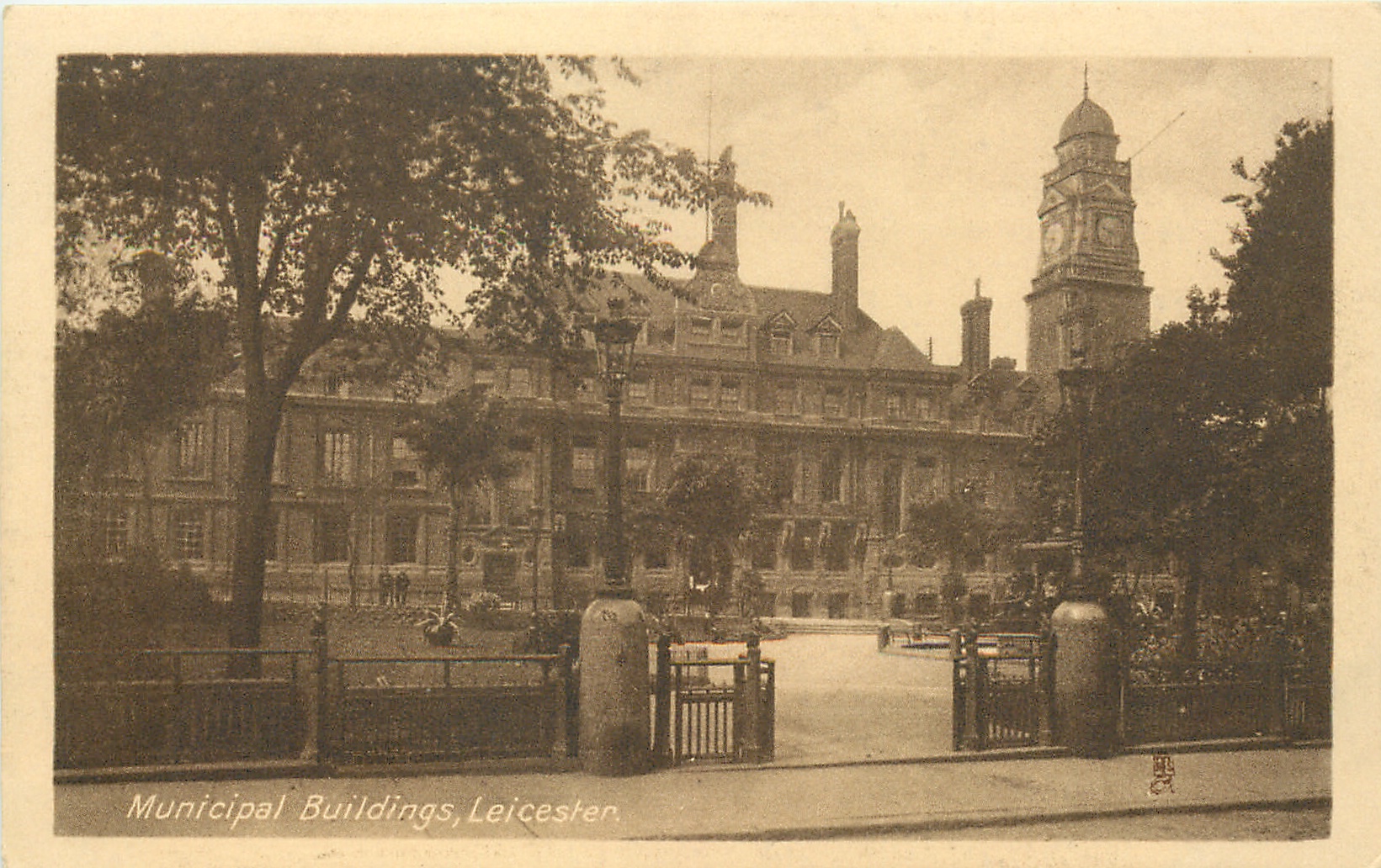
Municipal Buildings, 1902

Now, anyone who can access street google will be instantly able to match these locations with what they look like today, leaving me just to add a picture post card of the Municipal Buildings, which Tuck and Sons described as “a fine building constructed in the Queen Ann style, was begun in 1874 and erected at a cost of £51,000".

Location; Leicester

Pictures; The Market Place, entry to the Market Place, New Walk and Municipal Buildings, from a set of six, published in 1902, issued by Tuck & Sons, courtesy of TuckDB http://tuckdb.org/history

*Knighton, https://chorltonhistory.blogspot.com/search/label/Knighton


**Tuck and Son, http://tuckdb.org/history


Tuesday, 3 January 2023

My city .... my song ........ or Song for Belper ....... on the wireless today*

Now being from London I grew up with a shedload of songs about my city, and because dad was from Newcastle Upon Tyne there were plenty to stand in contrast.

But Belper, and Leicester passed me by, so I was intrigued by a gentle progrmame on the wireless about those towns who went out and commissioned their own song.*

Of these my favourite has to be "It's a Leciester Fiesta" which is on You tube, and which I have played at least five times, sharing it along the way with our Josh and Polly who live there.

All of which leave me to share the programme notes and a link yo Song for Belper.

"Britain has a revered canon of Great Music inspired by particular places and composed by Ralph Vaughan Williams, William Walton, Arnold Bax and others. Music performed live across the centuries and evoking parts of the British Isles in the imagination of millions around the world through recordings.

Then there’s the pop records released in the 1970s and 80s that were commissioned by town councils around Britain to promote the joys of the place and its people.

These are the small songs about places that were not created by great artists in the bliss of inspiration - but by the offer of hard cash, as an answer to critics, or as social engineering by a local council.

Bafta-winning writer and musician Jason Hazeley (Ladybird Books, Portishead) and producer Peter Curran enlist the help of legendary DJ Tony Blackburn, Emmy-winning James Bond and Sherlock composer David Arnold and contemporary architecture and social historian, John Grindrod. They are joined by town planner John Frankland and songwriters Tracey Wilkinson from the Rough Truffles Community Choir and The Rt Hon Sir Gregory Knight MP, composer of It’s a Leicester Fiesta.

A Foghorn Company production for BBC Radio 4"

Pictures; The Market Place, entry to the Market Place,  from a set of six, published in 1902, issued by Tuck & Sons, courtesy of TuckDB  http://tuckdb.org/history

*Song for Belper, Radio 4, https://www.bbc.co.uk/programmes/m001gk63

**It's a Leicester Festival, https://www.youtube.com/watch?v=QNUZIWce3cE

Saturday, 8 May 2021

In celebration of the Co-op …… London Road ….. and a little bit more

I doubt many of the customers of the London Road Co-op in Leicester give much thought to the history of the building.


It is pretty much what you would expect of one of their shops, with its corporate blue logo, and grey paintwork.

What marks it out as slightly different is that it is not a new build, and appears to have a bit of a history.

That history includes a hotel which closed sometime in 2008 if not earlier.

It was called the Gable Hotel, and part of it is now the Flexistay Leicester Gables Aparthotel, whose website announces that “The former Gables Hotel is now the Flexistay Gables Aparthotel Leicester, offering you flexible long or short-term accommodation at an affordable price.

The aparthotel is designed to give you a comfortable and convenient stay. Every room is well appointed with a large en-suite, tea and coffee making facilities, flat screen Freeview TV and hairdryer”.*


And as you do I wonder what Mr. and Mrs Cadell or their immediate neighbour,  the Wooley’s would have thought of their two fine homes being transformed into a hotel and Co-op store.

The two fine homes were called Glenwood and Holmdate and both contained eleven rooms with extensive rear gardens. 

On one level I suppose both families might have seen the logic of a commercial use for their homes.  

In 1911 Mr. Cadell described himself as a draper with premises at 17 High Street in the centre of Leicester, while Mr. Wooley was a “Chemist and Dentist”.

As you would expect from their occupations andstatus, both families employed a servant, one of whom was local while the cook and housemaid who worked for the Wooleys’ came from Warrington and Batley.


In time I will explore the history of those two properties, seeking to uncover the date of their construction and that moment when they became a hotel.

And once that has been done I might explore the stories of some of their close neighbours who included The Independent Order of Rechabites, and the Leicester Citizens Social Reform and Vigilance Association.

For now, I know that The Independent Order of Rechabites also known as the Sons and Daughters of Rechab, is a fraternal organisation and friendly society founded in England in 1835 as part of the wider temperance movement to promote total abstinence from alcoholic beverages”.**

Pictures; London Road Co-op, Leicester, 2021, Leicester, from the collection of Andrew Simpson, and a postcard of The Independent Order of Rechabites, 1910, from Independent Order of Rechabites, wikipedia

* Flexistay Leicester Gables Aparthotel, https://www.flexistay.com/H-1063-Flexistay-Leicester-Gables-Aparthotel.aspx

** Independent Order of Rechabites, https://en.wikipedia.org/wiki/Independent_Order_of_Rechabites


Thursday, 7 May 2020

So just how do you discover when your house was built? …………….

It seems a deceptively easy question to answer.

And it is, if you are the first resident in a new build or you have the deeds.

The house, 2020
For the rest of us it becomes a tad more difficult.

So, when we moved into our house on Beech Road, the estate agent confidently assured us that it was built “around 1910” only to discover when we looked at our deeds that it was in fact 1915.

All of which may seem trivial to some people, but for others like me it mattered.

The fact that I had to wait 25 years to be able to see the deeds and establish the correct chronology was important, but then I am interested in local history.

Now, for all those who don’t have access to their deeds, and “can’t ask a friend” the route to establishing the age of a property can be quite a challenge.

The UK Land Registry contains more than 25 million titles showing evidence of ownership for more than 87% of the land mass of England and Wales [and since 1995], anyone buying or selling land or property, or taking out a mortgage, must apply to be registered.* 

But if you "owned your home from before 1990 and not taken out a mortgage since, your property my not be registered”.**

Added to this “much of the land owned by the Crown, the aristocracy, and the church has not been registered, because it has never been sold”.**

And to do a search there is a fee.

Directory, 1895
All of which means for some people there has to be another answer.

Maps are a good starting point, but there can be a gap between the publication of one map and another.

Alternatively, there are the Street and Trade Directories which began in the 19th century and survived almost till the end of the 20th century.  They list streets, trades, and residents, and were published annually.  But the older ones were patchy in the streets and the individuals who were included, and of course it involves a long tedious search for the first mention of your property on your street.

If you know the name of someone who occupied the house they might appear on the census returns, but these were compiled on a ten year cycle, and the first which offers the detail of residents by streets was first issued in 1841, and the last that is available to peruse is the one for 1911.

Although there is the 1939 Register, which was almost a census but quite, and was ordered up to give the Government an accurate list of UK residents which was used to create the programme of identity cards.

All of which leaves  the electoral registers, which are published each year, and like the directories it becomes a process of elimination, checking back until your house does not appear.

It isn’t full proof and relies on the inhabitants having a vote and so qualifying to be added to the list.

And it was the electoral register which led me to the date of a house in Knighton in Leicester.

Knighton, 1902 .... no house
The design of the house and surrounding properties, pointed to a date sometime in the
early 1900s which fitted with the development of Knighton, which offered a window from 1906 to 1911.

In 1906 the house was absent from the street, but it is there in 1911 and appears on the census return, which supplied the name of Mr. Arthur Hammond.

And armed with that name it became a simple process to work back from the 1911-12 electoral registers, locating first the street and then Me. Hammond.

Not that I had to trawl back far, because 1911 was indeed the first time either the
house or the elector is recorded.

So, in the case of this house that pretty much is that.

I could go looking in the local media for a mention of the street or the development, but I rather think this would add little.

Pictures; Knighton, 1902, OS Map for Leicester, 1902, the house , 2020

*HM Land Registry, https://www.gov.uk/government/organisations/land-registry/about

** HM Land Registry