Showing posts with label Trolley buses. Show all posts

Monday, 6 July 2026

Of trolley buses and a company called SELNEC


The trolley bus never did much for me.

They were much quieter than the bus or the old trams but they always made me feel ill.  I think it was the combination of the heat and the smell of the leather seats with the disinfectant which I found uncomfortable.

Stevenson Square December 1966, the last Manchester trolley bus
But they were a common enough sight in many of our cities to warrant a bit of a story.

I can’t remember using them at home but London Transport operated them for thirty years on 68 routes with 1811 trolley buses.

Here in Manchester the service which began in 1938 covered 9 routes using 189 vehicles.

Ours came off the road in 1966 and this one in Stevenson Square was the last in the December of that year.  Stevenson Square was the terminus of trolleybus services to Audenshaw and Stalybridge.

Piccadilly with an Ashton-Under-Lyne trolley bus, 1960
Nor were we alone in operating trolley buses, and it is equally possible that had you jumped on a trolley bus to Ashton-Under-Lyne it would have been the blue and cream ones operated by Ashton Corporation.

They had been quicker off the mark staring operations in the February of 1925 on five routes with just 19 trolley buses and like Manchester abandoned them in 1966.

This was just three years before I arrived in the city so the sight of this Ashton trolley bus in Piccadilly around 1960 is one lost to me.

But I do just remember the sheer number of corporation bus companies in the city in 1969.

The green livery of the joint Transport and Electricty Board
Along with the disticntive red livery of Manchester and the blue and cream of Ashton there was the green of Salford and the green of the Stalybridge, Hyde, Mossley and Dukinfield Joint Transport and Electricity Board along with the maroon and cream colours of Oldham.

And no doubt if I dug deeper I could come up with the routes of some of the neigboring authorites whoses trams, trolley buses and motor buses entered the city.  All of which came to an end in 1969 with the formation of a unified bus company covering the whole of greater Manchester and initially known as SELNEC, or South East Lancashire North East Cheshire.

A SELNEC bus, 2008
Its orange and white livery would not have been my choice but then having to choose a colour scheme which did not upset the local feelings of the eleven participating bus companies would always have meant coming up with something very different.

This was a huge undertaking, covering a large conurbation and an operation broken down into four divisions, each with their own different coloured logo.

And for those who like these things here are the eleven corporation companies, the number of vehicles they brought to the enterprise and the division they belonged to.


Now that will endear me to some but risk the derision of others who mutter train spotter, which is a little inaccurate given that this began as a story about trolley buses and has gone way beyond that.

So with that in mind I shall take leave of the almost silent successor to the tram.


Stalybridge bus station and the last Ashton trolley bus, 1966
Pictures; Manchester Corporation trolley bus, Stevenson Square 1966, and Ashton-Under-Lyne Corporation trolley bus, Stalybridge bus station, 1966 © Alan Murray-Rust, geograph.org.uk Wikipedia Commons, Ashton-Under-Lyne Corporation trolley bus in Piccadilly, 1960, and Stalybridge, Hyde, Mossley & Dukinfield Transport & Electricity Board motor bus from the collection of J.F.A.Hampson, SELNEC Bus, Mikey from Wythenshawe, Museum of Transport, Wikipedia Commons


Monday, 18 May 2026

Trolleybus 698 Woolwich-Bexleyheath ….. now that’s a zippy title

Now I have my old friend Richard Woods to thank for igniting memories of trolley buses.

 Tolleybus no. 1768, 2014
He sent over a link to a trip from Woolwich to Bexleyheath in 1959 on Trolleybus 698, which followed on from an equally fascinating home movie about the old, old Woolwich ferry as it crossed the River in 1961.*

Of the two the Ferry will always be more special to me.

Not so the trolley bus which seemed calculated to make me feel very wretched.  

I think it was the mix of heat, that faint smell of disinfectant and the slight whirring noise, which guaranteed to make me feel sick before the end of any journey.

So, I approached TROLLEYBUS 698 Woolwich-Bexleyheath with a bit of trepidation, but was won over by the scenes as it made its almost silent smooth way from the cinema facing the River.

A Manchester rival, 1955
It is a spot I remember well, because a decade later I stood at the same place waiting for a bus to work, and remember that even on summer’s day it could be a miserable place at 6 in the morning, made worse in winter when the rain came off the water and penetrated each layer of clothing.

My Wikipedia tells me that “Trolleybuses served the London Passenger Transport Area from 1931 until 1962. For much of its existence, the London system was the largest in the world. It peaked at 68 routes, with a maximum fleet of 1,811 trolleybuses”.** 

So that is it.  

For some the attraction of the home movie will be the trolley bus, for others the scenery and for anyone born after 1962 perhaps it will the novelty of seeing this thing that looked like a bus with echoes of the tram.

One of my nieces did recently ask me what was a trolley bus?  To which this film does the bit. 

Location; on the trolley bus from Woolwich

Picture; Preserved London Transport Q1 class trolleybus no. 1768, on display at the Regent Street Bus Cavalcade held as part of the Year of the Bus. No. 1768 ran on services in West London between 1948 and 1961. Following its withdrawal, it was retained for preservation. As of 2014, it was owned by the London Transport Museum. June 2014. Author; Bahnfrend. This file is licensed under the Creative Commons Attribution-Share Alike 4.0 International license. Manchester Corporation Trolley Bus, 1955, m48371, courtesy of Manchester Libraries, Information and Archives, Manchester City Council, http://images.manchester.gov.uk/index.php?session=pass  

*TROLLEYBUS 698 Woolwich-Bexleyheath London 1959, YouTube, by Alan Snowdon Archive, https://www.bing.com/videos/search?q=old+woolwich+ferry+engine+videos&&view=detail&mid=3DACF91326BDA4A52B813DACF91326BDA4A52B81&rvsmid=37FDE2E288F635F8664937FDE2E288F635F86649&FORM=VDQVAP

**Trolleybuses in London, https://en.wikipedia.org/wiki/Trolleybuses_in_London


Thursday, 5 September 2024

Trams … trolley buses …… and a thank you

I am a fan of those old stately Corporation trams which trundled our towns and cities for almost half a century and were the workhorse of public transport from London to Manchester and onto Glasgow and pretty much everywhere in between.

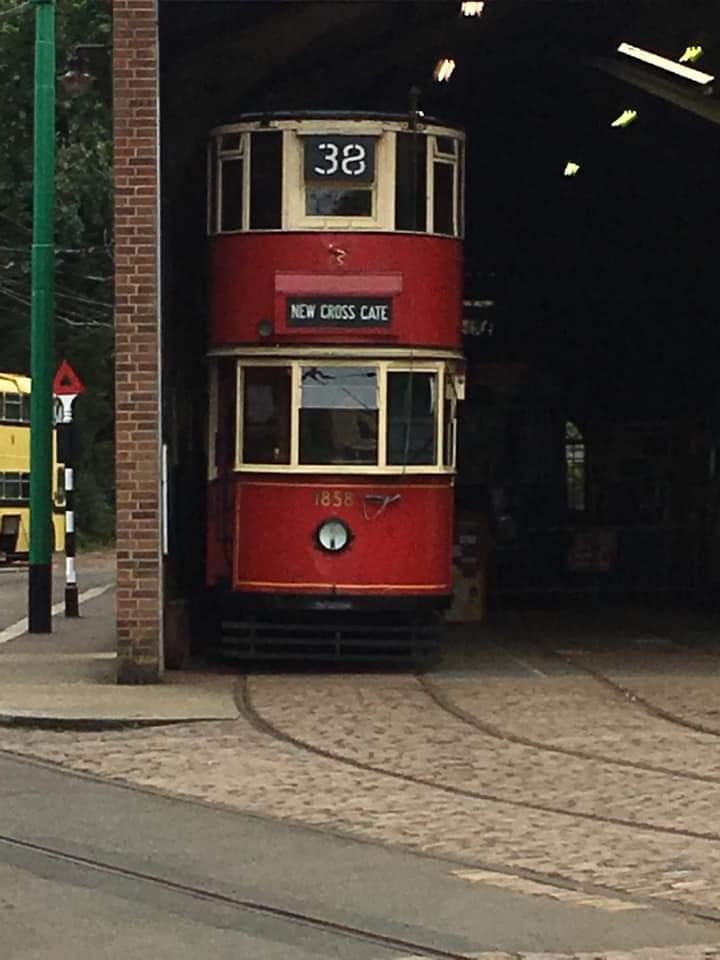
Car 1858, route 38, destination New Cross Gate

I am told I was present as the last London Transport tram finished its last journey and with some ceremony slid into New Cross depot and into history.

Trolley bus route 696  Welling to Woolwich Ferry
I was only three and have no memory of the event, but it is just possible I travelled on one as a passenger on a journey.

That said I can own up to regular trips on a trolley bus which while it looked a bit like a motor bus was powered by electricity from overhead cables.

They were operated by most local authorities, but my experience of them was via Derby Corporation, and consisted of tortuous journeys from the town centre out to the small village of Chellaston.

I have never travelled well in cars or buses, but trips in those trolley buses were infinitely worse.

It may have been the mix of smells from the leather and fabric seats combined with the disinfectant and the heat but I never once escaped feeling sick and to this day that humming, whirring noise the engine or what passed for an engine makes still brings back horrible memories.

The terminus for the trolley bus at Chellaston was Shelton Lock which was a good ten-minute walk from Nana’s house, which gave time for a sort of recovery.

But the dread was always that there would be another journey on another day, on another trolley bus.

Still over 60 years later I can be objective about the trolley bus and recognise its place in transport history, but will always have a soft spot for its predecessor the tram.

All of which brings me to Ron Eaton who posted some wonderful images of a London tram and trolley bus with the message “Hi Andrew thought you might like these”, which of course I do.  

All the news fit to print, on car 1858, r, 
It was on the back of the story “Travelling on LCC number 1622 with memories of the Old Kent Road and Well Hall which appeared yesterday on my blog.

I have yet to ask Ron where he took them and indeed whether I have permission to reproduce them.  But as he sent them via social media, I am guessing it’s ok. 

So thank you Ron, and I hope your trolley bus experiences were better than mine.

And Ron now tells me  'they are all ianEast Anglia Transport Museum well worth a visit".

Location; the days of trams and trolley buses

Pictures; courtesy of Ron Easton, 2024

*“Travelling on LCC number 1622 with memories of the Old Kent Road and Well Hall,  https://chorltonhistory.blogspot.com/2019/11/travelling-on-lcc-tram-number-1622-with.html


Wednesday, 8 May 2024

The curse of the Trolley bus ……..

I hated trolley buses and did my best to avoid them at home in southeast London.

                           Trolley bus, no, 1786, Regent Street, 2014
Sadly, I couldn’t dodge those silent purveyors of overheated cabins which reeked of disinfectant, warm upholstery and worn leather when I stayed with my grandparents in Derby. 

The journey back to the village of Chellaston was an ordeal I dreaded and always made me ill. 

Occasionally I have revisited this monstrous mix of tram and motor bus, but only to pour scorn on them confident that they are now passing out of living memory. *

Manchester Corporation flirted with them from 1938 till 1966 and even operated some with neighbouring Ashton- Under-Lyne, and in the collection, I have pictures of Manchester’s red trolley buses parked up or passing those of other local authorities.

Paying for a trolley journey, undated
But I had always wondered why I couldn’t remember travelling on them in my part of London, because they were there traveling routes through Peckham to New Cross, and Woolwich to Bexleyheath and Dartford. **

The first London trolley buses began their pernicious journey in 1931and four years later the London Transport Passenger Board or as.we.kmew.it .... London Transport took the decision to expand the trolley bus experience which by its peak consisted of 68 routes with a maximum fleet of 1,811 trolley buses.  By comparison Manchester operated nine routes with 189 vehicles.

Happily, as early as 1952 London took the decision to phase them out and during 1959 through to 1962 the cull was achieved, with most of the newer fleet being sold to a Spanish consortium.

And that I think explains why I never had to travel on a London Transport trolley bus, because by the time I was wandering London alone using my Red Rover ticket the last routes were disappearing like snow in a winter sun.

Leaving just the ordeal of the green Derby variant, but that lasted just a few short years.

Happily, I arrived in Manchester just three years after they had consigned theirs to the scrap heap.

Romford Road , Ilford, Route 663 Ilford Broadway - Aldgate, July 1955
But I do rather wish I could remember travelling on the old Corporation trams, those tall stately precursors of the trolley and motor bus.

The last London tram made its last journey in the July of 1952.  It was car no. 1951 and travelled the five-miles of Route 40 from Woolwich to New Cross via Charlton and Greenwich. And as such pretty much covered all of my part of southeast London.

Family tradition has me at the New Cross depot when car 1951 trundled in.

Alas I have no memory of the event, which is a shame, because there can’t be that many of us left who were there.*** 

Still while I may mourn not remembering car 1951, I can’t say I would have made an effort to wave goodbye to the last trolley bus.

But I won't be churlish, and for those who hold trolley buses close there is a fine cutaway diagram of a London Transport trolley bus along with a tram in The Eagle Book of Cutaways, 1988, alas copyright prevents me from showing it.

Pictures; Preserved London Transport Q1 class trolleybus no. 1768, on display at the Regent Street Bus Cavalcade held as part of the Year of the Bus. No. 1768 ran on services in West London between 1948 and 1961. Following its withdrawal, it was retained for preservation. As of 2014, it was owned by the London Transport Museum. June 2014. Author; Bahnfrend. This file is licensed under the Creative Commons Attribution-Share Alike 4.0 International license, Romford Road at Manor Park, Ilford, Route 663 Ilford Broadway - Aldgate, July 13, 1955,Ben Brooksbank, Permission, Creative Commons Attribution Share-alike license 2.0 trolley bus ticket, undated, from the collection of Kelly Richards

*Trolleybuses, https://chorltonhistory.blogspot.com/search?q=Trolley+buses

**Trolleybus and Tram Routes, 1947, Mapping London, https://mappinglondon.co.uk/2018/trolleybus-tram-routes-1947/

***The last Manchester tram completed its last journey in 1949, the year I was born


Friday, 21 April 2023

Who mourned the passing of the trolley bus?

I was too young to have caught one of those old Corporation trams.

Even so I have  a soft spot for these tall stately vehicles which dominated our towns and cities for over half a century.

But I have less time for the trolley bus which began replacing them in Manchester in 1938.

They were quieter and smoother than either the old tram or the motor bus but I never took to them.

Even a short distance on one was likely to make me feel ill and even now I can vividly remember the smell of the warm leather seats mixed with the disinfectant and the low hum.

So I have to admit that I have struggled with Peter’s fine picture of a Huddersfield trolley bus.

But I can put prejudice aside and record that the trolley bus has long since joined the Corporation tram as part of our transport history.

The first in the UK were being run in Leeds and Bradford as early as 1911 and Bradford has the distinction of seeing the last in 1972.

London began operating them from 1931 and finished them 31 years later.
Here in Manchester our last ran in 1966 having operated over nine routes with a fleet of 189 vehicles for nearly 30 years.

All of which leads me finally to Huddersfield which having started their service in 1933 continued till 1968.

And for those that revel in trolley bus facts, Huddersfield had one of only four trolley bus turntables in the UK.  It was manually operated and the Longwood trolley bus turntable survived well into the 1980s, although it had ceased doing its job of turning Huddersfield trolley buses terminating at Dod-Lea in 1940.

At which point I cannot believe I am about to enter the wonderful world of trolley buses but that is what Peter’s painting has done for me.

There are three former Huddersfield trolleybuses preserved at the Trolleybus Museum at Sandtoft,* the British Trolleybus Society has a full list of all surviving trolleybuses,** and a list and description of UK trolleybus systems List of trolleybus systems in the United Kingdom which has a heap of interesting information.***

Painting; Huddersfield trolley bus  © 2014 Peter Topping, Paintings from Pictures,
Web: www.paintingsfrompictures.co.uk Facebook:  Paintings from Pictures

*The Trolleybus Museum at Sandtoft, Lincolnshire, http://www.sandtoft.org.uk/

**British Trolleybus Society, http://www.britishtrolley.org.uk/preserved-trolleybuses

***List of trolleybus systems in the United Kingdom, http://en.wikipedia.org/wiki/List_of_trolleybus_systems_in_the_United_Kingdom