Showing posts with label Knott Mill. Show all posts

Friday, 24 July 2026

Looking for the lost 32 cottages and 15 cellars, home to 208 people

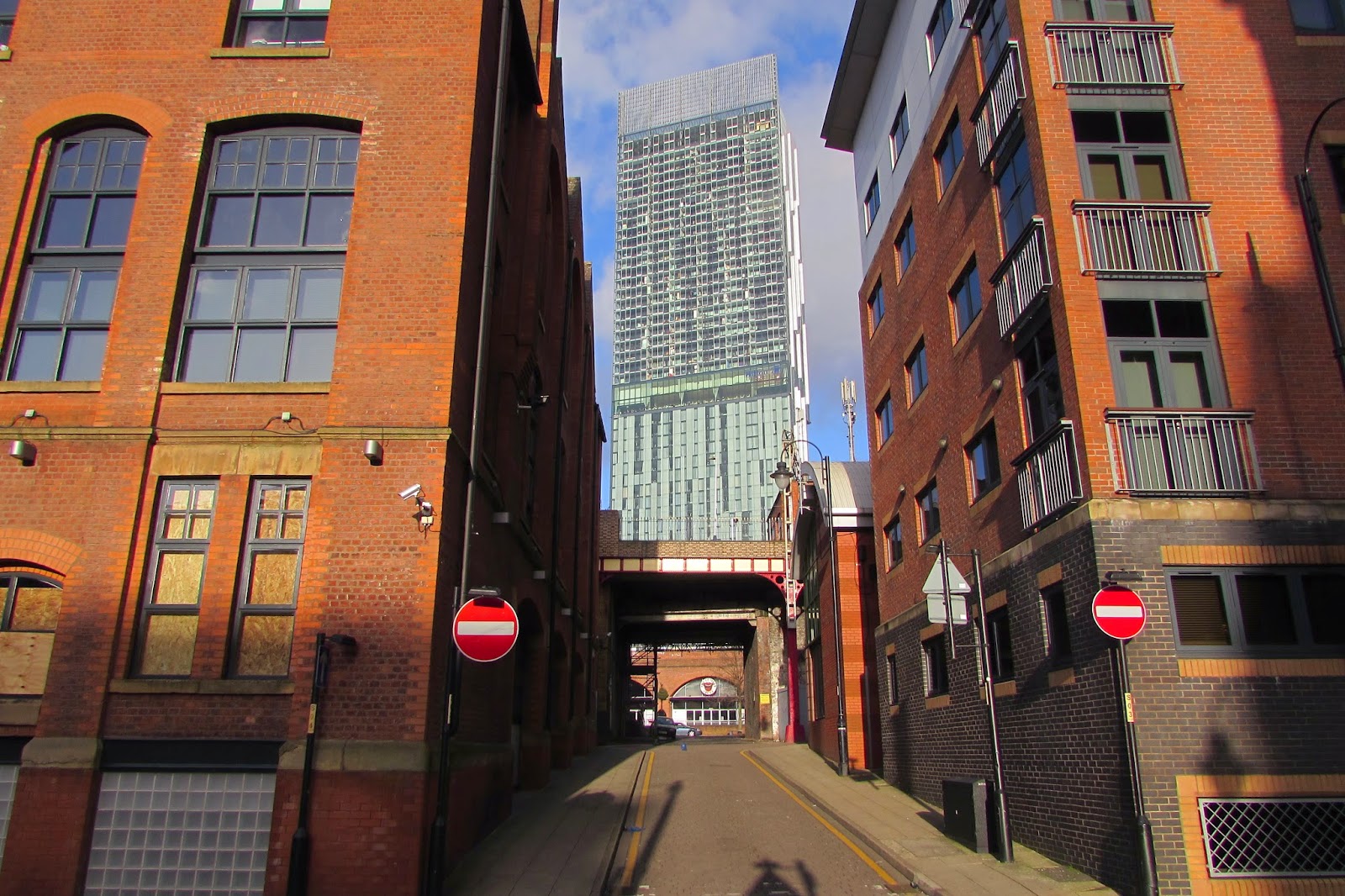
Looking down Commercial Street, 2015
Now I first wandered down Commercial Street sometime in the 1980s looking for Omega Street, and its neighbours Alpha Street and Fogg’s Place.

And I must have missed them by just a few years.

That said I don’t think they would have featured in any glossy guide to comfortable inner city living.

In 1853 they had formed a complex of back to back housing consisting of 32 cottages and fifteen cellars inhabited by 208 people.*

Commercial  Omega Street, 1849
Directly opposite was the Egerton Mill, while behind them there were two more and the surrounding area was dominated by more textile mills, a handful of iron works and the Hulme Brewery.

And I doubt even the most optimistic estate agent could gloss over the noise from the nearby railway or the smell from the river Medlock which flowed in a curve close by.

Back in the 1980s you could still see the outline of the house walls in what at the time was a temporary car park but when I returned some 20 years later these had vanished under new tarmac and there was nothing left to show what had once been there.

Looking across to Omega Street from Commercial Street, 2002
Now another eighteen years on and the surrounding buildings had either been demolished or made genteel and the worst I suspect in the form of pollution comes from the noise of loud music in the flats opposite or the conversation of the office workers making their way home.

And even that car park is now boarded up which may soon mean even space inhabited by those three streets and 32 cottages will be lost for ever.

Location, Manchester

Pictures; Commercial Street, 2014 courtesy of Andy Robertson, Omega Street, 2003 from the collection of Andrew Simpson and area in 1849 from the OS for Manchester & Salford, 1842-49, courtesy of Digital Archives Association, http://www.digitalarchives.co.uk/

* Report of the Manchester and Salford Sanitary Association 1853

Wednesday, 5 March 2025

Driving down into Knott Mill ……… 1969

For all those who remember taking that short journey into the  air before descending equally quickly towards Knott Mill and the city centre.

Location; Manchester

Picture; that elevated road in the sky, 1969, courtesy of Manchester Archives+ Town Hall Photographers' Collection,
https://www.flickr.com/photos/manchesterarchiveplus/albums/72157684413651581?fbclid=IwAR35NR9v6lzJfkiSsHgHdQyL2CCuQUHuCuVr8xnd403q534MNgY5g1nAZfY,

Thursday, 30 January 2025

Knott Mill in 1963

I wish I had known Knott Mill in the 1960s.

As it was it would be a full decade later that I wandered down there.

Of course my excuse was that as a student and later working in Wythenshawe this end of Deansgate was a bit off the beaten track.

So to redress that simple omission here is a litho print made by my friend Ann Love in 1963.

Back then she was still at Manchester College of Art, studying Book Illustration and wandering the city for subject matter.

I am rather pleased that she did and moreover that she recorded this bit of Knott Mill.

Picture; litho print of Knott Mill, 1963 courtesy of Ann Love.

Monday, 30 September 2024

“Look on my Works”* ……… and wonder …… a story for Alan

I don’t usually do then and now pictures but sometimes I break the rule, especially when it’s a place I have known for heaps of time.

The Rochdale Canal, 1979

And so, it is with the stretch of the Rochdale Canal from Piccadilly down to Castlefield.

Back in the 1970s I regularly walked it, marveling on how it had survived a combination of neglect and willful vandalism and how it offered up glimpses of what had once been.

The Rochdale Canal, 2023
Like those pipes running along the wall of what had once been part of  St Mary’s Hospital and supplied steam to a host of buildings from the old Electricity  Station.  

Some of the lagging had fallen away and steam rose from the pipes leaving me a tad worried that one day I would cop for a scolding burst.

And further along there were those half sunken boats which were a continuing source of mystery and fed my imagination with possible disasters which had overcome crew and cargo.

The future of the canal always seemed in doubt, and despite its historic significance and its role in shipping water through the city there was always the possibility it would end up being filled in.

But not so and the story of its restoration is there to read. 

Suffice to say it was saved and now boasts plenty of amenities along its towpath of which Deansgate Locks are but one.

And so last Thursday I looked down on that bit of water beside the bars and reflected on the changes on the skyline, which of course is the point of the two pictures, and the rest as they say is for you to "compare and contrast".

Looking down towards Castlefield, 1979

Location; The Rochdale Canal

Pictures, My canal, 1979 and 2023, from the collection of Andrew Simpson

*"Look on my Works, ye Mighty, and despair!", Ozymandias, Percy Bysshe Shelley, 1817 

Sunday, 21 July 2024

Stories from Deansgate Castlefield ….no. 1 introducing the book

Deansgate Castlefield metro stop is the place where history tumbles out in all directions

Heaps of towers, 2023
You know you are arriving at somewhere special when the views of identical new residential properties give way to something much older and more interesting.

It begins with that network of waterways which make up the Castlefield Canal Basin, interspersed with the tall lattice structures that imitate medieval castle walls and takes in some fine 18th century warehouses, along with the spire of the old Congregational Chapel and that growing number of tower blocks which seemingly reach up to scrape the sky.

On arriving, 2022
And on arriving at Castlefield Deansgate just a minute’s walk away is the bold edifice of Deansgate Railway Station which as everyone knows and some constantly reiterate is really Knott Mill Railway Station gateway to Salford and beyond.

But for those whose interests are elsewhere beside the entrance to Deansgate/Knot Mill is the Atlas Bar which has its own claim to a bit of history, having opened in 1999 boasts that it serves 570 different gins from around the world.

Nor is it alone for just across the road there is Deansgate Locks, while nestling in the canal basin can be found Dukes 92, and the even longer established Barca Bar all of which are part of the renaissance of the area which has gone from a busy but grubby work a day corner of the city to an elegant residential and leisure centre.

Atlas, 2023

And not to out change Castlefield, in 1982 it became an “Urban Heritage Park” which is an unofficial designation for an inner-city area regarded as worthy of preservation because of its architectural and historic interest.

Fort in the sun, 2022
It was here that the Romans established one of their forts as part of the “pacification” of northern Britain.

The network of military establishments connected the big legionary bases of Chester and York, and like many of these forts it attracted a settlement which grew up outside its walls.  

Here could be found metal workers, bar owners, merchants and anyone attracted to the Roman army which offered a degree of safety and a ready market for pretty much everything your average Roman soldier might want.

Alas only a fragment of the original fort still exists, but a series of archaeological digs in the 1970s uncovered finds from the civilian settlement.

In turn the presence of that fort led to a City Council project to recreate two sections of wall and a gateway.  The construction was undertaken by apprentices from the Direct Works Department and included laying out a series of ditches which were the first line of defence.

Water, unlight and bridges, 2003

All of these are there to see along with part of the civilian village running from one of the walls by Beaufort Road out towards Liverpool Road, while the remaining section at Duke Street offers up views down in to Castlefield Bowl and one of the arms of the canal basin.

A rally at the Castlefield Bowl, 2024

The Bowl is a popular venue for a live entertainment and has a capacity for 8,000 and as well as music events is used for political rallies.

Canal Basin, 2003
I could go on but that would be to reveal all the stories from our second book in the series The History of Greater Manchester by Tram.*

The idea of telling the story of Greater Manchester by using the tram network has a lot going for it. 

You can catch a tram from the city centre and go south, east, north, and west and along the way each of the 99 stops will have a story to tell, and being the tram, you can just jump off, explore this little pocket of history and move on. 

Or skip to the end destinations and discover interesting historical things about Didsbury, Ashton-Under-Lyne, Rochdale, Oldham, Salford and bits of Trafford, Altrincham and Bury.


The first in the series …. Trafford Bar to East Didsbury was published earlier in the year and the next Cornbrook to Exchange Square will be out in August.

They are available from Chorlton Bookshop, and from us at www.pubbooks.co.uk, price £4.99

Location Deansgate Castlefield

Pictures; Castlefield and Knott Mill, 2003-2024, from the collection of Andrew Simpson

*A History of Greater Manchester by Tram, https://chorltonhistory.blogspot.com/search/label/A%20new%20book%20on%20the%20History%20of%20Greater%20Manchester%20by%20Tram

Sunday, 4 February 2024

Lazy history …….

 Well, just occasionally I break the cardinal rule, don’t do then and now pictures.


But rules are meant to be broken  ……. sometimes, and so here are two of the Rochdale Canal as it flows from Knott Mill into the Castlefield Basin.

Something like 44 years separates the two.

The first was taken using a camera which relied on smelly photography and the second the all singing digital replacement.


Of course they are not exactly taken from the same spot, but close enough.

I could have written about the transformation of the canal over those 40 plus years but I have done that heaps of times and anyway this is lazy history.*

Location; the Rochdale Canal

Pictures; the Rochdale Canal, 1979 and 2023, from the collection of Andrew Simpson

*The Rochale Canal, https://chorltonhistory.blogspot.com/search/label/The%20Rochdale%20Canal

Tuesday, 13 June 2023

When the landscape continues to change ……… yesterday in Knott Mill

So, all of us with a camera and an interest in the history of Manchester regularly go out and record the changing landscape.

Old and new, 2023
I could have wandered up Oxford Road, taken a series of pictures as the tram headed into and out of Cornbrook, but insteadI  settled on Knott Mill.

I won't be alone in watching as more of those towers rise towards the sky.

I did think that the bubble of new high rise properties and the wish to live in the inner city would burst, but apparently not.

Enough said.

I await a plethora of new pictures from others with a camera and an interest in the history of Manchester.


Location; Knott Mill and Castlefield

The Atlas Bar and towers, 2023

Pictures; changing landscape at Knott Mill and Castlefield, 2023, from the collection of Andrew Simpson

Southern Street, 2023


Friday, 5 May 2023

The man .... the canal ..... and a promise of Mexico

There I was on Whitworth Street West, with Deansgate Locks behind me, the Rochdale Canal below and the man with the promise of Mexican Street food at his fingertips.


And that is about it.

I could wander off on one and write about the canal in the 1970s, its history going back through the 19th century and its restoration.

I could but that would also have to bring in the transformation of a set of railway arches into that strip of bars, and restaurants which are Deansgate Locks.

So I won't.  They can all be found here on the blog.

Instead I shall just say the chap and his menu of Mexican Street Food served in el diablo caught my eye and that was it.


Location; Whitworth Street West


Picture; Man with food, 2023, from the collection of Andrew Simpson

*el diablo Tequila and Taco Bar, https://www.eldiablobars.com/

Thursday, 23 March 2023

Down behind Deansgate Station with the memory of a dark and forbidding period in our history

I think it must be a full decade since I wandered around the small network of streets behind Deansgate railway station.

During the 1980s and into the turn of the last century the area bounded by Commercial Street, Jackson Street and Omega Place was part of a series of guided walks and talks  I did around this part of the city.*

They had started as a study of Liverpool Road Railway station grew to include the pubs, surviving houses in Castlefield along with the canal basin and spread out across Deansgate.

Back in the 1980s much of the area was still a place waiting for something to happen, and now thirty years later this has happened.  The empty and derelect buildings have either been converted into smart office and residential properties or been replaced by tall 21st century glass and steel structures.

But Andy Robertson has managed to capture a little of what I remember and looking at his pictures it is easy to conjure up those walks I made and something of what the area was like back in the mid 19th century.

Over two decades ago I wrote that

“in a small area which still keeps the original place names of Commercial Street, Jordan Street and Omgea Place, the 1853 Sanitary report records two hundred people living there in what is now a small car park.  It was still possible in the mid 1980s to see the levelled walls of the buildings at ground level.

Chorlton-upon-Medlock which also neighbours Castlefield and includes Little Ireland, had a population in 1851 of 35,546 squeezed into 6,951 houses.


The high numbers of people who were buried in the St Johns graveyard can further attest this density of living in the area. 

Between 1848-51 the burial records show 457 deaths, which is matched by an inscription, which reports that 22,000 lie in the park. 

Similar data comes from Angel Meadow where 44,000 people were buried between 1789-1816."  

The 1853 report commented that the houses on Omega Place were by no the worst properties that could be found in the area but still rereading the report is to be transported into a world of overcrowding, poor sanitation and grim prospects.

Which just leaves me to add that this was once Knott Mill Railway Station.

Pictures; Little Peter Street & Commercial Street, 2014, from the collection of Andy Roberston

*Castlefield, http://chorltonhistory.blogspot.co.uk/search/label/Castlefield

**Report on the Sanitary Condition of Certain Parts of Manchester, M126/5/1/13, Manchester Libraries, Information and Archives, Manchester City Council, quoted in Castlefield, Andrew Simpson, 2003


Friday, 3 March 2023

Posters from the Past ...... no 21 ....... Deansgate Castlefield ….. Gateway to Manchester

 Now the project is simple, take an image of a building we all love and turn it into the style of poster which was popular in the middle decades of the last century.*

And because so many of us use the tram and will pass through Deansgate Castlefield it seemed a logical choice to use the Metro stop for a poster.

Of course, there will be those from the Friends of the Metro Link who will point out that strictly speaking Cornbrook should be given the title of Gateway to Manchester, Salford and beyond.

It is after all one of the main switching points and I believe is also the hub of the electronic stuff which makes the network function happily.

But I like Deansgate Castlefield better.

Location; Deansgate Castlefield

Painting; Deansgate Castlefield, © 2023 Peter Topping,  Paintings from Pictures, from a photograph by Andrew Simpson, 2023

Web: www.paintingsfrompictures.co.uk 

*Posters from the Past, https://chorltonhistory.blogspot.co.uk/search/label/Posters%20from%20the%20Past


Knott Mill shapes ………

Location; Knott Mill

Picture; The lift at Knott Mill, 2023, from the collection of Andrew Simpson


Tuesday, 14 February 2023

The lift at Knott Mill ……

Location; Knott Mill

Picture; The lift at Knott Mill, 2023, from the collection of Andrew Simpson


Friday, 27 January 2023

Small people …… tall buildings …….

 This is not a winge or even a rant about the rise and rise of those tall buildings which climb from the ground to touch the sky in ever increasing numbers.

Looking for the person, 2023
After all it would be unhistorical to pitch a story about the development of these buildings which in a short two decades have transformed Manchester and Salford’s skyline without recognising what went before.

Greengate, 2022
The early 19th century saw the construction of large numbers of textile mills along with metal, dye, and engineering works all of which had their own impressive chimneys which belched out smoke.

They were visible from the surrounding countryside, leaving a layer of sooty blackness on buildings and even played their part in the evolution of the black and yellow ladybird.

These “industrial blotches” were accompanied by rows of mean terraced houses, some of which were better built than others but together with the industrial properties advanced across what had been green fields, turning most of our rivers and streams into conduits running with all manner of pollution. 

And this new build contributed to the wiping away of some of the elegant houses built in the 18th century as well as their Tudor and Jacobean neighbours.

So, we should always be careful about calling down piles of criticism on the trend for ever more tall properties which dominate the twin cities.

But and there is always a but, even given the commercial argument about building high, and the what I assume is an economic benefit to the city’s economy I wonder about the pursuit of climbing ever skywards.

Deansgate shapes, 2023
And it is this.  

When the building is so tall that it makes people insignificant in its shadow I wonder if we have got it right.

Old architecture recognised that buildings should not overwhelm the people who lived inside and beside them.  Even the Medieval Cathedrals with their tall spires stretching heavenly and their great glass windows were still on a human dimension.

And here someone will throw in that red herring that in the past technology couldn’t deliver the means to giant buildings, to which the riposte as ever is simply that “just because we can do something doesn’t always mean we have to”.

So once looking across to Knott Mill and beyond, the tallest building at Knott Mill was the old Congregational Chapel which snuggles up to the railway viaduct, a few yards opposite the railway station. It was built in 1858 and its slender tower rose majestically into the sky.

Knott Mill, 2023
By 2019 it was fast being eclipsed by new build and equally slender cranes.

Of course it is an observation as redundant as that which might have been made in 1810 as the character of 18th century Manchester and Salford was fast disappearing in the rush to all things industrial.

Still, it does allow me to show off some recent and a few past pictures of Manchester.

And all but one were taken down at Knott Mill using the advantage of height confered by the Deansgate Castlefield tram stop.

It is a story that won't go away and one which will give the interested and the social historian hours of research as they match what was with what is and speculate on what will be.

For now I will just thank Andy Robertson for his vast collection of images which he tirelessly adds to as he records how the twin cities are changing under the impact of all that new build.

Knott Mill, 2019

Location; Manchester and Salford

Pictures; Deansgate and Knott Mill, 2023, Looking into Greengate, 2022, from the collection of Andrew Simpson and in 2019 courtesy of Andy Robertson

Saturday, 30 April 2022

Walking the City …….. in April

The city’s skyline continues to be transformed, with what were once the tallest buildings we had overtaken by those that climb to the clouds.


Location; Knott Mill

Picture; April skyline, 2022, from the collection of Andrew Simpson


Saturday, 15 May 2021

Following the Medlock ……….. from Gaythorn into Knott Mill

This will be the last of the short series exploring the changing landscape on either side of the Medlock as it flows from Gaythorn,  through to Knott Mill and beyond.

Old and new along the Medlock, 2021

It is one of those places rich in industrial history with more than its share of iffy housing, which consisted of numerous back to back properties and closed courts.

As late as 1794 it still flowed through open fields, but already there were was the evidence of what was to come, in the shape of a printing press, several dye works and an iron foundry.

Half a century later and these had been joined by a heap more.  

So, as the river ran through Gaythorn, it encountered the Gaythorn Chemical Works, the gasworks, a cotton mill and the Medlock Street Dye Works, before navigating the Medlock Street Iron Works, the Hulme Brewery, the Knot Mill Iron Works and finally as it passed under the Knott Mill Bridge washing up against the Brazil Cotton Workes owned by Lea Birch & Co.

Knott Mill, 1794

Some  of this industrial history was still there to see until relatively recently, although the few bits still standing had almost all been converted into other uses.

Knott Mill, 1849

And back in the 1980s the evidence of those back to backs was still visible in one cark park on Jordan Street Street.* 

The houses bordering Fogg’s Place, Alpha Street and Omega Street have long gone, but the outline of the lower bricks were still there in thirty years ago. 

Since then the cark park has been properly surfaced, the surrounding 19th century buildings transformed, and joined by bright shiny new build, some of which house offices, others housing people and some doing both.

There will be a few who moan at the new developments, but will rarely acknowledge that some of these 19th century conversions, were themselves responsible for sweeping away earlier properties or worse still building over those open fields.

Along the Medlock, 2021

And while some of the new build might not win an architectural prize, at least it might be argued they have  filled what were empty derelict spaces which in turn were bordered by decaying and sad mills and warehouses which no one wanted or could think had a useful life.

In time I will return to some of those back to backs off Jordan Street and research who lived there in the middle decades of the 19th century, but for now I will just follow Andy’s series of pictures which followed the Medlock as it flowed through Knott Mill and under Chester Road.

Location; Knott Mill

Old and new, 2021


Pictures; following the Medlock at Knott Mill, 2021 from the collection of Andy Robertson, and the area in 1794 from Green’s map of Manchester,  and in 1849 from the OS map of Manchester and Salford, 1849, courtesy of Digital Archives Association, https://digitalarchives.co.uk/

*Knott Mill, https://chorltonhistory.blogspot.com/search?q=omega+place

Thursday, 13 May 2021

The bits the developers forgot ………. the Medlock, .......some shiny new build ...... and lots of old stuff

Now, it must be two decades since I walked around the patch marked out by Deansgate, with Owen Street to the east and Commercial Street to the west.


And it will be more than 30 years ago that I wandered theses streets armed with a camera and set of notes from the 1850s describing the housing and sanitation conditions of the area.

Much of it has changed dramatically, but the Medlock still flows through it and despite the brand new blocks of properties there remain more than a few relics of the past.

So, after Andy sent over his latest pictures from a recent adventure in the area, they had to be part of a story.


I long ago lost a series of pictures I took of this bit of the river, so these recent images are fascinating.

The rest is for anyone who wants to follow in his footsteps.


Location; off Deansgate, 


Pictures; off Deansgate, 2021, from the collection of Andy Robertson

Wednesday, 30 December 2020

Looking for people on Deansgate on Christmas Day

I am not surprised that Andy didn’t find many people out on Christmas Day, but the upshot was that he got some uninterrupted pictures of Knott Mill.


Even in the time of Covid, with lockdown, tier three, and may be worse to come this junction is a busy one, and it would be a brave soul who chose to stand in the middle of the road to capture the views under the Bridgewater Viaduct or up along Deansgate.

But Andy did, and that is enough for me.


Location; Knott Mill


Pictures;  Christmas Day at Knott Mill, 2020, from the collection of Andy Robertson


Monday, 17 February 2020

Watching out on the old and the new ………………

Now it would be easy to go off on one, and shout about the relentless march of the crane, along with the destruction of much that was our Victorian and Edwardian city.

But then, those earlier developments were built on green fields, and did their bit to see off Georgian and Tudor gems.

That is not to say I am happy at the loss of so much of Manchester and Salford’s industrial and commercial past.

At least Andy Robertson is recording much of that past before it is gone.

Location; Knott Mill, 2020, from the collection of Andy Robertson

Thursday, 30 January 2020

What have they done to our landscape? …………….. looking out across the city

Now I nether, judge or comment ………… that I leave to you.

But here are two more of the images of changing Manchester from the camera of Andy Robertson, who for three decades and more has been recording the transformation of where we live.


Location; Knott Mill


Pictures; looking out across the city, from a metro stop, 2020 from the collection of Andy Robertson

Thursday, 11 July 2019

Spot the tall structure …… with Andy Robertson looking out from Knott Mill

Once and it was not that long ago, the tallest building at Knott Mill was the old Congregational Chapel which snuggles up to the railway viaduct, a few yards opposite the railway station.

It was built in 1858 and its slender tower rose majestically into the sky.

But now as Andy’s picture shows it is fast being eclipsed by new build and equally slender cranes.

Location; Knott Mill


Picture; Knott Mill, 2019, from the collection of Andy Robertson