Showing posts with label Friends of Chorlton Graveyard. Show all posts

Monday, 25 May 2026

If you go down to the graveyard today …. You’re sure of a big surprise* …..

 Well, “a big surprise” may be overstating the experience but yesterday I came across these stone setts.

Those mysterious stones, 2026
It’s an odd discovery given that I have alternatively walked through and sat in the old parish graveyard for over four decades.

They appear just to the north and west of the entrance to the old parish church.

Often, they are hidden under a mix of mud and leaf detritus, and I suppose are not that interesting, especially when set against the stone inscriptions of the surviving gravestones.

Once before the 1980s make over there were 362 of them ranging from austere and plain slabs to grand monumental records of lives lived out in Chorlton-cum-Hardy.

But with the landscaping of the graveyard came a decision to dispose of most of them, leaving just a handful dotted around the gardens.  The fate of the majority is unclear, but I suspect they ended up as hard core in some motorway.

And with their departure was lost the records of so many of our residents who lived here in the 18th and 19 centuries. Apart from the scandal of destroying the memories of people whose relatives had invested time, money and emotion in recording their lives, there is that simple observation that so much of our history has been lost.

But setting that aside there is the mystery of this stretch of stones.

I wondered how long they had been there, and whether they were original dating from the 19th century into earlier.

I will have walked through the place long before the makeover, but I can’t remember seeing them.

And I suppose they may have been part of the landscaping especially as they appear to include a feature which looks to have been a space for a tree, now long since gone.

Gravestones and inscriptions, 1976

A similar pattern of stones appears around the memorial to PC Cook that policeman who was shot in the line of duty. His death was commemorated by an elaborate monument which was removed and is now in Preston, leaving the present stone slab which is faced with the same sets.

Looking back at the plan of the original 362 gravestone, our mystery spot was inhabited by four headstones of which only one has survived the cull.  This is to John, Margaret, James and John Renshaw who were interred between 121 and 1844.  

The Renshaw family, 2010
Alas those commemorating the Guy, Rogers, Lobley, Horsefield  and Heywood families no longer exist, and with them go the stories of Ann Guy who died aged 81Gertrude “infant daughter of William Henry and Georgina Rogers 8 months, 14days and great granddaughter f the above” and "Louisa Mary [also] daughter of William Henry and Georgina Rogers” who died at 15 months in the August of 1869.  Or Thomas who was the “son of Thomas and Elizabeth Gilmore” who died on July 21st 1870, just 2 months old.

Now set against these lost stories of grief, my stone sets don’t amount to much, but it would be fun to know who thought they should be placed here close to the church entrance.

There is a scheme of planting dating from April 1977 from Recreational Services Department of Manchester City Council which suggests that our spot was for either Lonicera Pileata “an unpretentious ever green plant” or Cytisus praecox a “flowering deciduous shrub”.

But which ever it was it has long gone along with the gravestones that occupied its place.

Location; Chorlton graveyard

Pictures; Chorlton graveyard, 2026, 2010 from the collection of Andrew Simpson and the plan of the churchyard, Register Of Grave Descriptions, St Clement’s Old Churchyard, Chorlton Green,1976, RG 37/99, City Engineer and Surveyor, Town Hall, Manchester

*Teddy Bears Picnic,  Jimmy Kennedy, 1932


Wednesday, 13 August 2025

Three Forgotten Graves .... another story from Tony Goulding

This memorial to Helen Richmond Cox is one of three situated alongside a boundary wall of the old St. Clement’s churchyard in Chorlton-cum-Hardy. 

 Memorial to Helen Richmond Cox

All three are to a greater or lesser extent obscured by vegetation. Not that any actually mark their remains nor even the site of their graves. 

All the bodies in the graveyard were exhumed in 1930 and reinterred in Southern Cemetery then in the 1980s when Manchester Council decided that graveyard was in a hazardous state and needed to be landscaped, most of the memorials were removed then either destroyed or haphazardly replaced. 

Esther Floweth’s memorial
Some were laid flat to form a pathway with others replaced as ornamental features.    

One of the other gravestones records the birth and death of another child, Esther Floweth, who died on 1st March 1868 aged just 5 years and 9 months. The third is of Anne Ormrod, who was 80 years old when she died on 9th June 1867 while visiting her daughter on that forgotten road of Chorlton-cum-Hardy, Lloyd Street.

None of these three burials were of a parishioner of St. Clements. Although Ann Ormrod was residing in the parish when she died, she was a native of Bolton, Lancashire. 

Helen Richmond Cox hailed from Stretford, and Esther Floweth lived in Hulme, Manchester. This is not at all unusual, as of the 841 burials recorded in St. Clement’s burial register between 1st January 1851 and 31st December 1876 only 320 show their “abode” as Chorlton-cum-Hardy. 

This comprises just 38% of internments.  However, closer examination reveals that with the expansion of the township’s population the trend from1860 onwards was for a gradual increase in the percentage of “local” burials.

Ann Ormrod’s gravestone
While many of those buried who were not residents of St. Clement’s parish were from neighbouring  townships of Didsbury, Withington, and Stretford the majority were from further afield. Hulme and to a lesser degree Chorlton-on-Medlock were the main areas although, Ardwick, Pendleton, and Salford also featured. There was even a small number whose homes were given as much further away in places like Blackpool and Everton!

The large number of non-resident burials obviously made a substantial contribution to the pressure which forced the Home Office to close the graveyard (1) following an enquiry on 25th November 1881.

It is impossible to know the motives involved in these choices to inter a loved one in Chorlton-cum-Hardy, but it is fun to speculate. One reason could be antagonism towards their local vicar leading them to worship in St. Clement’s. 

It could be a combination of the desire, with the industrial spread of Manchester during the middle of the 19th century, for a more idyllic place to bury loved ones offered by the still rural Chorlton-cum-Hardy and the opportunity for some extra revenue for the parish the burial fees would provide. 

Finally, it has been suggested that in some instances there was either no local church or one with a very limited if any graveyard. Some also will have had relatives buried in St. Clement’s. This was the case with Maria Birley of Southport, Lancashire, the widow of Rev. William Birley who had been appointed St. Clement’s first Rector on 17th February 1843 and served in that post until December 1859. (2)     

In this category also is the burial of Frederick Cope on 26th February 1874 whose home address was by far the most distant. After a successful career as a wine merchant in Manchester, when he resided for a time at Oak Bank, Chorlton-cum-Hardy, he retired to his birth county, Warwickshire, viz, Campion Lodge, Leamington. Following his death there on 19th February 1874 his coffin was brought north, and he was interred in the same grave as his wife Elizabeth and two of his children Emily Simms and Frederick Adam (3)

To conclude, like Ann Ormrod, one of the Blackpool residents, William Hughes, was also a visitor to the area. In his case after attending a sale in Manchester he intended to call at Barlow Hall hoping to get a position there and to look-up some old friends in the area he knew from his previous work as a coachman at the Hall, for Sir William Cunliffe Brooks. 

Barlow Hall - 1910
The unfortunate man was “found drowned” that being the verdict of the inquest into the circumstances of his death held at Jackson’s Boat on 17th December 1864.

The matter was widely reported in the press as he was found in “The Moat” a pit in the garden of the home of a prominent banker Conservative M. P. and a Baronet!

Pictures, Barlow Hall – 1910 by Jenny Wylie http://www.british-history.ac.uk/image.aspx?compid=41427&filename=fig99.gif&pubid=288, others from the collection of Tony Goulding.

Notes: -

1) The order prohibited the opening of new graves and only allowed burials of those with a family plot and only if there was sufficient depth to adequately cover the coffin. The final burial was that of Thomas Caleb Butcher on 25th February 1916. (Blog story 22nd August 2020).

2) Rev. William Birley had become an inspector of schools and was the Rector of St. Stephen’s in Pendleton, Salford when he died on 27th July 1865, he was interred in his previous parish’s graveyard. Interestingly the entry in the burials register of St Clement’s shows that his abode was first entered as Chorlton-cum-Hardy before being amended to Pendleton.

3) Both of Fredericks children buried in this grave died young. His daughter, Emily Simms was just 13 years old when she died in April 1846.  Frederick Adam, his only son, died in a tragic suicide when he shot himself in the evening of Friday 1st July 1853. (Blog story 24th October 2015)


Wednesday, 9 July 2025

Secrets from a Chorlton grave yard ……

I am looking at the remains of a clay pipe dating from around 1831.

King William lV pipe 1831-37

I can be fairly confident of that date because 1831 was the year of the coronation of William lV and our pipe carries a reference to that coronation.

The mystery is how it got to be in the graveyard.  Eric of Needham Avenue will be quick to advance outlandish explanations, but I suspect it was just lost or thrown away, but could of course belong to one of our gravediggers.

It was found along with a selection of coins, tokens, buttons  and a ring during a series of archaeological digs, not long before the graveyard was landscaped.

The dig in 1981
Now the trouble with archaeological digs is that for most of us they look just like a jumble of unconnected holes in the ground with a few bits of stone poking up out of the earth.

Which pretty much seems to be the case from this picture taken in 1981 of the old parish church during the dig conducted by Angus Bateman

He began “some exploratory and very amateurish digs, at weekends, intermittently between October 1970 and August 1972” * and concluded he needed to gain more experience in running a dig and to this end enrolled in a course in archaeology at Manchester University.  

The subsequent 1977 dig formed the project for that certificate and led on to further digs culminating in the 1980-81 season which was carried out with South Trafford Archaeological Group.

The graveyard, 2012
The excavations and the subsequent research undertaken by Angus have helped with an understanding of the two churches which stood on the site from about 1512 till 1949 and a possible dating sequence for the extension of the graveyard in the early nineteenth century.  

The fragments from the later church were carefully analysed and recorded and in some cases Angus was able to track the manufacturers, some of whom were still trading in the 1970s.  He also undertook a very detailed record of all the gravestones, including an analysis of the style and composition of the inscriptions and some work on the light they threw on life expectancy amongst the young in the township.

Location; Chorlton Graveyard

Pictures; the fragment of the King William lV pipe from the collection of Angus Bateman, the dig in 1981 from the Lloyd Collection and the graveyard in 2012 from the collection of Andrew Simpson

* Bateman, Angus J., Excavations and Other Investigations at Old St Clements Church Yard Chorlton Manchester 1977, Report of work done in part fulfilment of the Certificate Course in Methods of Archaeology, Extra-mural Department, University of Manchester, held by South Trafford Archaeological Group

Saturday, 26 April 2025

Two pictures ….. and more stories

I have Steve Casson to thank for these two picture postcards of the old St Clements’s Church and the Bowling Green Hotel.

St Clememt's Church, date unknown
I don’t have dates for either, but the battered state of the cards suggests we are back in the 19th century.

And that distressed state adds to their impact, offering up heaps of possible stories, of who originally owned them, how they survived and how eventually they passed to Steve.

But there is even more.

So, in the case of the church there are those steps leading up to the rear of the old Bowling Green Hotel.  

I say old because the pub was demolished to make way for the present building which dates from 1908.

All of which suggests that our photographer was standing roughly on the site of the new pub.

I had never realized that the old pub stood on a slight rise.

The image also gives a fine view of the church from an angle I have also never seen, and along with the details of the windows and great east window there is the pipe of the Arnott stove which was used to keep the church warm.

Bowling Green Hotel, date unknown
The picture of the Bowling Green Hotel is one I am familiar with, but never ceases to interest me.

Steve has also passed over a series of newspaper clippings covering the removal of the headstone memorial to PC Cock who was murdered in Whalley Range, and an act of vandalism to the churchyard when gravestones were toppled over.

PC Cook’s story is in itself a fascinating one offering up an insight into how some mistrusted the Irish, after suspicion fell on the Hebron brothers who were agricultural labourers from Ireland.

Luckily for them the real murderer confessed.

Mr. Casson in the former churchyard, 1978
The memorial stone to the policeman was removed in 1956 to the head quarters of the Lancashire Constabulary at Preston, and in its place is a modest stone inscription close to the Lych Gate.

For years there was also a wooden noticeboard above the bar in the Bowling Green which recounted the story of the murder, but alas it disappeared a long time ago.

But at least we now have this collection of material connected to the church and graveyard.

Steve told me that "I would be confident that the photos were at one time in the possession of Fred maybe through his connections as verger". 

Mr. Casson had been a verger at the church from 1930 till its closure in 1940, he served in the Great War in the Lancashire Fusiliers and was the local window cleaner. 

Location; Chorlton graveyard


Pictures; the old St Clements’s Church and Bowling Green Hotel, undated, newspaper clipping from the Journal April 13th 1978 featuring Mr. Casson, courtesy of Steve Casson

Sunday, 15 October 2023

The two Chorlton historic firsts …. today at the Bowling Green

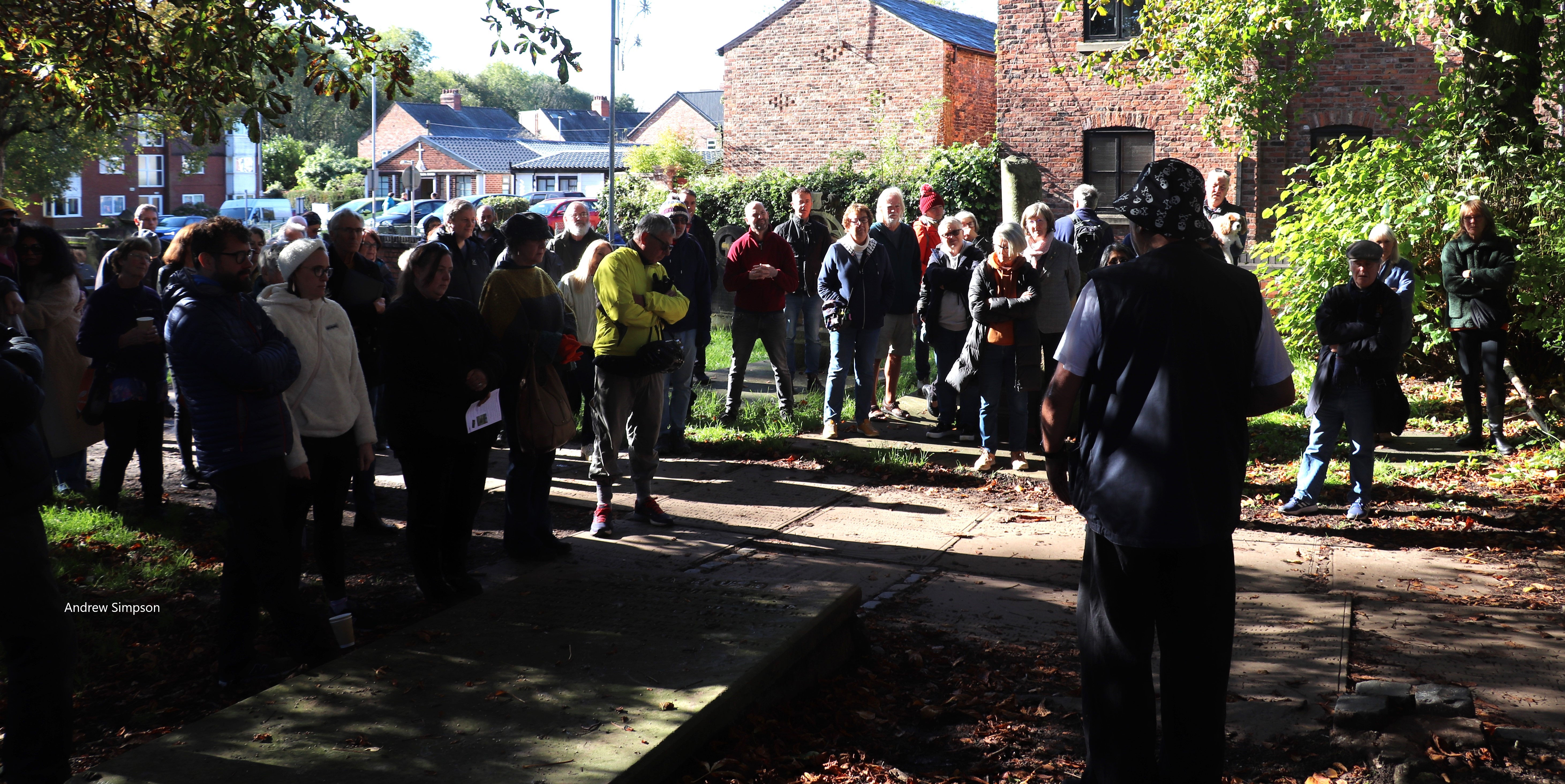
Today was the unveiling of the first new blue plaque in Chorlton, and the first event of the Friends of Chorlton Graveyard

Councillor Benham unveils the plaque, 2023

So, thank you ….. thank you to the 70 who turned up …. to Mark Canney of the Bowling Green who acted as host, to the two Peters and Steve who organised the blue plaque and to members of the newly formed Friends of Chorlton Graveyard.

People gather, 2023
Not forgetting Chorlton Civic Society who supported both events and Councillor Mathew Benham who unveiled the plaque on the wall of the Bowling Green Hotel highlighting the pub’s position as one of the oldest in Chorlton.

Councillor Benham has been a good friend to the graveyard group.  

He was there at the very beginning offering advice and help and liaised with Neighbourhood Services in facilitating the establishment of the group.

And today in front of 70 people the plaques were unveiled, followed by a talk on the history of the graveyard.

Part of the history, 2023

At the end of which people were invited to make suggestions about how they saw the graveyard being developed.

Listening to the history, 2023

And the sun shone.

Friends of the Graveyard, 2013
Not bad for two events in one day.

And the thankyous I nearly missed.

Thank you to the staff of the Bowling Green who put on light refreshments.

To Mark Canney who bought me a pint and to the party of dinners who sat while waiting for their meal and listened to the speeches.

At which point I think it would a tad selective to all those who turned up, but thanks anyway to Lawrence, Dave Bishop, Tony Goulding, Cath Brownhill and her husband, along with Kath and Karen and my old south east London chum Ed Jury who like me has come to revel in Chorlton's history.

And of course Peter's family.

And sorry if I missed you out.

Location; the Bowling Green and Chorlton graveyard

Jude and Mark offering suggestions for the future, 2023

Pictures. The events on the day, 2023, from the collection of Andrew Simpson 


The lost Chorlton gravestones ……. discover their stories today .... in the Bowling Green Hotel at midday

History hasn’t been kind to those buried in our churchyard.

Just fifty years ago there were still 362 gravestones which marked the lives and deaths of the individuals and families who had lived in Chorlton since the mid-18th century.

They were a mixed bunch, from the great and wealthy to farmers, shopkeepers, traders, and agricultural workers.

Some died in infancy others in childbirth and yet more lived on into old age surrounded by their children and grandchildren.

Our own local historian Thomas Ellwood drew on the recollections of some of the older residents in 1885 to write a series of articles about the township. 

And because those he spoke to drew on the memories of their parents and grandparents we are back to the time when the old King George lost the American colonies.

Many of the families who lay here were old Chorlton families who had lived in the township for centuries, and some of their descendants are still here, while others moved in over the course of the last 200 years.  These newcomers challenge the accepted convention that until the mid-19th century people seldom moved far from where they were born.

But their stories are now under threat, as their gravestones deteriorate and the inscriptions of who they were begin to vanish.

Already most of the 362 gravestones have been lost, discarded when the graveyard had its makeover in the 1980s.

The remaining handful have suffered from being used as a pathway through the site and the constant footfall is wearing away their names, and much more.

Added to which few are now where they were originally placed.


Happily we do have a record of the original inscriptions of all 362 grave stones which was undertaken in 1975.

But already some had become undecipherable.

Still enough were recorded which allows us in conjunction with the parish records and census records and other historical material to start to tell their stories.

Sadly the surviving few need some tender care and attention.

To this end a “Friends” group has been formed to look to saving what is left, maintain the churchyard and think about how this unique piece of history can be preserved and remain a peaceful place of contemplation.

So today, Andrew Simpson and Peter Topping will share some of the graveyard’s history and thoughts on how the Friends can work together to enhance the place.

Meet at the Bowling Green at mid-day today.

Location Bowling Green Hotel

Pictures; Chorlton graveyard, 2008, from the collection of Andrew Simpson, and  the Register of Grave Inscriptions, City Engineer and Surveyor, 1975

Saturday, 14 October 2023

And what did you do to help restore our historic graveyard? ........ find out tomorrow at 12 at the Bowling Green Hotel

 Just over a month ago a few of us came together to look at ways in which the graveyard by the green could be helped.

The graveyard, 2023

It has been at the centre of Chorlton life for over three centuries and surrounded a succession of local churches, dating back to the early 1500s.

The Lych Gate, circa 1900
And here were the graves of more than 360 individuals and families, from the great and wealthy to traders, shopkeepers, farmers, and agricultural workers.

The church was closed in 1940 and demolished nine years later leaving the graveyard a closed and almost forgotten place till it was landscaped and given a makeover in the 1980s.

And forty years on it is time to come together to look at it again.

In the intervening years some of the gravestones which act as a path have moved slightly and others are suffering from the constant foot fall which is steadily wearing away the inscriptions.

The Lych Gate, 1980

All of which led to the formation of a “Friends” group which could look to the immediate need of keeping the gravestones clear of the detritus of old leaves and soil and have an overview of how the place could be developed in partnership with the City Council.

Looking across the green to the graveyard, 1981
So, this Sunday come along at 12 to the Bowling Green Hotel where after the unveiling of a blue plaque marking the historic importance of the pub, we will be taking about the group.

Andrew Simpson will give a short talk about the history of the graveyard and the parish church along with some of those who were buried there and then Peter will outline the aims of the Friends’s group.

Already the newly established Facebook Friends site has attracted 210 members in just over a month and each day a few more sign up. *

And almost Breaking News there is a planning application in for the City Council to renovate the Lych Gate and external walls.

Renovating the Lych Gate in 1993

So that is it, come along on Sunday and be part of the project.

Pictures; The Lych Gate, circa, 1900 from the Lloyd Collection, Target Tower Repairs, South Manchester Express and Advertiser, 1993, and pictures of the Rec, 1980, 1981, and 2023 from the collection of Andrew Simpson

**The Friends of Chorlton Graveyard, www.facebook.com/groups/chorltongraveyard

**Listed building consent for fabric repairs and redecoration of the Lych Gate and boundary walls, 136990/LO/2023, Manchester City Council Planning Portal, https://pa.manchester.gov.uk/online-applications/applicationDetails.do?activeTab=documents&keyVal=RURB6TBCJOG00


Tuesday, 3 October 2023

When even the weather is unkind to our graveyard ……..

The old churchyard by the village green is a special place.


For many it is somewhere to sit quietly amongst the trees and bushes, and for others like me it’s a place full of Chorlton’s history.

But as the newly formed Friends of Chorlton Graveyard know, it needs a heap of tender care and attention.  Many of the gravestones that form the path are now titling slightly, making for an uneven and dangerous surface which after heavy rain has turned the area into a series of lakes.

Equally worrying is that the constant foot fall is wearing away the inscriptions, and when they have gone the names and the stories of many of our past residents will be lost for ever.

The Friends want to address these issues by working with the city council to tackle the immediate issues, explore how the graveyard could be improved, and act as a focus for maintaining the site.

The Friends are under the wing of Chorlton Voice (Civic Society) and have been helped by Cllr Mathew Bentham and officers from the Council’s Neighbour Services, and recently set up a Facebook group which has attracted a lot of interest.

And on October 15th the Friends invite you to meet us at the Bowling Green Hotel at 12.00pm to hear the story of the graveyard and its church, as well as being able to offer up suggestions about how to restore the site.


Location; Chorlton graveyard

Pictures; the graveyard on a wet autumnal day, 2023, from the collection of Andrew Simpson

*The Friends of Chorlton Graveyard, www.facebook.com/groups/chorltongraveyard


Tuesday, 29 August 2023

Saving that bit of Chorlton’s history for another century and a bit …..

For many the Lych Gate on the village green is one of the iconic images of where we live.

Meeting at the Lych Gate, circa 1900
It has stood at the entrance to the old parish burial graveyard since 1887 and was erected to commemorate Queen Victoria’s Jubilee.

And long after the parish church was abandoned and demolished and most of the gravestones carted away it stood as a reminder that this was the spot where most of Chorlton were baptised, married, and finally buried stretching back into the 17th century.

But this listed building is now in need of some tender care and attention.

It last had a make over in 1993 when the bell tower “was repaired with specialist Victorian tiles from Staffordshire”. *

Repairing the Lych Gate, 1993

The need to revisit the building was raised by Andrew Simpson and Peter Topping earlier in the year as part of a bigger initiative to restore the former parish graveyard.

Looking towards the graveyard, 1981

Suggestions included relocating the remaining gravestones, creating a ramp at the southern entrance, and a series of story boards which would explain the history and significance of the site.

Central to the plan would be the establishment of a Friend’s group of volunteers who would adopt the graveyard, and in partnership with the City Council look to maintain the place and look to its future.

To this end Andrew and Peter contacted Cllr Mathew Benham who organised several meetings with Neighbourhood Services and the plan for the Friend’s group is advancing.

And now there is an application in for “fabric repairs and redecoration of the Lych Gate and boundary wall”.**

The application from the City Council to do the work was submitted in May and is now out for consultation, and you can see the plans in detail by following the link below.

There will be many who will greet the news with great pleasure.

The Lych Gate, 1980

Some, because the Lych Gate is a special part of  Chorlton while for many others it will be the memories of hearing the bell at New Year or from illicit games in the tower. 

An arch and a heap of gravestones, 2023
And for those who would like to join this exciting project there is now a Facebook site which will feature regular updates and contributions from those who want to see the graveyard continue as a focus for our history into the next century and a bit.***

Leaving me just say the report of the 1990s repairs needs a tad correction, because the gate dates from 1887 not 1897 and the church was demolished in 1949 not 1930.

Location; Chorlton Green

Pictures; The Lych Gate, circa, 1900 from the Lloyd Collection, Target Tower Repairs, South Manchester Express and Advertiser, 1993, and pictures of the Rec, 1980, 1981, and 2023 from the collection of Andrew Simpson

*Target Tower Repairs, South Manchester Express Advertiser, April 8, 1993

**Listed building consent for fabric repairs and redecoration of the Lych Gate and boundary walls, 136990/LO/2023, Manchester City Council Planning Portal, https://pa.manchester.gov.uk/online-applications/applicationDetails.do?activeTab=documents&keyVal=RURB6TBCJOG00

***The Friends of Chorlton Graveyard, https://www.facebook.com/groups/1381914932356270