Showing posts with label The Red Cross. Show all posts

Sunday, 25 May 2025

The forgotten hospital in Longford Hall

 I know l shouldn't be surprised that Longford Hall was given over to use by the Red Cross as an Auxiliary Hospital during the Great War.


Many family homes, along with schools and other public buildings were requisitions or volunteered as hospitals for soldiers  recovering from wounds and illnesses. 

Here in Chorlton l have tracked three with the promise of another, and over the years l have written about more in Didsbury, Whalley Range, Salford and across Manchester and beyond.

I just didn't think of Longford Hall but I should. It was a fine large building, formerly the residence of the  Ryland family and from 1908 it was owned by Stretford.

So at the outbreak of war it became a centre of war activity including its role as a hospital.

After the war most of these hospitals were returned to private use or continued as hospitals. 

The equipment from beds to cooking pans and typewriters were sold off and with two generations their existence had started to fade.

So l am off to do the research, starting with one of those scrap books recording photographs and comments of the hospital.

Location; Longford Hall

Pictures; pictures, undated courtesy of Bill Sumner

Wednesday, 29 November 2023

Miss Lydia William Falconar Grant ……… a nurse from the Great War

I never tire of the way that a chance picture of some one long dead sets off a story which goes off in a dozen different directions.


And so, it was yesterday when Tony sent over his photograph of one of the gravestones in Southern Cemetery with the comment, “knowing your interest in the Red Cross I thought you might find this interesting”, which of course I did.

The grave belongs to Miss Lydia William Falconar Grant, who died on April 1st, 1917 at the Ducie Avenue Military Hospital.  

The inscription reads “Lydia William Falconar Grant V.A.D. Member of the Red Cross Society of Australia, born at Falcon Hall, Morningside, Edinburgh and died at Ducie Avenue Military Hospital, Manchester, on the 1st of April 1917, Elder daughter of Peter G. Grant & Emily Grant of Brisbane, Queensland”.

She was born in Scotland in 1880, grew up in Australia, served at a military hospital just off Oxford Road, in Manchester, and died just a year after she was engaged by the Red Cross as a member of the Voluntary Aid Detachment.

This was a voluntary unit of civilians providing nursing care for servicemen in the UK and across the British Empire.

And this was the start of the story.

Falcon Hall was a very large 18th century mansion in Edinburgh, which according to one source belonged to the family.  Her father described himself as a “land surveyor”, and after returning to Australia in late 1880 he appears to have become a police magistrate.


Miss. Grant was educated at the Ladies’ Methodist College in Melbourne, and was living in Brisbane when she volunteered to serve with the Voluntary Aid Detachment.

She left Australia in September 1916, and after four days in London was posted to Manchester, beginning work in December of that year.

According to one press report she  felt the intense cold weather in Manchester but “she was always very happy, and keenly interested in her work.  Her letters showed also that she had met with great kindness from those with whom she came into contact, and found both in sisters and nurses engaged in the same hospital much congenial comradeship”.*

The hospital was the former Ducie Avenue Municipal school, which had been requisitioned in 1916, and consisted of 240 beds, of which 88 were specialists’ ones, and until 1917 it had an orthopedic section.

Sadly, she contracted measles in the late March of 1917, which developed into Septic Arthritis on March 28th, and by the following day she “became unconscious with very little hope of recovery”.


Her funeral was reported in The Searchlight, which was the monthly publication of Second Western General Hospital in May, reporting that "Miss. Grant was one of the first contingent of the Australian Probationer who came to us last November and during her short period of work here and also during her illness, bravely and patiently borne had greatly endeared herself to all she came into contact.

She was laid to rest in Southern Cemetery on April 4th, close to the grave of V.A.D., Nursing Member Pearce, whom we buried only a few weeks ago.  At the request of friends, the funeral was a private one, and the service, which was very impressive, was conducted by the Ven. Archdeacon Aspinall, assisted by Cap, Worseley.  

It was attended by Sargt. C Grant, 1st Australian Division, Capt. Brentnall, R.A.M.C. (T.F.) and a large number of Sisters and nurses of the Second Western General Hospital staff, including seven other members of the Australian contingent”.


I doubt I will ever get to see the letters she wrote home, and so have no way of knowing what she thought of Manchester, but I hope on her days off she got to see something of the city.

There will be more that will come to light about Miss Grant.

For now, we have a photograph, an entry in the book commemorating the work of the 2nd Western General Hospital,*** her Red Cross record card and a handful of other sources.

And I have to thank Bruce Terrell who is a relative and first alerted me to the photograph of Miss. Grant and to Bruce Anderson who gave me permission to reproduce pictures of the Ducie Avenue Military Hospital from his excellent web site, Rusholme & Victoria Park Archive****, and went off and did his own research and coming back with many of the other sources I used, from the Cairns Family History.


Leaving me just to thank Tony Goulding who sent me the picture of the grave and set me on  the story.

Location; Scotland, Australia, Manchester

Pictures; gravestone of Miss Lydia William Falconar Grant, 2020, from the collection of Tony Goulding, cover 2nd Western General Hospital, 1919, courtesy of David Harrop, photograph of Miss. Grant, Women in war, ANZAC Centenary Queensland, 2014-2018, https://anzac100.initiatives.qld.gov.au/remember/women-in-war/index.aspx, Ducie Avenue Military Hospital, 1916-1919, courtesy of Rusholme & Victoria Park Archive, https://rusholmearchive.org/rusholme-military-hospitals-1914-1918

* Cairns Family History, https://cdfhs.org/indexes/cairns-wwi-soldiers/grant-lydia-wilhelmina-falconer/

**The Late Miss Lydia Grant,  V.A.D., Cairns Post May 16th, 1917

*** 2nd Western General Hospital, Manchester , 1914-1919

**** Ducie Avenue Military Hospital, 2nd Western General Hospital, Rusholme & Victoria Park Archive, https://rusholmearchive.org/rusholme-military-hospitals-1914-1918

***** Cairns Family History, https://cdfhs.org/indexes/cairns-wwi-soldiers/grant-lydia-wilhelmina-falconer/

Monday, 5 June 2023

Letters should be addressed ....... Prisoner of War Post, Stalag XVIII.A. Germany .... stories of a P.O.W.

 It’s always in the detail, so while you need the “big picture” which places everything in the past into a context, it’s the little bits which give meaning to the grand sweep of history.


And this letter to a Mrs. Hirst of Caldecott Road Higher Blackley is no exception.  It was sent by the Red Cross at the beginning of April 1945 and concerned her son Frank who was a P. O.W. in Germany.

The Red Cross was “very glad that your son’s camp address is now known [and] letters should be addressed to him as follows, Prisoner of War Post, Kriegsgefangenenpost, Gnr. Frank Hirst, British Prisoner of War No: 9611 Stalag XVIII.A. Germany”

Stalag XVIII.A was in the southern part of Austria near the town of Wolfsberg.

Just when he had been captured is unclear, but his family will no doubt have been relieved that they had a contact point to send letters.

And to know that he was entitled to Red Cross parcels which went via Geneva to the camps.  

Mrs. Hirst also received a leaflet which detailed the contents of a typical parcel which" are specifically planned to supply what is most needed in the Prisoner of War Camps.”

These included biscuits, cheese, jam, milk, and cold beef, and variations provided by the Indian Comforts Committee of the Indian Red Cross Society and contained “curry, lentils, certain spices and rice”.

Added to these there were supplies of tobacco, cigarettes and soap.

The leaflet also offered advice on what to include in the letter as well as information on how prisoners could correspond with family in Britain.

But and there always is a but the Red Cross acknowledged that due to “the present conditions in Germany, the dispatch of all individually addressed parcels to prisoners of war had been suspended by the G.P.O.  for the time being, but the International Red Cross Committee at Geneva will continue to deliver Red Cross food parcels to all camps”.


This was after all the closing stages of the war. The western allies were fighting their way across Germany, while the Red Army was moving to occupy Vienna and capture western Prussia.

All of which meant that on that April day the war in Europe had just over a month to run.

As yet I don’t know what happened to Frank Hirst, when he was liberated and how his life after the war played out.

He was born in January 1921, had an elder brother and his parents ran a fish and chip shop from 75 Milton Street in Southport.  

They were from Huddersfield and by 1939 had moved to Higher Blackley.  

By then his father appears to have given up battering fish and described himself as a “power loom woollen weaver, unemployed”.

In time more about the family will come to light, but for now it is this letter which offers up so much detail about the fate of P.O.W’s and which will have relevance to anyone who had a relative captured by the Germans in the last world war.

Location, Southport, Manchester, and Austria.

Pictures; Red Cross letter, 1945, courtesy of David Harrop.

Friday, 2 September 2022

Remembering Miss Hilda Peare …….. a nurse from the Great War …. today at Southern Cemetery

 Miss Hilda Peare has come back out of the shadows.

Hilda Peare, 1917
She was a Red Cross Nurse during the Great War, who died “of a severe attack of Scarlatina, contracted while she was engaged nursing the sick and wounded of the fighting forces”*

She was buried in Southern Cemetery with full military honours, and then quietly slipped into obscurity, until now when her contribution will be remembered at a special commemorative service on September 2nd in the Cemetery.**

And here I have David Rawson to thank for not only alerting me to the service, but doing all the research on Miss Peare.***

According to David, “Some years ago, the manager of the cemetery, Pete, came across a record of Hilda's burial and located the site. 

Given her war role he organised for a small marker memorial to be placed at the grave. Pete described her as a 'trench nurse'.

Last May, the Common War Graves Commission  held a war graves week, and I met Liz Marsland who is the public engagement coordinator for the CWGC in the North West. Pete showed us the grave and as the conversation developed about Hilda, we thought that she deserved a CWGC headstone.

Normally if a casualty has a memorial erected privately the CWGC does not then add one of theirs. So, Liz made the case for Hilda to get a CWGC headstone and they agreed”.

Hilda Peare was born in Ireland in 1894, “attended the French School in Bray, Co. Wicklow. 

This school was for young Protestant ladies from across Ireland. It was a boarding school and so Hilda would have been used to living away from home. We know that she was at this school age 17. Clearly a fairly well off family”.

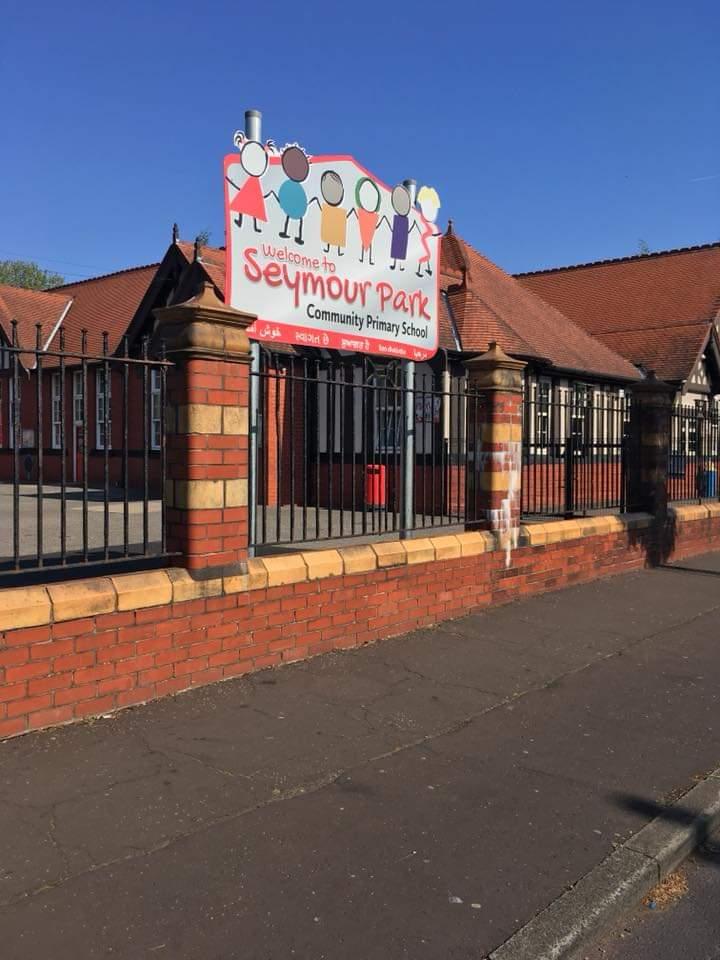
Seymour Park School, 2022
In the autumn of 1915 she enlisted in the Voluntary Aid Detachments of the Red Cross for service administering to sick and wounded servicemen, and was posted to the 2nd Western General Hospital based at Whitworth Street, and from there was redirected to the Seymour Park Auxiliary Hospital on Northumberland Road in Stretford.

The hospital had been a school which was opened in 1907 and is still there today.

During the course of the war, some schools were requisitioned as hospitals along with other buildings like church halls and private residents which were donated by their owners.

Her death was widely reported in the Irish Press, with The Free Press commentating “that her devotion to duty was fully appreciated was evident from the remarkable demonstration of regret on the occasion of her internment. 

She was buried with full military honours, the gun-carriage and the firing party being supplied by the Commanding Officer of Heaton Park Depot. The sergeants of the local detachment of the Royal Army Medical Corps acted as pall bearers, and the band of St Joseph's School played the Dead March in Saul along the route. 

Beautiful wreaths and floral tributes were sent by the officers and men of the Royal Army Medical Corps, the Matron, Sisters, and Nurses of the various military hospitals in the locality, the ladies of the V. A. D., and the patients of the branch hospital where Nurse Peare worked”.

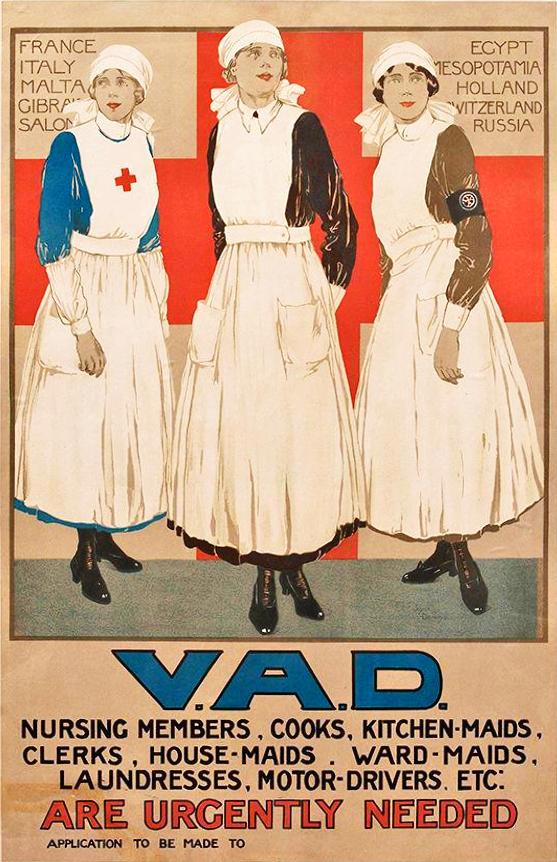
V.A.D., recruitment poster, 1915

And so, it is fitting that a century and a bit after that service she should be remembered in Southern Cemetery.

But that is not quite the end, because David has added  “as knowledge of this event spreads, our friend Cath Brownhill, was telling me that she was a Captain in the Army Reserve based at 207 Field Hospital.

WW1 memorial at the drill Hall, 2022

She has found that Hilda is remembered on the WW1 memorial at the drill Hall on King's Rd (207 HQ)

Cath took the picture. Hilda is toward the top of the left hand column. Although she is down as Pearce rather than Peare".

Original grave marker, 2022 on display
There is much more, and David’s research offers up a wealth of information on the work of the VADS, and Miss Peare’s background, along with fresh avenues of research.

The original grave marker is now on display at his permanent exhibition of memorabilia in the Remembrance Lodge at Southern Cemetery and will also include other material pertaining to Ms. Pearce

Added to this there is The Red Cross’s own data base of those who served as VADS, which is temporarily down for maintenance.

But for now, that is it.  

The ceremony will be held in Southern Cemetery, on September 2nd at 10.30 for 11am, and The Irish Consul General will be attending to represent the Irish Government.

The new gravestone to Ms. Perare, 2022

Pictures; Miss Hilda Peare, circa 1915-1917, Seymour Park School, 2022,  from the collection of David Rawson, V.A.D., Recruitment poster, 1915, Imperial War Museum and WW1 memorial at the drill Hall on King's Rd (207 HQ), 2022, courtesy of Catherine Brownhill, and the grave marker and new Red Cross Gravestone, 2022,  from David Harrop.


*The Free Press, March 14th, 1917

** The ceremony will be held in Southern Cemetery, on September 2nd at 10.30 for 11am

*** David Rawson, is one of the three Manchester City Councillors for the Chorlton Park Ward.


Tuesday, 16 August 2022

Remembering Miss Hilda Peare …….. a nurse from the Great War …. buried in Southern Cemetery

 Miss Hilda Peare has come back out of the shadows.

Hilda Peare, 1917
She was a Red Cross Nurse during the Great War, who died “of a severe attack of Scarlatina, contracted while she was engaged nursing the sick and wounded of the fighting forces”*

She was buried in Southern Cemetery with full military honours, and then quietly slipped into obscurity, until now when her contribution will be remembered at a special commemorative service on September 2nd in the Cemetery.**

And here I have David Rawson to thank for not only alerting me to the service, but doing all the research on Miss Peare.***

According to David, “Some years ago, the manager of the cemetery, Pete, came across a record of Hilda's burial and located the site. 

Given her war role he organised for a small marker memorial to be placed at the grave. Pete described her as a 'trench nurse'.

Last May, the Commonwealth War Graves Commission  held a war graves week, and I met Liz Marsland who is the public engagement coordinator for the CWGC in the North West. Pete showed us the grave and as the conversation developed about Hilda, we thought that she deserved a CWGC headstone.

Normally if a casualty has a memorial erected privately the CWGC does not then add one of theirs. So, Liz made the case for Hilda to get a CWGC headstone and they agreed”.

Hilda Peare was born in Ireland in 1894, “attended the French School in Bray, Co. Wicklow. 

This school was for young Protestant ladies from across Ireland. It was a boarding school and so Hilda would have been used to living away from home. We know that she was at this school age 17. Clearly a fairly well off family”.

Seymour Park School, 2022
In the autumn of 1915 she enlisted in the Voluntary Aid Detachments of the Red Cross for service administering to sick and wounded servicemen, and was posted to the 2nd Western General Hospital based at Whitworth Street, and from there was redirected to the Seymour Park Auxiliary Hospital on Northumberland Road in Stretford.

The hospital had been a school which was opened in 1907 and is still there today.

During the course of the war, some schools were requisitioned as hospitals along with other buildings like church halls and private residents which were donated by their owners.

Her death was widely reported in the Irish Press, with The Free Press commentating “that her devotion to duty was fully appreciated was evident from the remarkable demonstration of regret on the occasion of her internment. 

She was buried with full military honours, the gun-carriage and the firing party being supplied by the Commanding Officer of Heaton Park Depot. The sergeants of the local detachment of the Royal Army Medical Corps acted as pall bearers, and the band of St Joseph's School played the Dead March in Saul along the route. 

Beautiful wreaths and floral tributes were sent by the officers and men of the Royal Army Medical Corps, the Matron, Sisters, and Nurses of the various military hospitals in the locality, the ladies of the V. A. D., and the patients of the branch hospital where Nurse Peare worked”.

V.A.D., recruitment poster, 1915

And so, it is fitting that a century and a bit after that service she should be remembered in Southern Cemetery.

But that is not quite the end, because David has added  “as knowledge of this event spreads, our friend Cath Brownhill, was telling me that she was a Captain in the Army Reserve based at 207 Field Hospital.

WW1 memorial at the drill Hall, 2022

She has found that Hilda is remembered on the WW1 memorial at the drill Hall on King's Rd (207 HQ)

Cath took these pictures. Hilda is toward the top of the left hand column. Although she is down as Pearce rather than Peare".

There is much more, and David’s research offers up a wealth of information on the work of the VADS, and Miss Peare’s background, along with fresh avenues of research.

Added to this there is The Red Cross’s own data base of those who served as VADS, which is temporarily down for maintenance.

But for now, that is it.  

The ceremony will be held in Southern Cemetery, on September 2nd at 10.30 for 11am, and David tells me "I've just had a conversation with Liz (from CWGC) about the order of service. The Irish Consul General will be attending to represent the Irish Govt, which is great".

Pictures; Miss Hilda Peare, circa 1915-1917, Seymour Park School, 2022,  from the collection of David Rawson, V.A.D., Recruitment poster, 1915, Imperial War Museum and WW1 memorial at the drill Hall on King's Rd (207 HQ), 2022, courtesy of Catherine Brownhill.

Marker memorial to Miss Pearce, 2022 

*The Free Press, March 14th, 1917

** The ceremony will be held in Southern Cemetery, on September 2nd at 10.30 for 11am

*** David Rawson, is one of the three Manchester City Councillors for the Chorlton Park Ward.

Friday, 18 February 2022

The soldier …… the Hall and a thank you ….

Now I like the way a story takes an unexpected twist and, in the process, sheds fresh light on the life of a soldier of the Great War.

Sidney Albert Taylor, 1916
And so, it is with Sidney Albert Taylor, who in 1916 was recovering from wounds in the small village of Woodstock in Norfolk.*

The story was prompted by the discovery of a picture postcard with his photograph on one side and an upbeat message to a Miss I. A. Taylor of Gateshead on the reverse.

It was slim pickings but I found Miss I.A. Taylor, who turned out to be Sidney Albert’s sister and from there the story unfolded back into the later 19th century with their births and early lives and in the case of Mr. Taylor forward into 1939.

But what was missing from the piece was just exactly where he had spent his time as an invalid in that tiny Norfolk village.  My Wikipedia tells me that it is a small village which in the 2001 census had a population of 362 in 157 households, and ten years had increased by just 37 people.**

And judging by Street Google the place will not have been so different 108 years ago.

In the story finished buy adding “I will go looking for where in the village he spent his time recovering from his wounds, but I suspect it has gone”, but has so often happens I got drawn away.

Daily Express, November 20, 1916
I did wonder about whether he was in a private home which had been given over to the Red Cross.

It was a practice that you can find all over the country in the Great War, where the owners of large houses and even modest ones, turned them over to be used as hospitals.  It was an act of generosity which in many cases saw the building remain a medical facility after the conflict.

Alternatively, many recovering soldiers were looked after in converted church halls, and even schools.

Woodbastick Hall, circa 1914

But I doubted Woodbastick would have had a large enough church hall or school which would have done the business.

And there I left it.  

So, I was very pleased today when I received an email from Terry who wrote, 'Dear Andrew, You wrote, I will go looking for where in the village he spent his time recovering from his wounds, but I suspect it has gone. 

I think I’ve found where he stayed and you’re correct, it has gone. “Lost Heritage, Woodbastwick Hall, Location, Woodbastwick, County, Norfolk. Year demolished, 1971, Reason, Poor state of repair - possibly demolished to avoid listing. The photo is of the hall just about the time of WW1, taken from the website."'**

And that was perfect because the site offers up the history of the Hall and some nice pictures, which can be viewed by following the link.

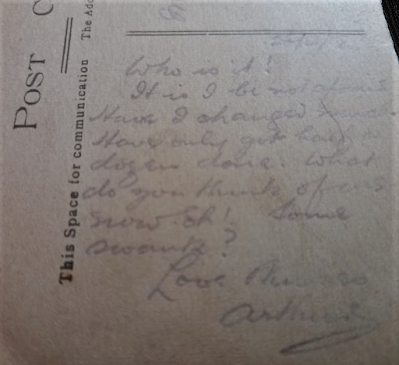
The message from Sidney Albert, 1916
The added bonus was a newspaper account of seven wounded soldiers arriving from the Battle of Ypres to recover the Red Cross Auxiliary Hospital, at Woodbastick Hall.

Now The Red Cross carries an online site detailing all their medical establishments during the Great War, and I may dip into it …… but of course I may be beaten to the research by Terry, which just leads me to thank him.

Location; Norfolk

Pictures; Sidney Albert Taylor, 1916, from the collection of David Harrop,Woodbastick Hall, circa 1914, courtesy of Matthew Beckett,  and newspaper clipping courtesy of Terry. 

*A photograph ..... a postcard ..... and the search for a sister ....Sidney Albert Taylor ...... https://chorltonhistory.blogspot.com/2022/02/this-is-sidney-albert-taylor-sometime.html

** Woodbastwick, https://en.wikipedia.org/wiki/Woodbastwick

 ***Woodbastick Hall, Norfolk, http://www.lostheritage.org.uk/houses/lh_norfolk_woodbastwickhall_info_gallery.html

Wednesday, 5 January 2022

William Eccles …… solder of the Great War comes out of the shadows

This is the story of William Eccles, who was born in 1892 in Gorton, served in the 19th Battalion of the Manchester Regiment and died in Victoria Hospital in Stretford in 1918.

The St John's medal, date uknown
Like so many men who served during the Great War, much of his life is lost to us.

But piecing together the little we know and bringing him out of the shadows has been a collaborative venture and is as much part of the story as this 27 years old man.

He appears on the 1901 and 1911 census and lived on Woodland Road in Gorton.  The house was a modest one consisting of five rooms and was home to his parents, two siblings and an uncle. 

The house is still there today, and his grave has also survived and can be viewed in the Stockport Willow Grove Cemetery.

Other than that, there is little so far to mark his life.  I know from the 1911 census that he was a milkman and possibly worked for his father who was also a self-employed milkman.  

Whether he enlisted or volunteered is unclear, but he does not hold the 1914 or 1914-15 Star so I guess he joined up in 1916 or afterwards.

Hospital (School Hall)
But he was not married as his army record shows his pension went to his mother on his death.

And here we almost came to the end of the inquiry, because the same pension document referred to his death in Victoria Hospital, Stretford, which proved an elusive place to track down, more so because the Red Cross lists it as the Victoria Hospital Council Street.

At this point I am indebted Bill Sumner to my Facebook pal, who replied to my request for help with “It was in the Victoria Park School Henshaw St but older references were Council St probably because the houses were not completely built at that time. 

There are many references to the staff on the Red Cross Site. I have an internal photo here of the Hospital (School Hall). The school exterior view Henshaw St Pritchard St Corner”.

Victoria Park Hospital
So now we have a location and images of where William Eccles died, and in time perhaps more will come to light about the hospital.

I could of course call up his death certificate and discover whether he died of wounds, or perhaps the flu. 

Instead, I will close where I should have begun with a mention of David Harrop who acquired this young man’s medals and started the inquiry.

Amongst the collection are the two medals awarded to all who fought in the Great War, the bronze medallion issued to the families of those who were killed, and The St John's medal which has his name inscribed on the back with his service number.

Bronze Medallion, 1919

Nor is that quite the end because in the course of the research I came across a relative who may be able to furnish more.


So, as I said a story which depends on the collaboration of a group of people as history inquiries should be.

Location, Gorton,  and Stretford


Pictures; The St John's medal, date uknown, from the collection of David Harrop, and two pictures of Victoria Hospital, Stretford, date unknown, courtesy of Bill Sumner

*British Red Cross https://vad.redcross.org.uk/en/~/media/BritishRedCross/Documents/Who%20we%20are/History%20and%20archives/List%20of%20auxiliary%20hospitals%20in%20the%20UK%20during%20the%20First%20World%20War.pdf