Showing posts with label Growing up in New Cross. Show all posts

Saturday, 22 August 2015

Growing up in New Cross nu 13 ....... Queen Tika, Gene Autry and a hidden city and Saturday Morning Pictures

I remain fascinated how one image has stayed with me for over half a century and still has the power to take me back to a Saturday morning in the pictures.

The Phantom Riders 
So distant is the memory that I can now no longer even remember much of the cinema

But the scene where two horsemen descend into an ancient city 20,000 feet underground whose residents abandoned the surface thousands of years ago has never left me.

Saturday Morn' at the Pictures
The city had a Queen and all the political and social structure of a pre industrial society but many of the trappings of the future.

So while Queen Tika is assisted by Lord Argo, and her soldiers ride on horses, there are robots and a sinister death chamber powered by electricity.

Queen Ticka, a robot and Lord Argo
For years I pondered on those scenes and had begun to think it was all in my imagination.

But no they were real enough and part of Phantom Empire, which ran to12 episodes and was filmed in 1935 by Mascot Films.

And I have an article by James Howard in Eagle Times to thank for bringing that memory out into the sunlight.*

The film was “an amalgamation of science fiction, and the western genre” and starred Gene Autry one of the “singing cowboys.”**

The plot was convoluted, involving an evil Professor, his equally unpleasant gang and a plan to cheat Mr Autry out of his farm which stood on a deposit of radium.

The Posters from Eagle Times
And in to this already twisted tale is introduced the city of Murania which along with its robots and death chamber has a bunch of very advanced scientists and a machine which can restore life.

Queen Tika is unaware of a revolution planned by Lord Argo and a group who have been saved from the death chamber and is more concerned that the outside world will discover the city.

So to foil that discovery she sends her “Thunder Guard” to the surface to pretty much have a go at anyone they come into contact with including of course Mr Autry, who in turn breaks into the city and the rest as they say will be continued.***

Now until I read Mr Howard’s article I had no idea of the plot or that it ran to a full 12 episodes, and am tempted to buy the DVD if only to explore the extent that Hollywood tried to mix the Western with science fiction against a backdrop of revolution, robots and death chambers.

In the meantime it is reassuring that another of those child hood memories is rooted in reality, even if that reality was a tad far fetched.

Eagle Times spring 2015
All of which just leaves me to explore Mascot Films, and the actress Dorothy Christy who played Queen Tika.

Mascot Films was one of those small American film companies which specialised in making film series and B westerns and is notable for producing the first film serial to use sound.  This was the King of the Kongo in 1929.

The company was formed in 1927 and merged with several other companies to form Republic Pictures in 1935.

Ms Christy was born in 1906 and her film career lasted from 1929 till 1953 and so like Mascot Films covered one of the most important periods in the history of cinema.

Not that  had any idea about all this as I sat in that cinema just 50 or so years ago.

Such are the twists of history.

Pictures; from Saturday Morn’ at the Pictures, reproduced in Eagle Times, 2015

* Saturday Mornin’ at the Pictures, No 2 The Phantom Empire, James Howard, Eagle Times Vol 28 No 1 Spring 2015, http://eagle-times.blogspot.com/

**James Howard Ibid Saturday Morn’ at the Pictures

***The Phantom Empire is now available on DVD

Monday, 17 August 2015

Growing up in New Cross nu 12 ........... down in Deptford and across the back to the Health Centre

Now if you have to go swimming I can’t think of anywhere better than the baths at Deptford which was a grand old building and one which made you feel special because it had all the magic and grandeur of any Prince’s palace.

It was off the main road just past the Town Hall and seemed even to a ten year old an odd location.

Laurie Grove is a narrow enough street and the baths were sandwiched between houses.

But what it offered was magic enough.

It began as you entered and were hit by that mix of warm air, the smell of chlorinated water and noise.

And even before you had bought your ticket and gone through the turn style the hot sticky atmosphere made your winter clothes stick to you, which continued as you walked along the pool side to the changing rooms.

The bigger of the two contained a water chute along with diving platforms which were both a terror and an abiding source of attraction for the young offering a constant challenge to achieve the slide or dive without being stopped by the attendant.

Nor were the Deptford Baths the only ones on offer for just behind where we lived was the Peckham Health Centre.

It was here that we had our school swimming lessons made all the more enjoyable by those odd incidents like the day Paul Driver fell into the baths fully clothed and for ever after was known as Dribble.

And as you do I took both places for granted which was a shame because  the Deptford Baths which had opened in 1898  just missed its centenary closing in 1991 while the bold experiment that was the Health Centre had long closed by the time I was old enough to know of its existence.

That said  we used it as a nursery for my sisters for a while, and by one of those odd coincidences in the 1980s  I came across a reference to it in a set of speaking notes made by Mr Barlow who worked for the Manchester and Salford Co-operative Society.

He had visited it in 1946 and gave a series of speeches to local Labour and Co-op Parties here in Manchester praising its achievements and arguing for more such enterprises.

Thinking back I don't know why we never used the swimming baths at the Health Centre or why for that matter we made the trek up to Laurie Grove but we did, and I am pleased that the building has survived and while no one can splash and shout inside its impressive facade, the building has been retained and is well worth a visit.

Picture; ©  Dr Neil Clifton and licensed for reuse under this Creative Commons Licence. http://www.geograph.org.uk/photo/1786698

Sunday, 16 August 2015

Growing up in New Cross nu 11 ............ of mission halls, synagogues and a factory

Yesterday I went looking for the South London Mission Hall on Lausanne Road.

That Baptist Church on Lausanne Road, 1872
And today I found it and got a lot more than I expected which is what often happens.

In 1872 it clearly shows up as Baptist Chapel, in 1899 it was a synagogue and by 1952 as my mission hall, “seating 160.”

Then sometime during the 1970s  it was swept away along with everything else down to Queens Road.

Now I know that from 1889 till 1905 it was the South East London Synagogue which  had previously been in a "house in 452 New Cross Road in 1888, and then moved to two rooms in Nettleton Road, New Cross, followed by a hut in 1889 in Lausanne Road, Peckham." and then relocating to New Cross Road in the March of 1905.*

All of which I discovered when reading South East London Synagogue from the site Transpontine.**

After which it may have opened as the South London Mission.

I do have the names of some of the people associated with the building, which will help.

In 1878 it was the Rev Thomas John Cole who I can track around Peckham from the 1870s through to the 1900s on the electoral rolls and at one point lived at number 1 St Mary’s Road.


Manufacture amongst the smart houses, 1872
So as they say it’s all still to play for.

But in the course of wandering up and down Lausanne Road using the maps of the late 19th and 20th centuries I came across a Confectionery Manufacturer.  It stood four doors up from Mona Road and shows up on the 1872 OS and is still there on 1952.***

And that means that it will still have been there when I was growing up and in all probability I will have passed it countless times on my up to  the doctors at the top of the road.

Something of its industrial past is still there to see and like my mission hall it calls for more research.

I just wish we had taken photographs of both.

Picture; Lausanne Road, 1872 OS London, courtesy of Digital Archives Association, http://www.digitalarchives.co.uk/

*South-East London Synagogue, Jewish Communities & Recordshttp://www.jewishgen.org/JCR-UK/London/selondon/index.htm London Synagogue

**Transpontine, http://transpont.blogspot.co.uk/2007/01/south-east-london-synagogue.html

***1872 OS London, courtesy of Digital Archives Association, http://www.digitalarchives.co.uk/
 and Southwark Historical Mapping, http://search.ancestry.co.uk/cgi-bin/sse.dll?gss=angs-c&new=1&rank=1&gsfn=Thomas+John&gsln=Cole&msrpn__ftp=Peckham&msydy=1891&msypn__ftp=london&gskw=Rev&cpxt=1&cp=11&MSAV=1&uidh=zga&pcat=35&h=1054650&recoff=4+5&db=LMAelectoralreg&indiv=1&ml_rpos=15

Saturday, 15 August 2015

Growing up in New Cross nu 10 ............. that Roll of Honour in Edmund Waller school and George Carly of Lausanne Road

Growing up in Lausanne Road in the 1950s was to be untouched by the Great War.

Replica Cenotaph circa 1920
Of course the evidence of the Second World War was still all around us.

Many of the bomb sites had yet to be redeveloped and there were those signs announcing EWS and Shelters.*

Added to which there were plenty of gable ends  which had been cemented over and told of the house next door which had been blown away.

But the Great War was different.  It was rarely a topic of conversation which given the more recent conflict was understandable.

And yet those who had participated in it either as combatants or on the Home Front would still be in their late 50s or early 60s, would yet to have retired and some were not yet grandparents.

But I can think of only one moment when it impinged on me and that was at school at Edmund Waller.

In the upstairs hall on a ledge in a glass case was the Roll of Honour, opened at a particular page with those who had survived recorded in black ink and those who had died in red.

I have often wondered if the pages were turned regularly and more recently whether it still exists in the school and is on display.

Joseph Thomas circa 1914-15
Today that conflict is remembered in a way that was not the case when I was growing up.

Rightly so we have come again to recognise the sacrifice of that generation but I think all too often we see them as either young men staring back at us in their ill fitting uniforms or as frail individuals with faltering voices in wheel chairs and forget that when that war was over they settled down to productive lives, raising families with decades ahead of them.

And I was reminded of this when I met with Nicola whose great uncle had fought in the war and died aged just 23 on the Western Front in 1917.

He had been one of those young me who had enlisted in the first few months of the outbreak of war and was in the 2nd City Battalion of the Manchester’s which formed the second Manchester Pals Battalion.

Early in 1915 young Joseph Thomas sent a picture postcard to his brother announcing he was coming home on leave.

The card like many of the time carried an image of a group of young soldiers and after posting the story Nicola got in touch and identified her great uncle.

In the family collection was this replica of the Cenotaph made by Kingsway Art China of London.*


Replica Cenotaph circa 1920
Once these must have been manufactured in their thousands but I doubt that many still exist and those that do will be in collections whose owners have little knowledge of its personal history.
This one however retains that link with the Thomas family and that young man.

And by extension I wonder how many other very personal memorabilia exist in Peckham and which contain a story.

Yesterday I reflected on the story of young George Carly who had lived in our house.

He was  born in 1894 and died on the Western Front at the Battle of the Somme on September 18 1916 and I rather hope that I will uncover something of his.

Pictures; replica of the Cenotaph, circa 1920s courtesy of Nicola O'Neil and Joseph Thomas circa 1914-15 from a picture postcard, 1915 from the collection of David Harrop

Friday, 14 August 2015

Growing up in New Cross nu 9 George Carly ...........a soldier of the Great War

Unknown group of soldiers, 1916
George Carly and I were neighbours separated by just 40 years and sharing the same house.

Of course I didn’t know him and only discovered his existence yesterday when I began to explore the history of where I had lived in the 1950s.

The family appear on the 1911 census and were still there three years later when the Great War began.

That in its self has drawn me to them fired also by a curiosity over their names.  Mr Carly’s middle name was Garibaldi and his wife’s was Zilpah.

Not that their birth places were unusual.  Mr Carly had been born in Sussex in 1865 and Mrs Carly in Greenwich

Unknown group of soldiers, 1916
I suspect given his birth year his father may have admired the Italian nationalist Garibaldi and in time I will I hope discover more about Lucy Zilpah Carly.

But for now it is enough to know that in the April 1911 the Carly’s had been married for 18 years and had six children ranging in age from George who was 17 down to Ivy who was three.

And knowing the house so well it is easy to begin to fit them into the different rooms wonder who slept where and which jobs around the place each was given to do.

My dad always talked about how his was the job of cleaning the fire places and bringing up the coal in his home in Gateshead and I suspect the same would have been true of the Carly’s particularly as they did not employ a servant.

At which point it is easy to slip into speculation about the family.

Mr Clark and his son George described themselves as “catering clerks.”
 George Carly of Lausanne Road, born in 1894 and died at the Somme in 1916

The remaining children with the exception of Ivy were listed as “student” or at “school” and so I wonder if Edmund Waller was where they went which is the school me and my sisters attended.

The school dates from the 1887 with an extension added in 1899 so it is possible that at least some of them might have attended.

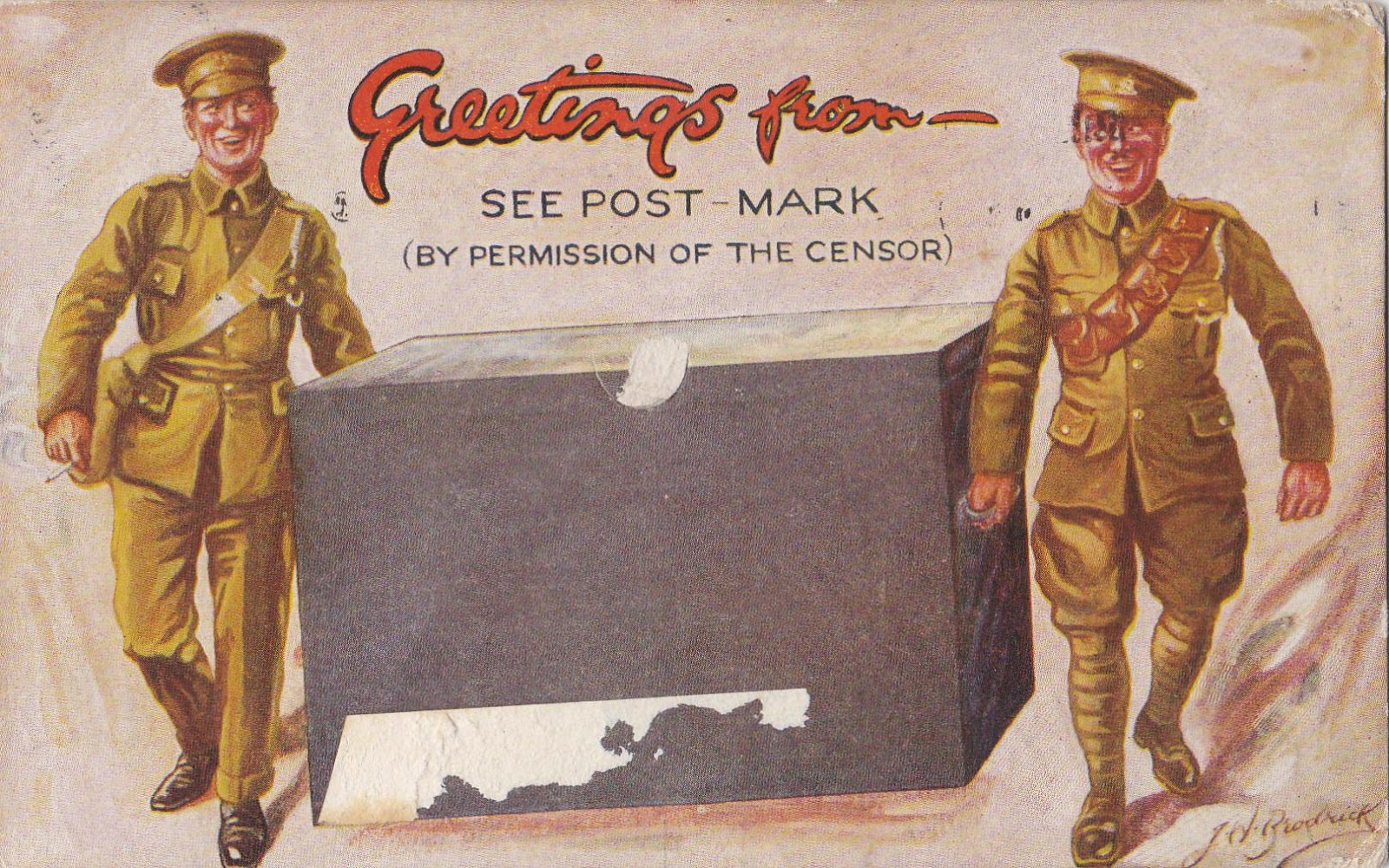
Greetings ............ circa 1918
And I will go looking for school registers and admission books but in the meantime it is George who occupies my thoughts.

At his death he was serving in B Company of the First Battalion Queen’s Westminster Rifles and was killed on September 18 1916 at the Battle of the Somme.

Now if I have got this right the Queens’ Westminster Rifles had been formed in the August of 1914 at 58 Buckingham Gate and had been a Territorial Force and left for France in the November.

Sadly like so many of the men who served in the Great War George’s military records were destroyed which at present leaves us very little other than a reference on the Thieupal Memorial.

Not that this will stop me.

Now I know we inhabited the same house I feel the need to find out more.

Pictures; Daily Mail War Postcards, 1916, and others courtesy of David Harrop


*The London Regiment, The Long, Long Trail, http://www.1914-1918.net/london.htm


Thursday, 13 August 2015

Growing up in New Cross nu 8 ............... the coalman and the corner shop

Child hood memories don’t always make good history but that said they remain a powerful link to the past.

The coal bill, 1963
The trouble with them is that they end up telescoped into a vague point in time and more often are jumbled up with a whole mix of things.

That for the historian makes them tricky because they can’t always be verified, may refer to different periods and above all suffer from that rosy glow which walks with all nostalgia and would have us believe that summers were always sunny and hot and Wagon Wheels were bigger.

But there is no doubting the sound of the coal man which not only takes me to my child hood but is a link to how we live today.

I can’t remember when he came but it was a regular occurrence throughout the winter and one which Dad kept going into the summer when coal was cheaper.

It began with that sound akin to thunder as the coal shot down the chute into the cellar with a roar and was followed by the that quieter noise as the pile slowly settled with lumps finding their own place in the heap.

Shopping list and receipt, 1968
And for perhaps fifteen or so minutes later the house was taken over by the smell which managed to escape from behind two closed cellar doors and hung in the house as an afterthought.

Those memories are always combined with the sound of dad raking out the stove first thing in the morning and setting a fresh fire going which heated the back boiler providing hot water for the day.

It will have been a sound repeated in homes across the country and was as much as wake up call as the alarm or here in the north the tapping of the “knocker up.”

And for the last thirty years our own children have been  greeted by those same sounds as I too rake out the downstairs fires and set them ready to go.

Nor is this some affectation because as the summer draws on lighting a fire in the early evening lifts what can still be a cold room and saves on the central heating.

It was how we lived back in the 1950s when of course central heating for most people was unheard of.

And in much the same way most of us back then would not have had a fridge which in turn meant that shopping was something you did every day.

I am hard pressed to remember all of the shops on that stretch of Queens Road from Lausanne along to Dennet’s but there was a butcher’s and two grocer’s shops of which Attins commanded most of our business.

All the basics were there and the shop was yet to go self service, so butter still came cut from a block, and cheese came in two colours, red or white.  But it was  more up market than the other shop so the biscuits no longer came loose in tins at the front of the counter and it was one of the first to offer frozen food.

But it was that other smaller grocer’s shop which pitches me back far beyond the 1950s.  It opened on a Sunday and was I suppose the out of hours convenience store of the time, which was quite prepared to defy Sunday Trading bye-laws by offering prohibited products provided they were well wrapped up and disguised with a stern command that no way was I to tell anyone what I had bought.

Queens Road before the shops 1872

Now that parade of shops was doing the business as far back as 1914 when Mr Clark at number 208 was cutting hair, James Wallis Green sold oil and William George Larrett offered the finest pork along with Frederick Langley & Sons, who were cutlers, and vied for trade with a fruit shop, a fried fish dealer, Mrs Emily Virgo who ran the bakery and post Office and Applin & Flint, the laundry.

Not that the parade set out that way back in 1872 they were a fine set of houses set back from the road with longish gardens.

But never underestimate the power of commercial considerations and at some point during between 1896 and 1915  the front gardens were lost it her interests of shop extensions which might just confirm a memory of  a set of steps at the back of Attins which lead up to the original front of the house.

But here I may be wrong which just brings us back neatly to the unreliability of memories and I suppose the necessity to go digging in the records.

All of which is another story for another time and just leaves me to reflect  that my shops have long gone replaced sometime in the 1970s by the Somerville Estate.

And just after the post went live Adrian commented "that I can remember Larrett's the butchers in Queens Road.in the late 50's, my nan wouldn't go anywhere else for her meat,see went to pick it from the shop on Fridays and they would keep it until Saturday, as it was my job to get all her shopping.

I was given the ticket to go and collect the meat and you were aloud to go to the front of the line and not wait in the queue, then on the greengrocer in New Cross Gate for all her vegetables.i can also remember that on the corner of Queens Rd and Dennetts Rd was I think a launderette. Wow your site brings back memories of my childhood."

Which pretty much means Mr Larrett had been selling his sausages and beef for over 40 years, now I wonder id the same will be said of Aldi.

Pictures; Coal bill 1963, and shopping list 1968, from the collection of Marjorie Holmes, Queens Road, from the OS map of London, 1862-72, courtesy of Digital Archives Association, http://www.digitalarchives.co.uk/

Wednesday, 12 August 2015

Growing up in New Cross nu 7 ........... memories of when the milk arrived by horse, of dye cast toys and much more

When you are around the past there is always that temptation to slide into nostalgia or worse still to adopt a cynical, hard and sneering approach.

The first sends you tip toeing down picturesque cobbled streets to the strains of a barrel organ and the knowledge that no one locks their doors at night.

The other points up that the cobbles were actually called sets, were often dangerous to both horse and pedestrian while  the barrel organ had a limited repertoire and if people did leave their homes unlocked that was because there was little worth stealing.

It started with a picture of a horse trough near Lausanne Road sparked a series of conversations in our house which went off in different directions and included naturally enough horse drawn vehicles, some of the carrying companies and milk bottles and the cream at the top of the milk.

These are not the memories that summon up the fall of empires or the onset of wars but are as much the stuff of history.

And so I got thinking of the milk vans that delivered our milk in London in the 1950s.  Our round still relied on a horse drawn wagon which however as a consession to the mid 20th century came with big rubber wheels.

It belonged to United Dairies which had been formed in 1917 from a number of smaller companies and by the 1950s had become the UK’s largest dairy products company.

Here as you would expect are a legion of little stories.

Back in the 1920s the United Dairies pioneered the sale of pasteurized milk which had been an issue stretching back to the beginning of the last century.

In 1907 one correspondant to the Manchester Guardian had asked that simple question “Can the present system of milk supply be improved.?”

It was an issue of public safety for what was wanted “is milk which is clean and free from pathogenic germs and which is rich in fat.”

But given the often poor level of scrutiny on the farm and during transportation there was no guarantee of its purity for “milk is a mysterious fluid which tells no tales of its manipulation.”  Moreover it was also at the mercy of “crowds of filthy shops in which milk is exposed side by side with firewood and candles.”

At every stage there was the danger of contamination. “The difficulty on the farm is to secure cleanliness in the milker, the atmosphere, the cooling plant and the churn.  The difficulty in the town dairy is largely in the dust laden atmosphere, which alone shows the need of bottling.  The difficulties in the home are dirty jugs and other vessels in which the milk is exposed until it is required.”

And so not for the first time there had been a call for the involvement of the municipal authorities in the production, supply and provision of milk.

This was after all a period when in the interests of public health local government was getting more and more involved in everything from transport and education to housing, sanitation along with clean drinking water, gas and electric suppilies.

But is was also the age of the train when more and more things were carried by rail of which milk was one.

United Dairies, was a large user of milk trains, and in agreement with the railway companies supplied its own distinctive coloured milk containers to top the railway companies chassis.

While rival Express Dairies preferred the Great Western Railway, United Dairies preferred the Southern Railway.

Those odd looking milk containers were a common enough site on our railways as were the toy versions which appeared on the model railway sets of my youth.

Along with them were those miniature dye cast models of horse carts, motorised floats and the milk lorries.

All were familiar toys when I was young but have pretty much disappeared and are now collectors items, which I suppose has also become the fate of the milkman.

One did pass our house today but they are as much a rarity as the dye cast model.

Here on Beech Road the deliveries lingered on till the turn of the century, but you got that sense that like the rag and bone man and the knife grinder their day was numbered.


Now they are as much a memory as the local dairy on Brookburn Road or the horse drawn milk float which is just about where I started.

Pictures; United Dairies 6 wheel milk tank originally a British Railway Milk Tank Waggon now part of the rolling stock of the Bluebell Railway,  August 2007, by Bluebellnutter, other images from the internet source unknown

*James Long, Municipal Milk, Manchester Guardian, November 20th, 1907

Tuesday, 11 August 2015

Growing up in New Cross nu 6 .................. Muffin the Mule, Sunday Night at the Palladium and a telly with doors

Now I belong to that first telly generation which means I can remember a time when there were only two television channels which shut down by 10.30 and offered up a mix of quiz programmes,  home grown drama and variety shows and lots of American imports.

Added to which there were those frequent “breaks in transmission” filled by the potter’s wheel or the London to Brighton train ride in under four minutes.

Of course we knew nothing better and it was still a novelty to watch moving pictures in your own home with just your family for company and not to have to suffer the man with smelly habits or the lady eating her way through three bags of crisps at the cinema.

I remember our first telly which did look like a piece of furniture, did have those slightly curved doors and after it had been on for a while gave off a faint smell of warm dust and valves.

It also seemed to break down a lot, although that might just be a false memory.  After all when you are nine even one short break can seem an eternity.


But it was and remains magic, and now over fifty years on it is still a pretty neat place to call up a range s of entertainment.

But for all that the telly was beginning to dominate our home there was still the wireless which until the mid 60s meant the Home or Light Service with its mix of serious and happy programmes of which my favourites were and have remained the comedies from ITMA, the Goons and the Navy Lark to Hancock and much later I’m Sorry I Haven’t a Clue.

Now that means that I straddled the two and I have never lost the joy of listening rather than watching.  So while we have a wireless in the kitchen the tellys are all elsewhere, after all if you are slicing the carrots it’s best to watch what you are doing.

And yet I am part of that telly generation and also of the generation that grew up with an explosion of consumerism which with the help of rising wages and HP meant that a telly, a fridge, the washing machine and a hoover were all to enter our house during the course of the 1950s.

In this we were not alone and while some a decade later began to sneer at consumerism it is well to remember that my parents and grand parents who went out and got these items were the same people who had lived through world wars, a trade depression and mass unemployment.

The spectre of the Mean Test Inspector was just twenty years in the immediate past while the memories of the workhouse and of being ill without the National Health Service walked in the memory of many people.

So looking back it is easy to scorn at the amateurishness of much of what we watched, smile at the size of the TV screen and deride the idea that some people tried to hide it behind cabinet doors, but the presence of the television in Lausanne Road marked an important moment in the story of our house.

Pictures; television and washing machine, 1952  and TV  Guide from  Sunday in 1964 from the collection of Graham Gill

Monday, 10 August 2015

Growing up in New Cross nu 5 .......... a heap of electoral rolls and the lost houses of Lausanne Road

Miss Elsie Mabel Carly lived in our house on Lausanne Road for just under half a century.

Lausanne Road, 1953
The family were there sometime around 1904 and moved out in 1951 when my dad and mum bought the house.

I doubt that I would have found out that much about the Carly's had I not begun trawling the electoral registers to see where my parents lived before I was born.

And as I uncovered the different properties ending with Kender Street and Lausanne Road it occurred to  me that I should be able to use the same registers to find out who had lived in our house before us.

Now I knew the Carly’s were there in 1911, a piece of research that led me on to tell the story of young George Carly, who was born in 1894 and died on the Western Front during the Battle of the Somme on September 18 1916.**

At his death he was serving in B Company of the First Battalion Queen’s Westminster Rifles and if I have got this right the Queens’ Westminster Rifles had been formed in the August of 1914 at 58 Buckingham Gate and had been a Territorial Force and leaving for France in the November.

From the Thieupal Memorial
Sadly like so many of the men who served in the Great War George’s military records were destroyed which at present leaves us very little other than a reference on the Thieupal Memorial.

The family continued to live at Lausanne Road and it is those electoral rolls which allowed me to follow Miss Elsie from 1929 when she gained the first through the 1920s up to 1951 with that added bonus of a telephone directory which listed her as the subscriber in 1947.

Nor is that quite all because I she lived to see her 97th birthday dying in Hastings in 2000 which was where her father had been born.


The Swiss tavern, 2007
In time I think I shall go looking for her two sisters who she shared the house with until 1951.

Not that these were the only surprises that came out of those electoral registers.

Having found Miss Elsie I went looking for our news agents on Mona Road and found instead the house numbers of two of my friends.

I knew John Cox had lived on Dennett’s Road and Jimmy O’Donnell on Somerville Road, and there on the register I found their parents.

Not perhaps the greatest bit of detective work but one that took me back to my childhood.

And there were two final discoveries.  One was of a pub on Luggard Road which clearly has long gone and the other was the block of police flats which stood between number 28 and the wood yard which abutted the Swiss Tavern.

The old police fala, Lausanne Road, 2007
When I was growing up I just took the flats for granted.  Looking at them now they stand out as 1950s build and sure enough the prewar maps show eight houses identical to ours and from the electoral registers we can track who lived in numbers 30 through to 42.


The old police flats, 2007
And sometime between October 7 1940 and June 6 1941 they received a hit from a high explosive bomb and the rest as they say was a bomb site followed by post war reconstruction.***

All of which is confirmed by the surveyors report on the house from 1951 which commented on how
“The main roof is covered with concrete plain tiles (presumably done in recent years under war damage repairs) and appears to be in very good condition.”

Now I rather think there is a story here which if I had access to the local newspaper of the period I would be able to tease out but just maybe some stories are left unresearched and unwritten.

Pictures; our house, circa 1954, from the collection of Andrew Simpson and  the police flats, and the Swiss Tavern, 2017, from the collection of Colin Fitzpatrick

Sunday, 9 August 2015

Growing up in New Cross nu 5 off to Samuel Pepys

The one sure certainty of failing the 11 plus was that you went to a secondary modern school.

Beginning Samuel Pepys, 1961
Not of course that this over surprised me.

My mother had been told by my year 6 teacher back in the January of 1961 “that I was not academic material.”  A sentence that burned deeply into my mother and condemned my father and me to endless evenings of 11 plus tests by the kitchen stove.

All to no avail.  I failed.  But not before I along with all the other also runs had to endure the class interviews where the hopefuls destined for a bright grammar school future would give a presentation to the rest of us, which were really rehearsals for the real thing in front of the head teachers of the local grammar schools.

To this day I remember my first introduction to Vasco da Gamma that Portuguese sailor who boldly went where no European had sailed before.  Even then I wondered why the cabin boy and cook as well as the man steering the ship never got a look in through the entire talk.

Years later teaching year 8s the European voyages of discovery, plunder and much else I was always pulled up by the mention of the said captain and taken back the twelve years to the upstairs classroom of Edmund Waller Junior School and the talk given by Barry Whatshisname.

Samuel Pepys, 1961-66
But enough of such bitter vituperation.  That was what the 11 plus was supposed to do.  Separate the elite from the rest of us, and while they went on to a bright academic environment we were destined for schools which specialised in more practical things, .......woodwork not Wordsworth, technical drawing not Tennyson and so much more.

Added to that our schools were not as well funded and led to one glorious episode where just before my O level history exam in 1966 we were given a world historical atlas published in 1938 which finished with the wonderfully optimistic comment that “it is hoped the leaders of Germany and Italy will see sense and rejoin the League of Nations in a profound desire to solve issues by peaceful means.”  

Now today I can see the dark humour in that, but at the time I pondered how we had to use a thirty year old text book which added to everything else got the next ten years of European history so wrong.

But my secondary modern school and many others across the country strived not to give us a second class education.

They were fully aware that a rigid test at 11 did not mean that those who failed to pass were failures.  And so many of us were entered for 0 level exams that badge of so called academic excellence while class mates were given the practical skills which enabled them to become tradesmen in a whole range of occupations

Getting ready to leave, 1966
And these places attracted the talented and committed teachers.  I can remember many who I would have been happy to work beside when I started teaching in 1973.

Indeed in the years after I started I benefited from the advice, good humour and wisdom of those who had been at Oldwood Secondary School here in Manchester before it was merged with the local grammar school to form Poundswick High School.

But despite all their efforts secondary modern schools were just that.  They were a secondary form of education for those who judged unsuitable for the full academic experience.

Today as then selection at 11 has its supporters who in their advocacy of grammar schools focus on the poor records of some comprehensive schools and on a golden age of grammar school education in the late 1940's and 50's.

Now I can be both objective and generous in my recognition of the opportunities grammar schools gave to children of all classes particularly ones who like me came from a working class background.

But I was under no illusion at the time and since that what we who failed that 11 plus were offered was less than best.

Not for us that heady excitement of preparing for a new educational world with like minded bright young things.  In the September of 1961 I assembled with the majority of my male ex classmates from junior school in the playground of Samuel Pepys, and apart from the uniform and an absence of girls there was little to mark this off as any different from what I had already experienced.

Pictures; from the collection of Andrew Simpson

Saturday, 8 August 2015

Growing up in New Cross nu 4 off on a Jolly down to Brighton with the works do

Dad circa 1947
I remember the first time I went to Brighton.

It will have been sometime in the autumn of 1963 and was what has become known as a “jolly” but was officially “the works outing” and amongst my Dad’s colleagues was simply a “Beano.”

Of course these dos weren’t exclusive to work places, many pubs, clubs and institutes would have their day out in the sun with just that right mix of beer, sand, sea and fish and chips.

For Glenton’s it was always the south coast while for Tudor Crisps in Peterlee where I worked briefly it was Whitby or Scarborough and for the countless pubs and factories here in Manchester it was Blackpool.

In many ways the destination didn’t matter, it was the journey which usually involved several pub stops along the way, a “slap up meal” before and after a walk along the front and more pubs and hotels.

Most of those on that Glenton’s do were from the garage although there were a few from the office at New Cross and I think a couple more from Saxton’s the estate agents who owned the coach company.

Off on a Chara early 20th century
Unlike most our trip was not in the summer but mid October when the season was over and the coaches parked in the garage and the drivers taking a long well earned rest

Such trips have a long history stretching back to the charabanc which was a horse drawn vehicle used for sightseeing and works outings usually to the countryside or seaside. They were usually open topped and were common in Britain in the early 20th century.

In time the horse gave way to a motorised version which often had a detachable body so that when the summer season was over the vehicle could be used as a flat bed lorry.


They were not very comfortable and by the 1920s were being replaced by the coach. These might still have a canvas top but were far more comfortable.

Horse drawn Chara, late 19th century
And here there is another connection with Glenton’s because for years back in the 1930s a model of Dad's coach proudly sat in the office window at New Cross, and by degree by the 1950s made its way to the back of the office and finally came home to our house where I played with it for years.

It was a beautifully crafted model which in the untender care of a six year old slowly lost much of its finer detail until all that was left was the chassis and four wheels.

All of which is perhaps a lesson on what a five year old should be given as a toy.

As for that day in Brighton it passed well enough.  Dad I think had gone out of duty and perhaps to fill the numbers I was invited along with my friends Jimmy O’Donnell and John Cox.

For me it was a one off and while I have been on work nights out I have never repeated the “Jolly” and have yet to return to Brighton which has along ago reinvented itself, unlike Blackpool which continues to offer that mix of cheap fun by the sea enlivened by the procession of hen night groups.

All a long way from Brighton and that day out with Glenton’s but thinking about it perhaps not.

Pictures; charabancs from the early 20th century, from the Lloyd Collection.

Friday, 7 August 2015

Growing up in New Cross nu 3 ........... the knife sharpener

The Rag and bone man, 1953
Now I don’t remember his name, or how often he knocked on, or whether we even used him but the man who worked the streets sharpening knives was a familiar sight around Lausanne Road.

He sharpened the knives using a grinding wheel set in a hand cart which was pedal powered.

The sides were painted green and his name was picked out in black and yellow.

At the time he would have been one of many itinerant tradesmen who called offering everything from fresh fish, to brushes, encyclopedias and subscriptions to well known magazines and newspapers.

And of course there was also the  rag and bone man.

I have no idea how much of a living he made but he was popular with our elderly next door neighbour who always had something for him to make sharp.

I rather think Dad did our own.  He was of that generation who pretty much would repair most simple things, from a bit of re pointing around a chimney stack to cutting and sticking rubber soles to the bottom of our shoes.

All of which was fine until he was working away and the sole began to come unstuck.

Mending clothes, 1930
Never underestimate the embarrassment of walking to school with a flapping sole which threatened to part from the shoe and equally worse those round heel additions which screwed into the shoe and again always seemed to come loose when Dad was somewhere else.


Mending the clothes, 1930
And it was long after we left Peckham that I came across the hoard of lost tools which both mum and dad used.  My parents were after all perhaps the last of “make and mend” generation which always resorted to repairing before buying new.

And for years I followed suit, darning socks on the same tool Nana had used and sewing up holes in the children’s jumpers and joggers.

But things had moved on and neither I nor they really liked repaired clothes.

All of which I suppose explains the final disappearance of the knife man.

Either old age and infirmity or just the consumer economy will have done for him, as did for so many of those that came calling.

Of course I doubt that if was that profitable a trade.

Many of these itinerant salesmen were at the bottom of the economic heap working in an uncertain business where competition was fierce
Rags and rubbish 1971
A quick trawl of the census returns for any of our cities during the 19th and early 20th century reveals just how many of these brush makers, umbrella makers and match girls lived in overcrowded cheap lodging houses with little prospect of anything better.

Not that these trades have gone away.  There are still many who make a living on the margin and tramp the streets following those who came before them.

I have yet to come across the knife man, but we get calls from the fresh fish van, the young men with big bags of dusters and other household goods and of course the eager charity workers.

But it is the rag and bone man who has transformed himself.  Now he appears in a lorry and his street cry replaced by a snatch of music from a loud speaker with a prerecorded message.

So perhaps it is only a matter of time before the knife man reappears, after all one already advertises on the net

None of which gets me knowing any more about that man with his green handcart on Lausanne Road.

But perhaps someone will remember him.

Picture; darning tool circa 1930 from the collection of Andrew Simpson, and rag and bone man, Wythenshawe, T Baddeley, August 1953,m44840  and similar cart, Denton, 1971, T Brooks, m59864, courtesy of Manchester Libraries, Information and Archives, Manchester City Council, http://images.manchester.gov.uk/index.php?session=pass


Thursday, 6 August 2015

Growing up in New Cross nu 2 ........... looking for that newsagents on Mona Road

Lausanne Road, 2007
I went looking for the little newsagents on Mona Road.

In its time it delivered our papers, my comics and once briefly provided me with a job.

But the less said about the paper round the better. It was a disaster for me, the shop and the customers.

Despite this hiccup I still have a fond spot for the place and remember that overpowering smell of newsprint and chocolate along with the heavy dark wooden counters and shelves that disappeared into the ceiling and no doubt had you rummaged at the back there would have been the odd item which was sold as new when the old king died.

Now Mona Road isn’t a very long road and consisted of just six houses on the north side and seven opposite.

And as well as being the location for our newsagent was also part of the route I took from Lausanne Road to Edmund Waller.

So I felt fairly confident that it would be one of those little personal landmarks which would still be there and while I was prepared for some changes I would still be able to buy a Kit Kat, look through the comics and touch a bit of my past.

I reckoned the old hand painted sign running the length of the shop would have gone along with the small shop window replaced by one of those 1970s walls of glass.  This I reasoned was progress but the reality was worse, for along with the other five houses it had gone completely, cleared away and replaced by a large block of flats which spill out on to Lausanne Road.

And while they were at it those responsible also did away with a stretch of Dennett’s Road.

At which point it would easy and lazy to condemn what happened to that bit of my history, but I haven’t lived there since 1964, don’t pay the council tax and have no idea of the state of the properties which were demolished.

So I shall return to my newsagents.

Searching back through the memories I think it must once have been a private residence which at some time was converted.  Back in 1914 the directory lists a Mr Tom Noble newsagent at number 13 which seems to be a smaller property at the end of the row at the Dennett’s end.

The eagle Comic, 1959
But I remember it in the middle of the row and I doubt there will be any one who can help.

Which of course is the problem, for with the passage of over half a century I have lost contact with everyone I knew in the area.

That said I have made new friends, some of whom we have discovered lived very close by and but for an accident of different schools may well have become friends.

And I am confident that something will eventually pop up about that newsagent and if not it will have to be the hard trawl through the old directories for the 1950s.  But they are not on line and can only be accessed by a visit to the local studies centre, which will involve a trip back to Peckham.

Which is pretty much where I came in and just leaves me to reflect on the Eagle comic which fell through our door from Mona Road everyday from the mid 1950s through to the early 60’s.

It saw me through my early years and pretty much sums up much about the period which I rather think will work its way into a story.

Pictures; Walter Green House, 2007 from the collection of Colin Fitzpatrick , Safari in Space,  the Eagle Comic, 1959


Wednesday, 5 August 2015

Growing up in New Cross Nu 1 .............. New Cross Library

Both mum and dad were voracious readers devouring two or three books a week.

New Cross Library, 1911
In the winter dad would prefer the battered old armchair in the kitchen.

Here beside the equally battered stove he would pass the evening with a succession of historical novels.

Mum on the other hand preferred the front room with the telly mixing the news, light entertainment and those kitchen sink dramas with a variety of reading stuff.

She also wrote short plays, stories and was working on a novel based on the people she came across in our bit of South East London.

Dad, 1962
Meanwhile Dad would also spend part of those long winter evenings making toys for the five of us for Christmas.

I didn’t think at the time we were unusual and I still don’t and that I suppose is the point, because it is all too easy to slip into simplistic stereo types when you are writing about growing up in Peckham.

But like any working class area it was a place rich with variety.

There were plenty of pubs, cinemas and characters who could have stepped out of a Dickens’s novel but at the same time the library on New Cross Road was always full as was the private circulating library based in the local book shop.

Both of them I remember vividly.

The book shop which was opposite the library was stacked full of books to buy and borrow.

It was one of those dark cavernous places where the shelves ran up into the ceiling and each book carried a blue sticker with the name and address of the shop on the back.

Conversations were conducted in hushed tones but they were always animated as mum swapped her opinions on the book she had just read with the owners who in turn would suggest different titles.

Some were by the same author in the same style but other’s would offer up an alternative, “Well Mrs Simpson if you enjoyed that one, why not look at this, it’s only just come into the shop and I think you would find it interesting.”

Mum, 1955
By comparison New Cross Public Library was that old fashioned style of library with neat solid reading tables, matched by sturdy bookshelves full of everything you might ever want to read, and laid out in meticulous order.

And it was visited with the utmost care to remain as quiet as possible, which if you forgot you were quickly made of aware of by the signs requesting “Silence which were everywhere.”

It was a Carnegie Library built in 1911 and not unlike our own here in Chorlton-cum-Hardy.*

I always thought it was a place to endure rather than enjoy and always tried to avoid visiting.

And yet now as I hold a copy of a book mother forgot to return that smell of disinfectant which still permeates the book takes me right back to the library which I miss.

Now the book was James Joyce’s Ulysses, which I have to confess I have never read and I rather think mum didn’t either.

I have thought of returning it but the library has long since relocated but just possibly the current owners would welcome a little bit of the building's past history.

They are the Music Room London, who according to their site established their "first rehearsal studio in 1985, when it was located in the basement of The Garden Gallery on Monson Road, New Cross Gate. This small basement studio, famous for its toasted cheese sandwiches, was frequented by many including Daevid Allen’s Franco-British progressive/psychedelic rock band Gong."**

Now that I think mother would have approved of given  she was always one for anything which shook the trees.

The Music Rooms, 2015
She was I suspect the only person on Lausanne Road to take the Police Gazette.

In mum’s defence she found the stories of robberies fraud and much worse a fascinating  starting point for stories, and possible chapters in that book.

In fact thinking back our paper bill must have been mega, because along with the newspapers, Police Gazette and a shed full of comics ranging from the Beano, Eagle and Look and Learn there were also Punch, Knitting Weekly and Railway Monthly.

All told a vast acre of news print which came into the house and was devoured before being passed on to mum’s best friend, B who lived at the top of Kinder Street.

That said my Eagles were carefully stored away along with the Lion and Tiger and later the Look and Learn to be brought out on rainy days.

Alas all were junked when we left Peckham, although just last week I came across one of those knitting patterns, but that as they say is for another time.

Pictures; Dad 1962, and mum 1956 from the collection of Andrew Simpson, New Cross Library in 1911, The London Music Rooms, New Cross Road courtesy of the The Music Room London,  2015, and Lausanne Road, 2007 from the collection of Colin Fitzpatrick


*Debates which never go away, ......... the story of our public library, http://chorltonhistory.blogspot.co.uk/2015/01/debates-which-never-go-away-story-of.html

**Music Room London, http://www.musicroomlondon.com/