Showing posts with label War Memorials. Show all posts

Tuesday, 27 January 2026

A quiet day in Hallaton with a war memorial

This is the war memorial in the village of Hallaton.

The memorial, 2024

We came across it on a hot sunny day as we made our way through Leicestershire to the Cotswolds.

It was one of half a dozen we encountered, and the sheer number in what was a short journey reinforced that simple fact of how many young men died during the Great War.

Such was the suffering and profound sense of loss along with the wish to remember their sacrifice that war memorials were erected by local subscription across the country.

They come in different designs and sizes, but all reinforce the magnitude of the deaths.

More so when you compare the number killed with the size of the communities who built them.  

The 45 Sentinels, 2024

I have yet to find out the population of Hallaton in 1918, but I guess it will be a tad smaller than the 594 who were here in 2011, and that is telling given that the war memorial records the names of 41 men who from the Great War and 4 from the Second World War.

And as if to underline that loss we saw just four people on a day when nothing else stirred, save the occasional passing car and the work of a stone mason repairing the church wall.

But the community has not forgotten the men, because close by was an information board to “The 45 Sentinels” which records the site of 45 trees planted around the village for each of the fallen. “Each tree has an engraved plaque with the man’s name, regiment and date of death”. And those details are replicated again on the information board.

Location; Hallaton

Pictures; the war memorials, 2024, from the collection of Andrew Simpson


Monday, 4 August 2025

In Mousehole ….. remembering those who never came home

 When the sums were finally done the cost of the Great War was horrendous.

In Mousehole, 2025

They included 887,858 military deaths, 16,829 civilian deaths, a huge number of wounded from the battlefields, which amounted to between 1.9% and 2.22% of the total population.

Figures which will have had their own powerful and personal impact on families and communities.

No where more so than in the tiny villages and hamlets across the country.  Statisticians might argue that the loss was no greater than in the great cities and towns, but in the small communities of rural Britain it might have felt so.

And I was struck by that thought last week as we explored the fishing villages along the eastern coast of Cornwall.

From Mousehole where we stayed through Newlyn and Penzance and inland through small villages and hamlets all of which each had their own monument to those who fought and those who never came back.

Of course, statistics often gloss over the detail, so while the loss was great, it was not so everywhere.  

Six members of our family went to war, including my great grandfather who returned to the colours, my grandfather, his two brothers and my uncles George and Fergus, and all returned.  As well as my two German great uncles which underlines that simple observation that for my family the conflict was a civil war as well as a clash of nations.

But in Mousehole using the 1901 census because the data is more accessible than either 1911 or 1921 and projecting forward to 1914-1918 the 36 who died during the war amounted to roughly 12% of the male population who might have been eligible for military service.

Sharing the view with the war memorial, 2025
It's a calculation fraught with the potential for mistakes, but there were 206 males out of a total population of 969 who during the Great War might have volunteered or been called up.

And yes the figures and calculations do need revisiting. 

Nor is  that all because my old friend Lois reminded me "You know, of course, of the 'thankful' villages, where no men were lost during the war, and the "double thankful" places where every man who served returned home from both World Wars. 

I always think there must have been some feelings of guilt for those who returned , that they did come home, but many of them would have been grievously wounded - in body and mind".

Location; Mousehole, Cornwall

Picture; Remembering those who left Mousehole for two world wars, 2025, from the collection of Andrew Simpson


Monday, 12 May 2025

Looking for the answer to a tiny mystery …..

Among the pictures our dad collected in the 1920s and 30s is this one.


It is a war memorial and I guess is in Scotland.

But there are no accompanying notes or a date.

That said I think it will date to the mid decades of the last century with just a possible extension into the 1950s.

And the reason for this was that this picture and the rest of the collection were used by Dad in his work for Glenton Tours, driving and hosting coach parties on holidays across Britain.

From the early 1930s he worked for Glenton Tours who were based in New Cross in south east London, and the pictures may well have been an aide memoir when preparing for the trips.

So all suggestions gratefully accepted.

Location; somewhere

Picture; the unidentified war memorial, undated, from the Simpson collection


Monday, 11 November 2024

Didsbury Schools War Memorial ..another story from Tony Goulding

This memorial, on Grange Lane, Didsbury, Manchester lists 75 former pupils of Elm Grove School Didsbury and of its former incarnation as the area’s National School. 
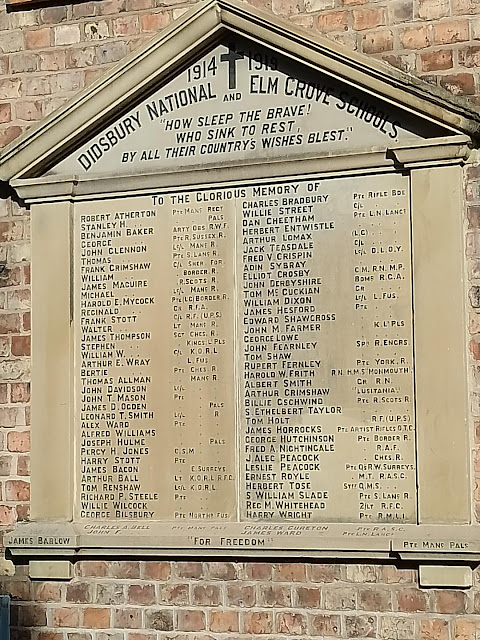
Didsbury Schools Memorial 

One sad and poignant aspect is that many of the entries include the diminutive form of the Christian names; such as “Tom”, “Harry”, “Billie”, “Willie” etc. Thus, recalling the names that would have likely echoed around the school’s playground. All have a story to tell of a life sadly cut short; below is a random selection of just 4.

Arthur Grimshaw - “Lusitania” 


The sinking of the Lusitania
Arthur Grimshaw is the only civilian amongst the 75 names. As a young man of only 18 he was sailing back from Brooklyn, New York on the R.M.S. Lusitania when it sank on 7th May 1915 after being torpedoed by a German U-boat.

Arthur was born to James Biggam Grimshaw and his wife Annie (née Truelove), during the December quarter of 1896 in Didsbury, Lancashire where his father had a tailor’s shop at 112, Wilmslow Road. Arthur was his parents' eldest child and only surviving son. A younger brother, Charles Leslie died aged 6 in the December quarter of 1905. James Biggam and Annie’s three other children were all girls; Mary Louisa, Nora, and Kathleen. The 1911 census record shows 14-year-old Arthur already having left school and working as an “office boy”. He had travelled to New York to visit a friend Arthur “Whitcaide”, in 1914 on board the R.M.S. Cedric a White Star Line liner.

James George Horrocks 28th Battalion, The London Regiment - “Artists Rifles”  

Player’s cigarette card -1908
James George Horrocks was born in the September quarter of 1881 in Didsbury where his father, also a James, lived on Wilmslow Road and was working as a head gardener. His Pendleton, Salford born father had married his mother Hannah (née Marshall) from Stourbridge, Worcestershire in Cheltenham during the September quarter of 1875. According to the 1911 census the couple had a total of 11 children 5 of whom had died. (Incidentally, as a widower James would not have been obliged to provide this information and the entry was subsequently crossed through.) James George was the eldest surviving child before being killed in action at Passchendaele on 30th October 1917, whilst serving as a private in the 28th (County of London) Battalion of The London Regiment, otherwise “The Artists Rifles”. Despite having been married to Louise Frances Elizabeth (née Crossland) at St. Peter’s Church, Levenshulme, Manchester on Boxing Day 1904 and having a young daughter, Mabel, born in Newton Heath, Manchester on 9th April 1906, James George did not wait to be conscripted but enlisted on 9th December 1915. Initially, due to his family status he was placed on the Army Reserve list, however on 4th November 1916 he was mobilized. He sailed from Southampton in the evening of 19th March 1917 arriving at Le Harve in France the following morning and finally joining his unit on 1st April 1917. In the 1911 census and his army records reveal he was a shipping clerk in civilian life and lived on Whitby Road, Fallowfield, Manchester. (variously at nos. 92 and 35)

Willie Gschwind

Willie Gschwind
Willie Gschwind was born in Islington, London during the December quarter of 1888. He was the eldest of the three children of Swiss parents, William Gabriel Gschwind and Bertha (née Troxler). He had a sister, Dorothea Alice and a younger brother, Theodor Rudolf. Willie was a private in the 15th (Manchester Scots) Battalion, The Royal Scots (Lothian Regiment) and was a killed in the slaughter of the first day of the Battle of the Somme, 1st July 1916. Willie’s Army service was shockingly short; he enlisted on 27th November 1915, arrived in France on 5th May 1916 and died less than 2-months later. On his enlistment he was recorded as unmarried and living with his parents and sister at “Blythewood”, 21, Parkfield Road, Didsbury, Manchester. He was 27 years and 2 months old, occupation a “shipper” with a height recorded as just 5’ 4”. With the carnage and resultant confusion of the battle, Willie was initially posted as wounded and missing and it was not for another 6 months until the War Office confirmed his death following a fruitless enquiry through the auspices of the International Red Cross

As a footnote to Willie’s story prior to his Army service Willie and his father had been embroiled in a criminal case, when William Gschwind senior had been accused of attempting to trade with the enemy vis-à-vis exporting cloth to Germany which could be used in the manufacturing of Zeppelin Airships. The case was ultimately dismissed in March 1915. On 30th June 1927, made a claim for the substantial sum of £50,000 (or more than £2.6 million in today's value) in the War Compensation Court with respect to his lost trade with neutral countries. A wonderfully worded, vituperative letter he had sent to the Home Secretary was read to the court by the Attorney General in which he complained of “damage suffered by --- direct and particular interference with my ------ business by this gang of Cerberian miscreant Government officials ----- especially that criminal super-Prussian swinehound, the former Home Secretary. ----- That dilatory, miserable, stupid Foreign Office and their fools of advisers -------. The wilfully debased, perverted and arrogant and super-Prussian recruiting sergeants and makers of scraps of paper of international treaties”.Perhaps unsurprisingly, given this attack, his claim was unsuccessful.

Harold William Frith – Royal Navy 
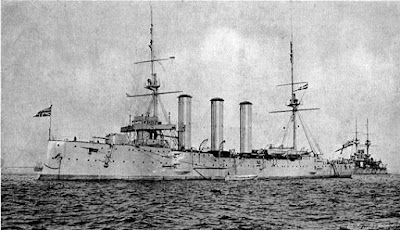
H.M.S. Monmouth.
Harold William is one of only 4 Royal Navy personnel and the only one to die in action at sea; two others. Elliot Cowan Crosby and Albert Smith both died of disease, the former in Italy on 17th October 1918 of “pleurisy following influenza”, the latter died on 22nd November 1918 in Manchester and is buried in the city’s Southern Cemetery - Grave T 584 in the consecrated (i.e. Church of England) section. The final naval casualty was Henry Wright who as a private in the Royal Marines Light Infantry was killed while fighting on the Western Front on 15th November 1916 during the final phase of the Battle of the Somme, the Battle of the Ancre.

 Harold William Frith was born on 26th February 1897 in Withington, Manchester to William Henry Frith, a house decorator, and his wife Elizabeth (née Moore). He first lived at 18, Lady Barn Road, then at 23, Egerton Street. He was his parents’ only surviving child, an older sister, Alice, dying before he was born. In June 1902, Harold William’s father died, aged just 34, when he was only 5 years old. His mother moved with her son to live with Harold William’s maternal grandmother, Elizabeth Moore (and her husband George); initially just next door to 21, Egerton Street. The 1911 census, however, shows the 14-year-old Harold William, already working as a watchmaker/ jeweller's apprentice, had moved with his mother and grandmother, now also widowed, to 16, Rippingham Road, Withington. His mother had opened a drapery shop. (1)

 As well as being the only one on the memorial to be killed in an action at sea, Harold William was also one of the earliest casualties of the War and quite possibly the youngest of the 75 names. He had joined The Royal Navy as a boy sailor on 24th April 1913 with a view to signing up for a 12-year engagement once he reached the age of 18 on 26th February 1915.(2) He was destined to never reach his eighteenth birthday however, as when Britain declared war on Germany on 4th August 1914 he had just joined, on 30th July his second ship H.M.S. Monmouth, having previously being part of the crew of H.M.S Edgar for 5 months.

     On 1st November 1914, H.M.S. Monmouth was sunk during the Battle of Coronel of the coast of southern Chile. Harold William Frith was one of the 1,660 sailors who died across the two ships lost in the battle; the other being H.M.S. Good Hope.

 Pictures: - Didsbury Schools Memorial from the collection of Tony Goulding.

Lusitania sinking from German Federal Archive. This file is licensed under the Creative Commons Attribution-Share Alike 3.0 Germany license.

Attribution: Bundesarchiv, DVM 10 Bild-23-61-17 / CC-BY-SA 3.0

 Soldier of The Artists Rifles 1908 cigarette card by John Player & Sons Tobacco Company. Public Domain  https://talesfromthesupplydepot.blog/2020/03/10/the-territorial-force-cigarette-cards-part-3/,

Pte William Gschwind courtesy of Imperial War Museum’s collections. © IWM (HU 115530) 

H.M.S. Monmouth By Unknown author - Postcard, Public Domain

Notes: 

1) This appears to have been a quite successful business as the 1921 census records show it at 124, Wilmslow Road, Didsbury, Manchester with Elizabeth being joined in the enterprise by her unmarried older sister, Alice Drusilla Moore.

2) Harold William Frith's  Navy Papers also reveal that he stood 5'11" tall with a 331/2 inch chest and had brown hair, blue eyes, and a fresh complexion.

Wednesday, 3 January 2024

The memorial to the Partisan

We are all familiar with war memorials which commemorate the many.

Usually they date from the Great War with a smaller panel for those who fought in later wars.

But here is one with a difference.

It is one man, who was not in uniform but still served his country heroically.

The memorial is a simple affair and stands beside the shore of one of the lakes in Italy.

We came across it by accident last week.

He was an Italian partisan executed by the Fascists on August 4 1944.

It is a simple memorial to a brave man, who gave his life in defence of Italy, and freedom and while it is small and unadorned is a powerful reminder of the sacrifice made by one man.


Picture; war memorial to the Partisan, 2018, Intra, from the collection of Andrew Simpson

Monday, 4 December 2023

Remember them ……..

After over 80 years a war memorial to some of the men who fought in the Great War has come out of the shadows.

The memorial went into storage sometime after All Saints Church was bombed in 1940.

The details remain sketchy, and it is unclear whether the church was the one in All Saints in Chorlton on Medlock or the one in Stretford.

Many of the men listed came from Hulme or Chorlton on Medlock and David Harrop who is now the custodian of the memorial says that “two possibly three are interred in Southern Cemetery, and many family members of these men are interred in Southern, it really is the most appropriate location and reflects the memorials origins”.

All of which points to the All Saints Church on Oxford Road.

The church was badly fire damaged and was demolished in 1949.

So it is fitting that David will be placing it in his permanent exhibition in the Remembrance Lodge at Southern Cemetery.  The exhibition already contains many items related to the two World Wars and some which have links to servicemen and women who are interned in the Cemetery.

A heap more work needs to be done on the men listed and in time it maybe possible to finally identify the church.

But for now, as David has said it’s presence in Southern Cemetery “is the most appropriate location and reflects the memorials origins”.*

Location; The Remembrance Lodge Southern Cemetery

Pictures; the War memorial 2023, courtesy of David Harrop

*The memorial will be on show later in the year or at the start of the next


Sunday, 18 June 2023

On Galatas with a Greek war memorial

It stands in the small harbour of Galatas which is opposite the Greek holiday island of Poros.

I was there 40 years ago with Lois and Michael, but to my shame took very little notice of the war memorial.

To be fair it was my first time in Greece and that potent mix of sun, wine and Greek food would always push everything else to one side.

I am sure if I dig deep enough I will find some information on the memorial, which I am guessing commemorates the war for independence along with the two world wars and the conflict with Turkey.

But I bet there will be someone who can put me right.

I wish I had taken more interest in the memorial, and thinking back it is only an accident that it got included in the shot.

Such are the photographs we take on holiday.


We shall see.

Location; Greece


Picture; Galatas, 1981, from the collection of Andrew Simpson

Tuesday, 13 June 2023

Sacro Monte di Varese

“The Sacro Monte of Varese is located a few kilometers from the city and nestled in the regional park ‘Campo dei Fiori’ which literally translates to "Field of Flowers’. 


It consists of the Holy Road and the Sanctuary, as well as the small medieval village surrounding the Sanctuary. 

The Holy Road with its 14 chapels, rise up the mountain to the little village of Santa Maria del Monte and it ends with the Sanctuary (15th chapel) dedicated to the Virgin Mary. 


The rise is 2 kilometers along on a cobblestone path, and every chapel represents one of the Mysteries of Jesus Christ's life. You can find at the mountaintop the Sanctuary, the Cloister of Monache Romite Ambrosiane, 

The Museo Baroffio e del Santuario, the Casa Museo Lodovico Pogliaghi, the permanent nativity scene, and different restaurants, bars, a pizzeria, three hotels and a bed & breakfast.

The recently restored Vellone-Sacro Monte funicular operates between a parking lot at the first chapel ‘Prima Cappella’ and the top of Sacro Monte on Saturdays and Sundays throughout most of the year”.*

Location; Sacro Monte di Varese

Pictures, Sacro Monte di Varese, 2020, & 2016, from the collection of Andrew Simpson

* Sacro Monte di Varese, https://en.wikipedia.org/wiki/Sacro_Monte_di_Varese

Saturday, 6 May 2023

By the lake at Mergozza ........ remembering those who marched away

It is a simple monument as befits the small village of Mergozzo.


The memorial looks out across the lake and stands in the main square, ringed by restaurants and surrounded by stone benches, making it part of the community.

Location; Mergozza


Picture; the war memorial Mergozza, from the collection of Andrew Simpson

Tuesday, 11 April 2023

Remembering those who went to fight from Sant’Agnello

Sant’ Angello is just outside Sorrento and like everywhere has its own war memorial.

It stands in front of the Municipal Building in a small open space filled with flowers and sits perfectly at the heart of the town.

To one side are some street benches, and on the other a series of cafes from which you can stare back at the statue and the names inscribed on the four faces of the memorial.

It is easy to forget that Italy stood with the allies in the Great War and while the Fascists took the country into the that second war on the side of Nazi Germany there were many who opposed that alliance with Hitler.

And there were many who not only opposed Fascism and the Fascist adventures in Africa, and then from 1940 in Greece and elsewhere, but also were killed by the regime and later by the German army for that opposition.

All of which makes those tired jokes about Italian bravery both bad taste and inaccurate.

From the socialist deputies murdered when Mussolini took power to the partisans who fought both his government and the Germans that opposition was fierce and determined.

All of which were in my thoughts as I sat in the sun yesterday beside the war memorial of Sant’ Agnello.

The life of the town moves past it and I doubt that many give it much of a glance, but then that I suspect is how most memorials are regarded.

They are a memorial to those who died and are venerated as such but remain just a part of the towns existence.


And that is how it should be.


Location; Sant’Agnello


Picture; the war memorial, Sant’ Agnello, 2017, from the collection of Andrew Simpson

Wednesday, 15 March 2023

The placing of war memorials ...... in Intra on the Lakes

The memorial stands in a busy square facing out across the water in the small town of Intra on the lake.


And its location is perfect.

All too often war memorials are sighted away from the hurly burly of everyday life and while this allows you to sit in peace and contemplate the sacrifices recorded on the panels of the memorial it also takes that record of the dead out of the space inhabited by the living.

So it is fitting that this one should be in that busy square surrounded by bars and a small playground allowing the living to acknowledge the war dead every time they sit and sip a coffee, meet friends or just play with the kids.

There are other memorials in Intra including one to a partisan executed in 1944 and another to the Italian air force.

Each like this one in  a place where lots of people will pass by.

Location; Intra

Picture; war memorial Intra, 2018, from the collection of Andrew Simpson

Thursday, 29 September 2022

A key ring .......a war memorial ........ and memories of a father in law

Now I must have seen this key ring countless times and never given it much thought.


But then as it was constantly in use by Simone I dare say the details missed me by.

One side carries an image of an angel over a field of crosses with the dates 1915-1918, and the other the words “SACRARRIO DEI CADUTI DI REDIPUGLIA”.

My Wikipedia tell me that "The military shrine of Redipuglia is a monumental military cemetery located in Friuli-Venezia Giulia , in Redi Puglia , in the province of Gorizia . Built in the Fascist era and inaugurated in the presence of Benito Mussolini on 18 September 1938 , it contains the remains of over 100,000 Italian soldiers who died during the First World War . 

It is the centrepiece of a commemorative park of over 100 hectares which includes a part of the Gorizia - Monfalconese Karst (theatre during the Great War of the hard battles of the Isonzo ) with the enormous dimensions of the area involved which make it the largest military shrine in Italy and one of the largest in the world".*

Not that Simone was a supporter of Fascism or Mussolini, quite the reverse, but the link is that Simone did his military service in Redipuglia in the late 1950s and must have picked up the key ring around then.

Its worn and chipped state is testimony to the fact that it was in constant use for over 60 years.

Talking to Simone years ago, he reflected that Redi Puglia which is high up on the northeast of Italy was a shock for a young 18-year-old who had been born and grew up in Naples.

It was where he first encountered snow, an experience he never forgot.

Location; Redipuglia

Pictures, Simone’s key ring, circa 1956

*Military memorial of Redipuglia, https://it.wikipedia.org/wiki/Sacrario_militare_di_Redipuglia


Wednesday, 3 August 2022

On coming across a memorial at the seaside ……..

The memorial to the men who left from Brixham for Utah Beach in June 1944 is simple and all the more powerful for that.

Location; Brixham


Picture; memorial to the men who sailed away, 2022, from the collection of Andrew Simpson

Sunday, 3 July 2022

On the Via Cesario Console with the monument to a forgotten war

Now the translation is not the best but the memorial on the Via Cesario Console is dedicated “To the Soldiers of the Earth, Sea and Land Falling In the Arrows Of Africa Advancing Domestic Terms Resolved To The World Mission” which I grant you is a bit of a mouthful.

And I am more than happy to concede that there is someone out there who can give a better version of the original, “Al soldati Della Terra Del Mare E Del Cielo Che Caddero Nelle Gverre D'Africa Avanzando I Termini Della Patria Risorta Alla Missione Mondiale.”

But essentially this is I think a memorial to those Italian soldiers who died fighting to establish a colonial empire in Africa.

Unlike Britain, France and some of the other European countries Italy came late to creating an overseas empire but nevertheless by a mix of diplomacy and naked aggression managed to acquire  bits of North Africa, Somaliland, and China, but met with a humiliating defeat in its attempt to take part of Ethiopia.

So I rather think the memorial is about those African wars, and that raises that sticky question that not all war memorials will be judged in the same way.

In the case of those dedicated to Europe’s colonial wars they always omit any reference to the suffering of the peoples of  Africa and Asia who were killed during invasion of their countries and subsequently by the exploitation of their natural resources.

Location; Naples

Picture; war memorial on the Via Cesario Console, 2017 from the collection of Andrew Simpson

Sunday, 12 June 2022

The memorial at Bolehill

We all know the full enormity of the Great War on all our communities.


But the full impact comes only when you fall across a memorial in a village.

We were in the small village of Bolehill in Derbyshire,and just by the main road was the memorial listing the dead from the world wars.

The list for the Great War was as you would expect longer, consisting to 2 names, three of which all carried the name of Hall.

I don't know if they were related, but I suspect they were.

The village is still a small community.

The lighting was iffy and the quality of pictures, not that much to write home about, but the memorial is poignant.

Location; Derbyshire


Pictures, the war memorial, 2019, from the collection of Andrew Simpson

Thursday, 9 June 2022

In Wirksworth .............

Wirksworth is a market town in the Derbyshire Dales district of Derbyshire, England, with a population recorded as 5,038 in the 2011 census.

It contains the source of the River Ecclesbourne.

The town was granted a market charter by Edward I in 1306. The market is held today on Tuesdays in the Memorial Gardens.

The parish church of St Mary's is believed to date from about 653. Wirksworth developed as a centre for lead mining and later stone quarrying.

Many lead mines in the area were owned by the Gell family of nearby Hopton Hall. *

There is more I could say about this small market town, which contains a picturesque parish church, tucked away behind one of the main roads, a handful of pubs and some interesting restaurants which lean heavily towards vegetarianism.

But it was the war memorial that caught my attention set in a small garden which had been remodeled for the purpose in 1977.

Along with the memorial listing the men of the town from both world wars who never came back, there is a smaller Falkland War Island stone, a wrought iron, silhouette  and a stone “ erected “For the people of Wirksworth on November 2018 to commemorate the centenary of the end of the First World War”, which stand to the left of a set of gates.


Location; Wirksworth, Derbyshire


Pictures; the war memorial, Wirksworth, 2019, from the collection of Andrew Simpson

*Wirksworth, https://en.wikipedia.org/wiki/Wirksworth

Tuesday, 15 February 2022

At Stresa .... looking out over Lake Maggiore and a war memorial

We had taken ourselves off for the morning to Stresa, which is a small town of about 5,000 residents on the shores of Lake Maggiore, about 90 kilometres northwest of Milan.


Our intention was to take the ferry to the islands, and as we parked up we came across the war monument.

It is a simple design and commemorates those who fought in the Great War and contains their names on a brass plaque.

Their are 45 on the plaque, which for a small town was a large number of men.

It is very close to the ferry office and so is in the heart of the town, with people passing each day, or choosing to sit on the benches that surround it.


Location; Stresa


Pictures; Stresa, 2018, from the collection of Andrew Simpson

Saturday, 22 January 2022

The Deal Bandstand and memorial

Now I bet I am not the only one to associate bandstands with the 19th century, and that explosion of civic pride that saw the creation of municipal parks which came with carefully laid out flowerbeds, water features and of course a bandstand.

And when our Liz and Colin sent over some pictures of Deal I fell on their bandstand image.

What surprised me is that it dates only from 1989 and was erected in memory of eleven members of the Band of the Royal Marines School of Music who were killed at 8.25 am on Friday September 2nd 1989 by an IRA bomb.

The names of the eleven servicemen will be found on special plaques mounted on the bandstand itself”.*


Location; Deal

Picture, The Deal Memorial Bandstand, 2019, from the collection of Elizabeth and Colin Fitzpatrick

* The Deal Memorial Bandstand, Information Board


Wednesday, 15 December 2021

Remembering Joseph Thomas from Chorlton who died in the Great War

The replica, circa 1920s
I wonder just how many of these small replicas of the Cenotaph still exist.

They would have been made in their thousands and displayed on mantle pieces and in cabinets across the country.

Some will have evoked proud memories of a war fought well but for many more they must have been a painful reminder of a lost loved one who died on some faraway battlefield or out at sea.

The end of the Second World War may have given them a renewed significance but as we passed into the long years of peace and growing prosperity most will have been consigned to a back room, and finally laid to rest in a suitcase in the attic.

And in the way of these things those that weren’t thrown away will have been given to a jumble sale and by degree made their way into a collection.

Of course the personal story which went with each will have been lost.

Joseph Thomas, circa 1914-15
But not this one.

This one I can trace to a family and the young Joseph Thomas who was born in 1894 and died on the Western Front in 1917.*

Joseph grew up in Chorlton-cum-Hardy and  worked for Richard Haworth & Co Ltd who had offices at 19 Cooper Street.

The building has long gone but it faced the Town Hall close to where the Cenotaph now stands.

And like many other young men working in the offices of the city he enlisted in one of the Pal’s Battalions.

The first had been raised in the August in a few days and Joseph enlisted in the second city battalion that September.

This was the 17th Manchester’s which after basic training left for France in the November of the following year.

I doubt I would ever have come across him had it not been for a picture postcard he sent to his brother.

The post card asked for an advance till pay day and alerted the family that he was coming home on leave.

At that stage all I had was his brother’s name and address but that was enough to begin to uncover the story of the family and shed light on the young man who just signed himself Joe.

By the end of the afternoon his early career was clear along with the details of his enlistment and a photograph of ten soldiers one of whom I guessed was Joseph.

The rest as they say just fell into place.

Within an hour of posting the story Nicola and Steven had been in touch and were able to identify young Joseph which in turn led to a meeting at which they showed me a collection of family material including photographs, certificates and the replica Cenotaph.

And that I think is a good point to close.

Of all the memorabilia I have come across from the Great War this replica Cenotaph brings me very close to the loss the Thomas family must have felt.

Picture; replica Cenotaph circa 1920s from the collection of Nicola O’Niel and detail from the picture postcard showing young Joseph, circa 1914-15 from the collection of David Harrop

*Uncovering the story of Joseph Thomas of Chorlton born 1894, died 1917 on the Western Front, http://chorltonhistory.blogspot.co.uk/search/label/Chorlton%20and%20the%20Great%20War

Friday, 5 November 2021

The Manchester War Memorial ….. and a bit of silly confusion

I don’t have a date for this picture postcard of the “War Memorial and Midland Hotel Manchester”, but I am guessing it won’t be too long after the memorial was erected.


It was sent over by my old “posty” friend David Harrop who has a huge collection of postal memorabilia, along with an equally impressive collection of “things” from both World Wars.

But something caught my eye in the image to the left of the Cenotaph, and it being a slow day I was drawn to it.

It is of course the eastern pillar which is balanced by its neighbour and together stand either side of the main memorial, but for a few brief moments I was confused, and tried to work out what a tall structure beyond the Midland might be.  


I even pondered if it was some photographic accident, but happily didn’t go down the route speculating what trick was being played on me.

Although I did almost go looking for structures in the space between the Midland and Central Station which dated from the 1920s.

Instead I went away, answered the door and when I came back it was obvious what it was.

So that is it.

Location; St Peter’s Square

Picture; “War Memorial and Midland Hotel Manchester”, date unknown, from the collection of David Harrop