Showing posts with label Thomas Walker. Show all posts

Wednesday, 30 September 2026

Chorlton's own radical ... Thomas Walker

This is the story of Thomas Walker one time pillar of Manchester society but also a radical politician who campaigned for the abolition of the slave trade, supported the French Revolution and was indicted for treason in 1794.

The family lived at Barlow Hall from the late 18th century spending the summer there before moving back for the winter to their town house on South Parade which faces what is now Parsonage Gardens.
And it was there that a mob attacked Walker who was forced to drive them off by discharging a pistol in the December of 1792.

This was at the height of political debate over the issues of press freedom and the French Revolution.
“Emboldened by drink and fired on by agitators, groups hostile to the radicals began to gather around the city.  Walker was in no doubt that this was pre planned.  
‘Parties were collected in different public houses, and from thence paraded in the streets with a fiddler before them, and carrying board on which was painted with CHURCH and KING in large letters’ 

On four separate occasions a mob gathered outside South Parade, broke the windows and attempted to force their way in.  Supported by friends Thomas Walker was forced to fire into the air to disperse the crowds.

The magistrates did nothing to prevent the events and while a “regiment of dragoons was in town, booted and under arms”    and ready to disperse the rioters no order was given.

As if to add insult to injury the main concern of the magistrates when they finally met Walker was that he should not fire at the crowd again if the mob returned!  These attacks had been matched by similar ones on the home of Priestly in Birmingham and in Nottingham.”*
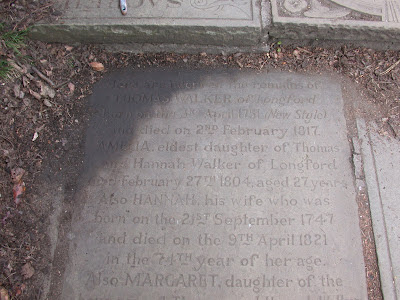
Walker survived both the attacks and was acquitted of treason, after which he retired to the new family home at Longford House where he died in February 1817 and was buried in the parish church on the green.

Location; Chorlton

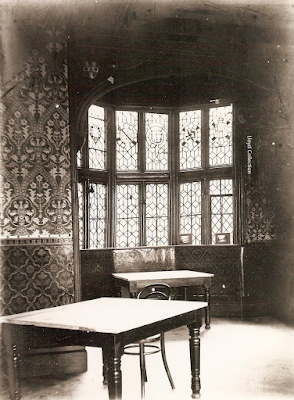
Pictures;  Barlow Hall, circa 1890, from the Lloyd Collection, and the Walker family gravestone in the parish churchyard from the collection of Andrew Simpson, 2011.

Next; Thomas Walker and the campaign to abolish the Slave Trade

* The Story of Chorlton-cum-Hardy, Andrew Simpson, 2012, http://chorltonhistory.blogspot.co.uk/search/label/A%20new%20book%20for%20Chorlton


Monday, 22 June 2026

Walking into Stretford along Edge Lane in 1847

Now if I wanted to walk to Stretford from the village in the late spring of 1847 I would have used the old road.

It started at Hardy Lane as a foot path twisted and turned its way following the course of the Brook at one point before skirting the church and green and going off across Turn Moss, under the Duke’s Canal and coming out at the pump opposite the Cock Inn.

It is a road I have written about before* so instead I think I will take Edge Lane which if you were at all of an inquisitive nature would be a better choice, for it offered you a chance of gazing over some fine houses.

So Edge Lane it is, starting at the green with its farmhouses and pubs and then out along the road which took you to the junction with High Lane.

Now I said it gave you a chance to gaze on some fine house but most of these are set back in their own gardens.  This is particularly true of Longford house the home of the Walker family from the early 19th century.

They too are a family who I have written about, Thomas Walker was a Manchester politician, radical and businessman who is buried in the parish church yard, and his son Charles was a noted author.  But there home like its successor Longford Hall was some distance away from the road and not therefore easily visible.

Nor so Edge House home of George and Mary Bannister who farmed 150 acres of land and employed eight men.  Their home was up a long winding lane set in an orchard.

There were of course more humble homes, along the way which were lived in by James Cain, carpenter,James Hodcroft, market gardener and William Barlow florist.

And then there was Peel House, the last before the canal.  I think it dates from after the 1830s, had its own lodge house, orchard and gardens and was the home of Norbury family who included an inspector of houses, a retired cotton merchant and a solicitor’s clerk.

I would have liked to have seen Peel House, and there are photographs but these are the property of Trafford Libraries who guard their copyright.  Had I arrived just a few years earlier in Manchester and I might have seen the building for myself, but it was demolished in 1967.

Like all such walks what you saw depended on when you walked the walk.

So a little earlier in the decade and there would a have been a few meaner cottages, while  just into the next decade and beyond Peel House the home of Thomas Massey who lived by the new railway station and was employed as a railway porter.

Fast forward just another 30 years and this end of Edge Lane would have been dominated by a series of large houses with impressive sounding names like Standish House, Fern Bank, Wansbeck House and Beech House.

But the 1880s and 90s are out of my comfort zone, I as many know prefer to walk the fields and lanes of the township in the years before 1850.

So I shall close with a place that would have been easily accessible both from the old road and Edge Lane and this was Turn Moss Farm. It is mentioned in some of the histories of Stretford, was the subject of plenty of photographs and is remembered by my old friend Alan Brown who worked for the farmer during the last war.  Bu that is a story for another time.

Location; Chorlton, Manchester

*http://chorltonhistory.blogspot.co.uk/search/label/The%20Old%20Road
**http://chorltonhistory.blogspot.co.uk/2012/01/childhood-memories-of-war-service-farm.html

Pictures; detail of Edge Lane from the OS map of Lancashire 1841-53, and Hennet’s map of Lancashire 1830 courtesy of Digital Archives, http://www.digitalarchives.co.uk/ and looking across Turn Moss circa 1950s, from the collection of David Bishop

Sunday, 21 June 2026

Longford Hall and our own Chorlton radical

Here is the story of our own radical who lived on the site of what was Longford Hall at the beginning of the 19th century.

 This I have admit is an odd view of Longford Hall which was built in 1857 and demolished in 1995, but I rather like it, and it does convey something of the grandeur of the old building which Pevsner in 1969 described Longford Hall “as the only surviving example of the Italianate style of architecture in the Manchester district.” *

The Hall was built by John and Enriqueta Rylands as a fitting home to a textile manufacturer who in 1888 employed 15,000 people in 17 mills and factories.**
But before that there was an property known as Longford House which had been the home of the Walker family, of which perhaps the most interesting was Thomas Walker, one time pillar of Manchester society but also a radical politician who campaigned for the abolition of the slave trade, supported the French Revolution and was indicted for treason in 1794.

The family lived at Barlow Hall from the late 18th century spending the summer there before moving back for the winter to their town house on South Parade which faces what is now Parsonage Gardens.  And it was there that a mob attacked Walker who was forced to drive them off by discharging a pistol in the December of 1792.

This was at the height of political debate over the issues of press freedom and the French Revolution.
“Emboldened by drink and fired on by agitators, groups hostile to the radicals began to gather around the city.  Walker was in no doubt that this was pre planned.  ‘Parties were collected in different public houses, and from thence paraded in the streets with a fiddler before them, and carrying board on which was painted with CHURCH and KING in large letters’ 

On four separate occasions a mob gathered outside South Parade, broke the windows and attempted to force their way in.  Supported by friends Thomas Walker was forced to fire into the air to disperse the crowds.  The magistrates did nothing to prevent the events and while a “regiment of dragoons was in town, booted and under arms”    and ready to disperse the rioters no order was given.  As if to add insult to injury the main concern of the magistrates when they finally met Walker was that he should not fire at the crowd again if the mob returned!  These attacks had been matched by similar ones on the home of Priestly in Birmingham and in Nottingham.”***

Walker survived both the attacks and was acquitted of treason, after which he retired to the new family home at Longford House where he died in February 1817 and was buried in the parish church on the green.

Pictures; Longford Hall, 1920, Courtesy of Manchester Libraries, Information and Archives, Manchester City Council, m67353, and the Walker family gravestone in the parish churchyard from the collection of Andrew Simpson.


* Pevsner N, The Buildings of England South Lancashire,

** for more on the history of the hall and park visit Friends of Longford Park @ http://friendsoflongfordpark.org.uk/
*** The Story of Chorlton-cum-Hardy, Andrew Simpson, 2012, http://chorltonhistory.blogspot.co.uk/search/label/A%20new%20book%20for%20Chorlton

Saturday, 1 June 2024

Down Edge Lane at Alderfield and Rye Bank in 1845 ............ avoiding Mrs White and Mr Gresty

Edge Lane 1845
Now that stretch of Edge Lane which runs out of the old township up to Longford Park is somewhere I don’t often visit.

And that is a shame because it was one of those parts of Chorlton which had some fine houses built during the last quarter of the 19th century with stories which have yet to be discovered.

But today I am drawn to what I might have seen in the 1840s had I walked the road out from the village and up to Longford House which had been the home of Thomas Walker, one time pillar of Manchester society but also a radical politician who campaigned for the abolition of the slave trade, supported the French Revolution and was indicted for treason in 1794.

The family lived at Barlow Hall from the late 18th century spending the summer there before moving back for the winter to their town house on South Parade which faces what is now Parsonage Gardens.  And it was there that a mob attacked Walker who was forced to drive them off by discharging a pistol in the December of 1792.

Walker survived both the attacks and was acquitted of treason, after which he retired to the new family home at Longford House where he died in February 1817 and was buried in the parish church on the green.

Edge Lane in 1893
Now had I walked along Edge Lane in the summer of 1845 Longford House would not have been visible from the road and I would have to content myself with gazing at the row of trees that bordered the lane and which ran out on all sides surrounding the estate from the prying eyes of people like me.

I suppose I might have wandered across the fields which lay to the east of the estate.

These were Alder Field farmed by Mary White and Rye Bank farmed by James Gresty and on to Reap Bank.

But I would have had to be careful, the first two were arable fields probably growing barley and William Chessyre’s Reap Bank was Meadow land and no farmers now or then is happy at people wandering over their crops.

That said I wonder just when those fields were given over to development.  By 1893 there were two grand houses on the site of Alderfield and what is now Alderfield Road had been cut, pretty much ending where it does today.

It shouldn’t be too difficult to track the history of those two houses using the rate books, directories and census records and from that begin to plot the development of this small area which was home also to one of our oldest Bowling clubs.

And with that I rather think there will be more stories to add to those that have already been told on this little bit of Chorlton.

Pictures; detail of the area from the 1845 OS map for Lancashire, and the OS map of South Lancashire, 1893, courtesy of Digital Archives Association, http://www.digitalarchives.co.uk/

Next; creeping development along Edge Lane and a few interesting people.

Saturday, 5 June 2021

The lost churches of Manchester….... no.1 ..... St Mary’s

I suppose I should have made the connection between that open patch of green sandwiched between Deansgate and St Mary’s Parsonage and a lost church.

Parsonage Gardens, 2020

It of course all there in the names, ……. Parsonage Gardens, St Mary’s Parsonage, and St Mary’s Gate.

From which you can deduce the church was St Mary’s.  It lasted just 134 years, which is longer than some Manchester churches, but a mere minnow when compared to St Ann’s its near neighbour, which will soon be celebrating its 309th birthday.

St Mary's Church, 1890

And both were the new kids on the block back in the 18th century when compared to the Cathedral, bits of which date back to 1422, replacing an earlier church which was possibly Anglo Saxon.

I have Barry Collison to thank for posting a short article from the Manchester Weekly Times, dated Saturday January 4th, 1890, announcing the closure of St Mary’s,  which had been “deserted by its congregation, abandoned by the clergy and left to decay, [and was] an eye sore to everyone”.*

Its church plate and what was left of its congregation was transferred to St Ann’s which had already attracted many of the former worshippers.

And part of the reason was what had once been surrounded by prosperous residents had steadily moved out as the area increasingly became a centre for industry and commerce.

Back in the 1790s South Parade had been home to the wealthy Thomas Walker who was for a while the Borough reeve of Manchester, and alternated between the family town house and their home in the countryside at Barlow Hall in Chorlton-cum-Hardy.

St Mary's Church, 1794

South Parade looked out on to the church, which was the scene of an outrageous attack on his property by a Church and King mob objecting to his support for the French Revolution.  

The attacks lasted two days, with the mob breaking windows on the first day and threatening to burn the house down on the second, and injuring Mr. Walker in the process.  

By all accounts it was a close run thing.  The civil authorities did nothing, his children were forced to escape through the back garden and the crowd was only driven off after he discharged a pistol.

Little over a century later the church “wore an aspect of woeful melancholy.  Around it are warehouses and offices full of life, and busy drays or carts wind about the surrounding streets incessantly; the church, majestic in its proportions, remains silent and useless.  The thickly strewn gravestones that completely flag the church year only emphasis its deserted condition by hinting at a different past”.**

St Mary's Church, 1851

But even 40 years earlier H. Duffield in his guide to Manchester, could find little to say about the place, remarking that “it cannot be said to belong to any order of architecture”, and confined himself to a short description of the interior.  There was “a gallery round three sides of the church, and a good organ.”***

And by the time he was writing his piece the church was surrounded an all sides by commercial and industrial properties, with just a handful of houses.

All of which was in direct contrast to the scene in 1769, when Harrop’s Mercury carried an advert for a garden “to the west end of St Mary’s Church [which ran] down to the river, where in is contained a Flower garden, Orchard and shrubbery, with a large quantity of Gooseberries and Currant berry Trees, Strawberries, Fruit trees around the walls, a Neat Summer House, with two rooms papered and Grates fixed up in each Room, which goes along the River, lying open to the fields on that side which makes the Air good and the Garden pleasant”****

Interior of St Mary's Church, 1889

This was a time when sources referred to the river running “pure and bright, and many fishes could be seen from the fields that fringed its banks”.*****

Today the river runs a little cleaner than it did when St Mary’s closed, and residential properties have returned around Parsonage Gardens.

And that is a good point to finish, leaving me just to say this is the first of the series, and along the way we will include synagogue’s mosques, and temples.

Location; Manchester

St Mary's Church 1890

Pictures; Parsonage Gardens. 2020 from the collection of Andrew Simpson, St Mary’s Church, 1895, S.L. Coulhurst, m83196, interior of St Mary’s, 1889,  m70960, courtesy of Manchester Libraries, Information and Archives, Manchester City Council, http://images.manchester.gov.uk/index.php?session=pass St Mary’ Church, 1794, Green’s map of Manchester, the church in 1851, from Adshead's map of Manchester, 1851, courtesy of Digital Archives, http://www.digitalarchives.co.uk/ and St Mary's Church, 1890, Manchester Weekly Times, courtesy Barry Collison

*St Mary’s Church, Manchester, Manchester Weekly Times, Saturday January 4th, 1890

** ibid, St Mary’s Church

***The Strangers Guide to Manchester, H. Duffield, 1850.

**** quoted in Old Manchester, Two Glimpses of the Parsonage, Manchester Guardian, May 13, 1927.

*****ibid, in Old Manchester

Thursday, 6 February 2020

The last pictures of Longford Hall ........... September 1994


Now I can’t be sure that these are the last pictures to be taken of the hall but they will be amongst the last.

They were taken by Andy Roberston who recorded them shortly before the place was finally demolished in 1995.

The story of the hall has been well covered elsewhere and my own interest is really in the house that it replaced.  This had been the home of our Thomas Walker, who moved there from Barlow Hall and was buried in our parish churchyard.

Thomas Walker, one time pillar of Manchester society but was also a radical politician who campaigned for the abolition of the slave trade, supported the French Revolution and was indicted for treason in 1794.

The family lived at Barlow Hall from the late 18th century spending the summer there before moving back for the winter to their town house on South Parade which faces what is now Parsonage Gardens.  And it was there that a mob attacked Walker who was forced to drive them off by discharging a pistol in the December of 1792.

His family continued to live at the house after his death in 1819 until they sold it to the Rylands in 1855 who demolished it for the hall.

Back in 1994 I have to admit I was only vaguely aware of Longford Hall.

It was that place you saw when you ventured out with the kids into Longford Park and its demolition passed me by.

So I am indebted to Andy who lent me these pictures and gave me permission to use them.

I also have to say that he has a fine collection of photographs which record bits of lost Chorlton, but also east Manchester just before the Commonwealth stadium was built and some even more powerful images of the city centre just after the 1996 bombing.

And as you would expect he has stories to go with them.

But for now I shall just leave it at these reminders of what Longford Hall was like as the demolition team got going.

Pictures; from the collection of Andrew Robertson


*Thomas Walker, http://chorltonhistory.blogspot.co.uk/search/label/Thomas%20Walker

Monday, 18 November 2013

Longford Hall in the summer of 1914

Now this is another of those usual views of Longford Hall which was built in 1857 and demolished in 1995.

The Hall was built by John and Enriqueta Rylands as a fitting home to a textile manufacturer who in 1888 employed 15,000 people in 17 mills and factories.**

It replaced an earlier property which was known as Longford House and had been the home of the Walker family, of which perhaps the most interesting was Thomas Walker, one time pillar of Manchester society but also a radical politician who campaigned for the abolition of the slave trade, supported the French Revolution and was indicted for treason in 1794.

But I have written about both the Hall and Thomas Walker before, so instead I want to concentrate on the message written on the reverse of this picture postcard which was sent in the July of1914.

It written by John and posted to a Miss Katie Bolebrook of 21 Floatergate, Grimsby.
John was staying in Stretford and the language he uses could come straight out of any parody of the period.

“Dear Katie, I am having an awfully ripping time here and the girls (naughty boy), they are lovely.  Well goodbye, Your friend John.”

I went looking for the delightfully sounding Floatergate.  It was one of those centuries old streets in the very heart of Grimsby and like so many other places in towns and cities across the country it was swept away to be replaced by a 1960s development.  This was the Riverhead Centre and along with Floatergate went the historic Bull Ring.

At least Longford Hall survived it by another thirty years by which time I suspect John and Katie had also passed away.


Picture; Longford Hall, 1914 from the series Longford Park, issued by Tuck and Sons, courtesy of Tuck DB, http://tuckdb.org/

*Longford Hall and our own Chorlton radical, http://chorltonhistory.blogspot.co.uk/2012/07/longford-hall-and-our-own-chorlton.html

Friday, 7 December 2012

A new exhibition on Longford Park and Hall at Chorlton Library throughout December


I’m looking at a picture I have never seen before of part of Longford Park in 1933.  

It is fascinating for a number of reasons, not least because there in the top right hand corner, beyond the line of trees is the chimney of our own Chorlton brick works.

But for me it is also the detail of the verandahs, which fronted the length of the bowling greens and extended further east, as shown here.

Few now will remember them.  They were cleared away in 1936 to make way for the art deco shelters and cafe.

And so it is timely that there is an exhibition on the history of Longford Park at Chorlton Library which will run for the whole of December.

It is the work of Richard Bond who until recently was head of Manchester Archives and Local Studies and takes the story of the Hall and Park beyond its purchase in 1912 by Stretford Council and nicely brings stories of the estate and our own township together.

As Richard writes, "there are a lot of Chorlton connections with the park. Indeed, much of the area in the 1933 picture was actually part of Chorlton at the time. 

The boundary between Stretford and Chorlton bisected the park running roughly between the two long paths, and then headed to the right of the verandahs. Only in 1993 was the whole of the Park, and the Athletics Stadium incorporated in to Trafford.

The exhibition reveals the Chorlton connections go back a long way. The first prominent resident at Longford was Thomas Walker, who moved there from Barlow Hall in 1787 - shortly before he became Manchester's boroughreeve. 

He died in 1817 and I have located a tombstone in memory of him in old St Clement's churchyard, one of the last stones on the path before exiting at the Bowling Green end. 

The stone also records his son Charles James Stanley Walker, who converted what had been a farm into a hall before selling to John Rylands in 1855 (who then built his own hall). 
  
Moving forward to around 1912, Stretford Council persuaded its ratepayers to agree to purchase the Park on the basis there would be no extra charge, as they would recover costs by selling some of the land for houses. They then tried to sell the 11 acres on the Chorlton side of the boundary for housing but such was Manchester's opposition that this idea was then dropped, and indeed the land is still undeveloped to this day. 
  
Stretford Council quickly adapted the estate as a park but weren't sure what to do with the hall. Following an offer from Mr John Hilditch of Chorlton, an exhibition featuring some of his extensive collection of Chinese and Japanese art was opened in 1914. 

This was seen by 59,113 visitors by the end of October, when it closed as the hall was to be used as a home for Belgian refugees. 
  
The hall later became a Red Cross hospital but when this closed in 1921, the use of the hall was a problem again. In 1926, a Museum and Art Gallery was opened, which again featured Mr Hilditch's collection (who by this time had moved to Crumpsall). He died in 1930, and the Council then discovered he had not left the items to them in his will - as he was said to have promised - as in fact he left no will. “

All of which makes the exhibition an important contribution to our history as well as helping celebrate the centenary of the park this year. The Longford Park history display, at Chorlton Library throughout December

Pictures; the park in 1933, courtesy of Trafford Lifetimes, TL0996, Longford Hall, 1920, courtesy of Manchester Libraries, Information and Archives, Manchester City Council, m67353, and the Walker family gravestone in the parish churchyard from the collection of Richard Bond.