Showing posts with label A new book for Woolwich. Show all posts

Thursday, 25 September 2025

Stepping out in the Woolwich foot tunnel in 1916

I can’t say I enjoy using the foot tunnels under the Thames.

There would have been a time when walking under the river using the Woolwich or Greenwich tunnel was an adventure.

But then I was only 10 and like the Underground these days if there is a surface alternative I will take it.

It may mean using a bus on a congested road in the rush hour but I prefer it.

Looking back I am surprised I was so nonchalant at the illuminated sign at Rotherhithe warning of “MEN WORKING ON THE PUMPS” and thinking what that meant for the short journey to Wapping.

And the same unease resurfaced when I read that the refurbishment of both the Woolwich and Greenwich tunnels included work to reduce leakage, improve drainage as well as installing new lifts, CCTV communication facilities and signage.

Of course the tunnels are quite safe but at 67 I shall continue to use the ferry or take the longer route and cross by bridge up river.

That said this 1916 image of the Woolwich foot tunnel from the collection of Kristine Bedford perfectly captures how I remember the place.

The tunnel was “built by Walter Scott and Middleton, opened on 26 October 1912 [and offered] a free 24/7 alternative to the ferry crossing, which was periodically suspended during bad weather.”*

Now whenever I used it I was pretty much on my own and that long walk with the echoing sound of my own feet, the light and the stone pavement stretching out for nearly a third of a mile was always an experience.

Added to which there was that slow incline down and the then the slight rise which indicated that the journey was nearing its end.

Once upon a time just before six in the morning and at the end of the day it would have been a much busier place, particularly when the ferry was not running, but this empty scene is how I remember it and given my disinclination to wander underground it will remain a memory.

Picture; Woolwich Foot Tunnel circa 1916, courtesy of Kristina Bedford

*Woolwich Through Time, Kristina Bedford, 2014, Amberley Publishing,

Tuesday, 11 March 2025

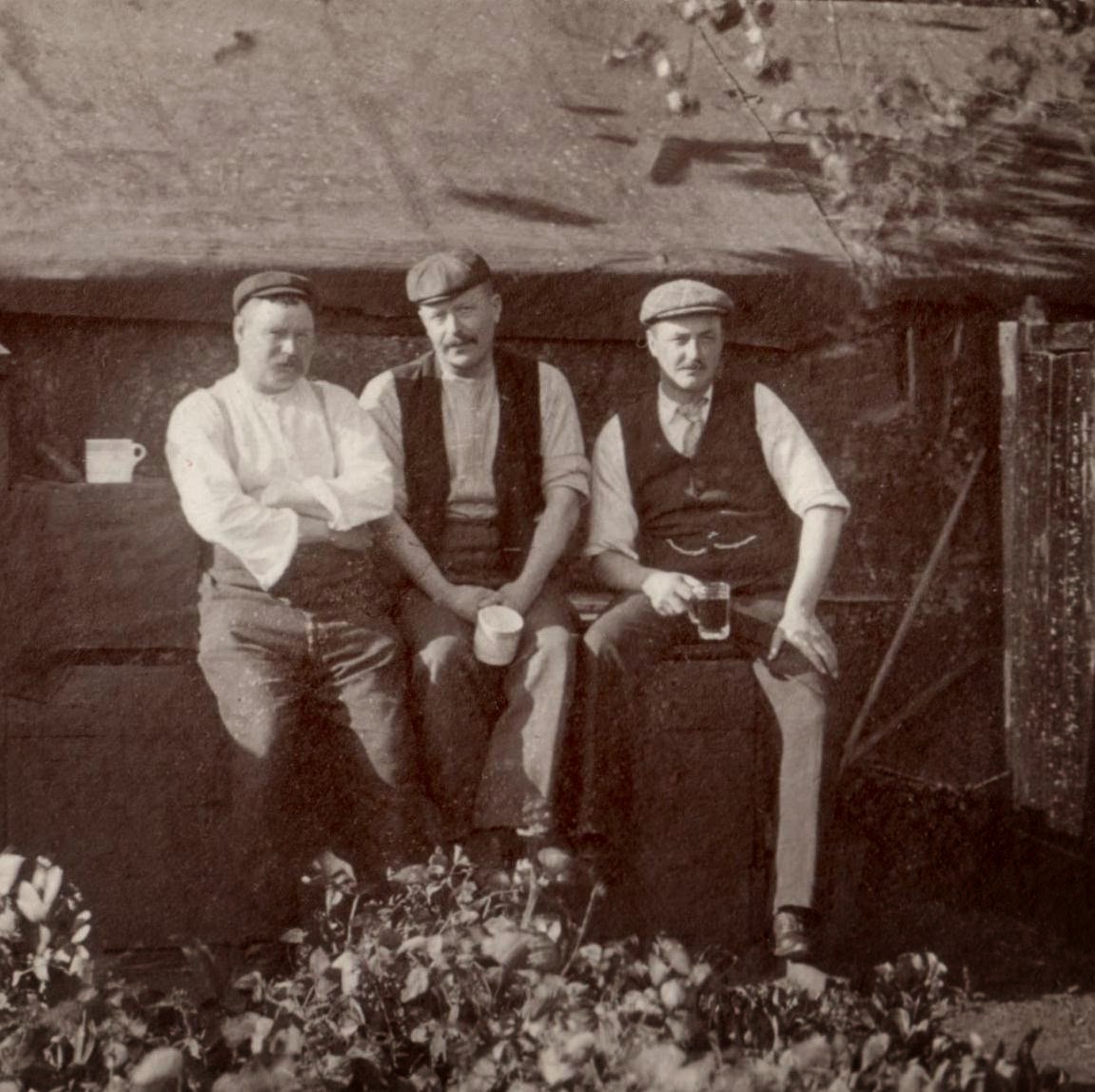
Lost Woolwich .......... no 3 relaxing in the allotments 1905

Now of all the places I knew in my youth I have to say Woolwich is one of those that has  undergone some of the most radical change.

So much so that big chunks of it I have difficulty recognising.

The Arsenal, Powis Street and even the old Pie and Mash shop were as familiar to me as they were to generations of people who grew up in Woolwich and are now just distant memories.

So with that in mind I have returned to images of a time before now.

This one is dated 1905.

I doubt I will ever know who these three men were or exactly what each grew on his allotments.

But it is a fine picture taken on a sunny day over a century ago

Picture; from Woolwich Through Time, Kristina Bedford, Amberley 2014

Thursday, 29 July 2021

Buying a pair of shoes and a canary in Beresford Square

I have always liked the market at Woolwich.

It is that mix of noise, colourful attractions, and the easy banter of the stall holders and of course the promise of a bargain.

In the late 1960s I swapped the stalls of Beresford Square for Grey Mare Lane in the shadow of the old colliery and later Ashton’s open and covered in markets.

A century and bit before that I might well have wandered through Salford’s Flat Iron Market where “poverty busied itself”* and everything was on sale from a pair of second hand boots to a used toothbrush.

All of which is a long way from Woolwich, but not quite, because as these images suggest poverty and looking for a bargain were as much a part of the landscape in Woolwich as they were in Beswick, Ancoats or Ashton.

And these pictures along with many other ones of Woolwich can be seen in Woolwich Through Time, by Kristin Bedford. **

Her book was published in 2014 and is a treasure trove of images of a vanished Woolwich.

Along with the market, the ferry and the Arsenal there are in total 180 photographs of what the place was like and how it has changed.

Now this is not the first time I have mentioned the book but this Saturday Ms Bedford will be at Woolwich Library from 1 pm to talk about the book, the pictures and the stories she has unearthed.

For me though it will be those of the market that I like the most.

I remember it as a crowded noisy affair where buses manoeuvred slowly past rows of stalls and Lou’s fruit and veg rubbed shoulders with the man selling prawns and the women doing a nice deal in plastic plates and pictures of the Green Lady.***

Today it is a pale imitation of all of that.  You might still be able to buy a Ib of apples and a cauliflower but the open trays of prawns and the Green Lady are gone.

And along with them much of the Woolwich I remember.

It is an odd observation that the place I knew was closer in many ways to the scenes from Ms Bedford’s book than the bright shinny new Woolwich.

Not that this is any way a criticism of what is now just a reflection on what was and is.
Pictures, courtesy of MS Bedford


*Robert Roberts, The Classic Slum, The Classic Slum, Salford stories from 1900,http://chorltonhistory.blogspot.co.uk/2013/01/the-classic-slum-salford-stories-from.html

** Woolwich Through Time is at Woolwich, Kristina Bedford, 2014

***The Green Lady. The Chinese Girl (often popularly known as The Green Lady) is a 1952 painting by Vladimir Tretchikoff. It became one of the world's most popular paintings when made into prints in the 1950s and 1960s, and is one of the world's best-selling art reproductions of the twentieth century

Friday, 13 March 2020

Lost Woolwich .......... no 1 dinner time 1915

Now of all the places I knew in my youth I have to say Woolwich is one of those that has been has undergone dome of the most radical change.

So much so that big chunks of it I have difficulty recognising.

The Royal Arsenal, Powis Street and even the old Pie and Mash shop were as familiar to me as they were to generations of people who grew up in Woolwich and are now just distant memories.

So with that in mind I have returned to images of a time before now.

This one is the Middle Gate of the Royal Arsenal at dinner time in 1915, and serves to remind us of just how many were employed behind its gates

Picture; from Woolwich Through Time, Kristina Bedford, Amberley 2014

Wednesday, 15 May 2019

Lost Woolwich .......... no 2

 Now of all the places I knew in my youth I have to say Woolwich is one of those that has been has undergone some of the most radical change.

So much so that big chunks of it I have difficulty recognising.

The Arsenal, Powis Street and even the old Pie and Mash shop were as familiar to me as they were to generations of people who grew up in Woolwich and are now just distant memories.

So with that in mind I have returned to images of a time before now.

This one is of Wellington Street in 1905, and serves to remind us of just how many were employed behind its gates

Picture; from Woolwich Through Time, Kristina Bedford, Amberley 2014

Monday, 3 July 2017

The Steedman's of Woolwich a family remembered

I have featured those new books on the history of Eltham and Woolwich by Kristina Bedford already so I was pleased when Ms Bedford agreed to write a story for the blog.*

Powis Street, early 20th century
It is the way that when you sit down to write a history of a place there is much that has to be left out.

So here is the  story of the Steedman family by Kristina.

When planning the running-order for the illustrations in Woolwich Through Time, I was delighted to be able to close the book on a personal note, with a rare Carte-de-Visite memorialising the grave of the Steedman family, 19th century Woolwich residents whose local migrations mirror the spider’s web of connections between Woolwich and its neighbour villages of Charlton and Plumstead.

The Steadman  family grave
Although near- indecipherable on the small CDV, digital scanning brought up the full text of the headstone, which reads

The Family Grave of
James Steedman
of
Edward Street Woolwich
In
Affectionate Remembrance of
Fanny
Wife of James Steedman
Died January 10th 1869
Aged 49 Years

Born in Scotland in 1812, engineer James Steedman married Fanny Joyce on 14 December 1840 at Deptford St Paul, by banns.

The following year’s census, taken in June, records the couple living on Dock Street in Poplar, Tower Hamlets, a district dominated by shipwrights and watermen.

They had moved to Blackheath by the time the birth of their first son James Thomas was registered under the September quarter, migrating again within two years to Charlton, where son John was born in 1843, and son Henry in 1848.

Powis Street,early 20th century
The 1851 census lists the family at 12 Paradise Row, Charlton, revealing that Fanny was herself born in Woolwich, where they had re-located by the time daughter Fanny was born on the 2nd of July, christened on the 24th of that month at the Parish Church of St Mary Magdalene, their address recorded as No 8 Edward Street.

Despite commemorating Fanny with the Rolls Royce of Headstone Monuments in the most expensive row at Woolwich Cemetery in Plumstead, widower James, now working as a money scrivener, re-married only six months later, on 22 July at Southwark St Saviour, the home parish of his bride, spinster Eliza Brumage.

The site of the family grave today
The 1871 census records the couple as living at No 8 Edward Street with Fanny Jr, who was attending school, Eliza’s widowed mother, and one domestic servant.

Edward Street had been re-christened Powis Street by the time of the 1881 census, when James, Eliza, Fanny, and one servant were living at No 158.

James had retired to a house named “Thames View” on Humber Road in Greenwich by the time of the 1891 census, where he lived on his own means with wife Eliza, daughter Fanny, and ‘scholar’ grandson Henry.

The National Probate Calendar reveals those means to have been considerable: “STEEDMAN James of “Thames-view” Humber-road Westcombe-park East Greenwich Kent died 15 July [1899] Probate London 16 September to Eliza Steedman widow James Thomas Steedman scrivener’s-clerk and Anthony Michael Brumage retired engineer from the Royal Navy Effects £17182 15s. 6d.” 

James Steedman, aged 87, was buried with his first wife Fanny in Woolwich Cemetery on 19 July 1899, joined on 11 July 1908 by second wife Eliza, three days after her death.

Despite the considerable financial investment James made in the family grave he took such pride in, the memorial was demolished and the plot planted over with grass during a general clearance at Woolwich Cemetery during the 1960s, to make the grounds easier and cheaper to maintain.

I hope that he would find some compensation in his family being re-commemorated in Woolwich Through Time and here in Andrew Simpson’s Blog.

© Kristina Bedford


Pictures; from the collection of Kristina Bedford

*Woolwich Through Time, Kristina Bedford, 2014, Amberley Publishing, http://www.amberleybooks.com/shop/article_9781445615998/Woolwich-Through-Time%3CBR%3E%3CI%3EKristina-Bedford%3C_I%3E.html?sessid=f42LuNWNjgDnHlkr3Etd8rM4BTeNXIQYwmBHgTVsVRMJHdYsgtXh06DHtO7pQGrv&shop_param=cid%3D16%26aid%3D9781445615998%26

Eltham Through Time, 2013, Amberley Publishing,  http://www.amberleybooks.com/shop/article_9781445616001/Eltham-Through-Time%3CBR%3E%3CI%3EKristina-Bedford%3C_I%3E.html?sessid=f42LuNWNjgDnHlkr3Etd8rM4BTeNXIQYwmBHgTVsVRMJHdYsgtXh06DHtO7pQGrv&shop_param=cid%3D1%26aid%3D9781445616001%26

Ms Bedford also has an interesting web site, Ancestral Deeds, http://www.ancestraldeeds.co.uk/


Tuesday, 25 February 2014

A new book on Woolwich and its past

Woolwich in the 1940s
I grew up in Eltham but have always had a sneaking fascination for Woolwich which is just that bit more edgy, a bit more run down and lots more fun.

Here were the Dockyard, the Arsenal and the open air market.*

Not that I knew anything about the Dockyard which started in 1512 and closed in 1869, or the Arsenal which I passed most days but whose insides were a mystery known only to those who worked there.

So of the three on my list there was only the open air market which was free for me to roam over in the years I was growing up in Well Hall in the 1960s and 70s.

I remember it as a vibrant, busy place with the stalls crammed into every corner and selling pretty much anything.

But it too seems a pale shadow of what I remember it to be like.

Even the river does not offer up the same excitement or the same sights.

All of which means that any book which contains images of that lost Woolwich is one to grab with both hands.

And there is a new one out.  It is Woolwich Through Time by Kristina Bedford* whose companion book on Eltham was published at the end of last year.

I have ordered up a copy and await it falling through the door.

Like her earlier book it contains 180 images spread over 96 pages and is a mix of that old Woolwich with modern pictures which are designed to show how the place has changed.

And in its way it has changed more dramatically than Eltham so much so that looking at bits of it today I find it hard to remember the Woolwich I knew.**

But that is a price you pay for leaving the place and rarely coming home, which makes Ms Bedford’s book one for the shelf.

*Down amongst the stalls in Beresford Square, Woolwich sometime in the late 1940s, http://chorltonhistory.blogspot.co.uk/2013/08/down-amongst-stalls-in-beresford-square.html

**Woolwich Through Time, Amberley Publishing, 2014, £14.99, http://www.amberleybooks.com/shop/article_9781445615998/Woolwich-Through-Time%3CBR%3E%3CI%3EKristina-Bedford%3C_I%3E.html?sessid=UC3s7Yjfg9edlbva9eYmDcJvxGTRGKzIaotRju5WpW5IQ4chnpuRO5JYcy87CDEe&shop_param=cid%3D16%26aid%3D9781445615998%26

Ms Bedford also has an interesting web site, Ancestral Deeds, http://www.ancestraldeeds.co.uk/

Picture; courtesy of Mark Flynn, http://www.markfynn.com/london-postcards.htm