Showing posts with label Chorlton in the 1930s. Show all posts

Sunday, 11 October 2026

Looking down on Chorlton in 1927

I like aerial photographs of Chorlton and this one has the lot.

Looking down on my bit of Chorlton, circa 1930s-40s
My friend Bill sent it over  and it comes from Britain from Above.

And what makes it particularly special is that there,  to the left is Beech Road, the Rec and our house.

It was taken in 1927, and the picture offers up some interesting detail.

There is a  tram cruising down Barlow Moor Road, and there is still some open at the top of Beech Road by the tram terminus.  That land I think was built on sometime in the 1950s or 60s.

Beech Road, a lost farm, the Rec and a bowling green

And looking carefully at Beaumont Road, it is just possible to see the old farmhouse set back from Beech Road, which Scott the builder didn’t demolish until sometime in the 1930s.

Its replacement I am fairly confident was not built until after the war in 1945.

Which just leaves the eagled eyed to spot that to the north of Rec, there is still the bowling ground belonging to the Masons.

This would not become a carpark until the early 1960s.

And the photograph clearly shows the farmyard of what had once been Bailey’s Farm, and would not become Ivy Court until the late 1970s.

On Barlow Moor Road

I could go, but that would spoil the fun, so I shall close by pointing to the buildings on Barlow Moor Road, just south of Beech Road.

The Chorlton Ballroom is still looking splendid, and it would be many decades before it became a series of nightclubs, before being knocked down for a fast food outlet.

And beyond the ballroom, there is Lime Bank, which dates from the late 18th century.

So I shall just thank Bill Sumner who found and sent the image over to me.

Location; Chorlton

Picture; aerial photograph of Chorlton, 1927, Britain from Above, EPW 017620

Thursday, 8 October 2026

Beech Road in the summer of 1932


We are on Beech Road in the summer of 1932.  

Judging by the shadows and the activity it must be sometime in the
morning.

The manager of John Williams and Sons looks on as his assistant sweeps the pavement in front of the shop and beyond him other shop keepers are laying out their produce.

As yet there are few people about and most of those are on bikes are more than likely out on their first delivery rounds.

Most seem oblivious to the camera, except that is for the two by the lampspost who have stopped their conversation to gaze back at the photographer.

The picture perfectly captures Beech Road in the early years of the 1930s.  The stone setts on Wilton Road have yet to be covered and the old railings around the Rec are still in place, otherwise it is not so different from today.

Of course the absence of cars is quite striking as are the shop fronts with their tall windows,  and painted signs.

What is all the more remarkable is that it is a scene which is more familiar to us than to those who walked the road before 1930.

I had always assumed that the row of shops which included John Williams & Sons had been built sometime soon after the beginning of the 20th century.

The site had originally been occupied by Sutton’s Cottage which was a wattle and daub dwelling and may well have been built in the early 1800s and was demolished in 1891.*

So it was reasonable enough to assume that the plot was built over soon afterwards but not so.

The other surprise was that John Williams and Sons were not local traders but in fact owned a chain of grocer shops across the city and beyond which in 1931 accounted for 41 shops of which there were three in Chorlton**, six in Didsbury and
another four in Rusholme.

Now I rather think there is a story here.  Back in 1895 they are listed as John & Sons with five shops in Didsbury abd Fallowfield which by 1911 had become 11 with John Williams described as managing director and the head office at 400 Dickinson Road.

Later still although I can’t date it is a wonderful advert for the company which advertises their ‘“Dainty, Delightful Delicious Tea, [from] John Williams & Sons limited, “The Suburban Grocers”, [at] 28 Victoria Street Manchester Stockport & Branches’.

And looking at the interior of one of their shops sometime in the early 20th century there is more than an element of “class” about the place.

So while the shelves groan with tinned produce and between the potted plants are the familiar posters advertising Californian Apricots at 6½d, and Coffee and other things, it is less cluttered, less in your face and far more discreet.

All of which makes me wonder at what our own shop on Beech Road would have been like, but that like the full story of John Williams and Sons will just have to wait.

Location; Beech Road, Chorlton


Picture; from the Lloyd Collection, 1932

*Sarah Sutton http://chorltonhistory.blogspot.co.uk/2012/02/sarah-sutton-life-lived-out-on-row.html

**32 Beech Road, Wilbraham Road, 211 Upper Chorlton Road.


Sunday, 26 April 2026

Down at the Savoy Cinema in 1937 on Manchester Road watching Road to Glory

Now back in the summer of 1937 I could have had three cinemas to choose from here in Chorlton and of these the most impressive was the Savoy on Manchester Road which had opened in 1920 as the Picture House before being renamed the Savoy when it was leased to the Savoy Cinemas and later became the Gaumont.

And in the summer of 1937 for three days I could have gone and seen Road to Glory made the year before by Howard Hawks which told the story of trench life during the Great War through the lives of a French regiment and included as you would expect a tangled “love interest” between a nurse and two officers.

I am not sure it would have appealed but at least I know what was on offer and that is thanks to Peter McLoughlin who shared this film bill with me.

I doubt that there are many of these still knocking around.  After all they are the sort of thing which you pick and then discard but this one has survived it is a wonderful insight into a night at the “flicks.”

The obvious starting point are the films themselves and in time I will look them all up and in the process get something of an idea of what the cinema going public were being offered back then.

For modern audiences the frequency of the shows will also be a revelation.  

When I was growing up in the 1950s you got I think a week of the same show, but two decades earlier and programmes changed more regularly which I guess is both a recognition of the number of films being churned out but also that people went to the pictures more than once a week.

Not that this should be much of a surprise.  In an age before the telly the pictures offered a nights entertainment which included the film and a newsreel and was all done with style.

The old flea pits still existed but the big purpose built cinemas of the 1920s and more especially the 30’s gave you a sense of luxury which started with the uniformed doorman and continued with that plush auditorium which was light and bright and had a distinctive smell which I guess was a mix of those thick carpets and the floor polish and much later there was the smell of the hot dogs slowly cooking in a corner beyond the box office.

And the picture houses were warm which on a cold winter’s night was another attraction and on one of those dark nights they would be one of the only buildings which were lit up and acted a beacon as well as a promise of a good night ahead.

All of which brings me back to that film bill and the simple observation that you should always be careful about what you are going to throw away.

Pictures; film bill for the Savoy ABC, 1937 courtesy of Peter McLoughlin, and the Picture House later the Savoy, 1922, from the Lloyd Collection.


Thursday, 16 April 2026

Rare pictures of the Horse and Jockey and a mysterious historian of Chorlton


This is one of three photographs that I doubt very few people have seen.

It is the Horse and Jockey in 1933 and appears in a Short History of Chorlton-cum-Hardy published privately in that year.

There are plenty of pictures of the pub from the very early years of the 20th century and lots from the 1950s onwards but so far I have only come across a couple which date to the 30s and 40s.

So this is an interesting one and shows the original before it expanded into the cottages on the left of the front door.

To our right beyond the fence had been the home of the Wilton family who lived there for most of the 19th century.  It was Samuel Wilton who around 1818 enclosed the green for his own personal garden with tall hedges and an allotment.  The space only returned to public use with the death of his daughter.

The remaining two photographs are of the parish church and Hough End Hall and all three were taken by F. Blyth who also printed the book at the College of Technology in Manchester while on his second year course.

But the text is by a J.D. Blythe and is as far as I know the first new account of Chorlton’s history since the twenty-six articles written by Thomas Ellwood during 1885-86.

Mr Blyth drew heavily on those articles and in places follows the earlier history word for word.  Not that this is to rubbish the book, particularly as I doubt it was meant as a serious rival to Ellwood’s work.  It may have just been a vehicle for F Blyth to complete a course at the college demonstrating his skill at photography and printing.

Now there is very little on either man.  J.D. Blythe was here on Claude Road between 1922 and 1929 and  is listed in the telephone directory but without trawling the street directories for the period we have no knowing when he went to live in Chorltonville and when he left.

There is a record of a J.D Blyth leaving for South Africa in 1919 with the stated purpose of settling in the Natal, but he returns just four months later in February 1920, and so far that is about it.

Location; Chorlton-cum-Hardy

Picture; the Horse & Jockey in 1933, F Blyth from A Short History of Chorlton-cum-Hardy, by J.D.Blyth, 1933

Tuesday, 24 March 2026

"See better days and do better things," the sad end of the Chorlton Liberal Club.


The Chorlton Liberal Club had opened in the October of 1897.

It wasn’t the first club the Liberals had had here, that was on Wilbraham Road but the new one on Manchester Road was more “commodious and suitable for the purpose.”*

Its opening was greeted “with the hope that the club would strengthen Liberalism in Chorlton-cum-Hardy” and membership figures seemed to bear this out. 

In the space of the year they had recruited another 50 members and were confident of more.  I suspect the club was only part of that success, with something also down to the influx of new people into the township.

Not that they saw it that way.  The official opening was done with a gold key and the job fell to Reuben Spencer “an old Liberal” who “hoped it would be a centre of light and leading, round which young men would be prepared to take a part in social, municipal and public life generally.”

We might jib at the emphasis on men especially as women were active in local politics and within two decades Sheena Simon was elected with a majority of over 1400 votes and 58% of the vote as the first woman Liberal councillor for Chorlton.**

Nationally the years around the opening of the club were not good for the Liberals.  They lost both the 1895 and 1900 general elections and would not be returned to office till 1906.

Locally they fared better both on the old Withington District Council and after our incorporation into the city on the Manchester City Council and by the 1920s were so evenly balanced with the Conservatives that the Manchester Guardian reported in 1928 that

“there are few wards in which Conservative and Liberal opinion is so nicely balanced.  Of the eight elections that have been fought in Chorlton since 1920 four have been won by the Conservatives and four by the Liberals.”**

But by the early 1930s the Liberals were on the defensive increasingly being squeezed by the Labour Party.

They won their last seat in 1932, saw their sitting councillor Lady Sheena Simon loose to the Conservatives the following year and after 1935 did not  contest another election  till 1946 by which time they had slipped to third place.***

I suspect this might have also been reflected in the state of the club which I remember as a slightly dowdy place by the 1970s.

All of which was a great shame.  It had been a private residence before becoming a club and I rather think might have been built sometime in the 1880s.  It last occupants had been the Lloyd family who where there in 1891.

It remained an impressive building and gained a new lease of life after the fire in the 1980s when it became the Lauriston Club.

And now with the close of the club it is again a residential property.

Pictures; the Liberal Club after the fire from the Lloyd collection, undated

*Liberalism at Chorlton-Cum-Hardy, Manchester Guardian, October 11, 1897
**Not that she was the first woman councillor here in Chorlton, that was Jane Redford elected in 1910.  She was not a Liberal but styled herself a Progressive Candidate and must have been close enough to the Liberal outlook to ensure they never put up a candidate against her or other Progressives.
**The Chorlton By-Election, Manchester Guardian December 18, 1928
*** Local election results 1904-1949, compiled by Lawrence Beedle

Monday, 23 March 2026

Standing in front of the Rivoli on Barlow Moor Road sometime in 1936

Now I can’t be certain when this photograph of the Rivoli on Barlow Moor Road was taken but given that the cinema opened in November 1936 and closed because of bomb damage four years later it will be sometime between the two.

And there are other clues to a possible date.

The first is the film Anthony Adverse which was released in the November of 1936 and will have been showing in suburban cinemas within the year.

It was a dreadful film based on an impossible plot heavy in morality and set in the late 18th and early 19th centuries.

That said it featured infidelity, a mistress of Napoleon and the remorse of a slave trader who turned away from “that odious traffic in human flesh” and was set in lush tropical surroundings and magnificent European palaces.

Added to which it had the young Olivia de Havilland who at the age of 20 was starring in her fourth film having already acted with Errol Flynn in Captain Blood and who within the year would star in The Charge of the Light Brigade and later still The Private Lives of Elizabeth and Essex and that all time weepy that was Gone With the Wind.

The film had also picked up four Academy Awards so I guess had we been here back then we would have gone along.

And that might have been the motive for Mr Clarke of 83 Clarence Road to take the photograph and add it to his portfolio of images he marketed as picture postcards.*

After all if you had seen the film or just visited the cinema you might just be prompted to pick this card out of all the rest next time you wanted to send a message which is what postcard manufactures banked on.

Commercial photographers with an eye to what would sell toured local streets taking pictures of individual houses and offering them to the residents and when that market dried up offered them to postcard companies.

In the case of Mr Clarke he did both, producing the cards with his imprint and selling them to the local shops, including Mr Lloyd’s on Upper Chorlton Road and Mrs Burt’s stationers on Wilbraham Road.

He was active during the 1920s and into the 30s and produced a series of book marks for the opening of Central Ref.

By 1940 he “re-located the family home and ceased making his living solely from photography as a 1944 wedding certificate shows him as an Inland Revenue clerk residing at 5, Keppel Rd.”**

But during his time as a commercial photographer he produced some fascinating pictures of Chorlton, of which this is one that I have never seen before.

And for all those who have debated the actual location of the cinema there is no doubting that Mr Clarke’s picture nails it firmly on the spot now occupied by K.F.C.

What I also like is the detail of the two kiosks on either side of the entrance and that the Rivoli is one of those new picture houses which have fully embraced the motor car as the cark park sign indicates.

So that pretty much is that.

Picture; the Rivoli circa 1936-40 from the collection of Peter McLoughlin

*Harold Clarke, http://chorltonhistory.blogspot.co.uk/search/label/Harold%20Clarke

**Tony Goulding, grandson

Sunday, 22 March 2026

Madam Jethro ….. Gifted Clairvoyant … the 6ft Mahogany wardrobe … and “The Gladiator” Photo Works …… Chorlton in 1937

 It is often the seemingly trivial things people leave behind, which offer up fascinating insights into how we lived.

And so, it is with a copy of the Chorlton and Wilbrahamton News from the late 1930s which Maggie Watson passed over to me last night, with the comment,  “During our renovation we found a crumpled newspaper under a stair tread. I saved what I could. 

It was obviously put there at the time the house was built in 1937. Are these of any interest to you?”.

 Which of course I was. 

 Her house was built by Scott the builder, who built and lived in the house we now occupy on Beech Road.

 All of which made the newspaper a bit more interesting and more so because Maggie’s house had been the site of a farmhouse which dated back to the early 19th century and possibly into the 18th century.

 Discoveries like Maggie’s will usually confirm things we already knew, push back dates of buildings, and open up new enquiries.


So, the advert for the Grange Laundry on Beech Road “A Really Good Laundry”, pointed to the uninterrupted continuity of the business through the first half of the last century, while Thomas’s Coaches at 4 Chorlton Green pushed back the date when this new industry has a presence beside the old village green.

 And that brings me to Madam Jethro ….. Gifted Clairvoyant, who must surely be worth a search.   

 The entry in the small adds column announces “Madam Jethro, Gifted Clairvoyant .  Book your appointments please.  Hours 2 to 8pm.  Borderland every Thursday”,  but it offers no clues as to where she lived, leaving me just to reflect that with The Great War less than 20 years in the past there will have been many wondering whether  Madam Jethro could provide a link to a lost relative.


The adds also shine a light on the attitudes of the day, when a property owner could advertise “Large Unfurnished Room; Lady,- 16, High Lane, Chorlton” and the Riding’s Cycle company with a branch at 363 Barlow Moor Road, could take a quarter page advert showing pictures of eleven women with the caption “More Pretty Entrants in Riding’s Great Northern Cycle Queen Contest”.

 What strikes you are the number of adverts for electrical repair shops, along with such services as “Have your Car thoroughly cleaned and “Simonized” by competent man” and “Mrs. M. Craddy, ‘Spirella’ Corsetiere, Demonstrations in Client’s Own Home, by Appointment.  At home, Saturday, 10 to 6. – 2 Chelford Road, Darley Park, Manchester  16. Tel. Chorlton 3271”.


Sadly, the news and features pages were not retained by who ever secreted the bits that Maggie found and that is a loss, but there is more than enough to provide us with a picture of Chorlton-cum-Hardy in 1937.

 I can’t be sure at present who secreted the bits of newspaper, but it is odds on it was one of Whitelegg family who were there in 1939.  Mr. Reginald Whitelegg  was born in 1884, his wife Millicent two years later and the children, George and Millicent were born in 1908 and 1919.

 Given that Reginald was a house painter and his son a bricklayer, it is just possible they worked for or worked with Joe Scott who built their house, and was known to reward employees and friends with favourable terms when renting out the houses he built.

And so tomorrow and into the next week I think I shall wander across the adverts, recording the cost of items, the names of some local shop keepers, along with a sideways look at the cinemas and the films being shown on the first week in July.

 Leaving me just to mention that Gladiator Photoworks, which operated from 2a Keppel Road and boldly claimed that “Better Snaps Cost No More Bring Your Films Where Your Snapshots Are Actually Made It costs no more to have your snaps finished by Professional Photographers Snapshot Specialists".

 Location; Chorlton

 Pictures; from The Chorlton and Wilbrahamton News, July 16, 1937, from the collection of Maggie Watson


Saturday, 21 March 2026

Discovering a little bit of Whalley Range’s history

Now here is a bit of history that I bet lots of people know but has passed me by and it concerns St Margaret’s playing fields in Whalley Range.

The land is on Brantingham Road and was gifted by the wife of one of the vicars of St Margaret’s and in in 1937 it was the destination of that years Chorlton carnival.

Back in the 1930s there were a number of carnivals across the city but Chorlton’s seemed to be the biggest according to the Manchester Guardian which reported that “the gala held in St Margaret’s playing fields, Chorlton-cum-Hardy, on Saturday [June 19th] may be said to mark the opening of the charity carnival season.“*

Now I recently wrote about the carnival but pretty much ignored the playing fields but after a few people asked where they were I went looking.**

The obvious place was beside St Margaret’s Church in Whalley Range and while I was close I wasn’t in quite the right place.

The church had been built in 1849 on land given by Samuel Brooks but the playing fields date from sometime later.

I have yet to establish when but I do know that in 1894 the land was still part of Whalley Farm and as late as 1911 Brantingham Road had yet to be developed fully.

That said I hope to talk to Mr Boulter the vicar at  St Margaret’s and perhaps even before then someone will come forward a bit more of the story.

And within minutes of posting this story,  Pawel Lech Michalczyk who pointed out that  "St Werburgh's Church owned playing fields.

These were opposite Parkgaye Farm, accessible via the short cul-de-sac off St Werburgh's Road.

It was the whole triangle between the railway line and Chorlton Brook, almost up to Mauldeth Road West.

Its now part of the Chorlton High School campus."

Location; Whalley Range

Picture; horses being paraded along Oswald Road sometime in the 1930s, courtesy of Mrs Kay, from the Lloyd collection

*Manchester Guardian June 21 1937


Friday, 20 March 2026

A 'gang' of 'teenagers' ........... just before the War outside the Horse and Jockey

Now I like the way that people continue to be generous with both their family pictures and the memories.

So I was very pleased when this one was sent to me by Yvonne.

The Horse and Jockey will always be special to me, not only because as one of our oldest pubs it featured in my first book and was the venue for its launch but also because as the “Pub on the Green” it has been at the centre of much of Chorlton's history.*

But rather than ramble on I will share Yvonne’s description of the picture.

"Hello Andrew!  I enjoy reading your post on the Chorlton Blog.  

I was born there - leaving when I was 8.  I have a photo of my mother and sister with their 'gang' from about 1936 outside the Horse and Jockey.  

It’s of a 'gang' of 'teenagers' just before the War outside the Horse and Jockey. 


My mum Dilys on the left, her sister Gwen on the right. She used to tell us all their names but the only one I can remember is Joe Rook!”

And that is a pretty good start.

Yvonne hopes it will “stir some memories up” and so do I.


All of which just leaves me to thank Yvonne.
Location; Chorlton

Picture; A 'gang' of 'teenagers' outside the Horse and Jockey circa 1936 courtesy of Yvonne Richardson

*The Story of Chorlton-cum-Hardy, 


Thursday, 19 March 2026

The old church on the green in 1933

This is one of my favourite pictures of the old parish church.

It was taken by F. Blyth and appeared in A Short History of Chorlton-cum-Hardy written by J. D. Blyth in 1933.

Now at present I don’t know whether J.D. Blyth was the father or brother of the photographer, and both remain shadowy figures.

The text is drawn from the work of the late 19th century historian Thomas Ellwood and pretty much repeats the earlier work word by word.

Not that there is anything wrong in that.

Mr Ellwood’s work had been published as a series of newspaper articles between 1885 and 86 and while some of them reappeared in church magazines during the early 20th century I rather think that that by 1933 they were less well known.

That said it is the three photographs that draw you into the short history, and this is partly because we do not have many floating around from the 1930s.

This one of the church was taken from the south and it shows off some of the detail which is often missing from other pictures.  The side aisles were added in 1837 around the time that two Arnot stoves were installed for heating and the flue and chimney of one of them is just visible behind the spire.

The church had just another seven years of working life because it was closed in 1940 and demolished in 1949.

The grave stones remained in place until the area was landscaped in the early 1980s and many of the headstones taken away.

Picture; the parish church from the south, 1933, by F. Blyth, from A Short history of Chorlton-cum-Hardy by J.D. Blyth, 1933

Wednesday, 18 March 2026

That vanished road in Chorlton ……… 1907 - 1937 RIP

I won’t be the only one in Chorlton who is fascinated by the lost roads of Chorlton.

Some just changed their name, but others have vanished completely.

And one of those is Cardiff Road which was off Longford Road. 

Cardiff Road, 1937

It consisted of 12 two up two down properties and dates from sometime after 1901 and had but a short life.

So, while it doesn’t appear on the 1901 census, it is on a street directory two years later and crops up on various historical records until 1939.

It is a place I have written about but never really dug deep into its story.

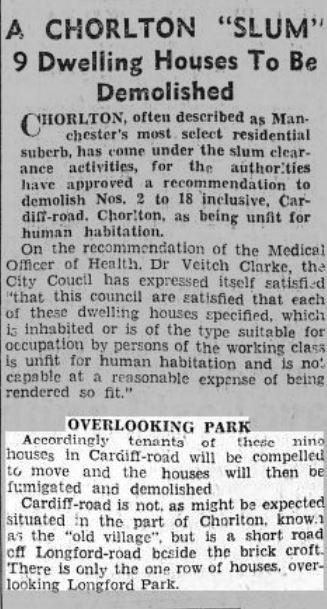
But today I have redressed that omission, mainly because of a press cutting sent over by Chris Geliher who added "Hi Andrew. Came upon this clipping from the M/c City News 16/7/37. Thought you might be interested on the off chance that you haven't already seen it”.

Cardiff Road, 1907
And of course, I was very interested because it offered up the first clue as to why Cardiff Road had been expunged from the record.

According to the Manchester City News the Corporation had approved the “recommendation to demolish nos. 2-18 , inclusive Cardiff-road, Chorlton, as being unfit for human habitation”, adding that Dr Veitch Clarke, the Medical Officer of Health for the City Council had pointed out that the houses were “not capable at a reasonable expense of being rendered fit” to live in.*

Now I would dearly like to know who had built the properties and who rented them out, if only to search for similar “rundown” houses that the landlord was responsible for in Chorlton.  Alas the Rate Books that can be accessed online stop in 1900, and there appears at present no other reference to ownership in the historic records.

But looking at the census return for 1911 there is much to shudder at, not least because some of the properties were incredibly overcrowded.

At number 20 Annie Elizabeth Wilson shared the house with her eight children ranging in age from 20 down to 5, while at 24, Mr. Devine and his wife lived with four children, a nephew, a sister in law and two lodgers.

Cardiff Road, 2015
Nor are these two houses the exception.   At number 2, Jane Fitzgerald lived with her two children and a lodger, and at 12 there were a total of seven people.

Perhaps most shocking is the census return for number 8 which revealed two families inhabiting the one house, consisting of one family of six and another of 4.

At present there is no way of knowing just how poorly built the properties were, but their very short life suggests that they were not the best in the housing stock of Chorlton-cum-Hardy.

Indeed, they back onto our own brick works which might offer up a possible landlord.

A decade on in 1921 there was still evidence of overcrowding in almost all of the four roomed houses and severe overcrowding in two.  

Cardiff Road, 1911

What is in interesting from both the 1911 and 1921 census returns is that few of the inhabitants were linked to the brick trade, and only one man in 1921 was directly employed at the brick works and he described himself as unemployed.  

Others worked for the grocery chain Twfords in Chorlton, two were employed by Manchester Corporation, one was a carter, and another was a warehouseman for J. R. Smith on Ducie Street in town.

All of which leaves me with that opening sentence from the newspaper report which proclaimed “Chorlton often described as Manchester’s most select residential suburb has come under the slum clearance activities for the authorities”.

So despite the detractors who shout that Chorlton has become a “twee place” to live, there were those who thought it so over eighty years ago.  Didsbury please take note.

Location; Chorlton

Pictures; A Chorlton “Slum” 9 Dwelling Houses to be Demolished, Manchester City News, July 16th, 1937, courtesy of Chris Geliher, Cardiff Road, 1907 from the OS map of Manchester and Salford, 1907, and in 2015 from the collection of Andy Robertson

*A Chorlton “Slum” 9 Dwelling Houses to be Demolished, Manchester City News, July 16th, 1937

Tuesday, 17 March 2026

Snaps of Chorlton No 2 Beech Road, 1935 King George V’s Jubilee


An occasional series featuring private and personal photographs of Chorlton.

Beech Road, 1935
Today we are on Beech Road during the Jubilee of King George V.  I cannot be exact but it will have been between May 6th and May 12th.

It was taken by Marjorie’s sister sometime in the afternoon.

Despite its’ lack of clarity there is enough here to give us a flavour of Beech Road in the 1930s.

To our immediate left is the wall in front of Row House and the adjoining building which by 1929 was the Grange Laundry.  And beyond on the corner of Acres Road was William Allen the iron monger’s who has dropped his canopy to shield the shop from the bright spring sunshine and like all the shop keepers of the period has some at least of his wares on display outside.

It is a fine May day and the bright sunshine has brought out the people, even so there is enough of a breeze to lift the flag and bunting.

And I suppose the thing that most marks this off from today is the absence of cars.  There well away up Beech Road at the corner of Chequers Road is the only one.

What also makes the picture just that little bit more priceless is that the young girl in the foreground is Marjorie.

Picture; Beech Road, 1935, from the collection of Marjorie Holmes

Friday, 13 March 2026

Looking for "June" The Ladies hairdresser and Busy Bee Stores, sometime in 1930

Looking "June" the Hairdressers on Wilbraham Road
I never underestimate the power of a collection of old local adverts to offer up fascinating stories and pretty much take you all over the place.

So here in front of me are a set of those adverts which appeared on the dust jacket of a book lent out by Mr R. Greig Wilson who owned a newsagents on Sandy Lane and also ran one of our Circulating libraries.

Now circulating libraries were private affairs and existed alongside the local public library, and such was the demand for novels and lighter factual material that many of our newsagents went into business renting books out.

Busy Bee
At home in London mother was a regular at the local bookshop who also traded in lending copies and across Chorlton there were quite a few, from the one that operated on Beech Road, to Mr Lloyd’s on
Upper Chorlton Road and of course R. Greig Wilson’s on Sandy Lane.

It is a topic I have visited quite a few times over the years and no doubt will return to.

But for today my attention has been drawn to Busy Bee Stores  (W. Wellard, Proprietor) at 264 Upper Chorlton Road, and “June” The Ladies’ Hairdresser and Beauty Specialist on Broadwalk Wilbraham Road.

It will take some time to date the collection of adverts and that will involve trawling the directories but I think they will be from the 1930s.

Not that Mr Grieg has been much of a help for he was selling his “Stationary, Tobacco and Picture postcards” along with delivering his newspapers from at least 1911.

That said it will be after 1911 because down on Upper Chorlton Road at 264 was a Mr John Joseph Taylor who was a tailor.

Now Mr Wellard was trading as an iron monger at the shop by 1929 and Charles Slightman who also advertised on the dust cover was selling his newspapers and lending out his collection of over 1,000 books from his lending library on Manchester Road from 1923 through to 1935 so we are in the right decade and a bit.

"June"
And until those directories yield up a definite date I am settling for sometime in the 1930s for it was around then that “June” at the Broadwalk began Permanent Waving by the Nestlé System which was the "Radione" system in which the hair was wound dry and inserted into hollow cellophane tubes sealed at both ends, but contained moistened paper”*

Long along Wilbraham Road circa 1930s
She was in her saloon at 523 Wilbraham Road by 1929 but Karl Nessler who had perfected his alternative method of curling hair in 1905 using a mixture of cow urine and water did not come up with the improvement which he called the Nestlé System until the 30’s.

“June” charged 20/- for the process and also offered "Tinting, Manicure, Face Massage , [and] all kinds of hair work carried out by experts.”

I have often wondered whether her customers were aware that Mr Nessler had arrived in Britain from Germany in 1901 and facing being interned when the Great War broke out fled to America, or that during his first experiments on his wife he managed to burn her hair off and cause some scalp burns.

That advert for an early perm, circa 1905
All of which is a complete digression but is one of the fascinating little journeys behind which there is a serious point because together the eleven adverts will reveal a little bit more about the Chorlton of just eighty or so years ago.

And in one of those nice little twist of coincidences, 264 Upper Chorlton Road is again a hardware store specialising in much the same stuff as Busy Bee which along with offering “Glass and China [as] a speciality offered “Electric Vacuum cleaners for Hire.”

But there the coincidences stop for now where “June" permed and manicured the present proprietor offers sweets and newspapers which I suppose has almost brought us full circle.

Pictures, adverts from the dust cover of a book courtesy of Margaret Connelly, Wilbraham Road in 2014 from the collection of Andy Robertson and an  early 20th century advertisement for Nessler's permanent wave machine, transferred by SreeBot, Wikipedia

*Perm (hairstyle), https://en.wikipedia.org/wiki/Perm_(hairstyle)

Saturday, 14 February 2026

Uncovering one of our local photographers, A H Clarke .............where local history met family history

Now I have been fascinated by Harold Clarke who was one of our local commercial photographers.*


Barlow Moor Road, circa 1926
During the 1920s and 30s he recorded many scenes of Chorlton and they are a priceless snap shot of the area.

This one was taken by Harold Clarke of 83 Clarence Road Chorlton, and may have been part of a series issued by Lilywhite Ltd, of Brighouse, in Yorkshire.

There are 21 of his photographs in the Greater Manchester County Records collection dating from 1926 through to 1934 and some from 1926 carry a serial number close to the one in the picture.

All of which is an introduction to a story written by Tony Goulding, who has contributed to the blog before.

“Your posts using postcards produced by A H Clarke re-kindled in me an interest in my family history. A  H Clarke was my maternal grandfather. 


Miss Clarke's ration book, 1939
I had previously searched in vain for 83, Clarence Road where my mother was raised, as her ration book shows. 

I had not noticed the name change to Claridge Roadd. 

On a recent walk past the house I realised how close it was to the old brickworks and remembered how my mother had told me how she used to get into trouble for playing around them and the clay pits.

My grandfather was born in Reddith, Worcestershire in 1889, the son of William who owned tobacconist/photographers on the High St. 

His mother Bessie was a member of the Woodfield family prominent in the town both as needle factory owners and in local politics. 

Arthur Harold became a professional photographer. 

In the 1911 census he is recorded as working as a photographer’s assistant in Hitchin, Herts. He later moved back to Redditch, then after the break-up of his first marriage in the early 1920's lived for a little while in Toxteth, Liverpool, where my mother was born in 1927 before settling in  Chorlton in about 1930.


Book marks Central Ref, 1934
He was obviously quite enterprising at this time as can be seen by these bookmarks he produced of the newly opened Central Library.

Sometime in the early 1940's he both re-located the family home and ceased making his living solely from photography as a 1944 wedding certificate shows him as an Inland Revenue clerk residing at 5, Keppel Rd. 

It must remain a matter of conjecture whether this change was for personal reasons or was due to economic pressure on the photographic trade by the advance in camera ownership and the decline in postcard usage as a result of the increased availability of telephones. 

Of course any such difficulties would be exacerbated by war time shortages, rationing, and restrictions.

Finally it is ironic that I haven't got any photos of my grandfather, who died  in 1952; two years before I was born ------a man who must have taken 10's of 1,000's of them in his lifetime.”

And so there you have it a little bit more of the history of those who recorded our history.

© Tony Goulding May 2015

Pictures; from the collection of Harold Clark, Barlow Moor Road, circa 1926, from the Lloyd Collection, and the ration book and book mark courtesy of Tony Clarke.

*Harold Clarke, http://chorltonhistory.blogspot.co.uk/2015/01/travelling-around-chorlton-in-1930s-in.html

Monday, 19 January 2026

Cycling to a beauty contest …….. “the pretty entrants” of 1937

I bet there will be someone who remembers Riding’s Stores Ltd.


They sold cycles and advertised themselves as “The largest Quality Cycle Specialists in the North of England”, with branches on Deansgate, Corporation Street, Market Street and Swan Street, with shops in Moss Side, Rusholme and Stretford as well as here at 362 Barlow Moor Road.

And in their drive to bring cycles to the world they boasted “No Risk - No Bother – No Fuss – It’s so easy, so simple Riding’s ‘Best of All’ Easy Ways”, which meant that from 1/6 a week you could have any Hercules model , with the added bonus of no deposit and a ”Seven Day Free Riding Trial”.


The advertisement appeared in the Chorlton and Wilbrahampton News for July  16th, 1937, but what caught my eye was an additional notice drawing attention to “More Pretty Entrants in Riding’s Great Northern Cycle Queen Contest”, which featured eleven young women, with one posing with a cycle, another in a swim suit and another talking on the telephone.

And in an act of overkill, the company posted yet another reference to the contest calling on women to “Send in your photographs now!  Adding, “Waste no time. This is a marvelous opportunity for some local girl to gain fame and popularity”.

All that was required was a  name and an address on the back of the picture which was to be sent in a “1½d. sealed envelope to Riding’s” main showrooms on Stockport Road. 

The company also embraced all the modern technology, promising that “Elimination contests will be filmed and the final selection will take place at the New Manchester Hippodrome”, which I suppose opened up the potential for a cinema news story.

But if that was not enticement enough there was the promise “handsome cash prizes” and the simply direct question “Will You Be Queen?”

So, there you have it and by one of those little quirky twists, the Riding’s shop on Barlow Moor Road was just four doors down from Ken Foster’s cycle shop.  Now that is a bit of historical continuity,

Location; Chorlton and Manchester

Pictures; addverts from the Chorlton and Wilbrahampton News, July 1937 from the collection of Maggie Watson


Thursday, 8 January 2026

Net curtains, venetian blinds and that horseman on Brookburn Road .......... Chorlton in the 1920s and 30s

More than anything it’s the detail that draws you in to this photograph of Annie  and Nelly  outside 67 Hawthorn Road in the spring of 1930.

It starts with those net curtains which had been a badge of respectable living from the early years of the last century and would only be swept away by the new look of the 1950s.

I remember them well but more than the curtains it’s those blinds, made of slated wood which made a distinctive clunk when you raised or lowered them.

They filled the windows along with the nets and of course those heavy plush curtains which between them were required features of any surbuban home no matter however modest.

And each in their way made perfect sense.

In an age before central heating the heavier the curtains the better to keep the place warm in winter, while the blinds were essential for houses modifying the full strength of the sun in summer.

Today we might find the nets a tad over fancy but this was still a more private time when displaying the contents of your front room was regarded as more than a bit ostentatious.

The only concession to the seasons was that in some homes at least the heavy curtains came down in summer for lighter ones around the time the sweep would be called in to do the chimneys.

It is a way of life which has pretty much gone, along with the iron railings that topped the small front walls and could be as elaborate as these at number 67 and with that care for detail the gate’s design mirrored perfectly the railings.

And back when Annie and Nelly posed for the camera their home was less than thirty years old and had been part of that housing explosion which had turned Chorlton from a rural community to a suburb of Manchester.

But this was still a period of transition when the sight of a man on a horse was unlikely to turn a head.

We still had farmers who used horses to cart their produce from the fields while plenty of tradesmen transported their good across the township by horse drawn vans.

All of which is a lead in to Jim Mcloughlin sitting astride a horse by Brookburn Road.

Behind him is Brook Dairy which long before it  specialized in milk had been a farm dating back into the 18th century.
I am not sure when the farmhouse was demolished but it should be easy enough to find out by trawling the directories although I doubt that any one will remember its passing.

It will I suspect date from the when the dairy was taken over by Express Dairies which have now also gone leaving the site to be redeveloped into a row of modern houses,

That said there will be plenty who remember the yard, and on reflection I wish I had asked for that big sign which reminded drivers to be mindful of the neighbours.

After all the residents of the houses next door would still have been asleep when the crates of milk were being loaded onto the floats.

And that is now as much a part of our past as horses on Brookburn Road and net curtains up by Hawthorn Road.

Pictures; from the collection of Peter McLoughlin.

Wednesday, 31 December 2025

Celebrating New Year ….. with turnips ….. a carrot …..Mr. Wilding ….. and a bit of humour

After 89 years I doubt I will turn up much on The Chorlton-cum-Hardy Amateur Gardeners’.

The invitation to New Year fun, 1936

But then until Gill Curtis posted this delightful programme advertising their New Year’s Eve Gathering, I didn’t even know they existed, but exist they did.

As Gill wrote “I thought your members might be interested in a flyer I’ve found from 1936 proving that Chorlton cum Hardy was the place to be on New Year’s Eve. My grandfather obviously thought so as he was the piano player!”

Parker's, circa 1930s
Now, I am not surprised that there was a gardening group.  

There were plenty of other such groups in Chorlton which had developed as the township grew from a small agricultural community into a suburb of Manchester.

The transformation had begun in the mid-1860s with urban creep up from Stretford Railway Station along Edge Lane and then the newly cut Wilbraham Road.

But the real pace of change started in the 1880s around what was once the Four Banks and stretched along Barlow Moor and Manchester Roads and out towards Longford Park in one direction and Chorlton-cum-Hardy Railway Station in the other.

The area attracted the “middling people” many of whom worked in the city but wanted to live in an area which still had a rural feel.  They included those who described themselves “professionals" and "clerks" along with businessmen.

And as they did, they set up “societies” from theatre and operatic groups to public speaking, gardening and a whole range of sporting activities.

In 1909 the Chorlton-cum-Hardy Show included in its event the best Chorlton garden.  The show continued well into the 1930s and featured agricultural as well as gardening events.*

Five and bit hours of fun, 1936
So, in 1936 The Chorlton-cum-Hardy Amateur Gardeners’ staged their New Years event which was at 357 Barlow Moor Road, near to the junction with Hardy lane and Mauldeth Road West.  The parade of shops still exists.

Back then it was owned by Parker’s Bakery of Needham Avenue and was one of a number of outlets across Chorlton.

To modern eyes it may seem a tame affair, but the programme is not without a sense of humour and begs the question of whether there are other bits of memorabilia out there connected to the group.

We shall see.

Leaving me just to thank Gill.

Location, Chorlton-cum-Hardy

Pictures; The Chorlton-cum-Hardy Amateur Gardeners’, New Year’s Eve Gathering, 1936, from the collection of Gill Curtis 

*Winning the best kept garden on Nicolas Road in 1909, https://chorltonhistory.blogspot.com/2018/08/winning-best-kept-garden-on-nicholas.html

Saturday, 19 July 2025

One place …. just 87 years apart ….. Beech Road 1935 …. 2022

The blog doesn’t usually do then and now pictures.

Beech Road, 1935
But this one which was taken by the sister of Marjorie Holmes is a favourite of mine.

It is a bit blurred but that is what comes with a “snap”, but then the quality of the second is only marginally better.

 The first was taken during the Jubilee celebrations for King George V in 1935 and mine just a few days ago.

I will leave it to others to make the obvious observation and repeat that request for more “snaps” of where we live.

For those interested behind the wall on the left of Marjorie's picture was still a laundry, while what is now Suburban Green, had been variously an ironmonger's, a hair dressers and even a piano shop before settling down to its long association as a bar and restaurant in the mid 1980s.

Beech Road, 2022

The first of which was Café on the Green.

Location; Beech Road


Pictures; Beech Road, 1935, from the collection of Marjorie Holmes, and in 2022 from the collection of Andrew Simpson