Showing posts with label Red Cross Nurses. Show all posts

Wednesday, 10 June 2026

What Miss Sarah Kate Sloane did in the Great War ..... part 1

Now, I am only at the beginning of the story of Ms Sloane, who was born in 1871 and died in 1965, but already it promises to be a fascinating piece of research.

British War Medal, 1914-1919
She was born and died in Leicester and spent most of her life there, save for those periods when as a Red Cross nurse she served in hospitals across the country and in France during the Great War.

And it was her wartime medals which drew me into her story, and while I have accumulated some biographical details, I know there is much more.

She was awarded The British War Medal, 1914-18, The Allied Victory Medal, 1914-19, The War Medal Medal, 1939-45, and the Defence Medal, 1939-45, and the first two carry an inscription which includes her name and the letters V.A.D, which refer to her role as a member of the Voluntary Aid Detachment.

Members of V.A.D. performed a variety of tasks in Red Cross Hospitals, from nursing to cleaning, washing, and cooking, as well as administration and many also took on fund raising activities in the community.

Ms Sloane came from a medical family and both her father and brother were doctors, which makes her choice of nursing and unsurprising one.

Evington House, 2022, formerly Kighton V.A.D., Hospital
The Red Cross records show she served from 1915 through to 1917, at various Red Cross hospitals, starting at the Knighton V.A.D., hospital close to where she lived.

From 1916 she was at No.2 B.R.C. Hospital in Rouen, followed by Frensham Hill Military Hospital,  and Ullesthorpe Court, & Charnwood V.A.D. Hospitals.

After which she worked for the Discharged Soldiers & Sailors organization, which was part of the Ministry of Labour and focused on finding suitable employment for men no longer in the forces.

So far, I have no pictures of Ms Sloane, but I know where she lived in Leicester, and some at least of the houses are still standing today, as is the Knighton V.A.D Hospital which is now known as Evington House and stands in Evington Park.

Evington House, 2022, formerly Kighton V.A.D., Hospital
The house dates from the early 19th century, and bits maybe much older.  In its time it was owned by one family with links to the campaign against the slave trade, and in 1914 was lent by its then owner to the Red Cross.

There are various accounts of the house including its time as a hospital and many also include a fascinating account of the daily routines by Miss Alice Henderson who was the commandment which appeared in the Wyggeston Girls Gazette in 1919.

I suspect much of what Miss Henderson outlined in the article would have been familiar to Sarah Sloane, and was pretty much the lot of many who worked in Red Cross Hospitals.*

And that at present is pretty much all there is.  I know she arrived back from Algiers in 1931, left over £55,000 at her death in 1965 and lived for 30 years at 8 University Road, in Leicester.

Defence Medal, 1939-45
But I don’t have a clue how she voted, what she thought of the big issues of the day or how she occupied her time after war service.

That said I am confident I will find out more.  There are people who have included her in their own family history records, and I await a reply from the Leicester Records Office so there is much more to play for.

All of which leaves me with that odd reflection that history can be messy and can surprise you.

So, when I started the search for the story of Sarah Kate’s medals, I had no idea that she came from Leicester or that our Josh and Polly would turn out to live just minutes away from both Knighton V.A.D., hospital, and her home on University Road.

But then that’s the fun of the past.

Location; Leicester, and elsewhere

Pictures; Miss Sloane’s medal, courtesy of David Harrop and Evington House, formerly Knighton V.A.D., hospital, from the collection of Josh Simpson

Sources; census records, 1901-1921, Red Cross Records, 1914-1919, Baptismal record, 1871, various street directories  and electoral registers, 1920-1930, Probate Records

* Evington’s VAD Hospital, Evington Echo, December 19th, 2014, https://evingtonecho.uk/evingtons-vad-hospital/

& Evington House, Evington Park, https://storyofparksleicester.com/park-histories/evington-park/#:~:text=This%20house%20is%20said%20to,hunter%20gatherers%20roaming%20over%20it.&text=In%20Roman%20times%20and%20on,have%20been%20a%20Roman%20cemetery

Tuesday, 3 March 2026

Never be surprised at what you find on Wilbraham Road ............. nurses and Red a Cross Hospital

Now this is just the start of that story of a Red Cross hospital on Wilbraham Road and at this stage I have no idea where it will lead.

Until recently I knew that during the Great War the Red Cross ran two hospitals in Chorlton, one in the Sunday school of the Baptist Church on Edge Lane and the other in the Sunday School on Manchester Road.

The first opened in 1914 and the second must date from sometime in 1916 or 1917.

But given the demand for hospital beds I have always wondered if there were not more.

Just down the road in Whalley Range and south into Didsbury a number of private homes were given over to the Red Cross so it seemed logical that Chorlton must have had its own share of smaller Red Cross establishments.

That said none have turned up in the records of which the best is a book by the Red Cross on their work in east Lancashire which offers up a wealth of detail about the hospitals they ran.

But the book was published in 1916 and concentrates on those hospitals which had been set up between 1914-15 and so while the hospital on Edge Lane is included the one on Manchester Road is absent.

So I was intrigued when Pawel Lech Michalczyk told me that “the house next to the Chorlton Conservative Club is listed as a hospital in 1917.  It was Wycombe, and described as an auxiliary military hospital in the 1917 Slater's street directory.”

Now that set me off looking and back in 1911 Wycombe was home to Mr and Mrs Barnes, their four children and Miss Mary Jane Williams who was 27 and employed as a domestic servant.

Mr Williams described himself a “Merchant” and is listed in the 1911 directory as the “Managing Directory of James Barnes Ltd.”

Now Wycombe is a big house which was described as having 12 rooms making it large enough to have been run as a small auxiliary hospital.

And that is where the story stops, but I rather think it will only be a pause.

Picture;  picture postcard possibly Willow Bank Red Cross Hospital, circa 1914 courtesy of David Harrop,


Tuesday, 27 May 2025

Miss Ada Bidgood of 11 Holland Road, Chorlton-cum- Hardy steps out of the shadows

Here is another of our Red Cross nurses who served here in Chorlton in the Great War.

Miss Bidgood's shift
She was Miss Ada Bidgood, and I doubt I would have ever come to have known about her work as a Red Cross nurse, were it not for postcard with her duty rota for Saturday August 19th starting at 1.30.

The card is undated, but on the reverse carried Miss Bidwood’s address which was 11 Holland Road.

On the surface it isn’t much to go on, but it was enough.

There were three Red Cross hospitals in Chorlton.

Two were situated in the Sunday School buildings of The McLaren Baptist Memorial Church on Edge Lane, and the Methodist Church on Manchester Road, and the last was in a private house beside the old Conservative Club.

A search of the Red Cross data base revealed that Ada was at the Baptist Church and had started in the April of 1916, continuing through till the April of 1918, working part time, and engaged in “ward and dispensary duties”.

She lived with her parents and three siblings, and the family moved around, having lived in Yorkshire, Durham and Warwickshire, which may in part be because her father, described himself as a Publisher District Manager, although by 1939 he recorded his status as a “retired art dealer”.

At present I know little more about Ada, other than that she was born in 1885 and died in 1975 in Stockport and never married.

Her address
But it is a start and offers up a name and a few brief biographical details of one our nurses.

The McLaren Baptist Church was the first to offer their Sunday School as a convalescent hospital.

The story of its first was written up by the East Lancashire Branch of the British Red Cross as part of “An Illustrated Account of the Work of the Branch During the First Year of the War.” *

And its presence represented a massive commitment on the part of the 16,000 Chorlton people.

The number of voluntary nurses and orderlies ran to 89 and another 70 worked at some point in the kitchen.

There were also regular fund-raising activities, loans of equipment and twice weekly ward concerts.

 More than anything it shows the level to which the war effort was supported and funded by voluntary actions.

 Like many churches of the period it had a large Sunday school and it was this which was converted into the hospital in November 1914.

Soldiers outside the MCLaren Baptist Church, date unknown
Like many churches of the period it had a large Sunday school and it was this which was converted into the hospital in November 1914.

 “a ward of 31 beds, kitchens, mess room, bath room, dispensary, pack stores, linen rooms, matrons’ room and office” all of which were on the ground floor.

The building was large enough to accommodate


The Sunday School to the left, converted into a hospital
The original plan had been for 25 beds but in May 1915 an extra six beds were added.

What is astounding is that the cost of equipping the hospital which came to £140 was met by public subscription after an appeal for funds from the local Red Cross, and that this was “in addition to the liberal amount of hospital appurtenances so freely furnished on loan by the public.”

Nor did the generosity stop there. For while the War Office allowance for each man per day was 2 shillings [10p], the average cost for the upkeep per bed was 25 shillings [£1.25p] which again was met by the public through “subscriptions, donations and the proceeds of entertainments.”

During that first year of the war 159 volunteers worked at the hospital and all but four came from the township.

There are many familiar names, some whose families had been in the township for generations.

Ann Higginbotham aged 22 was the daughter of Alfred and Emily whose family had farmed by the green since the 1840’s.

There were also newer names like H. F. Dawson and A. H. Dawson or the Kemps. Miss Kemp worked in the kitchen while Harry her father was on the committee.

He had two chemists’ shops and would be remembered for over half a century by Kemp’s Corner.

And to these we can add Miss Ada Bidgood, who I now also know was due to start her shift on August 19th, 1917

Location; Chorlton

Pictures; Miss Ada Bidgood’s postcard, date unknown, courtesy of David Harrop, and The McLaren Baptist Memorial Church, date unknown from the collection of Chris Griffiths


*Chorlton-cum-Hardy Red Cross Hospital, East Lancashire Branch of the British Red Cross Society Sherratt & Hughes, 1916

Sunday, 25 May 2025

The forgotten hospital in Longford Hall

 I know l shouldn't be surprised that Longford Hall was given over to use by the Red Cross as an Auxiliary Hospital during the Great War.


Many family homes, along with schools and other public buildings were requisitions or volunteered as hospitals for soldiers  recovering from wounds and illnesses. 

Here in Chorlton l have tracked three with the promise of another, and over the years l have written about more in Didsbury, Whalley Range, Salford and across Manchester and beyond.

I just didn't think of Longford Hall but I should. It was a fine large building, formerly the residence of the  Ryland family and from 1908 it was owned by Stretford.

So at the outbreak of war it became a centre of war activity including its role as a hospital.

After the war most of these hospitals were returned to private use or continued as hospitals. 

The equipment from beds to cooking pans and typewriters were sold off and with two generations their existence had started to fade.

So l am off to do the research, starting with one of those scrap books recording photographs and comments of the hospital.

Location; Longford Hall

Pictures; pictures, undated courtesy of Bill Sumner

Wednesday, 29 November 2023

Miss Lydia William Falconar Grant ……… a nurse from the Great War

I never tire of the way that a chance picture of some one long dead sets off a story which goes off in a dozen different directions.


And so, it was yesterday when Tony sent over his photograph of one of the gravestones in Southern Cemetery with the comment, “knowing your interest in the Red Cross I thought you might find this interesting”, which of course I did.

The grave belongs to Miss Lydia William Falconar Grant, who died on April 1st, 1917 at the Ducie Avenue Military Hospital.  

The inscription reads “Lydia William Falconar Grant V.A.D. Member of the Red Cross Society of Australia, born at Falcon Hall, Morningside, Edinburgh and died at Ducie Avenue Military Hospital, Manchester, on the 1st of April 1917, Elder daughter of Peter G. Grant & Emily Grant of Brisbane, Queensland”.

She was born in Scotland in 1880, grew up in Australia, served at a military hospital just off Oxford Road, in Manchester, and died just a year after she was engaged by the Red Cross as a member of the Voluntary Aid Detachment.

This was a voluntary unit of civilians providing nursing care for servicemen in the UK and across the British Empire.

And this was the start of the story.

Falcon Hall was a very large 18th century mansion in Edinburgh, which according to one source belonged to the family.  Her father described himself as a “land surveyor”, and after returning to Australia in late 1880 he appears to have become a police magistrate.


Miss. Grant was educated at the Ladies’ Methodist College in Melbourne, and was living in Brisbane when she volunteered to serve with the Voluntary Aid Detachment.

She left Australia in September 1916, and after four days in London was posted to Manchester, beginning work in December of that year.

According to one press report she  felt the intense cold weather in Manchester but “she was always very happy, and keenly interested in her work.  Her letters showed also that she had met with great kindness from those with whom she came into contact, and found both in sisters and nurses engaged in the same hospital much congenial comradeship”.*

The hospital was the former Ducie Avenue Municipal school, which had been requisitioned in 1916, and consisted of 240 beds, of which 88 were specialists’ ones, and until 1917 it had an orthopedic section.

Sadly, she contracted measles in the late March of 1917, which developed into Septic Arthritis on March 28th, and by the following day she “became unconscious with very little hope of recovery”.


Her funeral was reported in The Searchlight, which was the monthly publication of Second Western General Hospital in May, reporting that "Miss. Grant was one of the first contingent of the Australian Probationer who came to us last November and during her short period of work here and also during her illness, bravely and patiently borne had greatly endeared herself to all she came into contact.

She was laid to rest in Southern Cemetery on April 4th, close to the grave of V.A.D., Nursing Member Pearce, whom we buried only a few weeks ago.  At the request of friends, the funeral was a private one, and the service, which was very impressive, was conducted by the Ven. Archdeacon Aspinall, assisted by Cap, Worseley.  

It was attended by Sargt. C Grant, 1st Australian Division, Capt. Brentnall, R.A.M.C. (T.F.) and a large number of Sisters and nurses of the Second Western General Hospital staff, including seven other members of the Australian contingent”.


I doubt I will ever get to see the letters she wrote home, and so have no way of knowing what she thought of Manchester, but I hope on her days off she got to see something of the city.

There will be more that will come to light about Miss Grant.

For now, we have a photograph, an entry in the book commemorating the work of the 2nd Western General Hospital,*** her Red Cross record card and a handful of other sources.

And I have to thank Bruce Terrell who is a relative and first alerted me to the photograph of Miss. Grant and to Bruce Anderson who gave me permission to reproduce pictures of the Ducie Avenue Military Hospital from his excellent web site, Rusholme & Victoria Park Archive****, and went off and did his own research and coming back with many of the other sources I used, from the Cairns Family History.


Leaving me just to thank Tony Goulding who sent me the picture of the grave and set me on  the story.

Location; Scotland, Australia, Manchester

Pictures; gravestone of Miss Lydia William Falconar Grant, 2020, from the collection of Tony Goulding, cover 2nd Western General Hospital, 1919, courtesy of David Harrop, photograph of Miss. Grant, Women in war, ANZAC Centenary Queensland, 2014-2018, https://anzac100.initiatives.qld.gov.au/remember/women-in-war/index.aspx, Ducie Avenue Military Hospital, 1916-1919, courtesy of Rusholme & Victoria Park Archive, https://rusholmearchive.org/rusholme-military-hospitals-1914-1918

* Cairns Family History, https://cdfhs.org/indexes/cairns-wwi-soldiers/grant-lydia-wilhelmina-falconer/

**The Late Miss Lydia Grant,  V.A.D., Cairns Post May 16th, 1917

*** 2nd Western General Hospital, Manchester , 1914-1919

**** Ducie Avenue Military Hospital, 2nd Western General Hospital, Rusholme & Victoria Park Archive, https://rusholmearchive.org/rusholme-military-hospitals-1914-1918

***** Cairns Family History, https://cdfhs.org/indexes/cairns-wwi-soldiers/grant-lydia-wilhelmina-falconer/

Tuesday, 31 October 2023

Revealing more on the story of Private Jordan .............. from Cheltenham to Cairo

This is one of those sad postscripts, but one that holds the promise of discovering more about a soldier of the Great War.

Cairo War Memorial Cemetery
Yesterday I wrote about Private H F Jordan who spent time recovering from his wounds in the St John’s Red Cross Hospital in Cheltenham.*

During his time there he left a message in the autograph book which had been started by Ms Rachel Wattis.

But apart from a record of the medals he was awarded and an entry in the UK Army Register of Soldier’s Effects I could find nothing more about him.

Today I heard from David Harrop who owns the autograph book.  He had also gone looking for Private Jordan and found his grave in Cairo where he was buried in February 1919.

“This cemetery is within the Old Cairo cemetery area, which is situated approximately 5 kilometres south east of the centre of Cairo. 

The cemetery area is on the south side of the road Salah Salem, which runs west/east from the River Nile towards the green park area approximately 2 kilometres beyond and eventually towards the Citadel.”**

And Private Jordan rests close to the Records Office.

The message from Private Jordan, December 1916
We still have no idea how he died but we now have his full name and his date of birth and armed with these it should be possible to find out a little bit more about Frederick Thomas Harry Jordan who died aged 26 in Egypt four months after the end of the Great War.

And in doing so take the story of that message in the autograph book just a little further forward.

Picture; Cairo War Memorial Cemetery, courtesy of the Commonwealth War Graves Commissions, http://www.cwgc.org/find-a-cemetery/cemetery/11000/CAIRO%20WAR%20MEMORIAL%20CEMETERY and Private Jordan's message from Blighty, the autograph book of St John's Red Cross Hospital, Cheltenham from the collection of David Harrop

Image from the autograph book, © David Harrop


*Blighty ............. a unique record from the Great War part 2 looking for Private H F Jordan, http://chorltonhistory.blogspot.co.uk/2015/07/blighty-unique-record-from-great-war.html

**CAIRO WAR MEMORIAL CEMETERY, Commonwealth War Graves Commissions, http://www.cwgc.org/find-a-cemetery/cemetery/11000/CAIRO%20WAR%20MEMORIAL%20CEMETERY

Thursday, 26 October 2023

Miss Kathleen Robertson, a Red Cross hospital in Cheltenham and a hill station in India

I am off looking for the story of Ms Kathleen Robertson.

The Nilgiri Hills
She was a nurse with the Red Cross in Cheltenham during the Great War and her medals have just been acquired by David Harrop who has a collection of memorabilia from both world wars.

David was keen to add theses to the collection because they compliment an autograph book from the St John’s Red Cross Hospital in Cheltenham which was started in 1916 and ran through to the end of the war.

The book contains poems, pictures and comments from men recovering from wounds.  Some of the men were wounded at Gallipoli and others in the opening weeks of the Battle of the Somme.

Now I think I have found her in Cheltenham in 1911, and already the story has taken a fascinating turn.  She was born in 1897 at Coonoor in Madras which  is the second highest hill station in the Nilgiri mountains. It was a popular summer and weekend getaway for the British during the colonial days.

And I suspect that her mother will have chosen to settle there for Kathleen’s birth.
Now that is a bit of a supposition but in 1911 she was living with her grandmother at 29 Park Place Cheltenham.

All of which would suggest that her parents were still in India.

So there is much still to do from tracking her mother and father, discovering  more about Miss Robertson’s time the Red Cross and what happened to her after the Great War.

This will I hope involve the help of the local studies centre in Cheltenham who may be able to locate the staff list of the hospital.  As yet the Red Cross have yet to digitize all their staff records and I am hoping the centre will be able to find her.


And along the way I might find out more about her grandmother who was born in Tasmania.

In the meantime I await David’s pictures of Miss Robertson’s medals.

Picture; Nilgiri Hills in Tamil Nadu  http://www.flickr.com/photos/enchant_me/144986171/sizes/o/ , his file is licensed under the Creative Commons Attribution 2.0 Generic license. https://creativecommons.org/licenses/by/2.0/deed.en, no changes were made to this image

Saturday, 5 August 2023

Making Christmas a good one ……… in Rusholme with the Red Cross …. December 1918


The scene in this picture postcard will have been replicated across the country in Red Cross hospitals during the four years of the Great War.

This was the Red Cross Hospital in Rusholme in December 1918.

It was and is again a school, but for three years from 1915 it was one of the hospitals under the umbrella of the 2nd General Western Hospital.

I have written extensively about Red Cross Hospitals during the war and in particular those in Manchester, so I shall leave it at that.*

Other than to say this is another picture postcard plundered from the collection of David Harrop.


Location; Rusholme


Pictures; “Christmas tree given to the soldiers, December 1918” 1918, from the collection of David Harrop, and Heald Place School, Rusholme, 2023, courtesy of Goggle Maps.


*Red Cross Hospitals, https://chorltonhistory.blogspot.com/search/label/Red%20Cross%20Hospitals


Friday, 2 September 2022

Remembering Miss Hilda Peare …….. a nurse from the Great War …. today at Southern Cemetery

 Miss Hilda Peare has come back out of the shadows.

Hilda Peare, 1917
She was a Red Cross Nurse during the Great War, who died “of a severe attack of Scarlatina, contracted while she was engaged nursing the sick and wounded of the fighting forces”*

She was buried in Southern Cemetery with full military honours, and then quietly slipped into obscurity, until now when her contribution will be remembered at a special commemorative service on September 2nd in the Cemetery.**

And here I have David Rawson to thank for not only alerting me to the service, but doing all the research on Miss Peare.***

According to David, “Some years ago, the manager of the cemetery, Pete, came across a record of Hilda's burial and located the site. 

Given her war role he organised for a small marker memorial to be placed at the grave. Pete described her as a 'trench nurse'.

Last May, the Common War Graves Commission  held a war graves week, and I met Liz Marsland who is the public engagement coordinator for the CWGC in the North West. Pete showed us the grave and as the conversation developed about Hilda, we thought that she deserved a CWGC headstone.

Normally if a casualty has a memorial erected privately the CWGC does not then add one of theirs. So, Liz made the case for Hilda to get a CWGC headstone and they agreed”.

Hilda Peare was born in Ireland in 1894, “attended the French School in Bray, Co. Wicklow. 

This school was for young Protestant ladies from across Ireland. It was a boarding school and so Hilda would have been used to living away from home. We know that she was at this school age 17. Clearly a fairly well off family”.

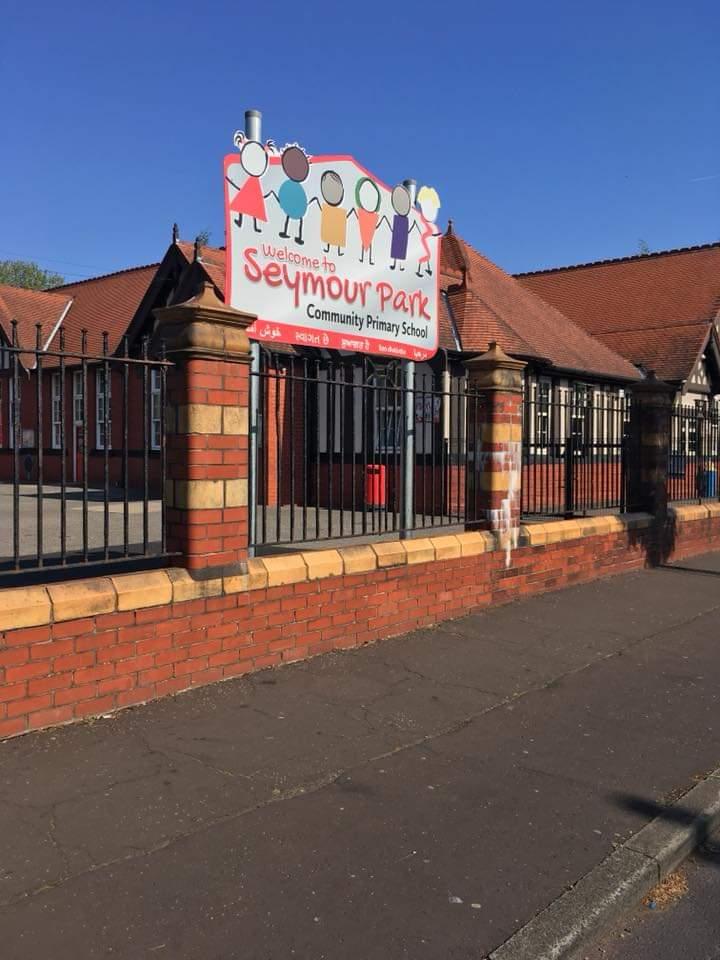
Seymour Park School, 2022
In the autumn of 1915 she enlisted in the Voluntary Aid Detachments of the Red Cross for service administering to sick and wounded servicemen, and was posted to the 2nd Western General Hospital based at Whitworth Street, and from there was redirected to the Seymour Park Auxiliary Hospital on Northumberland Road in Stretford.

The hospital had been a school which was opened in 1907 and is still there today.

During the course of the war, some schools were requisitioned as hospitals along with other buildings like church halls and private residents which were donated by their owners.

Her death was widely reported in the Irish Press, with The Free Press commentating “that her devotion to duty was fully appreciated was evident from the remarkable demonstration of regret on the occasion of her internment. 

She was buried with full military honours, the gun-carriage and the firing party being supplied by the Commanding Officer of Heaton Park Depot. The sergeants of the local detachment of the Royal Army Medical Corps acted as pall bearers, and the band of St Joseph's School played the Dead March in Saul along the route. 

Beautiful wreaths and floral tributes were sent by the officers and men of the Royal Army Medical Corps, the Matron, Sisters, and Nurses of the various military hospitals in the locality, the ladies of the V. A. D., and the patients of the branch hospital where Nurse Peare worked”.

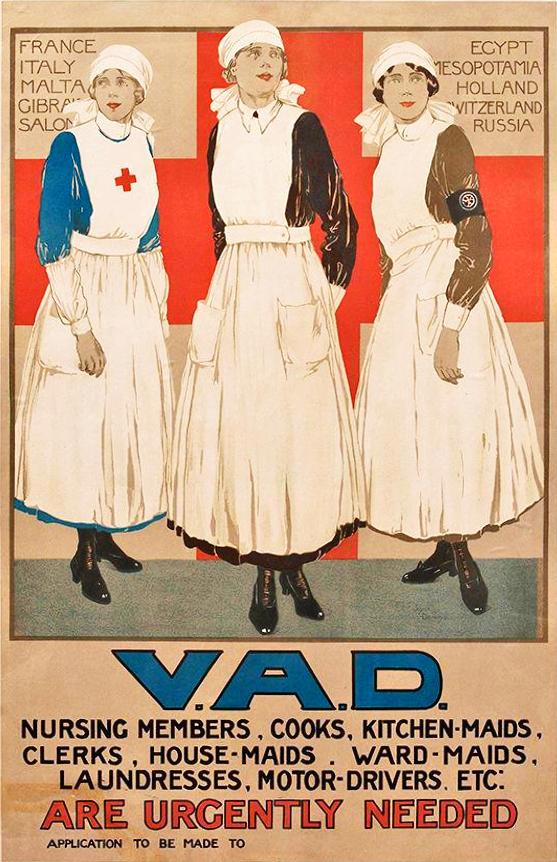
V.A.D., recruitment poster, 1915

And so, it is fitting that a century and a bit after that service she should be remembered in Southern Cemetery.

But that is not quite the end, because David has added  “as knowledge of this event spreads, our friend Cath Brownhill, was telling me that she was a Captain in the Army Reserve based at 207 Field Hospital.

WW1 memorial at the drill Hall, 2022

She has found that Hilda is remembered on the WW1 memorial at the drill Hall on King's Rd (207 HQ)

Cath took the picture. Hilda is toward the top of the left hand column. Although she is down as Pearce rather than Peare".

Original grave marker, 2022 on display
There is much more, and David’s research offers up a wealth of information on the work of the VADS, and Miss Peare’s background, along with fresh avenues of research.

The original grave marker is now on display at his permanent exhibition of memorabilia in the Remembrance Lodge at Southern Cemetery and will also include other material pertaining to Ms. Pearce

Added to this there is The Red Cross’s own data base of those who served as VADS, which is temporarily down for maintenance.

But for now, that is it.  

The ceremony will be held in Southern Cemetery, on September 2nd at 10.30 for 11am, and The Irish Consul General will be attending to represent the Irish Government.

The new gravestone to Ms. Perare, 2022

Pictures; Miss Hilda Peare, circa 1915-1917, Seymour Park School, 2022,  from the collection of David Rawson, V.A.D., Recruitment poster, 1915, Imperial War Museum and WW1 memorial at the drill Hall on King's Rd (207 HQ), 2022, courtesy of Catherine Brownhill, and the grave marker and new Red Cross Gravestone, 2022,  from David Harrop.


*The Free Press, March 14th, 1917

** The ceremony will be held in Southern Cemetery, on September 2nd at 10.30 for 11am

*** David Rawson, is one of the three Manchester City Councillors for the Chorlton Park Ward.


Tuesday, 16 August 2022

Remembering Miss Hilda Peare …….. a nurse from the Great War …. buried in Southern Cemetery

 Miss Hilda Peare has come back out of the shadows.

Hilda Peare, 1917
She was a Red Cross Nurse during the Great War, who died “of a severe attack of Scarlatina, contracted while she was engaged nursing the sick and wounded of the fighting forces”*

She was buried in Southern Cemetery with full military honours, and then quietly slipped into obscurity, until now when her contribution will be remembered at a special commemorative service on September 2nd in the Cemetery.**

And here I have David Rawson to thank for not only alerting me to the service, but doing all the research on Miss Peare.***

According to David, “Some years ago, the manager of the cemetery, Pete, came across a record of Hilda's burial and located the site. 

Given her war role he organised for a small marker memorial to be placed at the grave. Pete described her as a 'trench nurse'.

Last May, the Commonwealth War Graves Commission  held a war graves week, and I met Liz Marsland who is the public engagement coordinator for the CWGC in the North West. Pete showed us the grave and as the conversation developed about Hilda, we thought that she deserved a CWGC headstone.

Normally if a casualty has a memorial erected privately the CWGC does not then add one of theirs. So, Liz made the case for Hilda to get a CWGC headstone and they agreed”.

Hilda Peare was born in Ireland in 1894, “attended the French School in Bray, Co. Wicklow. 

This school was for young Protestant ladies from across Ireland. It was a boarding school and so Hilda would have been used to living away from home. We know that she was at this school age 17. Clearly a fairly well off family”.

Seymour Park School, 2022
In the autumn of 1915 she enlisted in the Voluntary Aid Detachments of the Red Cross for service administering to sick and wounded servicemen, and was posted to the 2nd Western General Hospital based at Whitworth Street, and from there was redirected to the Seymour Park Auxiliary Hospital on Northumberland Road in Stretford.

The hospital had been a school which was opened in 1907 and is still there today.

During the course of the war, some schools were requisitioned as hospitals along with other buildings like church halls and private residents which were donated by their owners.

Her death was widely reported in the Irish Press, with The Free Press commentating “that her devotion to duty was fully appreciated was evident from the remarkable demonstration of regret on the occasion of her internment. 

She was buried with full military honours, the gun-carriage and the firing party being supplied by the Commanding Officer of Heaton Park Depot. The sergeants of the local detachment of the Royal Army Medical Corps acted as pall bearers, and the band of St Joseph's School played the Dead March in Saul along the route. 

Beautiful wreaths and floral tributes were sent by the officers and men of the Royal Army Medical Corps, the Matron, Sisters, and Nurses of the various military hospitals in the locality, the ladies of the V. A. D., and the patients of the branch hospital where Nurse Peare worked”.

V.A.D., recruitment poster, 1915

And so, it is fitting that a century and a bit after that service she should be remembered in Southern Cemetery.

But that is not quite the end, because David has added  “as knowledge of this event spreads, our friend Cath Brownhill, was telling me that she was a Captain in the Army Reserve based at 207 Field Hospital.

WW1 memorial at the drill Hall, 2022

She has found that Hilda is remembered on the WW1 memorial at the drill Hall on King's Rd (207 HQ)

Cath took these pictures. Hilda is toward the top of the left hand column. Although she is down as Pearce rather than Peare".

There is much more, and David’s research offers up a wealth of information on the work of the VADS, and Miss Peare’s background, along with fresh avenues of research.

Added to this there is The Red Cross’s own data base of those who served as VADS, which is temporarily down for maintenance.

But for now, that is it.  

The ceremony will be held in Southern Cemetery, on September 2nd at 10.30 for 11am, and David tells me "I've just had a conversation with Liz (from CWGC) about the order of service. The Irish Consul General will be attending to represent the Irish Govt, which is great".

Pictures; Miss Hilda Peare, circa 1915-1917, Seymour Park School, 2022,  from the collection of David Rawson, V.A.D., Recruitment poster, 1915, Imperial War Museum and WW1 memorial at the drill Hall on King's Rd (207 HQ), 2022, courtesy of Catherine Brownhill.

Marker memorial to Miss Pearce, 2022 

*The Free Press, March 14th, 1917

** The ceremony will be held in Southern Cemetery, on September 2nd at 10.30 for 11am

*** David Rawson, is one of the three Manchester City Councillors for the Chorlton Park Ward.

Saturday, 6 February 2021

Mr Walter Mather, hospital orderly and his fascinating vesta case

This is a vesta case which was used for carrying matches.

They date from the 1830s and became particularly popular at the end of the 19th century and the early 20th, which fits perfectly with this one, which belonged to Mr Walter Mather.

The inscription records that he was awarded the case “in recognition of services at Woodlawn Hospital, 1914-19”.

Woodlawn was a Red Cross Hospital for men from the armed services recovering from wounds and illnesses.

It is a place I have written about quite extensively. *

It had been a private residence before the Great War and was handed over by its owner to the Red Cross for the duration of the conflict.

It was still there in Didsbury until relatively recently and there are those who have told me they knew the building when it was a private school.

That part of its history has yet to be revealed, and along with it, I hope we will discover more about Mr Mather.

According to the Red Cross records he joined the organisation in August 1916 and was living at 7 Clifton Avenue Fallowfield.

I have yet to find him in a census but the street directories for the early 1900s list numbers 5 to 11 Clifton Avenue as the Fallowfield Nurseries with a Walter Mather the proprietor and a Miss Elizabeth Cookson at number 5.

So the clues are there, and in time we should know more about him, his service at Woodlawn and perhaps about Miss Cookson.

We shall see.

In the meantime I remain fascinated by vesta cases, which were designed as a safety measure given that vesta matches when left together had a worrying and dangerous tendency to rub together and self ignite.

Pictures; the vesta case from the collection of David Harrop and the photograph of  Woodlawn courtesy of Rob Mellor

*Woodlawn,  https://chorltonhistory.blogspot.co.uk/search/label/Woodlawn


Thursday, 5 November 2020

Miss Marjorie Summers of Ashton on Mersey and that Red Cross Hospital on Wilbraham Road

Now there isn’t a connection between Miss Summers and Wycombe House on Wilbraham Road other than that both have links to the Red Cross in the Great War.

Wycombe House, 2016
Wycombe House is the one next to the old Conservative Club and I first became interested in it when
Pawel Lech Michalczyk told me that “the house next to the Chorlton Conservative Club is listed as a hospital in 1917.  It was Wycombe, and described as an auxiliary military hospital in the 1917 Slater's street directory.”

In 1911 Wycombe was home to Mr and Mrs Barnes, their four children and Miss Mary Jane Williams who was 27 and employed as a domestic servant.

Mr Barnes described himself a “Merchant” and is listed in the 1911 directory as the “Managing Directory of James Barnes Ltd.”

It was a big house which was described as having 12 rooms making it large enough to have been run as a small auxiliary hospital.

And during the Great War many families offered up their homes for use by the Red Cross but this one was new to me.

The gatepost, 2016
I had known about the two big hospitals in the Sunday Schools of the Methodist Church on Manchester Road, and the Baptist Church on Edge Lane but Wycombe had passed me by.

And so after Pawel had alerted me to it I promised myself I would go looking for its history.

But I must confess I was drawn away by other things, including that book on Manchester and The Great War.

So after over a year I resolved to visit the house and take a photograph.  This I did and at the same time met the owner who is currently renovating the property, and by one of those odd coincidences his wife is a nurse.

The medal of Miss Summers, 2017
I still have to check out the history of the property from 1911 on till 1919 which may explain just how it became a hospital and what happened to it after the war.

So for now I will conclude with Miss Marjorie Summers who was the proud recipient of this Red Cross medal which was acquired by David Harrop.

I know where was living in Ashton on Mersey in 1914 when she was engaged as an “instructor” and that by 1916 she is listed as “matron.”

Her Red Cross record card bears the stamps of the Linden Lea Auxiliary Military Hospital which was in Brooklands.

And there is a picture of the said hospital.

So there is still plenty to go for.

Location; Chorlton & Brooklands

Reverse of medal
Picture Wycombe House, Chorlton, from the collection of Andrew Simpson and the Red Cross Badge of Miss Marjorie Summers, 1916 courtesy of David Harrop


Tuesday, 27 August 2019

Miss May Winifred Wareham .............. part 2 Red Cross Nurse

I think I am a little closer to knowing a lot more about Miss May Winifred Wareham.

She had been born in 1888 in Oldham, spent her adult life in Heaton Mersey and first came to my attention through a collection of picture postcards she received from friends and family during the early decades of the 20th century.*

They are a fascinating insight into the travelling habits of middle class Edwardians and range from comic postcards to stunning landscapes of the Black Forest and Monte Carlo.

They now belong to David Harrop who in an effort to find out more about Miss Wareham took the collection to a meeting of the local church she attended and in the course of the conversation one woman remembered that May had worked as a Red Cross nurse during the Great War in Heaton Mersey.

This was one of the temporary hospitals set up during the conflict often in public buildings or private homes.**

They lasted for the duration of the war and then closed and within a generation had been largely forgotten by the communities that supported them.

The beds, blankets and all the other things needed to maintain the hospitals were auctioned off and the buildings returned to their former use, but there are reminders of their existence from a picture postcards taken at the time to a contemporary account of the hospitals in Greater Manchester.***

And now the Red Cross has begun to put online the records of those who served in the hospitals.****

It is a gigantic task given that 90,000 volunteered. The personnel records for surnames starting with A through to R are currently available and volunteers are updating the site with more names every few weeks.

So we shall have a little longer to wait for Miss Wareham but we are close.

So in the meantime I fall back on those picture postcards, which were made in their thousands and offer up a vivid record of the wards, the patients and nurses and the buildings.

But this is the first one I have seen which went behind the scenes and showed the kitchens which  makes it unique.

Here is the doing bit, from the big range, the pots and pans to the food being prepared and unlike others I have seen some at least of those standing in the kitchen will not be nurses but the equally important volunteers who undertook the cooking, the cleaning and the washing of sheets and clothes.

Nor is that all for it also reveals the name of the photographer who was T Everett-Innes of Stockport, and a search of the directories revealed that “Innes-Thomas Everett [of] 108 Wellington Road Heaton Chapel" was listed in Kelly’s 1902 Cheshire Directory as a Photographer.

It is an intriguing thought that Miss Wareham may well have bought some of his postcards to send to her friends and family in return for those scenes of Wales, the Black Forest and Monte Carlo.

I guess we will never know but with a bit of patience and careful research we may discover more about Thomas Everett Innes and more importantly the hospital where Miss Wareham worked because there is an entry on the 1916 Red Cross book on the Heaton Mersey establishment.

Well we shall see.

Picture; the kitchens, the Red Cross Hospital, Heaton Mersey circ 1914, T Everett-Innes, from the collection of David Harrop

Additional material courtesy of the archivist of the Red Cross Society http://www.redcross.org.uk/

*The Wareham Family, http://chorltonhistory.blogspot.co.uk/search/label/The%20Wareham%20family

**Red Cross Hospitals, http://chorltonhistory.blogspot.co.uk/search/label/Red%20Cross%20Hospitals

***East Lancashire Branch - An illustrated account of the work of the Branch during the first year of the war, 1916

****First World War volunteers, The Red Cross, http://www.redcross.org.uk/About-us/Who-we-are/History-and-origin/First-World-War


Additional material courtesy of the archivist of the Red Cross Society http://www.redcross.org.uk/

Wednesday, 3 July 2019

Working in a Red Cross Hospital in the Great War .................. Woodlawn in Didsbury

Woodlawn circa 1915
I am back again at Woodlawn which was a Red Cross hospital in Didsbury during the Great War.*

I first came across it by accident when researching a book and in the course of peeling back its history I came to learn a lot more about the role of the Red Cross during that war.**

Much of that story was unknown to me including the sheer number of hospitals run and staffed by the Red Cross here in south Manchester.

Most were set up in the early months of the war in large private homes, Sunday schools and other public buildings.

Staff and patients, circa 1915
They were generously supported by the local communities who raised funds and staffed the hospitals.

And when the war ended the buildings were turned to other uses, the equipment auctioned off and within two generations their presence was all but forgotten.

But the East Lancashire branch of the Red Cross left a record of the hospitals which includes a short general description, the names of the staff and their contributions as well as some statistics covering the first year and a bit of the war.***

Woodlawn had been a large residential property belonging  J.Broome, Esq., and was lent by his executors to the British Red Cross Society for use as an Auxiliary Hospital.

Woodlawn, 1894
According to the book it was
“situated in one of the healthiest residential suburbs of Manchester and surrounded by extensive grounds, Woodlawn is admirably suited for hospital purposes.”

It opened on November 25, 1914 with “very generous support, both financially and in kind.

For the equipment all the furniture, beds, bedding etc., were lent or given, and the expenditure necessitated an outlay of only £50.”

During its first nine months of operation it cared for 118 men who had been admitted for a number of reasons ranging from bullet and shrapnel wounds to the effects of being gassed and contracting frostbite and rheumatism.

And it is the degree of detail about the men, including their nationality their length of stay and where they received their primary wounds and illnesses which makes the story of Woodlawn so fascinating.

All too often you can get lost in the big picture which concentrates on the movements of armies, the advances and retreats and the sheer scale of the fatalities, but here is the very human detail.

Of the 118, the majority were British with a handful of Canadians and Australians and Belgians.  Most were wounded or fell ill in France and Belguim with a few from Gallipoli.

The average admittance per month was 13 and the average stay was 42 days with 80% being transferred to sick furlough and 17% remaining longer in the hospital.

Some of them left their names and units on a souvenir piece of linen and with a bit of research it may be possible to find out more about these young men.

More promising might be the stories of the 67 Red Cross Volunteers, along with the permanent medical staff and the committee many of who will have been locals.

Nurses & soldiers, cura 1915
As ever the starting point will be the census returns, and street directories and the excellent data base currently being compiled by the Red Cross of those who volunteered for service with the society.****

They after all were how Woodlawn was maintained and without them the recovery of those 118 men might well have been harder.

So it is fitting that I shall conclude with one more extract from the entry on Woodlawn,
 “Numerous entertainments have been held, and the large grounds attached provide facilities for all kinds of outdoor recreations.  

The large gardens and orchards have been a source of interest and profit, and to the patients so inclined a means of indulging in a favourite occupation.”

Pictures; of Woodlawn courtesy of Rob Mellor, and detail of Wood Lawn and gardens from the OS map of South Lancashire, 1888-94 courtesy of Digital Archives Association, http://www.digitalarchives.co.uk/

Additional material courtesy of the archivist of the Red Cross Society http://www.redcross.org.uk/

*Woodlawn, http://chorltonhistory.blogspot.co.uk/search/label/Woodlawn

**Red Cross Hospitals, http://chorltonhistory.blogspot.co.uk/search/label/Red%20Cross%20Hospitals

***East Lancashire Branch - An illustrated account of the work of the Branch during the first year of the war, 1916

****First World War volunteers, The Red Cross, http://www.redcross.org.uk/About-us/Who-we-are/History-and-origin/First-World-War