Showing posts with label Canada in the 1900s. Show all posts

Friday, 27 October 2023

The Man Behind the Autograph

Now I like the way that stories grow and take on a new direction, so here is a post from Susan who took a brief piece on an autograph book and revealed the man behind the comment written  in that Red Cross hospital autograph book in 1917. 

Introduction:  For me, the story of Sergeant John Henry DeGraves begins in 1917 in a hospital in Cheltenham, England, during the Great War.  The story includes a nurse, who had the foresight to think beyond those moments, and an autograph book in which were written the names, or thoughts, or little poems by convalescing soldiers. It was a book that was cherished and preserved, until it reached the hands of others in those beyond moments, who would also preserve and cherish it.

Without Nurse Rachel Wattis, of St. John's Hospital, it is likely that J.H. DeGraves and other wounded soldiers might have been forgotten entirely, as time passed.

Could John possibly have imagined that a short poem he placed in this little booklet was going to be seen and enjoyed by others over one hundred years later; or, that it would prompt a curious seeker, such as me, to want to learn something of his life?

 Here is what I found out about this Canadian soldier who was wounded in the field of battle and received care, far from home. Coincidentally, this all took place in the very hospital in which my great great grand uncle, fifty years earlier, had advocated for better medical treatment, especially for soldiers.

Early Life:  John Henry Harrington DeGraves was born January 28, 1886 in Albury, New South Wales, Australia, the son of Joseph Michael and Eliza Jane Brooks [Eisenholdt] DeGraves.

At the age of 17 in 1903, he arrived in British Columbia (B.C.), Canada. According to the 1911 Canadian Census, John, who was working as a Brakeman on the railway, his younger brother, Norman, and their mother, Eliza, were all living together at 1150 12th Avenue, in Vancouver. It is not clear if John's father also came to Canada.

John is recorded as being single at this time; however, a B.C. marriage certificate indicates he married Elizabeth White on November 3, 1908.

The next two records found for John were in Ship's Passenger Lists when he and Elizabeth sailed from Vancouver on the Niagara, arriving on September 27, 1913 in Sydney, Australia.

After a visit of five months, they returned to Vancouver on February 3, 1914 on the ship Wangara.  John's occupation, in both instances, was recorded as Captain of the Vancouver Fire Department. This was not to last long, as his life was interrupted by the onset of the Great War in August of 1914.

Great War Years:  John enlisted in Vernon, B.C. on July 8th, 1915.  At the time, he and Elizabeth had been living at 909 Richard St. in Vancouver. On his Attestation Papers, John stated he had prior military service of one year with Victoria Mounted Rifles in Australia.  After coming to Canada, he had been with 6th Regiment, Duke of Connaught's Own Rifles (4 1/2 years) and, also with the 11th Regiment, Irish Fusiliers of Canada. He is described as standing 6 feet, 1 1/4 inches and having a dark complexion, brown eyes and black hair.

John's unit, the 47th British Columbia Battalion (BCRD), sailed on the Missawabie from Montreal, November 13, 1915, arriving in Plymouth, England, November 23rd.  Shortly after, he was promoted to Sergeant and maintained this rank throughout his time of service.

On August 10, 1916, John went to France and was engaged in the field at the beginning of some of the most horrific battles faced by Canadian troops.

It was in "No Man's land" that John was awarded the Military Medal of Bravery for actions he took capturing a German dugout and obtaining vital information that helped the Canadian cause.  Only a few short weeks later, on December 30th at Vimy Ridge, a "whizz-bang" hit the trench in which John was located.

He received gunshot wounds to his head, left leg and right arm that resulted in his treatment in the field hospital in France for three weeks. John was then transferred to St. John's Hospital in Cheltenham at the end of January.

The wounds to his leg and head caused no serious concerns and healed quickly, leaving permanent scars; however, John's right arm had several wounds from the shoulder to below the elbow that never fully healed.

Eventually, he experienced ongoing weakness and pain, losing over 40% of the use of his arm, yet, it is fortunate for this writer, that it did not prevent him from penning a few lines in Nurse Wattis' autograph book.
On July 11, 1917, Sergeant John Henry DeGraves was discharged as being medically unfit to return to active service.  In April, 1918, John sailed on the Aquitania, leaving from Liverpool and arriving in Halifax, Nova Scotia  on April 29th. His destination was  Victoria, B.C. where he was officially discharged from the Canadian Expeditionary Forces on June 5, 1918.

After the War: John and  Elizabeth (who was called Lil) are known to have had at least one child, Bessie Brooks DeGraves, born in Vancouver after John enlisted.

Following the war, few records have been located for John; however, he is in the Voter's Lists from 1940 until the year of his death:
1940 Assistant Fire Chief -Living in Vancouver
1945 Now working as an exporter - Living in Vancouver
1949, 1953 and 1957 Retired and living in the Fraser Valley district of B.C.

Occasional Canadian newspaper articles mention John's name when he was assisting in the investigation of serious fires that occurred in his city. Unfortunately, no obituary has been located that might have filled in more of his life.

Death:  John and Elizabeth were living in Mission City, B.C. at the time of his death.  He died July 14, 1957 in Shaughnessy Hospital, Vancouver.  Elizabeth passed away in 1968 and their daughter, Bessie (Hargreaves) died in 1988.  John and Elizabeth are buried side by side in the Haztic Cemetery in the Fraser Valley.

And so, this concludes my brief story of a young soldier who left behind a few unspoken words in a country far removed from both his birth land and adopted homeland; yet, here we are in the year 2015 reading those words and thinking good thoughts of him.  It has been nice getting to know you, John Henry DeGraves.

© Researched and written by Susan [Hillman] Brazeau, BA, MA-IS,
August 2015, Lloydminster, Alberta, Canada

Picture, page from the St John's Red Cross Hospital autograph book, courtesy of David  Harrop and medal supplied by Susan [Hillman] Brazeau

Sources:
1.  Ancestry.ca:  Family research record
                           :  Australian 1891 Census
                           :  Australian Birth Marriage and Death records
                           :  1911 Census of Canada
                           :  Canadian Voter's Lists
                           :  Canadian Ships Passenger Lists 1913, 1914
                           :  Find-A-Grave
2.  British Columbia Vital Statistics (Birth, Death and Marriage records)
3.  Canada Great War Project
3.  Library and Archives Canada (Service Records)
4.  Andrew Simpson's Online Blog: Blighty… [July 9, 2015]


Saturday, 3 July 2021

A story of British Home Children in just 20 objects nu 5 .......... the Attestation papers of James Rogers, serving his adopted country

A story of British Home Children in just 20 objects which are in no particular order, have been selected purely at random and will reflect one of many different stories.

Anyone who wants to nominate their own is free to do so, just add a description in no more than 200 words and send it to me.

This is part of the attestation papers of James Rogers who enlisted in C.E.F, in 1915.  His given name was Roger Games Hall and he arrived in Canada in 1914.

His was an unhappy first year and he failed to settle in his first two farms and ran away from his third to Join the C.E.F.  He lied about his age and changed his name.

He served his adopted country until the duration in 1918.

Picture; from the collection of Andrew Simpson

Sunday, 6 October 2019

Edwin Norman Harland, born in Sidcup and emigrated to Canada and the case of Dr Crippen

The young Edwin
Now, I always find it a privilege when friends take the time to write for the blog and so I was especially pleased when Jean added another chapter in the story of her family.

Unlike my uncle, Harold Morris the milkman, whose whole life was, spent living a stone's throw away from the house in Welling where he was born; his uncle was to live out his life
in Canada, thousands of miles away.*

Edwin Norman Harland (a younger brother of Maud, Harold's mother) was born in Sidcup in 1882.

His great-grandfather, William Harland, had been a brickmaker working in places such as Loampit Hill, Lewisham, and Whitewall Creek, near Rochester, where he was to die in 1832 as one of England's first victims of cholera- leaving a widow and several young children to be cared for by his eldest son, also a brickmaker.

Making bricks circa 1870
One of these children, aged eight at the time of his father's death, was Richard Harland.

He struggled to make good and in time became a Master Brickmaker, founding his Camden Brickworks on Whitehorse Hill, Chislehurst, in the 1860s.

Edwin was named after his uncle, Edwin Harland, whose own brickworks (Harland Brothers) were in Sidcup, where Harland Avenue is today and where young Edwin's father, George, had worked until his early death at the age of 35.

Young Edwin had undoubtedly inherited his dark, good looks from his grandmother: Eleanor Cooper, Mrs Page.

Maud
Unusually for a Harland, Edwin was destined not to become a brickmaker.

It is not known when he chose to follow this different path, but by 1901, when aged 17, he had become a Railway Booking Clerk in Mottingham, close to Eltham where his widowed mother, Annie Page, had opened a baker's shop in what today is known as Footscray Road.

At the same time, 1901, a young Devon girl -Maud Mary Westcott- was working as a general servant to the Read family at No. 73 West Chislehurst Park, Eltham.

By now, Edwin was using not his first name but his second: Norman.

“Norman” and Maud were to marry in January 1905.  He was 22 and she was 24.

They were to have two sons: Lloyd George (born in 1906) and Ronald Norman (born in 1907).

Maud and Edwin, 1905
It would seem that by 1910 they may well have been having dreams of a better life for their sons, perhaps in Canada, with a land grant that would enable Norman to become a farmer working his own land.

In July 1910, another couple had plans for a new life in Canada.

They were an American physician Hawley Crippen and his lover, Ethel La Neve, who fled England after the circumstances of Dr Crippen's wife's death in London, gave cause for questioning.

Hawley and Ethel embarked for Canada at Antwerp, sailing on the SS Montrose; but they were recognised on board and, by means of the Montrose's wireless apparatus, the police were alerted and the couple arrested upon arrival.

This was the first time that Marconi’s wireless technology had been utilised at sea in this way, the couple's arrest making history. The value of wireless for life-saving purposes became so great that soon British ships of large size and carrying passengers were being equipped with the apparatus; and it was the summoning of vessels to the sinking Titanic in 1912 that brought home to the world the importance of wireless communication.

By 1914 nearly a thousand British merchant ships were using wireless. It was in that year that the Montrose was wrecked on the Goodwin Sands. With the outbreak of war, she had been sold to the Admiralty for use as a blockship at Dover, but she broke loose from her moorings during a gale, drifted out to sea and was lost.

By 1911, a year after Dr Crippen and his lover had fled from Antwerp in the Montrose,  Norman and Maud, with their two young sons (Lloyd aged 5 and Ronald aged 3) had made up their minds to seek a new life in Canada.  Joining the Montrose at Liverpool, they arrived safely at New Brunswick on 27 March.

The ship's log records show that their destination was Winnipeg, and that Norman's intention was to be a farm labourer.   Ten years later, Norman and his family were living in the municipality of North Star, in the district of North Battleford, Saskatchewan.

In Canada
Now aged 39, Norman's occupation was given as Farmer.  His two sons, Lloyd and Ronald, were now aged 15 and 13.

What happened next is best left to Carol, Norman's great-granddaughter....

Story © Jean Gammons

Pictures; from the collection of Carol Spencer, Edwin's great granddaughter


* The Harland Family, http://chorltonhistory.blogspot.co.uk/search/label/The%20Harland%20Family

Saturday, 30 June 2018

The story of a British Home Child ...... born in London, enlisted in the C.E.F., and died in Manchester in 1918

There is a story yet to be told about the twenty-six men of the Canadian Expeditionary Force who are buried here in Southern Cemetery.

Grave of Thomas John Loveland, 1918, Southern Cemetery
They will all have been patients in the nearby military hospital which until the Great War began had been the hospital for the local Workhouse.

And each will have died while recovering from their wounds or illnesses.

In time I want to follow up each of their lives in as much detail as I can.

For now I know that this is the grave of Thomas John Loveland of the Canadian Machine Gun Corps who died on November 6 1918, just days before the Armistice and end of the war.

He was just 21 years old and had been born here in the United Kingdom in London and he may even have been a British Home Child because his Attestation papers show his trade as a farmer and his next of kin as Eliza who was still living in the UK.

Cover of Canada in Khaki, 1917
Eliza was his sister who was just six years older than Thomas.  

Their father who had been a gas labourer had died in 1903 at the age of 35 leaving his wife Eleanor to bring up five children on her own. 

The eldest who was Eleanor was eleven years old and the youngest was just two. 

By 1911 they were living in a four roomed house at number 4 George Street at Walsoken in Cambridgeshire.  

But only Eliza and her mother are in the property which they share with a William Fearis and his daughter who was 18 months old. 

Both Mr Fearis and Mrs Loveland give their status as widowed and she describes herself as “Domestic housekeeper.”

In time I am minded to explore the story of Mr Fearis but for now I am content just to record that on the night of census Mrs Loveland’s youngest son was visiting. 

He was eleven years old, is described as a “scholar” and this offers up the possibility that he too was in care.  I doubt that he could have been living with either of his elder siblings because they were only sixteen and fourteen.

A page from Canadian Khaki
So I think we can be confident that on the death of Edward Loveland in 1903 all the children bar Eliza went into care.

In 1915 Eliza is still at the address when Thomas enlists in Canada.

And there the trial pretty much comes to an end.  I don’t yet know when their mother died or what happened to Eliza although her elder brother was killed on the Western Front in 1917.

All of which sort of brings the strands together.  Our own British Home Child like Thomas enlisted in the August of 1915 but he survived, we live just minutes way from Southern Cemetery where Private Loveland lies.

In little over three weeks there will be a special ceremony in Southern Cemetery to mark not just the centenary of the Battle of the Somme but also for Canada Day.

And the picture of all twenty-six graves of the men of the CEF were taken by David Harrop who has commemorated the centenary of the Somme with a special exhibition in the Remembrance Lodge at Southern and which will feature memorabilia connected to the Canadian Expeditionary Force, including the book Canada in Khaki.

And just as I posted the story Liz who is the archivist of the Together Trust  suggested that "he was a Barnardo’s boy by the looks of it."*

Southern Cemetery
The Together Trust was the old Manchester and Salford Boys'and Girls' Refuges and from 1870 were active in offering care to disadvantaged young people in the twin cities of Manchester and Salford.

Their archive is a wonderful collection of material covering the work carried out by the charity.

 And as Canada awoke and got into its stride Catherine West kindly did the research and confirms that
Thomas was a Barnardo's Home Child. He is listed on the Library and Archives Canada site at either www.bac-lac.gc.ca or www.collectionscanada.gc.ca 

Once there go to online research and search the British Home Child database."

So a pretty good result all round and another bit of international research.

The story of Manchester's involvement in the Great War is featured in the new book Manchester Remembering 1914-18, published today by the History Press.

Location; Southern Cemetery

Pictures; from the collection of David Harrop and of Southern Cemetery from Andrew Simpson

*Getting down and dusty/

**Manchester Remembering 1914-18 by Andrew Simpson

Order now from the History Press, 


Saturday, 27 August 2016

The young bride from 73 West Chislehurst Park, Eltham, living a new life with her family in the Canada of the 1900s

Now I am in reflective mood and have returned to stories of those who left Britain to start new lives in Canada and even further afield in Australia and New Zealand.

Maud and Edwin and the boys 1909
So here is the first of three from Carol Spencer some of whose family left south east England for the wide expanses of Canada just before the Great War.*

"Edwin Norman Harland along with his wife, Maude Mary Harland and two sons Lloyd and Ron set sail for Canada on the Montrose out of Liverpool, England.  They were heading for a better life in which free land was promised.

At that time to encourage settlers 160 acres of land was offered with a few conditions. First you must pay $10. Next a home must be built in the first year and 10 acres ploughed. Lastly you must live on the land for at least 6 months of the year for three years.

It really sounded so simple and easy to become a landowner!

Who could resist when owning land in Britain was almost an impossibility!

The family landed in St. John, New Brunswick in late March of 1912.  It was still winter in Canada.

They went to a restaurant for a meal and were really looking forward to it after the long voyage on the boat.

The restaurant served the best tea Maude had ever tasted and she asked the waitress what it was.

In Canada in 1912
Orange Pekoe became her tea of choice ever after.

The waitress was very friendly and struck up a conversation with them asking about their plans.  They were planning on heading west to Manitoba in hopes of finding work and possibly learning a little about Canadian life.

She gave them some excellent advice. The little boys, ages 3 and 5, were dressed in their best short pants and socks made of cotton.  She advised them to purchase long woollen underwear and heavier outer clothing otherwise they would freeze on their way west.  Clothing was upgraded and they were very grateful for the advice.

The train was boarded along with their settler’s effects which were few.  Maude did bring a few treasures with her.

A large brass bed warmer, which her great grandchildren always thought was a banjo minus the strings, a cut glass dish which was a wedding gift and her grandmothers  silver-plated bean pot.

They travelled by train for 3 days to Winnipeg, Manitoba.  Once in Manitoba work was readily available on farms.  Edwin got work as a farmhand and Maude became the housekeeper and cook for two bachelor farmers.  Edwin got on well as there was someone there to instruct him.

Maude was on her own and had to learn to cook many things in a new way.  Things were not the same as in Britain.  Two items in particular caused many trials.  Yeast for bread was dry not the same as home.  It needed to be soaked to make yeast sponge before mixing into the flour.

Maud
This was unknown to Maude and several batches of bread were mixed and buried when they would not rise!! Only to later rise out of the ground when the sun warmed them sufficiently!!

Being a very proud, independent woman, she had difficult time asking for help.  Pies were another experience.  They were made from dried fruit and unless soaked beforehand, would not work.

After dismal failure of turning out hard shells with fruit rattling around inside Maude waited for an opportunity to watch and learn.  She had acquired a hired girl and told the girl she should go ahead and make the pies and Maude would prepare the vegetables.

Maude kept a sharp eye on the girl and discovered her mistake while saving her pride."

© Carol Spencer, 2013

Pictures; courtesy of Carol Spencer

*The Harland Family, http://chorltonhistory.blogspot.co.uk/search/label/The%20Harland%20Family


Monday, 4 July 2016

Discovering our great uncle Roger did end up in British Columbia

Now here is a lesson on always believing the family stories and by extension reading the records.

Extract from his army records, 1919
Our great uncle Roger was migrated by Middlemore in 1914 on behalf of the Derby Guardians, worked on
three farms in NS and NB and ran away to enlist in the Canadian Expeditionary Force in 1915.

He did his time on the Western Front and was demobbed in January 1919 in St John NB.

So far so good.  I knew that he had settled in BC.

Revelstoke railway station, 1915
But British Columbia is a big place and despite a few leads it and a bit of leg work it all proved a damp squid.

And here comes that simple observation.............. always go back to the records and look again and again.

Which is what our Marisa did and she turned up the intriguing address of the B&B Department, Canadian Pacific Railway, Revelstoke, British Columbia.

Now I have no idea what a B&B Department was, or where in Revel stoke he worked.  But that as they say is just a matter of time.

If we are lucky the employee’s records may still exist or better still like some of the British railway companies will have been posted online.

MacKenzie Avenue, Revelstoke, 2003
There may also be municipal records relating to his stay in the town and who knows just possibly someone who has a connection to a James Rogers whose given name was Roger Hall, and whose birth address was Birmingham despite his stated one of Derby.

All of very intriguing and of course very promising leading me yet again to say always believe the family stories however unbelievable and check those records.

Location; Revelstoke, British Columbia

Picture; detail of the army records of James Rogers, courtesy of the Library and Archive Canada, Library and Archives Canada, http://www.bac-lac.gc.ca/eng/discover/military-heritage/first-world-war/first-world-war-1914-1918-cef/Pages/item.aspx?IdNumber=317382  Railway station in Revelstoke, British Columbia, Canada - 1915 from  Mississippi Department of Archives and History, Milton McFarland in the Public Domain and MacKenzie Avenue, Revelstoke,2003, Author waferboard, this file is licensed under the Creative Commons Attribution 2.0 Generic license.

Thursday, 23 June 2016

The story of Private John William Ingham of the CEF and a thank you to all those in Canada who helped in the research

Now the story of John William Ingham of the 46th Battalion of the Canadian Expeditionary Force has taken yet another unexpected twist.*

The family grave of Mr & Mrs Ingham
He enlisted in 1916 was wounded at Vimy Ridge the following year and was buried in Southern Cemetery in south Manchester.

But he had died of his wounds in Sheffield at the Wharncliffe War Hospital and was brought back to Manchester because his wife lived in Longsight.

The Wharncliffe War Hospital was established in April 1915 from what had formerly been the South Yorkshire Asylum. 37,000 patients were to pass through the hospital during the war, and over 200 are commemorated on its Roll of Honour.

And there is an entry for John William Ingham, which I came across on that excellent site Wharncliffe War Hospital.**

What I was not prepared for was when I followed the link I came across his gravestone which is in Southern Cemetery and sits away from those of his comrades in the CEF.

I have Dean Hill and Stuart Reeves to thank for the image and it does help take the story a little further.**

I now know from the research by Linda Wisking and Melisa Dolan that he settled in Canada in 1910 giving his previous occupation as a “carter” and his intended one as “farmer.”

That said I am puzzled by the 1916 census which has him and all those on the page as living on Front Street, Yorkton, Saskatchewan. But I am sure someone in Canada will be able to shed light on my confusion.

Southern Cemetery, 2014
And this co-operation is what has made possible the story and points to the willingness of people to follow up leads and dig deep into the records.

It would seem that Private Irving had also been regarded by the authorities as a valuable asset given that his papers are stamped “British Bonus Allowed” which was commission paid by the Canadian government's Immigration Branch to steamship booking agents in the United Kingdom for each suitable immigrant who purchased a ticket to sail to Canada.”***

Not that the immigrants saw the bonus.

Detail of the Irving family gravestone
.But at least I have cleared up why he enlisted in the CEF and did not return to volunteer for the British armed forces because by the April of 1916 he was a Canadian national.

There is still the issue of why his family did not join him but perhaps they would have had not the war intervened.

Location; Southern Cemetery, and Saskatchewan

Picture; the grave of Private Ingham © Dean Hill and Stuart Reeves and Southern Cemetery from the collection of Andrew Simpson

* Looking for more British Home Children in Southern Cemetery, https://chorltonhistory.blogspot.co.uk/2016/06/looking-for-more-british-home-children.html

**Wharncliffe War Hospital, http://www.wharncliffewarhospital.co.uk/Wharncliffe6.html

*** Terminology and Abbreviations, Library and Archives Canada, http://www.bac-lac.gc.ca/eng/discover/immigration/Pages/terminology-abbreviations.aspx

Thursday, 16 June 2016

Remembering them ...... 100 years after the Battle of the Somme part 1 Southern Cemetery and Claude Alsop

As we approach the centenary of the Somme preparations across the city are well in hand to mark the Battle which began on July 1 1916.

Claude Simpson Alsop, 1890-1916
There will be a service in the Cathedral, events at Heaton Park and an act of remembrance in Southern Cemetery attended by Major David Charron of the Royal Canadian Army.

And it is the ceremony in Southern Cemetery which will be the first of a series of events I want to feature.

July 1 is also Canada Day and there are twenty-six men of the Canadian Expeditionary Force buried in the cemetery.

Recently I wrote about one of these men, and today I am looking at another.*

By chance I chose the grave of C S Alsop.  I was drawn to his grave because of the small Canadian flag someone had left beside it.
Claude Simpson Alsop had been born in 1890 in Bristol, enlisted in the CEF in May 1915 and left for Europe the following March.

He was wounded in June and died of those wounds at 8.15 pm on July 25 in the Royal Infirmary in Manchester.

Just before he died he made his will leaving everything to his half sister who lived in Balham in London.  The house which is still there is a fine late 19th century end terrace.  His his father’s home at Claremont Crescent, Weston super Mare has also survived although now a little run down it was once a very impressive property.

Canada in Khaki, 1917
I had wondered if Claude Simpson Alsop was a British Home Child like Thomas John Loveland, who is also one of the twenty six.*

But not so. In 1911 he was 21 years old still living at home with his parents and six siblings.  He described himself as a “Drapery assistant” and his father ran a business making furniture.

I haven’t yet found any records of when he left for Canada but it will be after the April of 1911.

I do know that before enlisted he was working as a salesmen and lived at 298 Grey street, London Ontario.

The house or its successor is still there and is a typical timber clad building.

The probate details of his will confirms that he left everything to Almira Dorothy Alsop which amounted to £1417.

At the time she was 23 years old and had moved to Balham, and there the trail stops, although if she didn’t marry there may be a record of her on the electoral register somewhere but as she doesn’t appear on the registration of deaths I can only assume she changed her name by marriage.

J William Montgomery, 1892-1918
All perhaps a long way from Southern Cemetery and even further from Ontario. In time I will try looking for their siblings and there is a descendant listed on ancestry who I will contact.

In the meantime I will be there on July 1 in the cemetery.

The service starts at 10 in front of the memorial and afterwards I will join David Harrop in the Remembrance Lodge with his exhibition commemorating the Somme which to mark Canada Day he has included memorabilia from the CEF.

It will be a special day for me.  Not that I think there is a direct family connection between me and Claude Simpson Alsop, but more because as many know my great uncle was a British Home Child who also enlisted in the CEF in 1915 and saw action on the Western Front.

His sister later migrated to Canada and that side of our family still live not that far from Grey Street, in London.


So despite a century and another continent there will be something which connects me to that young Canadian soldier.

Location; Southern Cemetery

Pictures; graves of some of the twenty-six men of the Canadian Expeditionary Force Southern Cemetery, 2016 from the collection of David Harrop

*Discovering the story of one British Home Child, born in London, migrated to Ontario and buried in Manchester, https://chorltonhistory.blogspot.co.uk/2016/06/discovering-story-of-one-british-home.html

Saturday, 28 November 2015

Reflecting on the legacy of BHC a month and a bit after Thanksgiving

No one should ever underestimate the impact of the policy of migrating young people to Canada, Australia and other parts of the old empire.

There were success stories as well as harrowing tales of poor treatment and blighted lives.

Signing off form Middlemore, 1914
And as BHC moves to becoming a major area of serious historical study the legitimacy of the policy will become a matter of increasing interpretation and debate.

In the case of my great uncle who had a troubled time after arriving in Canada I doubt that his migration contributed to his wild challenging behaviour.

Canada, 2015
Sadly that was already settled upon him after years in care along with his siblings and the knowledge that his mother had been deemed “unfit to have control.”*

Added to which the vague stories of his father who separated from our great grandmother just five years after he was born will have added to his sense of displacement.

Now all of this I have visited already but as the Thanksgiving festival has all but been forgotten and the run up to Christmas takes over the legacy of my great uncle is exercising my thoughts again and in particular our own family links to Canada.

Great aunt Dolly and family circa 1950s
It is a complicated story because while we lose him sometime after 1925 his insistence that his sister should follow him over in 1925 led to an extended family which we have discovered.

Great Aunt Dolly went over on an Empire Scheme, found the love of her life, settled down and brought up a large family and even returned to Derby where she was born in 1968.

But until recently she was just a name until I found the letters she sent home to my sisters who in the 1970s were “doing” our family history and there was that reference to great uncle Roger and Canada, and the rest as they say became the story of yet one more BHC descendant engaged on a journey of discovery.

Renewing the links, Saul in Ontario, 2015
In the process I become an exponent of BHC history, made some fine friends across Canada and of course discovered my family.

And by one of those wonderful twists has meant that our Saul who is currently in southern Ontario renewed those family links a full century after great uncle Roger left Derby for Canada.  He spent a wonderful week with them and will look back on his three months in North America as a highlight of his stay.

All of which I wrote about recently so instead I shall reflect on my growing number of Canadian friends.

It  began with a chance exchange of emails with Lorri who like me was making sense of the idea that a loved one would have been sent at an early age to Canada in pursuit of a policy to solve the social problems on this side of the Atlantic.

And then as the circle of contacts widened I benefited from a network of support which offered help and advice, led on to the sharing of knowledge and blossomed into real friendships.

So it’s perhaps an odd way of looking at BHC but then as I often say history is messy and it takes you to places you never expected.

Pictures; from the family collections of Andrew Simpson, Jacquie Pember- Barnum and Andrea Pember

*Admission records Derby Workhouse, 1913

Wednesday, 9 September 2015

Selling watches in a Canadian winter in 1900


I am back in Canada with the Orillia Museum of Art & History featuring one of their pictures from Canada’s past.  

In this case an advert for J.B.Thompson watchmaker and jeweller, Orilla, Ontario.

I am always intrigued at the thinking behind such advertisements and can’t quite decide whether the message was that his watches worked in the cold of a Canadian winter, or that in the event of a snow storm you would always be able to know the time even if the train was buried under that white stuff.

But as ever the museum has provided a useful background to the picture.

"J.B. Thompson Trade Card 1890

J.B. Thompson :Watchmaker and Jeweller: published this advertising trade card illustrating a 
“Canadian Snow Plow,” around 1900. 

The Thompson Jewelry store was located at 57 Mississaga Street East from about 1884 to the early 1900’s and was later called Madden’s Jewelery. In his book 'Reminiscences' C.H. Hale tells us John Boyd Thompson was a leading Jeweler of his day and had a large business which included manufacturing on a small scale and which extended far into the lumber camps to the north. 


Mr. Thompson held the post of Mayor of Orillia in 1888 and his eldest son Arthur Boyd Thompson was a leading Orillia lawyer and authority on Municipal law.I am always intrigued at the thinking behind such advertisements."

Picture; courtesy of Orillia Museum of Art & History http://www.orilliamuseum.org/

Wednesday, 24 December 2014

Far from Eltham in the cold winters of Canada .......... the story of one family in the 1900s

The continuing story of one family who left south east London for Canada in 1913, told by Carol Spencer.*

The family in 193 with two unknown chilldren
"The first summer was spent in a tent until they got a log home constructed.

This was a small home with a kitchen, living room and two tiny bedrooms on the end.  It was about 20 feet by 8 feet in size with a cellar underneath. The roof was covered with sod lifted from the ground near the house.

The logs were chinked with mud and straw to block the cold winds in winter.  Later the inside walls would be covered with first newspapers and brown paper whichever was available.

Eventually Maude was able to add wallpaper and decorate but that was far into the future.  A wood cook stove in the kitchen and a heater in the living room provided heat.  Apple boxes and any wooden crates were used for storage and shelving as they became available.


The cellar was a dugout hole which you entered by a trap door in the kitchen.  This was used to store the winter’s supply of vegetables and canned food Maude processed in the summer and fall.  The first year the garden was a disaster.

Edwin, one of his sons and an unknown girl
Not having ever gardened Maude chose the spot where they had removed the sod(top soil) to make the roof. It seemed wise as it save plowing up the grass.  Unfortunately all the nutrients plants need to grow are in the top soil. Her garden was extremely poor.

As well there were many berries growing wild around them some right at their door.  These berries were saskatoons and blueberries and very plentiful through July and August.  A bachelor came by and told them that the saskatoons were poisonous never let the boys eat them.

This incorrect information was most unfortunate as fresh fruit was hard to come by and these berries could easily have been canned and used all the next winter.  They were a great addition to their diet in following years.

Edwin would supplement their diet hunting rabbits, prairie chickens, ducks, geese and deer.  This supplied meat when they had no pigs or cattle to butcher.

Chickens were also raised to supply eggs as well.

Supplies such as tea, coffee, flour and sugar had to be purchased at the local store, Red Cross Store and Post Office.

It was about 5 miles away and when families were short of cash things could be purchased on credit.  Very few luxuries such as candy or bought bread were bought.

The first year was very hard and lonesome.  Maude thought there must be a bridge nearby as she could hear hooves pounding of a bridge quite often.

Maud
This sound turned out to be the sound of a prairie chicken flapping its wings in a mating ritual not a bridge at all.

They had to clear a certain number of acres of land and with all the stones and trees this was very hard work.

They managed to do this and Edwin used the stones to build fences, reminiscent of England’s, around his farmyard.

Things remained difficult over the years and many jobs were taken on to supplement their income.

Norman became a well-digger and dug many wells throughout the area.  He and his boys were also very musical and they played at any local dances often for $1 or nothing.

He also became a justice of the peace as many of the other homesteaders were unable to speak or read English.  He would help them with legal papers and letters.

Maude became a midwife in the area and delivered many of the babies as there was no doctor or hospital closer than 30 miles away.

She took on the job of caretaker at the school that was built and was proud of the desk she received as payment, a proper piece of furniture.

Maude and Edwin became good friends with their new neighbors a gentleman from Germany with a teenage daughter and son.  These people could not speak English and Maude taught Nanny English using the Sears mail order catalogue.  This family remained close friends over the years."

© Carol Spencer, 2013

Pictures; courtesy of Carol Spencer

*The Harland Family, http://chorltonhistory.blogspot.co.uk/search/label/The%20Harland%20Family

Next; a success in Canada, new farms and a growing family

Tuesday, 23 December 2014

The family from south east London who did good in Canada in the early 20th century

This is the last for a while of stories about Edwin and Maud Harland who left south east London for Canada in 1913.

The family in 1913
It was written by Carol Spencer who is a descendant of the couple.

"Edwin managed to prove up his homestead and was very proud when his two sons procured homesteads next to him as they came of age.

His farm never grew very much larger. He managed to have a small herd of 7-10 cattle of which he was extremely proud too.

They had to work off the farm during the First World War and moved down to Lashburn which was about 40 miles south of the homestead at Red Cross.

While there Edwin worked for local farmers and dug wells.

He also built them a small home in the village.  Maude worked at the hospital as a cook and the boys attended school.  About 1919 they moved back to the homestead.

Tired of the hard life on the farm and all the neighbors and family having moved away to better land and prospects near Frenchman Butte, Maude decided to leave and move to the village of Frenchman Butte.


The family today
Edwin could not leave his dream even though it did not have a good future and stayed on the homestead.

He remained there until about 1960 when he fell ill and was cared for by his eldest son Lloyd until his death in 1970.

Edwin is buried at the Fort Pitt Church, Fort Pitt, Saskatchewan only a few miles south of his
homestead in Red Cross.

His eldest son, Lloyd and his sons and grandsons have brought Edwin’s dream to fruition as they run a large successful cattle ranch at Fort Pitt to this day.

Edwin and Maude gave so much to all the family in offering them opportunities they may never have had had they not been brave enough to take a chance themselves in 1912."

*The Harland Family, http://chorltonhistory.blogspot.co.uk/search/label/The%20Harland%20Family

© Carol Spencer, 2013

Pictures; from the collection of Carol Spencer

Monday, 22 December 2014

The Harland family of Saskatchewan, and a search for two young people

Now I have come to know the Harland family.*

They left south east London for a new life in Canada in 1912 and were one of that country’s success stories.

The early years were hard and they began life in Canada in a tent but with hard work and I guess a bit of luck they succeeded in carving out a decent life for themselves on a number of different farms across the country.

The story was written by Carol Spencer who is one of their descendants and will be featured on the blog through June and July.

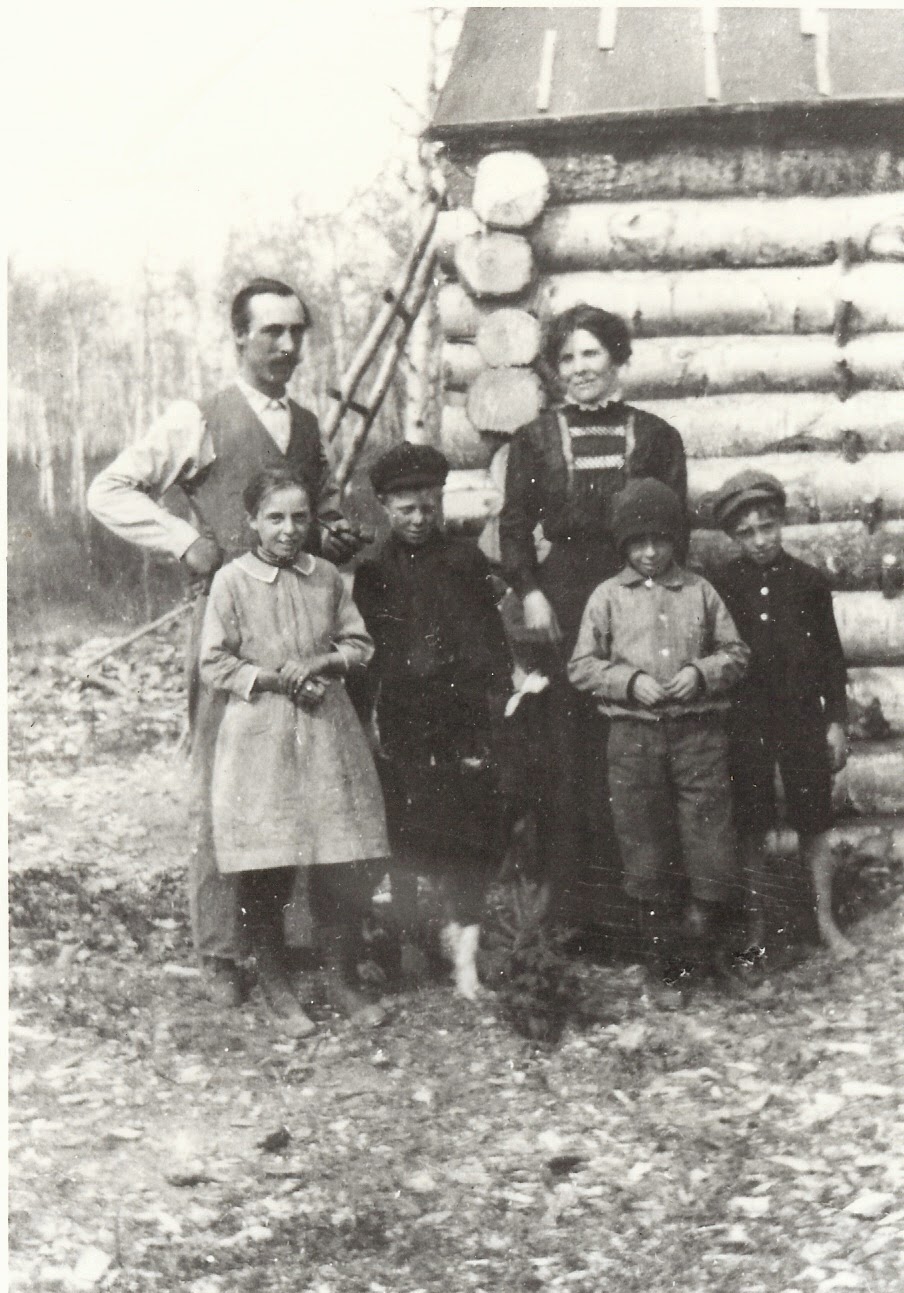
Along with the story Carol supplied me with a series of photographs and it is one of these that has drawn me in and led me off on a trail of investigation.

At first glance there is nothing unusual about the image.  Edwin and Maud are pictured with their two barefooted sons beside a log cabin sometime in 1913.

But it is the other two young people who interest me.  They are unknown and of course might just be friends or the children of neighbours.

But they could also be British Home Children employed on the farm.  Now I don’t usually do speculation but in this instance I am tempted to run with the idea.

The Harland farm near Frenchman Butte in northwest Saskatchewan was not a large one and “things remained difficult over the years and many jobs were taken on to supplement their income.  

Edwin became a well-digger and dug many wells throughout the area.”**

Even so  so I guess it is a possibility that they did from time to time take on labour and that the two staring out at us were also from Britain.

But I doubt we will ever know, my friend Jean has promised to ask Carol and it may just be that a document or letter referring to a British child might turn up.

And that of course raises an exciting avenue of research which might spin off into discovering who these two were or at least the names of children employed by the Harland’s.

That said I am at the limits of my knowledge and will have to explore the extent to which BHC were engaged in this part of Canada and who were the most likely charities to settle young people here in the first decade of the 20th century.

All of which may or may not help us with discovering the identities of the two young people, and with history being what it is it is just as likely that they were friends of the family in which case it has all been a bit of a wasted journey.

Well we shall see.

Pictures; courtesy of Carol Spencer


The Harland Family, http://chorltonhistory.blogspot.co.uk/search/label/The%20Harland%20Family

**Carol Spencer, Edwin Norman Harland 

Sunday, 21 December 2014

From south east London to Canada in 1913 part 2

This is the continuing story of Edwin and Maud Harland who left their home in south east London for Canada.*

Edwin as a young man
The story was written by Carol Spencer a direct descendant

"In the spring of 1913 Edwin set out to find his own piece of land.  They went on to Saskatoon and he made a couple of expeditions out to find the land of his dreams.

He travelled up to Carrot River area but was sure there were not enough trees.  (Carrot River is one of the richest farm areas in our province).  Next he checked out Red Cross District in Northwestern Saskatchewan.

Carrot River has rich, flat prairie land with lots of water.  Red Cross has many trees and rocky soil.  To Edwin the choice was clear!  Red Cross had trees for firewood and many rocks to build with.

Unfortunately rocks were not used much for building and trees needed to be removed before plowing.  His lack of farm experience left them in a difficult, tough life style.

The train line had reached Edam by this time and Edwin again loaded his family and belongings on the train and headed to northwest Saskatchewan to claim his homestead.

Maud with one of her sons to the right
Once in Edam a wagon and horses were purchased and all their belongings were loaded on to it and off to the claim they headed.  It was about a 60 mile journey and would take 2-3 days.

The road was a dirt trail of wagon ruts that required them to cross the Turtle River over which there was no bridge.

To Edwin it looked quite shallow and narrow.  He had Maude drive the wagon across then realized he was still on the wrong side of the river.  Being fairly athletic he decided he could very likely just jump the river and rejoin his family.

It was quite cool and the water was very cold as the ice had just thawed.  He backed up and took a running leap his long coat-tails flaring out behind.

Unfortunately he misjudged the distance and landed in the middle of the stream with the coat-tails floating out behind him.

Cold and wet he had to continue on as his family tried to hide their mirth!!  There were several stopping houses along the way for the family to stop at nights until they reached their claim."

Next; their first summer in Canada

© Carol Spencer, 2013

Pictures; courtesy of Carol Spencer

*The Harland Family, http://chorltonhistory.blogspot.co.uk/search/label/The%20Harland%20Family

Monday, 15 December 2014

Mr Knox and his 16 passengers in Orillia Ontario on a sunny day in 1911


Orchard Point, 1911 from the collection of Frank Kehoe
I am in Orchard Point, Ontario with a picture from 1911 which I grant is a long way from Chorlton, but images travel and this one in its way is a perfect piece of history.

It comes from a collection posted by the Orillia Museum of Art & History which I often visit because it “showcases the best of Orillia and Lake Country's culture and history through local and nationally significant exhibitions. OMAH's Discovery Gallery makes art touchable and fun for all ages”

And while I doubt I will ever be able to visit OMAH for those who might it “is located in the heart of Orillia's downtown shopping and restaurant district and is wheelchair accessible.”*

And so to the picture which I think works on many different levels for here is another of those images where lots of things are happening.

Mr Knox, and some of the children
At the centre is Mr Knox who we will return to later but for me it is the sixteen children who have crowded on to his car that draw you in to the photograph.

Some stare directly into the camera in the way that so many people did in those early picture from the beginning of the 20th century.

Others concentrate on the road ahead or the conversations of their friends.

But above all it is that sheer pleasure and novelty of a ride in a motor car and reminds me of that moment when Mr Shaw of Shaw’s Garages on Barlow Moor Road proudly stood in front of the first street side petrol pump in Chorlton.  As with this picture the camera had drawn a crowd but sadly unlike this one apart from Mr Shaw the rest of the people are lost to history.

Lillian Harris
But here sitting in Mr Knox’s car on that sunny day in 1911 are the names of all the children who climbed aboard and with those names a little of the story of the day.

The photograph is in the possession of Frank Kehoe who writes

“In 1911, sixteen children living at Orchard Point were given a real treat, a ride in a horseless carriage belonging to a Mr. Knox from Chicago. Mr. Knox had his car shipped from Chicago for his use when he spent his summers at the Klondike Hotel located at the Atherley Narrows. The hotel burnt in 1914. 

Back Row (L. to R.) Aubrey Gaudaur, Greta Harris, Mary Gaudaur, Stella Gaudaur, Rownea Gaudaur, Reg Gaudaur, Grace Stackhouse. Middle Row (L. to R.) Lillian Harris, Eva Harris, Nellie Harris. 

In front of Mr. Knox (the driver): Mavis Gaudaur, Stanley Harris, Oswald Harris, Selby Gaudaur, Mansel Harris. 

Still residing in Orillia are Reg Gaudaur’s children, Barbara McEown, Ross Gaudaur and Stella Gaudaur’s son, Frank Kehoe.”

So this makes Mr Kehoe’s picture such a treasure.  For those in Orillia the names of the children are a direct link to the towns’ past while for me the image captures the early age of the motor car, and perfectly captures that sunny day in 1911 when the car came to town.

Nellie Harris
Picture; from the collection of Frank Kehoe as displayed on the facebook site of the Orillia Museum of Art & History, https://www.facebook.com/pages/Orillia-Museum-of-Art-History/221378647891108

*Orillia Museum of Art & History, Peter Street South | Orillia, Ontario | L3V 5A9 | Telephone: (705) 326-2159 http://www.orilliamuseum.org/

**Always check your photo collections,

http://chorltonhistory.blogspot.co.uk/2012/04/always-check-your-photo-collections.html