Showing posts with label Albany Road. Show all posts

Thursday, 7 August 2025

Round Field Holt ….. Albany Road …… and a man called Enoch Royle

This is the story of a road.

Albany Road, circa 1920s
Not that there is much to distinguish it from all the other roads which from the 1880s into the next century transformed a place of fields and cottages into rows of shops and houses.

Along the way this place had lost its ancient name of Martledge and gained a new one.

The new one was less romantic and was just a statement.

 So, when people called the surrounding area New Chorlton, or the New Village it was only to distinguish it from the old centre of the township located around the former village green and the long twisty lane we now call Beech Road which was always known as Chorlton Row.

But New Chorlton had the railway station, which had opened to a flurry of interest in 1880 and was accompanied by a goods yard for the unloading and temporary storage of “things”.

Coal reciept, 1963
And because we were still a coal age part of the yard was given over to coal merchants, some of whom have yet to pass out of living memory, along with the Bailey family who regularly “walked” their newly arrived animals from the goods yard through Chorlton to their farm on St Werburgh’s Road.

As for Albany Road it was not cut until 1885, and then only extended to number 57, with the remaining seven houses coming along about nine years later.

To which will now be added a “4 storey building to form 40 residential apartments, together with cycle and car parking, bin store, landscaping, and boundary treatments” at 4B Albany Road.

Its a development which will replace a low-rise industrial building dating back to 1983.*

This plot has had a chequered past having once been railway land sitting at the end of the goods yard and briefly for a period in the 1920s into the 1930s was home to a tennis court.

Go back another century and it was farmed as arable land by William Knight and owned by the Egerton Estate.  Mr Knight counted 72 acres of arable, pasture and meadow land in his holding of which our spot had the delightful name of Round Field Holt.

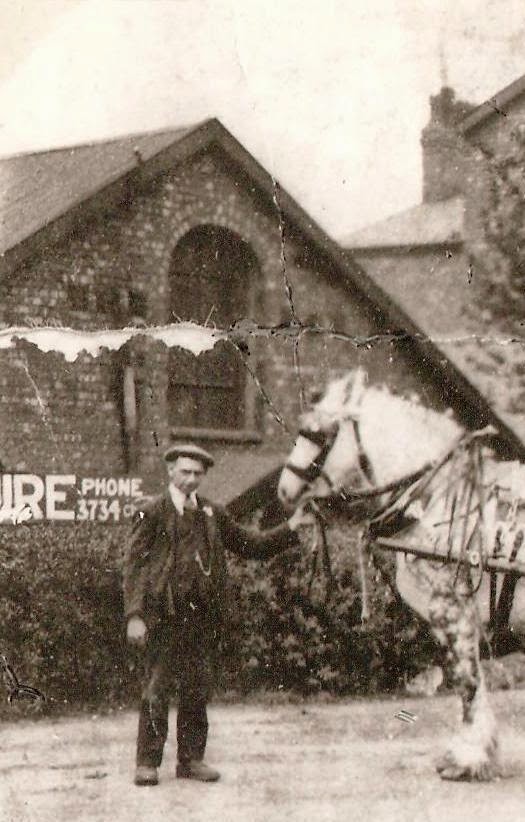
Enoch Royle and assistant, undated
To date I have found no pictures of the field although there are a few of the goods yeard and the railway station.

But Albany Road was recorded, and amongst the images there iare two of Mr. Enoch Royle and his wagon.  

He was a carter, and the two images show him on the stretch of Albany Road just past the junction with Brantingham Road.

What makes the two pictures of special interest are the buildings behind the wagon, one of which is the semidetached houses which are still there today and the other is the garage.

The church and hall, J Montgomery, 1968 from a lost picture postcard
And it is the garage that has always intrigued me, because I think this is on the site of what was once a church and church hall. 

There is a reference to the St Andrew’s Protestant Episcopal Evangelical Church and the Davenport Mores Hall on the corner of Albany and Brantingham.

It was run by the Rev William R. Graham D.D. and it was built sometime between 1907 and 1909, and two years later had become St Luke’s Protestant Episcopal Evangelical Church.

By then in 1911 the hall was unlisted but beside it on Albany Road sandwiched between the church and the home of Mrs Annie Kennedy was Metcalf & Higginbotham Ltd, paper merchants, which later is recorded as a “Furniture depository” and by 1950 as a garage.

All decked out, undated
All of which takes me back to the second picture of Enoch Royle which shows his wagon decked with decorations

The caption says “Decorated float in Albany Road, for Chorlton Carnival in the 1930s? Enoch Royle at the horses head, permission William Jackson.”

And I suppose that decorated float is where we will start.

According to the local historian John Lloyd, Chorlton staged a number of these carnivals during the mid-1930s which seemed usually to be centred on the Oswald Road part of new Chorlton and were part of the Rose Queen festivals which raised money for the Manchester and Salford Hospitals.

Before Albany Road, 1881
The Manchester Guardian in 1937 reported that carnival season had opened with “the gala held in St Margaret’s playing fields, Chorlton-cum-Hardy, on Saturday may be said to mark the opening of the charity carnival season. 

It has a history of five or six years only, but already it has become perhaps the most considerable effort of its kind undertaken in the city on behalf of the Manchester and Salford Medical Charities Fund”. 

And beyond a field, a railway and a Rose Queen Festival, there will be more on just how Albany Road fitted in to the story of Chorlton-cum Hardy but that is it for now.

Location; Albany Road

Pictures; Albany Road, circa 1920s, Enoch Royle and his wagons, undated but circa 1930s, from the Lloyd Collection, Coal reciept, 1963, courtesy of Marjory Holmes, and the church and hall, J Montgomery, 1968, from a lost picture postcard, m80123, courtesy of Manchester Libraries, Information and Archives, Manchester City Council, http://images.manchester.gov.uk/index.php?session=pass and Before Alabany Road, 1881, Withington Board of Health, courtesy of Trafford Local Studies Centre

*Application for the Erection of a 4 storey building to form 40  residential apartments, together with cycle and car parking, bin store, landscaping, and boundary treatments following demolition of existing buildings. 136878/FO/2023, Manchester City Council Planning Portal. 2023, https://pa.manchester.gov.uk/online-applications/applicationDetails.do?keyVal=RU36JOBCJDG00&activeTab=summary


Saturday, 7 June 2025

Of Chorlton carnivals, Enoch Royle's decorated cart and a missing church on Albany Road

Now there is a lot in this picture.

The caption says “Decorated float in Albany Road, for Chorlton Carnival in the 1930s? Enoch Royle at the horses head, permission William Jackson.”

And I suppose that decorated float is where we will start.

According to the local historian John Lloyd, Chorlton staged a number of these carnivals during the mid 1930s which seemed usually to be centred on the Oswald Road part of new Chorlton and were part of the Rose Queen festivals which raised money for the Manchester and Salford Hospitals.

The Manchester Guardian in 1937 reported that carnival season had opened with “the gala held in St Margaret’s playing fields, Chorlton-cum-Hardy, on Saturday may be said to mark the opening of the charity carnival season.  

It has a history of five or six years only, but already it has become perhaps the most considerable effort of its kind undertaken in the city on behalf of the Manchester and Salford Medical Charities Fund.  

It has all the customary carnival, features a queen to be crowned with picturesque ceremony, morris dancers and processions of characters in comic and fancy dresss on horseback, cycle or on foot.”

The last recorded was the 1937 one although others like the Stretford one lasted much longer.
Now Enoch Royle crops up in a number of pictures in the collection always with his wagon and always at the bottom of Albany Road.

Now I had assumed he was a coal man and said so in earlier posts,  but in 1929 when he was living at 26 Fielden Avenue he gave his occupation as carter which is important because I had gone looking for his coal yard on the corner of Albany and Brantingham Roads and instead found a church and a hall.

Both appear to have had a short life.  They were there by 1909 but had vanished by the 1940s and tantalizingly there are those who remember a business run from the corner which went under the name of Mores which means that I will have to go into the Ref and trawl the directories.

So that just leaves the house behind the cart which is still, there today and has in its time been both a private residence and a retail outlet.

My earlier story on Mr Royle prompted Andy Robertson to send me a picture of the property from a few years ago but sadly neither of us has a memory of what was beside the property before the garage.

So while I go searching for that bit of the story I shall close with the observation that back them you could see across to Manchester Road.

Picture; of Mr Royle circa 1930s, from the Lloyd collection, Albany Road in September 20102 , with 
Flynn's Electricals, courtesy of Andy Robertson 

*Manchester Guardian, June 21 1937


Monday, 5 February 2024

Travels through Chorlton in February ……. memories of Christmas Day


So ..... on February 5th I wonder about the discarded Christmas tree and assorted empty bottles.

Are we gazing at the tree which has just been forgotten?  Or did its owner only just accept it had to be thrown out along with the unwanted  cans of beer , wine bottle and festive used coffee cup? 

Location; Albany Road

Picture; Memories of Christmas Day, 2024, from the collection of Andrew Simpson


Thursday, 24 March 2022

Somewhere in Chorlton in 1929


I doubt that many of us could identify the road at first glance.

It is 1929, and the houses have been up for about forty years and are still in that first relatively  new phase before the roof and brick work need serious attention and before these family homes were divided up and given over to multi-occupancy.

Of course because it is 1929 there is not a car insight and on this sunny morning little seems to be stirring, all of which is a little deceptive as we are directly opposite the railway line  with frequent trains into Central Station and the heart of the city.

And also along this opposite side were the goods  yards where many of our coal merchants had their businesses.

All of which means it might not have been so quiet, but on this sunny morning it is hard to see what might disturb the peace and equally hard to see how today Albany Road could be left to a small boy a passerby and a woman on her knees cleaning the stone by the front gate.


Picture; from the Lloyd collection

Thursday, 5 August 2021

On being silly this summer ……no. 2 wondering what the collective is for a heap of trollies

A short series featuring the bits you don’t normally see.

And from Nigel Woodcock, a correction and a suggestion, 

"That’s a row, not a heap. Is the collective noun a wobble?" ....... pretty good for half six in the morning.

And from Andrew Grose, "A swerve" 
To which  Barnet Bee, has added "A mesh of trollies. Or maybe a parade of trollies".

And 4 and a bit hours after the story was posted, suggestions keep rolling in, so from Victoria Johnson, "A pound of trollies".

Location; Chorlton

Pictures;  a heap of trollies, 2021, from the collection of Andrew Simpson

Wednesday, 4 August 2021

On being silly this summer ……… no. 1 Chorlton windows

A short series featuring the silly bits you don’t normally see.

Location; Chorlton

Pictures;  Chorlton windows, 2021, from the collection of Andrew Simpson

Friday, 10 August 2018

So who remembers that church and the Davenport Mores Hall on the corner of Albany and Brantingham?

Now here is one of those mysteries which started out as something else.

Andy Robertson sent me this picture of the building at the bottom of Albany Road in response to a story on Enoch Royle the coal merchant whose father had his coal yard next door.

As you do it took me off on a series of thoughts about that house the yard and our reliance on the coal man.

And make no mistake well into the 20th century coal was the preferred way of heating our homes and for some the fuel that heated the open range used for cooking.

Along Albany Road down from the station there were a collection of coal merchants whose offices sat beside the railway line.

In 1911 there were Clifton & Kersley, Coal Co Ltd colliery proprietors, William Mylett coal merchant and Andrew Knowles and Sons Limited and well into the 1950s coal was unloaded bagged and sent out to homes across Chorlton.

And there will be plenty who remember being sent as a child to pay the coal bill at the offices of one of the merchants.

All of which seemed to make a nice story, mixing Enoch Royle’s coal yard where the garage now operates from, a bit on the house next door and reflections on how we heated our homes.

Until that is I turned up a reference to the St Andrew’s Protestant Episcopal Evangelical Church and the Davenport Mores Hall on the corner of Albany and Brantingham.

It was run by the Rev William R. Graham D.D. and it was built sometime between 1907 and 1909, and two years later had become St Luke’s Protestant Episcopal Evangelical Church.

By then in 1911 the hall was unlisted but beside it on Albany Road sandwiched between the church and the home of Mrs Annie Kennedy was Metcalf & Higginbotham Ltd, paper merchants.

Now I am intrigued by that church and the paper merchants which have far outstripped my interest in the house in Andy’s picture which I remember as a retail unit well into this century before it was returned to residential use.

So it is off to the archives and a search for St Andrew’s and St Luke's, the Rev Graham and Davenport Mores Hall.

They appear still to have been there in 1934 which means it is just possible they will be remembered by someone.
And remembered they have been is a sort of way, because Tony Goulding went digging and came up with this, "I have only known of the existence of this church for a couple of weeks when I found its location whilst consulting one of my old maps of Chorlton about another query,Intrigued I did a little of my own investigating----the only extra details I unearthed were from the 1911 SLATERS directory which gave the opening date as November 26 1905.

It accommodated 450 seats and there was a Sunday school with 300 places attached."

So there you are.

Pictures; Albany Road in September 20102 , with Flynn's Electricals, courtesy of Andy Robertson and sometime in the 1930s with Enoch Royle and father from the Lloyd Collection


Wednesday, 12 February 2014

Cosgrove Hall, remembering a little bit of Chorlton's film history

Brian Cosgrove unveiling the plaque to Cosgrove Hall
I have always been a fan of Danger Mouse and so was chuffed to be invited to watch Brian Cosgrove unveil a plaque at Cosgrove Hall Court on Albany Road.

It was here that Danger Mouse along with Chorlton and the Wheelies was made.

And now Hardy Productions have released their short film of the day.*

"Glad to be in Chorlton" - Cosgrove Hall Court Plaque Unveiling,  is a memorable film of a good day when we all came together to celebrate an animation company which produced some magical short films here in Chorlton.**

So thank you to Michael and Nigel who made the film and to McCarthy and Stone for organising the event at their new development on Albany Road

Picture; Brian Cosgrove unveiling the plaque at Cosgrove Hall Court, February 1014, courtesy of Hardy Productions

*Hardy Productions, http://hardyprodsuk.blogspot.co.uk/

**"Glad to be in Chorlton" - Cosgrove Hall Court Plaque Unveiling, https://plus.google.com/109541117941034501945/posts/LoABrQ4uvPu

***McCarthy and Stone, http://www.mccarthyandstone.co.uk/?gclid=CILtqa2Nx7wCFUj4wgod0B4AFg

Wednesday, 15 May 2013

A little of Chorlton's railway history, something about Morrisons and the new tram line to Didsbury


Chorlton Railway Station, circa 1900
It is one of those sad facts that if you can remember travelling from Chorlton railway station into the heart of the city or out in to the Hope Valley you will be on the wrong side of 45.

Not of course that 45 is old but it is just about the length of time that we have been missing a fast rail connection to Manchester.

And before the purists object the last train ran in 1967 and the first tram in 2011 which if you have done the sums is 44 years and to my reckoning  is still  a big chunk of anyone’s time.

But because shunting engines and goods waggons are even less interesting I doubt that few now are bothered with the fact that running alongside Albany Road was Chorlton’s own depot for coal and anything else that could be delivered by rail.

Weighing machine and hut, circa 1910
Now that I think is sad, especially as during the 50s my old friend Oliver Bailey remembers walking the newly arrived pigs from the goods yard through the roads of Chorlton to the family farm on Sandy Lane.

And likewise Ida can tell me which coal merchant she was sent to when the coal bill needed paying.

At any one time from the end of the 19th century well into the 20th century there were four or five coal merchants operating from Albany Road site along with builders and nurserymen. In 1911 there were five of them working from the yard by the railway line along with J. Duckett & Sons, building merchants, and J. A. Bruce Alexander, nurseryman.

It closed in November 1964 although a private siding stayed open for a while.

But with the closure of the railway link it all came to an end.  The coal merchants went, the rail tracks were pulled up to be replaced by a small business park and  a supermarket.

All of which brings us pretty much up to today.  The business park is still there and so is the supermarket which is now owned by Morrisons.

Morrisons, 2013, © Peter Topping
And I rather like the idea that Morrison’s are on the site of our old railway station.

After all the company was founded by William Morrison in 1899 just under twenty years after the railway arrived.

It began as an egg and butter stall in Rawson Market, Bradford and grew from there.

For most of its trading history it was based in the north but its purchase of Safeway in 2004 not only allowed it to expand across the country but brought it here to Chorlton.

At Morrisons with a story
In turn it has asked to be part of the Chorlton History trail and you can see part one of the story of the site along with paintings by Peter Topping in the store.

This as many will know is part of the GLAD TO BE IN CHORLTON initiative which now has 12  venues where you can read more about the history of where we live and something special about each place.

And as if on queue this comes along side the exciting news that from May 23rd you will be able to head out from the metro station next to Morrisons south to Didsbury, calling at Withington, Burton Road, West Didsbury, Didsbury Village and East Didsbury.

Metro stop, Chorlton, 2013 © Peter Topping
This 4.4km (2.7 miles) extension to the existing South Manchester line has been finished several months ahead of schedule.

So there you have it. A little of our railway history, something about Morrisons and the new tram line to Didsbury.

Pictures; Chorlton Railway Station circa 1900, from the Lloyd Collection, Morrisons supermarket and tram,© Peter Topping 2013 www.paintingsfrompictures.co.uk