Showing posts with label Rosa's cooking. Show all posts

Saturday, 4 October 2025

Of Naples in 1961 and Little Italy in Ancoats in 1901


Rosa in Naples 1961
This is one of my favourite pictures of Rosa.

It was taken in Naples when she was just 21 during the summer of 1961 just after she had collected her passport.

Later that year she left Italy with Simone her husband and moved to Cambridge.*

They were two of those economic migrants much derided by some who sought a new life in a new country.

In the same way and just sixty years earlier my father’s parents crossed the border from Scotland and settled in Gateshead while just a little later my maternal grandfather  came home to Derby with his German war bride.

And it carried on.  Dad and mum finally made their way to London where I was born and over the course of twenty years moved around south east London, and just under a decade later I left for Manchester.

All of which reinforces that simple idea that people move around, make new homes in new places and along the way add to the communities they have joined.

Nor is it all one way.  My great uncle left for Canada in 1914 followed by his sister eleven years later. One of my uncles carved out a career in India and east Africa before settling down in South Africa and to close the Italian connection Rosa and Simone finally left Cambridge for Italy returning not to Naples but Varese in the north.  Only for one of their daughters to return to Cambridge, relocate to Manchester and in the fullness of time to set up home with me.

13-15 Blossom Street, 1903
All of which is an introduction to the many who found a home here in Manchester in the 19th and 20th centuries.

Ours was the shock city of the Industrial Revolution and the mills, engineering plants, chemical works and collieries drew in the rural poor from the surrounding countryside, which were added to by those fleeing the famine in Ireland and later still those escaping the persecution in eastern Europe and the grinding poverty of southern Europe.

For some this was the eventual destination while for others it was the half way stage before crossing the Atlantic.

And their presence can still be found in the synagogues and Torah School of the Jewish community of Strangeways and Redbank and in names like Little Ireland and Little Italy.

Most have had their historians who have recorded their presence, ** which is all to the good because these communities have by and large vanished.  Little Ireland which had become one of our worst slums fell victim not to the sweep of town planners but to the railway, which cut through the area.

Not for the first time did a  railway company act as a means for slum clearance.  Much the same happened to sections of Angel Meadow in the north of the city and to parts of London’s slums.

In the case of the Jewish communities of Strangways and Redbank it was that other familiar social development which saw the better off moving out along Cheetham Hill Road to leafy more pleasant places.

Jersey Street, 2011
And so finally to Little Italy in Ancoats which became home to those from Italy who were seeking a better life.

They came from the great cities of the north like Milan, Turin and Genoa from the rural hinterland as well Naples, Sorrento, and Palermo.

It was a small close knit community inhabiting the area behind Great Ancoats Street and primarily located around Jersey Street, Blossom Street, and Henry Street.


Jersey Street, 1908, with No 2 Jackson Court to the left
Now as I often maintain if someone has done the research I have no intention of stealing their thunder, so for those who want to know more about Little Italy there is not only Anthony Rea’s book Little Italy, which was first published in 1988 but his equally fine site where you can find a wealth of information, stories and pictures.***

Added to this there are links to a whole range of other sites which give a comprehensive picture of he life they left and the contribution they made to their adopted city.

Pictures; Rosa in Naples, 1961 from the collection of the Balzano family, 13-15 Blossom Street,  A, Bradburn, 1903, m11033, and Jersey Street, 1908 m10153, courtesy of Manchester Libraries, Information and Archives, Manchester City Council, http://images.manchester.gov.uk/index.php?session=pass and Blossom Street from Great Ancoats Street with Gun Street and Henry Street beyond, 2010 from the collection of Andrew Simpson


*Messy history .......... Part One Migration, http://chorltonhistory.blogspot.co.uk/2011/12/messy-history-part-one-migration.html


** Bill Williams, The Making of Manchester Jewry, Manchester University Press 1976, Jewish Manchester: An Illustrated History, DB Publishing, 2008, and a new book on Manchester’s Pre Black History 1750-1926, Anthony Rea, Little Italy, Neil Richardson, 1988, and of course Little Ireland in Conditions of the Working Classes in England , Friedrich Engels, 1844

***Manchester's Ancoats, Little Italy, http://www.ancoatslittleitaly.com/index.html


Wednesday, 10 September 2025

Stories from the back streets of Naples ……. and a Neapolitan cookbook

There are many different categories of poverty, from not having the means to heat the home, provide food for the family or secure a decent education for your children.

Down a Neapolitan street, 2018

And up there with them is the absence of running water, which at the very least can mean a tedious frequent trip up and down stairs to the neighbourhood tap and at worst a long walk to a communal pump. 

With buildings that reach to the sky, 2019

Today, we take fresh and clean running water for granted.  It is one of those key steps forward in the provision of public health during the late 19th and early 20th century.

In my own family I would have to go back to my great grandmother and the 1870s and 80s, to be able to record stories of the communal water tap in the shared courtyard, and to my grandparents in the 1920s who shared an outside lavatory.  

But progress was in the air and by the time I regularly visited them three decades later, the lavatory had become their personal one, even if it was still located outside at the bottom of their yard.

And then in a casual conversation with Rosa who was born in Naples in 1940 I was reminded that drawing water from a tap in her home was as alien to her as it had been for great grandmother.

We had just had pasta for dinner, and as I went to start washing up, Rosa pointed to the huge saucepan of “pasta water” and suggested I use it to wash the pots and plates.

It struck me as odd, but it was still warm, and more to the point had I been back in Naples in 1940, I wouldn’t have entertained wasting water ….. not if it meant going down and coming back 4 flights of stairs with a fresh supply.

A Napoli Si Mangia cosi

From there the talk drifted to one of the cook books which has sat in our house for over 20 years.  It was published in 1986 and is entitled A Napoli Si Mangia cosi', which means In Naples you eat like this.

It was one of the things Rosa gave Tina when she left home to come to Britain a full 35 years ago.

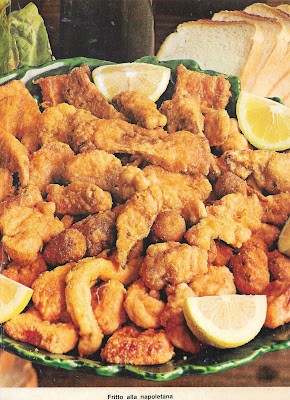
Fritto alla napoletana
It is much used, held together in part by sellotape and a book I occasionally flip through.

Now, I can’t speak or read Italian, despite many embarrassing attempts, and so having looked at the pictures I would put the book back.

What I didn’t know was that it is not written in Italian, but in Neapolitan which for some Italians can be as incomprehensible as any foreign language.

And even now she will often say to me this is the Italian for something, but in Naples we would say …….

All of which leaves me to decide if I should give up on Italian and go straight for Neapolitan.

We shall see.

But I now know that Fritto alla napoletana is a selection of vegetables and zucchini flowers dipped in batter and fried.

Pictures; from A Napoli Si Mangia cosi' and Naples Street, 2018-19, from the collection of Saul Simpson and Balzano

Friday, 24 May 2024

Dandelions, traditional food from Italy and childhood memories


It was after I gave up the fight to eradicate the dandelion from our garden that I remembered we were once served them in a salad in Greece.

Yellow and happy ... the dandelion
Like all casual gardeners the presence of this weed is a badge that I don’t care about the garden and a constant reminder that I should be out there pulling them up.

But they are a source of food and en mass I reckon they do look pretty neat.

Now the best time to harvest the leaves is in early spring when apparently they are “tender and delicious and can be served in salads and sandwiches.”

All of which was a revelation to me, but on reflection I can’t think why that should be.

There are many perfectly edible plants that grow wild.

Tina’s mum can often be found collecting these greens and bringing them home to serve up in a meal.

And when the children were younger Rosa would take them into the woods to collect chestnuts which she would either roast or boil.

In my case all I have left from my own childhood foraging is a memory of eating blackberries when out walking the lanes with my grandfather, although I do also cherish a few late September afternoon collecting from fruit from the side of a canal and making a pie with them.

My old friends John and Margaret would make regular journeys onto the meadows collecting Elderberry flowers to make into home wine.

Hedgerow Harvest, July 1946
I suppose it is a habit that we have lost preferring to buy them rather than collect them.

And I guess is also connected with the distance many of us are from our rural past.  Once it would have been commonplace to pick what could be found in the hedgerows.

But even sixty years ago it was for many a peculiarity so much so that in July 1946 the Ministry of Food issued advice of gathering food from the countryside.

These were still years of food rationing after the war and the Government offered a free advice service on how to plan prepare and cook meals.

Hedgerow Harvest declared that “there is a wealth of wild foods in our hedgerows and fields for those who are within reach of the countryside” and provided recipes for Elderberry pudding, Blackberry or Elderberry Roly Poly, Blackberry or Elderberry Kissell and Blackberry or Elderberry Tart, along with suggestions for how to make pickles and chutneys, fruit bottling without sugar, how to preserve tomatoes and jam making."

All of which takes brings me back to Rosa.  She was born in Naples in 1940 and her early years were set against wartime shortages and a style of cooking which made do of what there was and the skill of making a little go along way.

Rosa's meal for dinner
So there are no little bags of salad in her fridge nor pre packed slices of meat with a long sell by date.  Her food is fresh and what is left over goes into another meal that evening or the following day.

And yes she will still collect the green leaves on her regular walks out of Varese and her children still have fond memories of days out with a basket looking for interesting things to eat.

Now I am fully aware that at this point there should appear a Government Health Warning about being very careful about what you collect.

This I fully endorse given my own total ignorance about what to eat from the hedgerows.

Which I suppose is a sad comment on just how much has been lost.

And equally on that simple fact that despite all I have said those dandelions in the front garden make me feel a little uneasy and I rather think will have to go.

Which has also to be an admission that I have never tried eating dandelion leaves.

But for all those like me who are reluctant gardeners, my botanist friend Dave Bishop has provided me with the perfect reason for inactivity.

In response to the story he posted, "There are at least 100 species Dandelions in the UK and lots of Dandelion look-a-likes. 

They're all good for bees and other pollinating insects. 

As we're in the midst of a mass extinction event - at least as dangerous as climate change - we urgently need to re-think our relationship with our wild flora".

Enough said.

Pictures; from the Food Free Advice Service of the Ministry of Food in the collection of Vince Piggott, dandelions near you and waiting for Rosa from the collection of Andrew Simpson

Friday, 9 February 2024

Celebrating the food of the Mediterranean in 1954

Now I know it is stating the obvious that today's cook books will be tomorrow's little bit of history.

After all to read an 18th century recipe of suggestions or a mid 19th century order of dinner is to step back into a different world.

Of course I am well aware that by and large these were books written for the rich and so offer only a partial picture of how we lived in the past.

That said there are plenty of insights into how the poor ate, or not ate.

My favourite is The Family Save – All, which aims to offer up a variety of cheaper foods which might well have been eaten by the poor.

So with all that in mind here are two books by Elizabeth David, written in 1950 and 1954 and republished in the 1960s.

I came across my two Penguin editions which date from 1967 in the mid '80 from Bryan the Book on Beech Road.

By then I was well aware of Elizabeth David from the works of Claudia Roden and the TV shows of Keith Floyd.

Now if you grew up in the 1950s when food was still pretty basic and the memory of rationing was still vivid these books which celebrated the colour and excitement of food from the Mediterranean must have been breathtaking.

After all talk to my parents generation and they will tell you that olive oil was what you bought from the chemists and used for a variety of medicinal purposes.

And here were "a collection of recipes made by the author when she lived in France, Italy the Greek Islands and Egypt doing her own cooking and obtaining her information at first hand."*

My copies are stained and brown at the edges but that just makes them all the more of a treat to look at.

And they contain a wonderful set of illustrations.

I wish I could ask my mother what she would have made of Insalata Di Funghi.  Now she liked her salads but I doubt that a plate of raw mushrooms with "olive oil, pepper, a little lemon juice and if you like, a scrap of garlic" would have been her first choice over tomato, cucumber and a bit of lettuce.

But that is perhaps unfair, mum was very forward thinking and given that Nana was German and some of what we ate owed a lot to that fact, I think she would have embraced it.

And I am sure if she could accompany us to Tina's parents in Italy she would fall on the roasted peppers, assorted fresh salads and fruits with the same joy that I do.

Tina's mum is from Naples and while she has lived in the north for nearly 40 years her cooking is still rooted in that southern cuisine.

Rosa and Simone briefly worked here in Britain arriving in 1960 to what we had to offer which must have been a bit of shock but they returned to Italy with a love of instant custard and jelly which is an interesting cultural swop.

Now I could have of course reflect on the causes of the fairly swift transformation in what we eat over the last five decades, but that has pretty much been done to death, so perhaps it’s just a trip down to the shops and see what nice things they have and what on our return Ms David could suggest we make.

Pictures; covers from Italian Food, 1967 and Mediterranean Food, 1967

* The Family Save – All, W. Kent & Co, London Second Edition 1861

**Mediterranean Food Elizabeth David, Penguin Second Edition 1967

Friday, 10 March 2023

Zeppole …. a saint …… and an empty plate

So, yesterday Rosa made zeppole.

It is a favourite and consists of butter, eggs, and flour which when mixed are put through a piping bag to make the desired shape and then deep fried and finished off with a dusting of sugar.

Sometimes she will add home made custard, but last night they were presented just as twisty sugared donuts and they vanished as quickly as snow in the winter sun.

The art is to mix the eggs into the butter dough while it is still warm, otherwise it is a very hard job to get the mix to come together easily.

And that was the basic mistake Rosa made when she first came to Cambridge from Naples in 1960.  

She and her husband Simone were economic migrants welcomed as valued additions to the workforce, and stayed for a decade, working in the local hospital and briefly as domestic servants.

That first Cambridge attempt led Rosa to write home asking her mother what went wrong.

Today it would be a phone call or a virtual conversation, but not so 63 years ago. 

And so instead of a 5-minute chat, the follow up corrections took weeks to arrive.

In the same way our dad well into the 1990s always wrote to his brothers, including the weekly airmail one to uncle Charles in South Africa.

By contrast like most people, I rarely write to family or friends, committing the business to the phone, or social media.

Likewise I doubt I would have eaten zeppole when I was growing up, which like so much of the food I now take for granted had to wait decades to be widely consumed in Britain.

They are pretty much typical of Italian cuisine but are most popular in Rome and Naples where Rosa will have eaten them from childhood.

Now, Rosa makes zeppole all the year round, but she told me that they are really a specialty made on St Joseph’s Day which is March 19th.

So, we were a tad early, but none of the family complained.

And having posted a picture on social media, my Canadian cousins recognized them as cruellers and friends offered up variations from Spain and elsewhere.

But then the idea of frying dough and adding sugar or something sweet is as old as the hills, and reminds me of that Neapolitan fried pizza, which is a story for another time.

Location; everywhere

Pictures; zeppole, 2023, from the collection of Andrew Simpson

Sunday, 21 August 2022

One hundred years of one house in Chorlton ....... part 139 ….. just how many ways can you cook Parmigiana di melanzane?

The continuing story of the house Joe and Mary Ann Scott lived in for over 50 years and the families that have lived here since.*

Parmigiana di melanzane, 2021

I would be very surprised if Joe and Mary Ann ever came across aubergines.

Now I might be doing them a disservice, but they lived in our house from 1915 till 1973 which for most people in a tiny suburb of south Manchester was not a time of culinary adventure.

To be fair two world wars and a Depression were not conducive to exploring new foods cooked in different ways.

And here I can’t be sniffy because my experience of aubergines was very late in coming and only happened in the 1980s when I first started going to Greece.

I don’t count my student flirtation with tinned ratatouille which came from the local independent supermarket on Burton Road and contained a smidgen of aubergines.

Parmigiiana di maelanzane, 2022
After Greece it would be another two decades before I came across Parmigiana di melanzane made by Tina’s mum in the family kitchen in Varese, just north of Milan.

This was a revelation.  You take slices of aubergine, fry them in olive oil with or with out a dusting of egg and flour, then layer them alternatively with mozzarella cheese in a dish, top with tomato sauce and bake in the oven.

And after a decent interval they came to Scott’s house, but my attempts while good do not compare with Rosa’s who was born in Naples in 1940 and has been making the dish from as soon as she could.

This week she varied it, telling me that this was not the Neapolitan way but a version from Calabria.

The aubergines were sliced in two, the contents cut in criss crosses thane covered with mozzarella, cover in sauce and wacked in the oven.

It’s the way they are served in restaurants I guess because it is quicker, but as nice as it was I prefer the other way.

fagioli e pasta, 2022
At which point someone will mutter so what, or complain that this has little to do with a century of one house in Chorlton, but I think it does.

Partly because it demonstrates how our tastes have changed over that century, highlighting the growing availability of different foods, but also the culinary adventure many of us who grew up in the 1950s now take for granted.

Of course Brexit and rising inflation may dampen that demand, but those experiences are now out there.

To which I can now add another favourite which is fagioli e pasta, or beans and pasta, which is cheap, filling and nutritious, and a dish which its British variations might pull on potatoes rather than pasta and so tick a meal Joe and Mary Ann might have been familiar with.

Location; Beech Road and Italy

Pictures; Parmigiana di melanzane, 2021 7 2022, and fagioli e pasta, 2022, from the collection of Andrew Simpson

*The Story of a House, https://chorltonhistory.blogspot.com/search/label/The%20story%20of%20a%20house

Saturday, 9 April 2022

Breakfast …. an Easter discussion ….. and the promise of sun

Now Varese is warming up .

The Easter display, 2022
Yesterday the sun shone and while there was the threat of rain in the afternoon, the temperature hovered around 19˚ and there is the promise that by Easter it will be in the mid-20s.

But then that is what you can expect of this city, which is north of Milan, surrounded by lakes and close to the Swiss border.

Every Easter holiday we have headed south from Manchester, taken in a few cold days and then basked in the sun which is warm enough to take in a bit of sunbathing and visit the local gelateria for an ice cream.

And that same sun makes you want to get out early and take in breakfast at La Cucina di Altamura at the top of the road. *

 La Cucina di Altamura, 2017
It has a prime location facing the main road and just a minute’s walk from the local church, making it a perfect spot for a treat after the service, or an espresso before catching the bus into the city centre.  

I can’t be sure when it opened but it was well established by 2017 and is a regular haunt for the family.

There was some discussion about whether to buy a little something for Easter, but then Rosa cooks a shedload of traditional festive food and so the discussion drifted onto what we would being eating.**

Rosa's festive food, 2019
But here there will be a departure from normal because this year we will be back in Manchester for Easter with Rosa cooking all the traditional Italian food and serving it in Chorlton.

I am guessing the sun will not be as kind but the food will be as excellent as ever.

Location; Varese

Pictures; La Cucina Di Altamura, 2022, from the collection of Balzano and in 2017 from the collection of Andrew Simpson

* La Cucina di Altamura,  Via Pietro Giannone, 2, 21100 Varese VA, Italy http://www.lacucinadialtamura.it/

** A little bit of Italy this Easter ....... Neopolitan pastries and Colomba, https://chorltonhistory.blogspot.com/2015/04/a-little-bit-of-italy-this-easter.html


Monday, 27 December 2021

One hundred years of one house in Chorlton ... part 130 ….. "Ccà nisciuno è fesso”

The continuing story of the house Joe and Mary Ann Scott lived in for over 50 years and the families that have lived here since.*

Baba and Zeppole, 2019

I doubt that Joe and Mary Ann would ever have thought that the house would one day regularly echo to a mix of Italian, Neapolitan, and English with a bit of Polish thrown in for good measure.

Or that much of the food which today is put on the table comes from the far south of Italy with the odd dish from Lombardy, and some from Poland.

Of course that will be how it is in homes across the country with only the origins of the food differing from a heap of other European countries, along with food from the sub-continent, China, south east Asia, and pretty much everywhere.

Beans, 2014
But this is our house and here it is Italian, or more strictly Neapolitan, with a Polish flavour from our Saul and Julia who live in Warsaw, and occasionally a half remembered German dish which I try to replicate from what Nana made for us.

And so this Christmas Rosa and Tina have made a variety of meals, from roast peppers,  parmigiana di melanzane, to my favourite  Sicilian salad, made with oranges, chili flakes and garlic.

That said Rosa will also serve up food from the north of Italy where she has lived for over half a century, and earlier in the week it was Pizzoccheri, which is a mix of pasta, potatoes, savoy cabbage and spinach and three types of cheese.

Pizzoccheri, 2021
Pizzoccheri is a type of short wide tagliatelle made from a mixture of buckwheat flour and wheat flour. The buckwheat gives the pasta a brown speckly look which I have to say was different.

She cooked the potatoes and cabbage together and then layered these with the cooked pasta and the diced cheese with more grated cheese on top and baked for about 15 minutes.

I have to confess that greens do not do much for me. I guess it dates back to overcooked green cabbage which was served up in my primary school. 

Even now I have vivid memories of the agony of forcing it down under the stern gaze of the dinner lady wanting to be anywhere than facing this plate of torture.

But such is Rosa’s cooking that this pasta and cabbage dish was just delightful.

It reminded me of Metternich’s observation that “Italy is only a geographical expression” and even now 150 years after most of the Italian states joined together to form a united country there is much below the surface that underlines the idea that the place is still a collection of regions.

The pasta, 2014
Leaving aside the very different food of the north and south there are the attitudes of many northern Italians to those of the south which is seen as a drain on the wealth and resources of the northern states. It is there too in the northern perception that the south can be a lawless and dangerous place.

And as if to underline this simple prejudice, Tina and I recently watched Benvenuti al sud

[Welcome to the south] in which a post office manager from Milan is sent south for two years to the town of Castellabate south of Naples. It is a comedy of misunderstandings and stereotypes and perfectly coveys how the two Italy’s perceive each other.

It is also true that the dialect of the south is almost incomprehensible to many northerners as are traditional southern names, which caused Tina much heartache during her school years in the north when fellow students and teachers made fun of her long first name.

Naples, 2017

The family continued to speak Neapolitan at home and now she and Rosa will regularly slip into the dialect of the south while watching TV here in the house in Chorlton.

And so it was that Rosa uttered the comment “Ccà nisciuno è fesso”, over coffee this morning.  

If I have got the spelling and translation correct it is “here nobody is a fool”**

There are others, but most would not pass the 9'clock threshhold.

Picture; Baba and Zeppole, from the collection of Balzano, Rosa's tomato and beans, her Pizzoccheri, the box cover of Pizzoccheri della Valtellina, Naples, 2017, from the collection of Saul Simpson

*The Story of a House, http://chorltonhistory.blogspot.co.uk/search/label/The%20story%20of%20a%20house

**Ccà nisciuno è fesso, here nobody is a fool


Tuesday, 7 December 2021

When the Yorkshires went into the soup ….. doing all the leftovers .......the Neapolitan way

Now if you are old enough to have listened to Educating Archie, sung along to Two Way Family Favorites and cowered behind the settee during Quatermass and the Pit, the leftovers from the Sunday Roast were the dinners of Monday into Tuesday and maybe even Wednesday.


It does of course make perfect sense, saves money and is a smack in the eye of all those adverts urging you to consume ever more expensive “luxury” processed food.

That said back in the 1960s I worked with someone who abhorred the idea of revisiting any bit of the leftovers.

Over the years I have paid lip service to the idea but more often than not forget the container full of a few roast potatoes, and handful of sprouts and some sad looking carrots.

Not so Rosa who is back with us for December.  She was born in Naples in the 1940s and grew up amongst dire food shortages, which improved only slightly in the immediate post war years.


So almost every item can be used up from a few slices of stale bread, a plate of pasta which got cooked but was never eaten and a shedload of other things.

And today it was the vegetables from yesterday’s dinner, to which she added two potatoes, an onion, some mushrooms and a tin of borlotti beans, with the one surviving Yorkshire pudding which pretty much reminded me of the dumplings mother and grandmother would add to a stew, or a soup.

The mantra was “add enough of them and by the time the family had worked their way through the dumplings, carrots and potatoes, the odd slivers of meat was left untouched”

Which is all I am going to say, other than to state the obvious that for large parts of the world's population over countless centuries, using the left overs was not a fad but a necessity, and many of the world's great dishes are meat free.

And will conclude with the correction that left over soup is not peculiar to Naples, because my German grandmother did the same as did Dad whose family were Scottish and countless others who read this.

Picture, Yorkshire pudding soup, 2021, from the collection of Andrew Simpson


Monday, 11 October 2021

Il passatutto ....... and the pleasures of making passata

Now here is a bit of technology that takes me back over 65 years, and sits belong side the steel mincer, which you clamped to the side of the table, and shredded the leftovers from the Sunday roast.


Today, most of us would use an electric food processor, but I still prefer this simple device, which is perfect for preparing peeled tomatoes for tomato sauce.

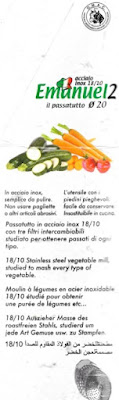
There are just three bits, which are a bowl, a bottom plate with holes like those in a colander, and a crank fitted with a bent metal blade that crushes the food and forces it through the holes in the plate.

So, nothing over elaborate, and nothing which can go wrong.  Although our last one which has lasted for over 20 years finally gave up on us after one of the small brackets came away from the bowl.

Like the new one it is from Naples, which is not surprising given that the Italian side of the family have been using them forever.  It is called a passatutto and can be used on a heap of different vegetables.

But when the family would gather to make their own passata they used a variation which is bigger and sturdier and fastened to the table.

My favourite is an old steel one with a detachable bowl which sat on top.

Today you can buy a host of differently shaped ones, some of which are powered by electricity, and boast plastic as well as steel parts.

But in essence they are all the same, and take me back to the stories of the 1960s and 70s, when the family along with aunts and uncles and cousins met up and worked through the day and into the night.

And the rest is a story for another time.

Pictures; il passatutto, 2021, from the collection of Andrew Simpson 


Tuesday, 21 September 2021

The art of Naples ............ Pasta e patate

Rosa is back from Milan, and with us into mid October.


And today she cooked Pasta e patate, which is a southern Italian dish and is just what it says it is ... pasta and potatoe.

Rosa was born in Naples and grew up there, only moving to the north in the early 1970s.

And so almost all she cooks is from the south.

I usually do the cooking in the house but when Rosa is here my job of cooking is relegated to the washing up.

After all why settle for pale imitations of Italian food when you can have the real thing?

Some of the pasta was left over from yesterday to which she added more, along with the potatoes and cooked in a tomatoe sauce.

During the cooking some of the potatoes disolved and helped add a thicker consistenecy to the sauce.

And that is all I have to say.

Location; north of Naples

Picture; Pasta e patate, 2021, from the collection of Andrew Simpson

Saturday, 17 July 2021

When Naples came to Chorlton …. no 4 pasta

A celebration of the food from Naples, cooked by Rosa, who was born and grew up in the city.

Location; Naples & Chorlton

Picture; a plate of pasta, 2021, from the collection of Andrew Simpson


Friday, 16 July 2021

When Naples came to Chorlton …. no 3 .... Pasta e Fagioli

A celebration of the food from Naples, cooked by Rosa, who was born and grew up in the city.


Pasta e Fagioli is one of our favourites, and  was celebrated by Dean Martin in that song, "That's Amore" in 1953.

Location; Naples & Chorlton

Picture; Pasta e Fagioli , 2021, from the collection of Andrew Simpson


Thursday, 15 July 2021

When Naples came to Chorlton …. no 2 .... peppers

 A celebration of the food from Naples, cooked by Rosa, who was born and grew up in the city.


Location; Naples & Chorlton


Picture; peppers, 2021, from the collection of Andrew Simpson


Wednesday, 14 July 2021

When Naples came to Chorlton …. no 1 Parmigiana di melanzane

A celebration of the food from Naples, cooked by Rosa, who was born and grew up in the city.

Location; Naples & Chorlton

Picture; Parmigiana di melanzane, 2021, from the collection of Andrew Simpson

Saturday, 10 July 2021

Bringing it home from Varese .... food without the football … no 3 Rosa’s pasta

So, I am bombarded with news coverage that the virus is on the run.


But despite being an optimist I will hold judgement, and I doubt we will get over to Italy in the near future to the visit family.


On the upside we have got Tina’s mum over from Milan, and that means meals have got just that bit more exciting.

A development which will please the kids who will all be dropping in over the next few weeks.  

All except our Saul and Julia who are in Warsaw.

Still I will continue to send them the pictures.


Location, Chorlton

Pictures; Rosa does pasta, aubergine, peppers, and much more, 2021, from the collection of Andrew Simpson


Thursday, 21 January 2021

Pepper day at Rosa’s place in Varese

Now yesterday was Peppers day, and Rosa excelled herself.


My favourite is her pepper salad, which she cooks with olive oil, some garlic and not a lot else.

I have tried cooking the way she does, and I have done the conventional, “wake’em under the grill until the skins go black, leave them to cool, peel them and serve in oil”, but they are never the same.

But then, Rosa comes from Naples and has been making them for nearly 70 years.

And yesterday she also stuffed some peppers, doing some with meat and some rice, and the rest as they say was pepper a day.

Location; Varese

Picture; Peppers day, 2021, from the collection of Rosa Balzano


Wednesday, 20 May 2020

Gnocchi di patata, Pizzoccheri della Valtellina, and a lesson in the geography of Italy

Now if I had a choice of Rosa’s cooking to eat it would be her native food from the south of Italy, that wonderful mix of fresh vegetables, olive oil and light pasta dishes.

But on a winter’s night with that raw wind which seems to find its way into every room in our house I reckon you can’t beat one of those heavy and hearty dishes of the north.

One of those that go down well with family and friends is gnocchi di patata.

It is made by mixing mashed potatoes with flour and an egg, then rolling the mixture into a sausage shape which is then cut and divided into balls and cooked in boiling salted water and served with melted butter and lots of parmesan cheese or in our case tomato sauce.

I say balls but that isn’t actually accurate. The shapes can vary slightly and Rosa’s are a little flatter and have ridges on one side which are achieved by a wonderful little wooden utensil. It resembles one of those tools that used to be used to make butter pats but has ridges along the underside of the flat surface. The art is to use the smooth side of the utensil to roll the cut shape and then the other side to add the ridges which are there to better hold the sauce.

But Rosa excelled herself on the last night before they flew back to Italy. We had been in Harrogate all day at the Turkish Baths but before we left the city she made Pizzoccheri della Valtellina, which put simply is a mix of pasta, potatoes, savoy cabbage and spinach and three types of cheese. Pizzoccheri is a type of short wide tagliattelle made from a mixture of buckwheat flour and wheat flour. The buckwheat gives the pasta a brown speckley look which I have to say was different.

She cooked the potatoes and cabbage together and then layered these with the cooked pasta and the diced cheese with more grated cheese on top and bake for about 15 minutes.

I have to confess that greens do not do much for me. I guess it dates back to overcooked green cabbage which was served up in my primary school. Even now I have vivid memories of the agony of forcing it down under the stern gaze of the dinner lady wanting to be anywhere than facing this plate of torture.

But such is Rosa’s cooking that this pasta and cabbage dish was just delightful.

It reminded me of Metternich’s observation that “Italy is only a geographical expression” and even now 150 years after most of the Italian states joined together to form a united country there is much below the surface that underlines the idea that the place is still a collection of regions.

Leaving aside the very different food of the north and south there are the attitudes of many northern Italians to those of the south which is seen as a drain on the wealth and resources of the northern states. It is there too in the northern perception that the south can be a lawless and dangerous place.

And as if to underline this simple prejudice, Tina and I recently watched Benvenuti al sud

[Welcome to the south] in which a post office manager from Milan is sent south for two years to the town of Castellabate south of Naples. It is a comedy of misunderstandings and stereotypes and perfectly coveys how the two Italy’s perceive each other.

It is also true that the dialect of the south is almost incomprehensible to many northerners as are traditional southern names, which caused Tina much heartache during her school years in the north when fellow students and teachers made fun of her long first name.

Picture; Rosa's peppers, her pasta, the box cover of Pizzoccheri della Valtellina and fruit salad, from the collection of Andrew Simpson

Sunday, 12 April 2020

Tasting Italy at Easter …………… from a distance


Now, like so many families, Easter this year has been very different.

Not only have we been unable to travel to see our kids in the run up to the festival, but flying out to be with the Italian side of the family will have to wait a year.

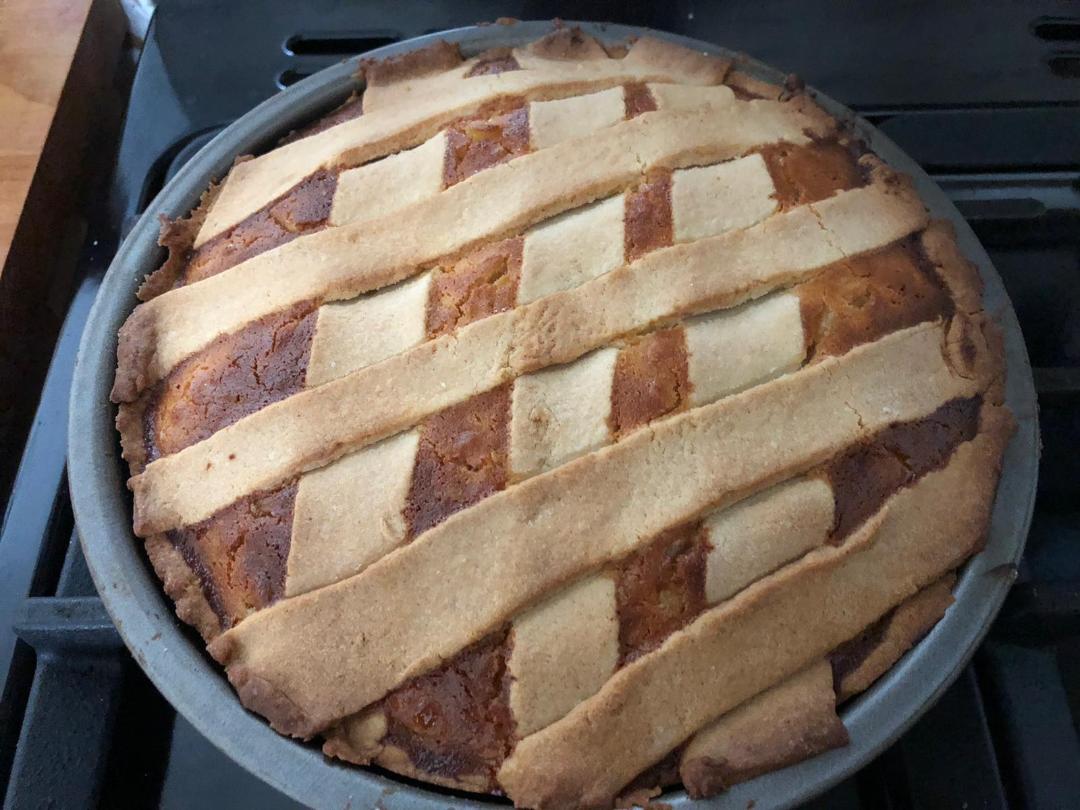
Rosa is from Naples, and so she would always bake pastiera which is that Neapolitan tart made with cooked wheat, eggs, ricotta cheese, and flavoured with orange flower water, and the savoury bread containing cheese, and meat.

On occasion she would make a variation of the savoury bread with eggs on top, and because I am vegetarian she would make a special one without the meat.


Depending on how many of our kids came with us there could be upwards of fifteen sitting around the table for the Easter meal, which as all good family meals do could stretch out across the afternoon, only to start again in the evening.

The one concession would be that the table had been cleared the plates and cutlery washed and put away, with much coffee and limoncello consumed before we started again.

And I miss those gatherings as I do Italy in spring, when the mornings might begin with a chill but usually turn out hot and sunny, and when the stillness of the early morning is broken by the sound of church bells.

But this year is different for another reason because Simone died on the day before Easter Sunday, making the separation all that more bitter.

And while there will be another Easter in Italy, it will not be the same.

Pictures; the taste of Italy, 2020

Monday, 2 March 2020

When a cook book becomes a bit of our collective past

Ricotta cheese, eggs, sugar and candied peel  with a lattice of pastry, 2010
I won’t be alone in having several bookshelves filled with cook books.

Most remain unopened from one year to the next and only come down to be looked at for the pictures and the carefully written stories.

Not that there is anything wrong in that but that doesn’t make them cook books.

To qualify for that status the book has to be much thumbed, with more than a few cooking stains and fall open at old favourite dishes many of which you know off by heart anyway.

And these books will all come with a history.

That history might be the book given as a wedding present or as a going away manual for the son or daughter about to set up their own home and they also will be full of recipes that reflect the eating habits of the past.

A finished Meta display, 1947
We still have mum’s two volumes of Meta Given’s Modern Encyclopedia of Cooking first published in the USA in 1947.

In its time it was as essential as Mrs Beaton’s guide to household management and followed a tradition which can be traced back to the monthly periodicals issued during the 19th century and the stylish recipe books of the century before.

I think the two volumes were given to mother soon after she settled down with my father and they have been part of my life since.

Not that she used them over much.  They have American measures and many of the foods listed would not have been available in those post war years when there was still rationing.

Here are appetisers like Apple Tempters and Shrimp Cocktail, traditional main courses of liver and onions, broiled, fried or roast chicken and a host of puddings.

Some do tempt me but others like Italian Style Liver Marconi and Tomatoes followed by Baked Pears with Marshmallows I am happy to leave alone.

Met's take in stuffed peppers, 1947
But they reflect that immediate post war period when the growing prosperity of the USA set it apart from Britain.

That said we did have Coronation Chicken that 1953 dish first served at the Queen’s Coronation meal which was a mixture of cold chicken with mayonnaise and curry.  It sounds quite tame today but against the backdrop of years of rationing I reckon it would have been pretty exotic.

I have dipped into Meta Given but it is a world away from what I am comfortable with eating.

So my manual of choice is the Silver Spoon which first appeared in Italy in 1950 and like Meta was meant as the ultimate guide to food, cooking and all you wanted to know about both.

I came across it  a decade ago and saw in it an opportunity to reproduce the meals which Rosa cooks when we go home to Italy.

Now family dishes are not learnt from cook books but handed down and in the case of Rosa’s cooking reflect her upbringing in Naples in the 1940s and early ‘50s when food was in short supply. So most of what we eat is weighted to the food of southern Italy with just the odd nod to the heavier dishes of the north, which means plenty of vegetables, fruit and fish and only small amounts of meat.

Rosa's fish stew, 2010
Of course the Silver Spoon includes the lot but I have to say I slide towards the south and fall back on Rosa’s favourites many of which come with a family story.

Like the one about the about making passata which began with the raw tomatoes and ended with the bottling of the finished stuff which was stored away in the garage and pretty much kept them going all winter.

It was a collective affair with uncles and aunts joining the kids, Simone and Rosa and lasted the day and was as much about getting together and retelling old tales as it was about making food.

Sadly the Silver Spoon leaves out the stories which are a shame and set me off thinking that perhaps it’s time to produce that family cook book which will offer both the workaday meals we remember with a bit of the family history.

We shall see.

Picture's Rosa's Easter tarts and fish stew 2010 and dishes from Meta Givern, 1948 from the collection of Andrew Simpson