Showing posts with label Roman History. Show all posts

Thursday, 29 January 2026

The Roman Arena ..... on the wireless today

This is another bit of history I enjoyed today.

It comes from that excellent series In Our Time and is free to listen to long after the first broadcast. 

"Misha Glenny and guests discuss the countless venues across the Roman Empire which for over five hundred years drew the biggest crowds both in the Republic and under the Emperors. 

The shows there delighted the masses who knew, no matter how low their place in society, they were much better off than the gladiators about to fight or the beasts to be slaughtered. 

Some of the Roman elites were disgusted, seeing this popular entertainment as morally corrupting and un-Roman. Moral degradation was a less immediate concern though than the overspill of violence. 

There was a constant threat of gladiators being used as a private army and while those of the elite wealthy enough to stage the shows hoped to win great prestige, they risked disappointing a crowd which could quickly become a mob and turn on them.

With Kathleen Coleman, James Loeb Professor of the Classics at Harvard University, John Pearce, Reader in Archaeology at King’s College London and, Matthew Nicholls, Fellow and Senior Tutor at St John’s College, Oxford

Producer: Simon Tillotson"*

Picture; mosaic depicting a gladiatorial fight  from the villa Nennig,** dating from the first century AD, 2021, https://www.flickr.com/photos/168399512@N02/51134391753/ Author TimeTravelRome, Licensing w:en:Creative Commons attribution This file is licensed under the Creative Commons Attribution 2.0 Generic license.***

*The Roman Arena BBC Radio 4, In Our Time, https://www.bbc.co.uk/programmes/m002qj85

**Nennig is a village in the Saarland, Germany, part of the municipality of Perl. It is situated on the river Moselle, opposite Remich, Luxembourg.

***Roman Villa Nennig, https://www.visitsaarland.co.uk/poi/detail/roman-villa-nennig-c859e1607c

Saturday, 17 January 2026

D Day ...... AD 43 .......Portrait Of An Age ..... and the death of General Gordan

Pan Edition 1961
I have begun re-reading The Great Invasion by Leonard Cottrell.

It was first published in 1958 and describes the Roman invasion and conquest of Britain.*

Now Mr Cottrell had himself been a war correspondent and this book was written only 13 years after the end of the last world war and must have had a real resonance.

“Among the readers of this book may be some who have known what it is like to wade on to an enemy beach under heavy fire. 

Others may have commanded troops in such actions, and experienced that nerve racking moment when all hangs in the balance, when the defenders have the advantage of protected positions, and the attackers have not had time to establish their fighting formations.” 

And in quoting Julius Caesar’s account of the military expedition to Britain in 55 BC Mr Cottrell observed that it “could almost describe an attack on the Normandy beaches or a Japanese island in the Pacific.”

So  there is a directness and a sense of authenticity about the account which other such later books on the subject do not give me.

Michael and Susan Henchard artist Robert Barnes, 1886
Now we all have our favourite books, the ones we return to time and time again to the point that we can  quote back at the author the opening lines or know just what awaits the leading characters just around the next page.

I never tire of those first few lines from A Tale of Two Cities and the sinister and chilling warning at the start of The War of The Worlds

In the same way I am still moved to indignation when the drunken  Michael Henchard sells his wife and daughter at the beginning of Hardy’s The Mayor of Casterbridge.

But history books are different, and mainly because the scholarship moves on and what was fresh and new is at best old and tired and all too often has been proved wrong by new discoveries.

Some of course survive because of the style, wit and elegance of the writing.
Gibbon’s Decline and Fall, Thomas Babbington Macaulay’s social history and Young’s Portrait of An Age are still a joy to read.

I do not think you can better the opening of Young’s Portrait of An Age, **

O.U.P., edition, 1960
“A BOY born in 1810, in time to have seen the rejoicings after Waterloo and the canal boats carrying the wounded to hospital, to remember the crowds cheering for Queen Caroline, and to have felt that the light had gone out of the world when Byron died, entered manhood with the ground rocking under his feet as it had done in 1789.  

Paris had risen against the Bourbons; Bologna against the Pope, Poland against Russia, the Belgians against the Dutch.  

Even in well drilled Germany little dynasts were shaking on their thrones and Niebuhr,*** who had seen one world revolution, sickened and died from fear of another.  

At home, forty years of Tory domination were ending in panic and dismay; Ireland, unappeased by Catholic Emancipation was smouldering with rebellion; from Kent to Dorset the skies were a light with burning ricks.”

And I still enjoy  the closing lines of the essay on the Death of General Gordan by
Lytton Strachey in his Eminent Victorians which having surveyed Gordan’s life and the campaign to avenge his death concludes that “General Gordan had always been a contradictious person – even a little off his head, perhaps, though a hero; and besides he was no longer there to contradict .... At any rate it all ended very happily – in a slaughter of twenty thousand Arabs, a vast addition to  the British Empire, and a step in the Peerage for Sir Evelyn Baring.”****

Penguin Classics, 1989
Set against the measured, and dry writings of so many here is a sweeping comment on British imperialism and a cynical examination of the later Victorian period.

All of which is a long way I know from D-Day AD 43 and the great Roman Invasion.

On the other hand these are the sorts of history books which capture the imagination and want you to read more leading you on to even greater study, if only to know whether Lytton Strachey was fair or Mr Cotteril accurate.

And of course are as entertaining as the those first few lines from A tale of Two Cities and the sinister and chilling warning at the start of The War of The Worlds*****

Pictures covers from Pan Books, The Mayor of Casterbridge, the O.U.P. and Penguin Classics

*The Great Invasion, Leonard Cottrell, 1958

**Portrait of an Age, G.M. Young, 1936

***Barthold George Niebuhr, August 27 1776 – January 2  1831, was a Danish-German statesman and historian who became Germany's leading historian of Ancient Rome and a founding father of modern scholarly historiography.

****Eminent Victorians, Lytton Strachey, 1918

*****“It was the best of times, it was the worst of times, it was the age of wisdom, it was the age of foolishness, it was the epoch of belief, it was the epoch of incredulity, it was the season of Light, it was the season of Darkness, it was the spring of hope, it was the winter of despair, we had everything before us, we had nothing before us, we were all going direct to Heaven, we were all going direct the other way.”

“No one would have believed in the last years of the nineteenth century that this world was being watched keenly and closely by intelligences greater than man's and yet as mortal as his own; that as men busied themselves about their various concerns they were scrutinised and studied, perhaps almost as narrowly as a man with a microscope might scrutinise the transient creatures that swarm and multiply in a drop of water.”

Tuesday, 19 August 2025

My favourite Roman ........ Catullus ..... on the wireless today

I have returned to the poems of Catullus.

The 1968 edition

I first came across him in 1975, during a very messy moment at the end of a relationship.

And since then I regularly return to his poems.  

And today I am doing so with Natalie Haynes and her wonderful series Natalie Haynes Stands Up for the Classics * which the sleeve notes tell me Catullus was 

"The brilliant Roman love poet is the poster boy for teen angst. He feels everything intensely, from the stealing of his favourite napkin to the death of his lover Lesbia's pet sparrow. And then he dies young. Of course the Romantics loved him, as do his biographer Dr Daisy Dunn and Professor Llewelyn Morgan.

The 2004 edition
Born to an aristocratic family in Verona, Catullus is fearless in abusing in sophisticated verse his father's friend Julius Caesar, his ex-lover Lesbia and the poets unlucky enough to be his contemporaries. Satirical, scurrilous and obscene, his popularity endures.

'Rockstar mythologist' Natalie Haynes is the best-selling author of 'Divine Might', 'Stone Blind', and 'A Thousand Ships' as well as a reformed comedian who is a little bit obsessive about Ancient Greek and Rome.

Dr Daisy Dunn is an award-winning classicist. Her books, Catullus’ Bedspread: The Life of Rome’s Most Erotic Poet, and The Poems of Catullus: A New Translation, were published in 2016 and earned her a place in the Guardian‘s list of leading female historians.**

Producer...Beth O'Dea Read less"

Pictures; cover of The Poems of Catullus, Translated by Peter Whigham Penguin Classics, cover shows a portrait of Arteidorus from Hawara, Egypt, second century, British Museum 1974, reprint, and Catullus The Poems Translated by Peter Whigham Penguin Classics, 2004, cover shows a detail from a Roman mosiac 3rd-4th century AD in the Piazza Armenia villa of Maximinorous. Sicily, photoo AKGO/Eric Lessing

*Catullus, Natalie Haynes Stands Up for the Classics, Series 11, BBC Radio 4, https://www.bbc.co.uk/sounds/play/live/bbc_radio_fourfm

**Catullus’ Bedspread: The Life of Rome’s Most Erotic Poet, Daisy Dunn, 2016

Tuesday, 7 May 2024

Back with Being Roman ...... with Mary Beard ... the whistleblower

Now I am a great fan of the Roman historian Mary Beard, and so I was pleased to see she is back on Radio 4 with a new series on Being Roman.*

Artemidorus, Hawara, Egypt, second century
It is a series which explores the lives of what we might call "ordinary" Romans.

"Beneath starched Shakespearean togas and the pungent fug of gladiator sweat there are real Romans waiting to be discovered. To know what it was to be Roman you need to gather the scattered clues until they form a living, breathing human, witness to the highs and horrors of Europe’s greatest empire.

Mary Beard, Britain’s best-selling historian of the ancient world, rebuilds the lives of six citizens of the Roman Empire, from a poet to a squaddie. 

Her investigations reveal death and deceit on the Nile and the art of running a Roman pub, but it’s the thoughts and feelings of individual Romans she’s really interested in.

It's 61CE. The rebellion of Boudicca has finally been quashed, but London and other Roman cities lie in ruins. A new finance officer for the province, Gaius Julius Classicianus arrives, to face an enormous recovery job. 

Standing in his way is the Governor, busy exacting terrible reprisals from the local population. Classicianus does what brave subordinates have done ever since. 

Boudicca. London

He whistle-blows – writing to the emperor to remove the Governor from British shores. The stage is set for an imperial face-off. For the people of Britain, the stakes could not be higher.

Producer: Alasdair Cross

Expert Contributors: Matthew Nicholls, University of Oxford and Michael Marshall, Museum of London Archaeology

Cast: Tacitus played by Robert Wilfort

Translations by Mary Beard

Special thanks to the British Museum"*

Models of Roman soldiers, 1974

Picture; portrait of Artemidorus, Hawara, Egypt, second century, British Museum, taken from cover image  of the Poems of Catullus, Penguin Classics, 1968, statue of Boudicca, from the collection of Stephen Hall, models of Roman soldiers, from the collection of Andrew Simpson

*Being Roman, https://www.bbc.co.uk/sounds/play/live:bbc_radio_fourfm

Friday, 8 December 2023

Losing your history ……. and finding some stories

If you were born in the first half of the last century the chances are that you carried a little bit of our collective history around with you.

Queen Victoria penny, 1865
It would be there in your pocket, your purse or held for a rainy day in one those small containers which resembled a pillar box or any one of a heap of animals pretending to be a savings bank.

But in 1971 when the country adopted a currency based on decimal units almost all of the existing coinage was junked.  

Out went the old-fashioned penny, the threepenny bit as well as the ha’penny and while some silver coinage lingered on, kidnapped and made to perform a new role as decimal coins they too pretty quickly vanished as the bight new shinny stuff rolled out of the Mint.

And of course, all the new coins bore the head of the reigning monarch, which is how it has been ever since, ensuring that the oldest real decimal coin dated from 1971.

All of which for my generation wiped out the history lesson whereby you might have coins in your pocket stretching back into the mid-19th century, and meant you rubbed hands with effigies of Queen Victoria, Edward V11, King George V and V1 as well as the young Elizabeth.

Reverse of Queen Victoria, penny, 1865
The older the coin the more warn and thin it might have been but it still passed for legal tender, even though there was as ever the temptation to save the older ones for their historic connection.

So while early and mid-Victorian pennies were rare they did turn up, hence this 1865 one, and those of Edward and the two Georges were to pinch the phrase “two a penny”.

At which point I am not making out any great claims that this was much of a history lesson, but it did mean you were vaguely aware of the past stretching out in front of you.

And in another way, it points to the historical continuity which was a currency based on pounds shillings and pennies, where 240 pennies made a pound, 12 pennies made a shilling and twenty shillings made a pound, and along the way introduced to the guinea.

Half penny, 1951

At the time of decimalization great claims were made of how complicated was a currency based on different units, but I doubt many of us were, after all we grew up with it and it was just part of the backdrop of normal life, like steam locomotives, black and white television and bus conductors.

And in Junior school it was just one of the many ways you learnt to add up and subtract along with those more challenging problem solving exercises involving  four men, three women seven apples and the amount of money Eric Braithwaite might make from selling the apples to the people at 2d an apple.

All of which makes me wonder whether Roman school children had to endure the same brain numbing lessons or for that matter the slave sent out into the local market to get the best deals on olive oil and black pepper.

This is no flight of fancy but a very unsubtle way of introducing this Roman coin which along with three others I bought in a small shop behind the British Museum sometime around 1974.

Roman coin, Claudius, 43 -54 AD

At the time I was looking for the odd little teacher resource to make the teaching of Roman history a bit more interesting.

Already I had bought a replica Roman lamp and very shamefully presented an old leather sandal bought in the Eighth Day on Oxford Road as a genuine 1st century piece of Roman footwear similar to those found at Vindolanda along the Wall.

Reverse of the Claudian coin,
The older me shudders at such a breach of historical accuracy while the younger me enjoyed the hushed silence of 30 first year students in room 11 on Portway in Wythensawe.

Now as we are in confessional mood I can’t say this one is part of the four I bought for what amounted £2 new money, and it is possible that it came from a collection of replicas I bought later.

Either way I still find it something to look at, and put with the very real Viking oyster shell I bought in York at the Jorwick archaeological dig in the later 1970s for the price of 10 new pence, there being so many found during the excavation.

The shell I can date to the Viking settlements of York and I think the coin is the Emperor Claudius and the rest as they is another story.

Viking oyster shell, Jorvick
Location; our collection


Pictures; Queen Victoria penny 1865, half penny, 1951, a Roman coin from the era of the Emperor Claudius, [I think] and a Viking oyster shell from Jorvick


Friday, 1 December 2023

Being Roman ...... with Mary Beard ... what an excellent series

I am a great fan of Mary Beard who has that ability to recreate the world of the Romans in all its complicated, messy and fascinating way.

Woman with wax tablets and stylus
Soover the last six weeks  I have be listening to her Radio 4 series on "Being A Roman" and the first of the six on Loving an Emperor.*

"Beneath starched Shakespearean togas and the pungent fug of gladiator sweat there are real Romans waiting to be discovered. To know what it was to be Roman you need to gather the scattered clues until they form a living, breathing human, witness to the highs and horrors of Europe’s greatest empire.

Mary Beard, Britain’s best-selling historian of the ancient world, rebuilds the lives of six citizens of the Roman Empire, from a slave to an emperor. Her investigations reveal the stressful reality of Roman childhood, the rights of women and rules of migration, but it’s the thoughts and feelings of individual Romans she’s really interested in.

In the bloody chaos of civil war, a young bride witnesses the savage murder of her parents, fights for her inheritance and funds her husband’s flight from the brutal gangsters carving up the empire. On Hadrian’s Wall a Hertfordshire slave girl marries a Syrian trader. Is it a cross-cultural love story or a brutal tale of trafficking and sexual abuse?

An eleven year old boy steps on stage to perform his poetry to a baying crowd of 7000 and the Emperor himself. The political and financial future of his entire family will be decided in the next few stanzas.

Replica statue of Emperor Augustus, Rome, 2007

Across six episodes Mary Beard travels the Empire and gathers first-hand testimony and expert comment, creating an extraordinarily vivid sense of Being Roman.

In the first episode we meet Marcus Aurelius, the very model of the ideal Roman Emperor. Strong and masculine, but a deep thinker with wise words for every occasion. Richard Harris played him in the film Gladiator as a great leader of men, determined that loyal Russell Crowe inherit the Empire rather than his treacherous son, Joaquin Phoenix.

Artemidorus, Hawara, Egypt, second century
As Mary discovers, Marcus proves much more complicated- and interesting- than his image in popular culture. Letters to his beloved tutor reveal a naïve, sweet and dangerously flirtatious nature, while his record of campaigning and persecution under his rule shows an Emperor as comfortable with brutal violence as stoic philosophy.

Producer: Alasdair Cross

Expert Contributors: Amy Richlin, UCLA and Elizabeth Fentress

Cast: Marcus played by Josh Bryant-Jones and Fronto played by Tyler Cameron*

Pictures, Woman with wax tablets and stylus, Naples National Archaeological Museum, Accession number 9084 Naples National Archaeological Museum,  Replica statue of Emperor Augustus, Rome, 2007, portrait of Artemidorus, Hawara, Egypt, second century, British Museum, taken from cover image  of the Poems of Catullus, Penguin Classics, 1968

*Being Roman...Loving an Emperor, https://www.bbc.co.uk/programmes/m001s5ck

Wednesday, 5 July 2023

When Marches of Mutiny are the flavour of the month .... one to listen to

With a march on power still hitting the news this programme from the The Long View is a fascinating listen.*

 The only portrait of the dictator Sulla. 2016
"The notorious Wagner group of mercenaries marched for Moscow after calls from its leader to 'end this disgrace’. Yevgeny Prigozhin insisted it was a ‘march for justice’ and not a coup, but for 24 hours Russia’s future seemed uncertain and the political impact of the brief uprising remains to be seen.

The Roman general, Sulla, was the first leader of the Republic to seize power by force, marching twice on Rome – first in 88 BC, and the Streltsy uprising of Russian soldiers in 1698 proved a decisive moment in the rule of Peter the Great.

Jonathan Freedland takes the long view of marches of mutiny.

Contributors: Catherine Steel, Professor of Classics, University of Glasgow, and Simon Sebag Montefiore, historian and writer

Readings: Gerard McDermottand Samuel James

Producer:

Joel Moors"

Picture;This coin issue bears the only portrait of the dictator Sulla. 2016, https://www.cngcoins.com/Coin.aspx?CoinID=310030, Author, CNG, Licensing; Classical Numismatic Group, the copyright holder of this work, hereby publishes it under the following licenses: GNU head Permission is granted to copy, distribute and/or modify this document under the terms of the GNU Free Documentation License, Version 1.2 or any later version published by the Free Software Foundation; with no Invariant Sections, no Front-Cover Texts, and no Back-Cover Texts. A copy of the license is included in the section entitled GNU Free Documentation License.

*Marches of Mutiny, The Long View, Radio 4, https://www.bbc.co.uk/programmes/m001ng73

Friday, 19 May 2023

Mr. Virgil .... his epic poem ....and heaps on Roman farming .... on the wireless ... today

I wasn't going to listen to Virgil's Georgics on Radio 4.  

It is the latest programme from In Our Time, but I am glad I did, because it not only made me want to read Mr. Vergil's poem but shed light on heaps to do with how Roman agriculture, from small time farmers to the big "for profit" landed estates.

Grassland, 2023
And along the way offered up bit on Roman religion, culture and politics.  

Definitely one to listen to.

"In the year 29 BC the great Roman poet Virgil published these lines:

'Blessed is he who has succeeded in learning the laws of nature’s working, has cast beneath his feet all fear and fate’s implacable decree, and the howl of insatiable Death. But happy too is he who knows the rural gods…'

They’re from his poem the Georgics, a detailed account of farming life in the Italy of the time. ‘Georgics’ means ‘agricultural things’, and it’s often been read as a farming manual. 

But it was written at a moment when the Roman world was emerging from a period of civil war, and questions of land ownership and management were heavily contested. 

It’s also a philosophical reflection on humanity’s relationship with the natural world, the ravages of time, and the politics of Virgil’s day.

Fruits of the land, circa 63-79 AD
It’s exerted a profound influence on European writing about agriculture and rural life, and has much to offer environmental thinking today.

With, Katharine Earnshaw, Senior Lecturer in Classics and Ancient History at the University of Exeter; Neville Morley, Professor of Classics and Ancient History at the University of Exeter, and Diana Spencer, Professor of Classics at the University of Birmingham

Producer: Luke Mulhall"

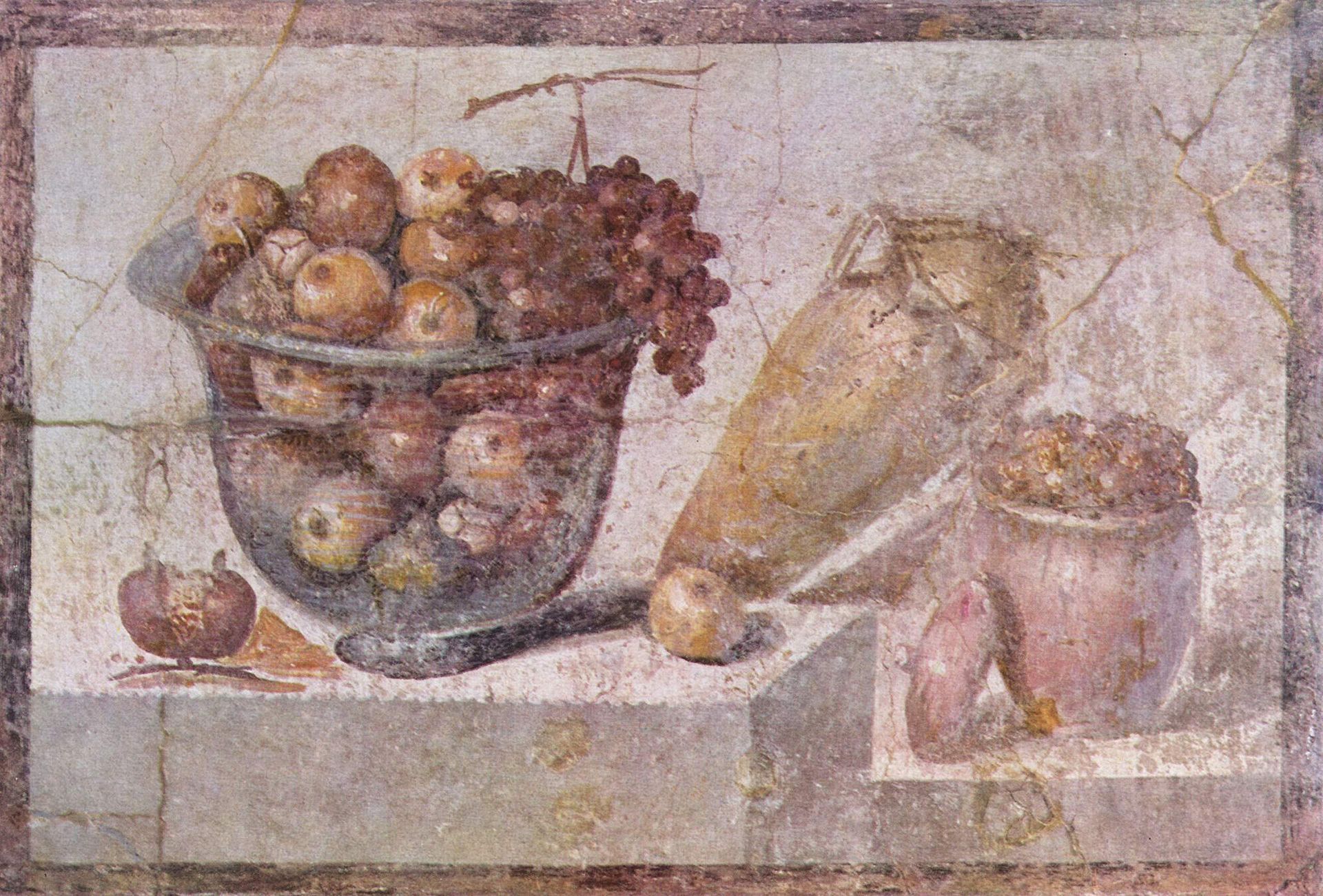
Picture; Grassland, 2023, from the collection of Andrew Simpson, Still life with glass bowl of fruit and vases, circa 63-79 AD,Naples National Archaeological Museum. The work of art depicted in this image and the reproduction thereof are in the public domain worldwide. The reproduction is part of a collection of reproductions compiled by The Yorck Project. The compilation copyright is held by Zenodot Verlagsgesellschaft mbH and licensed under the GNU Free Documentation License.

*Virgil's Georgics, In Our Time, Radio 4, https://www.bbc.co.uk/programmes/m001lyt4

Tuesday, 18 April 2023

A Roman street and Neapolitan pizza from Pizzeria I Decumani........ just perfect

We were in Naples and having chosen not to visit Pompeii and Herculaneum I suppose we felt more than a little guilty.

Walking the Roman street
After all here were those two Roman towns frozen in that moment back in 79 AD when Vesuvius erupted.

But there is only so much you can do in a week.  That said given my love of all things Roman I did feel a little that I had done something wrong.

But Tina knowing how I have felt came up with the Roman remains under the church of San Lorenzo Maggiore.

The church was built at the centre of the ancient Greek Roman city where today the via San Gregorio Armeno crosses the via dei Tribunali and underneath there is about half of an original Roman market which has been excavated over the last 25 years.

Just as at Pompeii you can walk down the main street past a collection of shops including a bakery, winery and laundry, step over the grooves used to drain the basins of dye and bleach and call at the offices of the tax collector.

A little further down the street are seven interconnected rooms with barrel vaults pierced by skylights designed to draw in the air and sunlight.

And in some of these rooms are the shop counters and wall niches along with at least one iron grill which would have protected the windows along the street and a selection of mosaic floors.

Now I grant you it lacks the size of Pompeii and today is deep beneath the streets of Naples but it still is a powerfully evocative place with the added bonus that you are almost on your own walking the 3 metre wide street which runs off for 54 metres offering you a slice of Roman life.

Pizzeria I Decumani
Now that did for me, particularly as it was only minutes away from the Pizzeria I Decumani.*

And of course if you want a pizza there is no where better than Naples.
The two most popular ones were packed out with long lines of hungry tourists waiting patiently outside but we had asked the local fruit seller on the corner of Via dei Tribunali who suggested Pizzeria I Decumani which he reckoned was not only the best but was where he ate.

Now it was midday and the place was full but we gave our name and sat outside in the small area opposite the shops and within the space of  five minutes were inside and ordering.

An as it happens the pizza I ordered
What came was a pretty spectacular pizza and one that cost just €3.50 compared to the €12 we had paid the day before in Sorrento.

So all in all a good day made even better by those narrow Neapolitan Streets with their tall buildings and drying washing hanging from the balconies, which is a story for another time.


*Via dei Tribunali, 58 80138 Napoli Italy‎ +39 081 557 1309

Picture; of the Roman street, "Scavi san lorenzo maggiore01"  and the rest  from the Pizzeria I Decumani

Monday, 17 April 2023

Melandra ……. part 1 …. rediscovering the Roman fort and making a new acquaintance

Now, you either like the Romans or you pass over them with a shudder.


For some they are the quintessential example of ruthless Imperial aggrandisement, characterised by vicious military campaigns, and an economy based on exploitation and slavery.

And that is before you get on to gladiators, dodgy Emperors and fish paste.

Me …. I take the more balanced view which does require a bit of convenient amnesia, but I have been fascinated by the Romans from about the age of 6, so as I head towards my 73rd birthday, I don’t see it changing.

All of which is an introduction to a short guide to the Roman fort of Melandra in Glossop which I picked up sometime in the 1970s.

The fort was one of a series built to consolidate the occupation of the Northwest and were linked by roads which connected the big legionary bases at Chester and York.

And having stumbled across the guide, I contacted the artist who drew a series of images, including a plan and a reconstruction of the fort.

This was Mike Brown, who has a long association with the archaeology of Melandra going back to the 1950s.

We spoke recently and the conversation ebbed and flowed about his lifelong interest in the fort, some of the more bizarre tales of the early days of excavation and the continuing plans to advance our knowledge of the place.

Mike has promised to send over a heap of material from the digs, including more of his pictures and an up-to-date version of the guidebook.

In the meantime, he referred me to an edition of the guide book produced in 2020 which can be accessed by following the link, and I rather think I will return to the story of Melandra and in particular the settlement which grew up outside the fort.

These civilian settlements offer up a rich insight into the relationship between the military and the varied groups who made their home outside the forts.

They were rough and ready places, as the discovery of a murder under the floor of a bar outside the fort at Housesteads testifies.

So, lots more to come and a thank you to Mike Brown.

Leaving me to add before someone else does that Python question ..... "What did the Romans do for us?"  Answers on a wax tablet and addressed to the Commanding Officer, Melandra Fort, although Mike will no doubt correct me and point to what we think the Romans called it which was Ardotalia.

 Location; Glossop

Pictures; reconstruction of the Roman fort of Melandra and plan of the fort and civilian settlement, 1973, courtesy of Mike Brown

*Glossop Heritage; https://glossopheritage.co.uk/ghtarchive/melandra/

Monday, 24 January 2022

The dark and messy goings on in Imperial Rome ....... back on my telly after 46 years

Now I am the first to admit that television dramas are not the most reliable way to learn history, for all the obvious reasons and recently said so.*


But done well they can offer up something, and with the passage of time become historical pieces, showing us how thought about a period in the past.

So last night I started on the box set of I Claudius which our Polly got me for Christmas.  The television series was first broadcast by the BBC in 1976.**

It tells the story of the first five Roman Emperors from Augustus through to Tiberius, Caligula, Claudius and Nero.

And wanders across a murky period of political murders, family warfare, heaps of casual sexual peccadillos, as well as incest.

At its heart is the study of one family's manipulation of people and politics to establish an Imperial dynasty.

It was based on two novels by Robert Graves, the first of which carried the same title as the TV series and the second which was called Claudius the God. 

I Claudius was published in 1934, and its sequel the following year and both were a success.  The story lines are fictional but are based on events and description which are drawn from historical accounts by the Roman historians, Suetonius and Tacitus.

I must have been just 16 when I came across Tacitus whose surviving accounts included a biography of Agricola his father in law who was the Roman general, as well accounts of campaigns in Britain and Germany and the politic of Rome.

Suetonius I came  to later, and his book The Twelve Caesars is as my Wikipedia tells me“is a set of twelve biographies of Julius Caesar and the first 11 emperors of the Roman Empire.

The work, written in AD 121 during the reign of the emperor Hadrian, was the most popular work of Suetonius, at that time Hadrian's personal secretary, and is the largest among his surviving writings. It was dedicated to a friend, the Praetorian prefect Gaius Septicius Clarus.

The Twelve Caesars was considered very significant in antiquity and remains a primary source on Roman history.

The book discusses the significant and critical period of the Principate from the end of the Republic to the reign of Domitian; comparisons are often made with Tacitus, whose surviving works document a similar period”.***

I will have read it around 1976 and the fun was to match this source with the two books and of course the telly series.

And now 46 years on I have to say that the television series has stood the test of time.  

True, some of the sets look a bit clunky but like many a Shakespeare play the magic is in the words, stories, and of course the acting.


There was a first-rate cast, some of whom were distinguished actors, while others were just setting out.and with a script written by an accomplished writer, it all came together.

And that is that.

Location Rome, and the Empire

Pictures; replica of a statue of the Emperor Augustus, Rome, and bits of ancient Rome much knocked about, 2009, from the collection of Andrew Simpson

* La sposa, https://chorltonhistory.blogspot.com/2022/01/travelling-italian-history-with-la-sposa.html

**I Claudius - Complete BBC Series (5 Disc Box Set) [1976] [DVD]

***The Twelve Caesars, https://en.wikipedia.org/wiki/The_Twelve_Caesars


Saturday, 15 August 2020

Ferragosto, the emperor Augustus and a picnic ………. the celebration we will miss

Today we shall miss the public holiday in Varese.

By  Lake Ghirla, 2009
It is Ferragosto, and the family will be gathering this year in Virginia’s garden.

But of course we are still here in that post legacy lockdown mode.

Every year I get told the purpose of the event, and every year it quickly gets lost in the general party atmosphere.

It’s origins go back to the emperor Augustus, who made August 1st a day of rest, and according to one source it became the custom for workers to wish their employers “buon ferragosto”.*

Later the Catholic Church moved it to August 15th to coincide with the feast day of the Assumption of Mary.

Augustus, Rome, 2008

And in the 1920s Mussolini exploited the day to promote fascism, organizing popular trips through fascist leisure and recreational organisations.

Rosa's Aubergines, Varese, 2017
But the family won’t be thinking of those dark days, instead there will be food, lots of laughter, and the promise of a warm sunny day.

Tina remembers picnics and big family gatherings.

Sadly we will have to celebrate from afar in the garden here in Chorlton.

But we have done the aubergines and have a picture of Augustus to remember where it all started.

Chino, Naples, 2017
Added to which there is some very nice wine, gently cooling in the fridge and the promise of some soft drinks, because it would never do to over indulge too early on what looks to be another hot day.


Location; Varese, and Chorlton

Pictures; the emperor Augustus, 2008, Rosa’s aubergines, 2017, and a picnic by the lake 2009. 


* Ferragostohttps://en.wikipedia.org/wiki/Ferragosto

Tuesday, 18 February 2020

Collecting another Roman Villa ....... Brading in the Isle of Wight

You can never get enough Roman Villas in my opinion.

And so I was pleased when Angela Buckley, shared some pictures of the mosaic floor of the Roman Villa at Brading in the Isle of Wight.

Angela is a historian who has written some excellent books on Victorian crime, along with a regular blog.*

The villa at Brading is not one I have visited, and if you can’t get there, then other people’s pictures are the next best thing, along with the offical guide  from the museum of the villa.**

“The museum preserves the West Range, built around AD300, which is the last and grandest of three buildings on the site. 

The foundations of two earlier North and South Ranges are now outlined in chalk outside. 

The South Range was erected around AD 100, not long after the Roman invasion of Britain in AD 43 and was followed by the completion of the grander North Range around AD 200.

Since its re-discovery the villa and surrounding land have been excavated many times. Using artefacts and archaeological reports, the museum will take you on a tour from prehistory up to the modern day.

Why choose the site at Brading?
For those living here, this location was a perfect choice. 

It enabled these freedom to communicate with and travel to local Island settlements, mainland Britain and cross the Channel to Gaul (France).

Fertile arable lands around the Villa complex allowed good crops of grain to be grown. Sheep and cattle could fertilise the land between seasons and springs nearby gave a good water supply.

The West Range
By the early fourth century this high status house was completed. 

As a winged corridor villa, common in southern Britain, it provided separate private living accommodation for the owner and their family together with space for entertaining guests. 

Like modern homes today the West Range had many changes and adaptions to the living space. This included removing and moving internal walls and adding new mosaics."

So that is it ……… another bit of Roman history to add to my collection, leaving me just to thank Angela for letting me use her pictures, and to say that the Villa has its own facebook site.

How neat is that?


Location; The Isle of Wight

Pictures; mosaic floor, from Brading Roman Villa, 2020, courtesy of Angela Buckley


*Victorian Supersleuth, https://victorian-supersleuth.com/?fbclid=IwAR3p-ieeN8snFOBL7QM9ULFtuIs00KAoB5f5DgU_MpMdK0ZFrVM9SGaR1tk

***Brading Roman Villa, https://bradingromanvilla.org.uk/discover/#introducing-the-villa

Thursday, 13 February 2020

The Battle of the Teutoburg Forest .....the big one the Romans lost

Now, as someone who has loved Roman history since I was very young, this is one I will be listening to this morning.

The Battle of the Teutoburg Forest, In Our Time, Radio 4, today at 9 am

"Melvyn Bragg and guests discuss the great Roman military disaster of 9 AD when Germanic tribes under Arminius ambushed and destroyed three legions under Varus. 

According to Suetonius, emperor Augustus hit his head against the wall when he heard the news, calling on Varus to give him back his legions. 

The defeat ended Roman expansion east of the Rhine. Victory changed the development of the Germanic peoples, both in the centuries that followed and in the nineteenth century when Arminius, by then known as Herman, became a rallying point for German nationalism.

With Peter Heather, Ellen O'Gorman, and Matthew Nicholls

Producer: Simon Tillotson"*

Picture; Airfix models, from the collection of Andrew Simpson

*Battle of the Teutoburg Forest, https://www.bbc.co.uk/programmes/m000f69q

Sunday, 10 February 2019

Looking for the Romans in Chorlton-cum-Hardy ………… and rediscovering Mr. Tacitus

Now it is odd how stories start.

A few days ago, I made a silly comment on social media about the Romans, only to have someone suggest that their record in Britain during their time here was nothing to shout about, going on to cite that 25% of the population was destroyed, along with Celtic culture and adding that the Britons were subjugated and made to pay huge taxes.

Well, its sometime since I did any serious research on Roman history, and slightly stung by the comments, I asked for his sources, only to be rebuffed, not once but twice in a very dismissive way.

So never wanting to appear incorrect or to shy away from a debate I went looking for the story, which of course begins with the acknowledgement that any invasion and conquest must be judged as wrong and will result in casualties and a loss of “national identity”.

But Britain wasn’t a nation, but a collection of “tribes” which had wandered across the Channel over a period of time, subjugating earlier groups.

In most cases the elites accommodated themselves to the new Roman way of life, adopting villa and town life and assuming Roman style names.

The island was open to a wider economy, bringing the produce of an Empire across the water and with it came people from every apart of that empire, with different languages, religions and cultures.

At which point there is that obvious thing to say that we still don’t know that much.

It starts with the death toll from the occupation.  There is a site which attempts some rough calculations*, but it is speculative and is often based on ancient historians who for all sorts of reasons may have exaggerated the numbers killed.

Add to that there is the debate on just how far Romanization went.

Some will argue it never penetrated much beyond the elites and the metropolitan class along with the army, leaving the majority to pretty much get on with their life as before.  Its theory which is supported by the decline in urban living in some places near the end of the Roman period.

But there is also plenty of evidence of just how far Roman influence extended beyond Hadrian’s Wall and how people were drawn to living beside army forts across the country.

To this can be added the degree to which when prosperity returned, there were attempts to rebuild “urban life”.

All of which makes me determined to turn to the new wave of Roman scholarship and see what conclusions are being advanced, before someone pips to the post.

And who knows, in the meantime someone might turn up a hoard of Roman artefacts in a garden here in Chorlton, which will set off a fresh debate and allow me to reengage with that chap who rubbished my comments.


Leaving me just to get in first with that oft quoted comment, "they make a desert, and they call it peace." 

Location; The Roman Empire


Pictures; models of Roman soldiers, and Bath, 2014, from the collection of Andrew Simpson

*Body Count of the Roman Empire, http://necrometrics.com/romestat.htm

**"they make a desert, and they call it peace",  Galgacus, Caledonian chief, from Tacitus: Agricola

Thursday, 21 May 2015

Josephus, who fought the Romans was captured, became a Roman citizen and wrote a fascinating book

So here is a fascinating story of a young man born in 37 AD “who fought the Romans in Galilee in the First Jewish-Roman War. 

He was captured by Vespasian's troops and became a Roman citizen, later describing the siege and fall of Jerusalem.

His actions and writings made him a controversial figure, from his lifetime to the present day.”*

Its part of that excellent Radio 4 series In Our Time, with Melvyn Bragg discussed the man with a panel of experts.

So as its about to start I shall leave it at that.

Tessa Rajak, Professor Emeritus of Ancient History, University of Reading

Philip Alexander, Professor Emeritus of Jewish Studies, University of Manchester

Martin Goodman, Professor of Jewish Studies, University of Oxford and President of the Oxford Centre for Hebrew and Jewish Studies

Producer: Simon Tillotson

Picture; A Roman portrait bust said to be of Josephus,  Wikipedia Commons, Scanned from a copy of Josephus' 'The Jewish War' dated 1888, image uploaded October 11 2007, original uploader was Jack1956 at English Wikipedia

* Josephus, In Our Time, Radio 4, Thursday May 21, http://www.bbc.co.uk/programmes/b05vfdzl

Friday, 24 October 2014

Back on Hadrian's Wall rediscovering a love of all things Roman

Dubnonum circa 250AD
I have been thinking about what started my long love affair with history and in particular the Romans.

It began while I was in school and well over half a century later it is still with me.

Now most of the time I crawl over the lives of people from the last two centuries but it doesn’t take much to trigger that old fascination with all things Roman.

Looking back it will have been those simple line drawings from the books by R.J. Unstead and later that magical book A Valley Grows Up followed by the fine illustrations of Alan Sorrell and Ron Embleton.

A view of the Wall, drawn in 1955
At its most basic it will have been a young boy’s interest in all things military from the legions and their campaigns and slowly blossomed out to all aspects of Roman life.

It has taken me to Rome and Pompeii and from Bath to Hadrian’s Wall along with countless museums across the country always with that simple wish to discover more.

Of all these places it will be Hadrian’s Wall which is there amongst the top three.

It is partly the romance of the place, the continuing discoveries that come up out of the ground and of course the way that every time I go back there are fresh interpretations.

Only yesterday my friend Lois shared the idea that the Wall was a way of containing the troops in what one academic has called “Wolf cages.”

And of course every Roman Emperor knew that to secure his position he had to ensure the loyalty of the army, whether that came from donations, profitable military campaigns or simply keeping them busy like building Hadrian’s Wall.

When I was at school the Wall was simply a way of stopping marauding tribes from invading the peaceful bits of Britain.

Later it was seen as more a statement of power and that bold assertion that this was the end of the civilized world.

But those that lived beyond it might have much to gain from the presence of the army which made  the Wall a customs and control point supervising the cross border economy.

Wood writing tablet
Now I don’t pretend to be anything but a novice when it comes to interpretations of the Wall’s part in the complicated history of Roman Britain but it has thrown up some fascinating glimpses of life on the frontier.

Of these it must be the  the Vindolanda writing tablets which I still go back to.

They range from simple lists of military supplies to letters home, requests for clothes and the invitation to a birthday party written around AD 100 from Claudia Severa, the wife of the commander of a nearby fort, to Sulpicia Lepidina.

Now these bring me as close as I can get to the Romans and along with that blog by Lois  on Hadrian’s Wall have sent me off on a quest again.

I have dusted down the map of the Wall, dug out the books I have on its history and started looking at train timetables.

All of which just leaves me wondering on whether I shall go east to Wallsend close to where father was born or head directly north from Manchester to explore the western side.  Cumbria beware.

Pictures; the Wall as interpreted in 1955, from Looking at History, R.J.Unstead, the imaginary Roman town of Dubnonum from A Valley Grows Up, Edward Osmond, 1953 and Wood writing tablet with a party invitation written in ink, in two hands, from Claudia Severa to Lepidina, uploaded by Fæ, 1986 and  licensed under the Creative Commons Attribution-Share Alike 3.0 Unportedlicense.

*New thoughts on Hadrian’s Wall and and exciting open on-line courses from universities around the world, Lois Elsden,
http://chorltonhistory.blogspot.co.uk/2014/10/new-thoughts-on-hadrians-wall-and-and.html

**Lois Elsden Writer, http://loiselden.com/


Thursday, 23 October 2014

New thoughts on Hadrian’s Wall and and exciting open on-line courses from universities around the world

One of those occasional posts from my friend Lois about Hadrian’s Wall and  exciting open on-line courses offered from universities around the world

Many people are enjoying leaning new subjects or exploring topics they know already about but  in more depth, and they may be doing this at home by studying a MOOC. MOOC… a massive open on-line course run by a variety of universities across the world in every subject you could imagine.

Earlier this year I studied a ten week MOOC run by Brown University in Pennsylvania, and now I am following ‘Hadrian’s Wall: Life on the Roman Frontier’, run by Newcastle University.

It is fascinating; much of the material we are looking at and reading about is to do with the Roman soldiers who were stationed along the wall, and the life they lived. However, what is in a way more interesting, is the different perspective we are offered on what most of us would generally just take for granted.

I guess most of us have an image of what life was like along the wall, a desolate place; dreadful no doubt in winter, with soldiers who may have come from anywhere in the empire to serve their time guarding this distant outpost.

I guess we would imagine life to be tough at certain times, rough weather and attacks from the 'barbarians'; we might also imagine that in between the fighting, life might be much the same as anywhere else in the empire.

The soldiers would buy and trade with locals, be provisioned by them, have them as servants and slaves, maybe marry local women and have families. All the time, I guess we would think of the fortresses along the wall as the place of safety, where these hardy men could retreat to when they were under attack.

Professor Simon James from the University of Leicester offers a different view; maybe the forts were to contain the soldiers, 'wolf cages' as he describes them.

Initially I thought it meant that the forts kept the soldiers under control and prevented them from going out looting and preying on the local villages and settlements; however, many of the soldiers actually didn't want to be there at all.

Soldiers would desert, riot, and even mutiny. These ‘cages’ were to keep the soldiers in, not to keep them safe but to keep them virtually imprisoned.

This is what so many MOOCs do; they make you look at things the other way round, make you look at something from a differently perspective.  Wolf cages... to keep the enemy out, or to keep the soldiers in?

Future Learn,  https://www.futurelearn.com/courses/upcoming

https://www.coursera.org/courses?orderby=upcomin

© loiselsden.co.uk

And there are plenty more stories on archaeology, writing, history, food and beer  at Lois Elsden Writer, http://loiselden.com/