Showing posts with label Chorlton in the 1900s. Show all posts

Thursday, 3 September 2026

It happened here in Chorlton and also in Didsbury .............. National Baby Week .... July 1917

Just a century ago a crowd assembled on the Rec opposite our house on Beech Road and listened to Mrs Jane Redford, Mr Peach and Miss Place of the Manchester & Salford Day Nurseries speak in support of National Baby Week.

The week long campaign aimed to rouse “a universal determination to prevent the unnecessary wastage of infant life, [focusing on] all the causes which make for the high rate of infant mortality. 

According to statistics 80,000 babies under a year old die every year in the United Kingdom of which 50,000 might have been saved.”*

Now this is all the more remarkable when you consider that we were by that summer in to year three of the Great War.

A war which had already caused thousands of causalities and although the organisers did not know it was about to deliver even more as the British army launched the Third Battle of Ypres, commonly known as Passchendaele which would in its three months result in the deaths of 244,897 British and Commonwealth  soldiers.

The celebration began with processions through Chorlton and Didsbury both led by “a band and numbers of green and white banners.”

The Didsbury procession which was "followed by a meeting addressed by Miss Margaret Ashton and Mr C T Needham M P and others included Red Cross nurses and munition workers."

By contrast the Chorlton march was made up entirely of  “small children with a few mothers and big sisters to look after the babies and large crowds turned out to watch.”

Sadly no photographs have come to light and I have no idea what Mrs Jane Redford or the others said in the Rec on that Saturday afternoon.

But Mrs Redford was an important figure both in Chorlton and the City and her personal papers may still be available.

She had been active for over 30 years serving on various public bodies including the Board of Henshaw’s Blind Asylum and as a Poor Law Guardian for the Chorlton Union where she had campaigned for the provision of trained nurses for workhouse hospitals.

And in 1910 after winning a municipal election here in Chorlton, she became not only our first woman councillor but also the second woman elected to Manchester City Council.

And she spoke on the Rec opposite our house which really was a bit of history which happened here.

Location; Chorlton-cum-Hardy, Manchester

Pictures; the Rec circa 1910 from the Lloyd Collection and Mrs Redford, date unknown courtesy of Lawrence Beedle

*Baby Week Opening of the Campaign in Manchester, Manchester Guardian July 2 1917

Tuesday, 11 August 2026

A history of Chorlton in just 20 objects number 13, the school photograph


Continuing the story of Chorlton in just a paragraph. They are in no particular order, and have been selected purely at random.

I have no idea of the date but would guess sometime in the early 20th century, if not a little earlier.  If that is the case the picture will have been taken in the yard of the old school on the green, which was built in 1878, replaced an earlier one from the 1840s which in turn had replaced an even earlier school.  In the way of things school photographs do not change over much.  They are drawn from a range of the social groupings, and the children stare back with that mix of seriousness, curiosity and in the case of the little girl on the second row a delightful smile.  In many ways their school experiences would be not so different from their parents but a world away from those of today.

Location; Chorlton

Picture; from the Lloyd collection, date unknown

Wednesday, 5 August 2026

A Chorlton secret ……. the demolished cinema …….. and Mr. Shaw’s superior garage

 Unless you were in the know I doubt you would ever have realized that behind the shops on Barlow Moor Road between the former Co-op and Coriander there is a large building which specialises in MOT’s and car repairs.

A garage revealed, 2024

But then you would either have to be a customer or wandered down the alley from the main road and found the place.

Shaw's Motor Garage, 1959
Today it is clearly visible from Barlow Moor Road but for a century and more the garage was obscured by that Co-op store, which was once our first purpose, built cinema which opened as The Palais de Luxe de Luxe in 1914.

That relic of the picture age, and the store which once traded as a Tesco, Hanbury’s and Co-op was recently demolished and the open space reveals the line of the garage.

Back in the second decade of the last century it was Shaw’s Motor Garage which had  the first kerb side petrol pump in Chorlton.

The garage was still there in 1959 when Mr. A H Downs took a picture of the building which pretty much matches an earlier one from 1912 which shows Mr. Shaw and a large crowd admiring the petrol pump for the photographer.

Mr. Shaw and his garage, 1912

And not to be out done some time in the 1980s I clocked the same spot when part of the original signage was briefly on show.

The ghost sign, 1984
Mr. Shaw was one of those enterprising men who seized the “motor car moment” at the start of the 20tth century and may even have rented out space to the company which built the Chorlton cars.

All of which I have written about.*

At some point the open space of the former Palais de Luxe de Luxe will be filled with new build, leaving me just to pin down just when the front part of the garage became shops and renew my search for Mr. Shaw.

Location; Barlow Moor Road

Pictures; the space wot was the cinema revealing the garage, 2024, row of shops and ghost sign, circa 1984, from the collection of Andrew Simpson, Shaw’s garage in 1959, A.H. Downes, m17515, courtesy of Manchester Libraries, Information and Archives, Manchester City Council, http://images.manchester.gov.uk/index.php?session=pass and in 1912, from the Lloyd collection

**When Chorlton made cars ………..https://chorltonhistory.blogspot.com/2023/01/when-chorlton-made-cars.html

Sunday, 2 August 2026

The story of a strike and of strikes yet to come, part two .... a Chorlton postcard

On Newton street in July 1911
The Carters came out on strike in Manchester at the beginning of July 1911. 

It was the picture of police escorting a strike breaker which first caught my interest.

But they were not the first or the last during the next few years to withdraw their labour to advance a demand for better pay and conditions.

Early in 1912 the miners had come out following a ballot “in favour of giving notice to establish the principle of a minimum wage for every man and boy working underground,”* and at the beginning of March Manchester Municipal workers voted to follow those of Stalybridge, Salford and Stockport and strike for higher pay.

You can get a sense of the mounting conflict from the newspapers of the period. The Manchester Guardian was quick to comment on the concerns over coal stocks in the Greater Manchester area just weeks after the miners had come out, and carried reports that in Nottingham the bakers and painters were about to go on strike while in Manchester there was serious disruption to the rail network.

Leonard's fears
And here in Chorlton on the day the Guardian reported that 60% of trains from one Manchester railway station had been “knocked off” Leonard wrote to a friend of his worries about his mother’s illness and that “all our staff intend to come out on strike this weekend.”

Now it may never be possible to discover the business that he ran or what happened on Friday March 15th when the strike was due to start, but I shall endeavour to try.

He was “busy making arrangements to fill their places” and thought that “this Coal crisis ..... is a terrible affair.” 

All of which rather eclipsed his pleasure that at the Parliamentary bye-election earlier in the year “our man got in (Good old Blue) turned a liberal majority from over 2,000 to a conservative one of 500, great excitement.”

It is a fascinating glimpse on how people here in Chorlton looked out on the mounting political and industrial unrest and sadly represents the only comment we have so far.

As it was the strikes rumbled on through the year, but more about them tomorrow.

Picture; detail of a postcard sent on March 12th 1912 from the Lloyd collection, detail from the Carter's strike, courtesy of the Greater Manchester Police Museum

*Balllot paper issued by the Miner’s Federation of Great Britain, January 1912


Thursday, 23 July 2026

A Chorlton wedding in the April of 1913 and a tiny mystery

I doubt I would ever have got to know about Mr Hugget Billing and Miss Vivien Horsfall Attwood if it weren’t for Sally’s wedding photograph.

The couple were married at St Clements Church in Chorlton-cum-Hardy on April 16th 1913, and on that Wednesday the Manchester Courier was on hand to record the event which according to the paper was “crowded.”

And I think that may have been down to Vivien’s father who was a journalist and newspaper editor.

As such he will have been well known, added to which the family had lived in Chorlton on Cavendish Road from at least 1901 and so I guess there would have been plenty of local well wishers.

Mr Herbert Huggins Billing was a salesman who had been born in Rusholme, lived in Ancoats and in 1911 was residing in Longsight.

The couple settled in Chorlton and lived at 42 Claude Road.  Vivien died in 1930 and Herbert Huggins fourteen years later.

In time I will delve deeper into their stories.  I know they had two daughters and just before his death Vivien’s father was living opposite them at number 55 Claude Road.

Of course all such research runs the danger of becoming intrusive especially if there are direct living relatives and so I am minded to concentrate on what their lives might tell us about Chorlton and Manchester during the first half of the 20th century.

The records of how much all three left when they died reveal something of their financial background and a future hunt will tell us which paper Vivien’s father edited, and in time I might solve the little mystery of why her parents and her husband are all buried in Southern Cemetery but she is missing from the family plot.

That maybe because she died at Oakmore in Cheshire but I can’t be sure.

That said even I have to own up to a little curiosity and wonder why Miss Attwood gave her age as 28 in 1913 when she was in fact 31.


Picture; A Chorlton Wedding, the Manchester Courier, April 17 1913, from the collection of Sally Dervan

Wednesday, 22 July 2026

Buying your meat from Mr Unsworth of 2 Chorlton Green in 1909 .... Chorlton's corner shop nu 10

The caption on the picture just says “James Unsworth’s butcher shop on the corner of the Green Albermarle Road.  This shop later became and still is a barbers shop. Private photograph, origin unknown.”

Now I remember it as a barber’s shop, regularly visiting it during the 70s and 80s and even taking my eldest.

Bob who had the business when I went there had been born in Chorlton and had plenty of stories about the place.

I can date the picture from sometime after 1903 and before 1911.

This I can be certain of because back in 1903 the terrace of three shops and houses had yet to be built and from at least 1911 this butcher’s shop was run by Mr Mark Glazerbrook who was recorded in the directories from the start of 1911 at no 2 Chorlton Green.

A decade earlier he had been helping his father run the family butcher’s shop in Railway Street in Ardwick, and in 1910 he married Lillian Carr.

So just perhaps this was their first married home.

That said within another ten years he was trading in Reddish all of which points to the high turnover of some of these small family businesses.

Mr Unsworth was at number 2 in 1909 when his neighbours were Ernest Bugler, cycle maker at number 4 and Stanley Moss, grocer at number 6.

Two years later both James and Mr Moss had moved on.

I don’t suppose we should be surprised for back in the early 20th century there were plenty of butchers, grocers and green grocers in close proximity in Chorlton and competition must have been fierce.

Just opposite was Whittaker’s the grocers and up along Beech Road there were more grocery and butchers shops with even more across the green and behind.

And that is about it except to say I got through the story without commenting on the meat on display in the open air, the sand on the shop floor or  Mr Unsworth’s long knife.

On the other hand, here is the shop in 1979, when those of us who wanted a haircut and a good natter would call in at Bob's.

And that really is it.

Location; Chorlton-cum-Hardy

Picture; of Mr Unsworths' shop circa 1909 from the Lloyd collection and Bobs's in 1979 from the collection of Andrew Simpson

Tuesday, 21 July 2026

Will those responsible ……… return the drinking fountain to the Rec on Beech Road

It is one of those silly stories which started with a couple of pictures of the Rec in the early morning.

Early morning on the Rec, 2021

And progressed through to a newspaper report from September 1897 of an ordinary meeting of the Withington Urban District Council at which Mr. Burgess “intimated that a gentleman in Manchester, whose name he would not at present mention, had offered to give a drinking fountain to be placed in Chorlton-cum-Hardy”.*

I had been looking for information about the early years of the Recreation Ground on Beech Road.**

It had been opened in the May of 1896, and was gift form Lord Egerton of a strip of land which had for centuries been known as Row Acre.***

And here I went very  wrong, because so engrossed was I in the research that the fountain and the Rec came together and for a brief while I went searching for just where the drinking fountain might have been located on what is now called Beech Road Park.

Waiting for something to happen, 2021
All of which will allow Mr. Pedantic of Provis Road to mumble that the story is a nonsense, and artificially connects pictures of the Rec on a Tuesday morning with the real drinking fountain which was on Chorlton Green.

And he would be right, leaving me to reflect on that earlier bit of public open space which is surrounded by two pubs, the old parish burial ground, the village school along with two former farm houses.

Today most of us think of Chorlton green as an open space of grass ringed by trees but this was not how it has always been.

Before the turn of the 19th century it may have been much bigger and indeed for most of that century was not even open to the people of the village, having been enclosed by Samuel Wilton and not returned to public use until the 1890s.

And then for a great stretch of time remained without grass but did have a pretty neat water fountain.

The Green, circa 1900
The picture dates from 1906 when the Horse and Jockey was still just a set of beer rooms on either side of the main door, Miss Wilton’s outhouse still jutted out from the building and the space between the main entrance and the sweet shop was still a private residence.

I have always liked the lamp which stands on the green, with its hint of Narnia.

And back in the May of 1986 I can remember walking past it in the early evening and coming across a string quartet playing around its base.  Today people would just take it in their stride mutter something about it being typically Chorlton, but back then it struck me as the promise of things to come.

Which later that night with the defeat of the Conservative candidate and the election of the first Labour Councillor it  indeed seem to herald something new.

But being a historian I have to own up to the fact that the following year the Conservatives were back but they were on borrowed time, and 1987 marked the final year that a Conservative would be elected from Chorlton to the Town Hall.

The year before may have been the first string quartet on the green but it has not been the last.

The drinking fountain, circa 190o
I have to say I prefer the grass but lament the loss of the fountain.  

First it lost its cups and then vanished sometime in the 1920s or 30s.  To my mind that was a loss.  Public fountains are wonderful places to meet people, spend time chatting and just having a drink on a hot day.

Once it would have been the village pump which offered all three and which on hot summer days had the added bonus of a place the kids could play.

Now there is a lot more history to explore in the photograph of the fountain but I rather think I will leave that for another time.

To which Michael Wood has added, "My recollection is that the fountain on the rec was located centrally outside the shelter, as on the attached snip from the georeferenced maps website showing OS 25” 1892-1914 series.  

It was the same design as was used in Chorlton Park near the tennis courts, a perfunctory iron structure with domed hoods over the outlets, operated by a button on top -  nothing like the elaborate ornamental feature on the Green.  Can’t find an image at the moment, but I could draw one!  

The Rec, 1914
They must have been a common municipal feature in their time, but by the mid-sixties they were semi-functioning or defunct. "

And I hope he does, as it is I never knew about the bandstand.

Location; Chorlton

Pictures; the Rec very early on a Tuesday morning from the collection of Andrew Simpson and the drinking fountain on the green, circa 1900, from the Lloyd Collection

*District Councils, Manchester Guardian, September 10th, 1897

**Public Recreation Grounds at Withington, Manchester Guardian, May 18th, 1896

***Breaking News ……….. the Rec on Beech Road is officially opened, https://chorltonhistory.blogspot.com/2020/04/breaking-news-rec-on-beech-road-is.html


Monday, 20 July 2026

Lost in the attic .............. a new collection of photographs of Chorlton........ nu 1 Whitelow Road

This is Whitelow Road sometime in the early 20th century and with the picture comes one of those intriguing little stories.

It is one of a collection of images which were donated to St Clements Church and were found in the attic of a house.

And that is about all I know of the history of the twenty or so photographs of Chorlton.

All except one date from sometime after 1900 and measure 25.5 cms by 42 cms and have been reproduced from picture postcards.

I would love to know who went to all the trouble of first collecting and then enlarging the images and later storing them away.

Now there will be a story there but I doubt it will ever come to light.

So instead I shall concentrate on this one which shows a gang of labourers at work.

I don’t have a date but the company whose name plate appears on the steam engines was Davies Brothers, Asphalt Road Makers who were listed in the 1911 directory with an office on Princess Street and a depot on Green Lane.

Green Lane ran from Brook Street to the Garratt Bridge by the River Medlock in Chorlton on Medlock and long ago was swept away by new developments which included the old BBC Broadcasting building.

What makes the picture interesting is that it is one I have never seen before and comes with a companion photograph which also shows Whitelow Road with the same team of workmen.

Both contain a wealth of detail from the steam engines, barrels of tar to the wooden sets and the large number of labourers.

This was after all at a time when much of the work still relied on muscle power and so despite the steam engines it was still down to shovels, wheelbarrows and a lot of effort.

But the pictures also include that small band of spectators who have been drawn to the scene.

Like the workman they stare back at the camera with that mix of poses, some stopped in their tracks, a few looking curious and the rest those who just can’t miss the opportunity to be in the picture.

And of these the one I am drawn to is the chap in uniform pausing with his parcels to be caught on camera.

Now I am sure there will be someone who can help explains the use of the long wooden beam across the road and others who will want to speculate exactly where along Whitelow Road the pictures were taken from so I shall close by reflecting on how many more pictures of old Chorlton are sitting in attics across the township.

Pictures; Whitelow Road date unknown, from the Simpson Collection


Friday, 17 July 2026

Five pictures …… one road …… and a heap of Chorlton’s story

This is Brook Lane in 1909 on the cusp of a change.

1909

For centuries it had led out of the village past the old Bowling Green Hotel, crossed Chorlton Brook, past Brook Farm, and petered out in several footpaths, one of  which twisted off towards Hardy Lane.

But in the spring of 1909 the eastern side of the lane was being developed by a row of new houses, which faced the entrance to the sewage works, and the home of Charles Hall the manager of the works.

In the distance there is still open land which within a year and bit will be filled with the new Chorltonville estate, while the new brick sides of the bridge over the brook have yet to replace the low stone wall and to the right the scene is dominated by the farm buildings of Charles Cookson who lived in Brook Farm.

1911

The new row of houses bears closer inspection, because the first is being constructed to accommodate a shop, and later photographs show that it was occupied by Mrs. Harrier Forster whose window announced that it was a confectioners, and given that it was the only shop in the row of ten properties I guess she sold a few other “essential” items.

And at the beginning of 1910, Mrs. Forster’s neighbours included a joiner, two engineers, a waiter, and a designer along with two clerks and an architect. 

In time I will trawl the census returns to find out more about these residents and the lives of Charles Cookson and Charles Ball.

1910

For now I will just add the remaining three images , one looking back towards the new Bowling Green Hotel showing the club house, and two looking up the lane.

What makes these two interesting is that they qualify as then and now pictures.  

The first, as the shop is still yet to be finished, and before the ville was built, and the other with Mrs. Foster in residence and the new estate in place.

Together they offer up a series of images of where we live as the township continued on its journey from a small rural community to a large urban settlement on the edge of Manchester.

1910
Just six years before our first picture, Chorlton  rate payers had voted to join the city along with Burnage, Didsbury, and Withington, while at the turn of the century Manchester City Corporation trams had arrived, predated by arrival of the railway.

And the second major housing boom which began in 1880 had transformed the nort side of the township, eliminating the historic hamlet of Marledge and in the minds of many, dividing Chorlton into Old and New Chorlton and creating the two villages of Old and New Chorlton.

Location; Brook Lane

1912


Pictures; of Brook Lane, 1909, J. Jackson, m17679, 1911, B.F., m17684, J. Jackson, 1910, m17681, J. Jackson 1910, m17680, J. Jackson, 1912, m17685, courtesy of Manchester Libraries, Information and Archives, Manchester City Council, http://images.manchester.gov.uk/index.php?session=pass


Tuesday, 7 July 2026

There is always another on the way …… travelling by bus to Chorlton Station

I have Kevin Barker to thank for this picture.

I am looking at two employees of Manchester Corporation posing for their photograph on route number 9.

It’s a perfect example of how there is always another on the way, which might be a bus or a new picture I haven't seen before.

I think we will be on Edge Lane sometime in the early 20th century.

A quick search of The Manchester Bus by Michael Eyre and Chris Heaps reveals that this is “Daimler NA2687 at Longford Park on the service from Chorlton to the Stretford boundary at that point; it has the first of many bus bodies that would be built by the Car Works. Note the taller bonnet line of the Y type chassis”. 


They date the picture to 1914 and tell me that the bus could seat 38 but in 1923 was rebuilt to increase the number of seats to 44 by extending the upper deck over the driver’s cab.

And that is about it.

Other than to say I have no idea that there was once a bus to and from Chorlton railway station to Longford Park.

The fun will be to identify the back drop and leaving me to thank Kevin for whizzing the picture over today and to Andy Robertson for his indulgence in letting me continue to borrow his bus and tram books on an extended loan which will soon be a decade.


Location; Edge Lane?


Picture; Daimler NA2687 at Longford Park, 1914, courtesy of Kevin Barker

* The Manchester Bus by Michael Eyre and Chris Heaps, 1989


Friday, 19 June 2026

Gaze upon this tarry thing ... all you in Chorlton who want to be nostalgic

Now I am never one to stop a good story, and remain fully aware that out there, some remain nostalgic about stone setts which were once a common form of road surface.

The Beech Road sett, late 19th century
So here is one of mine. I cannot now reveal how I came to acquire it, suffice to say that once a very long time ago when Beech Road was going through an earlier tar experience, this one was about to be thrown away.

I asked if I could have it as a relic of that old Chorlton and I was given two.

It will date from I suppose the late 19th century but maybe from the 1900s.

I just don’t know.

Of course some will know and there will a minute either in the records of the old Withington UDC or Manchester Corporation, but I am not going to look.

It sits in a special place beside two handmade bricks, one dating from the late 18th century which was part of a one up one down back to back house on Miller Street and the other from that grand property which once stood on Beech Road beside Acres Road which some will still call Acres Crack.

Longford Road, circa 1900
I have to admit that the old tin potty also from Miller Street was refused entry by the family, which I suspect was for the best.

Location; Chorlton

Pictures; a Chorlton stone sett from the collection of Andrew Simpson and Longford Road circa 1900 from the Lloyd Collection

Sunday, 17 May 2026

The photograph, a house on South Meade, and a mystery

I am looking at a picture of a group or workmen outside a house on South Meade and at first glance there doesn’t seem to be anything unusual about what I am looking at.

The men represent a cross section of skills, ages and experience, and may well have posed for similar photographs across Chorltonville.

But I know exactly which house this was and have already begun to discover its history which starts with the simple fact that it has been occupied by only two families in the century and a bit since it was built.

And so, while we will never know the identity of the men staring back at us, we do have the deeds, as well as a collection of documents relating to its construction, which will help tell the story of this particular house.

The first family to move in was Mr. and Mrs. Jones.  In 1939 he described himself as a “Commercial Traveller in the Gas Industry”.

Everyone will find something interesting in the picture, with some focusing on the appearance of the men, the presence of the apprentice boy, and the flat caps and pipes.

The building contractor was Thomas Whiteley and a search might turn up something about the building firm, but I doubt that will extend to a list of employees.

For now, until Laura passes over its history for me to look over, we are left with the photograph of the workmen and the image of the house.

But for now, it is exciting that we are able to pin a group of craftsmen to one house sometime in 1911.

Leaving me just to ponder on Mr. and Mrs. Jones and a mystery which might be answered by those documents.

We shall see.

Location; Chorltonville

Picture; workmen outside South Meade, 1911, courtesy of Laura Hopkins

Special thanks to Laura, who kindly showed me the picture and has promised to lend me the house documents and to Jude who lives next door, and first told me about the picture.

Saturday, 16 May 2026

The case of the missing Domestic Servants ……………..

Now it is one of those received pieces of historical truth, that the age of the domestic servant peeked in the early years of the 20th century.

South Drive, circa, 1900s
Before that date, even the most modest of homes might boast a servant.

After the Great War, the rising cost of living, the advance of labour saving devices, and the growing expectations of “the servant class” combined to shrink what had once been a source of employment for many young people.

All of which I knew from trawling the census returns for Chorlton and many other places.

But I had never gone looking for the hard evidence, and then yesterday rising out of a discussion on a blog story about Chorltonville, I decided to test the idea, and to test it through the records of the estate.

A number of people had questioned whether the residents would have employed servants, given the size of the houses and occupations of those who lived in the properties.

As a project it had much going for it, because there are a limited number of households and they are grouped in a compact and defined area.

Chorltonville from the air, circa 1930s
In the April of 1911 eighteen households on South Drive returned the census form.*

The occupations listed were pretty much what you would expect for the estate, consisting of a high proportion who described themselves as “Commercial Travellers”, a couple of clerical workers, two employers, along with an actor, one manager, and one on “private means”.

Of these eighteen households, six employed a domestic servant, who lived in the home.  Not surprisingly two worked for the two employers, another for the one householder on “private means”, but the remaining there were employed who commercial travelers and a clerk.

It is of course a very limited survey, but what is interesting is that when compared to the 1939 Register which required every householder to supply basic biographical details for all the occupants, none of the six households employed a servant.

In their place comes that familiar term “unpaid domestic duties” or “housekeeper” which in each case refers to a wife,  which of course raises an interesting debate about the role married women.

Other than that, of the full eighteen, only one household listed an individual who was described as a “housekeeper”.

Which just leaves me to report that none of the original six who employed a servant in 1911 were still living in their house by 1939.

So, that is it, other than to say in a quiet time I shall go back to the historical record to push forward our knowledge of servants in the Ville.

Location; Chorltonville

Pictures; from the Lloyd Collection, circa 1900s-30s.

* 1911 census, Enu 11, Didsbury, South Manchester & 1939 Register

Friday, 15 May 2026

The insurance clerk, the travelling salesmen and Mrs Buxton from the USA ....... a bit of Chorltonville in 1911

Now every bit of Chorlton has its own story and Chorltonville is no exception.

South Drive, 1913
Most people will know it began as a bold venture to supply decent homes at affordable rents on a plot of farm land at the beginning of the 20th century.

There had been a modest pilot scheme which had been built behind Upper Chorlton Road, but the ‘ville was the big one.

The houses were built in record time and by April 1911 the first residents were showing up on the census for that year.

They were tenants rather than owners but within a decade the association had been wound up and the properties began to be sold off.

The estate has remained a popular place to live and many of my friends have passed through or chosen to settle and bring up their families in this quiet secluded place.

Something of its history has featured in our  book the Quirks of Chorlton-cum-Hardy* .

And with that in mind I went back to the records to see just what the demographic of the estate was like back at the beginning of the last century.

It is a big task and involves trawling the census returns street by street.  So far I have been looking at South Drive, and have covered just 39 homes, from numbers 1 to 65, and 2 to 22.  There are gaps which suggest some homes were vacant and I am fully aware that this is but a small sample but it’s a start.

The Tradesmen calls, 1913
What strikes you is the number of residents who gave their occupation as a commercial r travelling salesmen.
In all there were 14 of the 39 engaged in the job, along with a number of clerks, two shop keepers, two teachers and a University lecturer.

And what is particularly interesting is that some at least of these occupations reflect the new industries.

One of our salesmen was selling telephones, another electrical cables, and a third heating, ventilation and lighting, while Ms Vera Harris of South Drive was a typist.

But amongst all this “new stuff” there were the more traditional ways of earning a living of which domestic service featured highly.  Of our 39 residents, six employed a servant and one family had two.

It will be interesting to see how this small sample compares with the rest of the ‘ville and with the whole of Chorlton.  But that is a very big undertaking.  An earlier study suggested that in total 29 households in Chorltonville employed a servant.

So, for now I will just close with the reflection that a walk down South Drive in the April of 1911 would have been punctuated by a hosts of accents including more than a few from London, as well as the North East, a few from Northern Ireland and two from the USA and two more from Sweden.

All of which makes the place as cosmopolitan as it is today.

Location; Chorltonville

Pictures South Drive, early 20th century from the Lloyd Collection 

*The Qurks of Chorlton-cum-Hardy, Andrew Simpson & Peter Topping, 2017

Saturday, 25 April 2026

When we had a post office on Beech Road

Now I am never surprised at what turns up on eBay, especially when my old friend David Harrop is involved.

At Beech Road post office, 1914
So here with a little bit of our postal history is a reminder that once we had a post office on Beech Road.

During the 19th century it moved around a bit but by the end of that century was at number 109 Beech Road.

And on October 17 1914 one parcel passed through the post office.

Post woman, circa 1916
I would love to know where it was going and for that matter that was to receive it, but all we have is this section of the parcel.

In time I will check out who the sub-post master was on that day, but I think it could have been Mr Robert Chorley who was doing the business of selling stamps and all things posty three years earlier in 1911. 

The shop was also a stationers and this was clearly the primary business as on both the census for 1911 and the in the street directory he describes himself as a “Stationer and Sub-Post Master” and he was no doubt helped by his wife, Hannah Elizabeth. 

The couple had been married for eight years and had taken over the post office sometime after 1901.

And that is about it for now.

Location Chorlton-cum-Hardy


Picture; parcel post markings, 1914, and post woman, circa 1916, courtesy of David Harrop

Thursday, 26 March 2026

Down an alley ……..

Now if I were seven again, I rather think I might have been drawn off Beech Road and down the alley.

Down the alley, 2020

One day I will go and search its history, but for now I am content to record that back in 1969 it belonged to Ken Allen who used it as a store for his shop at 115 Beech Road.

Ken Allen, circa 1970s
And back in 1939 it was occupied by Abbot and Connie Palliaser.  Mr. Pallisaser described himself as a  “Furniture dealer Motor Engineer by Trade”, who may well have taken over the property from Harris and Son “decorators who were there in 1911.

A search of the Rate Books will tell me more, and I am inclined also to go looking for Mrs. Annie Dennis who shared 115 with the Palliasers in 1939.  She described herself as a widow with no occupation who had been born in 1872.

I grant you that this search may not be as exciting as the adventure I could have taken back when I was seven and furtively wandered into the alley, but perhaps less scary.

Location; Beech Road

Picture; down an alley, 2020, from the collection of Andrew Simpson, and Ken Allen, circa 1970 , courtesy of Lawrence Beedle


Wednesday, 18 March 2026

That vanished road in Chorlton ……… 1907 - 1937 RIP

I won’t be the only one in Chorlton who is fascinated by the lost roads of Chorlton.

Some just changed their name, but others have vanished completely.

And one of those is Cardiff Road which was off Longford Road. 

Cardiff Road, 1937

It consisted of 12 two up two down properties and dates from sometime after 1901 and had but a short life.

So, while it doesn’t appear on the 1901 census, it is on a street directory two years later and crops up on various historical records until 1939.

It is a place I have written about but never really dug deep into its story.

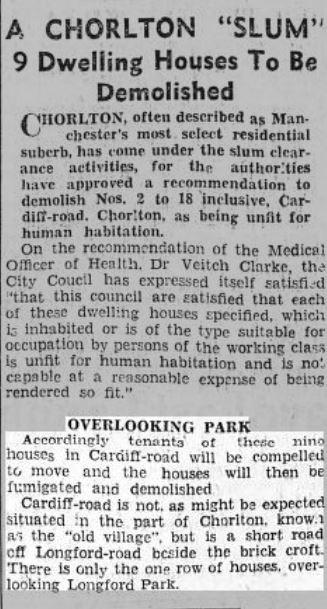
But today I have redressed that omission, mainly because of a press cutting sent over by Chris Geliher who added "Hi Andrew. Came upon this clipping from the M/c City News 16/7/37. Thought you might be interested on the off chance that you haven't already seen it”.

Cardiff Road, 1907
And of course, I was very interested because it offered up the first clue as to why Cardiff Road had been expunged from the record.

According to the Manchester City News the Corporation had approved the “recommendation to demolish nos. 2-18 , inclusive Cardiff-road, Chorlton, as being unfit for human habitation”, adding that Dr Veitch Clarke, the Medical Officer of Health for the City Council had pointed out that the houses were “not capable at a reasonable expense of being rendered fit” to live in.*

Now I would dearly like to know who had built the properties and who rented them out, if only to search for similar “rundown” houses that the landlord was responsible for in Chorlton.  Alas the Rate Books that can be accessed online stop in 1900, and there appears at present no other reference to ownership in the historic records.

But looking at the census return for 1911 there is much to shudder at, not least because some of the properties were incredibly overcrowded.

At number 20 Annie Elizabeth Wilson shared the house with her eight children ranging in age from 20 down to 5, while at 24, Mr. Devine and his wife lived with four children, a nephew, a sister in law and two lodgers.

Cardiff Road, 2015
Nor are these two houses the exception.   At number 2, Jane Fitzgerald lived with her two children and a lodger, and at 12 there were a total of seven people.

Perhaps most shocking is the census return for number 8 which revealed two families inhabiting the one house, consisting of one family of six and another of 4.

At present there is no way of knowing just how poorly built the properties were, but their very short life suggests that they were not the best in the housing stock of Chorlton-cum-Hardy.

Indeed, they back onto our own brick works which might offer up a possible landlord.

A decade on in 1921 there was still evidence of overcrowding in almost all of the four roomed houses and severe overcrowding in two.  

Cardiff Road, 1911

What is in interesting from both the 1911 and 1921 census returns is that few of the inhabitants were linked to the brick trade, and only one man in 1921 was directly employed at the brick works and he described himself as unemployed.  

Others worked for the grocery chain Twfords in Chorlton, two were employed by Manchester Corporation, one was a carter, and another was a warehouseman for J. R. Smith on Ducie Street in town.

All of which leaves me with that opening sentence from the newspaper report which proclaimed “Chorlton often described as Manchester’s most select residential suburb has come under the slum clearance activities for the authorities”.

So despite the detractors who shout that Chorlton has become a “twee place” to live, there were those who thought it so over eighty years ago.  Didsbury please take note.

Location; Chorlton

Pictures; A Chorlton “Slum” 9 Dwelling Houses to be Demolished, Manchester City News, July 16th, 1937, courtesy of Chris Geliher, Cardiff Road, 1907 from the OS map of Manchester and Salford, 1907, and in 2015 from the collection of Andy Robertson

*A Chorlton “Slum” 9 Dwelling Houses to be Demolished, Manchester City News, July 16th, 1937