Showing posts with label West Didsbury. Show all posts

Thursday, 8 January 2026

One bedsit …. the lost tennis courts …… and those dream homes …..

Number One Malvern Grove is an unimposing house on the corner of Burton Road in West Didsbury.

1 Malvern Grove, house and garden 2022
And it was where I lived for six months in my student days in 1970.

I say unimposing but once it was the smart home of Mr and Mrs Simpson, their two children and Katherine Williams who was 23, from Everton and was employed as a “general servant”.

I know the property was there by 1896 and with a bit of digging should be able establish when it was built and perhaps date the rest of the homes on this small cul-de-sac.

And with a bit more diligence it will be possible to list most of the households from when it was built through to 1911 when the Simpson’s were there and on to when it became a series of bedsits.

It had ten rooms and two cellars, and I occupied one of the back down stairs rooms which might have once been the kitchen. It was a small room furnished as I remember with a bed, a table, two chairs an electric ring and one of those water heaters which held a pint and bit of water and ate electricity.

That ground floor rear room, 2022
Like all crummy bedsits I have lived in it was basic, cold, with walls covered in woodchip and painted in multiple coats of emulsion.   All very cheap and not very cheerful.

Added to which there was that lingering smell of 10 different evening meals permeating the place and the bone cold hall.

And here I stayed for just six months, at a time when I could have been very lonely were it not for some of the other residents who took me under their wing.  

They made sure that most nights I accompanied them across the road to the Old House at Home and took pity on a student ensuring that only occasionally was I allowed to buy a round.

At the time I never thought about the house or its history, instead I was captivated by the two 1960s “dream houses” just two doors away along the Grove.  They resembled exactly properties which had featured on the back of Kellog’s Corn Flakes boxes and had been part of an advertising competition which offered up the prospect of winning one of these “dream houses”.

On cold winter nights with all their house lights on they looked inviting and comfy with the promise of warm evenings in front of a television in the company of a happy noisy family.

Albemarle Lawn Tennis Court, 1958

Over the years I have gone back, and the ghosts are still there from the lad who lived in the cellar, his mate “Strain Chocker” and the policewoman who lived upstairs.  They  mix with the memory that most Saturday night’s the population of the house doubled.

What I didn’t know was that just a few yards down what had been an unmade road was the Albemarle Lawn Tennis Court. It shows up on the 1958 OS, had two courts, a club house and an adjacent building.  The courts were accessed from Abberton Road, and the path is still there although it has been incorporated into the side garden of one of the houses.

Student days, Chatham Grove, 1970, Mike, John, and Lois
They may still have been there in 1970 I just never went to look, but now are a bit of new build called Stow Gardens, and my dream houses have gone.

All of which could have burst my bubble.  But then it is over half a century since I called Malvern Grove my home and along with the tennis courts the pub is no more and as is the house on Chatham Grove where a friend spent a time and we celebrated his birthday, with cake and tuna and sweetcorn salad.

The afternoon was memorable if only because at the age of 19 I had never had either tuna or sweet corn.

And of course back then I had no idea that the family who I shared the house with me were also called Simpson.  Not that I see any significance in that .... long ago I realised just how many Simpson's I occupy the planet with.

So that is it.

Except to say there must be people who remember the tennis courts, like me spent happy nights in the Old House, and who knows may also have lived in 1 Malvern Grove and perhaps even knew "Strain Chocker"

We shall see.

Location; Burton Road

Pictures Malvern Grove, 2022, courtesy of Google Maps, Albemarle Lawn Tennis Court, 1958, OS map of Manchester & Salford, 1958, and Mike John & Lois, Student days, Chatham Grove, 1970 from the collection of Lois Elsden

Tuesday, 19 August 2025

The benign and fairly gentle River Mersey


The Mersey up by the meadows and down past Jackson’s Boat can seem a benign and fairly gentle stretch of water.

And this picture taken some time in the early 20th century captures just such a moment.

It was taken on the edge of the township by Red Bank Farm which was lonely outposts hard by the river, well away from the rest of community.

Another peaceful scene, May 2009
It is a peaceful scene on a warm sunny day and you can see why our commercial photographer went to the trouble to take the scene.

As it turns out he took more than one and there are a whole series shot on the same day along this part of the water.

He must have had it easier then to get the water’s edge.

Most of the river at this point is today viewed from towering banks built and added to over the centuries as the main defence against a powerful threat to the lives and livelihoods of all those who lived beside it.

And a less peaceful scene, February, 1991
Generations of farmers have laboured to construct this natural wall to repel the flood waters of the Mersey and three are plenty of moments when our benign and fairly gentle stretch of water burst even these defences, in what were sometimes flash floods and often such an immense tide of water that it created a huge lake several miles wide across the meadows.

Here below in the February of 1991 the Mersey was just lapping the top of the uppermost bank.


Location; along the Mersey

Pictures; from the Lloyd collection, circa 1900, and the collections of David Bishop, 1991 and Andrew Simpson, 2009

Tuesday, 29 April 2025

The Didsbury mystery …… and “a right pong”

Now I say mystery, but I suspect there will be an avalanche of answers to the simple question, what is it?

The mystery object, 2025

The blog regularly gets requests to search out people, places, and events, as well as being offered pictures and stories, and so I welcomed the message from Dominic Parker who wrote in “Hi Andrew, big fan of your work!  Wondered if you could enlighten as to what this is?

Craigmore Avenue and the Mersey, 2025
It’s in a garden I maintain on Craigmore Avenue West Didsbury.  My own theory is its some sort of ventilation for an old tip or something like that, it kicks off a right pong every now and then”.

Craigmore Avenue is off Princess Road close to where the Mersey does one of its loops and is sited on what was Redbank Farm.

I can’t be exactly sure when the avenue was cut but it will be sometime after 1936.  The OS map for that year shows the farm still there but the 1938-46 version records the presence of the avenue with its houses.

Looking at all the maps going back to 1818 there is no indication of a water course feeding into the Mersey at this spot.

But the City Council conducted widespread controlled tipping which at the time lauded as the new and scientific way was “'controlled tipping'.  Here the rubbish is dumped on low lying land and is spread carefully out and ‘sealed’ by covering with a thick layer of soil. 

Redbank Farm and the Mersey, 1894
Then another layer of waste is put on top, ‘sealed’ and so the land is built up into what becomes in a year or two solid land.  

Just as the clinker obtained from the incineration method is put to good use in road making, the controlled tipping method is usefully applied to filling up waste land, and as you will find on the Mersey Bank at Wythenshawe that a large area of waste land previously liable to floods has been built up by this method into high solid land, grass-grown and suitable for all sorts of purposes, such as playing fields and parks...”

Now just exactly where around Craigmore Avenue the City Council may have undertaken tipping is as yet unclear but with a bit more research and perhaps some anecdotal memories, we may be able to establish if this were so.

I don't think that the Corporation would build on tipped land, and there is no evidence on the maps from the 1930s that the area by Redbank Farm was tipped on, especially given that the farm had existed on that spot from the early 19th if not the late 18th century.

The Mersey and Redbank Farm to the left, 1915
Despite the Mersey’s unpredictable flood record, generations of farmers would bot choose to build and live in a farm so close to the River.

So, it is over to the experts. …. Sorry Dominic.

And just an hour after the story went live we had the suggestion that it was a "Septic tank vent" which has form, but I think all the houses will have been connected to the sewage system, but it will be interesting to hear from local residents.

Location; Close to the Mersey in West Didsbury

Pictures; the mystery object, Dominic Parker, 2025, Craigmore Avenue, 2025, courtesy of Google Maps, Redbank Farm 1894, from the OS map of South Lancashire, courtesy of Digital Archive Association, http://digitalarchives.co.uk/ The Mersey at Red Bank 1915 from the Lloyd collection

*Our City, Manchester 1838-1938, the Manchester Municipal Officer’s Guild, 1938


Sunday, 28 April 2024

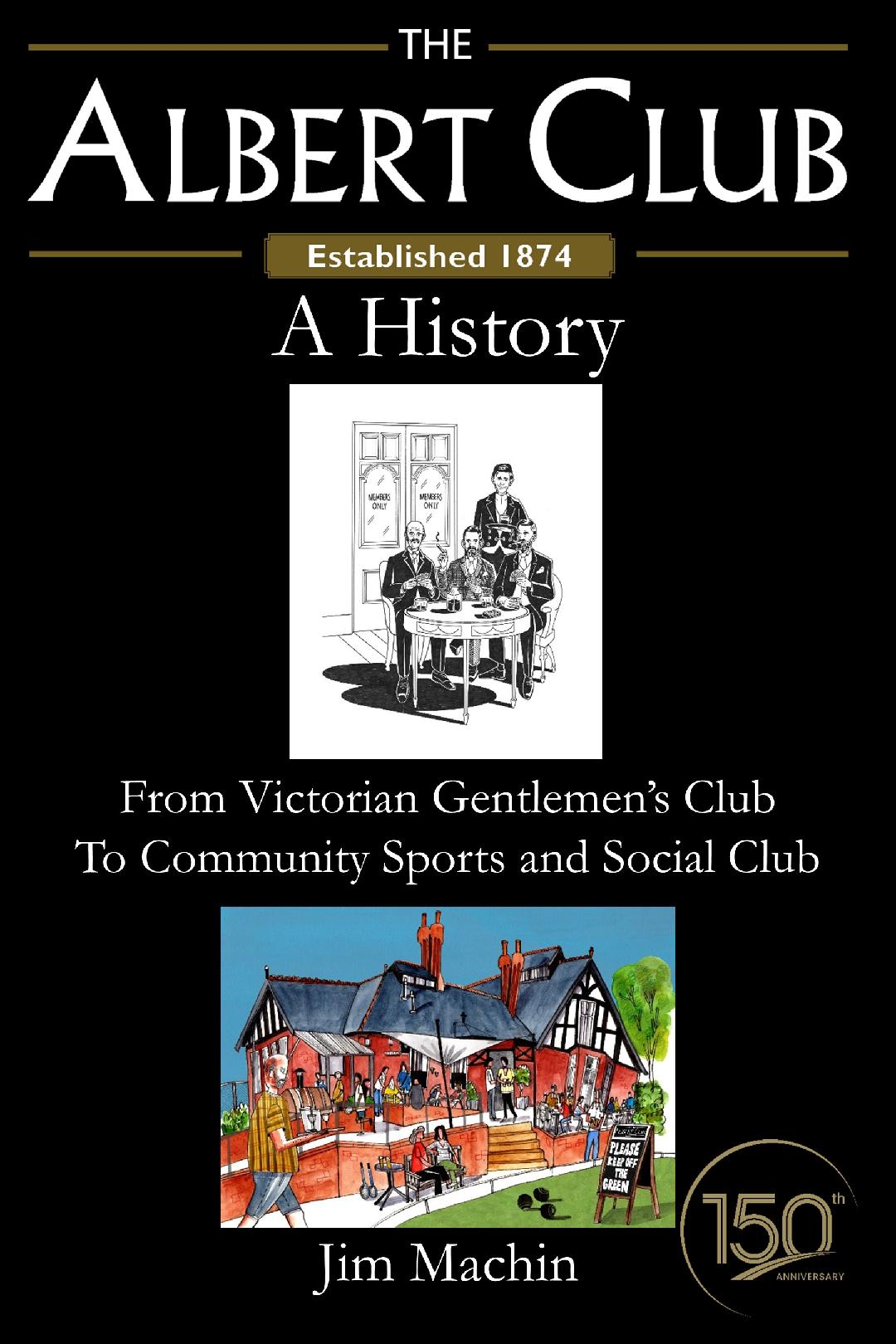
The Albert Club ..... a history and an insight into West Didsbury and beyond ...... over two centuries

Now I am looking forward to reading The Albert Club, A History, which has been written by Jim Machin.


It is one of those books which combines the story of one sport's club in West Didsbury which was established in 1874 and along the way offers up a wonderful social commentary on both the area and a picture of life over two centuries.

Jim Writes, 

"Pre-order your copy at the Albert Club now, over the bar for £10. All profits will go to the Albert Club. 

The Albert Club started in 1874 as a gentlemen’s club for the wealthy merchants, industrialists, and professionals of late-Victorian Manchester, especially those living in West Didsbury, Didsbury and Withington.

It is now a thriving community sports and social club at the heart of West Didsbury life.

Designed by leading Manchester architects of the time, it is believed that the club is the oldest lawn tennis club, still using the same original clubhouse and grounds, in the world.


How did this happen? Who were the gentlemen? How were they connected? How well-known were they in Manchester and Britain? What was club life like? What were the clubhouse and grounds like? How did the sports develop? How does the club’s story reflect the social history of Manchester and Britain? How long did it take women to be allowed full access? And how did that happen?

There is tragedy and comedy, and evidence of other forgotten Manchester histories. The social norms and dialogue of the earlier eras are often shocking, but sometimes surprisingly similar to the modern day. Some things don’t change!

Written in the style of a reference book, the reader can select those subjects and periods they are interested in, from 1874 right up to the last 35 years.

You can also find out if an early Albert member (1874 to 1924) lived in your house, and what they did for a living.

The book is in Royal format (9" x 6"). The main content of the book is 300 pages long, with another 70 pages of appendices, references, index and introduction".

Here’s what the Albert’s proof readers have been saying:

"Meticulously researched and well written, it brings to life the many generations of Albert members.

It made fascinating reading. You have worked wonders researching the lives of all those amazing early members.

You've done a great job mate! Looking forward to reading the rest.

A fantastic read, absolutely amazing to find out about the history of the club and the courts, you’ve done a fantastic job here and should be really, really proud of yourself!

A love letter to the Albert. Tears in my eyes. Amazing!

A fascinating insight into the people and history of Didsbury.

Undoubtedly the best book about the Albert Club that I have ever seen. I picked it up and could not put it down. Must have been the super glue.

Amazing read. Well done! You must be proud and relieved to have finished.

Hear, hear! Brought tears to my eyes."

The Albert Club, 39-41 Old Lansdowne Road, West Didsbury, Manchester M20 2PA

thealbertclub.co.uk


Saturday, 24 June 2023

A little mystery from West Didsbury ………

I doubt we will ever know who the person was who wrote to Miss Eva Stewart, or for that matter why they had left Ireland, or  the identity of a Mrs. G, who is described as “a lovely person”.


The date the picture postcard was sent is unclear, but I know that the red penny stamp of King George V dates from between 1912 and 1922.*

The message reads, “arrived here alright, and had a good night on boat.  I’m just feeling at home here, Mrs. G is a lovely woman, will write tomorrow”.

The house is still there, and is one of those sturdy but modest family homes, which appears on the OS map of 1894 and maybe older.

I cannot find a reference to a Mrs. G for 1911 on the street directories and for now do not have access to those for the rest of the period up to 1922. A search of the later ones will have to wait till I go into Central Ref.


And that leaves so many questions.  

The correspondent might have arrived from Ireland to take up a post as a domestic servant, but that is sheer speculation and so very unhistorical, and alternatively Mrs. G might have been the landlady.

The next step will be to trawl the 1911 census, but I fear that will yield nothing.

So that is it, leaving me just to comment on the photograph which many will recognise as the hospital of what was still the Withington Workhouse.

The experts might be able to make something of the car and conjure up a date, but I will leave that to them.

Location; West Didsbury

Picture; picture postcard, circa 1912-22 from the collection of David Harrop

*I await the expert to correct my assertion of 1912-22.


Tuesday, 30 May 2023

The little bit of history Phil found in his garden …………..

I grew up with those plates, cups and saucers which came with blue decorative designs.

Found by Phil, 2023
Sometimes the blue extended to the entire plate and depending on the design you might also get leaves, and flowers, a group of fishermen with their rods, and in the distance little flimsy bridges, and the odd pagoda.

So common were they in our house, our Nana’s house and in the homes of neighbours that they were just the background to our lives.

Back then I can’t say I liked them, but I was  curios at the number of fragments which turned up in the garden of the old house.

26 Lausanne Road in Peckham had been built in the 1870s and by the time I was growing up there eighty or, so years later there were lots of these bits buried just below the surface.

And a decade later in the 1960s they could also be found in the garden of the house in Well Hall Road which dated from 1915.

All of which might have suggested to me that these “blue” ceramics had a long history and had been mass produced throughout the 19th and into the 20th centuries.

The posh stuff circa 1800, 2016
But at 10 rolling through into my teenage years fragments of China didn’t feature.

Now I am intrigued which made Phil’s question about his bit of blue plate one to follow up.

Along with a picture he commented, “Our back yard now has a trench.... for the new drain. 

The trench diggers today found this and left it somewhere prominent. What could it be and how old? 

Our house was built 1880 Kenilworth Avenue off Burton Rd, West Didsbury. 

The fragment is 10 cm long, 

It could be part of a wash basin or tureen?”

And I was fascinated.  

There will be possible answers on the net, which Phil will follow up along with a query to the Art Gallery in town. As for the two pictures I am well aware of the differences, but blue China is Blue China.

So watch this space.

Location; Didsbury

Picture; a bit of blue China, lost but found, broken but clean, 2023. Courtesy of Phil Portus, and posh stuff, Blue Willow china, c. late 1800s, various manufactures, Lahaina Heritage Museum, 2016, Author Wmpearl, Licensing, I, the copyright holder of this work, hereby publish it under the following license:Creative Commons CC-Zero This file is made available under the Creative Commons CC0 1.0 Universal Public Domain Dedication.

*Willow pattern, https://en.wikipedia.org/wiki/Willow_pattern 

and

Blue Printed Earthenware In The 19th Century, http://printedbritishpotteryandporcelain.com/pottery/ceramics/blue-printed-earthenware-19th-century

Monday, 2 May 2022

Southern Cemetery ….. a house in West Didsbury …….. and a certain Jeanne Vignot of á Neuilly-sur-Seine

I am the first to admit that speculating on the relationship between a Jeanne Vignot in France and the mystery resident of Clyde Road , is both unhistorical and unlikely to take you anywhere.

But the romantic in me wonders just why aJeanne received this picture postcard in the January of 1908, and what she thought of being sent a photograph of a cemetery, even if it was the impressive Southern Cemetery.

In time I might go looking for Jeanne, but for now, because it is easier I will go for the person who sent it.  The clue is on the postcard in the form of the sender’s address, which is 93 Clyde Road.
The house is still there today and is one of a pair which as then goes under the title of Kinloss Villas, and dates from 1882.

But here is the problem, I know who was there in 1901 and who was there eight years later, but for now pinpointing the residents in the year the card was sent still alludes.

That discovery will have to wait for the next visit to Central Ref and a trawl of the directories for 1908.

Suffice to say in 1901 it was the home of Mr. and Mrs. Hale, their four children and two servants.

By 1909 it is occupied by Mr. and Mrs. Amirayan, but they have proved quite elusive.  I know he was a “Manager of Exports” and in 1929 had offices at 29 Princess Street, and that his wife and daughter had traveled from Australia and Japan in the 1920s, but apart from one official record from 1939, I can’t find much else, and that much else extends to no census records.

So it remains a but of a mystery, but nature and all historians abhor a mystery so I shall plug on to find the identity of the person at 93 Clyde Road and a possible connection with France.

Location; West Didsbury

Picture postcard. Southern Cemetery, 1908 from the collection of David Harrop

Tuesday, 7 July 2020

That pub on Palatine Road ……… with a bit of its history

Now, the Greenfinch pub rather dominates the corner of Palatine Road and Lapwing Lane.

It was  once a school for ladies, whose Principle was Miss Aurelia Hahnel.

She was busy expanding the minds of her students from 1878 to sometime between 1909 and 1911, by which time she was in her mid-sixties and may have decided that that was enough teaching for anyone.

The property was owned by the Midland Railway Company who seem to have bought it from a William Eastwood Green and looks to have been built in 1870.  Mr. had an extensive portfolio of property in the area including the White Lion.

Aurelia Hahnel’s father was Austrian, and he is listed variously as a merchant, chemist, and baker.  He died in 1900 in Boston in the USA and appears from the records to have been absent from the family from at least 1881.

It may just be that he was away during the years of the census, but that said, as yet Miss Aurelia is also absent from the 1861, 1871 and 1891 census records.

And for those who like a bit more history, one source records that it was once built as consulting rooms or small hospital by a doctor, for two of his daughters who failed to qualify”. *

I suspect this may refer to Mr. Thomas Ashton Goodfellow who as a GP, was living with his family in the property in 1911, but somewhere the story has lost something, because Mr. and Mrs. Goodfellow had three sons the eldest of which was just 8 in 1911.

The family appear still to be in the property when our doctor died in 1937.


Picture; the Greenfinch, from Manchester Pubs The Stories Behind the Doors Didsbury, Peter Topping & Andrew Simpson, 2019.  Available from www.pubbooks.co.uk and local bookshops.


*WHAT?UB, https://whatpub.com/pubs/MAS/4207/greenfinch-west-didsbury

Sunday, 21 June 2020

A house in Didsbury, that brewer from Hulme and a new church ....... a story from Chris O'Connor

Following on from the recent blog on William Roberts, a brewer from Hulme, I had the honour of being asked to write the follow up blog based on some research I had been doing recently on the road. 

Oaks Farm, Christ Church Avenue, Darley Avenue, 1888
I live on Manor Drive in Chorlton.

Andrew had already unearthed a lot of information on William, but some further research was needed to determine where he lived in Didsbury and which church he offered to build.

The entrance to Manor Drive is just behind St Ambrose Church on Princess Parkway.

Before boundary and post code changes, it was previously in West Didsbury but now firmly resides in M21.

The origins of Manor Drive (original name Broxton Road) were a row of 4 farm cottages on what was called Oaks Farm.

Oaks Farm consisted of a few fields, some farm buildings and a large farmhouse on the corner of Darley Avenue and Christ Church Avenue.

As you can see on the map from 1888, Christ Church can be seen across the road from Oaks Farmhouse.

Further research on the christchurchdidsbury.org.uk website led me to some more information about our William Roberts. It reads “The Church was a gift to the community from Mr. William Roberts of Darleydale, Derbyshire”.

It also goes onto say “In the 1870s he employed 62 men and lived at Oaks Farm which occupied the site which is now St. Ambrose’s Church”.

Aerial View, 1933 
The Oaks farmhouse was still around 1933, as can be seen in this aerial view of Princess Parkway.
 Aerial Views, 1933

 Oaks Farmhouse and Christ Church, 1933

Quite clearly from the zoomed up version of the aerial view, we can see Oaks Farmhouse overlooking Christ Church. This fact is further confirmed on christchurchdidsbury.org.uk “At this point Mr. Roberts offered to build a church and rectory at his own expense and insisted on the present site, the corner of Darley Avenue and Princess Road (rumour has it that he wanted to see the church from his home!).


Oaks Farmhouse and Christ Church, 1933
 In 1881 he was still living on the Chorlton/Didsbury boarder and would have watched the building of the Church and Rectory.”

So, it seems like our Brewer, William Roberts in fact lived in West Didsbury and built Christ Church.

I’ve found further connections between Manor Drive and Oaks farm to other drinks manufacturers’ from Manchester….but we’ll leave that information for the next blog 😉

Chris O’Connor © 2020

Location: West Didsbury and Chorlton.

Pictures:  Oaks Farm, Christ Church Avenue, Darley Avenue, 1888, from OS Six Inch map, courtesy of National Library of Scotland, Aerial views, 1933 N. S Roberts m67695, courtesy of Manchester Libraries, Information and Archives, Manchester City Council, http://images.manchester.gov.uk/index.php?session=pass

Wednesday, 27 May 2020

Passing the ghost bank ....... doing the essential walk and making it historic .... no. 25

Now I am back with that ghost bank. 

It is  one of those buildings that I have never given much thought to, but it caught Barbarella's eye recently on a walk, and she sent over a series of pictures, adding, "This used to be a physiotherapy centre, about twenty years ago. Lapwing Lane"

It is the former bank on Lapwing Lane and I must have passed it countless times, and on occasion stared at it from the window of the restaurant opposite.

I did once try to take some pictures but the light was wrong and I gave up which is a shame because I might have been inspired to dig down in to the history of The Mercantile Bank of Lancashire.

But Barbarella's pictures have caught it perfectly.

As yet I haven’t found out much other than it merged with the Lancashire and Yorkshire Bank in 1904 which merged with the Bank of Liverpool and Martin in 1927 which subsequently changed its name to Martins and in turn merged with Barclays in 1969.

But there will be someone out there who knows all about the bank and in time will be in touch.

In the meantime I know that our building dates from 1903, which means it had a brief existence as the Mercantile Bank.

Such are the exciting times of the banking world.

And since I posted this Richard has dug deeper and discovered that the Mercantile Bank Of Lancashire Ltd was "founded in 1890 with a head office at temporary premises in Guardian Buildings, Cross Street, Manchester, with capital of £1m, its early growth reflected the continuing industrial prosperity of Manchester.

The completion of the Manchester Ship Canal resulted in over 200 new accounts, and on 30 June 1891 the bank reported a net profit of £2,806.

Several branches were opened in the Manchester area, as well as others across Cheshire, Derbyshire, Staffordshire and Yorkshire.

In 1900 branches were acquired on the Isle of Man by amalgamation with the Manx Bank.

Soon after, however, the Mercantile Bank began to run into difficulty, partly due to the effect of the Boer War on investments.

The board of directors saw that as a relatively small bank, they could only survive by further amalgamation.

In the early part of 1904, several meetings were held with the Lancashire and Yorkshire Bank, and on 1 July the business of the Mercantile Bank was transferred to the Lancashire and Yorkshire Bank."*

And in turn the Lancashire and Yorkshire Bank merged with he Bank of Liverpool and Martin in 1927.

Pictures; former Mercantile Bank of Lancashire, 1903, from the collection of Barbarella Bonvento, 2020

*Barclays Bank PLC, https://www.archive.barclays.com/items/show/5305

Saturday, 16 May 2020

Reuniting a war memorial with its church in West Didsbury ........ the picture of St Mary's

Now, ever since I discovered that the war memorial in the grounds of what was St Luke’s on Burton Road had come from another church which closed in 1929 I had been looking for a picture of that lost church.

St Maru's, date unknown
It was called St Mary’s and was located on Queens Court Road on the corner with Palatine Road. 

There was no reference to it in the Directories, although there was a school bearing the same name behind Barlow Moor Road.

Then as so often happens, someone came forward and offered up the answer, which in this case was Maureen Stephenson who responded to the original story with, "The following information is from Pam Siddon's booklet West Didsbury - A Walk on the West Side. Hopefully, it will solve the St. Mary's mystery. 

On the opposite side of the St. Aidan’s United Reform Church, on Palatine Road was  St. Mary's Church, which was demolished in 1929.

St Mary's on Queens Court Road
St. Mary's had been built in when the parishioners of St Luke's on Burton Road became very resentful at having to attend services there. 

The road was badly lit, the pavements dirty and hardly anyone lived nearby. 

In 1888 they held a meeting and agreed to build a temporary church on Palatine Road. 

St. Mary's was a wooden structure of pitched pine with a corrugated iron roof which was always known as 'The Iron Church'. 

The organist and choirmaster, Samuel Lamford, was the music critic of 'The Manchester Guardian'. (Andrew, the church may have been on the site of the present day Queens Court flats?)"

Queens Court
And having finally got its location I found it on the 1893 OS map for South Lancashire, and again on the 1933 OS, after which it was demolished and the complex of flats known as Queens Court was built.

But until now I lacked a picture, but that too has now been sorted, because a few days ago John Waterton posted a picture postcard of the church  from the Wrench series and gave me permission to reuse it.

I don’t have a date, and although there is a serial number on the card, I have yet to locate a Wrench catalogue which would provide that date.

The War Memoriral, Northern Grove, 2017
Still, for now it is enough that I can place the memorial beside its original church.

Location; Didsbury


Pictures; St Mary’s from a Wrench picture postcard courtesy of John Waterton, the war memorial 2017 from the collection of Andrew Simpson, and Queens Court, 2020 from the collection of Barbarella Bonvento


Thursday, 7 May 2020

Feeding centres, a war memorial and the British Mountaineering Council ….. doing the essential walk and making it historic .... no. 11

Now when you set off on one of your “essential walks”, the chances are something will turn up and surprise you.

The former church and war memorial, 2020
And much the same happened to me today when Barbarella sent over a series of pictures from her walk through West Didsbury.

She was drawn to that old church on the corner of Burton Road, and Northern Grove.

I have had a stab at researching its story.

I know that back in 1903 it was the Christ Church Mission Hall with a Sunday School of the same name beside it.

And I also know that eight years later it had undergone a name change, so while the Sunday School was still Christ Church Sunday School the Mission Hall was now known as St Luke’s .

But that is pretty much it, except for the war memorial which has featured on the blog before*.

 What I didn't know until today is that the memorial had been moved from St Mary’s Church, and for that I have to thank a site which has researched all the names on the memorial.**

Leaving just one reference to the church on the Church of England Heritage Record.***

But undaunted there are always the little bits of stories which offer up something interesting.

The home of the British Mountaineering Council, 2020
Since 2017 the building has been the office of the British Mountaineering Council, which was formed in 1944, has 75,000 members and briefly flirted with a name change to Climb Britain but dropped the idea just two months after it announced the rebrand in the face of stiff opposition.

And in the absence of any detailed information on the church I thought that was it, but, no, there is more.

In 1941 the building was designated one of the “33 rest and feeding centres for the reception of homeless people”, who had been “bombed out”.  According to the Manchester Guardian “considerable progress has been made of late in the securing of necessary beds, bedding and equipment in centres which are centrally heated and possessed of the necessary lavatory and other accommodation requisite where large numbers are congregated”.****

One of the 33 Rest & Feeding Centres, 1941
On a happier note, seven years earlier the Sunday School Hall had played host to The West Didsbury Dramatic Society who were “a recent formation but whose ambition is high”.****  The play was The Rising Sun, which recounted the struggle of a family run shop in the face of competition from the “big store”.

And despite the grimness of the plot and the lack of stage space and equipment, the newspaper’s critic commented that it was a success.

All of which means that the next time I pass the old church building, I shall ponder on it’s current use and the part it played in Didsbury’s history.

Location; West Didsbury

Pictures; Burton Road, 2020, from the collection of Barbarella Bonvento

* Stories from a Didsbury war monument, https://chorltonhistory.blogspot.com/2019/03/stories-from-didsbury-war-monument.html

**War Memorials, https://www.tapatalk.com/groups/warmemorials/st-mary-s-church-school-t5140.html

*** Church of England Church Heritage  Record; https://facultyonline.churchofengland.org/church-heritage-record-west-didsbury-st-luke-624171

****Manchester’s Rest and Feeding Centres, Manchester Guardian January 3, 1941

*****Heijerman’s Rising Sun at Didsbury, The Manchester Guardian, April 9, 1934

Wednesday, 6 May 2020

In West Didsbury with the Synagogue ….. doing the essential walk and making it historic .... no. 10

Now I am really enjoying the pictures Barbarella is sending of her essential walks, and today is no exception.

Her Sunday walk began in “Didsbury ending in Chorlton near the M&S- Leon fabrics, and then back via Southern Cemetery”.

And along the way there was the  Shaare Hayim Synagogue which is an impressive building, located on Queenston Road and extending down Old Lansdowne Road.

“It dates from 1927 and is a Grade ll listed building.

Originally, it served the needs of the Withington Congregation of Spanish and Portuguese Jews, which had previously been located on Mauldeth Road in Withington, and which was formed in 1904.

In 1997 the congregation merged with the Sha'are Sedek Synagogue which worshipped on Old Landsdowne Road and was formed in 1924.


Both congregations are from the Sephardic tradition which originated in the Iberian Peninsula, North Africa and Middle East.

The merger resulted in the demolition of the Old Landsdowne Synagogue and the development of the site for residential properties, which allowed the funding of the renovation of the Queenston site”.*

Location; Didsbury

Pictures; Walking in West Didsbury, 2020, from the collection of Barbarella Bonvento

*Chorlton-cum-Hardy Churches, Chapels, Temples A Synagogue and a Mosque, Andrew Simpson & Peter Topping, 2018, pages 160-165


Wednesday, 22 April 2020

In Marie Louise Gardens …… with Miss Benson’s story which stubbornly refuses to be told

This is Marie Louise Gardens, often described as “the gem” and a place I still have yet to visit.

The tragic story of how it came to be is fairly well known, suffice to say that it commemorates the premature death of Marie Louise Silkens who died aged just 26 in 1891, but for those who want more, just follow the link to an excellent account of the parks history by The Friends of Marie Louise Gardens.*

For now, I am more interested in the postcard which carried the picture of the gardens, and the elusive Miss. Benson who sent the card from Heaton Mersey in the evening of September 16th 1905, which was a Saturday.

The message refers to a photo, hopes all is well with the family and that they are “looking out for the surprise you requested”.

And that pretty much is that.

A trawl of the records in both Heaton Mersey and Wigan has got me no nearer finding either Miss Benson or her family, and while I have come close they stubbornly refuse to come out of the shadows.

More so because there is doubt about the Wigan address, which has been crossed through.

I read it as Park Road, and there is a number 88 Park Road, close to Mesnes Park.

But on closer inspection it looks like Pearl Road, and sadly there is only a  Pearl Street, whose houses look like they postdate 1905.

Which just leaves me with the picture from the postcard.

Now, given that the park was opened in 1903 and our card was sent in 1905, the scene in front of us will be one of the earliest images of the Gardens.

And that will have to do.

Location; Didsbury

Picture; Marie Louise Gardens, circa 1903-1905, from the collection of David Harrop


*The Friends of Marie Louise Gardens, https://www.marielouisegardens.org.uk/?page_id=47


Friday, 3 April 2020

Always explore properly …… Parkfield Road and Didsbury United Reformed Church

Now it’s a simple lesson, but one I don’t always follow through, which is …… never stay on the main roads, always wander off and you will be amazed at what you find.

It is an idea I used to adhere to, and back in the 1970s got to know much of the city by just turning off the big busy street and exploring the smaller often much more interesting ones.

But I don’t do it as often as I should, and so when Barbarella sent over this picture of a church I was totally stumped.

Of course, residents of West Didsbury will know it well, but I didn’t, and it was only when Barbarella said it was almost opposite the synagogue I knew where to look. 

It is Didsbury United Reformed Church, or as it once was St Aiden’s Presbyterian Church, and it is one I have passed countless times, but only from Palatine Road.

And I have to admit I have at times thought it odd, given what looks to be a small footprint facing Palatine Road, but then as I now know it extends down Parkfield Road.

So, there you are.

Location; West Didsbury

Picture; Didsbury United Reformed Church, 2020, from the collection of Barbarella Bonvento


Thursday, 2 April 2020

On the occasion of the golden wedding anniversary of Mr and Mrs Wareing of Buxton Avenue ......... a greetings telegram from 1942

Now I am back with the telegram.

For 189 years they were the quickest way of sending a message and the arrival of the Telegram Boy might herald all sorts of news.

Nana received one in 1942 informing her that my uncle was missing, another a little later with the news that he was a Prisoner of War, and the most dreaded of all telegrams which broke the news of his death on the other side of the world.

So for me the telegram is always associated with grim news, but of course there were plenty of happy ones and my friend Ann sent me two.

Both were sent in the August of 1942 congratulating Mr and Mrs Wareing of Buxton Avenue on their Golden Wedding anniversary.

Of the two this is my favourite from Barbara and Margaret Preen with the delightful image to accompany the message.

They were married in 1892 and had lived in Buxton Avenue since 1911.  Mr Wareing described himself as a road surveyor and at present that is all I know, but I guess Ann will have them and in the fullness of time more will be revealed.

For now it is a nice reminder that telegrams were for all occasions and all seasons.

Picture; greeting telegram, 1942, from the collection of Ann Love


Wednesday, 1 April 2020

On Lapwing Lane …………before the end of the tram


This will be the last tram story for a while and having reflected a few days ago on the end of Manchester Corporation Tramways, I thought I would close with this one of car number 309 on the 41 route to Exchange.

I don’t have a date, but we are on Lapwing Lane in West Didsbury, with familiar set of buildings acting as a backdrop.

And if you wanted to be a little playful, creeping up behind our tram is one of the motorized buses which would ‘do’ for the tram.

Location; West Didsbury

Picture; West Didsbury, date unknown, from the collection of Allan Brown


Friday, 28 February 2020

Remembering that lost institution which was the Launderette…….. on Burton Road with Gudrun

Farewell Launderettes, everywhere. 

We knew you well, spent many a wet Sunday morning watching other people's clothes twisting and tumbling amongst the soap and bubbles.

In the hour and ten, we wondered just how sensible it had been to wash a pink and yellow leotard with the white office shirts, and above all tried each week to summon up the courage to talk to the bar maid from the Midland.

We won't see your likes again.

You dominated the middle decades of the last century, saw off the Laundries, and offered many lonely bed sit people a warm place in which to share the smell of soap suds and the rumble of those hot air driers.

And now most of you have gone, including Gudrun’s which after a decent interval of mourning gave way to Proove, the Italian pizza place.

Picture; Gudrun Launderette, Burton Road, circa 2014, from the collection of Steve Marland

Wednesday, 18 September 2019

On Lapwing Lane with tram car 570 and unknown cyclist

Now this picture has a long been a puzzle to me.

The caption says Lapwing Lane, and I had always tried to match the scene with the stretch of road which runs from Burton Road up to Palatine Road.

But I rather think we are on that bit of Lapwing Lane opposite the Metro stop.

It does rather require a leap of faith in that the frontage of the building has undergone a fair bit of change, not least the loss of the brick bits above the windows of the upper storey and the brick features.

But something similar was done to the row of shops and houses on Barlow Moor Road facing the old tram terminus in Chorlton.

That said I am open to suggestions.

For now, I like this image which shows the man frantically cycling away, while the woman in the background travels at a more stately pace and both are outpaced by car 570 from Exchange on its way to Didsbury.

Location; West Didsbury

Picture; tram car 570, date unknown, from the collection of Allan Brown

Sunday, 4 February 2018

A night at Proove on Burton Road, eating pizza and reflecting on what has gone before

Now I wonder what Mrs Jessie Owen, who sold tobacco on Burton Road would have made of pizza.

To be fair she was selling her tobacco back in 1911 and I doubt that she would have ever eaten pizza.

All of which is a shame because her shop today is occupied by Proove who make a fine pizza.*

They also serve up some of my favourite street foods, including Pizza Fritta and Croccheè.
Croccheè originated in Sicily and is made from mashed potato and egg, covered in bread crumbs and fried, while Pizza Fritta is made by sealing the toppings between two layers of pizza dough and deep frying until crispy.

I first had Pizza Fritta at Rosa’s home in Varese, north of Milan and I was instantly hooked on it.

Rosa is from Naples which is where the fried pizza comes from and now whenever we go back to the city it is always something I order.

But yesterday I had a mushroom pizza while Tina went for one with several toppings made to order.

And while we waited, we passed the time talking to the staff, many of whom like Tina are Italian and so the conversation ebbed and flowed touching on Naples, and Rome and some tiny villages tucked away in the north.

We had gone in during the late afternoon and already the place was busy, and by the time we left was becoming very busy which is always a sign that the food and the service is good.

So, that just leaves me thinking about Mrs Jessie Owens, who in 1911 was 35 years of age, had been married for fifteen years and had two children.

She owned and ran the business while her husband was a commercial traveller for a soap manufacturer, and like many, she employed a servant, who was young Elizabeth Simcock from Cheshire.

In time I will find out more about both the Owen family and Miss Simcock and will go looking for a picture of the shop.

Sadly the only one I have of the stretch of Burton Road which included that tobacconist, just misses off Mrs Owens shop, but no matter, someone will turn up with a photograph along with others who have also eaten pizza at Prooveor its companion restaurant in Sheffield.

We shall see.

Location; West Didsbury

Pictures; pizza, courtesy of Proove and Burton Road, date unknown, from Didsbury Through Time, 2013, Andrew Simpson & Peter Topping


*Proovewestdidsbury@proove.co.uk 160 Burton Road, West Didsbury, Manchester M20 1LH  0161 669 9061