Showing posts with label Coins. Show all posts

Monday, 20 October 2025

The Chorlton farthing, halfpenny and penny from Reynard Road …. bringing luck to the house

Now, there will be someone who can offer up a full and detailed explanation for the practice of putting coins in or around the entrance to a house.

I am guessing it will be a pre Christian practice.  

One suggestion I read referred back to “Italian folklore probably - it's so that money will flow freely into the home and that the people inside prosper”, and another reminded me that coins were placed at the foot of masts in sailing ships.

My grandparents found a coin dating from King George III under the stone step in their two up two down on Hope Street in Derby, which dated the row of terraced houses .

And Jaime who lives on Reynard Road sent over these coins adding, “Good morning Andrew, I thought I’d share another interesting thing about our house. 

We are having some work done and my builder found some old coins in the old door frame.  There’s a 1927 penny, 1939 farthing, 1942+1943 half pennies. 

They were in the old back door frame. I think at a later date a small extension was added”.

The houses date from the early 20th century, and so as Jaime says the extension will have been added later sometime after 1943, but I suspect not long afterwards, but maybe after the war.

In 1939, a Mr. Sydney Mckew who was a long distance lorry driver shared the house with Ada Faulkner and George Hayes, which for the time being is s close a we are going to get to those coins and the little back extension.  

Ada was twelve years older than Sydney and described her occupation as “Unpaid domestic duties”, while George was 29 and was “Milk Roundsman”.

In time we may find out more about the three and push forward the time when they lived in the house to when the coins were deposited.

But for now that is pretty much it, other than to reflect that there will be many like me who not only remember all of the coins Jaime sent over but will have used them until they became history with the move to decimal coinage.

Although I have come across and written about other odd objects found in houses, including the Salford shoe, and the 1910 cheese sandwich.

Location; Chorlton

Pictures; “Four coins from a doorway", 2021, from the collection of Jaime Cockcroft-Bailey


Monday, 11 December 2023

Who needs brick dust? ………………

 This will be the last foray into those pennies, half pennies, farthings and shillings which were part of my growing up.*

Half Penny, 1951

And if you were born before 1971 they will have been part of how you paid for things, what you got as pocket money and more recently kept as mementos of your youth.

Most of the ones in my collection came from our Stella and last week I brought them out for a bit of fresh air prompting a series of stories about them, ranging from what a history lesson they offer up to that childhood practice of cleaning them with brick dust and a hankie.

And it was that last story of brick dust, and a hankie which prompted David O’Reilly to comment “Re your brick dust penny blog. Alternatively, you could leave a coin in vinegar over night? Or use a cloth to rub the coin with a mixture of HP sauce and salt !

Queen Victoria, 1865
Miss Rox, my pretty Primary school teacher in 1958 would give you a ‘good’ penny for any ‘bun’ penny you found. (Early Victoria reign impression with her hair tied behind in a bun).

As for childhood games and rhymes……. don’t get me started!

I have the Iona and Peter Opie books and made a lifetime study of it whenever I was on ‘yard duty’."

Now vinegar, HP sauce, and salt were all new to me, and on reflection I wish I had come across them back in 1959 which would have saved my fingers and mum’s handkerchief from the damaging effect of brick dust, not to mention the holes in the walls of Edmund Waller School.

The alternatives remind me also of the questionable practices engaged in to harden conkers before the all-important contests in the playground and in the street from September onto November.

That aside David also reminded me of the work of  Iona and Peter Opie who explored the rhymes and games of children played out in school yards and on the streets.**

Unlike David I never bought into the books although I knew of their work and now, I wish I had.

My own childhood games pretty much centred on playing fag cards which I was never that good at, and the odd game of football and cricket which I was equally lack lustre at, which pretty much left just mooching around.

Edward VII, 1909
The highlight always being wet days when we were kept in and the piles of old comics kept in a cupboard were brought out.

If I am honest I don’t remember many traditional kid’s rhymes which may be because we were from south east London and grew up in the 1950s when those songs and rhymes were on the decline.

The only one that stands out pitched a large number of American television stars  of Westerns into a rhyming story using their names set against a series of adventures.  

It was in its way a kid’s version of of that 1959 song “Delaware” by Irving Gordan and made popular by Perry Commo which referenced 15 US States in the form of puns, "like Della wear, new jersey, Calla 'phone ya, how ar' ya, Missus sip, mini-soda, Ora gone, I'll ask 'er, taxes, Wiscon sin, new brass key, Arkan saw, Tenne see, Flora die and misery".***

I have tried remembering the kid’s version but it has long since been lost from my memory, although if I am honest I was rubbish remembering all the connections back then.

The best I can offer are a selection of children's songs sung by the Clancy Brothers and Tommy Makem, along with some more about Charlie Chaplin by the Oldham Tinkers.

Kids playing on the streets, Hulme, Moss Side circa 1970s

It would have been just three years after the Clancy's and Tommy Makem recorded their melody at Carnegie Hall that I first heard those children's songs and a little later the Oldham Tinkers with a collection of songs about Charlie Chaplin.

And both have stayed with me

And that is about it.  I await the memories of others.

Location; the 1950s

Pictures; coins from the collection of Andrew Simpson, 1865-1951 and Kids playing on the streets, Hulme, Moss Side circa 1970s, courtesy of Roger Shelley

*Coins, https://chorltonhistory.blogspot.com/search/label/Coins

** The Iona and Peter Opie Archive, https://www.opiearchive.org/

***Delaware, https://en.wikipedia.org/wiki/Delaware_(song)

****Children's Medody Live at Carnegie at Nall, November 1963, https://www.youtube.com/watch?v=e5R03zuaRy4

*****Charlie Chaplin, The Oldham Tinkers, Oldham's Burning Sands, 1974, https://www.youtube.com/watch?v=qHm-b99-ER4


Sunday, 10 December 2023

Don’t try this one at home ……………

 This is one of those warnings which extends beyond the home to everywhere and involves an old coin, some brick dust and a hankey.

The penny that escaped the playground, 2023
With the passage of the years, I can’t remember when we used brick dust and a handkerchief to breath life into an old penny.

But it will be around 1959 or 1960 and I would be nine rising ten, and for a while it was all the rage in the playground of Edmund Waller School in New Cross.

At the time it seemed almost like magic.  You rubbed the clothe against the brickwork and then transferred the dust onto the coin and rubbed vigorously and after a while the dirt of decades began to vanish, and the penny took on a bright new appearance.

Preferably the penny couldn’t be too old or the detail on the coin would not benefit from the exercise.

Of course, today I am not surprised that the continued application of an abrasive would do the business.

The downside was that the surface of the penny became pitted, and worse still the practice left dents in the brick work which in some places resembled the craters of the moon.

And over sixty years later I wonder what staff and students make of these circular depressions in the bricks, but I suppose weathering will have probably left our handiwork less obvious.

And Edward VII remained safe, 2023
Why we stopped is a mystery.  There may have been a dictate from on high about damaging the walls of the school, or more likely we just got bored with something which didn’t do much for your hands or the penny, and led to difficult conversations with mother about the state of the hankies.

The disappearance of the old pennies followed by their copper  decimal equivalents will have pretty much killed off the practice, and now as we edge ever closer to a coinless existence few ten year olds will ever feel the need to stand in the playground with a handkerchief and some brick dust.

Cleaning your pennies will have faded into the past along with heaps of old playground games, children’s songs.

One of which I remember pitched a large number of American television stars  of Westerns into a rhyming story using their names set against a series of adventures.  It was in its way a kid’s version of of that 1959 song “Delaware” by Irving Gordan and made popular by Perry Commo which referenced 15 US States in the form of puns, "like Della wear, new jersey, Calla 'phone ya, how ar' ya, Missus sip, mini-soda, Ora gone, I'll ask 'er, taxes, Wiscon sin, new brass key, Arkan saw, Tenne see, Flora die and misery".*

I have tried remembering the kids version but it has long since been lost from my memory, although if I am honest I was rubbish remembering all the connections back then.

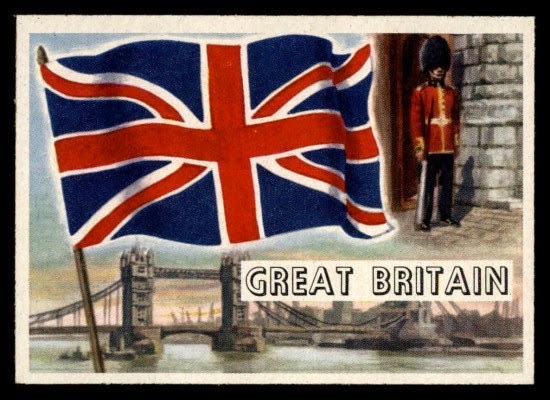
Great Britain Flag no. 26, 1956, Flags of the World

I guess it might well have started life as a skipping song and just transferred from one playground activity to another.

One of which will have been flicking cards, where you put two picture cards against a wall and flicked other ones  towards the two propped up.  

The winner was the first to knock a card down and the prize were the cards already on the floor.  

Originally it would have been cigarette or fag cards which by the 1950s had become the picture cards from boxes of tea bags.

But the favoured cards because they were so much bigger were those from a series called Flags of the World,

Italy, no. 80, 1956, Flags of the World
They came with a disgusting bit of bubble gum, and carried the flags of nations as they were in the mid 1950s and had useful information on the back including each country's currency, population, capital city and a translation of the word hello.

Often the bubble gum had gone hard and brittle, and the cards for ever afterward smelt of perfumed bubble gum.

Such were the things we did in the playground.

Location; in a playground

Picture; 1909 Edward VII penny from the collection of Andrew Simpson and the flag of the Great Britain, no.26 and Italy, no.80, 1956, courtesy of Flags of the World, Dean's Cards,  http://www.deanscards.com/c/716/1956-Topps-Flags-of-the-World

*Delaware, https://en.wikipedia.org/wiki/Delaware_(song)

**Flags of the World, https://chorltonhistory.blogspot.com/search/label/Flags%20of%20the%20World

Saturday, 9 December 2023

Mr. Boulton ….. one of his coins …. and King George III

It isn’t much to look at and until recently I had totally ignored it amongst the coins our Stella collected over four decades ago.

King George III on his Irish half penny, 1806

The image of King George III is almost unrecognizable and if it wasn’t for his name around the rim I would probably have discarded the coin and returned it to the collection.

But given the name I persevered, and scanned both sides which revealed the date 1805, the word Hibernia and a worn but distinct harp and crown.

So clearly there was a story, which involves Matthew Boulton, he of the Boulton and Watt steam partnership, and his Soho works in Birmingham.

My Wikipedia* offers up a fascinating history of the man, who with James Watt took the steam engine to a whole new level of technology and usage and along the way offered up one of my favourite observations about his part in the Industrial Revolution.  Speaking to James Boswell in 1776 at the Soho Works he grandly pronounced “I sell here, Sir, what all the world desires to have – POWER”.

A harp, a crown and the name Hibernia, 1806
It is a simple and powerful statement which has stuck with me ever since I first heard it quoted in an A level history lesson back in 1966 by Mr. Naismith.

And amongst all the things pouring out of the works was this Irish half penny, instantly identifiable by the harp.

And according to Historic Environment Scotland, "The obverse bears the robed and laureate bust of the king with long hair. A crowned harp is at design on the reverse.

The inscription reads ' GEORGIUS III D: G. REX’, on the obverse. 

This translates as: 'George III by the grace of God King'. The legend quotes 'HIBERNIA' on the reverse, which means, 'Ireland'.

In 1805 the Soho Mint struck large quantities of heavy weight copper pennies, halfpennies and farthings, and today these are perhaps the commonest of the older Irish coins still surviving. 

The precision striking and the engrailed edges made them difficult to counterfeit. 

They were the last official copper issue until 1822, but further tokens made their appearance in order to satisfy the public demand".**

All of which makes it far more interesting than the very worn lump of metal would at first seem to promise.

Now I am never over bothered about the value of such things on the open market which are now just part of the family history, but in the course of researching Mr. Boulton’s half penny one site suggested an uncirculated George III Irish half penny might go for £350, while one in “good condition” was worth £1.50, so given the state of ours I doubt I would be booking a luxury cruise on the strength of selling it.

1916 Penny
But as ever it is the stories associated with the coins which make each one interesting, and by extension take you into the very unhistorical temptation to speculate on how it was used and who used it over its long history.  

Daft I know as at the end of the day each was a coin designed to pay someone a wage or to buy a loaf of bread, a pint of beer, or a trip out.

And that leads me to my 1916 penny, less worn on one side than the other and of course issued in the middle of the Great War.

The romantic in me wonders what sort of journey it encountered in its 55 years from when it went into circulation till it was stopped in its tracks by the introduction of decimal coinage in 1971.

The possible uses are endless, but it might have passed over the counter to buy a ticket at one of the new cinemas which were being built, travelled the country or sat in a penny savings box.  Either way it will have seen plenty of use judging by its worn appearance.

A youthful Queen Victoria, 1883
And it fared a little worse than its Victorian predecessor from 1883, which given its age might have taken a lot more wear and tear.  

Queen Victoria still looks relatively youthful despite the fact that by the year of the coins issue she had been on the throne for 55 years.

No doubt someone will walk me through the changes to her appearance on her coinage from the coronation in 1837 to the “old lady” on later issues.

We shall see.

For now, that is it other than to say the small number of coins is strictly speaking not a collection, doesn’t contain anything more valuable than 3 penny bit, and apart from a couple of Roman ones all date from the last two centuries.

A worn Britannia, 1883

Location; 19th and 20th century Britain

Pictures; King George III Irish half penny, 1806, King George IV penny 1916, and Queen Victoria penny 1883, from the collection of Andrew Simpson

*Mathew Boulton, https://en.wikipedia.org/wiki/Matthew_Boulton

** Historic Environment Scotland https://www.historicenvironment.scot/archives-and-research/archives-and-collections/properties-in-care-collections/object/george-iii-irish-halfpenny-1805-modern-edinburgh-castle-48184


Friday, 8 December 2023

Losing your history ……. and finding some stories

If you were born in the first half of the last century the chances are that you carried a little bit of our collective history around with you.

Queen Victoria penny, 1865
It would be there in your pocket, your purse or held for a rainy day in one those small containers which resembled a pillar box or any one of a heap of animals pretending to be a savings bank.

But in 1971 when the country adopted a currency based on decimal units almost all of the existing coinage was junked.  

Out went the old-fashioned penny, the threepenny bit as well as the ha’penny and while some silver coinage lingered on, kidnapped and made to perform a new role as decimal coins they too pretty quickly vanished as the bight new shinny stuff rolled out of the Mint.

And of course, all the new coins bore the head of the reigning monarch, which is how it has been ever since, ensuring that the oldest real decimal coin dated from 1971.

All of which for my generation wiped out the history lesson whereby you might have coins in your pocket stretching back into the mid-19th century, and meant you rubbed hands with effigies of Queen Victoria, Edward V11, King George V and V1 as well as the young Elizabeth.

Reverse of Queen Victoria, penny, 1865
The older the coin the more warn and thin it might have been but it still passed for legal tender, even though there was as ever the temptation to save the older ones for their historic connection.

So while early and mid-Victorian pennies were rare they did turn up, hence this 1865 one, and those of Edward and the two Georges were to pinch the phrase “two a penny”.

At which point I am not making out any great claims that this was much of a history lesson, but it did mean you were vaguely aware of the past stretching out in front of you.

And in another way, it points to the historical continuity which was a currency based on pounds shillings and pennies, where 240 pennies made a pound, 12 pennies made a shilling and twenty shillings made a pound, and along the way introduced to the guinea.

Half penny, 1951

At the time of decimalization great claims were made of how complicated was a currency based on different units, but I doubt many of us were, after all we grew up with it and it was just part of the backdrop of normal life, like steam locomotives, black and white television and bus conductors.

And in Junior school it was just one of the many ways you learnt to add up and subtract along with those more challenging problem solving exercises involving  four men, three women seven apples and the amount of money Eric Braithwaite might make from selling the apples to the people at 2d an apple.

All of which makes me wonder whether Roman school children had to endure the same brain numbing lessons or for that matter the slave sent out into the local market to get the best deals on olive oil and black pepper.

This is no flight of fancy but a very unsubtle way of introducing this Roman coin which along with three others I bought in a small shop behind the British Museum sometime around 1974.

Roman coin, Claudius, 43 -54 AD

At the time I was looking for the odd little teacher resource to make the teaching of Roman history a bit more interesting.

Already I had bought a replica Roman lamp and very shamefully presented an old leather sandal bought in the Eighth Day on Oxford Road as a genuine 1st century piece of Roman footwear similar to those found at Vindolanda along the Wall.

Reverse of the Claudian coin,
The older me shudders at such a breach of historical accuracy while the younger me enjoyed the hushed silence of 30 first year students in room 11 on Portway in Wythensawe.

Now as we are in confessional mood I can’t say this one is part of the four I bought for what amounted £2 new money, and it is possible that it came from a collection of replicas I bought later.

Either way I still find it something to look at, and put with the very real Viking oyster shell I bought in York at the Jorwick archaeological dig in the later 1970s for the price of 10 new pence, there being so many found during the excavation.

The shell I can date to the Viking settlements of York and I think the coin is the Emperor Claudius and the rest as they is another story.

Viking oyster shell, Jorvick
Location; our collection


Pictures; Queen Victoria penny 1865, half penny, 1951, a Roman coin from the era of the Emperor Claudius, [I think] and a Viking oyster shell from Jorvick