Showing posts with label Eltham books. Show all posts

Monday, 22 June 2026

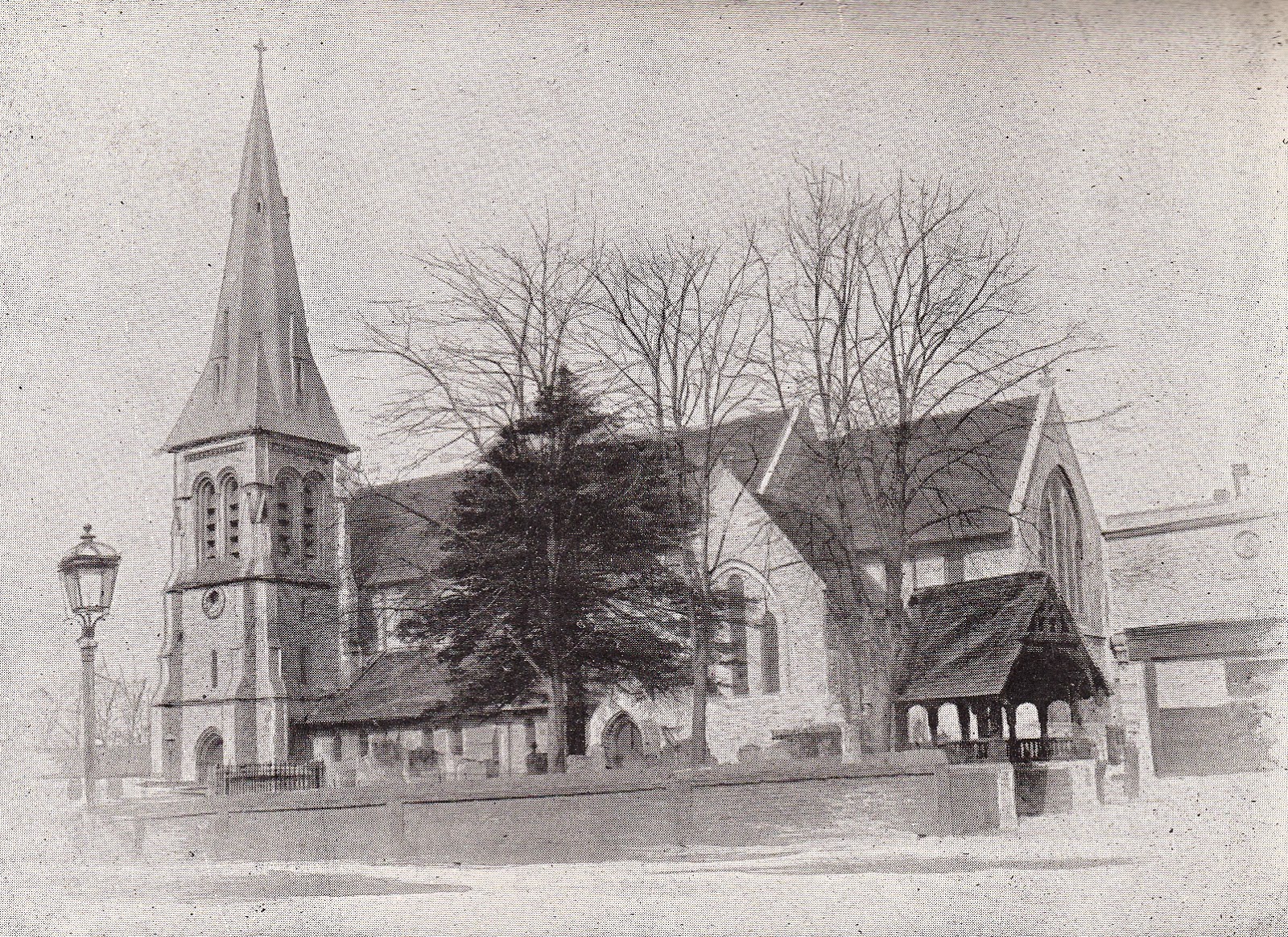
Looking at the parish church from the south in 1903

Now I like this picture of the parish church.  

It dates from around 1903 and comes from Some Records of Eltham 1060-1903 which is a marvellous little book written by Rev. Elphinstone Rivers who was the vicar of St John’s from 1895.*

I have written about our parish church before but what fascinates me about this photograph is that at first glance it looks just as it does today, but then there are the tiny details which I leave you to spot.

For me the added complication is that I was pass by in the summer when the mature trees pretty much obscure the view of the church so this 1903 picture does much to show the place off as it would have looked when brand new.

Picture; the parish church from the south , 1903, from Some Records of Eltham

*Some Records of Eltham 1060-1903, Rev. Elphinstone Rivers, 1903


Sunday, 12 October 2025

Uncovering the story of Eltham's trams ........... and a bit more too

I have long had a fascination for trams and I have just bought Eltham and Woolwich Tramways which contains “a wealth of nostalgia with many previously unpublished photographs depicting street scenes from the past.”*

Now I don’t do nostalgia it is a shallow preoccupation which distorts the past and leads you into all sorts of pitfalls.

On the other hand there is nothing wrong in wanting to peel back your own past and match your memories with the historic record and in doing so not only relive a bit of your youth but also learn more about that time.

So it is with trams.  I was just two and bit when the last one London tram trundled into the depot at New Cross and while family legend has it that I was there I have no memory of the event.

Likewise it would be another twelve years before we moved in to Well Hall and so the story of the Eltham and Woolwich trams is all new to me.

Bits of the story I already knew but Mr Hartley’s book is as promised full of some wonderful pictures which offer up scenes of Eltham and Woolwich before I knew them and as you would expect I was more than a little thrilled at getting close to our own house on Well Hall Road.

But it is easy to get seduced by the old pictures and forget the importance of the tram.  It was a cheap and for the time efficient means of transport reflected in the fact that within a few short decades it was adopted by local authorities across the country to replace horse drawn buses and trams.

LCC Tam, 1622,  route 40 from New Cross to Westminster, 2015
And because it was cheap and fast it opened up the suburbs by allowing workers to live further away from their work place.

Now to a certain extent the railways had pioneered this development but the tram could do this better.

After all it was far cheaper to lay tram track which had the added advantage that the routes could follow the existing road network.

So when the Government settled on Well Hall for its huge housing estate for the Arsenal workers in 1915 the tram network had already been in place for five years and following the Great War the network was extended to Lee, Lewisham and London.

All of which I suppose could mean that Ruskin’s observation that "Your railroad, when you come to understand it, is only a device for making the world smaller"** could equally be applied to the tram.

And on that note I shall leave off and go back to reading the book with just a thank you to Tricia Lesley who first alerted me to it and pass on a recommendation for the book which will not only delight fellow tram buffs like me but also offer up a snap shot of an Eltham which has pretty much vanished.

Sadly the book is out of print but where there is a will there is a copy and if enough people show an interest perhaps there could be a reprint.

Pictures; cover of Eltham & Woolwich Tramways, 1996, courtesy of the publishers and LCC tram 1622, 2015, Crich Tramway Village courtesy of Andy Robertson***


*Eltham and Woolwich Tramways, Robert J Harley, Middleton Press, 1996, https://www.middletonpress.co.uk/

**John Ruskin 1856

***Crich Tramway Village, http://www.tramway.co.uk/

Saturday, 11 October 2025

The Eltham Hutments ............ the book of the story and a thank you to Tricia

Now until very recently I had no idea that a small community of 1500 families lived close to where I grew up on Well Hall Road.

But then why should I?  They were erected in 1916 and had gone by 1937.

The first hints came from comments on  the Well Hall facebook site but it was my friend Tricia Leslie who first alerted me to the extent of this small estate and pointed me in the direction of The Eltham Hutments by John Kennett.

Mr Kennett is a respected local historian who has written extensively about the area and contributes a regular column for SE nine. **

And with the The Eltham Hutments he has uncovered a rich part of our history.

“Between 1916 and 1937 parts of the Well Hall and Eltham Park areas of Eltham were covered by temporary dwellings.  

These 1500 wooden huts were erected for Woolwich Arsenal munitions workers and their families.

To a whole generation of local people they were home yet memories of life in ‘the hutments’ are limited to a dwindling number of former residents.”***

The book covers the building of the huts, much on life in the community and their final demolition and removal.

What is all the more exciting is that Tricia has strong family links with those huts; “my grandfather is mentioned in the book as Mr W.B. (William Broadhurst) under the heading of Shooters Hill By-Pass (Rochester Way) and Re-Housing.  It was a test case that went to court.”

And she is currently researching the community which will be a fascinating addition to Eltham’s story.

Picture; cover of The Eltham Hutments, 1985

* The Eltham Hutments by John Kennett, 1985, Eltham Books

**SE nine, http://www.senine.co.uk/

***ibid John Kennett, page 1

Tuesday, 5 August 2025

A little bit of Eltham from Ontario in Canada

Now, a fascinating collection of photographs of Eltham fell through the letter box today, and what a journey it has had to arrive here in Manchester.

Cover of Village Eltham, undated
It was sent by my friend Barbara who like me left Eltham a long time ago and while I washed up in the North, she kept on going and lives in Canada close to heaps of my Canadian cousins.

Not only do we share Eltham but we both went to Crown Woods and she knew one of my great aunt’s sons who was well known locally in her part of Ontario.

We found each other via social media and despite its detractors Face Book and those other platforms can be a positive force in making new contacts, as well as allowing people to share their writing, and photographs with a wider world.

And make no mistake the writing and pictures which appear can be as excellent as anything produced by a professional.

All of which leads me back to the book which consists of 36 photographs from the early 20th century.

Some will be familiar, but many are new to me, and I suspect will be to others.  Most were I think produced by commercial photographers who will have sold some to residents as well as picture post card companies.

Often the photographer would have walked down particular streets and captured a selection of the houses, only to go back and offer up a copy to the occupants of each house.

This collection goes under the title of Village Eltham and were compiled by Gus White, Ian Murdock and Paula Richardson in 1984 and published by G & Pi Publications Eltham.*

I went looking for the company so that I could get permission to reproduce some of the images, but so far I haven’t been successful.

But then I guess someone in Eltham will know the three individuals or were involved with the publisher and if I am lucky will help me get in touch with them.

Until then mindful of copyright I shall just reproduce one image which ticks lots of boxes.

The carousel and the hutments, undated
It is number 36, “Entertainment at the Hutments”, and the caption runs “This horse drawn carousel was hand-cranked by the operator providing welcomed amusement for the children living in the huts. 

The Eltham hutments on the slopes of Shooters Hill were built during the First World War for the Woolwich Arsenal workers and removed in the 1930s”.

Few people will now know of the temporary accommodation which was built along with an estate of houses which became known as the Progress Estate.

And here the story takes a personal turn because we lived in one of those houses and all of us have fond memories of the place where we grew up and owned for 3 decades.

Added to this one of the huts featured in my book on Manchester and the Great War, and the story of George Davison from Manchester who in the March of 1918 made his will shortly before embarking for the Western Front.*

It was witnessed by H M Drinkhall and V L Dade and was hand written in a single sheet of note paper and is simple and the point. “This is the last will and testament of me George Gurnel Davison of Birch Vale Cottage, Roomily, Cheshire.

I give devise and bequeath to my dear wife Mary Ellen all my property whatsoever and wheresoever and I appoint her sole Executor of this my will.”

The will, 1918
By the time he made the will he had served with the Royal Artillery for four years and spent time in London and Ireland but now with the German offensive in full swing he was about to go to France, and as we know would be killed just three months later.

In one of his letters to his wife he had mentioned the Drinkhall family and how they were looking forward to her coming back to stay.

And that set me off looking for them, and in that I was helped by my friend Tricia, who located them to one of the hutments on what is now the site of the old Well Hall Odeon, which is just a few minutes’ walk from our old house.

So having made that connection between me, our house, H Drinkhall and a Manchester soldier I will close with that “horse drawn carousel” which was exactly like one I encountered on a Greek island in 1994, and another a decade later in a small remote Italian village.  

Both were operated by muscle power, and both were owned by a family of iterant travellers who pitched up for a few nights in a small village offering entertainment to the local children before moving on.

All of which just leaves me to make an appeal for anyone who knows or knew the three authors, so that I can share more of the images.

Location; Eltham

Pictures, cover and horse drawn carousel from Village Eltham, Will, 1918, of George Davison, from the collection of David Harrop

*Eltham Village,  Gus White, Ian Murdock and Paula Richardson in 1984 and published by G & Pi Publications Eltham

**A will ……. the Eltham Hutments and a soldier of the Great War, https://chorltonhistory.blogspot.com/2020/06/a-will-eltham-hutments-and-soldier-of.html

Saturday, 12 July 2025

The history of Eltham in just 20 objects ........Nu 4, a royal palace and another book

The challenge is to write a history of Eltham in just 20 objects which are in no particular order, and have been selected purely at random.

Anyone who wants to nominate their own is free to do so, just add a description in no more than 200 words and send it to me.

Now I don’t intend to write about the history of our royal palace, which is so much part of Eltham’s past other than to acknowledge its importance to the area.

Instead I want to highlight a book written all about it by Roy Brook and published in 1960.

It is now out of print but copies can be picked up relatively cheaply which is how I got my copy.

It is more than just the story of the Palace provinding information and maps on Eltham's development.

Picture; cover of the book

Monday, 2 June 2025

“The Moat, Well Hall”.......... sometime around 1903

The caption just says the “The Moat, Well Hall” and I just love this picture.

It comes from Some Records of Eltham which was published in 1903 and written by Rev. Elphinstone Rivers who was vicar of the parish church from 1895.*

In time I will go digging for more on the author but at present I am marvelling in this old book which my sister Jill found.

The chapters cover the early history of Eltham, include a heap of old documents and some fine pictures which brings me back to this one of Well Hall.

I guess it will have been taken when Edith Nesbit was in the big house which fronted the main road.

This had been built in 1733 and survived until 1930.

I like what the Rev. Elphinstone Rivers wrote about the spot, "seen from the roadway, the present comparatively modern farm house does not strike the beholder as being of great interest.

The old fashioned cottages a little to the north are of a
much more picturesque character.

If one takes the trouble to enter the farmhouse-yard, however, and walk around the back of the stables, he will encounter a fragment of an antique moat and just beyond he will see a picturesque gable end and chimney stack of ancient brickwork which formed a portion of the venerable mansion of the Ropers.

The spot is beautifully quiet one, and should be visited if one wants to see it at its best, when the setting sun is dipping behind the western horizon lighting up the quant old brickwork with a ruddy glow and filling the glass panes with a golden blaze of brilliance.”

Now for that alone I am pretty pleased our Jill found the book, and I rather think there will be more from Rev. Elphinstone Rivers.

Alas the identity of the man sitting by the moat will I fear never be discovered, but then I haven't read through the book so we shall see.

Picture; of the Moat at Well circ 1903, from Some Records of Eltham


*Some Records of Eltham 1060-1903, Rev. Elphinstone Rivers, 1903


Friday, 3 May 2019

Eltham A Pictorial History

Now it is always nice when you come across a new book on the history of Eltham.*

At which point there will be a few who point out that ELTHAM  A Pictorial History by the well known local historian Mr Kennet was published in 1995, and so does not really qualify as new.

But it is new to me, being another of the books that our Jill gave me on her recent visit north.

I haven’t checked the publisher’s catalogue but a quick search of the internet showed that it is still available and is well worth getting.

Here are chapters on the Palace, historic buildings, the pubs, church and grand houses and much more, so with Christmas not so far away I reckon it is well worth tracking down for some one’s stocking.

Picture, cover of ELTHAM  A Pictorial History

*ELTHAM  A Pictorial History, John Kennett, 1995

Tuesday, 5 May 2015

Eltham in the Making ......... from Roman Times until 1939

Now here is a fascinating book on Eltham which I am sure is still available.

It was produced by the Eltham Society in 1990 and covers pretty much all you might want to know about our history from the Romans till 1939.*

The Eltham Society was founded in 1965 and its watchwords are “Preserving the Past, Conserving the Present, Protecting the Future.”**

That said I only got round to joining last year which is a pity because I missed a lot.  It has a quarterly magazine and is active on a range of issues to do with Eltham.***

*Eltham in the Making Volume One, An Eltham Society Publication, 1999

**The Eltham Society http://www.theelthamsociety.org.uk/ 

***Passionate about local history, http://chorltonhistory.blogspot.co.uk/search/label/Eltham%20Society

Monday, 3 February 2014

You can never have enough books on Eltham

My copy of Eltham Through Time arrived a few days ago and of course I read it in one go.

There are 96 pages, and 180 images of Eltham, which mix the old and vanished Eltham with the same places today.

Now I do have to admit to a very personal interest in the book.  Like many people who read the blog I grew up in Eltham and look back with fond memories of Well Hall, the High Street and Crown Woods.

But like Ms Bedford I also write for Amberley Publishing who produced Eltham Through Time and so I have a very real professional interest in the book.

Like all those in the series the quality of the images and the juxtaposition of old and new pictures makes the book a fascinating read.

Leafing through the pages for a second time I have come across some old favourites along with some that are totally new to me. The added attraction of this edition is that over half are in colour and that makes for a nice contrast with the old black and white photographs.

Now just after it arrived my newsletter from the Eltham Society fell onto the door mat with a review of the book, but as you would expect I have left the review by Eltham historian Mr Kennett till the weekend.

So until then I shall just close with one outrageous piece of self promotion and mention Didsbury Through Time.

Like Ms Bedford’s book it contains 96 pages with a mix of old and new images but also some paintings by local artist Peter Topping and some stories of the people behind the doors of the houses, shops and grand mansions of this township a little over five miles from Manchester.

But that as they say is another book.

*Didsbury Through Time

Wednesday, 29 January 2014

A new book on the history of Eltham

I am waiting on the arrival of Eltham Through Time which was published in November by Amberley Publishing.*

It is by Kristina Bedford who lives in Charlton.

The book sets out to show how Eltham has changed with a mix of old photographs and contemporary ones.

It is not the first such book on Eltham.

R.R.C. Gregory published The Story of Royal Eltham in 1909 and since then there has been a succession of books.**

But what makes Ms Bedford’s book different is that half of the images are in colour.

Now at this stage I do have to declare an interest.

Along with local artist Peter Topping I have just published in the same series by Amberley and have been commissioned to write a collection of books on Manchester pubs and the breweries of Greater Manchester.

So I am well aware of both the challenges and possible pitfalls of writing a local history book.

First there is the task of collecting enough images and checking them for copyright.

Then there is the task of finding contemporary photographs which is not always easy.

Sometimes the buildings have been demolished or so dramatically changed as to be unrecognizable and sometimes the modern equivalent is just downright boring.

So much rides on the stories that accompany the pictures.  And I do say stories because a caption stating the date and place is just not enough.

If you are lucky after trawling old newspapers and visiting the archive or heritage centre you might uncover people who remember the old building and have something memorable to say about it.

Failing that there are always the chance comments of someone writing to a friend which can offer up a wealth of human detail.

And one such person was Bertha Geary aged thirteen of School Lane who in 1911 heard history.

"We saw the flying man on Tuesday night fly over head.  Beaumont is his name.  I wish you could have seen him.  

It made such a noise.”

He was André Beaumont and he was one of 30 competitors in the Daily Mail Circuit of Britain Air race in 1911.

Flying in a Blériot XI he was the first to complete the course which was no mean achievement as many of the aircraft either failed to take off or crashed along the way.

So to him went the £10,000 prize which was awarded to a man whose real name was Lieutenant Jean Louis Conneau of the French Navy.

All of which today we take for granted but was pure magic and wonderment to young Bertha, for who the persistent buzzing of the aircraft’s engines above her head was something new and I guess louder than anything she had yet encountered.

And what Bertha did on the postcard she sent her friend was to write her own address, and with this I was able to track her on a street directory, find out her surname and look her up on the census record.

All of which brought  Miss Geary and her family out of the shadows and led us to know a little bit more about the people who lived in Didsbury.

So I am hoping for the same from Ms Bedford.

Didsbury Through Time chronicles the changes to the area over the last century mixing old images of the place with new photographs and paintings and focusing on some of the people who lived behind the doors of the buildings featured in the book.

Pictures; covers of various books on Eltham, and Didsbury and detail from Bertha Gaery's postcard to a friend, 1911


* Eltham Through Time, Kristina Bedford, Amberley Publishing, 2013

** The Story of Royal Eltham, R.R.C.Gregory, 1909, The Story of Royal Eltham, Roy Brook, Harrop, 1960, Discover Eltham and its Environs, Darrell Spurgeon, Greenwich Guide Books, 1992, revised edition 2000, Eltham in Old Photographs, John Kennett, Alan Sutton, 1993, Eltham,  David Sleep, Tempus, 2004, and a range of books published by the Eltham Society, http://www.theelthamsociety.org.uk/