Showing posts with label Central Railway Station. Show all posts

Saturday, 30 May 2026

On Stretford Station with a bit of our railway past

It is 35 years since the last train ran from Stretford station which means that memories of a time before the tram will be fading

Stretford Station, April 1961
I briefly used the station back in the 1970s and had no idea of its history or the railway line.

It had been opened in 1849 by the Manchester South Junction and Altrincham Railway and was in part designed to transport food grown in Altrincham and Stretford into the heart of Manchester and in time would challenge the Duke's Canal as the main means of carrying heavy goods in to Manchester.

I have no doubt it would have created quite a stir.

The men who built the line were viewed at best with suspicion and at worst with fear.  They had a well deserved reputation for hard drinking and rough behaviour which is no surprise given the dangers of the work they undertook.

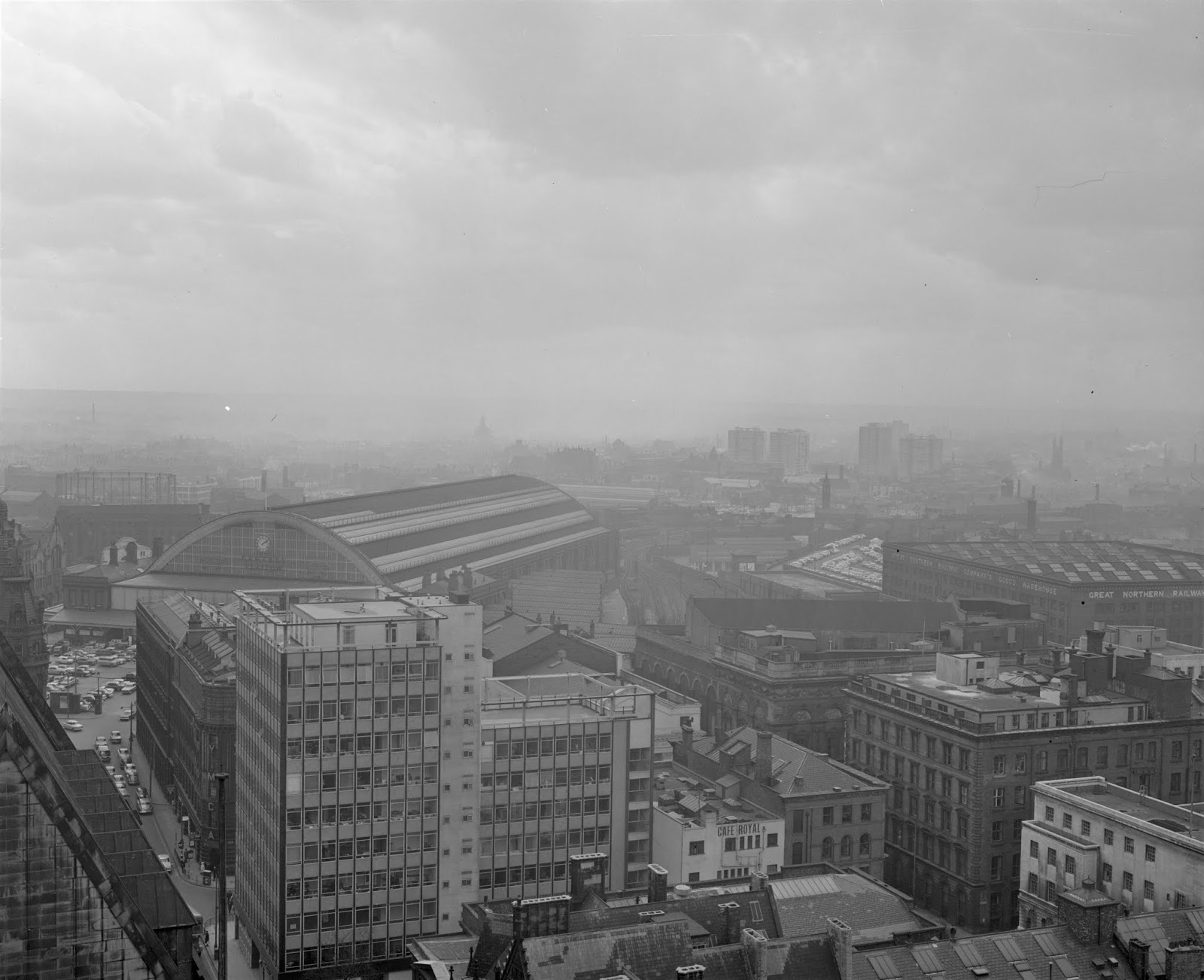
Central Station, April 1961
And there may well have been a few of  our farm a labourers who were taken on to do some of the least skilled work while some of our farmers and market gardeners would have taken advantage of the line to move their crops to the Manchester markets.

But its impact was also to start a wave of house building along Edge Lane.

The train offered the quickest way into town and allowed those who earned a living in the city to escape to what was still the countryside.

Of course by the time I used the train Edge Lane and the surrounding area had long lost any semblance of countryside, but the station still looked like an old fashioned railway, which is where my fiend Ann comes into the story.

She “found these the other day, tucked away. Stretford station in 1961, and Manchester Central, probably a similar date. I used to travel from Stretford to Oxford Road Station, spending my time on the journey drawing the other passengers.”

And so after sixty-two years a little bit of what an old railway station looked like is here to see again.
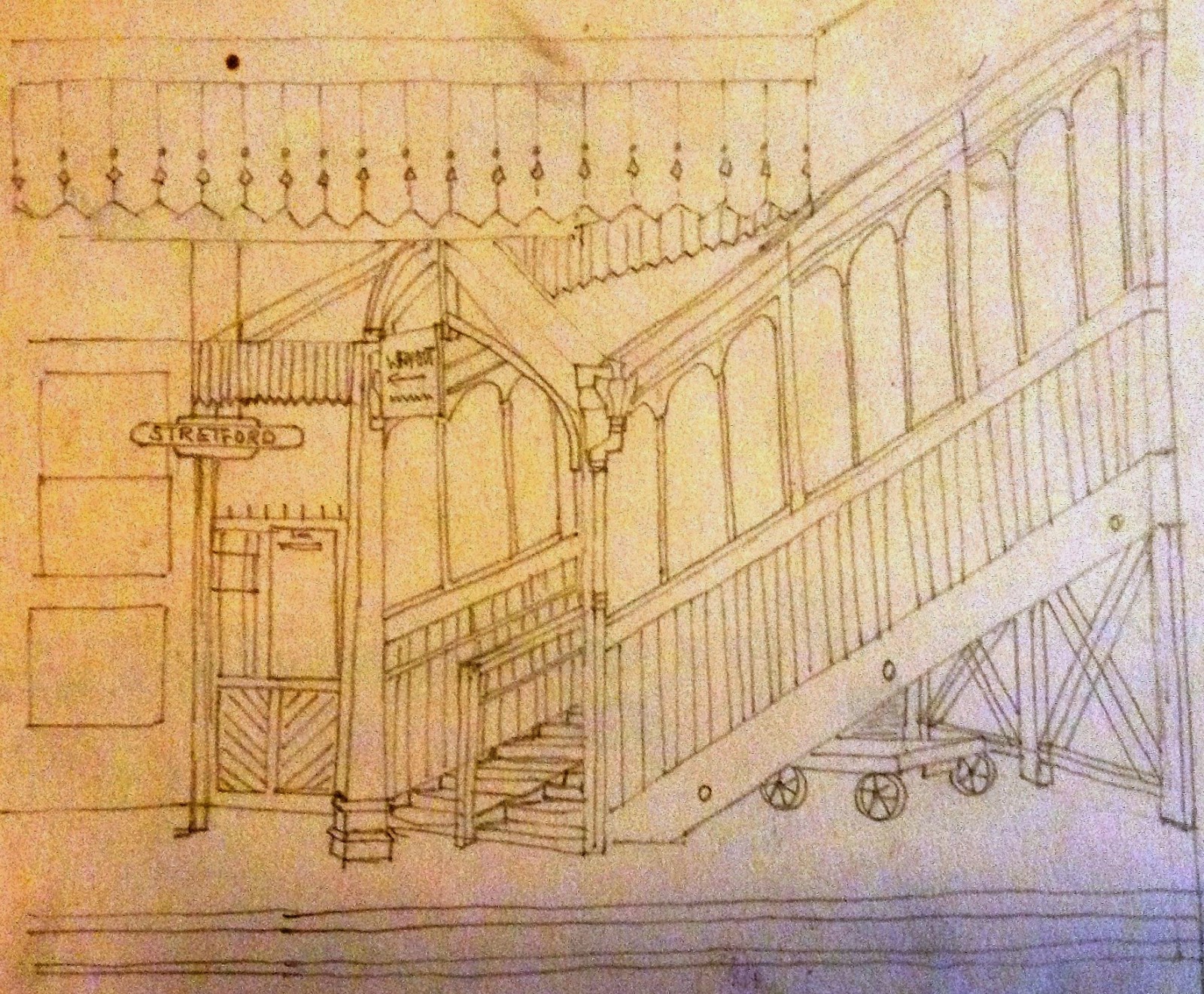
Now that is not so daft given that Stretford has become a Metro Stop with shiny yellow trams and Central having long lost its trains is now an Exhibition Centre.

Pictures; Stretford and Central Stations, April 1961 courtesy of Ann Love

Friday, 23 January 2026

Heaps of cars … missing trains ….. and Central Railway Station in colour

I missed the end of Central Railway Station by just a couple of months, and it was not for another decade that I stumbled across the place.

By then it had become a car park which I suppose was a bit of an insult although I guess most of those who parked up there thought it was a convenient use for that former grand terminus.

I can still remember marvelling at how impressive it still was with that giant wall of glass where the platforms almost ended.

Back then I mostly did black and white pictures and rarely did colour which is why most of my photographs of Central Railway Station are monochrome.


But occasionally I did venture into colour slides and recently began converting them into digital images.

Alas many suffered from over four decades in our cellar and the quality of them is iffy.

But there is enough to bring back to life that time in 1979 when armed with two cameras I wandered along the platforms, looking down on the parked cars and the slowly deteriorating remnants of station offices and other railway furniture.

Now there are plenty of pictures of Central after the trains left, but these are mine.


I have to confess that those I took in black and white are better, but here are some of the lost colour ones.
But  then as you do I decided to throw in some of the others and that really is it.

Location; Manchester Central Railway Station

Pictures; after the trains left, Manchester Central, 1979, from the collection of Andrew Simpson


Sunday, 18 May 2025

Central Station, a bar called Cox’s and a defeat

Now try as I may I have never been able to get a decent picture of G Mex from Peter Street looking down Mount Street.

And there will be plenty who murmur “and you missed the boat with this one too Andrew”.

Which I accept may be true but at least the image recorded the old Central Station and Cox’s Bar, both of which I remember with affection, although in the case of Central it was as a car park and not a place to catch trains, as it had closed just month before I arrived in the city,

Location; Manchester

Picture; Central Railway Station, 1979, from the collection of Andrew Simpson

Saturday, 19 April 2025

When G Mex was a car park ......

Now, with the passage of the decades it will become more difficult to find people who parked up in GMex.

In fact even the name GMex will be passing out of the collective memory as the place is now the Manchester Central Convention Complex, which may describe perfectly what the building does, but somehow doesn’t have the same appeal as GMex.

It’s time as a car park was not that long and for most of its existence this was Central Railway Station.

I just missed being able to catch a train from the station which closed in May 1969 just five months before I washed up in the city.

Instead I had to content myself with a visit about ten years later, when instead of trains there were cars.

I took quite a few pictures on that day, of which this is one.

It would be another seven years before I returned by which time work was well underway to transform it from an old railway station/car park into a conference centre but that as they say is another story.

Location; Manchester

Picture; Central Station, 1979, from the collection of Andrew Simpson

Monday, 17 February 2025

A day in the life of Central Station …. 1978

I am back with some snaps of the city I took nearly half a century ago.

Snaps are those pictures often taken with a cheap camera on the spur of the moment, and pretty much forgotten and lost soon afterwards.

And these of the old Central Railway Station are just such.  

They were taken with a modest camera, on a day exploring bits of the city.

I have much better images in the collection, many in black and white which do much greater justice to the that stunning wall of glass and iron but these I like because they are just snaps of a stroll round what had become a car park but had all the features of its former self.

So, while there will be many who remember it’s existence as a place to park up and plenty more who will have caught a train south to the suburbs, the Peak District even London those memories will be fading.

Leaving me just to say I missed the trains by just a few months as Manchester Central closed just before I washed up in Manchester in 1969.

That said I have written about it and continue to visit the place now that it has become an exhibition centre.*

And that’s it.

Location; Central Railway Station

Pictures; Railway Station, and car park, 1978, from the collection of Andrew Simpson

*Central Railway Station, https://chorltonhistory.blogspot.com/search/label/Central%20Railway%20Station


Friday, 12 May 2023

The silly detective story ….. one canal …. that stone wall …. and the viaduct

This will either seem a fascinating exploration of a forgotten bit of our past or confirmation that I need to get a life.

That brick wall, 2023

But I have become fascinated by the detail on this picture which I took last week down by the Rochdale Canal.

Like countless others I have passed it heaps of times and never gave it a thought.

Today it carries the tram which connects south Manchester, Salford and Altrincham to the city centre and beyond.

Added to which the arches to the left of my bit of brick are now home a collection of bars, and restaurants known as Deansgate Locks.

Those stone yards, 1851
A century earlier it supported a series of railway lines which terminated at Trafford Street.

And so back to the wall, which offers up the question of why is there a stone section at the bottom?

It may just be the solid stone foundations, but I rather think it may be more, particularly given the arched window which long ago was blocked off.

Looking at maps from the mid-19th century, all of the north side of the canal from Albion Street almost to Deansgate were a mix of stone, timber and coal yards and our spot stored stone.

The rate books for the period offer up eight names of people who may have run our stone yard, and I rather think ours may have been the business of a John Routledge, but that is based purely on his proximity in various records to the Albion Street end of that series of yards.

So it may be that the stone wall with its bricked-up arch ran beside the canal and Mr. Routledge’s business.

He and his family appear in the historical records.

In 1851 they were living on Stretford Road, and he described himself as a “Stone mason employing 40 men”.  Their home must have been a busy one give that along with the seven children Mr. and Mrs. Routledge shared the house with a niece and two servants.

Railway lines, 1900
In time I will go looking for 274 Stretford Road and other references in the census, trade directories and rate books, but now there is just one other surprise to sort out.

And that is my assumption that this stone wall supports the viaduct that carried the railway out of Central Station to Chorlton, Didsbury, Derbyshire and London.  

An easy assumption to make given that the tram now follows the same route as far as East Didsbury.

But no, the great viaduct joined a little further east, while running alongside the canal were a series of railway lines including a turntable which terminated close by Trafford Street.

And beside those lines directly facing the canal is a building which appears all all the later maps.

Trafford Street and the Canal, 1950
As late as 1950 those railway lines were still there, and while they ceased to be in use with the closing of Central Railway Station, this stretch of viaduct now plays its part in the creation of the tram network.

Of course, as soon as the story goes live someone will be able to offer up more information, with pictures and personal recollections.

We shall see.

Location; Whitworth Street, Manchester

Pictures; Bricks and things, Rochdale Canal, 2023, from the collection of Andrew Simpson, the Rochdale Street and Trafford Street, 1851, from Adshead’s map of Manchester 1851, and in 1900 from Goads Fire Insurance map, courtesy of Digital Archives Association, http://digitalarchives.co.uk/


Friday, 3 February 2023

Grab it while you can ……. views of Central Railway Station*

This is in the way of a public information warning ……. take your pictures of the old Central Railway Station roof while you can.

Now I know the front is secure, and you can get clear views of the graceful arch of glass and iron from Windmill Street.

But the rear is another matter.

Once before the closure of Central it was the impressive sight passengers would get as the train pulled into the station, albeit you might have to stick your head out of the window to see it.

And then for years it was still possible to get good pictures from the metro stop, before temporary buildings went up in front of it.


But new developments rising from Windmill Street are beginning to obscure the view from the tram stop.

So I suggest you take your pictures soon

Location; Deansgate Castlefield

Pictures; the former Central Railway Station roof, 2023, from the collection of Andrew Simpson

*Central Railway Station, https://chorltonhistory.blogspot.com/search/label/Central%20Railway%20Station


Monday, 12 September 2022

So what would you have done with the old Central Station in the heart of Manchester?

Now you will have to be a certain age to remember this image of the old Central Station before it was transformed into G-Mex.

And even older if you used it as a car park and of course older still if you caught a train from one of its nine platforms.

It opened in 1880 and closed to passengers in 1969.

I missed it by a couple of months and only discovered it in the late 1970s when I wandered in and photographed the interior.

Sadly the pictures have long since been lost, so I was very pleased when my friend Ann sent this one taken by her husband sometime around 1978.

Like other disused railway stations it suffered from dereliction, the indignity of being used as a car park and was damaged by fire.

But in 1982 it was bought by the Greater Manchester Council and work began to convert it into an exhibition centre.

This was a bold and imaginative plan and by one of those odd coincidences I got to see the work in progress sometime in 1985 or ’86, in the company of John Smith the leader of the Labour Party and Keith Bradley who went on to become the first Labour MP for Manchester Withington.

And just six years after G-Mex was opened part of the railway track that once ran into Central was adapted to take the Metro link which today is being extended to accommodate the Second City Crossing.

Like many who use the line I often gaze across at that great arched structure of iron and glass and reflect on just what was saved and how it could all have been so different when Howard photographed the building.

Picture; Central Station, 1978, from the collection of Howard Love


Wednesday, 4 May 2022

Railway architecture …….. no. 1 .......

Now not all railway architecture needs to be grand or be particularly memorable.


But I like this one, which carried one of the railway lines into the Great Western Warehouse.

Today it is just one of a number which occupy a space used for car parking off Bridgewater Street.

Location; off Deansgate

Picture; railway arch, 2022, from the collection of Andrew Simpson


Monday, 4 April 2022

Spotting the differences …….. Central Railway Station ….the YMCA, and the Café Royal ….…1963

I may not have arrived in the city until 1969, but there is plenty in these two pictures which I remember.

Well, I say that, but it being my first year in Manchester, there was much to explore, and I guess it will have been early 1970, when I took to wander down Peter Street.

By then, Central Railway Station had been closed for months, but much else in the photograph was still there and still in business.

I did see a series of concerts in the Free Trade Hall, looked into the ornate YMCA, and may even have caught a film in the Theatre Royal.

It would be another year or so before I ventured off down the side roads into that warren of streets and was rewarded by a clutch of old and wonderful pubs, and by degree onto Deansgate.

Now Mancunians my ponder on my lack of discovery, but like most students I was more familiar with the Oxford Road corridor which every day whisked me from Withington into Piccadilly.

But then, unlike my University friends, I was based at the College of Knowledge on Aytoun Street, and when faced with a spare few hours between lectures, rather than visit the Library I took to the city streets.

Looking back, it was a better choice, for it led by degree to forays into what we now call the Northern Quarter, and Spinneyfields, and down to the Castlefield Basin.

All were places waiting for something to happen, and pretty much unclear that anything would.

So, a trip along the Rochdale Canal took you through the heart of the commercial and industrial part of the city, along what was then a neglected waterway, while the unpromising saunter to the end of Corporation Street offered up Angel Meadows.

But I rather think I have strayed from Peter Street, and Central Railway Station.

Location; Peter Street

Picture looking out across the station and surrounding streets, 1963, Courtesy of Manchester Archives+ Town Hall Photographers' Collection, https://www.flickr.com/photos/manchesterarchiveplus/albums/72157684413651581?fbclid=IwAR35NR9v6lzJfkiSsHgHdQyL2CCuQUHuCuVr8xnd403q534MNgY5g1nAZfY

Friday, 11 February 2022

Easter offers on the railways .............. with the LMS and Mr. Casson

This is Mr. Edwin Casson who worked on the railways.

In the early 20th century he had been at Chorlton-cum-Hardy and near the end of his career worked at one of the big railway stations in the centre of the city.

His great grandson Steve, thinks it might have been Exchanges, which the purists will instantly call me out on and point to the fact that Exchange Railway Station was in Salford.

I wonder however if instead of Exchange we are at Central Station.

Both were operated by the London Midland and Scottish Railway which had come into existence in 1923 as an amalgamation of smaller companies.

And here I readily admit that I am on the frontier of my knowledge of railway companies.

Exchange had been part of the London North Western Railway which became part of the LMS*, while Central Station was home to the Cheshire Line Committee Railway, before it too was absorbed into the LMS..**

So, what convinces me that we are at Central is the sign to the right of Mr. Casson which carries the name Cheshire Lines Railway.

But I might have missed something, and I am sure there will be a flurry of corrections heading my way.

In my defence, I will just point out that Chorlton-cum-Hardy Railway Station was like Central, part of the Cheshire Line Committee, and so it is logical to suppose he moved up the line from the branch station to the main station.  But equally as an employee of the LMS he could have found himself at Exchange.

I can however place the picture sometime between 1923 when the LMS was formed and Mr. Casson’s death in 1939.

And that just leaves me to draw attention to the East offers.

Location; a railway station

Picture; Mr.  Casson at work, circa 1923-1939, from the collection of Steve Casson

*Manchester Exchange Railway Station, Disused Stations, http://www.disused-stations.org.uk/m/manchester_exchange/index.shtml

**Manchester Central Railway Station, Disused Stations, http://www.disused-stations.org.uk/m/manchester_central/index.shtml

Friday, 12 November 2021

Posters from the Past ........... no 3 Manchester Central and an adventure

“What if” Peter said “we take an iconic Manchester building and make it a bit more special by turning it into a period poster ...... the sort we grew up with.”

Now that I thought just had to be a brilliant project combining my love of old steam railways with that sense of magic and adventure that came with taking a train journey and of course Peter’s talents as an artist.

So here we are at Manchester Central Railway Station in the style of the sort of poster which was popular from the 1920s.

And all that was left was for me to write a story, and here I cheated falling back on one I wrote three years ago and revisited in 2016.

For this I feel no shame and would just point to the avalanche of repeats on the telly and the wireless, and if it is good enough for Morecombe and Wise and the Two Ronnie’s that will do for me.

So sit back in the waiting room of Chorlton Railway station for the 9.45 from Central.

It is Sunday April 7th 1957 and I am on Chorlton railway station waiting for the train from Central which left at 9.45 am and is due here just twelve minutes later.

The weather according to the forecast is promising, for “after frost at first, areas will have a fine, mainly sunny day, with normal or slightly higher temperature”* which will gives us about 8⁰C or a little bit more.

And that I reckon is just right for a ramble in the countryside which is what we would have been planning to do on that April morning back in 1957.

This I know from a delightful poster which British Railways published in that year**  advertising Special Excursions to Chinley, Edale, Hope, Bamford and Hathersage.

It is of course a journey that can no longer be made by rail, but back in 1957 our station still had another ten years before it was closed and there are quite a few people who remember making the trip into the Hope valley by train from Chorlton.

All of which makes the advert by British Railways a valuable piece of history, for not only do we have the journey times for this long vanished service but also the cost.  So from Chorlton it cost 4/3d for a return ticket to Hope and took just 19 minutes.

These were “organised rambles, with leaders provided, details of the routes to be taken and walks for both individuals and parties.”

So having done the ramble the train back would have left Hope at two minutes past seven arriving back in Chorlton at about 8.10 in the evening.

It is a journey I would have loved to have made, not least because it was while in Hope recently that we decided to take up serious walking.  But sadly back in 1957 I was just eight years old and living in London.

Location; Manchester


Poster; Manchester Central, © 2016 Peter Topping

Web: www.paintingsfrompictures.co.uk

Pictures; from Manchester Railway Termini, E.M.Johnson, Foxline Publishing,  1987

*The Observer April 7th 1957

**Special Excursions to Chinley, Edale, Hope, Bamford and Hathersage, from Manchester Railway Termini, E.M.Johnson, Foxline Publishing,  1987

Thursday, 16 September 2021

1978 and the car park was full ..... Central Railway Station

Now it must have been a busy day when Andy Robertson parked up at the old Central Railway Station.

I don’t suppose he can remember what day it was or why he was in town but that is his Blue Morris van parked on the forecourt, surrounded by heaps of other commercial and private vehicles.

Look closely and you can make out the coach hard up against the wall.

The station is not at its best, and had the plans to turn it into a conference venue not materialized, I guess it would have been a slow lingering decline until the building became too dangerous for cars or people.

Happily that didn’t happen and so while you will never now be able to catch the 4.10 slow train to Chorlton and on to Didsbury you can at least admire the restored frontage and maybe even look inside for the price of an admission ticket to an event of your choice.

Location; Manchester

Picture; Central Railway Station, 1978, from the collection of Andy Robertson

Monday, 22 March 2021

The lost Manchester Collection ..... no.2 ....... Central Railway Station ...... after the trains departed

Now I never used Central Railway Station.

It closed just months before I arrived in the city and it would be a full ten years before I discovered it.

By then it was relegated to a car park, which seems a real insult given that the car, bus and lorry helped do for the Age of Steam.

Still, when I wandered in there was still much that was left of its time as a railway station.

No one questioned me being there and I pretty much had the place to myself.

Fast forward almost another decade and I was back with John Smith, the leader of the Labour Party and Keith Bradley soon to be elected as the first Labour MP for Manchester Withington.

We were there to see the work being done to convert the building into the GMex Centre.

They were a series of photographs I took during the late 1970s into the ‘80s and have sat in our cellar for over thirty years.

On that occasion I didn’t have my camera, but back in 1979 I did, and these were two taken in the old days of film, when I developed and printed the pictures in a dark room using smelly chemicals.

Most never got beyond being negatives, including these two, but the arrival of a scanner for Christmas has brought them back into the daylight.

Location; Central Railway Station

Pictures; Central Railway Station, 1979 from the collection of Andrew Simpson

Thursday, 24 January 2019

The railway station, a beer festival and a change of name ........ Manchester Central


Now, when you spend your working day in the past, somethings pass you by.

Looking out from Manchester Central, 2017
Which is pretty much why I was surprised that GMex had changed its name to Manchester Central, and more so when I went on to discover that the change of name happened in 2007.

That said while I struggle to remember the new name, alternating between Manchester Central and Central Manchester, I do understand the logic, because for 89 years the site was home to Central Railway Station.

And while a lot of work went into transforming it into an exhibition centre it is still recognisable as a railway station, which English Heritage describes as, “Railway station, now exhibition hall and car park.

Beer, cider and good conversation, 2017
1876-9, by Sir John Fowler, for Midland Railway Company; altered. Iron and glass on brick undercroft, with brick side walls. Rectangular plan. 

Single segmental-vaulted vessel of 15 bays with 210-foot span, built on extensive undercrofts; pilastered 2-storey south side with 3 windows on each floor of each bay, those at ground floor round-headed and those above square-headed; segmental arched roof with ridged bands of glazing. 

C20 glazed canopy to entrance at north end. Vaulted undercroft with intersecting tunnel vaults. Intended entrance block at north end never built”. *

I could say more but I think English Heritage has nailed it.

Central Railway Station, 1979
As a railway station it closed in 1969 and reopened as GMex in 1986 and has been hosting events ever since.

And that brings me to the Beer and Cider Festival organised by CAMERA, which is currently in play at the posh front end of the hall.** 

I say the posh end, because from where Peter and I have a stand, we command an excellent view of the great station clock, glass window and a mix of old and contemporary buildings.

Manchester Pubs, Chorlton-cum-Hardy, 2017
We are here promoting our two Manchester pub books, and last night which was the opening day we sold a lot.***

Not that this is an outrageous piece of self-promotion, just the usual self-promotion.

What was nice, were the people who came up to us having bought the book at the last festival in 2017 and commented on how much they had enjoyed the central Manchester edition and were pleased that we had now added one on the pubs and bars of Chorlton-cum-Hardy.

And we will be back today, meeting old friends and making new ones until the festival’s close on Saturday evening.

The conversation will drift over the relative merits of the beer and cider, the two pub books and for me memories of the building after the railway trains had departed, and the building became just another car park.

Manchester Pubs, special edition, 2017
Leaving me just to say our stand is close to the official camera presence and we will be pleased to see you.

Manchester Pubs is available from www.pubbooks.co.uk

Location; Manchester

Pictures, inside GMex at the Beer and Cider Festival, 2019, and the railway station in 1979 from the collection of Andrew Simpson


** The Festival began on Wednesday night and finishes on Saturday.

*** Manchester Pubs is available from www.pubbooks.co.uk and Chorlton Bookshop or from us at the festival


Sunday, 4 November 2012

Central Station observing the little things


I don’t have an exact date but this photograph of the old Central Station crops us in so many collections which always put it sometime either side of 1900 that I am comfortable with that.

What I want to do is explore some of the detail of the picture.  And the obvious  place to start is that the fine canopy which stretched from the station’s entrance out to the road providing shelter for what appear to be some of the grander passengers arriving by horse drawn carriage.

And there are plenty of horses, some pulling elegant coaches, others neat little cabs and still more hauling the humble cart.  But away near the entrance to the station, under the canopy is a motor car.

But it is what is going on outside that intrigues me.  Just outside the station two men carry on a conversation by the lamp post while a little away to the right a carter attends to his horse.

A little closer to the station entrance a man rubs his chin as his attention is caught by the photographer, while others just ignore him.

I would like to think that perhaps one of the figures in the picture is from Chorlton, given that the station served the township but that is pure romantic tosh and best left alone.

Picture; from the collection of Rita Bishop, courtesy of David Bishop

Friday, 7 September 2012

Central Station, the one I just missed


Central Station was another I just missed.  

It closed in the May of 1969, just a few months before I arrived.  And in the way these things work it was a good few years before I came across it, and by then it had become a car park, which I suppose was the ultimate form of indignity for what had once been a proud example of 19th century public transport, reduced to a storage space for a less glamorous way of travel

Still that I guess saved it and allowed in time for it to be converted into the exhibition centre, which is pretty much how I first came across it.  I had sneaked in during the late 1970s took a few pictures of the place but it was during its conversion that I got to fully explore the building.  Along with my old friend Keith Bradley and the late Labour leader John Smith we were invited to watch the progress of conversion from 19th century railway station to 20th century exhibition hall.

Now I never took any photographs which was a pity, because there was much to see.

It was built between 1875 and 1880 by the  Cheshire Lines Committee, and was officially opened on 1 July 1880. A temporary wooden building was erected at the front of the station to house the ticket offices and waiting rooms.  It was planned that these would be replaced when a much grander building including the offices and a hotel were built.  This would have been similar to the one at St Pancras Station in London, but it never happened.  The Midland Hotel was built opposite and the wooden ticket office remained.

I do have a soft spot for Central, not least because it was where trains from Chorlton would have terminated.   I would have liked to have been one of the thousands who travelled into the place every day arriving under its impressive roof of iron and glass.  These were and still are one of the marvels of the railway age.  Central’s roof was 168 meters in length with a span of 64 meters which at its highest rose 27 meters from the platform floor.

It is a graceful arch of light which must have impressed all who saw it for the first time, and showed off Victorian engineering at its best.  And if you want a contrast just across the road is the old Liverpool Road Railway Station built just 50 years earlier. There the roof of the carriage shed is a simple wooden construction resting on cast iron pillars and would not have been out of place in a building made a hundred years earlier.  Indeed remove the iron supports and substitute wooden posts and you could almost be in a medieval barn.  Not so Central Station. It was the end point in railway engineering and one that sadly I and I suppose many people took for granted.  Shame really because it is a pretty impressive place.

Pictures; from the collection of Andrew Simpson and Courtesy of Manchester Libraries, Information and Archives, Manchester City Council, Central Station in 1955 by H. Milliagan, m62751 and in 1964 by C.E. Poole m 62772,and finally in 1971, by M. Luft, m62772