Showing posts with label Peckham. Show all posts

Saturday, 20 June 2026

Of Waterloo sunsets, Peckham Rye and the Pleasuance at Well Hall

Now it is just one of those things that you miss where you grew up.

Coming home, 2013
It is such an obvious statement but is none the less true.

I left south east London in 1969 for Manchester unsure what was ahead of me but convinced that I would be back, but like most plans it never happened.

Manchester is where I ended up, got married bought a house and brought up four kids.

In my twenties I can’t say I missed London and I guess it wasn’t until quite recently, long after I qualified for a concessionary bus pass and reached an age to be rewarded with the being offered a seat on the tram that I began to think of home.

Well Hall, 2011
And home really only begins when the ferry docks or the  train pulls across the river into Waterloo and then I know I am back.

Another 20 or so minutes later and after the train has taken that curve I have arrived home in Eltham.

But then because we moved around, the train could quite easily have taken me to Queens Road or New Cross and because for a long time our Elizabeth lived in Plumstead and Woolwich there was that other set of railway stations.

My kids always know which special song to play for me and ever since I first heard Waterloo Sunset it has been my tune, with a special meaning given that Kay and I would meet every Friday night under that clock.

Ten years earlier Waterloo Station would be one of the destinations along with London Bridge which would be the start of an adventure.

Woolwich, 2015
For with 2/6d pocket money and aged just ten there were lots of places you could go for a modest return fare and still have change for a variety of sweets.

Sometimes you struck gold and on other occasions you ended up in a dreary back street beside a canal with grim tall buildings all around you.

But that didn’t matter because the fun was in the expectation of where you might go and once there roaming across the city in search of anything that looked interesting.

And there were the bombsites which were still pretty much in evidence all around us.  Most of the time there wasn’t much to discover, but once we found a gas mask still in its box with the green paint and black rubber looking brand new.

Woolwich, circa 1940s
And then there was the old bombed church of St Mary’s which was a place where with a shared candle  a group of you could wander through the crypt anticipating all sorts of horrors and finding only a damp and smelly mattress.

Some adventures turned out not so well, like the time me, Jimmy O’Donnel and John Cox having walked from Lausanne Road to Greenwich, took the wrong turning by the entrance to the foot tunnel and instead of standing on the sand in front of the Naval College we turned left walked amongst the barges and sank up to our ankles in oily Thames mud.

To this day I remain ashamed that I blamed the other two when mother interrogated me on arriving home.

Worse than the interrogation was the bath that followed which seemed to take hours and involved much scrubbing to remove the dried mud from me and even longer to make my shoes half decent.

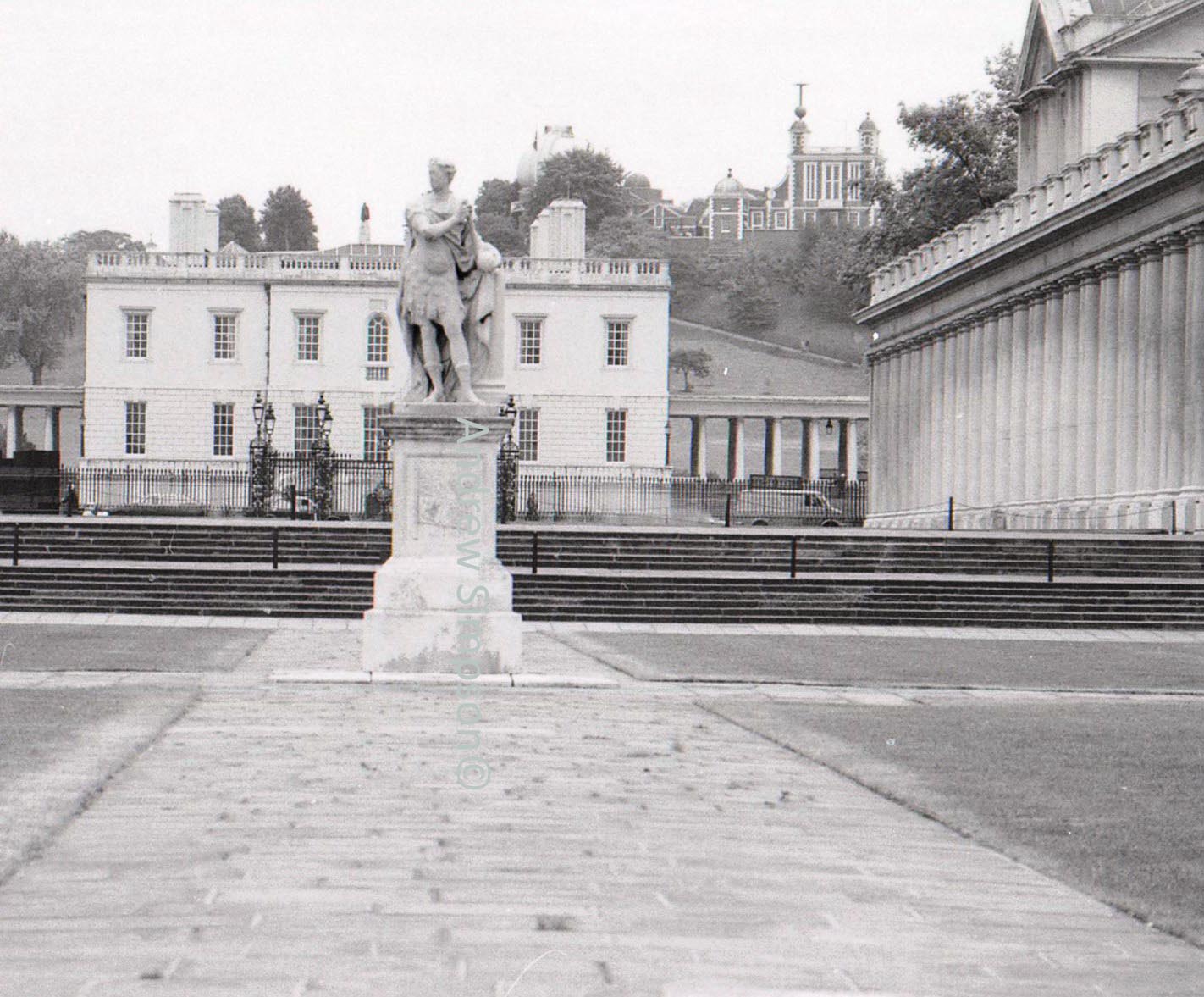
Today those trips are less perilous but no less fun and often involve a brief visit to an old haunt like the Pleasaunce at Well Hall which is only a few minute’s walk from our old house.

Cambden Church, 1904
Of course I am well aware that the places of my youth have changed and as in the case of Woolwich pretty dramatically but I don’t subscribe to that throw away judgement that places I knew are “now rubbish”, they are just different and no doubt there would be those catapulted into the 21st century from 1900 who would mourn the passing of the “smoke hole” at Woolwich and wish there were two lanes of traffic forcing their way down Powis Street.

I suppose for those of us who leave it is always a bit odd to be confronted with the disappearance of all our childhood memories.

That said I never tire of Waterloo Sunset or arriving south over the river.

Location; south of the river

Pictures from the collection of Andrew Simpson, Scott MacDonald and Elizabeth and Collin Fitzpatrick and Steve Bardrick, Camden Church Peckham Road, circa 1904, Albert Flint Photographer and Publisher, 68 Church Street, Camberwell in the series Camberwell, marked by Tuck and Sons, and reproduced courtesy of Tuck DB, https://tuckdb.org/

Thursday, 28 May 2026

Melting tar …… a busy butterfly ….. and a long lost adventure

Now the thing about getting old is that there seems to be heaps more time for the memories of the past to invade the doings of a busy day.

Shallow ponds and lazy streams, 2018 
And once that flight of nostalgic fancy starts to run its course it is easy to reflect on how your experiences of 60 odd years ago diverge from those of your kids or grandchildren.

I say that, but much of what our sons did when they were younger are only now being revealed as in their own bouts of nostalgia, they share stories of daring dos which they wouldn’t dare to have admitted to when they were 10.

Some of those stories do resonate.  Their adventures on the meadows on long summer days, chime in with my own, when armed with just a warm bottle of lemonade and a day stretching ahead of us, we wandered off in search of adventures in some faraway park, or along a stretch of the Thames.

Often it was at the end of a train journey or the limit of a Red Rover bus pass, and it usually involved a quiet suburban spot, unhindered by other people. 

One such place was at the end of a railway line, and rather than explore we just sat on the platform.  

There were no trains, no passengers and the only sound was that of a lazy insect collecting pollen, mixed with that distinctive smell of mown grass, which competed with the equally powerful smell of the oil-soaked wooden railway sleepers cooking in the sun.

We must have sat there for hours before boredom and the empty bottle of lemonade prompted us to move on.

The spot where we played  with the hot street tar in 1958
These of course can be replicated by our kids, but those of exploring bombsites have gone as is the simple pastime of watching the tar slowly melt on a hot summer’s day sitting on the side of the road and carefully making patterns of the black oozy stuff with a discarded lolly stick.  

Today the street surface doesn’t melt, and the lolly sticks are no longer there in abundance.

And in the same way those Clean Air Acts of the 1960s have happily done away with the heaps of polluted air which in turn gave us the smog’s which meant we got sent home early from school making our way along roads devoid of landmarks.

Nor today are there those thick sooty deposits on trees which when you climbed them left your hands and clothes grubby and grimy.

But enough of such nostalgic tosh.

Smog's and fogs, 1953
Our grandchildren I hope will never have to use bomb sites as playgrounds or come home with soot smeared clothes.

These they can leave to their imagination fed by granddad’s tales of aimless adventures on long ago summer holidays in that place called the 1950s.

I might try and pretend this is all about the historical context, but perhaps it is just a nostalgic wallow.

Location; nostalgia land

Pictures; Shallow ponds and lazy streams, 2018 from the collection of Andrew Simpson, the spot where me and Jimmy O' Donnel played in with the hot street tar in 1958, from the collection of Liz and Colin Fitzpatrick, 2015, and Nelson’s Column during the Great Smog of 1952, N T Stobbs, licensed for reuse under the Creative Commons Attribution-ShareAlike 2.0 license.


Saturday, 23 May 2026

Treasures from adventures in Peckham and Greenwich .............

To this day I wonder what happened to the gas mask and the replica18th century cap gun we found on our adventures.

Andrew Simpson, 1959
They weren’t found on the same day and now almost sixty years after the discoveries I have no clear idea of when we actually came across them.

We found the gas mask in a row of derelict houses on Queens Road up past the station.

I always thought that the block had been the victim of the Blitz, but it is more likely they were just awaiting demolition having done seventy or so years and were too tired to be saved.

And on what was a grey indifferent winter’s day with the light fading Jimmy, me and John Cox went exploring in the houses.

I remember they were still pretty much intact and somehow we got inside, wandered around and came across a pristine gas mask, still in its box.

It had that shinny look as if it had just come off the production line, with not a mark or scratch.

The filter I remember was white and there was a green painted strip around the black nozzle and I have no idea what happened to it.

It will have been the prize of the day but who took possession of it or what they did with it is lost.

Walking the tunnel, 2017
I do know that the cap gun stayed with me for a while and may have lingered around the house till we moved out to Eltham.

It had been found on one of our regular walks through the Greenwich Foot Tunnel, somewhere midway when the incline ends and you start to see the other end.

As adventures go it was always one of the good ones.  Aged ten there was the slight thrill at being under the River with all that water above you, and more often than not you were almost on your own, making the place just that bit scary.

Looking down to the Greenwich Foot Tunnel, 1977
Added to which there were the echo of your voices and then the sound of strange footsteps which would take an age before you could identify the person they belonged to.

Sometimes that led to the guessing game. Grown up or kid, male or female, old or young?  There were endless permutations and it lasted as long as it took for the mystery person to appear or how soon we bored with the game.

Finally there was the exit into that other place and having got there we felt obliged to stay in the small park and gaze out back across the river towards home.

But mindful that we were on someone else’s turf the stay was always short.

The Woolwich Foot Tunnel, 1978
What I do find curious is that we never used the Woolwich Foot Tunnel, that had to wait until the family moved to Eltham, and with the counter attraction of the Ferry, walking under the Thames was never going to happen.

By which time my Peckham adventures were over.

But in rediscovering them I remembered one last find, which came from the old Gaumont on Peckham High Street.  It wasn’t one I often went in preferring the ABC on the Old Kent Road but it was there that I found a shed load of those old film cuttings, which were small but when held up to light revealed an image.

The trouble of course was that there was little chance of ever re-sequencing them and in a matter of months they were thrown away. Just when I had come across them is also forgotten but I do know that the cinema closed on May 15th 1961, bowing out with Norman Wisdom in the “Bulldog Breed”and “The Final Dream”.

Such are the discoveries made on adventures.

Pictures; the foot tunnels, April 2017 from the collection of Neil Simpson, Looking down to the foot tunnel, 1977 from the collection of Jean Gammons, Andrew Simpson, circa 1959 and the Woolwich Foot Tunnel, 1978, from the collection of Andrew Simpson

Sunday, 29 March 2026

Glenton Tours …… the coach company that was the luxury motor holiday

Our dad worked for Glenton Tours for over half a century and the story of his part in that company and its part in the modern holiday industry is fascinating.*

Dad and Elizabeth recieving awards, date unknown

It started with an estate agent settling a debt and acquiring five motor coaches which became the core of a business which ran sight seeing tours across Britain and into Europe from 1929.

Elizabeth and Dad, date unknown
The company was in the right place at the right time, as rising disposable income allowed midddle class families the opportunity to go on a new type of coach holiday.

Not that these were run of the mill excursions, but carefully planned tours which lasted for seven, twelve and fourteen days and guaranteed the customers first class hotels, three good meals a day and an itinerary which provided the travellers with all they might want to do about the places of interest.

Added to which there were commentaries which offered up instant historical information along the way.  

These were provided by the driver on home tours and by a courier on the Continental journeys.

Father did both, starting with trips across Britain at the start of the season but slipping in to the Continental tours in late Spring and through to autumn.

Elizabeth, Dad, Frank and unknown courier, date unknown
We still have many of the notebooks and pictures he used for the home tours, and these are now a wonderful insight into the Britain of the 1930s and 40s.

He was pretty there from the start, and so we also have photographs which record the different coaches the company used from the beginning and the differing style of uniforms, from the peaked hat and white long coat to the fitted and style uniforms of the 1950s and 1960s.

And because father kept everything we also have some of the brochures which advertised the individual tours, prices and helpful information.

So from the 1951 brochure came the reassuring comments that “You do not have to bother about luggage, frontier, monetary or language difficulties” and the cost included “the inclusive charge provided for all food and accommodation, the sea crossing and gratuities to hotel staff."

Dad and unknown courier, date unknown
But given that this was soon after the war passengers were informed that “Ration Books are not necessary on any of our tours” but that passengers are advised take "a towel and soap in case some hotels are still unable to supply them.”**

All of which has reignited my interest in the company after receiving a collection of photographs from the grandson of the founder of Glenton Tours.  

Some of the pictures are of a Brighton Coach Rally which I can date to sometime in the late 1950s and early 1960s. 

 In his covering note he  wrote  “If your Father went to Brighton Coach Rallies there is a good chance that there is a picture of him”.

And there are heaps of him, mostly holding trophies he had won for successfully competing against other drivers in demonstrating driving skills before the public.***

Interior of one of the 1950s fleet, date unknown

What makes the pictures even more significant is that in the group pictures I can identify not only Dad but also his fellow Continental driver who was called Frank and who lived very close to us on Queens Road, and one of the couriers who we knew as Elizabeth.

One of the Glenton fleet, date unknown
All of which is a nice Sunday afternoon trip back through the story of Glenton Tours and our dad.

Pictures; Brighton Coach Rally, date unknown, courtesy of Peregrine Smith

*Glenton Tours, https://chorltonhistory.blogspot.com/search/label/Glenton%20Tours

*Motor Coach Holiday Tours, 1951

** UK Coach Rally, https://coachdisplays.co.uk/history/


Saturday, 7 February 2026

Adventures out of Peckham ........ the park, General Wolf and a song by Mr Como

The sun is shining and while it might not yet be hot enough to crack the paving stones, there is a promise of a fine day ahead of us.

Greenwich Park, 2017
And on days like this when you are ten, adventures just happen.

We had met up mid way between all our houses and immediately fell out about what to do.

None of us had much in the way of money so Red Rovers which offered unlimited travel across London for 2/6d was not going to happen and it became a matter of where we hadn’t been and how far it would take to get there.

All of us agreed that whatever we did it had to be out of Peckham and so for the second time in a week we headed off to Greenwich Park.

River, 2017
This was not entirely such a good idea as all three of us had been in the dog house for our last adventure which had involved us exploring the beach by the foot tunnel.

We could have chosen that sandy strip in front of the Naval College but instead opted for a spot down river by three beached barges, and that led to disaster as each of us sank up to our ankles in oozy, oily Thames mud.

That was terrifying enough, but having been rescued by a bargee who pulled all of us free, there was the long walk home caked in that mud and a series of almost identical interrogations about what had happened. To my eternal shame I blamed John and Jimmy.

But undaunted by such an ordeal we went back, although this time we kept to the park.

That long walk, 2017
Once through the gates, and having made the long walk past the water fountain to General Wolf, and faced with that steep slope we rolled down it.

Now that was fun but daft, given that the grass was newly cut and stuck to us, and then took ages to fall off while we played amongst the trees and explored the courtyard of the Royal Observatory.

Then, as the sun climbed higher in the sky we sat on the bench by General Wolf and like him we gazed out across park and the river to that other place, north of the water.

From General Wolf, 1978
Back then the river was still a working river and the tall blocks of flats and offices had yet to be built leaving a vague memory that we could see the Monument but sixty years separate me from that adventure and I dare say I have got that bit wrong.

But never underestimate the power of a sunny day and cut grass to throw you back into your childhood.  Or the delights of warm lemonade from a glass bottle that we shared.

We were the master of all we surveyed and to the bafflement of passersby recited a rhyme which contrived to name all the TV Westerns in a story.  I can no longer remember the details suffice to say,  that Rawhide, Bonanza, Laramie, Cheyanne and perhaps Have Gun Will Travel were all featured.

Looking up towards General Wolf
I guess it was inspired by the 1959 Perry Como song, Delaware, which had lines like, “What did Del-a-ware boy, what did Delaware, She wore a brand New Jersey”, going on to mention another 13 US States.

The challenge of both Mr Como’s song and our rhyme was to remember each line perfectly, a task I failed to do then and still can’t today.

Perhaps out there someone will remember the TV rhyme and offer it to me.

We shall see.

Location; Peckham and Greenwich

Pictures; Greenwich Park and the River, 2017 from the collection of Jillian Goldsmith, and looking out from General Wolf, and looking up to him, 1978 from the collection of Andrew Simpson

Monday, 3 November 2025

In search of an adventure out of Peckham ............. foot tunnels and a strange find

Now the thing about adventures is that there should be no rules, no preplanning and just an optimistic expectation that it will all turn out alright and along the way you will have some fun.

Woolwich Foot Tunnel, 1916
That said it is always best to go with someone to share the fun and when you are just ten years old it makes for a bit more safety.

After that it’s all pretty much how it turns out.

And the day we found the foot tunnel was just one of those. Now I know there are two, starting with the one at Greenwich which was finished in 1902 and the Woolwich one completed a decade later.

But it would be years before I came across Woolwich and anyway Greenwich had so much else to offer, which is how we had come across  the tunnel in the first place.

It had started with the usual exploration of the big park starting with the views from General Wolf’s statute across London and the debate about whether to take the windy path beside the Observatory or  just run down the steep hill.

That done it was a short hop and a skip to the Cutty Sark.

But the Cutty Sark cost to get in and so as you do we wandered to the river and there was the entrance to the tunnel.

None of us knew what to expect, but it was open, it was free and that spiral staircase was just an invitation not to be turned down.

Today at 73 I doubt that I would have set off along the white tiled tunnel but 63 years ago here was the adventure.

Looking down to the foot tunnel, 1977
We were not sure where it would take us, or  how long it would take but there was something quite compelling about making the journey.

It was partly the way the tunnel stretched off into the distance with no end in sight, with just the long line of lights in the ceiling and the gentle incline of the pathway which slopped ever downwards.

On that first foray we encountered just one person, whose footsteps we heard heading towards us long before we saw them.

But we did find a toy duelling pistol.  It had lost some of the bits to make it work and its plastic butt was only half intact but here was a prize which could not be ignored.

So it came home with us.

Who carried it on that long walk back from the park through Deptford and past New Cross Gate I can’t remember, or for that matter why it finished up in Lausanne Road, where it stayed as a trophy of that adventure.

I wish I still had it but it went when we left Peckham along with those adventures.

Picture; Woolwich Foot Tunnel circa 1916, courtesy of Kristina Bedford from  Woolwich Through Time, Kristina Bedford, 2014, Amberley Publishing, and Looking down to the foot tunnel, Greenwich 1977 from the collection of Jean Gammons

Tuesday, 21 October 2025

What we did in October when we were still a farming community

Cows on the meadows, 2003
An occasional series reflecting on what we did in the township when we were still a small rural community.

Now if I had been farming here in the 1850s I might well have turned to The Book of the Farm by Henry Stephens.*

It was written in 1844, and ran to countless editions. It was the manual for anyone wanting to be a farmer.

Everything is here from what crops to plant and when to how to make a well, as well as sound advice on hiring labourers, the construction of a water meadow, and the best location for the milk house and cheese room. I learned which materials were best for building a farm house and how much I could expect to pay for materials, as well as the most up to date scientific information on planting wurzels.

It was a practical book and so “the cost of digging a well in clay, eight feet in diameter and sixteen deep and building a ring three feet in diameter with dry rubble masonry is only L5 [£5] exclusive of carriage and the cost of pumps.”

He calculated that that two brood sows could produce 40 pigs between them and that retaining six for home use the remaining 34 could easily be sold at market.

So many of the smaller farmers and market gardeners in the township might well keep at least one sow and use it to supplement their income.

Nor should we forget that these animals were destined for the table and so the slaughter of pigs was best done around Martinmas in early November because “the flesh in the warm months is not sufficiently firm and is then liable to be fly born before it is cured” and doing so in early November had the added advantage that cured hams would be ready for Christmas.

But today and over the next few weeks I want to drop in to another farming book which is H Rider Haggard’s A Farmer’s Year, written in 1898 and published the following year.

Now he was farming in Norfolk a full half century later than Mr Stephens and of course Norfolk isn’t rural Chorlton or Eltham or anywhere in south east London..

Harrowing in Mustard on stubble
That said this is what he wrote for the beginning of October.

“Since harvest about 250 loads of manure have been carted from the yards direct to the various fields where they are to spread, and sundry dykes on the marshland have been drawn.  

Also a little thrashing has been done and we sold some barley at sixteen shillings and fifteen shillings according to its quality.

Today October 5th we are ploughing on the bean stubble but with the soil in its present condition it is dreadfully hard work for the horses.”


*Stephens Henry, The Book of the Farm, 1844

** Haggard, H Rider, A Farmer’s Year,  1899

Pictures; the Meadows, courtesy of David Bishop 2003, and Harrowing in Mustard on stubble from A Farmer’s Year, 1899

Tuesday, 9 September 2025

When a comic story holds more than a truth .............. stories from the Eagle

Now I have no recollection of post war rationing after all I was only four when it was finally abandoned.

But there will be plenty who not only remember it but will have stories of its impact on their daily lives.

Some of them will also have been regular readers of the Eagle comic which began in 1950 and continued into the following decade and here is the connection because running through several of the stories beginning with the first was how at a critical moment the Earth’s government was forced to introduce food rationing.*

Now even though I have read and re-read the stories countless times it never quite occurred to me that older readers of the Eagle would have vivid memories of both wartime and post war rationing.

That first Eagle story  was followed by the Red Moon Mystery when the planet was threatened by a rogue planet which had once destroyed all life on Mars and caused havoc before it was destroyed, which was repeated later by other stories which saw the earth’s population forced to be evacuated from their homes and ultimately  off the planet.

And when it wasn’t a natural disaster of sorts then there were always evil galactic nasties out on inter planetary domination of which the worst was the Mekon a not very nice dictator from Venus and his army of followers whose slavish devotion to their leader and ruthless behaviour would have been all too familiar to a generation that had been children during the last world war.

Of course such events are the stuff of good adventures and in slightly different forms will have appeared before and since but for those of us growing up in the 1950s they were pretty much a backdrop to the real thing.

Location; The 1950s

Pictures; from Eagle Comics in the collection of Andrew Simpson


*The Venus Story, April 14, 1950 – September 28 1951

Thursday, 28 August 2025

When a chunk of your history takes an unexpected turn ….. Glenton Tours

I have lived with the story of Glenton Tours for 75 years.*

Luggage label, undated

It was a coach company, offering tours of Britain and the Continent from the 1920s and was at the luxury end of the market.

They began when an estate agent in south east London settled a debt by accepting two coaches and entering the touring business.

Dad & Elizabeth, undated
It was the right thing to do at the right moment, as the growing middle class with money to spend sought holidays which combined a bit of culture, with a lot of sightseeing.

 Added to which Glenton’s promised to do the lot, and the lot included the itinerary, the hotels and meals with drivers and couriers who were pleasant, knowledgeable and always attentive.

In the age before cheap air travel and decades before the internet this was the way to see Britain and a host of European countries. 

Tours lasted between seven, twelve and fifteen days, with plenty to take in and free time built into the journey.

Brochure, 1951
And our dad drove their coaches across the UK and on to France, the Low Countries as far as Switzerland and Northern Italy.

He joined the firm sometime in the early 1930s and continued working for them until he retired in 1986.

Very early on in his career he was chosen as one of the two drivers to take coaches into Europe, and apart from a break during the last war, dad did the business and was highly thought of by the firm, his colleagues and the passengers.

And we grew up with that job, which from spring through to autumn would see him leave one morning to return seven, twelve or fifteen days later.

My treat when younger was to be picked up by him at the end of a tour and after the passengers had been dropped off Dad and I would go up to the garage in Nunhead where the coach would be serviced before starting all over again in the morning.

Now, while we had accumulated a lot of memorabilia from Dad what was missing was the detailed story of the firm itself.

And despite years of research, I had drawn almost a blank, until someone who worked with him got in touch. The message was simple enough with “I ran Glenton Tours until 1985. I am happy to supply information” and the promising news that “the archives are held in the Dover Transport Museum”.**

Dad,ready for the off, undated
So the next chapter is about to open up.

And like all such new twists, the story will offer up much about Glenton's along with how some of us spent our holidays during the last century, and maybe even something about our Dad.

We shall see.

And just before the story went live the museum got back to me with a picture of a vehicle Glenton's acquired in the 1960s. 

It is CC 9305 which Mr. Flood of the museum tells me "is a 1929 Dennis GL fitted with a 'toastrack' body by J.Roberts for Llandudno Urban District Council who used it for tours of the Great Orme until 1953. CC9305 was acquired in the 1960s by Glenton Tours of Peckham Rye and still carries the Glenton Livery".

Now l remember Dad talking about it and given that in the winter he worked in the paintshop of the garage he may well have worked on it.

CC 9305 which is a 1929 Dennis GL, bought by Glenton's in 1960
All of which adds to the excitement of the new chapter.


Pictures; Glenton Tours memorabilia from the Simpson collection, and the Glenton's coach, courtesy of Dover Transport Museum

* Glenton Tours, https://chorltonhistory.blogspot.com/search/label/Glenton%20Tours

**Dover Transport Museum, https://www.dovertransportmuseum.org.uk/


Wednesday, 27 August 2025

Travelling on LCC tram number 1622 with memories of the Old Kent Road and Well Hall

Now I missed travelling on a tram by just a matter of years, but had I been born a little earlier I might well have been on this one that rattled its way up from the Old Kent Road to Westminster.

And just possibly also taken the 44 and 46 which connected Eltham with Woolwich.

According to family legend I was actually there at New Cross when the last London tram took its last journey in the summer of 1952 but until yesterday I never thought I would come close to one.

Now I know I could visit the London Transport Museum where there is a fine 1910 tram from West Ham Tramways Corporation, but my number 40 which was the one my dad would have used is even closer to home.

It is in the collection of CRICH TRAMWAY VILLAGE just south of Matlock which is no distance for me but I accept is a long way from south east London.

But your loss is our gain and I have planned my visit.

In the meantime I have settled for a picture of LCC number 1622 which plied route 40 from New Cross.

It comes from my old friend Andy Robertson who has been recording the changes to the twin cities of Manchester and Salford and decided to take an afternoon off and visit the museum.

And there is plenty else to see from a Blackpool tram complete with its destination board announcing a Tour of the Illuminations to the Red Lion Hotel which was once in Stoke on Trent and facing demolition was rescued by the museum rebuilt and happily once again serves up a pint.

In his collection of pictures from the day is the sign on a Leeds tram informing passengers that “Spitting is Forbidden” which made sense in an age before antibiotics and the dangers from a range of infectious diseases was all too common.

It is I think Andy's favourite  while for me it will always be the number 40

Which just leaves me to mention Trams in Eltham by John Kennett** and The Campaign To Save The London Trams by Ann Watkins which includes a chapter on that last tram at New Cross.

Picture; trams at the Crich Tramway Village, 2015, from the collection of Andy Robertson, 

* Crich Tramway Village, http://www.tramway.co.uk/

** Trams in Eltham  by John Kennett, Eltham Society, http://www.theelthamsociety.org.uk/publications.php

*** The Campaign To Save The London Trams by Ann Watkins, http://www.kentarchaeology.ac/authors/019.pdf

Sunday, 6 July 2025

Planning an adventure across Peckham in the summer of 1960

Now I say Peckham, but the chances are that in the summer of 1960 it could have been anywhere, from Nunhead and on to Dulwich, or via Deptford to Greenwich Park and the River.*

Entrance to the Royal Observatory, 2017

Of course adventures back then were not planned, but pretty much spur of the moment, and relied as much on Jimmy and John Cox’s vague memories of how to get to these places as anything.

Steps down to the River

It being midweek and pocket money spent, a Red Rover was off the cards and like so many adventures it was done by foot, leaving in the morning and getting back in the afternoon in time for tea.

For those born in the first half of the last century such adventures will be as recognizable as Tin Tin, Robin Hood, and I Love Lucy from the telly, and Two Way Family Favourites on the wireless.

If we were lucky our pooled finances might run to a bottle of lemonade and the price of a bag of chips, all supposing we could find a chippy. 

And on the rare occasion we came across a chip shop and a bakery together, there was the meal beyond meals, consisting of a hollowed out bread roll filled with chips, and washed down with warm lemonade.

The promise of an adventure in the park

So, adventures were limited on how far we could walk till we got lost, and whether we were successful in finding the goal of the trip.

But always qualified by that simple rule that once beyond the few streets around Lausanne Road, we were in alien territory where any local gang of lads could take offence at our presence.

This never actually happened, but it was an expectation which was a lesson in always be vigilant.

That said most adventures passed off with out event, but more by accident than design.

Looking back the challenge to walk along the parapet above a disused railway line even then seemed fraught with danger, and the subsequent walk along that railway bed ended when boredom set in.

Not that it stopped us doing it again and again.  It was a walk  where we met no one, found the odd discarded treasure, and were accompanied by the occasional bird, and the lazy buzz of bees and the sight of butterflies.

The Thames, 2017

The only real disaster occurred down by the Thames at Greenwich.  

The tide was out and we had a choice of turning left or right at the bottom of the stone steps hard by the entrance to the foot tunnel.

Right would have taken us by degree to the sandy bit in front of the Naval College.

Left, and we were amongst a collection of beached barges.  These seemed more interesting, but we were unprepared for the oozy, oily river mud in which we slowly sank.  

We weren’t in any real danger, and was rescued by a workman, but walking home to Peckham with shoes and ankles covered in the foul smelly mud was not pleasant, but nothing to the interrogation from mother, and to my eternal shame the speed with which I blamed Jimmy and John.

That long ago summer was interrupted by both of them going off on holiday and left to my own devices I fell on the summer school at Edmund Waller.

And as we all know that summer of 1960, the sun shone every day, and boredom was banished from our activities.

Looking out from the park

But then nostalgia for those long gone holidays can be deceptive, and lead you off into adventures where it was always hot, never rained and there was always an interesting destination.

It was one of the last carefree summers, the following was marked by the transition from junior to secondary school, which offered up new friends, and while Jimmy and John also went to Samuel Pepys, the adventures were over.

Location; out of Peckham 

Pictures; Greenwich, 2017, from the collection of Jillian Goldsmith

*And for those who wonder why all the pictures are of Greenwich in 2017, back in 1960 I didn't have a camera, and a full 57 years later our Jillian retraced many of the Greenwich adventures and took some fine pictures.


Friday, 13 June 2025

The story of one house in Peckham number 5 ............ an adventure out beyond Deptford

The story of one house in Peckham over a century and a half, and of one family who lived there in the 1950s.*

The river, 1977
It is just one of those things that when I look back to the Peckham of my child hood the sun always shone and there were plenty of days when it was so hot that the tar at the side of the roads would go sticky.

And on such days like that with breakfast eaten, the day stretched out and adventures beckoned.

When I was older we would go down to Queens Road Station and take a train to where ever two shillings return would take us.

Sometimes we struck gold and explored new places refreshed by Tizer and a packet of fruit salads and on other less successful jaunts the journey ended by a dismal canal with the threat of rain and a feeling of supreme disappointment.

But in the summer of 1959 trains were for the future, instead Jimmy O’ Donnell, me and John Cox set off down Queens Road and on to Deptford with no clear idea of where we were going other than a vague plan to  reach Greenwich Park where Jimmy said there was and a bit of sandy beach by the river.

And still the memory of that walk has stayed with me along with the discovery of Blackheath all of which became even better as we walked through the park to stand beside that statute of Wolfe with the Thames and all London laid out before us.

Walking to the foot tunnel, 1977
It could all have been even better, had we made the right choice at the Cutty Sark, and found that bit of sandy beach.

Instead at the foot tunnel we made the wrong decision.

Having reached the entrance to the foot tunnel we took the steps down to the waterside and on a whim turned upriver and wandered beside the beached barges only to sink into ozzy oil soaked mud.

None of us sank deeper than our ankles but we were terrified and had to be rescued which added to the shame but was nothing compared with the long walk home and the knowledge that explaining how we came to be covered in a mix of Thames mud and oil would require a fair bit of imagination.

To my lasting shame I blamed Jimmy and John.  It was a lie I have carried with me a full 55 years only owning up to Jimmy recently.

Looking back of course it could have been worse but I rather think not very much worse.

And of course that was pretty much how it was back then.

You knew the bits of Peckham to avoid which still left vast areas to be explored from the Rye back across to our own park on Telegraph Hill and down into edgy Deptford.**

In between there were more parks, plenty of bombsites and Nunhead Cemetery a place best visited in the late afternoon when the officials were busy but a place to be out of before dusk.

Pictures; looking down Greenwich, and out across the Thames at Woolwich, 1977 from the collection of Jean Gammons

*The story of one house in Peckham, http://chorltonhistory.blogspot.co.uk/search/label/The%20story%20of%20one%20house%20in%20Peckham

**Peckham, http://chorltonhistory.blogspot.co.uk/search/label/Peckham


Saturday, 10 May 2025

An adventure, a fish market and the promise of some gruesome stories ..... Saturdays at the Tower of London part 1

Now the thing about adventures is that they are best done with friends.

It lessens the risks and more importantly offers up plenty of opportunities to relive the events which with the retelling become more exaggerated and all the more memorable.

That said there was always one place I did on my own and that was the Tower of London.

I may well have done the odd trip with Jimmy but I was best pleased when I did it alone which allowed me to explore the place for as long as I wanted, following  which ever guide took my fancy and above all just letting the walls, the stories and the exhibits work on my imagination.

And on a Saturday it was free to anyone under the age of 16 which meant that after buying the return ticket to London Bridge what was left of my pocket money could be spent on a packet of toffees and a couple of postcards of the Tower.

But as powerful an attraction as the place was it was just part of the day which began with the wait at Queens Road Station standing on the platform in the sky looking down between the gaps in the wooden floorboards at the ground below.

Once on the train there was the journey which got more exciting as the railway lines grew on either side offering up a shedload of other trains to stare at and making the arrival at London Bridge a pretty spectacular affair.

And there were all those flats, warehouses and factories to take in including the old Peak Frean biscuit plant which announced its presence by that thick sweet smell which lingered in the compartment long after the place had been passed.

But for me in anticipation of the Tower there was the walk across the old London Bridge with the warehouses fronting the south side of the river, each with their cranes and more often a ship lying alongside which was followed by the descent down a flight of dark steps to the Lower Road and the fish market

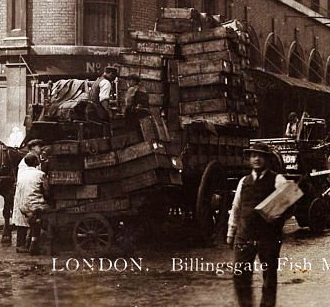
I usually got there around 10 on a Saturday by which time all the fish had been sold and apart from the odd porter there were just the men sweeping up.

That said there were still the odd bits of ice and discarded fish in the gutters and of course that all pervading smell.

A few hours earlier and the place would haven teeming with activity but even given the emptiness of the Lower Road there were those promising smaller roads including the one that led to the Monument which at the time had one of the best views across the City from its observational platform. And cost from memory 6d.

Not that I over dawdled around here for the prize was the Tower.

Pictures; The Tower of London , 2015 from the collection of Ryan Ginn and Billingsgate Fish Market, 1927, courtesy of MARK FLYNN POSTCARDS, http://www.markfynn.com/index.html

Monday, 3 February 2025

On rediscovering where you were born ............. The General Lying in Hospital at Lambeth

My hospital, 2007
We all have little bits of our past which we stumble across.

Most are too personal to warrant even a sentence in a history book but sometimes you know that there is a story and it is story which will pretty much touch lots of people.

I had never bothered looking up where I was born after all given that it happened on an October day in 1949 I just assumed like so many places in my life the hospital would long ago have vanished replaced by a dreary 1950’s office block or worse a car park.

But the General Lying in Hospital at Lambeth on York Road is still there although it closed for business in 1971.

Now if I am to be strictly accurate the building that saw me enter the world was the second Lying in Hospital.

The first opened on Westminster Bridge Road was replaced by my hospital in 1828 and in its time according to one source 150,000 babies were born there.*

All of which puts me in good company and no doubt once the story hits the web there will be some who come forward with their own stories.

Not that there is much to mine and until I began digging I had even got the name wrong believing that it was the Royal Lying in Hospital.

Nor do I have any memory of this grand building or whether I visited it when my four sisters were born.

I know that after its closure it fell into disrepair, went on to the Buildings at Risk Register and finally a shed load of money was spent on its restoration only for it to be sold to a hotel chain.

Perhaps it’s time for me to book a room there although I hardly think I will end up anywhere near where I resided 69 years ago.***

Picture; the General Lying in Hospital, August 27 2007, © Elliot Simpson

* The General Lying in Hospital, http://en.wikipedia.org/wiki/General_Lying-In_Hospital

**York Road, BHO British History on line http://www.british-history.ac.uk/survey-london/vol23/pp40-44 

***London, http://chorltonhistory.blogspot.co.uk/search/label/London

Friday, 24 January 2025

Waiting for the tally man

There is always a tally man.

The name may change, and so to the description of the business.

We knew it as “tally” but others will remember it as “the never never” or “HP” and today it’s simply  “credit.”

But the process was pretty much the same and consisted of the opportunity to buy goods in advance of the full payment up front.

Now I am not being sniffy about this.

For my family and for many others if we wanted to share in that new consumer boom of the 1950s and 60s, we pretty much were forced into putting down the deposit and paying monthly.

In our case it was a chap with a van who came round each week collected a small regular payment, brought back the shiny catalogue and if mother had decided on something he would bring it out of the said van.

I have completely forgotten the chap’s name which might have been Terry and until recently I had also forgotten the name of the firm which was John Blundell Ltd, but also seems to have traded as Edward Evans and maybe also the Hartlepools Mutual Trading Company Ltd.

But as you do in going through some old family stuff there, dating back to the 1960s were the payment cards.

There are no dates on any of the cards, but we were round 116 and our payment day was “day 6” which I suppose was a Friday and was always in the evening.

The weekly sums paid back range from 4 shillings up to a £1 and mother never seemed to miss a payment which given that a £ in 1964 was still a substantial amount of money was a serious commitment.

I have no idea when it began but Terry or his name sake was already a feature of the weekly routine in the late 1950s when were still in Lausanne Road and carried on when we moved to Well Hall.

From memory Dad always paid on the nail for the big domestic items like the washing machine, telly, and wireless and so the tally man was there for those items of clothes, bedding and shoes.

And these were always in demand given that there were five of us all at school.

The down side of the system was that it was no cheaper than credit today.

So the “Terms” on the card announce that “5p per week for every £1 in value or as arranged, Payments may be used as a deposit on a later purchase [and] Special terms arranged for Furniture and Cycles.”

Added to which of course many of the clothes items may well have been almost worn out before mother had finished paying for them.

But that was the price you paid, and while some more virtuous than me will mutter “we always saved up for and then bought” I have to point out that there was and still is not an option for many.
Not that this is a rant, or a reflection on the power of consumerism, just a reflection on how we lived prompted by the discovery of some old credit card payment books.

Location; Eltham, New Cross, Peckham and pretty much everywhere.

Pictures; tally Payments Cards circa 1964, from the collection of Andrew Simpson