Showing posts with label Wythenshawe. Show all posts

Saturday, 21 May 2022

Who built Wythenshawe ...... the exhibition .... today

 Now, this is an exhibition I will be visiting ….. 


And here I have to declare a personal interest because Wythenshawe was where I spent my 35 years teaching career history.

John Ayshford who is one of the organizers of the exhibition told me

The Simons visiting Manchester residents, 1922
“The exhibition is on the history of Wythenshawe and the fascinating lives of the somewhat forgotten local social reformers Ernest and Shena Simon. 

The Simons played an instrumental part in realising Wythenshawe's development as a garden city to provide better housing for the tens of thousands of families previously forced to live in Manchester's slums. 

Ernest Simon was a pioneering industrialist, politician and housing reformer whilst Shena Simon was a leading feminist and campaigner for comprehensive education who served on the education committee of Manchester City Council for over forty years. 

How to abolish the slums, 1929

When Ernest was appointed to the House of Lords the Simons took the name Lord and Lady Wythenshawe in recognition of the pride they took in Wythenshawe. 

Invitation to industry, 1932
We hope the exhibition will engage the local community in Wythenshawe with their history and foster local pride.

The exhibition will be held at the Wythenshawe Forum Library from 21st May–2nd July. The launch event for the exhibition is at 11:00 on 21st May at the Library. 

Local societies and councillors will be in attendance”.

Leaving me just to add that one of my first teaching projects was the story of Wythenshawe which always proved popular amongst the students who grew in the Woodhouse Park and Benchill areas of the estate.

Added to which my school which had been Oldwood Secondary had been adopted by Shena Simon as her own and she regularly attended Speech Days, although sadly the photographs of her visits have long since vanished.

I could add more but wont, leaving it to the references below provided by John to fill any gaps in people's knowledge.

Location; Forum Library, Wythenshawe M22 5RX

Wythenshawe Civic Week 1955

Pictures; courtesy of John Ayshford

*Shena Simon; https://en.wikipedia.org/wiki/Shena_Simon

**Ernest Simons, https://en.wikipedia.org/wiki/Ernest_Simon,_1st_Baron_Simon_of_Wythenshawe

***In Search of Athens: Ernest Simon’s Campaign to Bolster Britain’s Democratic Culture (1932-1939), by John Ayshford, https://manchesterhistorian.com/2021/in-search-of-athens-ernest-simons-campaign-to-bolster-britains-democratic-culture-1932-1939-by-john-ayshford/

And two more to read ........

Who Built Wythenshawe: The Forgotten Story of Ernest & Shena Simon and the Creation of Manchester’s Garden City, https://whobuiltwythenshawe.wordpress.com/


Who Built Wythenshawe? The Forgotten Story of Ernest & Shena Simon and the Creation of Manchester’s Garden City, https://manchesterhistories.co.uk/news-list/who-built-wythenshawe-the-forgotten-story-of-ernest-shena-simon-and-the-creation-of-manchesters-garden-city/


Wednesday, 11 May 2022

Who Built Wythenshawe? ........ the exhibition to visit

 Now, this is an exhibition I will be visiting ….. 


And here I have to declare a personal interest because Wythenshawe was where I spent my 35 years teaching career

John Ayshford who is one of the organizers of the exhibition told me

The Simons visiting Manchester residents, 1922
“The exhibition is on the history of Wythenshawe and the fascinating lives of the somewhat forgotten local social reformers Ernest and Shena Simon. 

The Simons played an instrumental part in realising Wythenshawe's development as a garden city to provide better housing for the tens of thousands of families previously forced to live in Manchester's slums. 

Ernest Simon was a pioneering industrialist, politician and housing reformer whilst Shena Simon was a leading feminist and campaigner for comprehensive education who served on the education committee of Manchester City Council for over forty years. 

How to abolish the slums, 1929

When Ernest was appointed to the House of Lords the Simons took the name Lord and Lady Wythenshawe in recognition of the pride they took in Wythenshawe. 

Invitation to industry, 1932
We hope the exhibition will engage the local community in Wythenshawe with their history and foster local pride.

The exhibition will be held at the Wythenshawe Forum Library from 21st May–2nd July. The launch event for the exhibition is at 11:00 on 21st May at the Library. 

Local societies and councillors will be in attendance”.

Leaving me just to add that one of my first teaching projects was the story of Wythenshawe which always proved popular amongst the students who grew in the Woodhouse Park and Benchill areas of the estate.

Added to which my school which had been Oldwood Secondary had been adopted by Shena Simon as her own and she regularly attended Speech Days, although sadly the photographs of her visits have long since vanished.

I could add more but wont, leaving it to the references below provided by John to fill any gaps in people's knowledge.

Location; Forum Library, Wythenshawe M22 5RX

Wythenshawe Civic Week 1955

Pictures; courtesy of John Ayshford

*Shena Simon; https://en.wikipedia.org/wiki/Shena_Simon

**Ernest Simons, https://en.wikipedia.org/wiki/Ernest_Simon,_1st_Baron_Simon_of_Wythenshawe

***In Search of Athens: Ernest Simon’s Campaign to Bolster Britain’s Democratic Culture (1932-1939), by John Ayshford, https://manchesterhistorian.com/2021/in-search-of-athens-ernest-simons-campaign-to-bolster-britains-democratic-culture-1932-1939-by-john-ayshford/


Monday, 19 July 2021

Quietly going about its business …. the Baguley Brook

Today, tiny water courses like the Baguley Brook, are pretty much forgotten, except for kids, and the Water Agency.


To which you might add nearby residents during one of those increasingly more frequent times when sudden changes in the weather turn such small streams into surging flows of water threatening a flash flood.

But once for many rural communities they were an essential part of life, when surface water, and wells provided water for drinking, cooking, and washing as well as irrigating the crops.

I have long been fascinated by them, more so because  many have vanished underground, long ago confined to brick culverts and all but forgotten, while others have apparently dried up.


Here in Chorlton there are still a handful which flow through the township, although some are now buried.  

There are others which while they appear to have dried up will be there waiting for a particularly wet winter to bubble to the surface.

Some once flowed across Chorlton Park, and after Corporation acquired the site which is now Southern Cemetery, much work had to be done to drain the area, involving a severs of culverts running down Barlow Moor Road, and under Hardy Lane, and out to the river.


Andy was out to the west of Wythenshawe Hall last week and took these of the Baguley Brook.

I went looking for information on this particular water course, but unless I missed an entry, it is slim pickings. 

That said I am convinced someone will know something and pass on the information.

We shall see.

Location; Wythenshawe

Pictures, Baguley Brook, 2021, from the collection of Andy Robertson


Wednesday, 26 August 2020

A Didsbury Pub and the long-lost Parkway

Now, the thing about stories is you are never quite sure where they are going to go.

The Mersey Hotel, date unknown
So, when I posted a story about the Mersey Hotel which opened in 1936 and variously became known as the Snooty Fox and the Mersey Lights, I wasn’t prepared for a series of old pictures of the pub plus some fascinating memories to land on the doormat.

But they did.  George Cieslik‎ sent over some fine photographs, while Catherine shared her memory of the pub at its best, when it offered live entertainment, which had included, Little and Large, Les Dawson, and Freddie and the Dreamers and Jimmy Ruffin.

It was Jimmy Ruffin who attracted Catherine who wrote, “Thank you Andrew for bring a memory smile to my face this morning. 

I may have shared my memory before but here it is again. At 16, too young to go in the pub, myself and my friend Christine stood at the French doors at the back trying to get a glimpse of Jimmy Ruffin. We did manage to sneak in eventually!”

Princess Road, 1965
And there will be many others who also have fond memories of nights spent in the pub on the Parkway.

Which is almost a contrived link to Princess Parkway which was the grand highway out of the city to the newly built estate of Wythenshawe.

Given that the new estate would be a garden city for Manchester’s inner city residents, it followed that the road south to Wythenshawe should be have all the characteristics of a park, with a central island reserved for trees and plants and that either side of the road there would be a large expanse of grassed land.

Northenden, 1965
It ran from Wythenshawe Road, past Wythenshawe Park and on over the Mersey to the Junction with Barlow Moor Road, where it joined Princess Road and on into the city.

It was still there in all its glory when I began working in Wythenshawe and it was George’s picture of the Mersey Hotel in front of the Parkway which got me reflecting on what it had been like.

That said work had already begun to transform the Parkway into a motorway in fulfillment of the 1945 Manchester Plan, and by 1974, 50,000 trees and shrubs were torn up, along with foot bridges with more work done later in the century. **

Didsbury, 1965
Today, the traffic thunders past the site of the old Mersey Hotel, and I suspect fewer and fewer people will remember that more elegant road.

Location; Manchester

Pictures; The Mersey Hotel, date unknown, from the collection of George Cieslik, and Princess Parkway, Northenden, 1965, m38617, Princess Parkway, Northenden, 1965, m38612, Princess Parkway Didsbury, 1965, 38621, courtesy of Manchester Libraries, Information and Archives, Manchester City Council, http://images.manchester.gov.uk/index.php?session=pass

*A New Manchester Parkway, Manchester Guardian, January 19th, 1932

**The 1945 Manchester Plan, was a bold plan to regenerate the city

***Princes Parkway, Wythenshawe’s History and Heritage, http://www.wythenshawe.btck.co.uk/DownMemoryLane/PrincessParkway

Sunday, 13 January 2019

The cinema that had the lot ....... outside the ABC in Northenden

Now depending on your age you may remember the old Forum Cinema in Northenden as somewhere to watch the annual pantomime, drink tea in its cafe or take a waltz around its ballroom and of course enjoy a film.

For the Forum Cinema on the corner of Palatine Road and Longley Lane was all of these things and more.

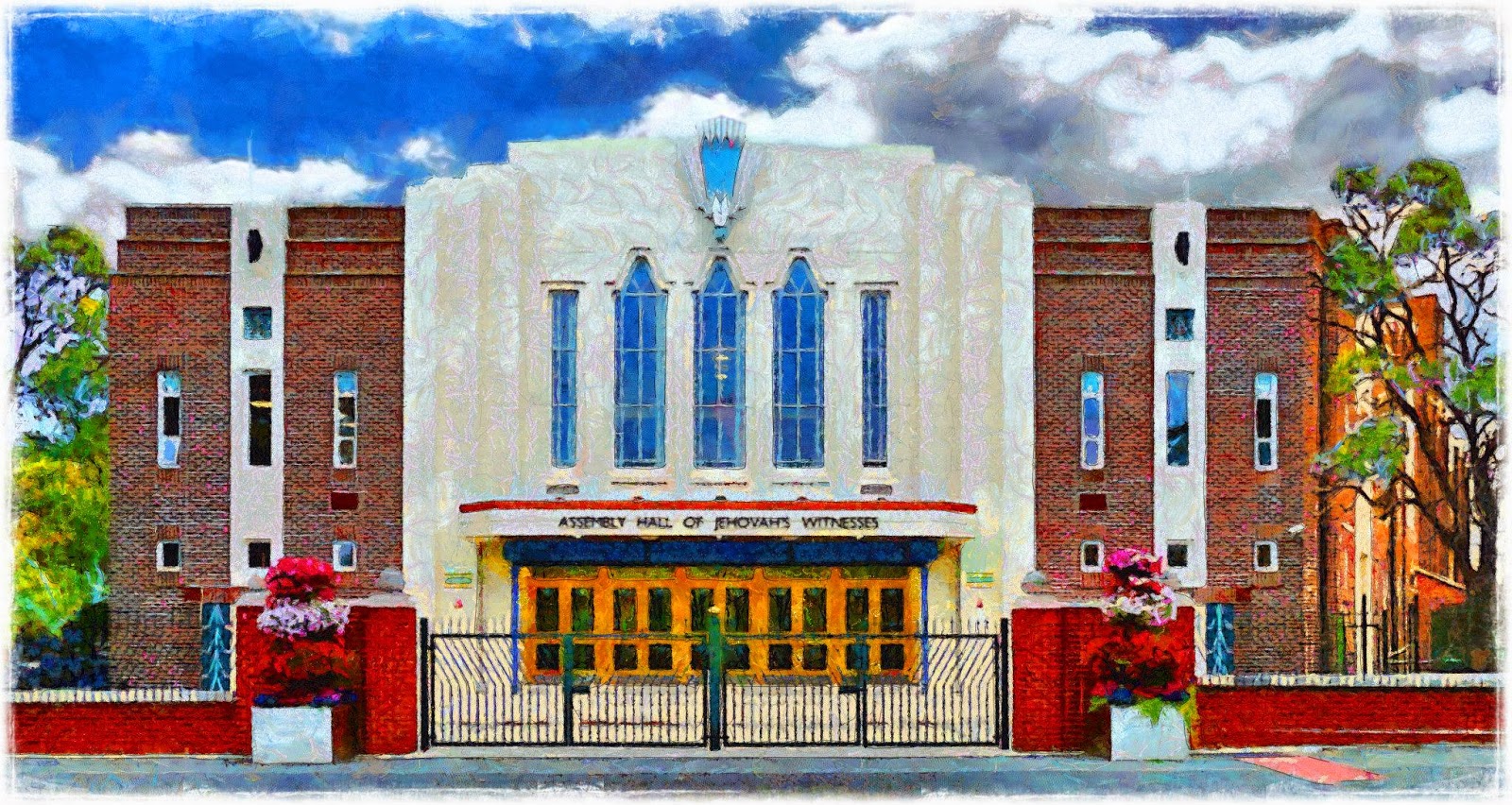
It opened in 1934 and was run by the independent Forum Company before being taken over by the ABC chain in 1936 who continued to run it until it closed in 1974, after which it was for a while the Forum Theatre and is now an Assembly Hall for the Jehovah’s Witness.

Along the way it boasted a Wurlitzer theatre organ which had originally been installed in the Cameo Theatre, Cleveland, Ohio and had a fully equipped stage, stage house and dressing rooms.*

In its time it was known as the Forum Cinema, the ABC and the ABC Wythenshawe and unlike so many this 1,904 seat picture house opened and closed with just the one screen.

I have to say that I never went despite the fact that I regularly passed it on my way to work. That said I was always impressed by its sheer grandeur all of which is reflected in Peter’s painting.

I doubt I will ever cross the entrance hall but I am pleased that it has been saved and continues to have a presence in Northenden.

Painting; the Old Forum Cinema, Palatine Road, Northenden © Peter Topping, Paintings from Pictures,
Web: www.paintingsfrompictures.co.uk 
Facebook:  Paintings from Pictures

* ABC Wythenshawe, http://cinematreasures.org/theaters/22563

Friday, 10 August 2018

In the company of the Manchester Bees ..... no.16 ....... Wythenshawe

From Sandra.

Location; Wythenshawe Hospital


Picture the Wythenshawe Hospital Bee, 2018, from the collection of Sandra Hopgood

Wednesday, 1 August 2018

In the company of the Manchester Bees ..... no.9 all the bees of Wythenshawe

Now I have Sharon Pearson to thank for the bees of Wythenshawe.

They are in the Forum and are a mix of mini bees and the big one.


Location; Wythenshawe

Pictures; the Wythenshawe bees, 2018, courtesy of Sharon Pearson


Sunday, 8 February 2015

Baguley Crafts .......keeping busy at the sanatorium, another story from Sally Dervan

In the late 1960s, when I was at primary school, I used to get an afternoon off once a fortnight to go to Baguley Chest Clinic (Wythenshawe Hospital). 

As a childhood asthma sufferer, it was thought that I needed regular physiotherapy to help my chest. I have very vivid memories of white coated physiotherapists putting me on a table that tipped head downwards and then bashing and shaking my chest and back to make me cough.

Although it sounds a bit of an ordeal, I actually remember it as quite a funny experience, (I used to get told off for giggling when I was supposed to be coughing) and it got me off school for the afternoon as an added bonus.

Another side benefit of my asthma was that it got me out of drinking the dreaded school milk  (because dairy products were then thought to be bad for asthmatics ) I hated milk , especially after it had sat on a school radiator for half a morning , so being banned from drinking it was a real treat !

From memory, the chest clinic I attended at Baguley was in one of the old EMS "huts”. The huts were built during WW2 at what was then Baguley Sanatorium, to help them cope with the war wounded.

The Baguley Sanatorium was opened by the Withington Urban District Council, as a hospital for the treatment of infectious diseases in 1902.

In 1912, Baguley Sanatorium was given over entirely to the treatment of Tuberculosis, with the treatment of other infectious diseases transferred to Monsall Hospital.

It was thought that the clean air of countrified Baguley would act as a tonic to sufferers from the smokey city of Manchester.

Many of the activities at the Sanatorium were carried on outdoors to take full benefit of the fresh air.

Patients on the road to recovery were encouraged to take part in therapeutic activities and to be out in the open air as part of their treatment, these included outdoor exercise and games, helping on the sanatoriums own farm and working in the patients workshop .

Because some of the sanatorium patients would be in hospital for months or even years, I imagine they were glad of these diversions, each day must have been really long.

Sadly, some patients at the sanatorium would never recover. Tuberculosis was a mass killer that was only really brought under any sort of control when streptomycin was discovered in the 1940s.

Many families lost someone to this awful disease and others would find that their life's ambitions were lost forever because of the lasting effects debilitating illness they had suffered from for so long.

A book by Robert Price Davies gives insight into the day to day lives of the people who were treated at the Sanatorium. I was not surprised to find that, despite the strict rules and regulations and the day to day sadness that the staff and patients must have encountered there is a general feeling that patients here “just got on with it” 

This comes as no surprise to me, as I have spent a long time working with people who have lived through the first half of the last century, with wars and all sorts of other hardships and greatly admire their stoicism and fortitude.

Occasionally when you have an interest in history, you find something that offers you an extra bit of insight into something you thought you already understood. When reading about the workshops and activities at the sanatorium, I had presumed that the patients made things for themselves, or as gifts for relatives and friends.

I was reading a Manchester City Council Yearbook from 1936. The book listed the events and achievements of the city in that year.

The yearbook also contains a number of advertisements from local companies, amongst these; I found a little insight into how enterprising the managers of the Sanatorium were.

The advert for "Baguley Crafts” tells us that there was some forward thinking around. Selling some of the items produced by the patients obviously allowed them to buy materials to sustain this therapeutic activity.

I would also like to think that the existence of "Baguley Crafts” meant that someone at the Sanatorium understood the value of boosting a person’s morale , when they might otherwise be at their lowest ebb , by demonstrating that something they had produced was desirable and by showing them that they still had valuable skills .

Having the ambition to finish a project and to see it on sale will have played a crucial part in helping patients look forward, rather than back, and allowed them to remain positive on the difficult road to recovery. Another example of this generation of people finding a silver lining for almost every cloud.

© Sally Dervan

Pictures; courtesy of Sally Dervan

Wednesday, 12 November 2014

Just a little later, travellling to the airport by tram

So Saturday was the day of the adventure, when I set off on the new tram route from Chorlton to Wythenshawe there by making a little bit of history.

Now in the great sweep of history I doubt that the event will even feature as a full stop in a book recording the story of public transport in Manchester but it was my little moment.

True it should have been last week when the service began and if I had lived along the route the Sunday before when residents were offered their own tram ride for putting up with the aggravation of years of construction work.

But Saturday it was and it was worth it not least for the views over the meadows and golf course but also because of the ingenious route which opened up a lot of Wythenshawe.

And that is where I think the line will be judged, for I suspect a lot of people flying out from the airport will still opt for a taxi, the train or a lift from a friend but for those living along its route it will be a quick and direct route to Civic and more importantly to town.

As someone who spent many years travelling by bus into and out of Wythenshawe the tram is a better alternative even given the need to change at Cornbrook for town.

A choice which seemed to have been made by quite a few people travelling the two or three stops either side of Civic and as the tram headed closer to town the number of passengers increased so that just beyond Sale Water Park some had to stand.

So despite some reservations about the tram crossing the meadows I have to say it is a benefit and reminds me of how the Corporation trams which began running at the beginning of the 20th century helped open up the suburbs of south Manchester.

Picture; the metro stop at Barlow Moor Road, 2014, and Deansgate from the collection of Andrew Simpson

Saturday, 24 May 2014

“a smell box” donkey stone, and memories of our recent past, a new story from Sally Dervan

We all love to tell a story, especially if we think we have a really good one.

In my work with older adults I meet many people with fantastic stories to tell.

The danger is, that within your circle of friends, it doesn’t take long before everyone has heard your “story“ and a repeat  performance of “ during the war “ may be met with a groan or a long sigh.

A younger person will often miss the value of stories told by previous generations.

In my case, I now cherish the family stories that were told to me as a child, even though I may have yawned when I listened to them for the “umpteenth” time as a kid. I really wish that some of the people who told me the interesting bits of their lives were still around so I could ask more questions

For those of us with an interest in history, people’s stories are simply fascinating.

At a recent event at Wythenshawe, I was asked to represent the organisation I work for by offering leaflets and information that might benefit the carers of people with Dementia.

It is easy to walk past a table full of leaflets,(I have seen a lot of people do that before) so we decided to put together an eye catching table full of memories next to the leaflet table and to encourage people to come and tell us some of the things their families may have grown tired of listening to.

The table contained old photos of Wythenshawe, old advertisements, vintage magazines, a donkey stone, old buttons, marbles, games and books.

There wasn’t a thing on the table that didn’t prompt some sort of memory from a passer by.

Some people sat for a while and gave us a lot of detail , others looked , made a comment and moved on , but everyone left us with a smile on their face , either because the memories were good ones , or because it was good to have a chance to tell the story to fresh and interested ears.

One of the items on the table was a “smell box.“ This is a wooden box with 13 little bottles inside .

Each bottle contains a different smell that can magically transport you back to another place and time. The smells include things like Germolene, The Dentists Surgery, Fresh Cut grass, Blackpool Rock.

It’s amazing where a smell can take you, even today, and more than 25 years since she died I only have to smell Yardley face powder or “4711” perfume and I am back with my Nana.

Memory is a fascinating (and sometimes frustrating!) thing but so valuable to us.

Several years ago we took some of the older people from our Day Centre to the Tower Ballroom at Blackpool .It’s a stunning place and full of memories for some of our older people.

A ballroom dancing display was in full swing. I sat there fascinated, but I wasn’t watching the dancers, I was watching the slippered feet of a very frail lady in a wheelchair. I hadn’t known she was a dancer; her Alzheimer’s disease had made her speech muddled at times. Luckily, her feet remembered all of the steps and were executing them almost perfectly on the footrests of her wheelchair as the dancers glided by.

There is more than one way to have your story heard...

© Sally Dervan
 
Pictures; from the collection of Sally Dervan