Showing posts with label Mayfield. Show all posts

Sunday, 17 August 2025

Grass and open fields return to Mayfield …….

It is a long time since anyone paddled in the River Medlock at Mayfield but that was what was happening yesterday in the sun.

Rivers and glowers, 2025


Mayfield is that old bit of Manchester which borders the River Medlock a little south of Piccadilly Railway Station.

Mayfield, 1819


Mayfield, 1849


In the early 19th century, it was still fields, but it was already being encroached on all sides by houses factories and foundries. 

Mayfield, 1950

And the signs were not good for either Mayfield or the land beyond the River Medlock which in 1819 was still marked as Chapel Field.

Mayfield, 2025
Within three decades both areas had been built over, with a network of mean terraced houses stretching down from the railway station only halted by the presence of the Hanover Mill, the Fairfield Print Works, the Ardwick Dye Works and the Chapelfield Dye Works which clung to both sides of the River Medlock.

And that was still the case a century later, so while swathes of terraced housing had gone the industry remained in that pocket of land bisected by the river.

Nor was that all because in the course of that century the river itself was taken away, hidden in culverts, and doomed to flow in the dark.

Flowers, football and the Medlock, 2025

But the deindustrialization of the late 20th century offered up a new chance for Mayfield, and the story of the bold plan to create the first new park in the city is there to read.

So never one to pinch other’s work I suggest you follow the links below to read about the project and its fruition.*

To which I can my own progress report which occupied the blog during 2021 and 2022.**

Leaving me just to include some pictures taken yesterday of the new park accompanied by the old maps.


Location, Mayfield

Pictures; Mayfield Park, 2025 from the collection of Andrew Simpson and Mayfield over the centuries, from Johnson’s map of Manchester drawn in 1819, the OS map for Manchester, 1849, courtesy of courtesy of Digital Archives Association,  http://digitalarchives.co.uk/  the OS map of Manchester and Salford, 1950 and Myfield 2025, courtesy of Google Maps

Grass, 2025

*Mayfield Park, Manchester, https://en.wikipedia.org/wiki/Mayfield_Park,_Manchester &

Mayfield Park, https://mayfieldpark.com/

**Mayfield Park, https://chorltonhistory.blogspot.com/search/label/Mayfield%20Park


Friday, 1 March 2024

The lost cottages of Mayfield ........ reveal themselves

 History hasn’t been kind to Mayfield Cottages.

Mayfield Cottages, 1849
There are no pictures of the properties, no reference to them in the street directories, and so far I haven’t even been able to locate them on the 1851 census.

Not that I should be over surprised at these omissions for they were in one of the unfashionable parts of the city, located just a little east of London Road, and sandwiched between the Medlock to the south and a railway viaduct to the north.

And while they looked out on to a school, they backed onto other houses, and were within earshot of a mill, two print works, a couple of dye works and a collection of bleaching houses, engine sheds and a tannery.

So, not the sort of place to attract a 19th century version of House and Home, intent on extolling the attractions of inner city living.

Nor can I be exactly sure when they were built.  They appear on the 1841 OS map of Manchester, but look to be absent from Johnson’s map of 1819.  

The earliest reference to them in the Rate Books is 1846 when they were owned by the Trustees of an A. Binyon, and commanded rents which were a tad lower than houses in the surrounding streets, ranging from 2/3d  up to 3/6d.

Those same rent books do offer up the names of the tenant who paid the rent, but so far the first individuals I can locate on the census records come from the 1861 census.

By which time the original ten cottages had increased to 12, and together they were occupied by 51 people, the eldest of whom was 72 and the youngest just 2 months.

The majority were from Manchester but the street would have echoed with accents drawn from as far away as Ireland, Cumberland and Middlesex.

And given the location of the cottages, most of those who lived there were engaged in manual work, probably in the nearby factories.  These included several textile workers, a warehouse porter, and a  calico machine printer.

But there were also a number engaged in skilled trades, including dressmaking, as well as a blacksmith and a wheelwright.  And these last two occupations are a reminder of the continued reliance on the horse and horse drawn vehicles.

Buxton Street, 1900

To these can be added Ann Smith who described herself as a “Charwoman”,  Alice Gregory who took in laundry and James Green who was a fishmonger and his next door neighbour who was a “Fruit salesmen”

Some of the cottages were back to back properties and some had cellars which in 1861 were occupied by families, ranging from a family of three and another of five.

The cottages were still there in 1894, but vanished under Mayfield Railway Station which opened in 1906.

So the search is now on to track the properties back and forward from the first known date of 1841, and look to see how many of the inhabitants can be brought out of the shadows, and perhaps add to our knowledge of this bit of the city. 

And because no images remain of the cottages I have fallen back on this one of no 6. Buxton Street which was just a few minute's walk away.

Location; Manchester

Pictures; Mayfield Cottages, 1849, from the OS map of Manchester and Salford, 1844-49, courtesy of Digital Archives Associationhttp://digitalarchives.co.uk/and no 6 Buxton Street, 1895, H Entwhistle, courtesy of Manchester Libraries, Information and Archives, Manchester City Council, http://images.manchester.gov.uk/index.php?session=pass


Thursday, 6 October 2022

Mayfield …….. that new park or …. how to claim back a bit of nature

Now, I have yet to wander down to Mayfield which contains “the new 6.5-acre Mayfield Park ….. Manchester city centre’s first public park. A liberating urban escape for all, it will be somewhere to walk, run, play, meet, picnic and paddle along the banks of River Medlock”.*

But lots of people have, including my old chum Andy Robertson who recorded his visit at the back of September.

Some have mumbled darkly why a new park?  Going on to question the economic value of creating an exciting new green place just minutes away from Piccadilly Railway Station and 10 minutes stroll from Piccadilly. 

Well, anyone who remembers the old blighted urban landscape, with its mix of car parks, open spaces and tired buildings will I think applaud the changes.

Apart from clumps of wildflowers and the odd bits of scrubby grass, this area has not been home to heaps of nature since the mid 18th century.  

I am not sure if during its final years of dereliction, the area was full of  Rosebay willowherb which I knew as Fireweed.  

It is a striking wild plant with tall spires of large pink/purple flowers that are best seen from June to September.  

Growing up in London in the 1950s it was a common site amongst the bomb sites which were yet to be developed.  But someone will be able to tell me.

In the meantime, I will explore Andy’s pictures which follow on from his earlier adventures recording the site before and during the building of the park.  

Many of these have appeared on the blog with something of the history of the area, back before the mills, ironworks and densely packed terrace houses covered the fields.

So that is it, leaving me just to wonder when Andy will visit that other garden …. the one in the sky down at Castlefield.  

Of course I could just go myself, which I may well do.

Location; Mayfield

Pictures; Mayfield, 2022, from the collection of Andy Robertson

*Mayfield, https://mayfieldmanchester.co.uk/

**Mayfield, https://chorltonhistory.blogspot.com/search/label/Mayfield


Wednesday, 16 February 2022

Mayfield in Manchester ..... that railway station forgotten by many and mourned by a few

 Now I never knew Mayfield Railway Station.

It was the one built alongside what was London Road Railway Station, and is now Piccadilly.

For those others old enough to remember when it had trains it will be a place of trips out to Stockport, Buxton, Wilmslow and Crewe, although from the 1920s onwards these were confined to the rush hours.

It closed for passenger traffic in 1960 having just reached its 50th birthday.  It briefly had a life as a parcel depot  but this finished in 1969 and two years later the mainline tracks were lifted.

After that, there were plans for “something” for Mayfield, but the years went by with it slowly deteriorating, visited only by the curious and those wanting to post pictures from a site few people knew much about.

The railway station took its name from the area south of Piccadilly Railway Station, and east of London Road.  

It appears on the old maps as Mayfield and was developed in the early 19th century and came to be dominated by Mayfield Station.

By the end of the last century, the railway station had closed, the densely packed terraced properties along with the mills, dyeworks and foundries had gone, and the place was waiting for something to happen.

For decades it was that half-forgotten place, visited by daring adventurers keen on recording its forlorn and neglected state.

And now it is part of an exciting regeneration scheme which has crossed the pages of the blog over the last few years.  My old friend Andy Robertson who specializes in chronicling the story of buildings and areas across the twin cities and beyond, has been revisiting the Mayfield site over the last few years.  

His task as ever has been to photograph the railway station and the accompanying site as it slowly is redeveloped.*

But at the weekend he took advantage of a guided tour led by Jonathan Schofield and took a series of pictures, which for some will provoke memories of long ago excursions, and for the curious offer up images of what happens to an old railway station.

To which we can add that for the young and those who have recently settled in Manchester, Andy’s pictures are a fascinating insight into our recent past.


Location; Mayfield, Manchester

Pictures; Mayfield, 2021, from the collection of Andy Robertson

*Mayfield, https://chorltonhistory.blogspot.com/search/label/Mayfield


Saturday, 27 November 2021

Discovering the Medlock at Mayfield …….

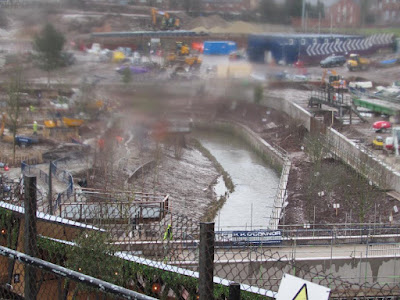
I am back at Mayfield, watching the continued work to transform a shabby and neglected part of the city into something interesting and exciting.*

Opening up the Medlock, 2021
And in the process open up a forgotten stretch of the River Medlock.

Mayfield lies south of Piccadilly Railway Station and I guess would once have been a pleasant place of fields, intersected by the meandering River Medlock, but by the early 1790s it was already being developed.

So, by 1793, the first streets were beginning to nibble at the open land, and in the following year there were dye works on either side of the river. 

And within a quarter of a century rows of terraced houses competed with a variety of industrial buildings transforming the area into a place of smoky chimneys and residential sprawl.

Mayfield, 1819

All of which was pretty much how it stayed until the middle of the last century, when the decline in the industrial base of the city and the  bombs of the Luftwaffe during the last war, left great swathes of it empty land, filled by car parks and small industrial units.

But developers and city planners like nature abhor a vacuum, and the plans to a create a “new urban neighbourhood” are well under way.  

It is a “transformational mixed-use city centre regeneration project reviving a former industrial heartland into a modern innovation quarter.  

Mayfield is a 24-acre brownfield site packed with heritage and the River Medlock flowing through its core. The site has an industrial history of innovation spanning back to the 1700’s with previous lives as a parcel depot, relief railway station and textile mill. The site was left derelict for over 30 years before the next phase of its revival began. 

The river, 2021
The Mayfield Partnership – comprised of U+I, Manchester City Council, Transport for Greater Manchester and LCR – formed in 2016 with a shared vision to deliver a modern neighbourhood at the heart of Manchester. 

Overall, the brownfield site will provide over 2.3m sq ft GIA office space facilitating 16,000 new jobs, 1,500 homes, 56,000 sq ft of retail and leisure, a new 300-bed hotel and 13-acres of public realm, including Mayfield Park – the city’s first new park in over 100 years”**.

And my old friend Andy Robertson has made it one of his projects to record that transformation.

Diggers and trenches, 2021

Leaving me just to add some of his pictures showing the ongoing work

Pictures; developments at Mayfield, 2021, from the collection of Andy Robertson, and Mayfield, 1819, from Johnson’s map of Manchester, 1819, courtesy of Digital Archives Association,  http://digitalarchives.co.uk/

*Mayfield,  https://chorltonhistory.blogspot.com/search/label/Mayfield

**Mayfield Manchester, https://www.uandiplc.com/our-places/mayfield  

Saturday, 31 July 2021

Mayfield …….. the next instalment

There will still be many for whom Mayfield in Manchester means nothing.*

Abandoned

For others old enough to remember the Railway Station it will be a place of trips out to Stockport, Buxton, Wilmslow and  Crew, although from the 1920s onwards these were confined to the rush hours.

It closed for passenger traffic in 1960 having just reached its 50th birthday.  It briefly had a life as a parcel depot but this finished in 1969 and two years later the mainline tracks were lifted.

After that, there were plans for “something” for Mayfield, but the years went by with it slowly deteriorating, visited only by the curious and those wanting to post pictures from a site few people knew much about.

Transformation

The railway station took its name from the area south of Piccadilly Railway Station, and east of London Road.  It appears on the old maps as Mayfield and was developed in the early 19th century, and came to be dominated by Mayfield Station.

By the end of the last century, the railway station had closed, the densely packed terraced properties along with the mills, dyeworks and foundries had gone and the place was waiting for something to happen.

And that something is now happening, which Andy Robertson has been chronically over the last few months. 

The river

That something will be “A transformational mixed-use city centre regeneration project reviving a former industrial heartland into a modern innovation quarter.  

Mayfield is a 24-acre brownfield site packed with heritage and the River Medlock flowing through its core. The site has an industrial history of innovation spanning back to the 1700’s with previous lives as a parcel depot, relief railway station and textile mill. The site was left derelict for over 30 years before the next phase of its revival began. 

The Mayfield Partnership – comprised of U+I, Manchester City Council, Transport for Greater Manchester and LCR – formed in 2016 with a shared vision to deliver a modern neighbourhood at the heart of Manchester. Overall, the brownfield site will provide over 2.3m sq ft GIA office space facilitating 13,000 new jobs, 1,500 homes, 56,000 sq ft of retail and leisure, a new 300-bed hotel and 13-acres of public realm, including Mayfield Park – the city’s first new park in over 100 years.

The cleared land

Consent for phase one of the scheme was granted in February 2020, which will see the creation of the 6.5-acre park, office buildings, a car park and significant public realm. Construction will begin in Q4 2020, with the first buildings estimated to complete in 2022.

Since day one of the Mayfield Partnership, the site’s heritage assets have been opened up to the city through a curated programme of placemaking-led events and projects. In 2017 GRUB moved in, attracting foodies to the railway arches on Temperance Street. In 2018, Mayfield & Co established a small community of creative independent businesses. In 2019, Broadwick Live took a five-year tenancy, with a brief to deliver a series of worthwhile events.

Mayfield developments

The first major live music events began with an ambitious programme involving The Warehouse Project and some of the biggest names in electronic dance music, all taking centre stage in the historic Depot. From 2019 through to the beginning of 2020, over 300,000 music lovers visited the site, raising the profile of the area within the city and creating an initial socio-economic uplift of £10m in its first year.  

The remaining phases of Mayfield will be developed over the next decade, and are expected to generate in the region of £7bn of socio-economic gain – creating a thriving and exciting neighbourhood for all Mancunians to enjoy”.**

I could go on but by following the link you can see just what bold plans are about to come into being, leaving me just to say that this is the second of Andy’s pictures which will not be the last.

Location; Mayfield, Manchester

Pictures; Mayfield, 2021, from the collection of Andy Robertson

*Mayfield, https://chorltonhistory.blogspot.com/search/label/Mayfield

**Mayfield Manchester, https://www.uandiplc.com/our-places/mayfield  


Tuesday, 11 May 2021

In at the beginning ……. transforming Mayfield

It is not everyday that you can claim to be in at the beginning of a new urban project which will transform a tired, neglected and almost forgotten bit of the city.


But this is one of Andy Robertson’s new projects.

He is a regular contributor to the blog and many of his 663 stories are about how the twin cities and the boroughs beyond have undergone massive change over the last decade.

And always Andy is there at the beginning, photographing decaying and empty buildings, and then returning again and again as the factories, warehouses and pubs are demolished, the land cleared, and the builders get to work on something new.


This week he has been in Mayfield, that area south of Piccadilly Railway Station, and east of London Road.  It appears on the old maps as Mayfield and was developed in the early 19th century, and came to be dominated by Mayfield Station.

By the end of the last century, the railway station had closed, the densely packed terraced properties along with the mills, dyeworks and foundries had gone and the place was waiting for something to happen.

And that something is now happening, which will be “A transformational mixed-use city centre regeneration project reviving a former industrial heartland into a modern innovation quarter.  

Mayfield is a 24-acre brownfield site packed with heritage and the River Medlock flowing through its core. The site has an industrial history of innovation spanning back to the 1700’s with previous lives as a parcel depot, relief railway station and textile mill. The site was left derelict for over 30 years before the next phase of its revival began. 


The Mayfield Partnership – comprised of U+I, Manchester City Council, Transport for Greater Manchester and LCR – formed in 2016 with a shared vision to deliver a modern neighbourhood at the heart of Manchester. Overall, the brownfield site will provide over 2.3m sq ft GIA office space facilitating 13,000 new jobs, 1,500 homes, 56,000 sq ft of retail and leisure, a new 300-bed hotel and 13-acres of public realm, including Mayfield Park – the city’s first new park in over 100 years.

Consent for phase one of the scheme was granted in February 2020, which will see the creation of the 6.5-acre park, office buildings, a car park and significant public realm. Construction will begin in Q4 2020, with the first buildings estimated to complete in 2022.

Since day one of the Mayfield Partnership, the site’s heritage assets have been opened up to the city through a curated programme of placemaking-led events and projects. In 2017 GRUB moved in, attracting foodies to the railway arches on Temperance Street. In 2018, Mayfield & Co established a small community of creative independent businesses. In 2019, Broadwick Live took a five-year tenancy, with a brief to deliver a series of worthwhile events.


The first major live music events began with an ambitious programme involving The Warehouse Project and some of the biggest names in electronic dance music, all taking centre stage in the historic Depot. From 2019 through to the beginning of 2020, over 300,000 music lovers visited the site, raising the profile of the area within the city and creating an initial socio-economic uplift of £10m in its first year.  

The remaining phases of Mayfield will be developed over the next decade, and are expected to generate in the region of £7bn of socio-economic gain – creating a thriving and exciting neighbourhood for all Mancunians to enjoy”.*

I could go on but by following the link you can see just what bold plans are about to to come into being, leaving me just that Andy’s first pictures will not be the last.

Location; Mayfield

Pictures; In at the beginning …. Mayfield, 2021 from the collection of Andy Robertson

*Mayfield Manchester, https://www.uandiplc.com/our-places/mayfield  


Monday, 10 May 2021

A little bit more of the River Medlock will soon come out into the daylight

Today Andy Robertson has reignited my fascination for Manchester’s rivers, especially those that have disappeared.


He sent over a series of pictures he took at the weekend, adding, “Parts of the Medlock in Mayfield are beginning to be unculverted. If you google MAYFIELD MEDLOCK on Twitter you can see a drone video. Cathy and I went there today sadly minus drone”.*

All very exciting and part of the regeneration of Mayfield area.

And as you do I did call up the video, and then went looking for just when the great slab of concrete confined the river to a stretch of darkness.

I rather think it was much earlier than suggested in the video, which offered a date of 50 years or so ago.


The slab is there in 1933, but had yet to be put in place 40 years earlier and may have been built when Mayfeid Station was built at the turn of the last century.

Either way someone will know, leaving me just to make a note to go looking at more maps, and reread that wonderful book, The Lost River of Manchester.*

Location; Mayfield

Pictures; Mayfield, 2021, from the collection of Andy Robertson

*Mayfield, https://twitter.com/MayfieldMCR

**The Lost Rivers of Manchester, https://chorltonhistory.blogspot.com/2018/03/the-lost-rivers-of-manchester.html

Ashworth, Geoffrey, The Lost River of Manchester, Willow Publishing, 1987


Tuesday, 19 January 2021

Just six years ago ….. in Mayfield …. that place full of history and heaps of changes

Mayfield is one of those places I have rediscovered.


For years it was a dismal place of empty industrial sites, and car parks which clearly had lots of history, but was now waiting for something to happen.

Well that has now begun to happen, with big development plans including an urban par.

Six years ago, Andy wandered along Boardman Street which runs into Fairfield Street.  It was he says “a gloomy November day in 2014 and the building, hard by the Medlock, has been demolished. In 1969 it housed many manufactories including 2 printers, preambulator rug mfrs, Glove mfrs, and motor car seat cover mfrs”.


It is now a car park, but I suspect not for long. 

Location; Mayfield

Pictures,  Boardman Street, 2014, from the collection of Andy Robertson


Wednesday, 13 January 2021

Popping back to Mayfield ....... railway stations, public baths and gardens

 Now Mayfield is back in the news.

Mayfield Railway Station, 2020

It’s the area just a little east of London Road and situated in the loop of the River Medlock.

Mayfield, 1819
It shows up in the maps of the early 19th century and disappeared under a mix of mills, foundaries, dyeworks,  and mean terraced housing.

In 1857 it got a set of Public Baths and Washhouse and in 1910 a Railway Station.

By the last decades of the last century, it had become a sorry place, having lost the Baths to enemy action during the last world war and its railway station to rationalization.

Added to which most of the industrial buildings had also gone along with the residential properties.

All of which made it ripe for development which is going on as I write, which includes a new exciting urban garden along with business and residential plans.

And not to be short changed I have posted stories about that development, the history of the railways station and most recently the rediscovery of the Public Baths.

Inside Mayfield Railway Station, 2020

So, my old friend Andy Robertson, couldn’t resist a trip to the area where he encountered the interior of the Railway Station.
Not that he is the first to have recorded the place, but as ever his will be unique as he returns, Covid restrictions permitting, to photograph how Mayfield changes.

And that is, and will be one of Andy’s major contributions to the history of the twin cities.  I doubt that there is anyone else who has consistently recorded chosen sites, from their slow decline, through to demolition and redevelopment, making his work part of how we will view the story of Manchester, Salford and Greater Manchester during the closing decades of the last century into the new one.

Location; Mayfield

Pictures; Mayfield Railway Station, 2020, from the collection of Andy Robertson, Mayfield, 1819, from Johnson’s map of Manchester, 1819, courtesy of Digital Archives Association,  http://digitalarchives.co.uk/

*Mayfield,  https://chorltonhistory.blogspot.com/search/label/Mayfield


Tuesday, 12 January 2021

Washing at Mayfield ……….. the story that won’t go away

Now yesterday I was reflecting on the discovery of the Mayfield Baths which were opened in 1857, enlarged in the 1920s and destroyed in an air raid during the last world war.*

Uncovering the Mayfield Baths, 2020

I always knew I would be returning to the story, but didn’t expect it would be the following day.

However, that changed when Richard Hector-Jones posted this picture with the comment “I was working at Mayfield Depot across the way before Christmas when the diggers uncovered this. Absolutely remarkable”.

And as you do I decided to go back into the records of the Manchester & Salford Baths and Laundries Company which built the Mayfield establishment along with others in Salford, Hulme and Victoria Park.  It had a short life, having been formed in 1855, it sold all its assets  to Manchester Corporation in 1877.

In an age when for many State intervention was still to be mistrusted it fell on charities and organizations like the Manchester & Salford Baths and Laundries Company to plug the gap.

And while there is no disguising the fact that the Baths offered the shareholders a return on their investment, the motivation was in part driven by philanthropy.

Today we might view that “desire to do good” with a degree of cynicism, given that some of the wealth held by these benefactors had been made from enterprises which exploited sections of the working population.

But as the chairman of the baths reaffirmed in a speech in 1856, “Their great object in establishing the baths was not so much to get a dividend as for the purpose of benefitting the working classes”**

Adding that the Manchester baths were better run and “paying better than any other public baths in the Kingdom”

Tomorrow; the mechanics and advantages of washing your clothes on the wash house.

Location; Manchester and Salford

Picture; Mayfield Baths excavations, December 2020, from the collection of Richard Hector-Jones

*What was lost is found .... the forgotten Manchester Baths in Mayfield, https://chorltonhistory.blogspot.com/2021/01/what-was-lost-is-found-forgotten.html

** Manchester & Salford Baths and Laundries Company, Manchester Guardian, March 3, 1865


Monday, 11 January 2021

What was lost is found .... the forgotten Manchester Baths in Mayfield

 Now like a lot of people I was fascinated at the news that “A large Victorian washhouse that served Manchester textile workers more than 150 years ago has been uncovered during work to create the city’s first public park in a century”.*

Leaf Street, 2016

It appeared on an online Guardian report on Sunday and promises to be very exciting, given that "The ornate tiles of the Mayfield baths, whose pools measured nearly 20 metres, were found in ‘stunning’ condition beneath a car park 164 years after it opened”.

Since then, Graham Mottershead, the project manager at Salford Archaeology, has been on radio 4 to explain the significance of the find, which  he said “is a fascinating example of the social and public health advancements that came about during the Industrial Revolution”.

The baths were opened in 1857 by the Manchester & Salford Baths and Laundries Company which had been formed two years earlier and had  built baths in Salford, as well as Mayfield, Victoria Park and Leaf Street in Hulme.**  Its assets were bought by Manchester Corporation in 1877. 

At the company’s first shareholder’s meeting on January 7th 1857, the company proudly announced the details of their first bathhouse in Greengate on a plot of land bounded by Rolla-street and Collier-street which was owned by the Salford Union.

Leaf Street, 2016

And having commissioned six architects to submit plans  of which three did, and while the successful plan was more expensive it was decided that it was affordable given that the demolition of the old workhouse would provide materials which could be used in the construction of the new building.

The Directors pointed out that “This establishment is placed  in the centre of a large and dense population with convenient thoroughfares and approaches leading thereto from every direction and is situated only eight minute’s walk from the Exchange”.***

And having opened the "Greengate establishment to public bathing on August 27th [1856] and the laundry on September 1st the receipts during the limited period have exceeded the most sanguine expectations …”

Leaf Street, 2016

So with the promise of even greater returns, the Directors announced that their second bathhouse was to be built at Mayfield in Ardwick.  

The company had already secured an “arrangement with the corporations of Manchester and Salford for a supply of water at the rate of 3d. per 1, 000 gallons of water" and having bought the plot expected the Mayfield Baths to be open on March 31st 1857.

They explained that “This establishment will be placed in the midst of a large and dense population .  The vendors of the land will construct a bridge over the Medlock by means of which , through Boardman-street, a ready and convient access from the districts of Ancoats as well as from all parts of Ardwick, will be secured”.

Mayfield 1924

The rest as they say is history, with the Baths being enlarged in 1925 only to be destroyed during the last world war.  The OS map for 1950 marks the site as “ruins” and the decision to just fill it in and use the site as a car park saved it.

But it isn’t the first of the company’s establishments to reappear into the daylight, because back in 2016 the Leaf Street comples was also redisvovered and excavated.  It had closed it 1977 and like Mayfield had just been filled in.

And it is from the Leaf Street baths that I have taken the pictures, which were taken by Andy Robertson.

Mayfield Baths, 1894

The Leaf Street remains show a striking similarity to those from Mayfield which is not unsurprising.  Sadly copyright considerations have precluded the use of those from the Guardian article, but I bet there will be more Mayfield pictures to see soon.

Location; Mayfield and Hulme.

Pictures; remains of Leaf Street Baths, 2016, from  the collection of Andy Robertson, the opening of the Public Washhouse Mayfield Baths, 1924, City Engineers, m57352, courtesy of Manchester Libraries, Information and Archives, Manchester City Council, http://images.manchester.gov.uk/index.php?session=pass, and Mayfield Baths, 1894, from the OS map of South Lancashire, courtesy of Digital Archives Association http://digitalarchives.co.uk/

*Victorian bathhouse uncovered beneath Manchester car park, Josh Halliday, January 10th, 2021, The Guardian, https://www.theguardian.com/science/2021/jan/10/victorian-mayfield-bathhouse-uncovered-archaeologist-beneath-manchester-car-park?CMP=share_btn_fb&fbclid=IwAR1mK29vk49WyMlFafXQ2vSnx9ZXETrIUBtSxRHCJN1yjhEXiPBeIxxjAGM

**Leaf Street Baths, https://chorltonhistory.blogspot.com/search?q=Leaf+Street

***Manchester and Salford Baths and Laundries Company, the Manchester Guardian, January 8th, 1857


Sunday, 16 November 2014

Down behind Piccadilly Station waiting for the Northern Hub ....... part 3 stories of of pubs and lost roads

The Star and Garter on Fairfield Street is one of those pubs that most people know even if they have never stepped inside.


The Star & Garter, 2014
Andy Robertson recorded it recently in a new set of photographs.*

It has been a listed building since June 1980 and a popular venue for music.

One source suggests that there was a Star and Garter as early as 1808 just about a hundred yards further along Fairfield Street and “moved brick by brick to its current location in 1877.”**

This earlier site was where today there is a little island on the corner of Baring Street and Travis Street.

The Star & Garter, 1844
The 1842 OS shows it as a substantial building bearing the name of the Star and Garter.

That said there are no references to it in the street directories for the 19th century and as late as 1877 there was only a beer shop close to the present pub continues run by George Clark.

And Mr Clark I found in the rate books for that year renting the property at number 14 Fairfield Street from a Mr Gibson who owned the adjoining two properties and charged an annual rent of £28.

The pub on the corner of Neild Street, 2014
Now I have been drawn into the history of the place, and will have to go off and look at the licensing records in the archives, especially as that date of 1877 is intriguing.

The following year there is no reference to either men on Fairfield Street so just possibly the beer shop closed when the Star and Garter was erected late in 1877.

Six years earlier number 14 had been home to Thomas Shawcross who gave his occupation as a shopkeeper.

Neild Street and Station Street, 1844
For now I shall have to await that research but as you do I wandered off down behind the pub along Neild Street which in its little way presents another small point of interest.

Today it runs for a short distance beside the old railway buildings before petering out in a dead end.

Back when the Star and Garter opened for business in 1877 it took a different route running directly south and is now buried underneath Mayfield Station.

That stretch that now comes to a dead end was before 1910 Station Street and it too came to an abrupt halt in front of the Boiler House and filtering ponds of the Mayfield Printing Works.

Now this may not be the most riveting of stories but it was one that took time in the making.

The site of number 14 Fairfield Street with Neild Street behind, 2014
I had just thought of showing Andy Robertson’s pictures of the pub which his son had suggested he should record as they were by Piccadilly Station.

As Andy said the area will soon be redeveloped with work on the Northern Hub and that of course led to looking up the story of the Star and Garter, and in turn exploring the directories, rate book and census returns along with maps of the area.

All of which revealed that this little bit of the city sandwiched between the two stations has undergone more change than most of us may have known.

Pictures; of the Star and Garter, 2014 from the collection of Andy Robertson and maps of the area from the 1842-44 OS for Manchester & Salford, courtesy of Digital Archives Association, http://www.digitalarchives.co.uk/

*Down behind Piccadilly Station waiting for the Northern Hub ....... part 1 pubs, warehouses and rivers, http://chorltonhistory.blogspot.co.uk/2014/11/down-behind-piccadilly-station-waiting.html

**The Star & Garter, http://en.wikipedia.org/wiki/The_Star_and_Garter

Saturday, 15 November 2014

Down behind Piccadilly Station waiting for the Northern Hub ....... part 2 tall viaducts and the spaces in between

Now I pretty much take for granted those tall railway viaducts which bring the trains into the city.

Temperance Street, 2014
Most of us will only give the road below a second’s glance as we start to collect our belongings and debate whether to get a taxi or the tram from the station.

But at street level they are massive structures snaking off into the distance and dominating the area.

Back when they were constructed they cut a swath through the houses, workshops and factories and were in their way some of the first slum clearance projects undertaken in our cities.

Temperance Street 2014
Take Temperance Street in the shadow of Piccadilly Railway Station which runs from Fairfield Street down towards Devonshire Street in Ardwick.

For most of that route it runs parallel with the viaduct from Piccadilly and earlier is sandwiched between that viaduct and the one that carried the track into Mayfield Station.

Looking at Andy Robertson’s picture of the street I am reminded of just how dismal these wastelands between railway lines can be.

But it was not always so, because before Mayfield Station was opened in 1910 to the south of Temperance Street was a series of smaller streets packed with terraced housing and all leading off to the Mayfield Dye and Print Works.

The lost streets, 1894
All of which went when Mayfield was built and what was lost included everything from Hoyle Street to Baring Street, which amounted to six streets and 96 assorted properties most of which were residential.

And so went Gray Street, Arthur Street, Mayfield Street along with Station Street and Bailey Street with three reservoirs and a school .

In fact everything west of Hoyle Street across to Baring Street.

Now in the fullness of time I think I will go looking for those old houses and some of the people who lived.

But for now I am content to look at Andy’s pictures and reflect on the changes yet to come with the plans for the Northern Hub.

Pictures; Temperance Street, 2014, from the collection of Andy Robertson, detail of Mayfield Works and surrounding streets from the 1894 OS of South Lancashire, courtesy of Digital Archives Associationhttp://www.digitalarchives.co.uk/