Showing posts with label The Romans. Show all posts

Sunday, 7 June 2026

Digging in the past: the arable farmer who's an archaeologist .... on the wireless now

It's not the zippiest of titles but it does the biz, because this is the story of one farmer in the Vale of Yorkshire who has uncovered some remarkable archaeological finds in his farm*.

Roman coin, Claudius, 43-54 AD
It comes from BBC Radio 4's On Your Farm which goes out every day at 6.30 am.  under the collective title of Farming Today and "gets to the heart of country life with a look at individual farming endeavours".

Its got the lot, covering heaps of different stories all related to farming,  So I have listened to "The Art of Asparagus", "A Cumbrian Farm", "Meet Syrian bee expert", "Marino Wool for Surfers", "Carbon Counting", and today's "Digging in the past".

 "Arable and archaeology are the two passions in Nick Wilson's life. 

He farms in the Vale of York but the discovery of a Roman burial site in one of his fields turbo-charged his interest in the past. 

That was nearly 10 years ago, since then he has studied for a PhD in archaeology and excavated acres of farmland. 

Reverse of the Claudian coin

As well as the Roman tomb, he's unearthed Bronze-age cooking pots, quern stones for grinding corn, jewellery and a hob-nail boot from Roman times"*.

Produced and presented by Rebecca Rooney".

Location; The Vale of York

Pictures; a Roman coin from the era of the Emperor Claudius, [I think], 1975,from the collection of Andrew Simpson 

*Digging in the past: the arable farmer who's an archaeologist,On Your Farm, BBC Radio 4, https://www.bbc.co.uk/sounds/play/m002xdbd

**On Your Farm, https://www.bbc.co.uk/programmes/b006s571

Thursday, 29 January 2026

The Roman Arena ..... on the wireless today

This is another bit of history I enjoyed today.

It comes from that excellent series In Our Time and is free to listen to long after the first broadcast. 

"Misha Glenny and guests discuss the countless venues across the Roman Empire which for over five hundred years drew the biggest crowds both in the Republic and under the Emperors. 

The shows there delighted the masses who knew, no matter how low their place in society, they were much better off than the gladiators about to fight or the beasts to be slaughtered. 

Some of the Roman elites were disgusted, seeing this popular entertainment as morally corrupting and un-Roman. Moral degradation was a less immediate concern though than the overspill of violence. 

There was a constant threat of gladiators being used as a private army and while those of the elite wealthy enough to stage the shows hoped to win great prestige, they risked disappointing a crowd which could quickly become a mob and turn on them.

With Kathleen Coleman, James Loeb Professor of the Classics at Harvard University, John Pearce, Reader in Archaeology at King’s College London and, Matthew Nicholls, Fellow and Senior Tutor at St John’s College, Oxford

Producer: Simon Tillotson"*

Picture; mosaic depicting a gladiatorial fight  from the villa Nennig,** dating from the first century AD, 2021, https://www.flickr.com/photos/168399512@N02/51134391753/ Author TimeTravelRome, Licensing w:en:Creative Commons attribution This file is licensed under the Creative Commons Attribution 2.0 Generic license.***

*The Roman Arena BBC Radio 4, In Our Time, https://www.bbc.co.uk/programmes/m002qj85

**Nennig is a village in the Saarland, Germany, part of the municipality of Perl. It is situated on the river Moselle, opposite Remich, Luxembourg.

***Roman Villa Nennig, https://www.visitsaarland.co.uk/poi/detail/roman-villa-nennig-c859e1607c

Saturday, 17 January 2026

D Day ...... AD 43 .......Portrait Of An Age ..... and the death of General Gordan

Pan Edition 1961
I have begun re-reading The Great Invasion by Leonard Cottrell.

It was first published in 1958 and describes the Roman invasion and conquest of Britain.*

Now Mr Cottrell had himself been a war correspondent and this book was written only 13 years after the end of the last world war and must have had a real resonance.

“Among the readers of this book may be some who have known what it is like to wade on to an enemy beach under heavy fire. 

Others may have commanded troops in such actions, and experienced that nerve racking moment when all hangs in the balance, when the defenders have the advantage of protected positions, and the attackers have not had time to establish their fighting formations.” 

And in quoting Julius Caesar’s account of the military expedition to Britain in 55 BC Mr Cottrell observed that it “could almost describe an attack on the Normandy beaches or a Japanese island in the Pacific.”

So  there is a directness and a sense of authenticity about the account which other such later books on the subject do not give me.

Michael and Susan Henchard artist Robert Barnes, 1886
Now we all have our favourite books, the ones we return to time and time again to the point that we can  quote back at the author the opening lines or know just what awaits the leading characters just around the next page.

I never tire of those first few lines from A Tale of Two Cities and the sinister and chilling warning at the start of The War of The Worlds

In the same way I am still moved to indignation when the drunken  Michael Henchard sells his wife and daughter at the beginning of Hardy’s The Mayor of Casterbridge.

But history books are different, and mainly because the scholarship moves on and what was fresh and new is at best old and tired and all too often has been proved wrong by new discoveries.

Some of course survive because of the style, wit and elegance of the writing.
Gibbon’s Decline and Fall, Thomas Babbington Macaulay’s social history and Young’s Portrait of An Age are still a joy to read.

I do not think you can better the opening of Young’s Portrait of An Age, **

O.U.P., edition, 1960
“A BOY born in 1810, in time to have seen the rejoicings after Waterloo and the canal boats carrying the wounded to hospital, to remember the crowds cheering for Queen Caroline, and to have felt that the light had gone out of the world when Byron died, entered manhood with the ground rocking under his feet as it had done in 1789.  

Paris had risen against the Bourbons; Bologna against the Pope, Poland against Russia, the Belgians against the Dutch.  

Even in well drilled Germany little dynasts were shaking on their thrones and Niebuhr,*** who had seen one world revolution, sickened and died from fear of another.  

At home, forty years of Tory domination were ending in panic and dismay; Ireland, unappeased by Catholic Emancipation was smouldering with rebellion; from Kent to Dorset the skies were a light with burning ricks.”

And I still enjoy  the closing lines of the essay on the Death of General Gordan by
Lytton Strachey in his Eminent Victorians which having surveyed Gordan’s life and the campaign to avenge his death concludes that “General Gordan had always been a contradictious person – even a little off his head, perhaps, though a hero; and besides he was no longer there to contradict .... At any rate it all ended very happily – in a slaughter of twenty thousand Arabs, a vast addition to  the British Empire, and a step in the Peerage for Sir Evelyn Baring.”****

Penguin Classics, 1989
Set against the measured, and dry writings of so many here is a sweeping comment on British imperialism and a cynical examination of the later Victorian period.

All of which is a long way I know from D-Day AD 43 and the great Roman Invasion.

On the other hand these are the sorts of history books which capture the imagination and want you to read more leading you on to even greater study, if only to know whether Lytton Strachey was fair or Mr Cotteril accurate.

And of course are as entertaining as the those first few lines from A tale of Two Cities and the sinister and chilling warning at the start of The War of The Worlds*****

Pictures covers from Pan Books, The Mayor of Casterbridge, the O.U.P. and Penguin Classics

*The Great Invasion, Leonard Cottrell, 1958

**Portrait of an Age, G.M. Young, 1936

***Barthold George Niebuhr, August 27 1776 – January 2  1831, was a Danish-German statesman and historian who became Germany's leading historian of Ancient Rome and a founding father of modern scholarly historiography.

****Eminent Victorians, Lytton Strachey, 1918

*****“It was the best of times, it was the worst of times, it was the age of wisdom, it was the age of foolishness, it was the epoch of belief, it was the epoch of incredulity, it was the season of Light, it was the season of Darkness, it was the spring of hope, it was the winter of despair, we had everything before us, we had nothing before us, we were all going direct to Heaven, we were all going direct the other way.”

“No one would have believed in the last years of the nineteenth century that this world was being watched keenly and closely by intelligences greater than man's and yet as mortal as his own; that as men busied themselves about their various concerns they were scrutinised and studied, perhaps almost as narrowly as a man with a microscope might scrutinise the transient creatures that swarm and multiply in a drop of water.”

Friday, 29 August 2025

One Roman poet …… a heap of poems and ...... a story

 Today I am renewing my friendship with Catullus.

2016

To be more accurate I am reading the biography of my favourite Roman poet.

I first came across him in 1966 along with the 16th century poet John Donne and they have stayed with me ever since.

Both appealed to a sixteen-year-old with their mix of funny, irreverent and love poetry, and anyone who has fallen in love, only to lose that love will remember just how bitterly intense the feelings are when you are a teenager.

1966 edition
All of which brings me back to Poem 8 with its angry response to an ended affair

“Break off 

                    Fallen Catallus

     time to cut losses,

bright days shone once

               you followed a girl

               here and there

............................................

now a woman is unwilling

Follow suit

a clean break

hard against the past”*

So that’s it.

Catullus’ Bedspread: The Life of Rome’s Most Erotic Poet, Daisy Dunn, 2016

"A biography of Gaius Valerius Catullus, Rome’s first great poet, a dandy who fell in love with another man’s wife and made it known to the world through his verse.

2004 edition
This superb book gives a rare portrait of life during one of the most critical moments in world history through the eyes of one of Rome’s greatest writers.

Living through the debauchery, decadence and spectacle of the crumbling Roman Republic, Catullus remains famous for the sharp, immediate poetry with which he skewered Rome’s sparring titans – Pompey, Crassus and his father’s friend, Julius Caesar. But it was for his erotic, scandalous but often tender love elegies that he became best known, inspired above all by his own lasting affair with a married woman whom he immortalised in his verse as ‘Lesbia’. A monumental figure for poets from Ovid and Virgil onwards, his journey across youth and experience, from Verona to Rome, Bithynia to Lake Garda, is traced in Daisy Dunn’s brilliant portrait of life during one of the most critical moments in world history”.**

Pictures; cover Catullus’ Bedspread: The Life of Rome’s Most Erotic Poet, 2016, cover of The Poems of Catullus, Translated by Peter Whigham Penguin Classics, cover shows a portrait of Arteidorus from Hawara, Egypt, second century, British Museum 1974, reprint, and Catullus The Poems Translated by Peter Whigham Penguin Classics, 2004, cover shows a detail from a Roman mosiac 3rd-4th century AD in the Piazza Armenia villa of Maximinorous. Sicily, photoo AKGO/Eric Lessing

*Poem Eight, The Poems of Catullus Penguin Books, 1966

** Catullus’ Bedspread: The Life of Rome’s Most Erotic Poet, Daisy Dunn, 2016


Tuesday, 19 August 2025

My favourite Roman ........ Catullus ..... on the wireless today

I have returned to the poems of Catullus.

The 1968 edition

I first came across him in 1975, during a very messy moment at the end of a relationship.

And since then I regularly return to his poems.  

And today I am doing so with Natalie Haynes and her wonderful series Natalie Haynes Stands Up for the Classics * which the sleeve notes tell me Catullus was 

"The brilliant Roman love poet is the poster boy for teen angst. He feels everything intensely, from the stealing of his favourite napkin to the death of his lover Lesbia's pet sparrow. And then he dies young. Of course the Romantics loved him, as do his biographer Dr Daisy Dunn and Professor Llewelyn Morgan.

The 2004 edition
Born to an aristocratic family in Verona, Catullus is fearless in abusing in sophisticated verse his father's friend Julius Caesar, his ex-lover Lesbia and the poets unlucky enough to be his contemporaries. Satirical, scurrilous and obscene, his popularity endures.

'Rockstar mythologist' Natalie Haynes is the best-selling author of 'Divine Might', 'Stone Blind', and 'A Thousand Ships' as well as a reformed comedian who is a little bit obsessive about Ancient Greek and Rome.

Dr Daisy Dunn is an award-winning classicist. Her books, Catullus’ Bedspread: The Life of Rome’s Most Erotic Poet, and The Poems of Catullus: A New Translation, were published in 2016 and earned her a place in the Guardian‘s list of leading female historians.**

Producer...Beth O'Dea Read less"

Pictures; cover of The Poems of Catullus, Translated by Peter Whigham Penguin Classics, cover shows a portrait of Arteidorus from Hawara, Egypt, second century, British Museum 1974, reprint, and Catullus The Poems Translated by Peter Whigham Penguin Classics, 2004, cover shows a detail from a Roman mosiac 3rd-4th century AD in the Piazza Armenia villa of Maximinorous. Sicily, photoo AKGO/Eric Lessing

*Catullus, Natalie Haynes Stands Up for the Classics, Series 11, BBC Radio 4, https://www.bbc.co.uk/sounds/play/live/bbc_radio_fourfm

**Catullus’ Bedspread: The Life of Rome’s Most Erotic Poet, Daisy Dunn, 2016

Friday, 18 July 2025

The Romans are back in Manchester ….. just as it should be

Now, the news that a bit of Roman road has been found in Manchester is the sort of news I like.

Two very knocked about Romans, 1975

I am and have always been fascinated by Roman history and yes, I fully accept the bits about slavery, conquests, nasty emperors and the exploitation of heaps of people but I remain fascinated none the less.

Down at the dig, 1979
And how much more fascinating to discover new Roman finds in the city.

It comes from an ongoing dig on Liverpool Road and is the missing bit from excavations done on the Roman fort and on the civilian settlement.

The digs in the 1970s were met with a lot excitement and provided a rebutal to the historian A J P Taylor who had dismissed the significance of Roman Manchester.

Indeed like many I made my way down to Liverpool Road and even took a party of students to observe the patient back breaking work of the team of archeaologists.

At which point I could quote from the article, but where would the fun be in that when here is the link.

Artemidorus, Hawara, Egypt, second century

I missed the story when the BBC first announced it so seven days later so here again is the link to the story.

Picture; portrait of Artemidorus, Hawara, Egypt, second century, British Museum, taken from cover image  of the Poems of Catullus, Penguin Classics, 1968, Digging for the Romans in Manchester 1979, and two Romans much knocked about circa 1974

*Roman road discovered in city centre, Angela Ferguson & Mat Trewern

BBC News, Manchester, July 12, 2025, https://www.bbc.co.uk/news/articles/c5y74246pppo


Thursday, 17 July 2025

There Was A Roman in Your Garden …..

 This is my summer reading. 

The press release tells me that, “It’s your LUCKY day! You’ve stumbled across an ancient treasure chest in your garden that was buried THOUSANDS of years ago by a child living in ancient Rome. 

And the chest is packed with 20 strange and curious items that tell us so much about their life, such as: Armour made of REAL crocodile skin, Twinkling TREASURE said to protect its wearer from evil, A fun game made of a PIG'S KNUCKLE, Evidence of the world's first PIZZA!”

So, I shall “Unpack the treasure chest and discover the objects that a child …. was using thousands of years ago. You’ll uncover fascinating facts and true tales about their school, family life, clothes, games, favourite snacks and so much more”.

It’s by “award-winning historian, broadcaster and bestselling author Bettany Hughes is here to dig up this newly discovered information for young budding historians everywhere”.*

I could quote more but the rest is all on the back cover, with of course all the Roman treasures contained inside the 215 pages of the book which costs £8.99.

I started it last night and was hooked.


As many know I still read kid’s books and regularly go back to the ones I read as child, from R.J. Unstead to the fictional ones by Rosemary Sutcliff, Geoffrey Treese, Henry Treece and Conan Doyle with a sidesway swipe at Kipling’s Puck of Pook’s Hill.

Nor am I alone because I remember one of my English teachers confided to me that in term time that was all he read. 

*There Was A Roman in Your Garden, Bettany Hughes, Puffin Books, £8.99, available from Chorlton Bookshop, 506 Wilbraham Rd, Chorlton-cum-Hardy, Manchester M21 9AW, 0161 881 6374, https://uk.bookshop.org/shop/chorltonbookshop


Thursday, 1 May 2025

Enlist in the Roman Army ....

I missed the event last weekend when Leicester did all things Roman.

Enlist today .... 2025

Spread across a number of historic sites over two days you had a pick of Roman things to do. 

So you could experience a "Livig Roman Camp", watch a Roman Soldier Muster and roll call as well as a march past, and for non military there were hands on activities, and the joys and benefits of being  Roman trader with the mysteries of Roman religion

Two days of fun packed history under the sun.

It is the sort of retelling  the past that I enjoy and judging by the turn out was popular.

All of which was mixed with medieval stuff.

And l missed it .... still l have pictures courtesy of our Josh and Arlo and souvenir brochure.*

Location; Leicester


Following the Roman Army, 2025

Pictures; of Romans from the collection of Joshua Michael

*Old Town Festival Roman Edition, April 26-April 27th, https://www.visitleicester.info/dbimgs/Old%20Town%20Brochure%202025.pdf

Tuesday, 7 May 2024

Back with Being Roman ...... with Mary Beard ... the whistleblower

Now I am a great fan of the Roman historian Mary Beard, and so I was pleased to see she is back on Radio 4 with a new series on Being Roman.*

Artemidorus, Hawara, Egypt, second century
It is a series which explores the lives of what we might call "ordinary" Romans.

"Beneath starched Shakespearean togas and the pungent fug of gladiator sweat there are real Romans waiting to be discovered. To know what it was to be Roman you need to gather the scattered clues until they form a living, breathing human, witness to the highs and horrors of Europe’s greatest empire.

Mary Beard, Britain’s best-selling historian of the ancient world, rebuilds the lives of six citizens of the Roman Empire, from a poet to a squaddie. 

Her investigations reveal death and deceit on the Nile and the art of running a Roman pub, but it’s the thoughts and feelings of individual Romans she’s really interested in.

It's 61CE. The rebellion of Boudicca has finally been quashed, but London and other Roman cities lie in ruins. A new finance officer for the province, Gaius Julius Classicianus arrives, to face an enormous recovery job. 

Standing in his way is the Governor, busy exacting terrible reprisals from the local population. Classicianus does what brave subordinates have done ever since. 

Boudicca. London

He whistle-blows – writing to the emperor to remove the Governor from British shores. The stage is set for an imperial face-off. For the people of Britain, the stakes could not be higher.

Producer: Alasdair Cross

Expert Contributors: Matthew Nicholls, University of Oxford and Michael Marshall, Museum of London Archaeology

Cast: Tacitus played by Robert Wilfort

Translations by Mary Beard

Special thanks to the British Museum"*

Models of Roman soldiers, 1974

Picture; portrait of Artemidorus, Hawara, Egypt, second century, British Museum, taken from cover image  of the Poems of Catullus, Penguin Classics, 1968, statue of Boudicca, from the collection of Stephen Hall, models of Roman soldiers, from the collection of Andrew Simpson

*Being Roman, https://www.bbc.co.uk/sounds/play/live:bbc_radio_fourfm

Tuesday, 2 April 2024

Bits of my history ……….

It started out as a folded wall chart progressed into a block mounted display and survived one house move, rested on several walls in several rooms and for a while was banished to the cellar.

But in that 46 years it was always a favourite bit of my history and has now been restored to a prominent place in the room where I scribble away on historical matters and delve deep into other people's past.

It came in a Sunday Times booklet on Roman Britain, which I bought for £1.95 in 1978, and that too was for a while also sent down to the cellar and to my shame spent longer in that dark place.

Some of the scholarship will have been overtaken by new archaeological finds and by revisions and reinterpretations about the Romans in Britain but it is still a fascinating glimpse into how they lived.


And as ever here are some of my favourites from the “leather bikini trunks of a dancing girl or acrobat” found in the Thames mud to  fine pictures of four Roman Emperors, an equally fine map of the Province and heaps more.

But the block mounted wall chart has not fared so well.  Forty years of being exposed to the sunlight has caused it fade in places, while one edge was damaged and part of it has come away from the its backing.

All of which means bits of it no longer deliver the story of the Roman Army as they did, but enough survives to make it a talking point.

I did once consider getting rid of it but our Ben said that would be an awful thing to do and so I didn’t, and glad I am that it is still here.

Most days I don’t give it a second glance, but occasionally I will stand in front of it, get lost in the detail, and reflect on how the Romans captured my imagination sometime around 1958 and still hold a power over me.

For others it will be the Vikings, the Tudors of the Industrial Revolution, and I do wonder what individually draws so many of us to a particular period or group of people ……. So answers on a postcard, preferably one with a historical image on the front.


Location; our house

Pictures from The Sunday Times Roman Britain  “Full-colour wall chart, map and guide to Roman life”, 1978

Thursday, 21 March 2024

An interesting Roman Emperor ....... Julian the Apostate

This is one I am listening to.

It is from the Radio 4 series In Our Time

Julian
"Melvyn Bragg and guests discuss the last pagan ruler of the Roman Empire. Fifty years after Constantine the Great converted to Christianity and introduced a policy of tolerating the faith across the empire, Julian (c.331 - 363 AD) aimed to promote paganism instead, branding Constantine the worst of all his predecessors. 

Julian was a philosopher-emperor in the mould of Marcus Aurelius and was noted in his lifetime for his letters and his satires, and it was his surprising success as a general in his youth in Gaul that had propelled him to power barely twenty years after a rival had slaughtered his family. 

Julian's pagan mission and his life were brought to a sudden end while on campaign against the Sasanian Empire in the east, but he left so much written evidence of his ideas that he remains one of the most intriguing of all the Roman emperors and a hero to the humanists of the Enlightenment.

With, James Corke-Webster, Reader in Classics, History and Liberal Arts at King’s College, London, Lea Niccolai, Assistant Professor in Classics at the University of Cambridge and Fellow and Director of Studies in Classics, Trinity College, and Shaun Tougher, Professor of Late Roman and Byzantine History at Cardiff University

Julian

Producer: Simon Tillotson"*

Picture; Julian, The Frigidarium in Cluny, Ash Crow, 2015, I, the copyright holder of this work, hereby publish it under the following license: attribution share alike This file is licensed under the Creative Commons Attribution-Share Alike 4.0 International license

*Julian the Apostate, https://www.bbc.co.uk/programmes/m001xd7b

Friday, 1 December 2023

Being Roman ...... with Mary Beard ... what an excellent series

I am a great fan of Mary Beard who has that ability to recreate the world of the Romans in all its complicated, messy and fascinating way.

Woman with wax tablets and stylus
Soover the last six weeks  I have be listening to her Radio 4 series on "Being A Roman" and the first of the six on Loving an Emperor.*

"Beneath starched Shakespearean togas and the pungent fug of gladiator sweat there are real Romans waiting to be discovered. To know what it was to be Roman you need to gather the scattered clues until they form a living, breathing human, witness to the highs and horrors of Europe’s greatest empire.

Mary Beard, Britain’s best-selling historian of the ancient world, rebuilds the lives of six citizens of the Roman Empire, from a slave to an emperor. Her investigations reveal the stressful reality of Roman childhood, the rights of women and rules of migration, but it’s the thoughts and feelings of individual Romans she’s really interested in.

In the bloody chaos of civil war, a young bride witnesses the savage murder of her parents, fights for her inheritance and funds her husband’s flight from the brutal gangsters carving up the empire. On Hadrian’s Wall a Hertfordshire slave girl marries a Syrian trader. Is it a cross-cultural love story or a brutal tale of trafficking and sexual abuse?

An eleven year old boy steps on stage to perform his poetry to a baying crowd of 7000 and the Emperor himself. The political and financial future of his entire family will be decided in the next few stanzas.

Replica statue of Emperor Augustus, Rome, 2007

Across six episodes Mary Beard travels the Empire and gathers first-hand testimony and expert comment, creating an extraordinarily vivid sense of Being Roman.

In the first episode we meet Marcus Aurelius, the very model of the ideal Roman Emperor. Strong and masculine, but a deep thinker with wise words for every occasion. Richard Harris played him in the film Gladiator as a great leader of men, determined that loyal Russell Crowe inherit the Empire rather than his treacherous son, Joaquin Phoenix.

Artemidorus, Hawara, Egypt, second century
As Mary discovers, Marcus proves much more complicated- and interesting- than his image in popular culture. Letters to his beloved tutor reveal a naïve, sweet and dangerously flirtatious nature, while his record of campaigning and persecution under his rule shows an Emperor as comfortable with brutal violence as stoic philosophy.

Producer: Alasdair Cross

Expert Contributors: Amy Richlin, UCLA and Elizabeth Fentress

Cast: Marcus played by Josh Bryant-Jones and Fronto played by Tyler Cameron*

Pictures, Woman with wax tablets and stylus, Naples National Archaeological Museum, Accession number 9084 Naples National Archaeological Museum,  Replica statue of Emperor Augustus, Rome, 2007, portrait of Artemidorus, Hawara, Egypt, second century, British Museum, taken from cover image  of the Poems of Catullus, Penguin Classics, 1968

*Being Roman...Loving an Emperor, https://www.bbc.co.uk/programmes/m001s5ck

Saturday, 4 November 2023

Viking helmets, a Zapata moustache, and some fierce looking chariots …… the silly story

Now I grew up with horrible Vikings wearing wings on their helmets, Celtic war chariots driving into massed ranks of Roman soldiers, and more recently artistic reconstructions of Iceni warriors and marauding Danes with impressive Zapata moustaches.


None of which are historically accurate, although to be fair when some of them were drawn and reproduced in the history books I read in the 1950s they may have been based on accepted historical knowledge.

Others of course were pure tosh, arising from a vivid imagination and in the case of the chariot sequence in the film Ben Hur, old fashioned nail biting drama.

But then, when did historical accuracy count more than spectacle?

Of course, in the case of chariots and swords on wheels, Hollywood chose to believe that all ancient armies wouldn’t look the part without such vicious accompaniments.

And at the same time packaged up and distributed an image of the American West, which had been set in stone in the early twentieth century with the first cowboy films with Tom Mix and others.

As the editor in The Man Who Shot Liberty Valance said,  "This is the West, sir. When the legend becomes fact, print the legend."*


Leaving me just to reflect on that other way of reproducing scenes from the past where the artist is influenced by the present.

And here I am thinking of a collection of pictures drawn to illustrate The Making of the British which was a series published in the Observer Magazine.**

There were ten parts, and as you do I kept them all, but sadly I can no long remember when they were published, but I am thinking the late 1960s.

One shows Queen Boudicca, surrounded by an army of Iceni warriors and another of a Viking posing with sword in hand, and what they have in common is that pretty much all of them were sporting fine Zapata moustaches which were fashionable at the time.


And it reminds me of one of my favourite observations of the future, written by Thomas Hobbs in 1650, who wrote “No man can have in his mind a conception of the future for the future is not yet.  But of conceptions of the past, we make a future.”***

Which of course is equally applicable to those who attempt to depict the past, by drawing on the present.

I would love to have included the pictures, but fear I might fall foul of copyright.

So I won’t, but instead just comment that the rest of the Vikings were wearing helmets with wings or horns, while in another picture of a cross section of Saxon men, and all nine were indeed men, a fair few of them had very fashionable sixties haircuts.

The Observer followed up the series, with The New British, the British and the Sea, and The British and America, all three of which were published between 1973 and 1975.

But despite their historical sweep, there appeared no reference to those who came to live in Britain from the Commonwealth or the Common Market.


To be fair I am missing a few parts of the later series, but I suspect the Windrush generation, those from the Indian subcontinent, along with those from Africa and the European six were not included.

It may be that the Observer returned to the concept in the succeeding decades and addressed the omission, but by then we no longer took the paper..

So, not for the first time the story started on a silly note and closed in a direction I hadn’t anticipated.

Leaving me just to point out to all those who crave historical accuracy, that the picture showing units of the 7th and 10th Legions engaging Celtic forces during Julius Caesar's first invasion of Britain is equally wrong.

The armour and helmets worn by the Roman legionaries date from roughly a century later.

Location; the past


Picture; drawings  by J.C.B. Knight, from People in History, Volume one, From Caractacus to Alfred 1955 and Looking at History, 1956, R.J. Unstead, Riders of the Range, Eagle, Vol 10 No. 22, May 30th 1959

* The Man Who Shot Liberty Valance, 1962 directed by John Ford and starring John Wayne and James Stewart.

**Hobbs, Thomas, The Elements of Law, Natural and Politics, 1650

*** The Making of the British, Observer Magazine, “A history – 10 parts – of the restless people whose coming together made Britain, and forged our national character”. The Observer followed it up with The New British, 1973, the British and the Sea, 1974 and The British and America, 1975

Friday, 19 May 2023

Mr. Virgil .... his epic poem ....and heaps on Roman farming .... on the wireless ... today

I wasn't going to listen to Virgil's Georgics on Radio 4.  

It is the latest programme from In Our Time, but I am glad I did, because it not only made me want to read Mr. Vergil's poem but shed light on heaps to do with how Roman agriculture, from small time farmers to the big "for profit" landed estates.

Grassland, 2023
And along the way offered up bit on Roman religion, culture and politics.  

Definitely one to listen to.

"In the year 29 BC the great Roman poet Virgil published these lines:

'Blessed is he who has succeeded in learning the laws of nature’s working, has cast beneath his feet all fear and fate’s implacable decree, and the howl of insatiable Death. But happy too is he who knows the rural gods…'

They’re from his poem the Georgics, a detailed account of farming life in the Italy of the time. ‘Georgics’ means ‘agricultural things’, and it’s often been read as a farming manual. 

But it was written at a moment when the Roman world was emerging from a period of civil war, and questions of land ownership and management were heavily contested. 

It’s also a philosophical reflection on humanity’s relationship with the natural world, the ravages of time, and the politics of Virgil’s day.

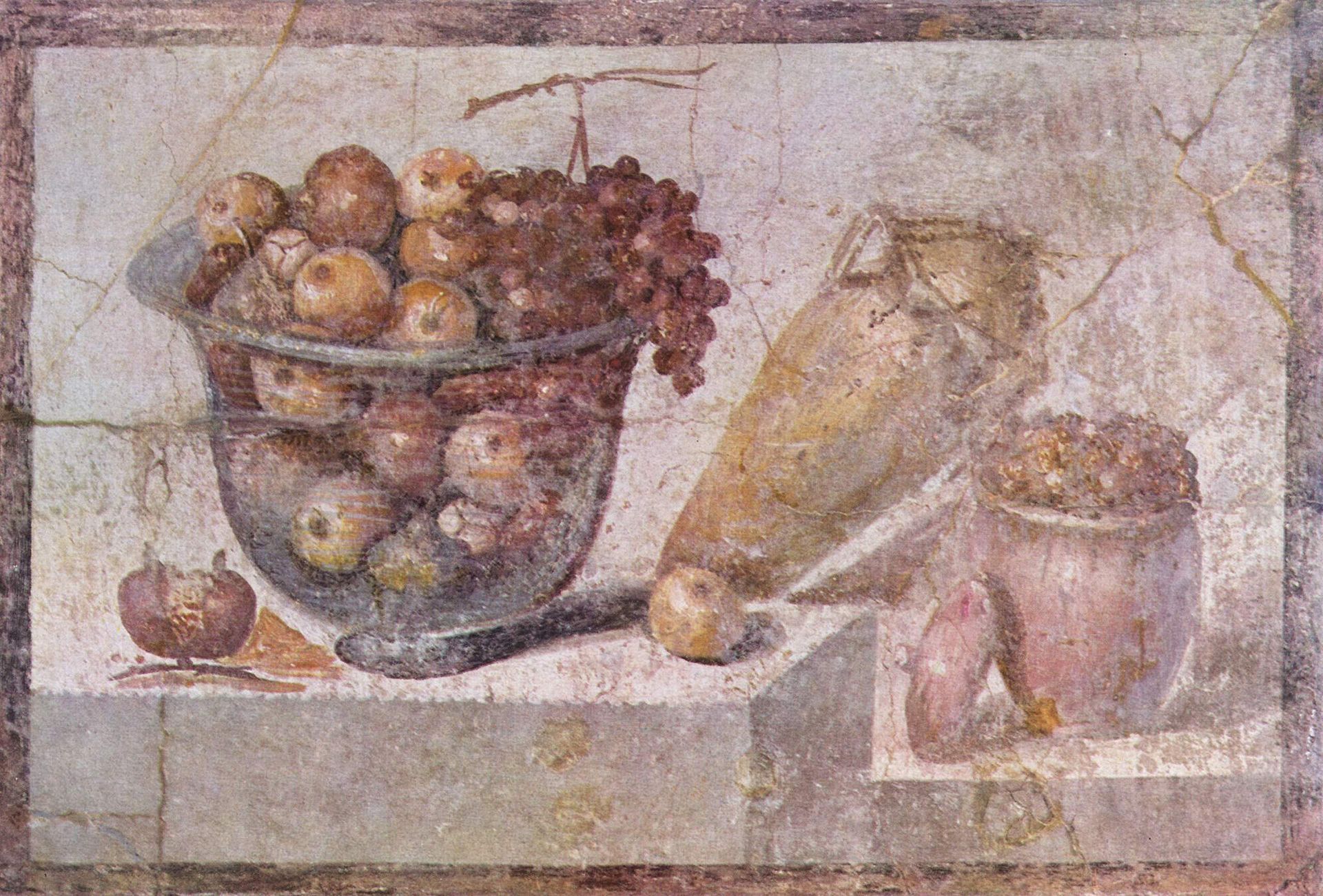
Fruits of the land, circa 63-79 AD
It’s exerted a profound influence on European writing about agriculture and rural life, and has much to offer environmental thinking today.

With, Katharine Earnshaw, Senior Lecturer in Classics and Ancient History at the University of Exeter; Neville Morley, Professor of Classics and Ancient History at the University of Exeter, and Diana Spencer, Professor of Classics at the University of Birmingham

Producer: Luke Mulhall"

Picture; Grassland, 2023, from the collection of Andrew Simpson, Still life with glass bowl of fruit and vases, circa 63-79 AD,Naples National Archaeological Museum. The work of art depicted in this image and the reproduction thereof are in the public domain worldwide. The reproduction is part of a collection of reproductions compiled by The Yorck Project. The compilation copyright is held by Zenodot Verlagsgesellschaft mbH and licensed under the GNU Free Documentation License.

*Virgil's Georgics, In Our Time, Radio 4, https://www.bbc.co.uk/programmes/m001lyt4

Monday, 17 April 2023

Melandra ……. part 1 …. rediscovering the Roman fort and making a new acquaintance

Now, you either like the Romans or you pass over them with a shudder.


For some they are the quintessential example of ruthless Imperial aggrandisement, characterised by vicious military campaigns, and an economy based on exploitation and slavery.

And that is before you get on to gladiators, dodgy Emperors and fish paste.

Me …. I take the more balanced view which does require a bit of convenient amnesia, but I have been fascinated by the Romans from about the age of 6, so as I head towards my 73rd birthday, I don’t see it changing.

All of which is an introduction to a short guide to the Roman fort of Melandra in Glossop which I picked up sometime in the 1970s.

The fort was one of a series built to consolidate the occupation of the Northwest and were linked by roads which connected the big legionary bases at Chester and York.

And having stumbled across the guide, I contacted the artist who drew a series of images, including a plan and a reconstruction of the fort.

This was Mike Brown, who has a long association with the archaeology of Melandra going back to the 1950s.

We spoke recently and the conversation ebbed and flowed about his lifelong interest in the fort, some of the more bizarre tales of the early days of excavation and the continuing plans to advance our knowledge of the place.

Mike has promised to send over a heap of material from the digs, including more of his pictures and an up-to-date version of the guidebook.

In the meantime, he referred me to an edition of the guide book produced in 2020 which can be accessed by following the link, and I rather think I will return to the story of Melandra and in particular the settlement which grew up outside the fort.

These civilian settlements offer up a rich insight into the relationship between the military and the varied groups who made their home outside the forts.

They were rough and ready places, as the discovery of a murder under the floor of a bar outside the fort at Housesteads testifies.

So, lots more to come and a thank you to Mike Brown.

Leaving me to add before someone else does that Python question ..... "What did the Romans do for us?"  Answers on a wax tablet and addressed to the Commanding Officer, Melandra Fort, although Mike will no doubt correct me and point to what we think the Romans called it which was Ardotalia.

 Location; Glossop

Pictures; reconstruction of the Roman fort of Melandra and plan of the fort and civilian settlement, 1973, courtesy of Mike Brown

*Glossop Heritage; https://glossopheritage.co.uk/ghtarchive/melandra/

Friday, 3 February 2023

A bit of Roman history …… the search for an artist …… and a lesson on never throwing things away

I don’t now know how many editions of the History of The English Speaking Peoples I bought back in 1969, but this copy is the only one to survive.

The cover tells me there were to be 112, but I doubt I bought more than a couple.

The marketing plan seems a good one.  

Take extracts from Winston Churchill’s History of the English Speaking Peoples, juxtapose his text with articles by some of the leading historians of the 1960s, throw in some pictures and maps along with biographies of leading historical figures and for 4/6 you had a bargain.

Well, I thought so as issue No.2 will testify.

Despite the passage of over half a century I can remember being drawn to the edition because of its connection with the Romans who captured my imagination when I was no more that eight and have stayed with me ever since.

In the winter of 1969 I would have been 18 and I almost certainly picked it up from Wilcox’s at the top of Well Hall Road and sold everything from books sweets and magazines to cards and stationary.

I guess my collection never went beyond the Romans, and Mr. Churchill’s chronicles of the Saxons, Vikings and Normans were lost to me.

But this edition was read and read again and offered up some fascinating images of which the picture of a Roman legionary set against a photograph of Trajan’s Column was a favourite.


I am not sure how many of the four legions which invaded Britain in 43 AD were equipped with the new body armour which came into use late in the Emperor Tiberius’s reign and it may be some were still wearing mail shirts.

Still that picture which came with a set of notes remained with me as the go to guide to the Roman army till I came across the books of Peter Connolly six or so years later.

And I have often wanted to reproduce it ….. but the ethics of copyright have always stopped me, which is how I went looking for the artist Julian Allen who is credited as painting it.

The plan was to ask his permission, but sadly he died in 1998, leaving me to search for his Estate.

In the meantime I have become interested in Mr. Allen who was born in 1942, studied at the Cambridge School of Art and the Central  College of Art in London and then went onto work for various newspapers as a “freelance illustrator and reporter”, before moving to America and continuing both as an artist working for publications as well as a freelance artist with “amassing an impressive list of clients including Esquire, GQ, Newsweek, Rolling Stone, Sports Illustrated, The New Yorker, The New York Times, and Time, among others. In 1988 he was among five prominent illustrators invited to Korea and Japan to visit art colleges, teach workshops, and give lectures”.**

Added to this while working for The New York magazine "he covered such diverse subjects as: the Watergate scandal; the Yom Kippur war in the Middle East (where he was injured in a bomb explosion); the Entebbe rescue; gypsies in New York; the bicentennial of the Revolutionary War; youth gangs in the South Bronx and numerous stories about New York subculture, crime, politics and food”. 

I could go on but I suggest you follow the link to the biography which is posted on the Norman Rockwell Museum site which has an archive of his work.

And that is one of those nice bits of serendipity as around the time I bought the magazine I had discovered the paintings of Norman Rockwell who I first came across in my grandmother’s house in Derby in copies of the Saturday Evening Post.  

Just how that American publication got to Derby is a mystery I never thought to pursue, but some of them came back to London with me.

All of which is perhaps another story for another time.

Pictures; cover from History of the English Speaking Peoples, The Legions March, Julian Allen, map of the Roman Empire, and inside page, Purnell, 1969

*The Roman Army Peter Connolly, 1975, & Greece and Rome at War, 1981, Peter Connolly

** The Norman Rockwell Museum, https://www.illustrationhistory.org/artists/julian-allen


Tuesday, 25 January 2022

Happy birthday Hadrian's Wall .........

1,900 years old this year.*

The Wall as interpreted in 1955

Hadrian's wall just east of Cawfields quarry 2005
Location; norther England

Pictures; The Wall as interpreted in 1955, Hadrian's wall just east of Cawfields quarry, Northumberland in October 2005, I, the copyright holder of this work, release this work into the public domain


*Back on Hadrian's Wall rediscovering a love of all things Roman, https://chorltonhistory.blogspot.com/2014/10/back-on-hadrians-wall-rediscovering.html

Sunday, 8 August 2021

Gladiators and lions come to Leicester

Now I grant you "Gladiators and lions come to Leicester" might be a tad to far, but nevertheless there is speculation that the city might offer up the first evidence “of exotic animals” in the arenas of Roman Britain.

Romans from Airfix, 1972
It comes from a story in  Sunday Times, which reports that excavations carried out during the construction of the new Novatel Hotel on Great Central Street uncovered a “carved bronze key handle depicting an unarmed barbarian grappling with a lion, while four naked young men cower in fear…… [which was] buried in the floor of what would have been a grand townhouse”.*

And that has led various academics to conclude that “Roman Britain imported lions for the execution of captives in public spectacles in Leicester”.

The Clock Tower

I can’t help but think it might not actually offer up this conclusion, which instead could have just been a key design prompted by the Roman love of all things gladiatorial and gruesome.

But I freely admit I am no expert and so I will await the report on the findings from the dig in the academic journal Britannia which is published tomorrow.

I would love to include a picture of the bronze key and a reconstruction of what Roman Leicester, might have looked like, but these trespass on copyright, so instead I have settled for two of my Airfix models, circa 1973, and a 1902 picture postcard of the Clock Tower which is close by.

Pictures, my Roman Airfix models, 1972, from the collection of Andrew Simpson, Clock Tower, from a set of six, published in 1902, issued by Tuck & Sons, courtesy of TuckDB, http://tuckdb.org/history

* Bronze artefact reveals lions roared in for the kill in Roman Leicester, Nicholas Hellen, The Sunday Times, August 8th, 2021


Friday, 18 June 2021

Six ways to leave a story about Ancient Rome ……. Edward Gibbon on the wireless

Now, I am looking forward to listening to the story of Edward Gibbon from the series In Our Time on Radio 4.

A bit of Rome a bit knocked about

I missed it yesterday when it was broadcast and will catch up with it today.

Mr. Gibbon is of course best known for his account of the Decline and Fall of the Roman Empire.

To my shame I have yet to read the six volumes of how work which mother bought for me back in 1961.

To be fair I was 11, and despite being fascinated by the Romans I was daunted by the expanse of reading.

So I will start with the wireless programme. 

"Melvyn Bragg and guests discuss the life and ideas of one of the great historians, best known for his History of the Decline and Fall of the Roman Empire (published 1776-89). 

According to Gibbon (1737-94), the idea for this work came to him on 15th of October 1764 as he sat musing amidst the ruins of Rome, while barefooted friars were singing vespers in the Temple of Jupiter. Decline and Fall covers thirteen centuries and is an enormous intellectual undertaking and, on publication, it became a phenomenal success across Europe.

Edward Gibbon, 1779

With David Womersley, The Thomas Wharton Professor of English Literature at St Catherine’s College, University of Oxford, Charlotte Roberts, Lecturer in English at University College London, and Karen O’Brien, Professor of English Literature at the University of Oxford

Producer: Simon Tillotson”


Pictures; a bit of Rome from after the Fall of the Empire, 2010, from the collection of Andrew Simpson, and Portrait of Edward Gibbon, 1779, Joshua Reynolds

*Edward Gibbon, In Our Time, Radio 4, https://www.bbc.co.uk/programmes/m000x0v2