Showing posts with label Southern Cemetery. Show all posts

Wednesday, 17 June 2026

Photographs from the Royal Herbert during the Great War ............ a unique album of pictures

The Royal Herbert, date unknown
Now the story of the Royal Herbert has just got a lot more exciting and that has a lot to do with a fascinating photograph album from the Great War.

It belongs to my old friend David Harrop who has a unique collection of memorabilia covering both world wars as well as the history of the Post Office.

And today I am looking through it with the hope that some at least of the men and the nurses in the pictures can be traced and their stories uncovered.

Christmas Day, 1915
In time I might even be able to discover the nurse responsible for the album.

A few of the nurses are named and tantalizingly two pictures are captioned “myself” so the search is on which may be made easier as the Red Cross continues to add to its online data base of those who served during the Great War.

And then there are the large number of photographs of soldiers in their “hospital blues” recovering on the wards, a few party scenes and handful from soldiers who had recovered and left the hospital.

Summer, 1916
Together they help reveal a little bit of life in the Royal Herbert during 1915 and 1916.

Given the quality of the cameras and the age of the pictures some images have not fared so well but even the poorest have a story to tell.

One of my favourites is of Sister Thomson and a group of men on a ward on Christmas Day in 1915 along with a much faded image of the garden in the summer of 1916.

Now these albums were quite common but I suspect not that many have survived.

Album cover
David has two more which contain comments, poems and drawings of men recovering from wounds and illnesses.

One remains a mystery but the other comes from a Red Cross Hospital in Cheltenham and it has been possible to track  some of the men who made a contribution.

Their stories are as varied as I am sure will be the ones from the Herbert and include a young Canadian who survived the war and went home to live a successful and productive life and another who is buried in the military hospital outside Cairo.

And like all good stories led my friend Susan who lives in Canada to tell the story of that young Canadian and in so doing brought his drawing and his words  off the pages of the Cheltenham book and back from the past.

Now that I have to say was both exciting and moving.

The Royal Herbert album is different in that it only has photographs but in looking through it I have made a link with a hospital I knew well and which at one point in the 1970s treated our mother.

All of which makes it that bit special.

David's permanent exhibition can be seen in the Remembrance Lodge in Southern Cemetery, Manchester and currently features a collection of material commemorating the Manchester Blitz.

Pictures; from the Royal Hebert collection, 1915-16 courtesy of David Harrop

*Blighty, http://chorltonhistory.blogspot.co.uk/search/label/Blighty

Wednesday, 7 May 2025

More from the Royal Herbert and that unknown nurse

"Myself" date unknown
Now while I am pretty sure where this picture outside the Royal Herbert  was taken I am no nearer to finding the identity of the nurse.*

The caption just says “myself” and while there are plenty of others in which she appears none have her name.

They all come from collection of photographs she compiled into an album of the staff and patients of the Royal Herbert during the Great War.

These picture books were an important part of the life of the hospitals and cover both military hospitals and those run by the Red Cross and St John Ambulance.

Some like this one are just photographs, but others contain comments, poems and drawings from men recovering from wounds and illnesses.

"Sister Heard and myself"
They represent an important part of the men’s recovery and while many of the names of the staff and patients are lost some are recorded and can be tracked.

In the case of John Henry Harrington De Graves of the Canadian Expeditionary Force who appears in an autograph book for a Red Cross Hospital in Cheltenham my friend Susan researched the Canadian side of his life both before and after the Great War.**

In time I am sure we will be able to do the same for some of the men and nurses of the Royal Herbert.

What makes this book just that bit more interesting is that the pictures include some from Gallipoli showing our unnamed nurse at Salonika.

So there you have it, a history book all on its own, which just leaves me to say I will be doing more research and to thank David Harrop from whose collection the album comes.
The Royal Herbert, date unknown


Location; Woolwich, London


Pictures; from the Royal Hebert collection, 1915-16 courtesy of David Harrop


*The Royal Herbert, http://chorltonhistory.blogspot.co.uk/search/label/The%20Royal%20Herbert%20Hospital 

**The Man Behind the Autograph,http://chorltonhistory.blogspot.co.uk/2015/08/the-man-behind-autograph.html

Saturday, 18 January 2025

The envelope that told the story of the Manchester Blitz

Now of all the records, the photographs and stories of the Manchester Blitz this little envelope is as powerful a reminder of the destruction that was heaped on the city on the nights of December 1940.

It was sent to W Marsden of 11 St Mary’s Gate but was returned to the Vicarage in High Wycombe, and the various official stamps tell the story.

It had been sent on August 20 1941 but according to the stamp the building was “Gone No Address” and to confirm the fact there was a hand written message “War Damage of property.”

Now number 11 was entirely destroyed during the Manchester Blitz along with all of the buildings opposite on the south side from Deansgate up to Cross Street.

I have yet to track down William Marsden.  I know that in 1911 the address was listed as the Union Bank of Manchester but more than that will need more research.

That said even in wartime the Post Office was more than efficient returning the letter just two days.

All of which just leaves me to go back and look at the directories for 1940 to be exactly sure what business was being conducted just before the blitz and also to look for who was living at the Vicarage.

Location;; Manchester


Pictures; from the collection of David Harrop

Monday, 4 December 2023

Remember them ……..

After over 80 years a war memorial to some of the men who fought in the Great War has come out of the shadows.

The memorial went into storage sometime after All Saints Church was bombed in 1940.

The details remain sketchy, and it is unclear whether the church was the one in All Saints in Chorlton on Medlock or the one in Stretford.

Many of the men listed came from Hulme or Chorlton on Medlock and David Harrop who is now the custodian of the memorial says that “two possibly three are interred in Southern Cemetery, and many family members of these men are interred in Southern, it really is the most appropriate location and reflects the memorials origins”.

All of which points to the All Saints Church on Oxford Road.

The church was badly fire damaged and was demolished in 1949.

So it is fitting that David will be placing it in his permanent exhibition in the Remembrance Lodge at Southern Cemetery.  The exhibition already contains many items related to the two World Wars and some which have links to servicemen and women who are interned in the Cemetery.

A heap more work needs to be done on the men listed and in time it maybe possible to finally identify the church.

But for now, as David has said it’s presence in Southern Cemetery “is the most appropriate location and reflects the memorials origins”.*

Location; The Remembrance Lodge Southern Cemetery

Pictures; the War memorial 2023, courtesy of David Harrop

*The memorial will be on show later in the year or at the start of the next


Tuesday, 28 November 2023

Private Ernest Francis Hahn from Australia, who was buried in Southern Cemetery in 1915 aged 22

It began with this simple grave stone in Southern Cemetery to a young man who died far from his home having crossed the world to fight at Gallipoli.

He was Ernest Francis Hahn who had been born in Redesdale in what was then still “the colony of Victoria” in Australia on June 23 1893, and left Melbourne in the December of 1914 ending up on the shores of the Ottoman Empire in the ill fated Gallipoli campaign.

He was wounded in early May with gunshot wounds to his chest and died here in Manchester at the General Hospital of enteric fever on June 25 1915.

It is a story that could be replicated many times but what marks this story out is that David Harrop posted the picture on a social network site in response to a request for information about Private Hahn's grave in Southern Cemetery from a relative and almost immediately he received a reply from Margaret Cooper in Australia, who supplied David with the story of this young man and concluded with that it was “nice to see the photos at Southern Cemetery and that he has such a peaceful resting place.”

And with Margaret's permission I was able to access a wealth of family material  which gave a context to the life of young Ernest who was the son of Heinrich Frederick Hahn who had been born in Germany in 1843, settled in Australia in 1865 and married Jane Rose in 1870.

Mr and Mrs Hahn had fourteen children had worked hard and were well respected in their home town.

Amongst the documents were Ernest's birth certificate, his obituary and his ANZAC medal along with much more about his brothers and sisters.

What also makes this new link with Margaret's family all the more fascinating is the sight of an Australian birth certificate which differs from those issued in Britain and which provided a wealth of additional information not included on our own.

All of which has added to my own knowledge and wish to go looking for my own Australian family.

So we all win and I shall close with Margaret's reply to my last email, "thank you for telling the story of Ernest Hahn in your blog. 

Gradually the stories of the occupants of the lonely graves are being told and it is nice to know people care and remember them and want to record who they were and something about their lives..............I think Australians are surprised at the respect shown by the English towards the war graves."

And here of course I have to mention David and his  unique collection of memorabilia from both world wars, some of which is permanently on show a in the Remembrance Lodge.

Picture; the grave stone of Private E R Hahn, 2015 from the collection of David Harrop, and Private E R Hahn's ANZAC medal courtesy of Margaret Cooper.

Additional material courtesy of Margaret Cooper

Wednesday, 9 August 2023

The Chorlton mysteries …….. which stubbornly keep their secrets

Sometimes despite a heap of research the stories just don’t come together.

Bomb damage, Manchester, 1941
And so, it is with a family of four who “were killed by enemy action in March 1941” and the mysterious link between a house in Chorltonville and the Nazi propagandist, Lord Haw Haw.

Both stories emerged from conversations during the week and in their different ways both seemed promising avenues of research.

The Smith family are buried in Southern Cemetery in the consecrated section T close to Barlow Moor Road, and a search of the City Council’s burial records list them as Eliza, Joseph, Ada and May.

I haven’t seen the grave yet, but Ed passed over the details and wondered where they may have lived.

I thought the bomb maps might offer up a location for their home, but that does depend to some extent on knowing where to look.

Barrage Balloon, 1940, Chorlton
Alas so far, I can’t find them on the 1921 census or the 1939 Register and while there is a reference to an Eliza Smith born in 1866, I can’t be sure this is her.

Nor do they appear in the list of dead killed on March 11th or the following day in one data base.*

Now given the confusion of war I fully accept that some records went missing, but it just ads to my failure.

And in the same way I haven’t been able to make a link between a house in North Meade and Lord Haw Haw, which was the was the “nickname applied to William Joyce, who broadcast Nazi propaganda to the UK from Germany during the Second World War. 

The broadcasts opened with "Germany calling, Germany calling", spoken in an affected upper-class English accent”. **

The possible link was suggested by one of our guests at the recent book launch, who said her mother had maintained that there was a connection between the house and the Nazi who had been an active Fascist in the 1930s before fleeing to Germany just before the outbreak of the war. ***

The census returns for 1921 and the 1939 Register threw up different people living at the property but as yet I can’t trace a connection to either the British Union of Fascists or to William Joyce.

The Meade, circa 1930
Nor so far I have come across a reference to Joyce in Manchester, despite trawling the Manchester Guardian, but then he was “Director of Propaganda for the British Union Of Fascists” and as such spoke at meetings around the country, so it is possible he appeared at a BUF meeting in the city or the surrounding area. ****

Now I not arrogant enough to suppose that just because I failed someone else will not be more successful, which lays down a sort of challenge.

But for now that is it, other than to record that Chorltonville appears unvisited by Goggle Maps which would have been a quick way of refreshing my memory of the said house on North Meade.

Chairs as weapons, Rotherham, 1936

So, we have all learnt something, apart from those residents of Chorltonville who already knew that Goggle Maps has not wandered down its leafy ways.

The Meade, 1913

Location; Manchester

Pictures; Blitz bomb damage, 1941, m08608, Fight at fascist Meeting, 1936courtesy of Manchester Libraries, Information and Archives, Manchester City Council,  http://images.manchester.gov.uk/index.php?session=pass barrage balloon on the Rec circa 1941 from the collection of Allan Brown, and the Meade, 1913, and circa 1930s from the Lloyd Collection

*Luftwaffe Over Manchester, The Blitz Years 1940-1944, Peter J C Smith, 2003, Neil Richardson

**Lord Haw Haw, https://en.wikipedia.org/wiki/Lord_Haw-Haw

*** The book …. some poems … a cake and the mystery of Lord Haw Haw in Chorltonville, https://chorltonhistory.blogspot.com/2022/11/the-book-some-poems-cake-and-mystery-of.html

****Fight at Fascist Meeting Chairs as Weapons, Manchester Guardian February 14th 1936


Monday, 20 March 2023

On church parade on Barlow Moor Road sometime after 1911

I doubt I will ever get to the full story of this photograph but as my friend Sally said when she showed the picture to me “you just keep spotting things.”

We are on Barlow Moor Road during what the caption says was a Church Parade.

In procession on Barlow Moor Road
I don’t have a date but it will sometime after 1911, because that was the date the tram service arrived at Southern Cemetery.

Beyond the trees can just be made out the tall chimneys of the Corporation’s destructor plant, planned by by the old Withington Local Health Board and built by its successor the Withington Urban District Council a little after 1894.

 By 1912 it accounted for 12,320 tons of refuse, some which was sold on to farmers, and 365 tons burned in the destructor.

The original plans for the site included placing the destructor’s furnaces ten feet below the surface of the ground and surrounding the area with an eight foot high wall.

Those chimney's from the destructor
The destructor had been opposed by the Chorlton Union who expressed their concerns for the health of the inmates of the nearby Withington Workhouse.

But I doubt that any in the parade had the destructor on their minds on that summer’s day.

Someone far more qualified than me will be able to comment on the parade.  The nearest destination was Christ Church in West Didsbury which had been built in 1881.

But this is a big procession and seems to be mainly young children which suggests either a joint Sunday School activity or much bigger event involving a number of churches.

Of gates and processions
I will go looking in the local papers for a reference to such a procession but in the meantime will focus on those railings opposite and the stone mason’s yard in the foreground.

Now I have always assumed that the stone wall topped by those ornate ironwork were there from the beginning but not so as the picture reveals.

As for the stonemasons, in 1911 there were three, J & H Patteson, Hilton’s Monumental Works, and Albert Fieldsend.

So that is about it.

Location; Barlow Moor Road

Picture; Barlow Moor Road date unknown courtesy of Sally Dervan.

Friday, 2 September 2022

Remembering Miss Hilda Peare …….. a nurse from the Great War …. today at Southern Cemetery

 Miss Hilda Peare has come back out of the shadows.

Hilda Peare, 1917
She was a Red Cross Nurse during the Great War, who died “of a severe attack of Scarlatina, contracted while she was engaged nursing the sick and wounded of the fighting forces”*

She was buried in Southern Cemetery with full military honours, and then quietly slipped into obscurity, until now when her contribution will be remembered at a special commemorative service on September 2nd in the Cemetery.**

And here I have David Rawson to thank for not only alerting me to the service, but doing all the research on Miss Peare.***

According to David, “Some years ago, the manager of the cemetery, Pete, came across a record of Hilda's burial and located the site. 

Given her war role he organised for a small marker memorial to be placed at the grave. Pete described her as a 'trench nurse'.

Last May, the Common War Graves Commission  held a war graves week, and I met Liz Marsland who is the public engagement coordinator for the CWGC in the North West. Pete showed us the grave and as the conversation developed about Hilda, we thought that she deserved a CWGC headstone.

Normally if a casualty has a memorial erected privately the CWGC does not then add one of theirs. So, Liz made the case for Hilda to get a CWGC headstone and they agreed”.

Hilda Peare was born in Ireland in 1894, “attended the French School in Bray, Co. Wicklow. 

This school was for young Protestant ladies from across Ireland. It was a boarding school and so Hilda would have been used to living away from home. We know that she was at this school age 17. Clearly a fairly well off family”.

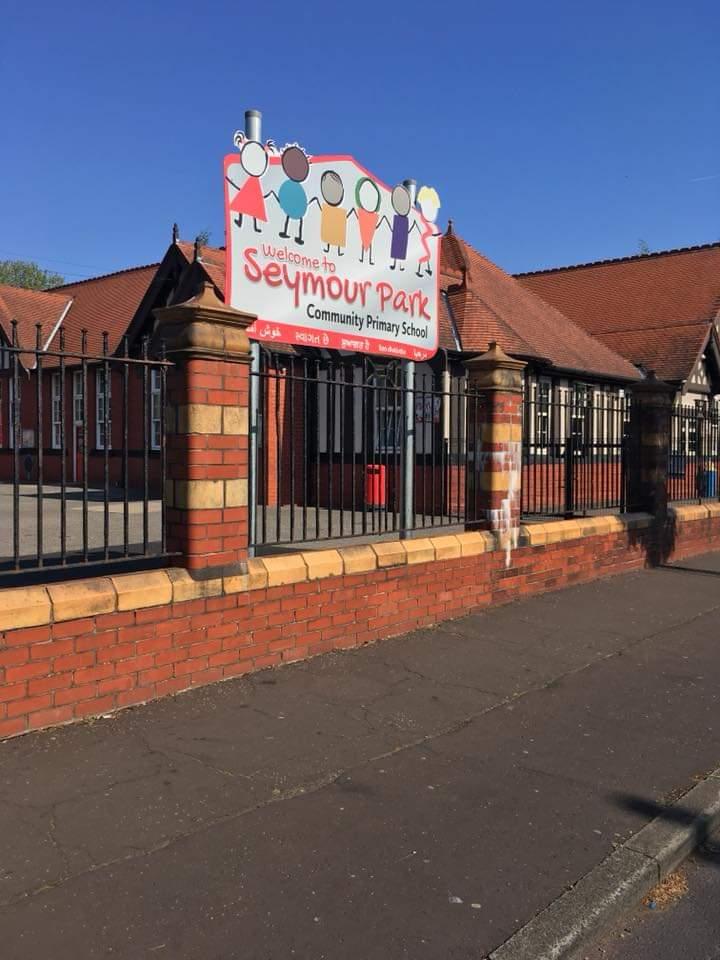
Seymour Park School, 2022
In the autumn of 1915 she enlisted in the Voluntary Aid Detachments of the Red Cross for service administering to sick and wounded servicemen, and was posted to the 2nd Western General Hospital based at Whitworth Street, and from there was redirected to the Seymour Park Auxiliary Hospital on Northumberland Road in Stretford.

The hospital had been a school which was opened in 1907 and is still there today.

During the course of the war, some schools were requisitioned as hospitals along with other buildings like church halls and private residents which were donated by their owners.

Her death was widely reported in the Irish Press, with The Free Press commentating “that her devotion to duty was fully appreciated was evident from the remarkable demonstration of regret on the occasion of her internment. 

She was buried with full military honours, the gun-carriage and the firing party being supplied by the Commanding Officer of Heaton Park Depot. The sergeants of the local detachment of the Royal Army Medical Corps acted as pall bearers, and the band of St Joseph's School played the Dead March in Saul along the route. 

Beautiful wreaths and floral tributes were sent by the officers and men of the Royal Army Medical Corps, the Matron, Sisters, and Nurses of the various military hospitals in the locality, the ladies of the V. A. D., and the patients of the branch hospital where Nurse Peare worked”.

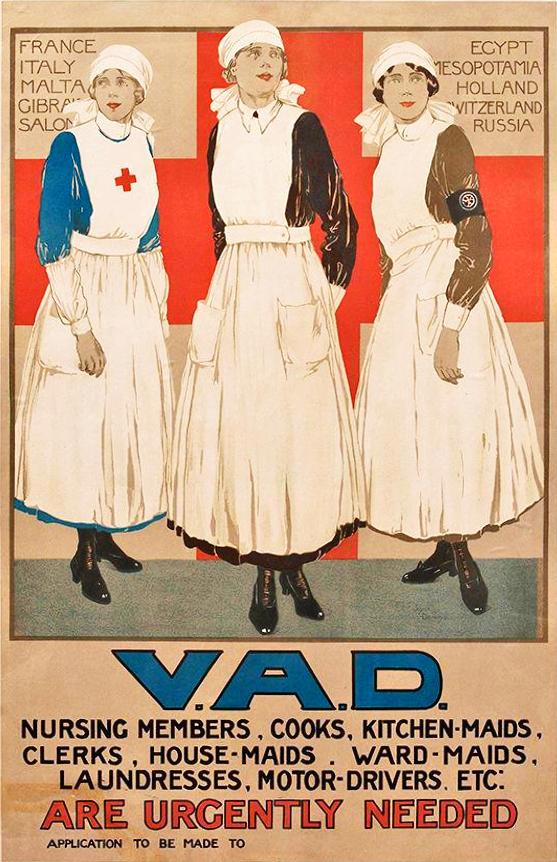
V.A.D., recruitment poster, 1915

And so, it is fitting that a century and a bit after that service she should be remembered in Southern Cemetery.

But that is not quite the end, because David has added  “as knowledge of this event spreads, our friend Cath Brownhill, was telling me that she was a Captain in the Army Reserve based at 207 Field Hospital.

WW1 memorial at the drill Hall, 2022

She has found that Hilda is remembered on the WW1 memorial at the drill Hall on King's Rd (207 HQ)

Cath took the picture. Hilda is toward the top of the left hand column. Although she is down as Pearce rather than Peare".

Original grave marker, 2022 on display
There is much more, and David’s research offers up a wealth of information on the work of the VADS, and Miss Peare’s background, along with fresh avenues of research.

The original grave marker is now on display at his permanent exhibition of memorabilia in the Remembrance Lodge at Southern Cemetery and will also include other material pertaining to Ms. Pearce

Added to this there is The Red Cross’s own data base of those who served as VADS, which is temporarily down for maintenance.

But for now, that is it.  

The ceremony will be held in Southern Cemetery, on September 2nd at 10.30 for 11am, and The Irish Consul General will be attending to represent the Irish Government.

The new gravestone to Ms. Perare, 2022

Pictures; Miss Hilda Peare, circa 1915-1917, Seymour Park School, 2022,  from the collection of David Rawson, V.A.D., Recruitment poster, 1915, Imperial War Museum and WW1 memorial at the drill Hall on King's Rd (207 HQ), 2022, courtesy of Catherine Brownhill, and the grave marker and new Red Cross Gravestone, 2022,  from David Harrop.


*The Free Press, March 14th, 1917

** The ceremony will be held in Southern Cemetery, on September 2nd at 10.30 for 11am

*** David Rawson, is one of the three Manchester City Councillors for the Chorlton Park Ward.


Sunday, 21 August 2022

Private Samuel Spence K.i.A. 24th August, 1901 …. another story from Tony Goulding

This memorial stone marks the grave of James Duncan Spence and his wife Jenefer (née Naylor) and includes a dedication to their son Samuel who was killed in action at  Rooikopje, South Africa on the 24th August, 1901 during the 2nd Boer War. 

It is located in Manchester’s Southern Cemetery, Non-conformist section, Plot D 710. 

The Spence family came to South Manchester from Dublin during the first decade of the 20th century, although James Duncan was born in Dumfries, Scotland and his wife hailed from Lyme Regis, Dorset. They were married on the 17th January, 1872 at the district church of Ballybunion in the parish of Killiheney, Listowel, County Kerry, Ireland. Samuel was born on the 23rd July, 1883 at 7, Lower Sackville Street, Dublin. (1)

When the 1901 census was taken on the 31st March, Samuel had already landed in South Africa as part of the Imperial Yeomanry, a force drawn from all parts of the British Empire to combat the rebellion of the Boer Republics. He had left his family home at 124, Cowper Road, Rathmines, Dublin to enlist on the 11th February and, lying about his age to do so, he joined, according to his attestation documents, the 13th battalion of that force.  The record of his death however, includes a reference to him belonging to the 74 (Dublin) company, 8th battalion, Imperial Yeomanry. Samuel left behind in Ireland his father James Duncan, recorded on the census return as a “printseller”, his mother Jenefer, an older brother, William Naylor, who was a picture dealer and six unmarried sisters. (2)

Shortly after James Duncan and Jenefer Spence re-located to Didsbury with their remaining sons and three of their youngest daughters (3), James Duncan died on the 21st May, 1909 at 5, Lansdowne Road, West Didsbury, Manchester. He had suffered with blindness from before the 1901 census which recorded him as “blind”. Jenefer Spence survived her husband by more than 17 years, dying on 2nd November, 1926.

I had expected that this would conclude the story of this grave. However, further investigation revealed that two other people, not recorded on the headstone, were also interred in it viz. Miss Anne Jane Cantley on the 17th April, 1937 and Henry Parnell Heney on the 1st October, 1942. 

The family connection of the second of these interments was straightforward, he was the husband of Stella Edith Spence, the second youngest daughter of James Duncan and Jenefer

Christ Church, West Didsbury.
The couple had married on the 12th February, 1923 at Christ Church, West Didsbury and in the 1939 register are shown living at 95, Atwood, Didsbury, Manchester. 

Living with them was Stella Edith’s older unmarried sister, Jenefer, who appropriately perhaps considering the fate of her brother, worked for The League of Nations as a confidential secretary in their offices at 53, Barton Arcade, Manchester.  Mr. Heney, who was a sales representative, latterly in the pharmaceutical industry, died, a week shy of his 56th birthday on the 26th September, 1942. He left an estate of £1,140-14s-7d. (equivalent today to £37,535).

Despite there being no shortage of biographical detail available concerning Anne Jane Cantley’s, finding her connection to the Spence family proved to be problematic and at present still remains a mystery. 

Grafton Street, Dublin circa 1870
Anne Jane was born in Dublin, Ireland in 1863, her parents were Joseph Cantley, who was a hosier and glover of 79, Grafton Street, Dublin and Marianne (née Boon).

 Of her earlier life in Ireland little has shown up in the records; perhaps as she was the first-born daughter, she remained single in order to take care of h.er parents in their old age. 

By 1911 she had moved to England and is recorded in that year’s census return residing with her brother Joseph, a surgeon, at 398, Great Cheetham Street East, Broughton, Salford, Lancashire. 

Her nephew, Joseph Donaldson, was recorded as newly born; he went on to have a distinguished career in Law. (4) 

Anne Jane Cantley later moved to Kensington, London where the 1921 census shows her as the manageress of a large up-market boarding house at 44-46, Longridge Road, Earls Court. Later, she briefly owned another boarding house a short distance away at 28, Nevern Square. 

Joseph Cantley’s shop

This was, apparently a joint venture with Eduard Gustaaf de Lange which was “dissolved by mutual consent” from the 31st December, 1927 as reported in the London Gazette on the 7th February, 1928. Sometime after this Anne Jane returned to live, with her brother’s widow and her children at 43, Brooklands Road, Prestwich, Manchester where she died on Tuesday the 13th April, 1937, aged 74. 

Pictures: - Headstone of the Spence family grave from the collection of Tony Goulding

Christ Church, West Didsbury courtesy of Manchester Libraries, Archives, and Information, http://manchester.gov.uk/index.php?session=pass

79, Grafton Street, Joseph Cantley’s hosier and glover shop, this, also, was home to the Dublin School of Photography and the Studio of Frederick Holland Mares, National Library of Ireland on The Commons, https://commons.wikimedia.org/wiki/File:79_Grafton_Street..._(8248610379). 

Notes: -

1) Sackville Street and its extension towards the River Liffey, Lower Sackville Street, was renamed O’Connell Street, in 1924, by the newly established Irish Free State government with one of its earliest actions.

2) Samuel did have two other siblings an older sister, Margaret Anne, who had recently married on the 27th July, 1899, and a younger brother, Albert Harley, born on the 4th December, 1886 who was for some reason absent from the census return of 1901. Albert Harley later emigrated to the United States from the family home in Manchester in 1907.

3) Stella Edith, the second youngest child, remained behind in Dublin for the time being.

4) Sir Joseph Donaldson Cantley O.B.E. became a High Court Judge. He was educated at Manchester Grammar School and The University of Manchester. In his legal career he was the lead prosecutor in the final capital murder case prior to the abolition of the death penalty when the conviction of Gwynne Evans and Peter Allen for the murder of John Alan West led to their executions on the 13th August, 1964 at Manchester’s Strangeways and Liverpool’s Walton Prisons, respectively. Later as a judge Mr. Cantley presided over the sensational conspiracy and incitement to murder trial of the former leader of the Liberal Party, Jeremy Thorpe. His reputation and legacy were to a degree sullied by his summing-up in this case which was deemed by many to have been too skewed in favour of the defence following the accused acquittal.


Tuesday, 16 August 2022

Remembering Miss Hilda Peare …….. a nurse from the Great War …. buried in Southern Cemetery

 Miss Hilda Peare has come back out of the shadows.

Hilda Peare, 1917
She was a Red Cross Nurse during the Great War, who died “of a severe attack of Scarlatina, contracted while she was engaged nursing the sick and wounded of the fighting forces”*

She was buried in Southern Cemetery with full military honours, and then quietly slipped into obscurity, until now when her contribution will be remembered at a special commemorative service on September 2nd in the Cemetery.**

And here I have David Rawson to thank for not only alerting me to the service, but doing all the research on Miss Peare.***

According to David, “Some years ago, the manager of the cemetery, Pete, came across a record of Hilda's burial and located the site. 

Given her war role he organised for a small marker memorial to be placed at the grave. Pete described her as a 'trench nurse'.

Last May, the Commonwealth War Graves Commission  held a war graves week, and I met Liz Marsland who is the public engagement coordinator for the CWGC in the North West. Pete showed us the grave and as the conversation developed about Hilda, we thought that she deserved a CWGC headstone.

Normally if a casualty has a memorial erected privately the CWGC does not then add one of theirs. So, Liz made the case for Hilda to get a CWGC headstone and they agreed”.

Hilda Peare was born in Ireland in 1894, “attended the French School in Bray, Co. Wicklow. 

This school was for young Protestant ladies from across Ireland. It was a boarding school and so Hilda would have been used to living away from home. We know that she was at this school age 17. Clearly a fairly well off family”.

Seymour Park School, 2022
In the autumn of 1915 she enlisted in the Voluntary Aid Detachments of the Red Cross for service administering to sick and wounded servicemen, and was posted to the 2nd Western General Hospital based at Whitworth Street, and from there was redirected to the Seymour Park Auxiliary Hospital on Northumberland Road in Stretford.

The hospital had been a school which was opened in 1907 and is still there today.

During the course of the war, some schools were requisitioned as hospitals along with other buildings like church halls and private residents which were donated by their owners.

Her death was widely reported in the Irish Press, with The Free Press commentating “that her devotion to duty was fully appreciated was evident from the remarkable demonstration of regret on the occasion of her internment. 

She was buried with full military honours, the gun-carriage and the firing party being supplied by the Commanding Officer of Heaton Park Depot. The sergeants of the local detachment of the Royal Army Medical Corps acted as pall bearers, and the band of St Joseph's School played the Dead March in Saul along the route. 

Beautiful wreaths and floral tributes were sent by the officers and men of the Royal Army Medical Corps, the Matron, Sisters, and Nurses of the various military hospitals in the locality, the ladies of the V. A. D., and the patients of the branch hospital where Nurse Peare worked”.

V.A.D., recruitment poster, 1915

And so, it is fitting that a century and a bit after that service she should be remembered in Southern Cemetery.

But that is not quite the end, because David has added  “as knowledge of this event spreads, our friend Cath Brownhill, was telling me that she was a Captain in the Army Reserve based at 207 Field Hospital.

WW1 memorial at the drill Hall, 2022

She has found that Hilda is remembered on the WW1 memorial at the drill Hall on King's Rd (207 HQ)

Cath took these pictures. Hilda is toward the top of the left hand column. Although she is down as Pearce rather than Peare".

There is much more, and David’s research offers up a wealth of information on the work of the VADS, and Miss Peare’s background, along with fresh avenues of research.

Added to this there is The Red Cross’s own data base of those who served as VADS, which is temporarily down for maintenance.

But for now, that is it.  

The ceremony will be held in Southern Cemetery, on September 2nd at 10.30 for 11am, and David tells me "I've just had a conversation with Liz (from CWGC) about the order of service. The Irish Consul General will be attending to represent the Irish Govt, which is great".

Pictures; Miss Hilda Peare, circa 1915-1917, Seymour Park School, 2022,  from the collection of David Rawson, V.A.D., Recruitment poster, 1915, Imperial War Museum and WW1 memorial at the drill Hall on King's Rd (207 HQ), 2022, courtesy of Catherine Brownhill.

Marker memorial to Miss Pearce, 2022 

*The Free Press, March 14th, 1917

** The ceremony will be held in Southern Cemetery, on September 2nd at 10.30 for 11am

*** David Rawson, is one of the three Manchester City Councillors for the Chorlton Park Ward.

Thursday, 7 July 2022

The Western Front ……. Australia …. and Southern Cemetery …… in memory of Corporal James I’anson

 This is one of the more than a million bronze memorials which were issued posthumously to the families of servicemen and women who died during the Great War.

The Bronze Plaque, 1919
It measures 122mm in diameter, depicts an image of Britannia holding a trident and standing beside a lion.

Two dolphins swim around Britannia and a second lion appears at the bottom.

Each plaque carried the name of the man or woman it commemorated with the inscription“died for Freedom and Honour”.

This one was for Corporal James I’anson of the 21st Battalion of the Manchester’s.

He was born in 1893, worked as a clerk in a warehouse and enlisted when he was 21 years old.

He was reported missing on September 3rd, 1916, and subsequently was found to have died on August 21st.

His name is recorded on the Thiepval Memorial to the Missing of the Somme, which records 72,337 missing servicemen who died in the Battles of the Somme and have no known grave.

It would be a full year before his obituary appeared in the Manchester Evening News in the August of 1917, and the entry included that moving line, “Dearly loved by his FATHER, MOTHER, BROTHER (on active service) and SISTERS”. *

James I'anson, circa 1914-1916

It was acquired by David Harrop who has a large collection of memorabilia from both world wars, some of which are on display at his permanent exhibition in the Memorial Lodge at Southern Cemetery.

In time David intends to include Corporal I’anson’s bronze plaque at the Lodge, which was donated by an individual from Australia, who had contacted one of the groups associated with the Manchester Regiment.

They in turn put him in contact with David who accepted the donation.

Just how the plaque made its way to Australia is unclear, but it may be that one of his siblings emigrated to Australia, or it may just have been bought by a collector.

I am not sure we will ever know, but in the fullness of time I will search the stories of his brother and three sisters, but for now it is enough that the memorial to this young man has returned to the city of his birth.

Location; Moss Side, France, Australia, and Southern Cemetery

Pictures; the bronze plaque, 1919, and photograph of Corporal I’anson, circa 1914-1916, courtesy of David Harrop.

*Manchester Evening News, August 10th, 1917

Monday, 23 May 2022

Catching the tram to Southern Cemetery ………….

An occasional series celebrating the old Manchester Corporation trams……. and by extension all Corporation trams everywhere.

I don’t have a date, for when car 978 trundled past on its way past Southern Cemetery, but I am guessing it will sometime during the 1920s and 1939.

Someone with far more knowledge than me, will be able to date the car in the corner.

That said I know that route 45 from Piccadilly to Southern Cemetery was converted to motor buses in February 1939.

All  of which means, that sadly there can be few people who could describe that journey.


Location; Chorlton

Picture; car 978 route 45, sometime before 1939 from the collection of Andrew Simpson

Monday, 2 May 2022

Southern Cemetery ….. a house in West Didsbury …….. and a certain Jeanne Vignot of á Neuilly-sur-Seine

I am the first to admit that speculating on the relationship between a Jeanne Vignot in France and the mystery resident of Clyde Road , is both unhistorical and unlikely to take you anywhere.

But the romantic in me wonders just why aJeanne received this picture postcard in the January of 1908, and what she thought of being sent a photograph of a cemetery, even if it was the impressive Southern Cemetery.

In time I might go looking for Jeanne, but for now, because it is easier I will go for the person who sent it.  The clue is on the postcard in the form of the sender’s address, which is 93 Clyde Road.
The house is still there today and is one of a pair which as then goes under the title of Kinloss Villas, and dates from 1882.

But here is the problem, I know who was there in 1901 and who was there eight years later, but for now pinpointing the residents in the year the card was sent still alludes.

That discovery will have to wait for the next visit to Central Ref and a trawl of the directories for 1908.

Suffice to say in 1901 it was the home of Mr. and Mrs. Hale, their four children and two servants.

By 1909 it is occupied by Mr. and Mrs. Amirayan, but they have proved quite elusive.  I know he was a “Manager of Exports” and in 1929 had offices at 29 Princess Street, and that his wife and daughter had traveled from Australia and Japan in the 1920s, but apart from one official record from 1939, I can’t find much else, and that much else extends to no census records.

So it remains a but of a mystery, but nature and all historians abhor a mystery so I shall plug on to find the identity of the person at 93 Clyde Road and a possible connection with France.

Location; West Didsbury

Picture postcard. Southern Cemetery, 1908 from the collection of David Harrop

Sunday, 1 May 2022

Walking in Southern Cemetery in early summer and thinking of conkers

A walk in Southern Cemetery will not appeal to everyone, but there is a tranquilly, and beauty in the place.

And of course a lot of history and for David my facebook chum plenty of memories of collecting conkers on warm autumn evenings.

Which is pretty much what I was doing at much the same time in Nunhead Cemetery in south east London.

Now conkers are something of the past, even my sons no longer collect them.  We of course were lucky in that there are plenty of conker trees in the Rec directly opposite us. And in the early autumn it was part of the day to go across and pick them up.

But I always think there is etiquette.  You don’t go throwing lumps of wood up into the trees to dislodge them.  The correct thing and the fun thing is to go looking for them on the ground, always hoping that they are still in their shells and when pried open are that deep shiny brown and not still white.  Or worse still just the size of a peanut.

I have to say that many of these conker searches were probably more to do with me reliving my own childhood than anything else.  As I recall my boys enjoyed many activities which were actually just a rerun of my own young activities in the 1950s.

So they had the Beano and Dandy, played monopoly at Christmas and helped Dad make cardboard rockets from cereal boxes.

And still safely stored away is the red, yellow and black car made from a squeezy bottle for a school competition.

It comes out occasionally which is more than can be said for the conkers.  These we gathered in such numbers that even all of our lads plus assorted friends never managed to use up.

And so they sat in a plasi bag in a corner of the cellar.

If we were lucky they just shrivelled but sometimes they went mouldy and ended up in the bin usually just before the first of the new harvest fell to the ground.

Throwing them out always seemed a waste and a bit of a reproach for not doing more with them.

But there are only so many that you can soak in vinegar and bake in the oven.

Not that we resorted to such underhand forms of cheating.

You just gently made the hole with a crewdriver, threaded the shoe lace of string through the conker and went in to the park or playground hoping that  all the effort of collectiong and preparing was not shattered with one hit for a rival.

After all no one wanted to do all this just to see the prize and joy not even become a "oner."

All of which is a long way from Southern Cemetery so for those not interested in conkers but wishing to follow up on a name on a gravestone or wishing to track down a family member there is always the City Council online database which holds the records of those buried in Manchester cemeteries.*

There is also a map which allows you to locate the grave.

*http://www.burialrecords.manchester.gov.uk/

Pictures; from the collection of Andrew Simpson

Saturday, 5 February 2022

Burials, cremations and offers through the door .....

 Odd what pops through the letter box as junk mail.

Through the door, 2021
I am always prepared for the heaps of takeaway menus, offers of a gardener, and even deals on double glazing.

But yesterday there was a letter from a firm choosing to cremate me, with never to be forgotten headlines like "Say goodbye your way" and promises of a "fuss free cremation" which could save me thousands and "comes as a pre-pay plan"

Now death and the arrangements to cater for the event are one of the last un talked about subjects, although there are those reassuring ads with a nice ageing "celebrity" which regularly appear on the telly, focusing as much on the surviving relatives as they do on those who are in the age zone where funerals and creations hover in the near distance.

And as some one who has more years behind me than ahead, they are perhaps a little more relevant than saving for my retirement or exploring the advantages of a long term holiday let.

That said I do wonder how they singled me out, rather than the nice couple just down the road in their late 20s.

All of which is an introduction to the story about Southern Cemetery on Barlow Moor Road, in South Manchester. 

Entrance to Southern Cemetery, date unknown
"It is the largest municipal cemetery in the UK and the second largest in Europe, with stunning gardens and pathways, and six grade 2 listed buildings, four of which are chapels. 

The cemetery is also the final resting place for many great Mancunians including philanthropist John Rylands, British aviator John Alcock and former Manchester United Manager, Sir Matt Busby”*

Now as a brief introduction to Southern Cemetery this pretty much does the business.

And there is no doubting the importance of the place both for those with relatives buried there and the general public some of whom visit the cemetery for the peace and tranquilly it offers along with some impressive scenery and wildlife.

For me of course there is also the history like the other big Manchester cemeteries it was built in response to the problem of inner city church yards which had become full and were according to many endangering the health of the living.

In the small church yard of St John’s off Deansgate an inscription on the memorial records 22,000 were buried there during the  18th and 19th centuries, and  in Angel Meadow 44,000 people were interred between 1789-1816.**

The Crematorium, date unknown
All of which led to the creation of these fit for purpose cemeteries on the edge of the city.

This started with Philips Park which was opened in 1865 on the east of the city and Southern Cemetery fourteen years later.

Alongside the push for a more rational policy of dealing with the dead came the move towards cremation and the formation of the Manchester Cremation society in 1888 which in turn set up the Manchester Cremation Company in 1890 with a capital of £10,000 raised by subscription.

It bought a plot of  6.75 acres of land close to Southern Cemetery, upon which it built a Crematorium with a chapel and a covered walk way with niches for urns.  It was officially opened on October 2nd 1892, and was only the second crematorium to be opened in the country.

But the number of cremations remained low.  So that in the first ten years there were only 471 which may have had something to do with the cost.


“The price of a basic cremation was £5-5s-0d and to this could be added a further £1-1s-0d for the clergyman and 15s-0d for burial of the ashes in the grounds. 

A niche would cost a further £2-12s-6d in the outside columbarium or £5-5s-0d inside the chapel to which a further £1-1s-0d would be added for carving the inscription on the slab. 

By comparison, a simple burial for an adult might cost as little as 10s or for a child 7s with the clergyman charging a further 2s 6d. Furthermore, burial might be available close to home while cremation would involve a time consuming and costly journey to the one crematorium in south Manchester.”

Sadly some of the registers and most other early records of the Crematorium were lost when the company's office in York Street, Manchester, was destroyed during the winter blitz of 1940.  But the list of the first 412 cremations up to 1900 is available in the library at Clayton House and while those from 1900 to December 23  1940, have been lost it may be possible to find a reference in a local newspaper death notice or a memorial plaque at the crematorium.

Memorial to  Satinik Kouyoumjian, 2013
But that still remains the vast number of gravestones which can be visited and for those with an interest in family history the City Council provides a link to the online database which holds the records of those buried in Manchester cemeteries.

Armed with this and a map of the plots it should be possible to track down a relative some one of interest.

Pictures; entrance to Southern Cemetery from the Lloyd collection, gravestone of Satinik Kouyoumjian from Manchester’s Armenian community from the collection of Andrew Simpson

*Southern Cemetery, http://www.manchester.gov.uk/info/200032/deaths_funerals_and_cemeteries/5099/manchester_cemeteries_and_blackley_crematorium/5

** Friends of Southern Cemetery, https://www.facebook.com/pages/Friends-of-Southern-Cemetery/104042376342221