Showing posts with label Chorlton High School. Show all posts
Sunday, 28 February 2021
Saturday, 28 November 2015
In the summer of 1970 with Chorlton High School
Now there will be many who will have an instant rapport with these images from Chorlton High School.
They date from the late 1960s and are part of a wonderful collection released by Tony Petrie and include photographs of the staff, students and buildings as well as pages from Unity which was the school magazine.
Schools like churches are embedded in our communities and are one of those seamless links from one decade to another.
In many cases they will have seen two perhaps even three generations of a family pass through the doors offering up a succession of stories along the way.
On a very personal level although I never went to Chorlton High school I did leave my own secondary school in the summer of 1969 and started at the old College of Commerce on Aytoun Street in the year covered by the Unity.
And just twenty-six years later the first of our lads walked through the gates at Darley Avenue, followed in the fullness of time by three more.
So the pictures and the magazine resonate with me because while the uniforms may have changed and the buildings have been replaced there is much that most of us can recognise.
It starts with the standard class photograph and goes on to the school magazine which will pretty much always be a mix of reports, records of achievement and contributions from staff and students.
Of course as a historian what draws me are the adverts and I will not be alone in playing that game of spotting the shops which are still around a full forty-six years later, working out what has replaced some of them and trying to remember which ones I used.
But what also makes this 1970 edition of Unity significant is that it was the first.
As the introduction explained, "Unity is the joining together of two separate ideas, or minds, or, in the case of Chorlton Grammar School and Barlow Hall School, the joining of two schools.
Phyisically, the buildings are separate but in the minds of the pupils and staff they are one - Chorlton High School.
Unity also describes the relations which exist between the pupils and staff on the academic side of the school.
We have chosen the title of "Unity" for a magazine not only as an outward symbol but as an indication of a common determination."
The decision to merge the City's grammar and secondary modern schools had been taken after much debate and in many cases meant retaining the exciting buildings and converting them into a Lower and Upper school with students spending the first two or three years in one building and then transferring across.
The transition was not always smooth and when I began teaching in one of the new high schools just four years later there were still a few problems.
Of these the most tiresome was that of commuting between the buildings to teach different age groups.
And Chorlton High School achieved a first for while staff using their cars were paid an allowance those using their bikes were not leading Mr Lloyd to challenge the arrangement.
Now John Lloyd will be fondly remembered not only as one of Chorlton's historians but as a craft teacher at the school but few know that his stand won the right of staff using their bikes to claim a commuting allowance.
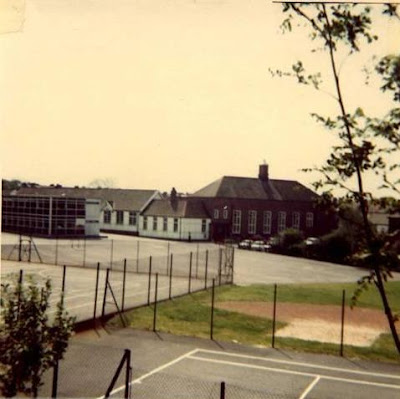
I suspect as I dig deeper with Tony's help more will be revealed of the history of the school and so I want to spend some time with that magazine for 1969-70 exploring just what went on in Chorlton High School and featuring a few class photographs and a selection of the now lost buildings.
Pictures; from the collection of A Petrie
![]() |
| Cover of Unity |
Schools like churches are embedded in our communities and are one of those seamless links from one decade to another.
In many cases they will have seen two perhaps even three generations of a family pass through the doors offering up a succession of stories along the way.
On a very personal level although I never went to Chorlton High school I did leave my own secondary school in the summer of 1969 and started at the old College of Commerce on Aytoun Street in the year covered by the Unity.
And just twenty-six years later the first of our lads walked through the gates at Darley Avenue, followed in the fullness of time by three more.
![]() |
| One of the buildings, 1972 |
It starts with the standard class photograph and goes on to the school magazine which will pretty much always be a mix of reports, records of achievement and contributions from staff and students.
Of course as a historian what draws me are the adverts and I will not be alone in playing that game of spotting the shops which are still around a full forty-six years later, working out what has replaced some of them and trying to remember which ones I used.
But what also makes this 1970 edition of Unity significant is that it was the first.
![]() |
| Toys and uniforms,, Chorlton, 1970 |
Phyisically, the buildings are separate but in the minds of the pupils and staff they are one - Chorlton High School.
Unity also describes the relations which exist between the pupils and staff on the academic side of the school.
We have chosen the title of "Unity" for a magazine not only as an outward symbol but as an indication of a common determination."
The decision to merge the City's grammar and secondary modern schools had been taken after much debate and in many cases meant retaining the exciting buildings and converting them into a Lower and Upper school with students spending the first two or three years in one building and then transferring across.
![]() |
| All you could want to know, Chorlton 1970 |
Of these the most tiresome was that of commuting between the buildings to teach different age groups.
And Chorlton High School achieved a first for while staff using their cars were paid an allowance those using their bikes were not leading Mr Lloyd to challenge the arrangement.
Now John Lloyd will be fondly remembered not only as one of Chorlton's historians but as a craft teacher at the school but few know that his stand won the right of staff using their bikes to claim a commuting allowance.
I suspect as I dig deeper with Tony's help more will be revealed of the history of the school and so I want to spend some time with that magazine for 1969-70 exploring just what went on in Chorlton High School and featuring a few class photographs and a selection of the now lost buildings.
Pictures; from the collection of A Petrie
Wednesday, 24 June 2015
Woodwork lessons at Chorlton High in the spring of 1930
It is a scene that anyone growing up in the middle decades of the 20th century will recognise.
It’s a wood work lesson at Chorlton High sometime in the 1930s. In my case our exploration of the joys of sawing, paining and gluing the stuff at Samuel Pepys Secondary Modern happened in the basement of the old 1880’s building while metalwork was in the new 1950’s annexe.
Now ours was an all boys school and similar practical lessons were in the neighbouring girls’ school where cooking was done over one of those solid fuel Rayburn ranges and needlework next door.
Of course so much hung on that difference between grammar school and secondary modern which might as well have been an ocean in distance...
In the grammar school the education was geared to what my Year 6 teacher said “were the academically advanced children” who had passed the 11 plus examination proving that they were fit for the thinking jobs and an education to deliver it.
The rest of us were destined for the secondary modern diet, which was more woodwork than, Wordsworth, and technical drawing rather than Tennyson
It’s a theme I have visited before so instead I will move on and over the next few weeks reflect on what it meant to go to school here in Chorlton in that great stretch of years from the late 19th century into the bright shiny decades of the 1940s and 50s.
Next “Cramming and paying”, the new Chorlton children chasing education opportunities
Pictures; from The Lloyd collection
Subscribe to:
Posts (Atom)


