Showing posts with label Eltham in the 1920s. Show all posts

Wednesday, 9 September 2026

The Welcome Inn ................... the early days

Now some stories just have a habit of not wanting to go away.

They stay hanging around challenging you to go off and discover something new to add to what has already been said.

And so it is with the Welcome Inn which every time I feature the pub strikes a chord with many people usually about my age.

In particular it is tales of Sunday nights which continue to bubble up enriched by the memories of meeting future husbands or lasting friends.

And I should know because while I was just that bit too young to drink I would listen to the happy crowds coming back down Well Hall Road past our house in the mid 60s a little after closing time.

More recently I began looking for the history of the place, and while a few people were able to offer up names of past landlords the very early history of the pub proved illusory.

And then my old friend, fellow researcher and local historian Tricia Leslie told me about The Woolwich Story by E.F. E. Jefferson.

It is as she promised me a wonderful account of the Borough from the earliest of times up to its merger with Greenwich.

I have already used the book and know I shall go on plundering it for some time to come.

So in the chapter on the 1920s I came across this “On the brow of the hill stood a large wooden building used as a workmen’s club but demolished about 1927 when the Welcome Inn was built.  

This modern hostelry set new standards in both furnishing and service.  Seated in comfort, one had to preserve patience until the waiter came to take the order, for customers were not permitted to get their own drinks at the bar. 


But this arrangement proved too leisurely, annoyed those who only had time for a quick one and tended generally toward the restraint of trade. A wise host discontinued the practice.”

Now I have no idea when that service was discontinued but I well remember the practice was still in use in some of the big Manchester pubs in the late 1960s, with the waiters in white jackets and in some rooms a bell push to summon assistance.

Sadly there are few photographs of the waiters or indeed the interiors and it would be nice if any could be shared of the Welcome in its heyday.

So that is it.  I now know when the pub was open which was clearly aimed at the Progress Estate and the new build going up behind the pub and the appeal is out for pictures.

We shall see what we get.

But in the meantime I shall go looking at the electoral registers which will give us the names of the landlords or landladies from when it opened through to the 1960s.

Location, Eltham

Picture; the site of the Welcome courtesy of Jean and the cover of The Woolwich Story

Tuesday, 8 September 2026

Going to the “flicks” in 1928

This will be the easiest cinema story, and is just a list of which picture houses were around in Eltham and Woolwich in 1928.

The challenge should you accept it, is dredge up the pictures, with the memories.

And yes I know someone will have written the book, but where would the fun be in going there?

Instead the list is from the Kinematograpgh Year Book for 1928, which lists all the cinema’s in the country, the film companies and much else.*


I have four Year books in the collection, spanning 1914, 1928, 1929 and 1947.


And because I can I shall wander across to Plumstead, and Blackheath, to publish their cinemas, and while I am at it will accept quests for other places.

Remember you saw it first on the blog.

Location Eltham and Woolwich

Picture; list of Eltham and Woolwich cinemas, 1928

* The Kinematograpgh Year Book for 1928

Monday, 7 September 2026

When a pint of Eltham Ale cost 4d and was brewed at our brewery.............. Eltham in 1874

Eltham Brewery, 1874
I often wonder just what a pint of Eltham Ale would have tasted like.

It was brewed buy our own Eltham Brewery and would have cost 4 pence back in 1874.*

According to their advert published in the October of that year they offered  twelve different ales stouts and porter and delivered across south east London and beyond which included Woolwich Charlton and out to Belvedere and Erith, and up to Peckham, New Cross and Brixton.

The old brewery had been up the High Street behind the Carpenters Arms and later moved to a spot just down from St John’s Church.

Eltham Brewery, 1920
Now I might be wrong but there seems to be little written about the brewery.

There is a reference to the old one in Mr Gregory’s book and another in Eltham in the Making and just two pictures which appear in other books.**

All of which is a bit odd given that it must have employed quite a few of our residents and supplied a decent number of pubs.

Of course Greenwich Heritage Centre is bound to to have something on it and in due course I shall go looking in their archives.

That said there will be someone who can put me right on the exact date it moved and more importantly when it ceased business.

It was still there in 1920 and six years earlier had been owned by the Kenward Brothers all of which promises a rich field of research.

Well we shall see.

Pictures, advert Eltham Brewery, 1874, from Grace’s Guide to British Industrial History, http://www.gracesguide.co.uk/Eltham_Brewery, and the brewery in 1920, GRW 215, http://boroughphotos.org/greenwich/ courtesy of Greenwich Heritage Centre, http://www.greenwichheritage.org/site/index.php

*All of which is a bit confusing  given that some sources suggest a pint in 1872 was 2½d so perhaps I did the sums wrong when I calculated the numbers of pints in a frkin of Eltham Ale which sold for 15 shillings.

**The Story of Royal Eltham, RR C Gregory, 1909, Eltham in the Making, 1990, Eltham, A Pictoral History, John Kennet, Eltham Through Time, Kristian Bedford, 2013 

Sunday, 6 September 2026

So what is the story behind the tram on Well Hall Road, one sunny spring day?

Now there is a fine line between nostalgia and remembering the past.

The first pretty much takes you nowhere and often distorts the past by making it seem somehow better than it was.

On the other hand remembering the past can trigger not only a series of memories but leads to wanting to find out more.

It often starts with that simplest of questions was this really how it was? And then takes you off into serious history which involves talking to others, cross checking their memories against research and beginning to record it for others to read.

And that often leads to community projects where memories and memorabilia come out of the cupboards, are dusted down and shared which not only adds to what we know but brings an area together, allowing the not so young to recreate the past for those too young to know what it had been like.

So here we are with one of those classic old pictures of Well Hall from a book on trams.*

There is no date on the picture, and the caption just says “early days on Well Hall Road [showing] that the local children had plenty of space to play.  All they had to do was get out of the way of the trams which plied the route every ten minutes. The ride from Woolwich to Eltham would have cost two pence.”

All of which draws you in and makes the picture worth investigating.

Judging by the trees and the children’s clothes I think we must be somewhere in the 1920s or 30s and taking into account the shadows it will be early afternoon.

Now it could be a Sunday which would explain the lack of traffic or we really are at a point in time when Well Hall Road was far less busy.

What I also find interesting is that the children by and large are ignoring the photographer.

Earlier in the century and certainly in the last decade of the 19th century the appearance of a man with a camera would have attracted the curious, the vain and those with nothing better to do.

You see them on the old pictures staring back at the camera, intrigued, mystified and just nosey.  But not here, which means we are either dealing with some very sophisticated young people or the world has moved on and street photographers were taken for granted.

And that just leaves me that little personal observation that however fascinating this picture is it just leaves off our house for the photographer has positioned himself just a tad further north, missing out 294 by a couple of blocks.

That said if I have got this right I have to satisfy myself with knowing that the corner house with its ever so fashionable lace curtains was the home of Mr and Mrs Burton in 1925.

The Burton’s were there by 1919 which means that Mr Christopher Dove Burton may have been an Arsenal worker, and just as an aside, I know that they were married in 1920 in Lambeth, and that Beatrice’s maiden name was Briant and it was as Miss Beatrice Briant that she shows up on the electoral roll in 1919 sharing the house with Mr Burton.

Now there is a story to follow up.

Pictures; Well Hall Road, date unknown, from the collection of G.L. Gundy, reproduced from Eltham and Woolwich Tramways

*Eltham and Woolwich Tramways, Robert J Harley, Middleton Press, 1996, https://www.middletonpress.co.uk/

Saturday, 5 September 2026

Playing on the Nine Fields, all the way from Well Hall to Kidbrooke

Kidbrook Lane in 1872 with the Nine Fields to the north
Now I know there will be people who know of the existence of the Nine Fields just beyond Well Hall out towards Kidbrooke.

But I think there will not be that many, and certainly now few who will have played on them

Their existence was unknown to me and it was my friend Jean who set me off on a search for them.

She rememberd that “my father told me there were fields stretching from Well Hall Road from the Catholic Church,right across to Kidbrook, before the Kidbrooke estate was built. 

Dad was talking about the 1920s when he was growing up at 47 Lovelace Green.”

And with the power of the internet there almost as soon as I started was a reference to the open land that was called Nine Fields, before the Page Brook estate was built.  Moreover she remembered that they were one vast children’s play area.  At one time small bi-planes were there offering cheap flights.”*

And in turn this led me on to an excellent description of the estates being built in the 1920.**

In the great sweep of world history I grant you that this little discovery is hardly earth shattering, but for people like me who have wandered that bit of Eltham and my sister who lives on Bournbrook Road it remains an interesting insight into what was and what has now gone.

Even more so because when we washed up on Well Hall Road in the 1960s those fields were still within living memory.

Now I am not so sure.

Location, Eltham, London

*Lily Tyrrell (Brown), from Eltham, Mottingham, New Eltham SE9
Royal Borough of Greenwich, http://www.thisiseltham.co.uk/lilyTyrrell.php
**Municipal Dreams, http://municipaldreams.wordpress.com/2013/08/06/page_estate_eltham/

And in turn this led me on to an excellent description of the eststaes being built in the 1920.** http://municipaldreams.wordpress.com/2013/08/06/page_estate_eltham/

Picture; detail from the OS for London 1862-72, courtesy of Digital Archives Association, http://www.digitalarchives.co.uk/

Friday, 4 September 2026

Eltham from the pen of Llwyd Roberts ....... nu 3 the old Brewery 1929

Now I am a great fan of the work of Mr Llwyd Roberts.

He was during the 1930s our artist in residence and during that time produced a heap of line drawings of Eltham and the surrounding area.

Some were reproduced from old photographs while others  were as he saw them at the time.

This is old Brewery which  which dates from 1928 in a building which according to Mr Roberts "originally a brewery, the upper floor of this building was later converted into the Baptist Meeting Room.  The brewery stood at the entrance of Jubilee Cottages, and the building was pulled down in 1928."


Picture; old brewery drawn 1929, Llwyd Roberts

Tuesday, 1 September 2026

Eltham from the pen of Llwyd Roberts ....... nu 2 St Mary's School 1929

Now I am a great fan of the work of Mr Llwyd Roberts.

He was during the 1920s and 30s our artist in residence and during that time produced a heap of line drawings of Eltham and the surrounding area.

Some were reproduced from old photographs while others  were as he saw them at the time.

This is St Mary’s School which dates from 1928 in a building which was in its time both an academy  for young gentlemen and before that a private residence.

According to Mr Roberts, this was "the convent chapel and St Mary's Diocesan Orphanage garden are replaced by the pavement in the now widened High Street.  The nun's house on the left has gone.  St Mary's School in its present form was founded in 1928."

And if you want more I suggest you follow the link.*

Picture; Eltham Parish Church; drawn circa 1929, Llwyd Roberts

* St. Mary's (Eltham) Community Complex, http://www.stmarys-eltham.co.uk/history.php

Monday, 31 August 2026

Uncovering a bit of the life of Lewis St J R Clutterbuck of Westmount Road in Eltham

Gertie's postcard 1915
Recently I was with Gertie about to send her postcard from Westmount Road in 1915.


She was keen to tell her friend E of how “I like the nursery work so much better so have taken a nurse’s place 2 children."

And it may be that her employers were the Clutterbuck’s who were in the house just four years earlier and at that time employed a child nurse for their daughter Jessie who was then just two.

I would really like to have found out more about Gertie but to date this is the only reference we have.

It is one of those frustrating things that sometimes people just fall through the cracks.  Not that I haven’t given up hope of tracing her, and the first long shot might be E whose surname we have and an address in Sudbury.

But as ever it is the people of property who leave more of a trail, and so it is with Lewis St J R Clutterbuck, his wife Isabella.

Royal Artillery Barracks, 1906
Lewis had been born in Dublin into an army family in 1885.    In 1891 Lewis and his parents were stationed in Chester Castle, and a decade later Lewis aged 16 was training to be an officer in Woolwich.

He married Isabella in 1907 in Dundalk and by 1911 they were in Eltham but I suspect only just because Jessie their daughter had been born in Henson in 1909.

And it is Lewis’s military record that allows us to trace him for the next fifty years.

In 1916 he was sent out to the Western Front, survived the war and was back in south east London after the Great War.

Now this I know this because in the October of 1919 when applying for his war medals his address was given as West Park Road in Eltham. Later for a short period he was in south West London before returning in the late 1920s to live on Westcombe Park Road in Blackheath.

Here he may have stayed until the late 1930s when he moved to Bishops Waltham in Hampshire where he died in a nursing home in 1965.

Church Parade, Royal Artillery Woolwich, 1939
He had steadily risen through the ranks, from a Lieutenant in the Royal Field Artillery in 1911, to a Major by 1916 and a Colonel by 1932 and along the way became an O.BE.

From 1932 he served on the Ordinance Committee of the Royal Arsenal and was still there five years later.

Now there is a lot still to find out about him and his wife Isabella and Jessie, not least what they were doing living in Newcastle-upon-Tyne in 1941 which may have been a war posting.

But it is enough to reflect on just where a simple postcard can take you.

Pictures; from the collection of Andrew Simpson, and pictures of Royal Artillery Barracks, 1906, and Church Parade, 1939 issued by Tuck & Sons, from the series Woolwich, courtesy of TuckDB,  http://tuckdb.org/

Sunday, 30 August 2026

When Harold married Alma in the April of 1928 at Dartford


I am looking at two images which are now 90 years old.

This was the wedding celebrations of Harold Morris and Alma Minnie Shove in April 1928.

We all have pictures like this but many of them will be undated and long ago the identities of those staring back at us will have been forgotten as have the events surrounding the image.

Now even if I didn’t know some of the people and couldn’t place them in the first half of the last century they do have a fascination and an importance.

Part of this is because photographs like this so rarely see the light of day and if they do it is limited to a close set of family and friends.

What of course strikes you first off are the clothes including those above the knee dresses, soon to fall a few inches as the 1930s came along.

And then there is the half hidden garden and house a reminder that most weddings for people like Harold and Alma ended back at the house.

But even here there are questions that we might never know or have an answer to, like the name and age of the elderly woman in the corner of the second picture. I rather think she will be in her 70s or perhaps older, and so her presence takes us back to the late 1850s.

A time almost as remote from Harold and Alma’s experiences as 1928 is to us.

It is just possible that this lady may have walked to her wedding, that amongst the guests would have been those who could remember reading the stories of the old Queen’s wedding in 1840, and more than a few whose parents had talked of the rejoicing of the news of the allied victory at Waterloo and the shock they felt at hearing of the death of Lord Nelson.

And in the same way looking back at that April of 1928 is to see a totally different landscape. Alma might have been 23 years old but it would be another four months before Parliament voted to extend the franchise to her and a full year before she vote in a general election.

That general election in the May of 1929  was dubbed the flapper election marking as it did the first time that women of Alma’s age and class could help determine the next government of this country.

Nor is that all for if the newlyweds had wanted to dance to record music it would have been via a wind up gramophone, many of the films they might have watched would still have been silent ones and many such couples could only hope to aspire to one of those new and clean electric cooker.

So bring on these old family photographs.

Location; Eltham, London

Picture’s from the collection of Jean Gammons

Thursday, 27 August 2026

Harold Morris of Eltham and Welling, a life lived out in service to the community.... part 1

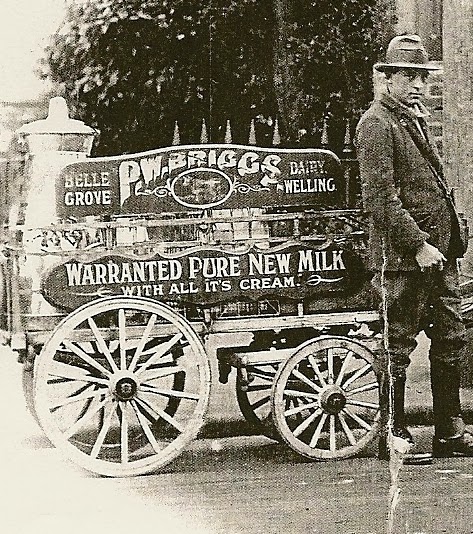
This is the young Harold Morris sometime in the early 1920s.

It is a wonderful picture not least because it takes us into a lost world when milk was still marketed by small independent businesses and delivered by horse and cart.

In an age when much milk was not so clean, fresh or free from disease it was important always to reassure the public that the product on sale was safe, and so to the promise on the side of the cart, “WARRANTED PURE NEW MILK” with the added enticer that it came “WITH ALL ITS CREAM.”

Now the firm in question was P.W.Briggs of Belle Grove in Welling who were later to be taken over by
United Diaries.

But not long before this picture was taken young Harold had run his own milk business and this is his story, which was researched and written by his niece Jean Gammons.

"Harold was born in Eltham in 1902 - the firstborn of Maud and William George Morris and a grandson of John and Annie Morris of Eltham.

By 1906 the family had moved to Belle Grove, then a hamlet situated on Watling Street at the foot of Shooters Hill,  close to the village of Welling on the ancient road between London and Dover.


There was no milk delivery service  for the villagers then -  if they wanted milk then they had to take a  jug or container of some kind up the hill to the dairy farm on Shooters Hill.

Young Harold's father was a machinist in the Royal Arsenal - where many young men of the surrounding area, including Eltham, would easily have found work making "Implements of War".   

War did come in 1914, and in the following year Harold turned 13 and was free to leave school and perhaps join his peers and his father at the Arsenal.  

But Harold remained a country boy at heart, who loved horses, birds and gardening. So what could he do if he turned his back on the Arsenal?

He had an idea, and so he walked across the fields to Eltham to visit his grandparents, who lived in Courtyard.  Thomas Tillings, the omnibus company, had a yard full of horses, carriage and carts of all kinds just behind his grandparents' cottage.

Perhaps they would let him have the use of a horse and cart so that he could set up a milk delivery service to serve the villagers of Welling.

They did, and thus he began his long and happy career as a milkman. Soon, his little enterprise was taken over by a bigger local company:  P W Briggs; and later by the United Dairies.


Young Harold's first love broke his heart, but when he was 26 he married a Bexleyheath girl, Alma Minnie Shove. The bridesmaid was his youngest sister, Dorothy (Jean's mother), a self-willed child of whom there might be more later. 

Her dress had too many frills in her view and so, on the bus journey to Bexleyheath she took scissors with her and cut off as many as she could before her parents noticed.


Harold was a good husband and father, holidays being days at the seaside in the time before  Holidays Abroad became common.

Through two world wars he served his country in a quiet way, ensuring that none of his customers ever woke up without milk on their doostep for their first cup of tea of the day.  

He won Gold Stars from the UD for his high selling figures: his secret, he said, was to whistle, so that people knew he was around and would then come out to buy something extra.

By the time he retired in 1967 to concentrate on his birds and garden, he had been a milkman for nearly 50 years.”

And it says much for his hard work that when he retired “his customers loaded him with presents, a total of £100 in premium bonds, good luck cards and a poem.”*

*Dartford Times, 1967

Pictures; from the collection of Jean Gammons


Tuesday, 17 March 2026

Well Hall in the 1920s nu 1 ........... catching the train and watching out for the cows

A short occasional series on Well Hall in the 1920s.

Now I washed up in Eltham in the spring of 1964 and for two and half years made the daily  train journey back to New Cross and Samuel Pepys School which continued until I switched to Crown Woods.

I didn’t like Samuel Pepys over much and the trip from Well Hall to New Cross and back was pretty much the best bit of the day.

Even now I have fond memories of seeing the woods above out house come into view ast thetrain took that final bend and came into the station.

The trains were always packed but there was something about knowing you were coming home to Well Hall.

And I suspect Mr Jefferson may have shared that feeling, so here are some of his memories of the same station just 40 or so years before I used the station.

They are taken from the book he published in 1970.

“The railway station was called simply ‘Well Hall’ when we came and the platforms were not so long as they are now.  

A workman’s ticket cost 8d return to London and early workers making their way past the tumbledown ‘Well Hall’ which is now the Pleasaunce would frequently be hindered by cows coming up hawthorn-hedged Kidbrooke Lane and turning in at the wide gate in Well Hall Road.”*

Location; Well Hall

Picture; the railway bridge over Well Hall Road, 2014, from the collection of Chrissie Rose

*The Woolwich Story, E.F.E. Jefferson, 1970 page 202

Sunday, 21 May 2017

Remembering those on our war memorial

The second in a series where I revisit stories about Eltham and the Great War

© Rod Allday
I have been thinking about the contribution Eltham made to the Great War.*

And a little later in the day I received the latest newsletter from the Eltham Society** which highlighted the efforts to track the 227 names which appear on the war memorial.

This is not an easy task not least because a large number of the service records of those who fought were destroyed during the Second World War.

And until relatively recently many of the other sources which might give clues to their lives were not available on line and might be deposited in a number of different locations.

But despite these obstacles it has been possible to uncover something about all but four of the men who “marched away”

The bulk of this research was undertaken by Tony Robins from 1991 till his death in 2004, and since then by Mr Nigel Bennett.

© Stephen Craven
The four remaining “Unknowns” are J.Mather, R.S.Thomas, R. Ward and H or I Young.

 But that isn’t quite the end of the quest, “Mr Bennett has discovered others whom he feels should be on the list, having been Servicemen of Eltham in WW1 but who died in England, perhaps after the Armistice on 11 November 1918, as a result of their injuries or illness.

At this late stage the names cannot be added to the stone. 

That was done only at the specific request of the families of those commemorated, in the mid 1920s.  

But we could add them to the digital and paper listings, at the IWM and locally for posterity. 

Some have standard-type Commonwealth War Commission gravestones in the churchyard.  

Others were buried with family members.”***

So there is the challenge.

Anyone wishing to help can contact the Eltham Society.****

Pictures; the war memorial © Rod Allday, & © Stephen Craven, and licensed for reuse under this Creative Commons Licence.

**1914-1918 Eltham’s Commemoration 2014-2018 Part One: FOUR TO FIND and FOUR TO EXPAND ON, Margaret E. Taylor,  The Eltham Society Newsletter No 196 May 2014

***ibid 1914-1918 Eltham’s Commemoration


****The Eltham Society, http://www.theelthamsociety.org.uk/

Monday, 9 November 2015

On this day in 1924 ..........

The war memorial, 2013
On this day just 91 years ago and a full decade after the outbreak of the Great War we unveiled our memorial to those who had particiapted in the War to End all Wars.

Now I am not one to lift other people’s research and so from the outset I want to make it clear that the story of our war memorial has been drawn entirely from an article by Margaret E Taylor which appeared in an edition of the Eltham Society’s newsletter.*

Even before the end of the Great War there was discussion on a possible war memorial but the general consensus was that this should wait till the conflict was over and so it was not till the December of 1918 that plans for a memorial were seriously canvassed.

A public meeting was held in the parish hall in March of the following year and the decision was taken to build a memorial with many favouring a market cross featuring the names of all those who had served as well as those who died.

The Remembrance service, 2015
After a degree of deliberation a design was chosen, agreed at another public meeting in the March of 1920 and was finally unveiled on November 9 1924.

And this is always the point where I defer to the original article and suggest if you want more you read the article in the newsletter.

Picture; the war memorial © Rod Allday, & © Stephen Craven, and licensed for reuse under this Creative Commons Licence amd the Remembrance Service November 2015 courtesy of Elaine Walters

* Margaret E Taylor, former Archivist at Eltham Church  (St John’s), The Eltham Society Newsletter No 198 November 2014, http://www.theelthamsociety.org.uk/