Showing posts with label Manchester in the 1930s. Show all posts

Friday, 21 August 2026

Poverty…. gas masks ….. going to the flicks …. and a night in Chorlton ….. stories from Madeline Alberta Linford

Madeline Alberta Linford was by any measure a remarkable woman.

Madeline Alberta Linford, 1921
At just 22 in 1917 she was writing for the Manchester Guardian, at 27 she had reported on the famine and typhus outbreak in Poland followed by on-the-spot reporting from Austria, and Germany.

In the same year she was chosen to create to create a page "aimed at the intelligent woman", defined by C. P. Scott  as discussing issues such as "domestic economy, labour-saving, dress, household prices, and the care of children".*

And she remained the only woman journalist on the Manchester Guardian till 1944.

During the war she was also night picture editor, combining it with voluntary war work.

She “wrote a biography of Mary Wollstonecraft, published in 1924, and five novels: Broken Bridges (1923), The Roadside Fire (1924), A Home and Children (1926) Bread and Honey (1928) and Out of the Window (1930)”.* 

To all of this she also championed other women writers.

I first came across Ms Linford when Tony Goulding wrote about her life for the blog back in 2023.** 

It is a comprehensive account of her life and particularly her time in Chorlton on Claude Road and Wilbraham Road and is an excellent starting point.

My interest was reignited after a chance conversation with Cllr Mathew Bentham whose friend now lives in her old house in Chorltonville.

August 1917
As you do, I went looking for her articles in the Manchester Guardian. 

Alas her stories on Poland, Germany and Austria have yet to turn up, but there were plenty of articles spanning her years as a critic reviewing plays, and films as well as those reporting on contemporary issues.

Reading them for the first time over a century since they were produced, they offer up a fascinating insight into Britain during the early and middle decades of the last century.

And there were some surprises, not least that in 1917 both here and in Hollywood films were being made in colour.

Her review of Annabel’s Romance in the August of 1917 at the Deansgate Picture House begins with that simple observation that “A coloured film is still rare” **, while five years later she playfully remarked that the colour effects in A Study in Scarlet made “Faces as expressionless as though a sponge had wiped the life out of them”.****

Deansgate Picture House, 1928

But for me it is her articles on hospitals, shopping and the impact of the war which bring the 1920s and 30 bouncing into life.

December 1922
Like the piece on the Manchester Babies’ Hospital in Burnage Lane, written in 1922 which is both informative and written with style.

She visited in late December when “the hospital is in party dress [with] its Christmas decorations which are simple and consist of silvered twigs latticed across windows with robins perching on them, trails of pink almond blossom, and bright ballons tugging at their strings.”*****

But this is 1922, in that time before the NHS when poverty is the main reason why the fifty-bed hospital is full and why “the fifty cots could be filled over and over again”.

“All of them are suffering in some way or another from malnutrition.  They come from the most destitute homes in Manchester where their poor little bodies have been the victims of ignorance, poverty and in a few tragic cases, of actual neglect … where all the good things of life are short”.

Manchester Babies’ Hospital, 1962
“Children of six months weighing only six pounds; newborn babies whose weight barely reaches three pounds. 

The wards are full of them, lying with terrible apathy in their cots, their faces wizened and furrowed like those of the very aged, and their waxen fingers as helpless as broken ones. Anyone who since the war has visited the infant welfare centres of Berlin or Vienna will find the tragedies all over again in this Manchester hospital.”

And because rickets marches with poverty “the conservatory has been turned into a semi-open-air ward for rickets”.

Equally telling is the admission of just how much money is needed to maintain and advance the care. So, while “The Babies’ Hospital is full of plans for the future and a laundry is now being built and X-ray department is one of the great needs [with] it is hoped an extension to enable another twenty babies to have their shire of skill and kindness but for these schemes as well as the ordinary everyday running of the hospital money is badly needed”.

It is a powerful piece of reporting which comes with the style of an accomplished writer and so she begins by locating the hospital in a “big old house of the type of successful businessmen built for their families half a century ago. One can imagine it furnished in mahogany and rep with steel engravings of ‘Pilate’s Wife’s Dream hanging in the hall and camellias cherished in the conservatory”.

That same playful way of writing is evident in a series of articles she wrote in the run up to the first war time Christmas of 1939.

Set against the novelty and danger of going out in the blackout, and the surprise that the shops almost had a prewar feel about them the ever-present conflict is not far away and includes a delightful and humorous take on what the fashionable woman looks for in a bag to contain her gas mask.

July 1947
And along with all the serious and the not so serious comes a review of our own “Chorlton Repertory Theatre Group which has been an enlivening feature of Chorlton-cum-Hardy and the neighbouring suburbs”.

Written in in the summer of 1947 it reviews the group’s “choice of plays, performed in the Public Hall ranging from Shakespeare to Noel Coward and to farces which had caught the fancy of West End audiences” and focused on “The Letter” by W. Somerset Maugham.

It is a well balanced and I think affectionate report and offers up the names of some of the actors.  These include Harry Littlewood, Gloria Foster, Arthur Spreckley, the producer, and James Lovell who “designed and painted the excellent sets” which might be another story. 

One to read, 2024
But for now, I will just leave you with a suggestion to read a review by Quentin Outram of a selection of Ms Linford’s writing “M.A.L” The Journalism and Writing of Madeline Alberta Linford" edited by Michael Herbert and published in 2024

Pictures; Portrait of Madeline from the Guardian’s photograph of its 1921 editorial staff researched by Tony Goulding, Manchester Babies’ Hospital in Burnage Lane, m15731, 1962 courtesy of Manchester Libraries, Information and Archives, Manchester City Council, http://images.manchester.gov.uk/index.php?session=pass Deansgate Picture House, from Kinematograph Year Book, 1928

Further reading; Outram, Quentin, The Journalism and Writing of Madeline Alberta Linford, Society for the Study of Labour History January 3rd 2023, https://sslh.org.uk/2025/01/03/the-journalism-and-writing-of-madeline-alberta-linford/

Herbert Michael,[ed] “M.A.L” The Journalism and Writing of Madeline Alberta Linford, self-published through Lulu.com and available Society for the Study of Labour History, https://sslh.org.uk/

* Madeline Alberta Linford, https://en.wikipedia.org/wiki/Madeline_Linford

**Madeline Alberta Linford .... another story from Tony Goulding, https://chorltonhistory.blogspot.com/2023/12/madeline-alberta-linford-another-story.html

***A Coloured film at Deansgate Picture House, Manchester Guardian, August 21st, 1917

****A Study in Scarlet, Manchester Guardian, February 24th 1922

*****A Hospital of Cots, The Sick Babies of Manchester, Manchester Guardian, December 29th, 1922

******Chorlton Theatre Group, Manchester Guardian, July 30th, 1947


Sunday, 12 July 2026

On borrowed time, with tram car 562 in the summer of 1938


 I do have to say that this is one of my favourites from the collection not least because there is so much going on in the picture.

Now it is August 2nd 1938 and car 562 is clanking its way along its route to Albert Square.

Once not that long ago its driver would have only had horse drawn vehicles and pedestrians to contend with but by the summer of 1938 it was pretty much free for all with cars, vans and lorries.

And the writing was on the wall for the stately tall tram.  Ten years before our picture, the decision had been taken to replace the 53 route from Stretford to Cheetham Hill with motor buses and just over a decade later in 1949 the last trams were running on their last journeys.  According to one source the switch to buses on the 53 route was to increase passenger numbers by 11%.*

Added to this was the real need to put in substantial capital investment if the trams were to continue to run and so in 1937 the Corporation took the decision to phase out the tram in favour of the bus and trolley bus.

And if had not been for the outbreak of war two years later there would have been no tram on route 38B passing Grosvenor Street.

It would mean the end of a network of 292 miles of tram track which in 1928 carried passengers on 953 trams across 46 routes. And of course the end of that delicate tracery of cables suspended above the roads which gave power to the trams.

You can of course be swept along by such nostalgic tosh, so back to the summer of 1938 on Grosvenor Street.  Our tram is sandwiched between the van of Ball & Lawrence Ltd who dealt in carpets and that swift moving car crossing car its path.

And then there are the adverts, some of which just fade into the background but deserve mention.  In the shop directly in front of the van and by the speeding car are displays for Craven and Players cigarettes while partially hidden from view is a reminder that the railway company offered routes to Liverpool and North Wales.

But for anyone with an eye to the date and to outbreak of the war a year later it is the advert to “Join the Modern Army” which has a special significance.

Picture; from the collection of Alan Brown

*http://en.wikipedia.org/wiki/Manchester_Corporation_Tramways

Thursday, 9 July 2026

Tram jam .............. Oxford Road

Now, somewhere I have a complete collection of press cuttings about Manchester's new road scheme, which resulted in huge rush hour congestion on Oxford Street and Road in 1938.

Tram Jam, 1938
It was a bold plan which was simply called Manchester's No 9 Traffic scheme. 

And it was a one way system that "included Oxford Street, a part of Oxford Road, and Princess Street"*

It had been in operation for eight days, including two Sundays before  "unprecedented congestion of trams in Oxford Street in the morning and the delays later in the day in Princess Street and Grovesnor Street showed showed the necessity  for alterations to the system".

Now the picture has no date, so it may have been taken during the road traffic scheme or was just  a tram jam in the rush hour at some other time in the 1930s.

Manchester's number 9 traffic scheme, 1938


Location Oxford Road

Picture; Oxford Road, circa 1939, from the collection of Allan Brown

*Manchester's One Way Traffic Scheme, The Manchester Guardian, June 13th, 1938

Saturday, 16 May 2026

Looking for the lost ...... one street over time in Ancoats ..... no 5 “debris and desolation”

The story of one street in Ancoats, and the people who lived and worked there.*

Ancoats residents, 1920
Now I am a little closer to being able to date the end of Homer Street.

It went in the big slum clearance push in the 1930s when a large chunk of the area around St Andrew’s Church in Ancoats went in matter of a few years.

Homer Street dated from 1837 and so just missed its hundredth birthday

And while some may have mourned its passing I doubt that there were many.

According to the Corporation there were 1,045 properties in the area around St Andrew’s Church of which “990 were occupied dwellings and 47 business premises leaving eight properties either derelict or unoccupied.”**

They were in the words of the Manchester Medical Officer of Health both unfit and “dangerous or injurious to health [and in his opinion were] a clearance area.”

Homer Street, 1894
He added that “in general the dwelling houses were of a similar type throughout the area, all fronting directly on to the streets, which generally speaking were somewhat narrow.  

These were conditions one generally found in the area of this type of small houses; narrow passages and high back yard walls. 

Of the houses 872 fronted into streets 39 feet or less in width, 469 on to streets of 24 feet or less.  The yards in the majority of cases were small and the property in the majority of cases was old.

There were 154 houses over 100 years old, 109 over 90, and 723 over 60 years old.  The density was 79 houses to the acre on net area and 52 to the acre on the gross area.”

Now like many I lived in a small two up two down terraced house in the 1970s and such properties can still be found across the country are still doing the business of keeping people warm, and comfortable and will still have a long life ahead of them.

But these were built at the end of the 19th century and by and large had been well maintained.

Those like the one my grandparents occupied in Hope Street, dated back to the beginning of the 19th century and were past their sell by date by the 1930s, but lingered on into the 60s.

Not so Homer Street or it neighbours, Andrew’s Square, Gees Place, Dryden Street and Marsden Square, all of which had all gone by 1938. The Corporation judged that many were worth less than £50 and “719 in the area were verminous.”

Of course there were objections, ranging from the landlords of some of the properties to those who thought that the replacement homes in Smedley were not suitable, leading one witness to at the inquiry on the clearance plans to describe them as “barracks” adding it was not acceptable to “make the British workman, after he has done his work climb six flights of stairs.”

Back of the demolished school, 1966
Some also questioned the policy of not rebuilding new homes in the area, pointing out that for some the cost of travelling from the new estates in places like Wythenshawe was very expensive.

But the Corporation “had zoned the whole of the area for light industrial purposes” and this was pretty much how it turned out.

The old school on the corner of Homer Street which had been opened in 1836 went, and the site became a sheet metal works while the rest of Homer Street was left as open land finally becoming a bus depot in the 1960s.

That industrial development was slow to come and in the August of 1939 the Reverend A. R. Denn of St Andrew’s wrote to the Manchester Guardian that the cleared area as “a scene of debris and desolation” with “the remains of houses in various stages of demolition.  Some buildings remain standing with broken windows and derelict doors.  

All around one may see the foundations of houses and the remains of door steps and yards, brick bats and odd pieces of stone are strewn about on all sides, whist here and there nature tries to cover up this hideousness with weary looking grass.”***

Adding that it “reminds one of the pictures of Flanders during the last war, and resembles nothing so much as the after-effects of an air raid.”

And while his observations may well have been accurate and echoed many who felt “it was not a square deal for those who have to live and work amid it”, it is worth pausing to reflect on what the Corporation was trying to do.

According to Alderman Jackson that was nothing less than a programme “to tackle about 30,000 houses in Manchester” at a time when the City was still recovering in many ways from the Depression.

There is nothing now to see of Homer Street.

For a while the plan of the streets continues to appear on maps but by 1960 even these have gone.

But nature and commerce abhor a vacuum and the site had undergone new development with the empty and derelict bus depot replaced by a large modern food warehouse.

Location; Ancoats

Pictures; Mothers' Outing, St Andrew’s Church,1920,  m70137, and Sheffield Street back of St Andrew's Church,  Revill and Son Ltd, 1966 Brooks T, m12041 courtesy of Manchester Libraries, Information and Archives, Manchester City Council, http://images.manchester.gov.uk/index.php?session=pass and Homer Street, 1894, from the OS South Lancashire, 1894, courtesy of Digital Archives Association, http://digitalarchives.co.uk/

*Homer Street, https://chorltonhistory.blogspot.co.uk/search/label/Homer%20Street

**Ancoats Clearance Order, Manchester Guardian, September 26, 1934

***Debris and Desolation, A.R. Denn, letter to the Manchester Guardian, August 4, 1939

****Amato Food Products, http://www.amatoproducts.co.uk/

Wednesday, 18 February 2026

Half a century of change in St Peter’s Square

Now this is one of the scenes of St Peter’s Square which has gradually changed over time.

I can’t be sure when the picture was taken but it was added to Valentine’s card catalogue in 1937 and will have to date from after 1934 when work on the Town Hall Extension was started.

That said the building was not completed till 1938 which means that when our photograph was made bits of the new Town Hall had yet to be finished.

Since then every decade some of what you can see has vanished, and what replaced it hasn’t always stayed the course.

Since I arrived in 1969 the building behind the tram has gone and  was for a while the Peace Garden and will presently be the relocated metro stop, which is also a reminder that the square lost its trams in the late 1940s and has seen them return.

The white building on the other corner of Mosley Street has also disappeared as has the building which fronted the parked cars on the right of the picture.  It went in favour of that utilitarian building called Elizabeth House which lasted just over forty years.

More recently we had the platforms of the tram stop outside the Library which has come and gone and the relocation of the Cenotaph.

And for those wanting more, Central Ref and the Town Hall Extension has undergone major refurbishment and changes reflecting what we want of public buildings in the 21st century.

So there you have it, most of this won’t be new to many but for some it may be a total revelation.

And no sooner  had I posted the story and  Robert offered up his own image taken from the Midland Hotel just a few days ago.

It is a supberb contrast to what our unknown photographer captured almsot eighty years ago.

Location; Manchester

Picture; St Peter’s Square, circa 1937, from the collection of David Harrop and in 2016 courtesy of Robert Moores

Wednesday, 26 November 2025

Taking the bus ………… a silly Didsbury story

I say silly but that would be unfair on this bus destination roller board, and equally unfair to Southern Cemetery, Withington, and the White Lion which also featured as places on the route.

My old posty friend David Harrop sent it over with the covering note that it dates from 1939 and alas “the original blind has been cut up I'm afraid”.

You might be forgiven for wondering about the historical significance of what looks to be at best a  trivial piece of transport ephemera.

But not so because if I have got this right, this destination board will have been for one of the buses which replaced the old tram services on the route from town to Didsbury.  

Long before the last Manchester Corporation Tram slid into oblivion the Committee had been replacing tram by bus.

And from December 1938 through to February 1939 the 41 service  [Chorlton-Exchange/Piccadilly] and the 42 [Didsbury-Piccadilly/Exchange] were turned from tram to bus.

All of which makes this bit of roller blind quite something.

Well, that is if you mourn the passing of the old Corporation trams and are fascinated by a 1939 bus.

Of course, I might have bits wrong, and will no doubt be corrected.

I was assisted in this story by David Posty Harrop and that excellent book The Manchester Bus, by Michael Eyre and Chris Heaps, which I borrowed from Andy Robertson who may want to ask for an overdue fine given the the time it has sat on our shelves.

Location; 1939

Picture; bus destination roller board, 1939, courtesy of David Harrop

*The Manchester Bus By Michael Eyre and Chris Heaps, 1989


Tuesday, 25 November 2025

In St Peter's Square on an August Sunday in 1937, reflecting on what was and what was to come


We are in St Peter’s Square on a Sunday.  

Now I can be certain of that because the picture is dated August 8th 1937 which was a Sunday.

And like many of the pictures in the collection there is much that you can peel back from what on the surface is just a photograph of a tram.

So starting with the obvious this is car 575 on its way to Burton Road and in the absence of a crew and passengers appears parked up.

Behind it is one of those buildings which were everywhere in the city centre, a mix of offices and shops, fronted in stone which had over half a century become grey and grimy, but with some nice arched windows on the upper storeys.

It was a solid sound building, most of which is out of view or hidden by the trams. But we can just glimpse the premises of Isaac’s Wallpapers who were at number 8.

They were an enterprising business and were quick to take advantage of the the coronation of King George V1 which had taken place in the May of that year, and so just four months after the event they were advertising as a “Coronation Offer Pure Oil Paint at 1/11d.”

David Isaacs had been trading from the shop since 1911 and I rather think there is a story here, as there will be in following up the entry from the directories for the Association Football Players Union which was at number 14 and whose secretary was Alfred S Owen.

The building has gone now, although I do remember standing on the steps of Central Ref gazing over at it on Saturday mornings as I took a break from some dusty article on the Anti Corn Law League.

By then it was a drab tired looking sort of place ready for its end waiting only to be replaced by something new and exciting.

This was to be Elisabeth House all glass and concrete walls which seem to have had few friends.  A building so misunderstood and disliked that no one can quite agree on when it went up.

Various sources suggest a date in the 1960s which does not quite fit with my memories of gazing across at it in 1970.

But recollections of events, places and buildings can so easily be wrong and I was prepared to accept that this was just one of those times when I was mistaken.

But not so. According to A Manchester View run by David Boardman,* Elisabeth House was built in 1971, which I am pleased to say means that my long term memory is fine, even if I can forget to put the wash on, turn off the lights.

I do have to say I am becoming a fan of his site offering as it does some interesting walks around buildings that have now vanished, and he has done an excellent job on chronicling the rise and demise of Elisabeth House which it is true had by the turn of this century become as tired looking as its predecessor and  it has to be said in perhaps half the time.

Now I do not have the same hard opinion of Elisabeth House as some but I will let you decide, for here is a 1924 picture of the old building taken from the Midland.

By the end it had become a sad sight, abandoned by both the Pancake and Italian restaurants and by the camera shop I occasionally visited.

One of its last episodes was to be used by a television crime series, and I rather envied the cast their view across the square to the Town Hall Extension.

All of which was a long way into the future on that August day in 1937.

But had I been there in the Square I would have felt at home on the steps of the Ref which was opened in 1934 and no doubt would have admired the Town Hall Extension which was almost finished and would be ready for its municipal staff and the public the following year.

Now us historians are always looking for continuity in the events of the past and so it is nice to reflect that just over forty years after the old majestic trams of Manchester Corporation vanished from our streets, they are back.

And that large white insurance building has also vanished although it survived until quite recently.

Location; Manchester

Pictures; St Peter’s Square in 1937 from the collection of Alan Brown, Elisabeth House, 1988,m04395,the premises of David Isaacs from the Midland Hotel, July 1924, City Engineers Department m04465 and the Town Hall Extension February 1937, m74925, courtesy of Manchester Libraries, Information and Archives, Manchester City Council
*http://manchesterhistory.net/manchester/tours/tour6/area6page61.html

Monday, 3 November 2025

A bit of co-operative history in Didsbury and a picture of how we shopped in 1935

It is easy to miss the stone with its initials M&S high up on the building which includes Expo Lounge, and  Holland &Barrett.

The M&S sign, 2020
A few who do spot it might ponder on how long Marks and Spencer were located here on Wilmslow Road, before moving to their brand-new store just along from the old Police Station.

But that would be to miss that this is a bit of our co-operative past, because this block was one of the chain of shops run by the Manchester and Salford Equitable Co-operative

It was opened on November 29th, 1929, and was one of the eight they opened that year, marking a huge expansion in the idea of co-operative trading across south Manchester, and was a response to the growth in both social and private housing which characterized the years after the Great War.*

And no doubt our store was part of the new look in co-operative retail, which the Manchester Guardian reported, was “something like a revolution in the shop-fitting of Co-operative stores”.**

Out went the “heavy mouldings [and] expanses of somber mahogany”, and instead “the greengrocers radiate attraction from stainless steel baskets on white marble bases [while] the butter and bacon gain a reflected splendour from a background of white vitroline branded with green, and the counter is smooth and shining coloured glass and stainless steel”.  Added to which the refrigerator counter is “lit from outside by lights above the glass.”.

The Manchester & Salford Co-op, 2020
It all reads very familiar but must have been an eye-catching departure from what had gone before.

And in other ways the co-op shops in south Manchester along with shopping in general was markedly different when compared to other parts of the city.

A survey conducted in 1934, across six Manchester local government wards, showed very different retail experiences.  The six were, Withington, Didsbury, Blackley, Levenshulme,  Miles Platting and Medlock Street.

Didsbury retailing, 2020
They were chosen for their very different profiles, so while Withington and Didsbury were judged, “mainly residential and middle class”; Blackley and Levenshulme  were “lower middle class and artisan” and  Miles Platting and Medlock Street were seen as “mainly working class or slum, thickly populated and intersected by busy main roads, with industrial property amongst houses and tenements.”***

Not surprising “another difference between the rough divisions is that in the first the average is one house [often big], one family; the second, one house [often small], one family; the third, one house to one, two, or three families”.

The total number of shops in the six wards  was 2,869, with a higher proportion of shops in the “poorer areas”, and these often had a limited range of products when compared to Didsbury and Withington, and had a lower ratable value.

How we ate, 1935
The same shops were likely to be closer to their customers than in the more prosperous areas, and very much like today there was a greater number of fast food or convenience outlets.

So, across the six wards there were 144 shops selling “fried fish and chips, cooled meats and tripe” with the highest number in Medlock Street and Miles Platting.

Likewise second hand furniture dealers and licensed pawnbrokers which are a measure of poverty, were “not found in Withington or Didsbury, and Blackley and Levenshulme  could only produce seven, [compared] to Medlock Street where there was 18 second-hand dealers and 29 brokers and Miles Platting has 5 dealers and 17 brokers”.

But on a lighter note the survey discovered that while hairdressers and barbers were more evenly distributed, with the highest proportionate number in Medlock Street with one to every 850 people, compared to Withington which “has one to every 3,000”.

Fresh food in Didsbury, 2019
Make of that what you will.****

Location; Didsbury, and Manchester in 1935

Pictures;  The M&S shop and Oxfam Shop, Wilmlsow Road, 2020, from the collection of Andrew Simpson


*Ayres Road, Old Trafford, Green End, Burnage, Parrs Wood Road North, Burnage, Warwick Road South, Firswood, Park Estate West, Timperley, Hardy Lane, Chorlton, School Road, Sale

**The Modern Shop, In Manchester, the Manchester Guardian, June 24, 1935

***Manchester Shops, Six Ward Survey Private Trader Predominant, Striking Contrasts, Dorothy Hodge, Manchester Guardian, February 16th, 1934

***To which Dorothy Hodge concluded “the residents of Withington uses the city barber to a considerable extent.”

Sunday, 19 October 2025

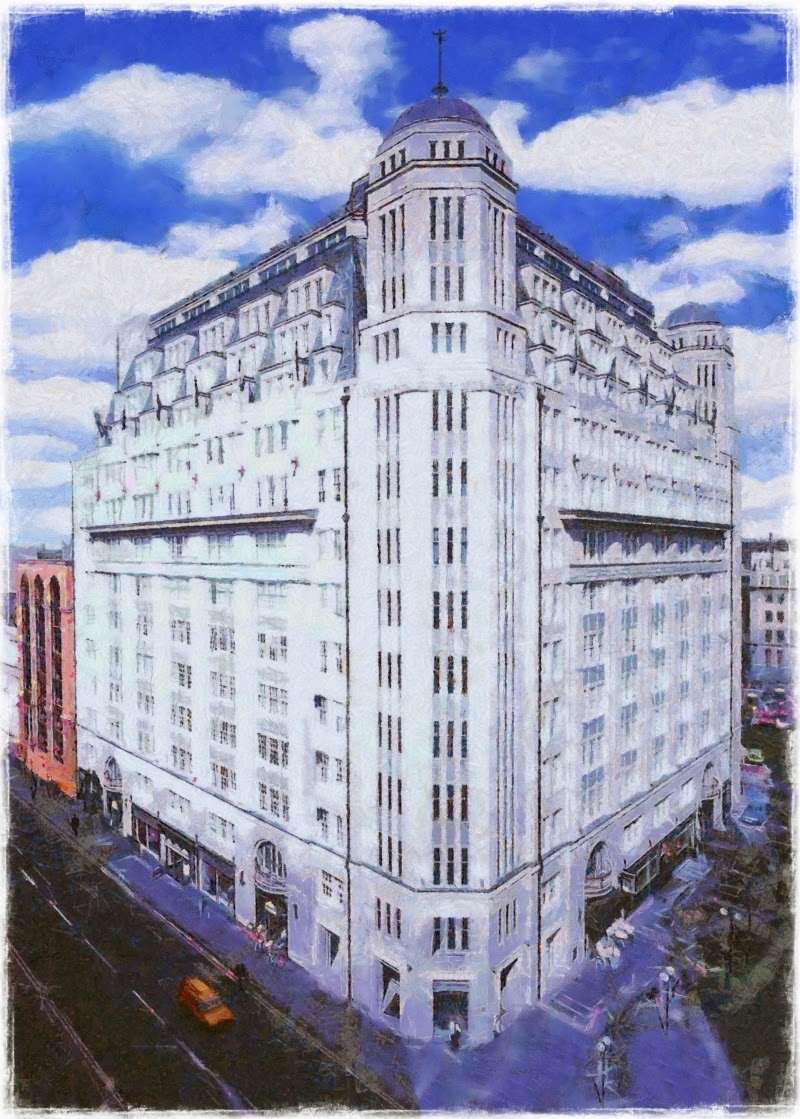
Sunlight House “a modern building with the best of old standards maintained"

Sunlight House, © 2013 Peter Topping
Last month I was on Quay Street with Sunlight House which when it was completed in 1932 was seen as a building which combined “modern conceptions of architecture in its sleekness and in the vertical lines, yet [retained] the best of the old standards of design.”*

It was designed and built by Joseph Sunlight as the headquarters for his business and was a lavish and modern building as befitted a man who claimed to have created more than one million pounds worth of property in the  first fourteen years as an independent architect.

Not that that he had it all his own way.

Just a few years after the building was opened his application for a license to serve alcohol was turned down.

And in 1949 he failed to get planning permission to “build a 35 storey extension to Sunlight House and a new 14-storey building between Peter Street and Jackson’s Row [because] the premises would dominate existing and proposed civic buildings, exceed the appropriate density of the area, injure the amenities of near-by buildings, and prejudice possible development plans.”**

So, even the mighty, wealthy and influential do not always get their way.

On Quay Street in 1911
Nor was his Parliamentary career a long one.  He was elected as the Liberal MP for Shrewsbury in the 1923 General Election only to lose the following year in the subsequent General Election.***

It is one of those interesting little asides of history that had he retained his seat he might well have seen his Brick Bill for the making of bigger bricks pass into law.

It was a private members bill which had survived its reading by one vote but fell by the wayside with the dissolution of Parliament in 1924.
All of which is a long way from Sunlight House and from the properties it replaced.

Now the Manchester Guardian had reported in 1931 that before Sunlight House “was erected the site contained some of Manchester’s worst slums.”

Twenty years earlier these had consisted of a mix of shops and lodging houses and judging from photographs may well have had their time.

*Sunlight House, the Manchester Guardian, May 12, 1931

And some of those who lived on Quay Street
**No extension to Sunlight House, the Manchester Guardian, July 2, 1949

***December 6 1923, October 29, 1924

Maps & pictures, detail of Quay Street from the 1888-93 OS map of South Lancashire, courtesy of Digital Archives Association, http://www.digitalarchives.co.uk/,  and street directory from Slater’s Manchester, Salford and Suburban Directory, 1911

Painting; Sunlight House, © 2013 Peter Topping, Paintings from Pictures,
Web: www.paintingsfrompictures.co.uk
Facebook:  Paintings from Pictures

Wednesday, 30 July 2025

Off to the seaside in the 1930s

Now if you are of a certain age you will remember the works outing to the seaside and the variation which were organised by the local pubs.

In my case it was a boozy day out to Brighton for the employees of Glenton Tours, and I guess because numbers were a tad low Dad asked me if I wanted to go and also if I wanted to bring some friends.

And so that was how at the tender age of 15 I went on my first “Beano” or “Jolly.

What they all had in common was that they ended up at the seaside, involved numerous stops for “refreshments”, “comfort pull ins”, more refreshments and somewhere along the way a meal.

In most cases you paid for the trip in instalments, travelled by motor coach set off early in the morning returning late at night.

And the benefits of the sea air and countryside were slightly negated by the enormous amounts of beer and cigarettes consumed on the journey but what fun they were.

In an age before paid holidays and when the annual leave from work was little more than a week and a bit a day out with friends and family was an important occasion.

They would be remembered for years after and the stories of those left behind along with the raunchy seaside entertainment would be told and retold becoming ever more outrageous and funny with each retelling.

I was reminded of all this by two photos from the collection of Ken Fish which date from the 1920s or 30s.

Both convey that mix of fun, excitement and anticipation at the trip ahead, and are an important record of the day away.

And long before the coach it was the horse drawn charabanc, but that is for another time.

Pictures; from the collection of Ken Fisher, date unknown

*The day the photographer took the picture of the charabanc, http://chorltonhistory.blogspot.co.uk/2012/02/day-photographer-took-picture-of.html


Wednesday, 16 July 2025

Memories of an ancient accident … one canal …. and that steep incline … Stoney Brew

Nothing quite prepares you for the way Jutland Street just drops away in front of your eyes.

Jutland Street before the drop, 2025

It is the road that runs from Ducie Street down to Store Street and it crosses the Ashton Canal. 

I first came across it in the summer of 1975 in the company of Norman Parry who had grown up close to the canal and still remembered all his childhood haunts.

Looking up Jutland Street, 1966
It had been a conversation one dinner hour about old Manchester that prompted Norman to offer a guided tour of the back streets around Piccadilly Railway Station and the basin of the Aston Canal.

And having told me he had learnt to swim in the canal he mischievously brought me to the summit of Jutland Street and with an impish smile told me to walk ahead of him and was pleased with my stunned reaction.

The road does just fall away, and it is a marvel that in the age of the horse and cart it was not prohibited to travel down the incline.

But I guess carters did take the chance, but with a heavy load and primitive brakes it has always struck me as an accident about to happen.

And looking down, 2025
And some time in the 1930s witnessed by Norman that is what happened.  A fully loaded wagon plummeted down the road smashing into a stone pillar outside what had been a timber yard.  The carter escaped but the horse was crushed.

All of which makes the popular name for the road which was “Stoney Brew” quite apt, but I sometimes wonder whether the present residents in their fine modern apartments on either side of Jutland Street are aware of the nick name, and I certainly don’t think they have come across the accident.

Looking at that incline it makes me think that ascending the road with a full load must have been equally dangerous.

The canal and Junction/Jutland Street 1849
And yet waggons must have done the trip, because the Ashton Canal ran in to a busy basin which back in 1849 was surrounded by the warehouses of various canal companies as well as the Manchester, Sheffield and Lincolnshire Railway and the North Staffordshire Railway, assorted coal wharfs and stone yards along with the Store Street Iron Works.

The canal had been completed in 1797 and my Priestly tells me “The Town of Manchester derives considerable advantage by the facility with which this canal and branches supply it with stone and coal at an easy rate”.*

And that for now is it.

Location; Jutland Street, formerly Junction Street

Pictures; Jutland Street from Store Street, 1966, : m02382, courtesy of Manchester Libraries, Information and Archives, Manchester City Council, http://images.manchester.gov.uk/index.php?session=pass and Jutland Street, 2025, courtesy of Google Maps and the area in 1849, .from the OS for Manchester & Salford, 1842-49, courtesy of Digital Archives Association, http://www.digitalarchives.co.uk/

*Historical Account of the Navigable Rivers, Canals, and Railways Throughout The United Kingdom, John Priestly, 1830


Sunday, 4 May 2025

Sunday in a Manchester Park

Now I have always liked this painting, and it perfectly conjures up a Sunday on a warm summer’s day in a Manchester park.

Writing in 1937, J P Priestly observed that, “The Corporation has made great efforts to provide young Manchester with healthy outdoor recreation, and there are now twenty-five parks and forty-eight recreation grounds in the city.

Nearly three quarters of the land in these parks is set aside for games including bowls tennis, cricket, golf, swimming, fishing, model yachting, football and hockey”.*

Of course, the cynical will observe that a few of the recreation grounds were little more than pockets of land, surrounded by factories while some of our parks were fighting a constant battle against pollution which blighted plants and left a smear of soot on the branches of trees.

But in the absence of open fields and clear crystal streams, this was it.

Location; Manchester

Picture; from Manchester ...... heart of the Industrial North

 *Manchester ...... heart of the Industrial North, Manchester Chamber of Commerce, 1937

Friday, 18 April 2025

Sunlight House a building “which has improved the appearance of the city and given it a dignity”

Sunlight House, © 2013 Peter Topping
Sunlight House is still a pretty impressive building and has been so since it was built in 1932 by the architect Joseph Sunlight.

It stands on Quay Street just down from Deansgate and a little before you get to the Opera House.

It was at the time according to the Manchester Guardian, “the tallest and largest building in Manchester, [standing] on a site of 3,000 square yards and rises 200 feet from the red rock foundations to its roof ridge. 

People who pass it are amazed at its massiveness.  It is a landmark which can be seen on a clear day from the Belmont Hills beyond Bolton, twenty miles distant.” 

Now I rather think I will go looking for what people thought about the building in 1931, and particularly on its impact as a landmark, if only to reflect on the response to that other tall building, which is the Beetham Tower.

The Beetham Tower is the tallest building in the Manchester dominating the sky line and can be seen from miles outside the city.

I do have mixed feelings about this modern giant alternating between that easy and lazy response that it is a blot on the landscape to marvelling at its sheer size and elegance.  But that I guess is how all new buildings are viewed.

Like Sunlight House the Tower sits on a comparatively small plot on Deansgate and is named after its developers.

But this is not about the Beetham Tower so I shall return to that article from the Guardian which writes

“It is shaped almost like a cube and is so proportioned as to be classic in form.  Modern conceptions of architecture are expressed in the sleekness and in the vertical lines.

There are sixteen storeys in the building and about a thousand rooms.  The basement, lofty and with large top-lighted dome is to be used as a restaurant and the ground floor for shops or showrooms and restaurant-café.

The occupants of the top floors will be able to enjoy fresh breezes in a healthy environment, unfamiliar in narrow streets and dark offices.

Every modern aid to cleanliness and efficiency is embodied.  The floors are of polished oak throughout the building.  

An electric vacuum cleaning apparatus draws the dust down to a receptacle in the basement.  

Express lifts are installed to travel at 450 feet per minute.  In every room there is an electric synchronised clock.

The architect has taken particular care to arrange for the most adequate lighting and ventilation.  

By widening the adjoining street to twice its previous breadth he improved the lighting at the same time as he enhanced the building perspective.  

The result is that people in the offices in Sunlight House will work under hygienic conditions.  The heating system of radiators is, further, conducive to cleanliness in the atmosphere.”

And at this point in the article I have almost lost the will to live.

Now I know that the newspaper story is a valuable contemporary account and no doubt the people who worked there were impressed but the piece reads just like a promotional extract from Mr Sunlight’s own notes.

An observation which is confirmed by the claim that

“Before this new pile was erected the site contained some of Manchester’s worst slums, and it is satisfactory to note, in view of the difficulties which Manchester and other places are having in the matter of removing slum populations and providing them with alternative accommodation that private enterprise has helped to transfer successfully the tenants of a congested area and put up a building with a rateable value of “30,000 a year.”

Which is where I shall leave Sunlight House for today, but there is more and I shall return tomorrow with just a little bit more on the building, its architect and his frustrated plans.

*Sunlight House, the Manchester Guardian, May 12, 1931


Photograph; properties on Quay Street, 1910, m68184,courtesy of Manchester Libraries, Information and Archives, Manchester City Council 


Painting; Sunlight House, © 2013 Peter Topping, Paintings from Pictures,
Web: www.paintingsfrompictures.co.uk
Facebook:  Paintings from Pictures

Wednesday, 16 April 2025

Arguing for peace in 1937 with Alice McIlwrick in Platt Fields

I shouldn’t have been surprised that Alice McIlwrick was involved in the Manchester and Salford Peace Week of 1937.

She was “socialist by conviction and anti establishment by nature”* who had stood nine years earlier as the first Labour candidate in a municipal election in Chorlton having contested Didsbury the year before.

And according to the Manchester Guardian was a “strong candidate” confident enough to have invited one of her opponents to her public meeting to debate the issues of the election.

It was just that I had not been able to follow her political career after 1928.  But something of her later life has now been provided by Tony McIlwrick her grandson along with a photograph, and it was that photograph that set me on to the Peace Week.

Standing beside the Lord Mayor and Mayoress of Manchester is Alice as they arrived at the “Manchester Peace Week Meeting in Platt Fields.”

Now Tony was puzzled  “as to why my grandmother was wearing what appears to be academic dress” but I rather think it may well have been connected with the events of the day because the meeting had been preceded by The “Peace Procession from All Saints to Platt Fields"** in which “nearly a thousand women from scores of different organisations in Manchester & Salford took part.

They began to assemble early in the afternoon and soon filled the pavement on two sides of All Saints Church” moving off “shepherded by an imposing array of policeman, a string of cars bearing placards; then the Lord Mayor’s Unemployed Band; then about a hundred women carrying flags, posters, banners and slogans of every description.

Next came the decorated wagon of the combined Women’s Co-operative Guilds followed by delegations dressed in costumes symbolising many different nationalities.

The main body of representatives from various organisations brought up the rear; with more embroidered banners, painted slogans, slashes and pennants.  A group of university women were conspicuous in academic caps and gowns.”

I have yet to come across a photograph of the peace procession but the Yorkshire Film Archive has preserved a similar march through Sheffield from 1936. https://www.yfanefa.com/record/6249


Now anyone wanting a more detailed description of the Peace Week can read an account at http://radicalmanchester.wordpress.com/2011/10/19/peace-and-antiwar-activiti-in-1930s-manchester/ which also puts the event into the context of peace activities in the city during the inter war years.

Suffice to say it was an ambitious week of meetings, marches and exhibitions.

Along with the Platt Fields rally there were six other meetings across the twin cities on the same day and another dozen during the week.

Four peace exhibitions were opened in the city, along with an “a peace shop near the corner of Deansgate and Blackfriars Street, displaying posters and literature with a section arranged particularly to appeal to children."

Many of the exhibitions organised by religious groups and trade unions took as their theme “the arts of peace” while two of the three films being shown during the week promoted the work of the League of Nations.

Here in south Manchester there were open air meetings in Rippingham Road Recreation Ground, Cringle Fields in Burnage, and Fog Lane Park as well as an exhibition in Withington and another in Levenshulme.

So Alice was not spoilt for choice, but I guess the highlight of the week must have been the peace procession and the Platt Fields rally, which takes me back to the photograph of her with the Lord Mayor who spoke of his own commitment to peace remarking that “what he had been saying against war for the last eight months [as Lord Mayor] he had been saying for the last thirty years.  There was no greater cause in the world than the cause of universal peace.”  And he concluded by regretting that the Council had voted not to adopt “an annual peace day in the City’s schools.”****

All of which must have resonated with Alice who had maintained a life time interest in schools and education having held a lecturing post at St Mary’s College for four years before her marriage in 1919 and been regarded as  “a pioneer in Activity Methods in Infants and Junior Schools.”*****

I would love to know what Alice thought of the rally and in the fullness of time I reckon I will.  After all until today I didn’t know about the Peace Week and for that I have Alice and Tony to thank, so as someone else once said “something will turn up”.

Location; Manchester

Pictures; Alice at Platt Fields courtesy of Tony McIlwrick, and headlines from the Manchester Guardian.

*Obituary Notice from Bangor University, 1964
**Manchester Guardian July 8th 1937
***Manchester Guardian, July 6th 1937
**** Manchester Guardian July 8th 1937
*****Obituary Notice from Bangor University, 1964

Sunday, 13 April 2025

Taking the Parkway …….. out of the city

Now, you will have to be of a certain age to remember that taking the bus out of the city to Wythenshawe meant travelling on the Parkway.


Writing about the new housing estate in 1937, J P Priestly commented that “a novel feature of the scheme is the provision of parkways from 250 to 300ft. in width, only 40ft. of which will be used for vehicular traffic and the remainder being laid out with trees, shrubbery and grass borders, through which footpaths will run”.*

Sadly, only one was actually built, and that now has been transformed in to a soulless and busy motorway, but for those who remember with fondness the Princess Parkway and everyone else who wonders what the attraction was, here is a reminder.

It comes in the form of a painting and while it may seem idealized, I have no doubt that back in 1937, it was as accurate as the other eleven which appeared in the book some of which have already appeared on the blog.

Location; Manchester

Picture; the Parkway from Manchester ...... heart of the Industrial North

*Manchester ...... heart of the Industrial North, Manchester Chamber of Commerce, 1937


Friday, 11 April 2025

In praise of a great city ........ Manchester in 1937

Now, you can just look at these wonderful paintings of a lost Manchester, admiring the colour and verve of what you see, followed by charting how different the individual scenes are today.

The Royal Exchange, 1937
But, that would be to ignore the accompanying text by J. B. Priestly which is not only a powerful homage to the City but is a fascinating piece of historic writing.

The paintings and text are taken from Manchester ...... heart of the Industrial North, published by the Manchester Chamber of Commerce, in 1937,* when Britain was emerging from the Great Depression which for many, was “that low dishonest decade”** of mass unemployment dire poverty and the Means Test.

And while the south was prospering, great chunks of the North, were still struggling, and so hence this book which shouts the energy, drive and civic pride of Manchester and by extension Salford and the surrounding towns.

“I believe in Manchester because what really matters in the end is character, and Manchester has the right sort of character.  Its history proves that in two very different ways.

First Manchester has not only always faced adversity with courage, but has always contrived to assert itself triumphantly at what would appear to be the worst possible moment.  It is a mistake to imagine that the cotton trade, of which Manchester is the centre, has flourished without interruption until the recent slump. 

King Street, 1937
During the American Civil War when the Southern States were blockaded, there was a cotton famine, and there have been periodic slumps since then.  Manchester’s answer to them has been to build its Ship Canal, triumphantly to organise its Jubilee Exhibition, to complete its impressive Royal Exchange during the difficult years of the Great War, and during the present slump to build a fine new Reference Library and to extend its Town Hall.  

No defeatism there.  

In the second place, the character of Manchester is shown in the influence that it has had on English public life, social, educational and artistic affairs.

I should estimate this influence as being equal to that of any other three English provincial cities put together.

When I was a boy living in Bradford, a city that shares some of the characteristics of Manchester, we thought of Manchester as we did of London.  And why not?  Manchester has the best newspaper, the best symphony orchestra and the best theatre in England.  

The Ship Canal
We know that the geographical position of this city is a magnificent one for it lies in the centre of a vast spider’s web of roads and railways, and canals, and has an outlet to the sea and really lies at the very hub and heart of a colossal straggling city that includes all the densely populated regions of South Lancashire and West Riding, and it has ample supplies of good water and coal and iron and power.

This is good, but character is better.  

Perhaps the secret of the Manchester character is that it is nine- tenths hard northern grit, solid Lancashire bone and muscle and brain, plus a remaining tenth, acting as a leaven, of liberal-minded and enterprising foreign influence, a contribution from Europe.  

You are not compelled to accept my analysis, but the smallest research will convince you that I am not wrong, in my estimate of the character of these people.  

Go and talk to them, and you, too, will believe in Manchester”.

Location; Manchester

Pictures; the Royal Exchange, King Street, and the Ship Canal, 1937 from Manchester ...... heart of the Industrial North

*Manchester ...... heart of the Industrial North, Manchester Chamber of Commerce, 1937

**September 1st 1939, W.H. Auden