Showing posts with label Visions of a better world. Show all posts

Monday, 12 June 2023

Saying something is wrong ........ alternative histories .... part 2

For many of us the 1980s was a scary time.

Uppermost in our concerns were the new generation of nuclear weapons and their delivery systems which sat beside the emergence of hard line leaders in both Washington and Moscow at the very moment when the Superpowers were again upping their support for proxy wars across the globe.

The deployment of Cruise missiles in Britain which took just 15 minutes from launch to hit their targets and the even faster American Pershing and Soviet SS 20s seemed to make the world a very unsafe place.

So faced with this appalling situation many took to the streets and protested.

There were monster demonstrations in London and smaller ones across the country and during the decade, I recorded several that were held in Manchester.

This one started behind Strangeways prison, although where the final destination was I can’t recall.

But someone will.

I do remember it was a very warm sunny day, and that is about it.

Location; Manchester


Pictures; Manchester, 1981 from the collection of Andrew Simpson

Friday, 12 May 2023

Visions of a better world .......... nu 2 the campaign badge

1985
The campaign badge has been around a long time.

It is one of those instant bits of political activity which makes the point cheaply and effectively.

A round bit of cardboard, some sticky tape and a safety pin and you have a badge.

Easier than that and just as effective is coloured ribbon, so loved of election rallies in the early 19th century, and the Suffragettes, and before ribbon there were bits of plant, flowers and bush stretching back into the past all of which were designed to mark out your political preference.

My first was “Lets Go with Labour” which I wore in 1966 but must have been a remnant from the ‘64 election.

It was a shinny plastic badge with a plastic pin which fixed into the back and I wore it throughout the campaign knocking on doors in Well Hall.  I was just 16 and such are the things you cut your political teeth on.

1974
Today the badge machine has made it all the simpler and allows almost anyone to turn them out for next to nothing in just a few minutes.

But for me it will always be those enamelled badges which take pride of place in the collection.  I have a few none of which date back before the 1950s.

Of these the old fashioned Labour Party badge is my favourite with its torch, pen and shovel representing all aspects of the labour movement combined with the torch of progress.

The newer version never really caught my imagination in the same way.
1986

Of the remaining enamelled ones it is that of the Sutton Manor NUM badge which stands out because of the contribution  made by many local people to their struggle during the Miners Strike.

And if like me you bought or picked up badges in support of campaigns they now have a place in our history.

Some were deadly serious, a few used humour and others were celebratory, and many today now seem to belong to a landscape that has long since vanished although that said it always seems that gains made in social progress do sometimes have to be fought all over again.

So for those of us who argued against a divided South Africa, wore  the Anti Apartheid badge can now look back on twenty years of that new rainbow nation.

1977
But other campaigns  like the attempt to save the Greater Manchester County Council failed and many more like Justice for Pensioners and the defence of the NHS remain real issues.

Looking back at my collection I cringe at some of the things I supported in my teens and early twenties, are saddened by those that were defeats but also remember how much I learnt by taking part and of some good friends I made along the way.

So each of the badges does represent an important moment in someone’s history and I think I shall return to some of them and explore their stories in more detail.

1980
Many are almost all that is now left of an impassioned moment when people came together to defend something they thought important.

Long after the paperwork has been lost , the newspaper stories discarded and the memories faded these badges record that moment.

They also point to that other simple observation that history does not always turn out the way you would like.

The years since independence in Zimbabwe have been difficult but I still remember the pleasure many of us felt at its promising start as a new country.

And I bet out there there are lots more badges and even more stories.

Pictures; badges from the  1950s to the 1990s from the collection of Andrew Simpson

Friday, 28 April 2023

The picture and the demonstration ....... October 1981

This is the story of one photograph from one demonstration.

The march was called to draw attention to the new generation of nuclear weapons and their delivery systems which were becoming operational at a time when relations between the two Super Powers were going through a turbulent period.

This one was held in the October of 1981 in Manchester and the route took the protesters from All Saints to Crown Square.

The lead banner is that of the Manchester City Labour Party, and quite a few people are carrying The “No to Cruise Missiles” placards.

I can’t now remember how many participated and given that the press at the time along with the Police tended to underestimate numbers I won’t bother trawling the records.

Suffice to say that looking at the collection of images I took on the day it was a big one.

Leaving that aside, and acknowledging that it is my picture, I do think this one captures the sense of what it was like to be on such a demonstration at that time.

And by extension pretty much what it would be like at any time.

What strikes you first is the range of ages, and while some of the youngest will have had little say in whether they were going to take part there are some teenagers present, who could have voted with their feet and gone elsewhere.

And even given the seriousness of the event someone has said something which has caused those closest to smile.

It is just the way that these things worked and often it would be the banter which lifted the spirits on a cold day which might also threaten rain.

This day seemed bright and warm and free from rain.

We are at a point in the march soon after the procession has set off and the paper sellers are conspicuous by their absence.

No doubt they were further back, near the beginning, hovering over those who were yet to set off.

And as yet there seems to be no shouted chant, which usually got the desired response, although just occasionally the shout would be ignored or got muddled in its execution, which led to a ripple of laughter down the line.

Looking carefully at the image I can name five individuals with certainty with an option on another five who I recognise but can’t call up their name.

But I remember we continued up Oxford Road and through St Peter’s Square into Piccadilly but after that I am unsure how we got to Crown Square, possibly down Market Street or Cannon Street, and then I am guessing along a bit of Deansgate.

Someone will remember.

Location; Manchester

Picture; Manchester Peace demonstration, 1981, from the collection of Andrew Simpson

Tuesday, 25 April 2023

Standing "on the threshold which leads into the palace of justice”

It was a slow day on Beech Road yesterday, and with little interest in sitting in the garden or watching yet another box set I took to reading a collection of historic speeches.*

Liverpool, 1980
Now, if you want to get out of a low mood, brought on by a combination of the virus, and the political scene, a couple of hours with Dr King, J.F. Kennedy, Betty Friedman, Abraham Lincoln, and Dolores Ibarruri Gomez, [La Pasionaria] and countless others, is guaranteed to set you up.

Of course, you have to be aware of the context in which the speeches were made, and if I am honest I gravitated at first to those whose politics I shared, and remember  watching.

Added to which some of those speeches were made by people who whose political record on certain issues might at times be a little flawed.

And finally, I take the possible criticism that sitting reading a speech is just armchair politics and the real test is going out and making a difference.

But at 70 with a lifetime of political activity which began when I was 16, I think I might be allowed to take the armchair.

What surprised  me were the speeches by politicians who I have always regarded as pariahs, like Enoch Powell who made that infamous “rivers of blood” speech made in Birmingham in 1968, but nine years earlier had condemned the treatment of Mau Mau detainees in the Kenyan detention camp at Hola, insisting that prisoners wherever they were held under British jurisdiction were entitled to the same rights of treatment.

Birmingham, 1983
The beatings of many of the prisoners and the deaths of ten of the men he argued was the responsibility of the Secretary of State, brushing aside the alleged crimes and their place of confinement as not relevant to  justice, concluding “We cannot, we dare not, in Africa of all places fall below our own highest standards in the acceptance of responsibility”.

That said, the speeches which I enjoyed rereading were those of Lincoln, Kennedy and Dr King, and staring with Colonel Rainsborough who in 1647, uttered, the powerful, statement of democratic principle “I think that the poorest he that is in England hath a life to live, as the greatest he; and therefore truly, Sir, I think it's clear, that every man that is to live under a government ought first by his own consent to put himself under that government; and I do think that the poorest man in England is not bound in a strict sense to that government that he hath not had a voice to put himself under”.

His was a contribution to the Putney Debates when the victorious Parliamentarian army sat down to discuss the future.

Manchester, 1984
And while that democratic statement was defeated by the Army Grandees and the forces of the establishment it still rings out.

As does the speech of Gideon Hausner, the Attorney General of the State of Israel at the trial Adolf Eichmann, responsible for the management of the Final Solution.

In a speech which lasted ten hours Mr. Hausner, opened by saying, “When I stand before you O Judges of Israel, to lead the prosecution of Adolf Eichmann, I do not stand alone.  

With me here are six million accusers.  But they cannot rise too their feet and point their finger at the man in the dock with the cry of ‘J’ Accuse on their lips.  For they are only ashes- ashes piled high on the hills of Auschwitz, and the fields of Treblinka and strewn in the forests of Poland. Their graves are scattered throughout Europe.  Their blood cries out but their voice is stilled.  Therefore, will I be their spokesman”.

What marks out many of these speeches is the power of the rhetoric, which makes us remember, the memorable lines, like those  from J.F. Kennedy’s  “The torch has passed to a new generation of Americans", “ask not what America will do for you, but what together we can do for the freedom of man”. “Ich bin ein Berliner”.

Birmingham, 1983
But sleek phrases are themselves not enough, they must arise from a very real need for change which Betty Friedman encapsulated in a speech on women’s rights in 1969 at the first national conference for repeal of abortion rules, when she talked about women being invisible and having to have “a full say in the decisions of their lives and their society”.

And of all the countless ones I read yesterday, and which still sit with me, it must be Dr King’s address on the centenary of Abraham’s Lincoln’s emancipation proclamation, made at a gathering of 210, 000 people at the Lincoln Memorial.

It is a powerfully written speech drawing on the language of the bible, shot through with the injustices of Black Americans and calling for action.

I  tried to pick out key sections, but in truth the whole speech is a mastery of rhetoric, leaving me to fall back on the oft quoted lines,

"I have a dream that my four little children will one day live in a nation where they will not be judged by the color of their skin but by the content of their character.

I have a dream today!

Birmingham, 1983
I have a dream that one day, down in Alabama, with its vicious racists, with its governor having his lips dripping with the words of "interposition" and "nullification" -- one day right there in Alabama little black boys and black girls will be able to join hands with little white boys and white girls as sisters and brothers.

I have a dream today!

I have a dream that one day every valley shall be exalted, and every hill and mountain shall be made low, the rough places will be made plain, and the crooked places will be made straight; "and the glory of the Lord shall be revealed and all flesh shall see it together.

This is our hope, and this is the faith that I go back to the South with".

Pictures from the collection of Andrew Simpson, 1981-87

*The Penguin Book of Twentieth Century Speeches. Edited by Brian MacArthur, 1992, & The Penguin Book of Historic Speeches, edited by Brian MacArthur, 1996

Friday, 25 June 2021

Visions of that better world........ reflecting on what I owe to my parents and grandparents

Uncle George and friends, 1918
I am part of that generation which was born directly after the Second World War and is now coming to retirement which gives you a degree of perspective.

For my children both those world wars are just history as remote in a way as the Charge of the Light Brigade, the Battle of Waterloo or the death of Nelson at Trafalgar.

Now there is nothing odd about that.  The eldest was born in 1984 and the youngest in ‘92 by which time the young men and women who had endured the Blitz, fought their way across Europe and the Far East were themselves preparing to receive their State pensions.

But for me those conflicts were still real events.

Nor could it be otherwise.

The tenth anniversary of the end of the last world war coincided with my sixth birthday and the reminders of that conflict were still very visible from bomb sites to surplus military equipment which could be bought for next to nothing.

Mother and friend, 1941, Lincolnshire
And that earlier world war was still all round us.

The war memorials and the Cenotaph were little more than 30 years old when I celebrated that sixth birthday and those that had fought in the Great War were still relatively young men and women.

Many were yet to be grandparents, and most were still active and not yet thinking of retirement.

Indeed it is a salutary thought that back then in 1955 many were younger than I am now.

All of which draws me back to my child hood and how my parents and grandparents dealt with those war time experiences.

By and large they didn’t talk about them in fact were reluctant to do so and when pushed made some flippant remark which hid deeper and perhaps darker experiences.

And for that I am grateful.  I grew up in a household of rising
Father with a hospital unit, 1941, North Shields
material expectations set against a period of prosperity not known to my parents or grandparents.

Their lives in the first half of the twentieth century had been pitted against that long period of economic stagnation culminating with the Great Depression which had been sandwiched between those two world war.

Uncle Roger and mother, 1939
But like most parents of the late 40s and 50s they made every effort to make our lives secure, comfortable and above all ones which were lived out with a sense of the progress made and yet to be made.

True there was the shadow of the bomb and some nasty little wars but they were kept at bay.  And I know that all parents through all time have tried to do their best for their children, but for me those generations who went through the two world wars did their bit not only to fight but to win the peace.

And that for me is well worth remembering.

Pictures; from the collection of Andrew Simpson

Sunday, 11 April 2021

Saying something is wrong ........ alternative histories .... part 1

Now I can remember the first demonstration I went on in the 1960s and then pretty much all of the others.

Liverpool, 1980
But those I supported during the 1980s have become a blur, and part of that was because there were so many of them which were provoked by a series of developments, none of which many of us thought were good.

There was steadily rising unemployment, a Government intent on curtailing the ability of the Trade Unions to do the business of protecting the work force while pursuing a policy of reducing expenditure for public services.

Along side these, there was the growing fear that a new generation of nuclear weapons and their delivery systems coupled with the hard line leaders in both Washington and Moscow threatened world peace.

Liverpool, 1980
So, many of us marched, firmly believing that in doing so we could express our concern and send a message to those in power.

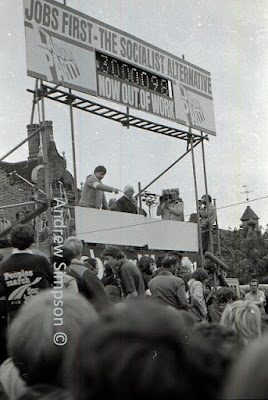
And from 1978 I documented all of the ones I attended, from Manchester to London and back via Liverpool and Birmingham.

I will leave others to write the history of that decade and to make judgements on the effectiveness of the demonstrations and instead will set about posting some of the pictures.

These have sat in the cellar for nearly four decades, left in a corner because they belonged to old photography, which relied on a dark room, smelly chemicals and an enlarger to bring them to life.

But as many know my Christmas present was one of those whizz scanners which can take a negative and make it into an electronic image.

Birmingham, 1983
I don’t pretend the quality is always the best, but they are a record of how many of us went about expressing our concerns and fears along with working within political parties and the trade union movement to bring about a change.

Liverpool, 1980 was the first national demonstration organised by the Labour Party just a year after the Conservative Government had been elected.

Birmingham was three years later.

Location; Liverpool and Birmingham

Pictures; Liverpool 1980,and Birmingham 1983, from the collection of Andrew Simpson

Sunday, 21 February 2021

Faces from a demonstration..... no.5 the politicians

I should not be surprised I suppose that the passage of nearly 40 years has made it difficult for me to name some of the people on the platform.

There, staring back at me is Denis Healey, while looking out across the crowd is Dennis Skinner, but the three to either side of him I can’t place.

The chap with the glasses I vaguely know but his name remains elusive and of the other two sadly I have no idea.

All will have spoken at the demonstration in Birmingham in 1983 which was part a protest to the rising level of unemployment and a platform for advocating a set of policies which would offer jobs to people.

But the Labour Party was in opposition and would remain so until 1997, and while Dennis Skinner would remain an MP arguing for radical change, Denis Haley would never again hold a Ministerial position.

I can’t remember much of the day, other than that Keith Tom and I had travelled down from Manchester in Keith’s car, and the march which preceded the demonstration and rally took a route off the beaten track which led us past closed industrial estates and rows of terraced houses.

The speakers included Michael Foot, Stan Orme, Eric Heffer and Tony Benn, but after 35 years I am hard pressed to remember if Denis Healey spoke or for that matter who else addressed the meeting.

Location; Birmingham


Pictures; Faces from a demonstration, 1983 Birmingham from the collection of Andrew Simpson

Thursday, 10 September 2020

Visions of a better world ....... no. 3 .... the promise of a new future and a bit of history

The badge will date from around 1979 and became a bit of history the following year when Zimbabwe became an independent country.

Most recently the shine of that promise of a proud African country became tarnished but the passing of Mr Mugabe as President gives that badge a new significance, as well as being a nice example of the campaign badge.


Picture; Coming Soon, Zimbabwe, 1979 from the collection of Andrew Simpson

Thursday, 4 April 2019

Saying something is wrong ........ alternative histories .... part 3 on the march

Now demonstrations can be noisy, busy and in their own way a bit of fun.

Liverpool 1980
Of course there is always a serious side to the event, and that will always be uppermost in the minds of those who have made the effort to walk the streets, in support of an industrial dispute, or protesting at the actions of a government or events on the other side of the world.

But mixed up with all that earnest stuff, and the serious speeches there are the funny moments.

Sometimes they come from a witty banner, or a repeated chant which snakes its way down the line of demonstrators, and sometimes it is when the set chant goes wrong, which started with the impassioned call to action but stops halfway or is just never picked up by the surrounding people leading to a burst of laughter.

Manchester 1982
And there are the paper sellers which back in the 1970s and 80s when I marched would be everywhere, from those selling the Morning Star and Socialist Weekly to Militant, Red Dwarf and on occasion the journal of the agricultural section of the Communist Party.

The theory always was that the Left never actually generated much revenue from all the sales, because in most cases it involved individuals from one group buying the paper of another, in an act of fraternal generosity or just curiosity.  Either way it always struck me as a fine example of the redistribution of wealth.

Amongst all the paper sellers hurrying “up the line” to get to new potential customers there were the entertainers, who were a mix of the serious and the humorous.

I cannot now remember what the woman in the fur coat was talking about, but given the date was 1980 and Mrs Thatcher was Prime Minister I can only assume the theme was a comic take on Tory policies.

Liverpool 1980
At other times there were those who harangued the marchers.  Some of these were supportive of the event, while others usually from the pavement hurled a mix of abuse and silly comments, which might be applauded or booed by the protesters.

And a side benefit for some was that they got to see the sights of a different city, from grand public buildings to glittering shops and hotels, although in some cases when the route was set to miss the most popular areas the scenery consisted of backstreets, closed warehouses and a line of industrial units.

All of which I rediscovered as I trawled the lost negatives which have sat in the cellar for four decades awaiting the technology to turn them into pictures and remind me of what I so often did during the 1970s and 80s.

And amongst the lost treasures there were the photographs of some of those who walked with me.

I always knew that in the collection there would be pictures of close friends, because of course they would have been on the same demonstration, but others were a complete surprise.

Birmingham 1983
So while I can still recall the Birmingham march with Tom and Keith, I was surprised to see Malcolm walking through Manchester selling papers and smiling back at me.

Such are the bonuses of uncovering that collection of “protest pictures”.

Location; Liverpool, Manchester, and Birmingham


Pictures; Saying something is wrong, pictures from demonstrations, 1979-84 from the collection of Andrew Simpson

Tuesday, 16 October 2018

Visions of a better world ....... no. 5 .... protest and survive

The older me is a little miffed at the way the demonstrators took to the fountains in Trafalgar Square, back in 1981.

But the younger me saw nothing wrong with making a point about the new generation of nuclear weapons and their delivery systems which both the USA and Soviet Union were about to deploy.

It was a time not unlike today, when events across the world made the place feel a more dangerous place.

There were conservative hardliners in power in both Washington and Moscow and we of course had Mrs Thatcher.

All of which made the concern that an alternative position had to be shouted from the roof tops and as in this case from the water fountains.

Location; London


Picture; Trafalgar Square, 1981 the CND demonstration, from the collection of Andrew Simpson

Monday, 15 October 2018

Visions of a better world ....... no. 4 .... the trade union banner

Now I can’t be exactly sure of the date.

It will be sometime in the 1970s or ‘80s and it will be in Manchester.

So that narrows it down but not much.

It might have been in support of the Firefighters pay claim of 1977 or the day of action undertaken by a host of public service workers two years later.

Equally it could have been anyone of a number of demonstrations I attended during those two decades.

Location Manchester

Picture; trade union banners; circa 1970-1988, from the collection of Andrew Simpson

Friday, 12 October 2018

Visions of a better world .......... nu 1 the protest march

This is a short series which explores and records  popular protest and the demand for change.


The date is 1980, the place Liverpool and the demonstration was against the actions of the new Conservative Government which had been elected the year before.

The picture shows the banner of the Moss Side Labour Party.

Location; Liverpool

Picture; Liverpool October 1980, from the collection of Andrew Simpson