Showing posts with label Manchester in the 1800s. Show all posts

Thursday, 16 July 2026

Henry Hunt ………. “and the Manchester Monument to Perpetuate His Memory”

I am back with Henry “Orator” Hunt who the Chartist newspaper described as the “one of the most bold, most strenuous , most disinterested and most able advocates of LABOUR’S CAUSE, that the cause ever had to boast of”.*

He was scheduled to speak at the “Manchester Reform Meeting” in St Peter’s Fields in the August of 1819, which was broken up by the authorities, with much loss of life, hundreds of casualties and which was for ever afterwards known as Peterloo.

What I hadn’t known was that years later a monument was erected in the grounds of Every Street Chapel in Ancoats.

It is a story  I have written about already, but until today had never come across an image of the actual monument which was demolished in 1888, and so I was more than pleased when Jon Silver, reproduced this one, which according to the Northern Star, “represents a monument, now in the course of erection Manchester, in the burial ground of the Chapel, belonging to the Rev. Mr. Schofield, in Every Street …..raised by means  of a subscription amongst the working people of England, to perpetuate the name and fame” of Mr. Henry Hunt.**

Jon found the image on another blog site, which referenced the Northern Star, and so as you do I went back to the collection of Northern Star editions, and came across the one for August 20th 1842, which not only carried the story of the monument but a detailed report on the events of Peterloo, including the names of the Manchester Yeomanry who brutally attacked the peaceful demonstrators.

Some of the Yeomanry, 1819
The list complements that of those who are recorded as casualties on the day long with those who were charged into the crowd.***

Most are from Manchester and Salford, with a few drawn from Stretford, Pendleton and Eccles with two are listed as “Foreigners”.

And while there are a smattering of the “gentry” and the professions, most were shop keepers, small businessmen and labourers, including Savage who is described as a quack doctor”.

All of which points to that simple truth that those who cut and sabered were little different in their class origins and occupations than the majority of the demonstrators who were their victim.

Now I am well aware that all the published names will have been trawled over by the eminent and the interested long before I got to see them, but that won’t stop me spending hours doing the same.

Leaving me just to highlight the link to online collection of the Northern Star, which makes fascinating reading.****

Such is research and the fun of history.

Location; Manchester, 1819, and 1842

Pictures; the engraving of the Henry Hunt memorial, the Yeomanry list and the front page of the Northern Star, from the edition of the Northern Star, August 20th, 1842

*Henry Hunt and the Manchester Monument to Perpetuate His Memory
Henry Hunt, The Northern Star, August 20th, 1842

**Henry Hunt, https://chorltonhistory.blogspot.com/search?q=henry+Hunt


***What did you do at Peterloo? https://chorltonhistory.blogspot.com/2019/08/what-did-you-do-at-peterloo.html

****The Northern Star, https://ncse.ac.uk/index.html

Tuesday, 30 June 2026

“paying due honour to the wisest and most virtuous Statesman that ever appeared in any country” *….. the Manchester Pitt Club

Now until today Pitt Clubs were just a footnote in history books on the late 18th and early 19th century.

The Manchester Pitt Medal, 1813
And were something which I always meant to follow up but never did.

They were formed throughout the country in honour of William Pitt the Younger to “keep green the memory of one who had sacrificed so much for his country” and in recognition of his undoubted talents which began “at the age of thirteen [when] he composed a tragedy, at fourteen when he matriculated at Cambridge and became an orator at twenty-one. 

At twenty-three he was Chancellor of the Exchequer at the early age of forty-seven he was proclaimed the “saviour of Europe”.*

The first club was formed in London in 1793 and our own Manchester Club in 1813, and another forty-two were dotted across Britain, including ones in Liverpool, Bolton, Blackburn and Saddleworth.

Pitt addressing the House of Commons in 1794 
William Pitt has always been one of those politicians who I should know more about, especially as I am fond of his despairing comment "Roll up the map: it will not be wanted these ten years.”* on the news that the Austrian and Russian armies had been defeated by Napoleon's army at the battle of Austerlitz in 1805, which pretty much left Britain to face the "Corsican Tyrant" alone.

And it will be his role as Prime Minister during the Revolutionary and Napoleonic Wars which will in part have cemented his reputation and contributed to the spread of the clubs.

All of which has led me to look up the records of the Manchester Club which contain for 1813-31 the minute, account and dinner books, as well as a list of members and are held at Manchester Archives and Local Studies, and Chetham's Library*

Thomas Walker, 1794
The real insight will be the members who I suspect will turn out to be no friends of the French Revolution and may will have applauded the Governments attempts to prosecute our own Thomas Walker for sedition in 1794.**** 

Mr. Walker had in his time held the most important post as Borough Reeve in Manchester, had campaigned against the Slave Trade, supported the revolution in France and had his town house on South Parade attacked by a Church and King mob.

So, I rather think there will be some rich picking in sifting through the story of Manchester Pitt Club.

The clubs had a short life and by the 1820s were on the decline.  But in their hey day they had been the place to go if were both a supporter of William Pitt and an avid ant Revolutionary. 

The focus of activities was the annual dinner which could be an elaborate affair.  The cost of the food and drink held by the London Club in 1808 ran to £841.  

The list of things consumed included 429 bottles of sherry at £139, 613 bottles of Port at £153, , 14 bottles of Madeira, £14 for “lights” , “£12 for “broken China” and another £8 for “broken glass”.  Added to there were the “87 Servant’s Dinner” costing £8 14 shillings and 6, which comes out at roughly shillings a head. And that is less than the brandy or the sugar consumed.

The reverse of the medal, 1813

Admission was by a badge or medal, and the Dudley Club’s cost 30 shillings each and were made of frosted silver while members of the London club paid £1 16s 6d.

And there was a strict protocol which demanded that “each member shall wear it at all meetings of the Club tied on his left breast with a garter of blue ribbon”.

Which brings to the Manchester medal which my old posty friend David Harrop has just acquired, and very impressive it looks.

But I can’t help but feel that back in 1813 I would not have been a member.  After all as Groucho Marx said, “I refuse to join any club that would have me as a member”, but in reality, I wouldn’t have been able to join and nor would I want to be part of a club which had as its members those who opposed the general principles of the French Revolution.

Location; Manchester, 1813

Pictures; The Manchester Pitt Club medal from the collection of David Harrop, Pitt addressing the House of Commons in 1794. The House of Commons 1793-94, by Karl Anton Hickel (died 1798), given to the National Portrait Gallery, London in 1885 and Thomas Walker, 1794

*Objectives of The London Pitt Club

**Garnett, S. Alan (1927). "Pitt Clubs and their badges" British Numismatic Journal. 19 (Second Series, IX): 213–218.

***Manchester Pitt Club, 1813-31: records, Manchester Archives and Local Studies, NRA 13262 Manchester, and 1813-31: minute, account and dinner books, list of members, Chetham's Library, DDX 354

****Thomas Walker, https://chorltonhistory.blogspot.com/search?q=Thomas+walker

Friday, 3 October 2025

If it wasn’t for the houses in between you could see all the way across the fields to Ancoats Hall*


Smithfield Wholesale Fish Market, 1900
We were in the Northern Quarter recently showing some of the family around this part of the city.

There will be many who remember it as a bustling area dominated by the whole sale markets and lots of little businesses.

But when I washed up in Manchester in the late 1960s it had taken on a more run down and seedy appearance, a place waiting for something to happen but not quite sure what that something might be.

Junk, 2 Dale Street
Today large parts of it seem to have a purpose and function again.  Here are those quirky little shops and businesses you won’t find elsewhere in the city.  It is to quote one review, “a centre of alternative and bohemian culture.”**

And as you would expect it’s also rich with history.

Walk these streets and more particularly the small narrow ones or the even smaller ones which sit behind them with names like Back Piccadilly and Back Thomas Street and it is still possible to get a sense of the city’s past.

More so because a fair number of the late 18th and early 19th century workers home and workshops have survived.

Detail from Green’s map of Manchester 1794
They were built just as Manchester was beginning to grow into something new and exciting on the back of commerce and cotton.

A place Asa Briggs described as “the shock city of the Industrial Revolution” and one that attracted visitors who came to gawp at the mills, the smoke, noise and great show warehouses, taking away vivid memories of the sheer frenetic activity of a new type of city.

Now there is no getting away from the fact that there was here also a lot of sorrow, blighted lives and a sense that for those working in the mills, living hard by the canals and factories and existing in awful housing conditions Manchester was no easy place to inhabit.

It was also a place of overcrowding, poor sanitation, and long hours of work which were recorded by Kay, Engels and others.


My old friend Richard Buxton’s family had moved to New Cross from rural Prestwich in the late 18th century and exchanged fields for those narrow mean streets and courts.

But during this period it was possible to walk just a few minutes from Piccadilly or New Cross and be in fields, with fresh streams and endless expanses of open countryside.

Richard Buxton is a case in point.  The family home may have been in a crowded little terrace off Great Ancoats Street but where he began work was just where the city met the country.

Port Street, 1960
In 1798 he was apprenticed at the age of twelve to James Heap in Port Street “to learn the trade of bat maker; that is a maker of children’s small leathern shoes.”

At that time Port Street was still on the edge of city.  On one side there were houses and workshops and open land on the other.

Standing with his back to the built up street Buxton could have looked out east on fields and the occasional houses with an almost uninterrupted view to Shooters Brook and the farms beyond.


Twenty years later you could still have followed the river Medlock or the Rochdale Canal out past Ancoats Hall and be open countryside by the time you reached Beswick.  Had you chosen to head west instead, once you had cleared Cornbrook with its dye works and chemical plants you were fair set for the field and farms which would eventually take you by degree to Chorlton and beyond.

Junk, 2 Dale Street
All of which would have been familiar to Buxton who was a botanist and often walked out of the city in the early to mid decades of the 19th century.

Now I know that is a long way from where we started in the Northern Quarter, so perhaps we should end where we started.

I think any one fascinated by the history of the city should just wander the area, and I suppose if you want a guide there is nothing better than Claire Hartwell’s book, Manchester, Penguin, 2001.

Our Jill and Jeff did.  The following day they were back there and in one of the shops on Dale Street Jill bought a very nice little red dress.  One of the memories and for showing off back in Eltham.

Pictures; Smithfield Wholesale Fish Market, 1900, now the Craft Centre, m59592,Port Street, 1960, H. Milligan, m04850, courtesy of Manchester Libraries, Information and Archives, Manchester City Council, Junk, 2 Dale Street, from the collection of Andrew Simpson, detail from Green’s map of Manchester 1794, courtesy of Digital Archives, http://www.digitalarchives.co.uk/

*apologies to Gus Elen and his music hall song, If it wasn't for the houses in between
Oh it really is a wery pretty garden
And Chingford to the eastward could be seen;
Wiv a ladder and some glasses,
You could see to 'Ackney Marshes,
If it wasn't for the 'ouses in between.
http://www.youtube.com/watch?v=n1GmDA8FU9w

** http://en.wikipedia.org/wiki/Northern_Quarter_(Manchester)

Tuesday, 22 July 2025

Bringing to account William Benson, Richard Whitelaw and the other 99 of the Manchester Yeomanry on August 16th 1819

Now no matter how many horrific stories come out of Ukraine and other places, nothing still prepares you for the violence of Peterloo.

According to one source, a quarter of the known recorded causalities were women, even though they comprised just 12% of those present on the day. *

And when you delve deeper into each one, the horror is all the greater.

Margaret Downes was “dreadfully cut in the breast; secreted clandestinely and not heard of, believed dead”, Mary Hays, “knocked down, trampled by cavalry, foot stripped of flesh & nails, pregnant, died 17 December 1819”, Sarah Jones, “severely beaten on the head, and much bruised by constables’ truncheons, suspected dead”, and Martha Partington, “thrown into a cellar on Bridge Street and was killed, died 16 Aug 1819.”**

Added to these, there was William Fildes aged just two, who was the “child of Ann,and was  rode over by cavalry, died 16 August 1819, and is buried Swedenborgian Chapel, Salford”.

In the case of four of the five, we know where they lived, and while their houses will have vanished long ago, using maps and street directories it is possible to revisit both their homes and the surrounding area as it would have been in the early 19th century.

And those maps, directories along with other official records allow us to zoom in on those who perpetuated the crimes, most of which were at the hands of the Manchester Yeomanry, who we might think of as a volunteer military defence force, first raised during the early years of the wars with Revolutionary France, but were also used to quell civil unrest.

The Manchester Yeomanry was raised in 1817, in the aftermath of the March of the Blanketeers, when a group of mainly Lancashire weavers intended to march to London and present a petition over the dire state of the Lancashire textile industry and the recent suspension of the Habeas Corpus Act. ****

Following its suppression, the authorities set about establishing a local yeomanry, which was drawn not only from the “people of plenty” but also included, both skilled and unskilled workers and a range of shopkeepers, publicans and others.

Leaving aside the question of how some of the men could afford to provide a horse, they were indeed a cross section of the population, and we know the names of 101 of them who were at Peterloo, and despite my dislike for their actions I am curious about them.

At which point it would be easy to dismiss them all as bunch of “class traitors”, vicious thugs who participated with glee in the suppression of the “Manchester Meeting”, and while that might be accurate of some if not most of them, it doesn’t go deeper enough in offering up an explanation.

I doubt that there exists a detailed collection of the thoughts and sayings of the 101, but it is possible to track many of them, not only through their occupations but to where in the city they lived.

Moreover, their devotion to the social order can be tracked back across the late 18th century through a series of “loyalist” activities during the 1790s, including the Church and King movement, the attack on the home of the radical Thomas Walker in South Parade, and the burning of effigies of Thomas Pain, of which the one that occurred at the top of Deansgate in December 1792 was recorded in detail.

And similar loyalist activities happened during the Jacobite rising in 1745, and back into the 17th century.  Further evidence is there in the split over the abolition of the Slave Trade.

So while I take pride in reading that 10,000 Mancunians signed a petition to Parliament in 1788 calling for the abolition of the trade, there was a counter petition of 4,000, which must have been well organized.

And that same organization can be seen in the way that the spontaneous outbursts of loyalty were worked on, both in the opposition to granting greater freedom to non-Anglicans to hold official posts and the reaction to the French Revolution.

The impetus clearly comes from those in the establishment who felt they had most to lose, but according to an excellent short piece by Frank O’Gorman, “Members of the highest classes tended to fill ornamental roles, the practical functions of loyalism being the work of men from the middling orders”, who were “principally from the ranks of the trading, manufacturing and official elements, some of whom were from quite humble backgrounds”.*****

All of which might explain why amongst the ranks who charged into the crowd on St Peter’s Fields we can count, William Benson , the landlord of the Fox on Jackson’s Row, Mr. Richard Whitelaw, an Attorney, living on King Street, and Robert Thorpe, a surgeon living at 21 Oldham Street.

Along with Samuel Green who had a printing business on New Garrett, and a host of shop keepers, and skilled and non skilled workers, with just “two gentleman”, a Professor of Dance and even a quack doctor.

Nor were they drawn exclusively from Manchester, for the same pattern of occupations can be replicated by those from Salford, including Edward Hulme of the Blue Cap on Greengate, the tobacconist, James Hardman, the businessman, John Bowker and the “hackney writer”, James Hamnett.

And for those who want to stray into Stretford, the township offered up a collection of butchers, a saddler, that quack doctor and even a labourer.

None of which might help explain the glee at which the Yeomanry went about their task, but might just throw a bit of light on who they were, leaving a heap more research to be done and a lot more detailed investigation of those who pulled the loyalist strings.

Location; Manchester

Picture; "To Henry Hunt, Esqr. as chairman of the meeting assembled on St. Peter's Field, Manchester on the 16th. of August, 1819", Peterloo, Manchester, print published by Richard Carlile, m01563, and Manchester Heroes", Peterloo, print from etching by unknown artist, published by S W Fores, 1819, m07587
courtesy of Manchester Libraries, Information and Archives, Manchester City Council, http://images.manchester.gov.uk/index.php?session=pass

*Morgan, Alison, Starving mothers and murdered children in cultural representations of Peterloo, Return to Peterloo Manchester Regional History Review volume 23 2012

**Records of the Manchester Peterloo Witnesses and casualties, 1819, findmypast, www.findmypast.co.uk

***Sarah Jones, 96 Silk Street, off George Leigh Street, Mary Hayes, Rawlinson Buildings Oxford Road, Chorlton Row, Mary Partington, King Street Eccles, William Fildes, 23 Kennedy Street

****The march was violently broken up and its leaders imprisoned. Bamford, Samuel, Bamford’s Life of a Radical, Vol 2, 1905 page 32

*****O’Gorman, Frank, Manchester Loyalism in the 1770s, Return to Peterloo Manchester Regional History Review volume 23 2012


Saturday, 6 July 2024

The Peterloo death which links Manchester to Salford and Prestwich ......... and brings young William Fildes out of the shadows

William Fildes deserves more than history has so far allotted him. *

Labour Party demonstration for Jobs, Birmingham, 1983
He was born in 1817 and died just two years later from injuries he sustained at Peterloo, when he was caught in the cavalry charge of the Manchester Yeomanry.

According to the witness account of his mother, Mrs. Ann Fildes, he fell from her arms when she was knocked down accidently by a sergeant-major, who was following the main body of horseman.

He died at ten that evening and was buried three days later in the New Jerusalem Temple on Bolton Street in Salford, in the shadow of Salford Railway Station, just beyond the New Bailey Prison.

New Jerusalem Temple, Salford, 1844
The church opened in 1813 and was part of the “New Church Movement” deriving its teachings from the writings of the Swedish theologian Emanuel Swedenborg. Along with the Salford church there were also churches and schools on Peter Street, in Manchester and at the Round House, on Every Street, in Ancoats. **

The New Jerusalem Temple, closed in 1890s, and after a succession of industrial uses was demolished in the 1990s, and is now a cap park.  “The initial removal of human remains from the surrounding graveyard in 1988 was followed by further excavations and re-burials at Agecroft between 2003 and 2007. Archaeologists estimate that there could be a further 6,000 burials remaining on the Bolton Street site”. **

So far, I have come across only one other reference to young William, and this comes from his baptismal record, dated September 23rd, 1817 just thirteen days after his birth.  The service was conducted at the Cross-Street Chapel and the document offers up the names of his parents, and the occupation of his father.  Charles Fildes and Ann Fray were married in St Mary in Prestwich, on December 5th, 1816, and both came from Whitefield.

Kennedy Street, 1844
And by 1819 they were in Manchester living at no. 23 Kennedy Street, which, then as now is a narrow street, which in the early 19th century consisting of rows of back to back houses, and closed courts.

We know that the family were still there in 1820, when Mr. Fildes is recorded as a waiter, but three years later he is the landlord of Haunch of Venison at 51 Dale Street.

But after that they are lost to us, although the 1841 census does turn up an Ann Fildes living in a closed court close to Redbank, with five children, the eldest of whom is 13 and the youngest five.  It is a remote possibility given that she was 50, her youngest just 5 and that she would have had to be 16 when she married.

All of which leads to that obvious observation that tracking the families of those who were at Peterloo can be difficult, and some will question the validity of doing it in the first place.

But I disagree.  For those that want, they can visit Kennedy Street, and the site of the New Jerusalem Temple, and with just a bit of imagination and empathy place themselves back beside the Filde family.

Kennedy Street, 2017,    but the opposite side and end to where the Filde's lived
Added to which we can put Charles and Ann amongst those who stood to one side of the Church of England, first at the Cross Street Chapel, and later the New Jerusalem Temple, which in turn might suggest their politics.

And as you do, while following their trail I came across another Filde family, who were radical enough to have named one of their children, James Washington, another Henry Hunt, and yet another Thomas Paine.

Location; Manchester 1819

Pictures; Birmingham, 1983, from the collection of Andrew Simpson, Kennedy Street, and Bolton Street, Salford, 1844, from the OS of Manchester & Salford, 1844, courtesy of Digital Archives Association, http://www.digitalarchives.co.uk/

*Bush, Michael, The Casualties of Peterloo, 2005, page 94, Marlow, Joyce The Peterloo Massacre, 1969, page 150-1, Casualty and Witness Records, findmypast, www.findmypast.co.uk

** New Jerusalem Temple Burials at Agecroft, Agecroft Chapel Restoration Group, https://agecroftchapel.org/swedenborg-church-memorial/

Friday, 14 July 2023

Just how do you discover the life of Sarah Judge ………………. killed at Peteroo?

The simple answer is that it is not easy, for Sarah like so many of the casualties at Peterloo, was never likely to fall into official documents.

Remembering Sarah and the others, August 2019
She was born and died before the State made it compulsory to register births, deaths, and marriages, and it would be another twenty-two years before census returns included names, occupations and places of both of those living in a property.

But she is important, because along with thousands of others she was in St Peter’s Field’s on August 16th, 1819, when the Manchester Yeomanry charged the assembled masses.

And she died from wounds sustained not from a saber but a police truncheon.  This we know because she appears in the lists of casualties which records, she was “severely beaten on the head, and much bruised by constables' truncheons. SUSPECTED DEAD”.*

Now a search of the records so far shows no reference to a burial for Sarah, but I think we can be pretty sure she died of those injurious.

But we know where she lived, which was 96 Silk Street, which was off Cornwall Street in a complex of streets bordered by Great Ancoats Street to the east, George Leigh Street to the south, Oldham Road to the north and an arm of the Rochdale Canal to the west.

Silk Street, with Sarah's possible home marked in red, 1851
It is still there today, although Cromwell Street is now Bengal Street and it has lost most of its buildings and looks pretty ripe for development, with two car parks, some open land and a couple of industrial buildings, all of which  may follow the properties at the western end which are now city apartments.

But if you are curious and go looking for it, you will find a narrow street which in the 19th century consisted of back to back properties, with more than a few closed courts which were accessed by tiny alleys off Silk Street.

Sarah’s house was at the western end just a few doors from the corner of Poland Street and today is a car park.

Silk Street was developed very quickly, so while in 1793 there appears few buildings along it stretch, by 1819, it was fully built up, and by 1850 there a was mill close side.

Sadly, I can find no reference to Sarah in the Rate Books for Silk Street, and as yet all the official records are blank.

All of which is to be expected.

Location; Manchester

Picture; Remembering Peterllo, 2019, from the collection of David Harrop, and Silk Street, in 1851 from Adshead’s map of Manchester, 1851, of Digital Archives Association, http://www.digitalarchives.co.uk/

*Records of the Manchester Peterloo Witnesses and casualties, 1819, findmypast, www.findmypast.co.uk

Wednesday, 20 March 2019

I wonder what Henry Orator Hunt did wrong? …… puzzled of Peterloo

Now it has taken me a while to get around to watching Mike Leigh’s film on Peterloo and I am a tad puzzled.

Henry Hunt circa 1820
The film I enjoyed, if you can enjoy watching innocent people cut down by a group of men on horses armed with sabres against a backdrop of poverty and unemployment.

The story of Peterloo is one I grew up with, having got the “O” level version from history text books, listened to the songs which praised Henry Hunt, and spent my share of time reading accounts of the massacre.

All of which I thought meant I could pass muster with most people when it came to the story and the results of that day in St Peter’s Fields.

But not so, because I seem to have got Henry Hunt very wrong.

For those who don’t know he was the main speaker on that August day, and understandably so given that he had a record of campaigning for the reform of Parliament, universal suffrage, and an end to child labour, and was imprisoned for two years for being at Peterloo.

He had earned the nickname Orator for his powerful speeches advancing the cause of reform and continued to do so until his death in 1835.

So, I am puzzled that in the film, he is portrayed as overbearing, single minded and more than a bit dismissive of Samuel Bamford, Joseph Johnson and the other Manchester Radicals, who were also at Peterloo and were arrested and imprisoned after the event.

Scenes from Peteroo, 1819
I wondered if it was because he was a wealthy farmer which marked him out as very different from the working-class people who are at the core of the film, or that he opposed those who advocated carrying weapons to the demonstration.

Or that in conversations he had with other radicals, he was insistent that the focus should be primarily on the issue of Parliamentary reform, and nothing else.

Today there might be those who have no time for him because he was wealthy, while others, knowing the violence which was unleashed at the meeting condemn the way he seems to have surrendered the means by which there could have been a fight back.

I suppose I will have to go back to basics, read his autobiography, and his speeches, along with what he did after Peterloo, which included standing successfully for election to Parliament in 1830 as the radical candidate for Preston, which was one of the few towns in England that had given the vote to all males who paid taxes.

Peterloo, 1819
During the course of which he had addressed not only Parliamentary reform but the need for a ten hour day and an end to child labour, commenting that "I have personally visited the factories, and witnessed the sufferings of the overworked children. but, my friends, you never heard of this. 

No, no, my speeches on the subject were all suppressed by the press."

After his victory, he and an estimated crowd of 16,000 people, marched to Manchester and held a meeting at the site of the Peterloo Massacre.

While in Parliament he opposed the 1832 Reform Act as it did not grant the vote to working class males. Instead he proposed what he called the Preston-type of universal suffrage, "a franchise which excluded all paupers and criminals but otherwise recognized the principle of an equality of political rights that all who paid taxes should have the vote." *

All of which makes me even more puzzled at just how he came across in the film.

Location; Manchester& Preston

Pictures; Henry Hunt,  (c. 1810), watercolour, by Adam Buck, 1759–1833, Peterloo, 1819 by Richard Carlile, m01563, Peterloo, 1819, m07589, and Veterans of Peterloo from a photograph taken in 1884, m07594, Courtesy of Manchester Libraries, Information and Archives, Manchester City Council, http://images.manchester.gov.uk/index.php?session=pass

*At which point I have admit the last bit was a straight crib from that excellent site called Spartacus Educational, ........ sometimes you just have to be lazy. Henry Hunt, Spartacus Educational, https://spartacus-educational.com/PRhunt.htm

Wednesday, 27 February 2019

The Second Peterloo .............. in New Cross on the evening of August 16 1819

The events on the evening of August 16 at New Cross doesn’t even merit a footnote in books on Peterloo.

A comment on the events of Peterloo, 1819
Of course compared with what happened earlier in the day at St Peter’s Field, the deaths of William Bradshaw and Joshua Whitworth who were shot by the military at New Cross are small beer.

The big picture which became known as Peterloo was an awful event.

It had all begun on an August day in 1819 when anything between 50,000 and 80,000 men, women and children had assembled in St Peter’s Field to listen to the case for reforming the representation of Parliament.

Just before 2 in the afternoon a unit of Cavalry charged into the crowd with their sabres.  The deaths resulting from that charge have never been exactly established but sources claimed between 11 and 15 people were killed and up to 700 injured.

Now New Cross is on the other side of town at the junction of Great Ancoats Street and Oldham Street which seems an odd spot for the incident.

But not so. To the east and south of New Cross there was a densely packed warren of small streets which were home to textile workers and those on the margins of subsistence.

The spot was known for food riots like the one that broke out in April 1812 in Oldham Road, when a food cart carrying food for sale at the markets in Shudehill was stopped and its load carried off.  Nearby shops were also attacked and looted.  The mob was eventually dispersed by soldiers but only as far as Middleton.

New Cross, 1794
There they met with an assembly of handloom weavers, miners and out of work factory operatives gathered to protest against the introduction of power loom machinery at Barton and Sons weaving mill.

The mob which had grown to 2000, was dispersed by “ a party of soldiers , horse and foot, from Manchester arriving, pursued those misguided people, some of whom made a feeble stand; but here again death was the consequence, five of them being shot and many severely wounded.”  

Revolution it was thought was in the air, and the Government responded with the Gag Acts, the suspension of Habeas Corpus   and the rounding up and imprisonment of political suspects.  Here in Manchester radicals were arrested and some like John Night were thrown into the New Bailey prison before being sent on to London, others like William Ogden were just “roughed up”.

And in the run up to Peterloo and in the days afterwards the area was seething with opposition to the authorities all of which are well documented in The Casualties of Peterloo which offers up some fascinating leads into the story of the area.*

In time I am minded to follow up those leads and delve deeper into the area which was the home of my old friend Richard Buxton** and accounted for 80 casualties from Peterloo.  It may even be possible to uncover something of the story of William Bradshaw and Joshua Whitworth.

Pictures; Peterloo, 1819, m77801,courtesy of Manchester Libraries, Information and Archives, Manchester City Council, http://images.manchester.gov.uk/index.php?session=pass and New Cross 1794 from Green’s map of Manchester, courtesy of Digital Archives Association, http://digitalarchives.co.uk/

*Bush, Michael, The Casualties of Peterloo, 2005

**Richard Buxton, http://chorltonhistory.blogspot.co.uk/search/label/Richard%20Buxton

Saturday, 28 July 2012

Richard Buxton, "all pleased with our day’s excursion” part eight


This will be the last post on Richard Buxton, who I have been writing about since January, http://chorltonhistory.blogspot.co.uk/search/label/Richard%20Buxton

His was  a great achievement.  From a humble background dogged by poverty and self taught he spent a life time identifying and collecting the “flowering plants, ferns, mosses and algae around Manchester” and publishing them in a book with contemporary poems.  It was as he said intended “for working men, the cultivators of the soil, and young people of both sexes.”  And in this he seems to have succeeded.  Botanists still read his book and use it to identify plants which he first saw.    In a spot where Chorlton (Gore) Brook runs into the Mersey David Bishop has seen the same plants first observed by Buxton one hundred and sixty years ago.

Nor should we underestimate what was involved in walking the fields around Manchester.  It may always have been a joy but it must have tested a man who had spent a week of unremitting toil in that Port Street workshop.  One such walk was to Chorlton which was still a small village four miles from Manchester.

He was to set off with other botanists at seven in the morning from Hunts Bank.  It had been he remembered “one of the hottest and driest summers that I can remember, and there had been no rain in the neighbourhood for two or three months; but on the day appointed for our meeting, very heavy rain came on about five in the morning.”  With great honesty he continued, “I should not have thought of stirring out of doors; but, having made the appointment, I thought it just possible that my friends might come, and I would not on any account disappoint them.  We all went in the rain, through Manchester to Chorlton-cum-Hardy. After staying at the last named place some time the weather changed and a fine day ensued ” encouraging them to push over the Mersey at Jackson’s Boat  and on to Baguley Moor and Hale Moss “and after having botanized there ..... returned to Manchester at dusk, all pleased with our day’s excursion”   

To the north of the city lies Kersal Moor.  Buxton often visited the moor, a place which was rich in mosses, heathers, grasses and ferns as well oak rown and cherry trees.  Here in June 1826 he “happened to see a person engaged in the same pursuits as myself ........... This was no other person than John Horsefield, hand-loom weaver of Whitefield the President of the Prestwich Society; and now president of the General Botanical Meeetings”.   Three years later an amateur insect collector named Robert Cribb, collected a series of about fifty small yellow and brown moths which turned out to be a previously unknown species of moth.

It was also the scene of the largest Chartist demonstration in the north.  On September 24th 1838 anything between 30,000 and 300,000 met to listen to speakers from all over the country.    Buxton does not record whether he was on the moor, nor what he felt about the Government stationing troops there ten years later in the face of further Chartist demonstrations.  As ever his autobiography records only his interest in the plants of the Moor and the work of Horsefield.

And it was from the Moor that he must have gazed back at the city and contrasted the peace and tranquilly of the place with noise, dirt and bustle of Manchester.  Just thirty-one  years later, the artist William Wyld captured the scene in his painting A View of Manchester from Kersal Moor.

In a literate world where reading and writing are taken for granted, it is easy to gloss over the fact that at the age of sixteen he was illiterate, and had to set himself the task of learning to read.  What is all the more remarkable is that having mastered the spelling book and the narrative of the New Testament he realized he needed to know not only how to pronounce the words but their exact meaning.  And so “By this means I was enabled not only to read, but also to understand the meaning of what I read, and to speak it correctly.”

All the more remarkable given that his working day lasted from six in the morning till eight or nine at night.
He does represent that strand of the urban working class who battled against poverty and an unfair system to improve himself not by money but by learning.  His goal was to better understand the world he lived in and share that understanding with others.  In that sense he was very remarkable.  In a few more generations compulsory state education would make his achievements of self learning a thing of the past.

And likewise the very method by which he made a living would soon also be consigned to the past. Having been apprenticed to a craft trade in a city increasingly dominated by machines and new ways of doing things his trade would soon be eclipsed.  Shoes with leather tops would be replaced by cloth and later machines would replace the skilled worker altogether.

I suppose the other great achievement was Buxton’s acceptance by other naturalists and his invitation to join the Manchester Mechanics' Institution natural history class, where, he largely compiled the Flora Mancuniensis (1840).

In 1861 Richard and his sister Mary had moved just about a mile away to Martin Street which was off St Andrews Street behind Piccadilly Railway Station.     Mary was by then aged 81 and a widow and he was 76.

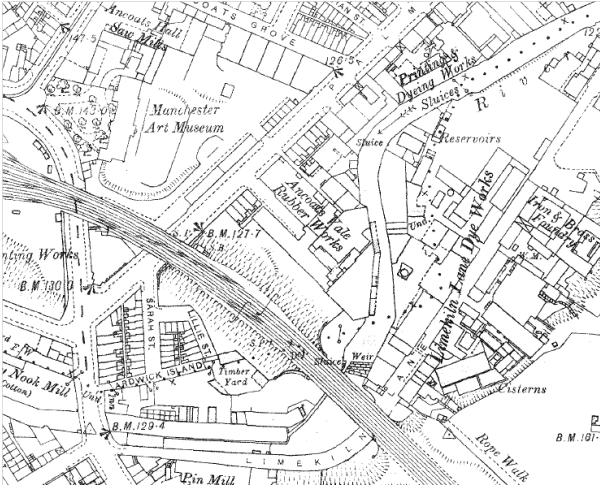
He died in January 1865 in Limekiln Lane, which seems a grim place.  The 1884 OS map shows the lane bounded by the river and reservoir and surrounded by an iron forge, lime kiln, printworks, a dye works and a rubber works.  Only a few houses existed in 1884 and today the area is empty.  A dismal place for what by then must have been a lonely end.

But there is something powerfully uplifting about his life.  He may have lived his life in what Engels described as a place which was “coal black and stinking” and have toiled for very little but he could write about “the cool shade of the woods, the bust insect world all alive and found an abundance of wild flowers.”

Pictures; our parish church circa 1860 from the collection of Tony Walker, Kersal Moor, By William Wyld 1859, Lime Kiln Lane, detail from 1880 OS for South Lancashire, courtsey of Digital Archives, http://www.digitalarchives.co.uk/

Saturday, 21 July 2012

Richard Buxton part seven .......Peterloo


Earlier in the month I wrote about Richard Buxton the working class botanist and his “quiet” life set against the backdrop of Revolution, war and trace depressions. http://chorltonhistory.blogspot.co.uk/search/label/Richard%20Buxton

In the early decades of the 19th century Revolution it was thought was in the air, and the Government responded with the Gag Acts, the suspension of Habeas Corpus   and the rounding up and imprisonment of political suspects.

Mindful of any potential protest the authorities acted equally promptly.   When thousands of Manchester men set out on March 10th 1817 to petition the King, the army stooped them near Stockport.  One hundred and sixty-seven were arrested, several received sabre wounds and one was shot dead.

The unrest stretched on into the 1830s and 40s, and Buxton would have been well aware of the Chartist demands of manhood suffrage.   In 1839 the local papers   were full of a group of Chartists arrested for allegedly drilling with weapons, thousands had demonstrated at Kersal Moor for the vote and across the north the military sat and waited for what the propertied classes feared would be social unrest at best and revolution at worst.

But the one event that stands out and which defined the politics of his early middle years was the massacre at Peterloo.  In August 1819 a peaceful demonstration at St Peters’ Field calling for the vote was broken up by the military.  Units of cavalry charged the crowd and soldiers of the 89th Infantry fired into them.  Thousands were wounded and eleven were killed.

Eye witness accounts still have the power to shock


”As the cavalry approached the mass of people used their utmost efforts to escape, so closely were they pressed in opposite directions by the soldiers, the special constables, the position of the hustings, and their own numbers that immediate escape was impossible..... The people were in a state of utter riot and confusion, leaving the ground strewn with hats and shoes.... During the whole of the confusion, heightened by the rattle of some artillery crossing the square, shrieks were heard in all directions..... Some were seen bleeding on the ground and unable to rise; others less severely injured but faint with loss of blood were retiring slowly.”

“The hustings remained with a few broken and hewed flag staves erect, and a torn or gashed banner or two drooping whilst over the field  were strewed caps, bonnets, hats, shawls and shoes, and other male and female dress trampled torn, and bloody ...”

Buxton would have been aware of the demonstration and may even have seen the Oldham contingent of 6000 strong heading into Ancoats from the north and the 2000 from Ashton streaming in from the east of the city.

More importantly he would have known neighbours from the close warren of streets bounding Gun Street who went to hear Orator Hunt.  Many of those who made their way to St Peters Field went as family units, community groups or just f friends and work mates.  And many who returned as casualties came from those same streets.  Eighty alone who gave their address lived in Ancoats, and the streets they inhabited were minutes walk from Buxton’s home.    Five came from Buxton’s street.  James Weir or Ware from number 11 had been bruised and trampled another had gone with his wife and child and was badly hurt.

Nor was this the end of the horror.  For the remainder of the day the military and the local police patrolled the streets like some occupying force, and in the early evening with tensions still high a large crowd gathered at New Cross.  This was a popular meeting place for people from both Ancoats and Collyhurst and was just minutes from Gun Street.  Some of the crowd began throwing stones at the police and soldiers opened fire.

Before the crowd had dispersed, Joseph Ashworthy had been killed and several others lay injured.  Not surprisingly many of those injured in this event also came from that close network of streets close to Buxton’s home.  He may even have shared the anticipation that “In that paralysis of terror anything might happen”     

Nothing did but the memory of what happened on that August day survived well into the last quarter of the nineteenth century.  In the 1870s one  weaver looking at a newspaper picture of Henry Hunt  on the workshop wall could still express anger at an event which happened sixty years before. And others were prepared to pose of a photograph sixty-five years after the event.

None of these or the other great events which he lived through are referred to in his autobiography and the nearest he came to a social comment was his regret that ordinary people were unable to  fully walk the fields, “To the poor, as a class, it is to be feared that the possession of land in this country is not generally attainable ....[but] I hope the lords of the soil will yet allow the pent up dwellers in the crowded city to walk and view the beauties of creation”     But this was a request and not a demand and is limited to the use of old footpaths.

But Buxton was operating in a world where he was dependant on charitable donations and his work as a botanical collector.    The 1840s were increasingly difficult financially and made worse by the failure of the second edition of his book to make much money.

Picture; Peterloo, 1819 by Richard Carlile, m01563, Peterloo, 1819, m07589, and Veterans of Peterloo from a photograph taken in 1884, m07594, Courtesy of Manchester Libraries, Information and Archives, Manchester City Council


Sunday, 15 July 2012

Richard Buxton part 6 when revolution was in the very air


I am back with my old friend Richard Buxton, the working class self taught botanist who compiled one of the most important books on the botany and fauna of south Manchester.

He is some someone I have written about already http://chorltonhistory.blogspot.co.uk/search/label/Richard%20Buxton and I promised to come back to him.

He lived and worked for most of his life in the mean little streets off Great Ancoats Street in the heart of this fast growing part of Manchester.  And today I want to explore his life set against the events of the time.

His was one of those “little lives lived out in a big century" and it encompassed the French Revolution and the long wars with France, unrest at home including trade union activity, demands for the vote and the great Chartists Petitions along with machine breaking, and food riots.

Very little in his autobiography gives a clue to whether he held political views or made comment on the great events of the day.     As a young man he might have known those who rejoiced at the news of the Revolution in France, and listened to calls for better pay, union solidarity and a halt to the factory machines.  He would have rejoiced himself at the news of the victory at Waterloo, and shared the despair as the trade cycles plunged many into unemployment and poverty.

Food riots were not infrequent and he may well have observed the riot that broke out in April 1812 in Oldham Road, New Cross when a food cart carrying food for sale at the markets in Shudehill was stopped and its load carried off.  Nearby shops were also attacked and looted.  The mob was eventually dispersed by soldiers but only as far as Middleton.

There they met with an assembly of handloom weavers, miners and out of work factory operatives gathered to protest against the introduction of power loom machinery at Barton and Sons weaving mill.  The mob which had grown to 2000, was dispersed by “ A party of soldiers , horse and foot, from Manchester arriving, pursued those misguided people, some of whom made a feeble stand; but here again death was the consequence, five of them being shot and many severely wounded.”  

Revolution it was thought was in the air, and the Government responded with the Gag Acts, the suspension of Habeas Corpus   and the rounding up and imprisonment of political suspects.  Here in Manchester radicals were arrested and some like John Night were thrown into the New Bailey prison before being sent on to London, others like William Ogden were just “roughed up”.
Picture; Peterloo, 1819, m07589 Courtesy of Manchester Libraries, Information and Archives, Manchester City Council