Showing posts sorted by relevance for query henry Hunt. Sort by date Show all posts

Tuesday, 12 August 2025

Who stole Henry ‘Orator’ Hunt? ……..

Now for those who don’t know Henry ‘Orator’ Hunt was one of the outstanding Radicals of the early 19th century.

Henry 'Orator' Hunt, circa 1820
He had campaigned for the reform of Parliament, called for universal suffrage, and demanded an end to child labour, and was imprisoned for two years for being at Peterloo.

Added to which in 1830 he was elected as the MP for Preston on a radical platform and went on to oppose the Reform Act because it didn’t go far enough.

And given such an illustrious commitment to reform and to Manchester, in 1842 he was commemorated by a monument, which four decades later was stolen.

The statue was not in one of the principle public places in the city but out on the edge, sandwiched between rows of working-class dwellings and in the shadow of a textile mill, and surrounded by an iron works, a chemical plant, and umpteen coal wharfs.

All of which I suppose was an appropriate spot for someone who had spent his adult life promoting equality and demanding a better deal for working people.

The Round Chapel and burial ground, Every Street, 1844
The monument was by all accounts an impressive thing.

The base was nearly six feet square and the plinth on which the monument rested was ten feet square.

There were spacious vaults underneath which were intended for “the remains of those who shall distinguish themselves in promoting the principles advocated by the late Henry Hunt”. *

And beneath the foundation stone were placed, the “memoirs of Henry Hunt, the history of the Peterloo massacre and his letters from Lancaster goal to the Reformers [along with] the placard announcing the ceremony, a copper plate likeness of Mr. Fergus O’Connor, and a copy of the address which was subsequently read to the meeting by Mr. Scholefield”.

Fergus O’Connor was one of the leaders of the Chartist movement and Mr. Scholefield, was the Rev. James Scholefield of the Every Street Chapel, and the monument was erected in the burial ground of the chapel.

Media coverage reported that “no less than 15,000 probably one half of whom were Chartists” [congregated] in Every Street and its neighbourhood”.

The Round Chapel, burial ground and Mr. Hunt's monument, 1851
The address referred to the events at Peterloo and the decision “to perpetuate the memory of Henry Hunt, Esq, and of those who fell in that action, by erecting a public monument and thus show to future generations how the people of these times estimated sterling worth, and how they appreciate genuine patriotism”.  

And that pretty much seems to be what happened over the next decade with leading members of the movement buried beside the monument.

In all five were interred in the grave which was “covered by a flat stone bearing the inscription “Names of the members of the Committee interred beneath.  Peter Rothwell died 6th of September 1847, aged 78 years; George Hadfield, died 12th of January 1848, aged 59 years; George Exley, died 24th of January 1848, aged 79 years; Henry Parry Bennet, died 10th of November 1851, aged 65 years; James Wheeler, died 13th of September 1854, aged 63 years”. **

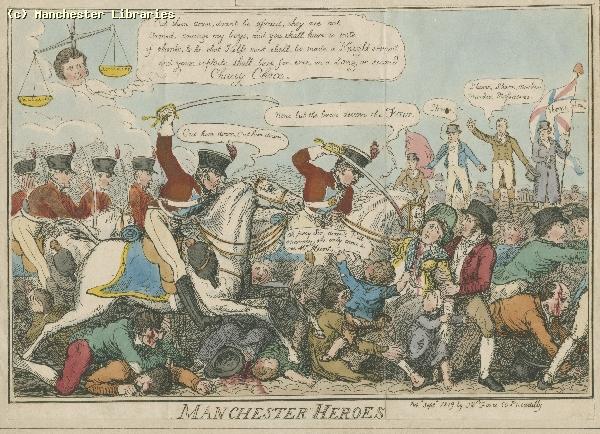
Peterloo, 1819
Sadly, the passage of time had not been kind to Mr. Hunt’s memorial and when the foundation stone was moved in 1888, the printed material had all but disintegrated and was in the words of an observer “rendered almost to pulp”, but there was a “medal of white metal” which was not mentioned in earlier accounts.

It had the figure of justice on one face and on the other a crown and a scroll bearing the words ‘Maga Charta, Liberty, Unity, Justice” and an inscription in the rim ‘Manchester Political Union, established August 16th, 1838’ ‘Universal suffrage, vote by ballot, annual Parliaments’”. **

And that leads me to the destruction of the monument, which was undertaken on the pretext that it was unsafe, although one visitor to the site at the time was less convinced that this was so.

Peterloo, 1819
Nevertheless, the contractor employed to make good the burial ground which had become neglected, broke the monument up and sold the stone for £3, which was then sold on again to “a man at Irlam-o’-the Height” who subsequently could not be traced.

This act of vandalism was condemned at the time and within days of its destruction an appeal was launched to raise money for a new monument.

There was some disagreement about what form the new memorial should take, with some arguing that the old site was unsuitable give the high wall that surrounded the old burial ground and its position on Every Street, “it had long been practically inaccessible for Manchester people” and a better alternative might be “a small marble tablet near the scene of Peterloo”.***

The Round Chapel, 1959
Today, little is left of the burial ground which is now an open piece of land surrounded by social housing and new build, but the outline of chapel has been preserved.

It was demolished in 1986 and a few of the original grave stones have been preserved.

Alas Mr. Hunt’s memorial is lost forever, although not as I first thought because of a vengeful act of conspiracy on the part anti-democratic forces but out of wanton greed compounded by neglect on the part of the family of the late Rev. Scholefield who had died in 1855.

Still I do have the names of the five interred beside the monument and they may yet bring forth fresh insights into Peterloo and that monument, in the centenary year of that massacre in St Peter’s Fields.

Location; Manchester

Pictures; Henry Hunt, circa. 1810, watercolour, by Adam Buck, 1759–1833, Peterloo, 1819 by Richard Carlile, m01563, Peterloo, 1819, m07589, the Round Chapel, 1959, m6868 , Courtesy of Manchester Libraries, Information and Archives, Manchester City Council, http://images.manchester.gov.uk/index.php?session=pass, the Round Chapel and burial ground, 1844, from the OS map of Manchester and Salford, 1842-44, and the Every Street burial ground, showing Mr. Hunt’s memorial, 1851, from Adshead map of Manchester, 1851, courtesy of Digital Archives Association, http://www.digitalarchives.co.uk/

*Monument to the late Henry Hunt, Manchester Guardian, March 27, 1842

**Henry Hunt’s Monument, Manchester Guardian October 6, 1888

***The Henry Hunt Memorial, The Manchester Guardian October 18, 1888

Thursday, 16 July 2026

Henry Hunt ………. “and the Manchester Monument to Perpetuate His Memory”

I am back with Henry “Orator” Hunt who the Chartist newspaper described as the “one of the most bold, most strenuous , most disinterested and most able advocates of LABOUR’S CAUSE, that the cause ever had to boast of”.*

He was scheduled to speak at the “Manchester Reform Meeting” in St Peter’s Fields in the August of 1819, which was broken up by the authorities, with much loss of life, hundreds of casualties and which was for ever afterwards known as Peterloo.

What I hadn’t known was that years later a monument was erected in the grounds of Every Street Chapel in Ancoats.

It is a story  I have written about already, but until today had never come across an image of the actual monument which was demolished in 1888, and so I was more than pleased when Jon Silver, reproduced this one, which according to the Northern Star, “represents a monument, now in the course of erection Manchester, in the burial ground of the Chapel, belonging to the Rev. Mr. Schofield, in Every Street …..raised by means  of a subscription amongst the working people of England, to perpetuate the name and fame” of Mr. Henry Hunt.**

Jon found the image on another blog site, which referenced the Northern Star, and so as you do I went back to the collection of Northern Star editions, and came across the one for August 20th 1842, which not only carried the story of the monument but a detailed report on the events of Peterloo, including the names of the Manchester Yeomanry who brutally attacked the peaceful demonstrators.

Some of the Yeomanry, 1819
The list complements that of those who are recorded as casualties on the day long with those who were charged into the crowd.***

Most are from Manchester and Salford, with a few drawn from Stretford, Pendleton and Eccles with two are listed as “Foreigners”.

And while there are a smattering of the “gentry” and the professions, most were shop keepers, small businessmen and labourers, including Savage who is described as a quack doctor”.

All of which points to that simple truth that those who cut and sabered were little different in their class origins and occupations than the majority of the demonstrators who were their victim.

Now I am well aware that all the published names will have been trawled over by the eminent and the interested long before I got to see them, but that won’t stop me spending hours doing the same.

Leaving me just to highlight the link to online collection of the Northern Star, which makes fascinating reading.****

Such is research and the fun of history.

Location; Manchester, 1819, and 1842

Pictures; the engraving of the Henry Hunt memorial, the Yeomanry list and the front page of the Northern Star, from the edition of the Northern Star, August 20th, 1842

*Henry Hunt and the Manchester Monument to Perpetuate His Memory
Henry Hunt, The Northern Star, August 20th, 1842

**Henry Hunt, https://chorltonhistory.blogspot.com/search?q=henry+Hunt


***What did you do at Peterloo? https://chorltonhistory.blogspot.com/2019/08/what-did-you-do-at-peterloo.html

****The Northern Star, https://ncse.ac.uk/index.html

Wednesday, 20 March 2019

I wonder what Henry Orator Hunt did wrong? …… puzzled of Peterloo

Now it has taken me a while to get around to watching Mike Leigh’s film on Peterloo and I am a tad puzzled.

Henry Hunt circa 1820
The film I enjoyed, if you can enjoy watching innocent people cut down by a group of men on horses armed with sabres against a backdrop of poverty and unemployment.

The story of Peterloo is one I grew up with, having got the “O” level version from history text books, listened to the songs which praised Henry Hunt, and spent my share of time reading accounts of the massacre.

All of which I thought meant I could pass muster with most people when it came to the story and the results of that day in St Peter’s Fields.

But not so, because I seem to have got Henry Hunt very wrong.

For those who don’t know he was the main speaker on that August day, and understandably so given that he had a record of campaigning for the reform of Parliament, universal suffrage, and an end to child labour, and was imprisoned for two years for being at Peterloo.

He had earned the nickname Orator for his powerful speeches advancing the cause of reform and continued to do so until his death in 1835.

So, I am puzzled that in the film, he is portrayed as overbearing, single minded and more than a bit dismissive of Samuel Bamford, Joseph Johnson and the other Manchester Radicals, who were also at Peterloo and were arrested and imprisoned after the event.

Scenes from Peteroo, 1819
I wondered if it was because he was a wealthy farmer which marked him out as very different from the working-class people who are at the core of the film, or that he opposed those who advocated carrying weapons to the demonstration.

Or that in conversations he had with other radicals, he was insistent that the focus should be primarily on the issue of Parliamentary reform, and nothing else.

Today there might be those who have no time for him because he was wealthy, while others, knowing the violence which was unleashed at the meeting condemn the way he seems to have surrendered the means by which there could have been a fight back.

I suppose I will have to go back to basics, read his autobiography, and his speeches, along with what he did after Peterloo, which included standing successfully for election to Parliament in 1830 as the radical candidate for Preston, which was one of the few towns in England that had given the vote to all males who paid taxes.

Peterloo, 1819
During the course of which he had addressed not only Parliamentary reform but the need for a ten hour day and an end to child labour, commenting that "I have personally visited the factories, and witnessed the sufferings of the overworked children. but, my friends, you never heard of this. 

No, no, my speeches on the subject were all suppressed by the press."

After his victory, he and an estimated crowd of 16,000 people, marched to Manchester and held a meeting at the site of the Peterloo Massacre.

While in Parliament he opposed the 1832 Reform Act as it did not grant the vote to working class males. Instead he proposed what he called the Preston-type of universal suffrage, "a franchise which excluded all paupers and criminals but otherwise recognized the principle of an equality of political rights that all who paid taxes should have the vote." *

All of which makes me even more puzzled at just how he came across in the film.

Location; Manchester& Preston

Pictures; Henry Hunt,  (c. 1810), watercolour, by Adam Buck, 1759–1833, Peterloo, 1819 by Richard Carlile, m01563, Peterloo, 1819, m07589, and Veterans of Peterloo from a photograph taken in 1884, m07594, Courtesy of Manchester Libraries, Information and Archives, Manchester City Council, http://images.manchester.gov.uk/index.php?session=pass

*At which point I have admit the last bit was a straight crib from that excellent site called Spartacus Educational, ........ sometimes you just have to be lazy. Henry Hunt, Spartacus Educational, https://spartacus-educational.com/PRhunt.htm

Tuesday, 1 January 2019

With Henry Hunt we’ll go, We’ll raise the cap of liberty, In spite of Nadin Joe*

Manchester, 1819
It is time for another two pictures from the collection of Manchester’s history of protest.

I tried resisting using an image of Peterloo but it remains an important event in the history of the city and one that I have written about before.

So I shall confine myself to the picture and move on to a more peaceful demonstration which wound its way through the city streets passing close to St Peter’s Field in November 2011 and represented one of the biggest protests in Manchester since the the Coalition Government was formed.

* Henry Hunt, a popular song from the period of Peterloo.  Henry Orator Hunt was a radical who argued for annual parliaments and universal suffrage,

He had been invited to speak at the rally in St Peter’s Field in the August of 1819 and was arrested and convicted for his part in the demonstration.

Manchester 2011
Joseph Nadin deputy-constable of Manchester 1801-1821.  “He was a renowned thief-catcher with the reputation of turning every offence into a felony.  The significance of this peculiar twist is that a successful felonious charge was rewarded with a fee of 40 shillings” Hewitt Eric J.,A History of Policing in Manchester, 1979

This  reputation  led the radical Samuel Bamford to observe of Nadin that “he had the homely tact to take care of his own interests.  

He housed a good harvest whilst his sun was up and retired to spend his evening in ease and plenty on a farm of his own within the borders of Cheshire.” Bamford Samuel Passages in the Life of a Radical, 1840-42, also quoted by Eric Hewit

Nadin was also no friend of popular protest and radical politics and during the period that Habeus Corpus was suspended was zealous in his arrest and imprisonment without trial of radicals, and those suspected of being radicals.

Pictures; Peterloo, 1819, m07589, Courtesy of Manchester Libraries, Information and Archives, Manchester City Council http://images.manchester.gov.uk/index.php?session=pass and 2011 from the collection of Andrew Simpson

Friday, 17 July 2026

Rescuing five Manchester Radicals ……………"from the enormous condescension of posterity”

How easy it is to lose our history, and once lost how much more difficult to retrieve.

Alexander Somerville, 1848
This I know is not an original idea but is one that I have been wrestling with today, as I seek to uncover the lives of five radical working men all of whom were born in the 18th century and died long before Parliament extended the vote to include a section of the male working class.

They were, Peter Rothwell, George Hadfield, George Exley, Henry Parry Bennet, and James Wheeler.

I doubt I would ever have come across any of them, were it not that all five were buried beside the monument to Henry “Orator” Hunt, which stood in the burial ground of the Round Chapel on Every Street.

They were part of the committee responsible for that monument, and I suspect had been at Peterloo along with Mr. Hunt.

As yet, I don’t know what they looked like, the position they took on the reform of Parliament and where they stood on the broad spectrum of opinion within the Chartist movement.

To be honest I don’t even know if they were all Chartists, but I suspect they were.

Off Oldham Road, home to some of the "five", 1851
They may appear in the autobiographies of other radicals like Samuel Bamford and Mr. Hunt, and if I am very lucky, I might turn up a reference to the memorial committee.

I have trawled the database of the Working-Class Museum in Salford and gone looking for any reference in the newspapers to the five, but so far have only found them in the census returns, directories and registers of births deaths and marriages.

But I am confident that I have found all five in the official records, which list their occupations as cotton weaver, tailor, and baker, in fact three of the five were bakers.

Back Prussia Street, 1851
All lived in the northern part of the city in an area which was densely packed with rows of terraced houses which in turn were surrounded by textile mills, iron works and timber yards, bounded by the Ashton and the Rochdale Canals.

In the absence of anything on their politics, and their activities I am forced back on exploring just where they lived.

Henry Parry Bennet who was one of the three bakers lived with his wife on Bradford Street, throughout the 1840s and into the next decade, and died there in 1851.  And as you do, I wondered on the fate of his wife, who was 62.  But like so many working people of the period, she is lost from the records with nothing listed as yet after the date of her husband’s death.

Conversely in the case of Peter Rothwell there is bewildering choice of candidates, one of whom lived in a property which commanded an annual rent of £20 and would have entitled him to a vote in the reformed Parliament and another Mr. Rothwell, who in 1841 described himself as a cotton weaver and lived with his family and assorted others in Back Prussia Street.

Prussia Street, 1904
In all there were ten people sharing the house, four of whom along with Mr. Rothwell and his wife Ann were well past retirement age, but I suspect were still hard at it working in the nearby cotton mills.

Back Prussia Street was, as its name suggests directly behind Prussia Street, which ran from Oldham Road down to Jersey Street, and like the rest of this part of town was a mix of cotton mills, foundries, timber yards with the odd glass making works thrown in.

And to further complicate the picture, a Peter Rothwell in 1844 was listed in the rate books as living in the cellar of a property on Bradford Street which was close to where the Bennet’s lived.

It is all tantalizing and is a bit like looking through a dirty window, which reveals some detail but not much.

I suspect our cellar dwelling Mr. Rothwell will be the same as he that lived on Back Prussia Street and is a reminder that people moved around the city in a way that most of us don’t today.

I continue to trawl the records and might yet turn up the minutes of the committee which erected the monument to Mr. Hunt, and remain confident that there will be some reference to them, but in the meantime, they are just names.

Prussia Street, 1907
But not quite, because we know that the organization that went into the erection of the monument and the subsequent preparations for the day of its unveiling are impressive.

The committee had decided on charging a penny for admission to the event and set up platforms from which spectators could observe the speeches, for which they wee asked to pay an extra 6 pence.

And on the day the committee had to cope with an estimated crowd of 15,000 people, which would have taxed any group of marshals charged with making for a peaceful and dignified day.

So that is it, ………. Not much perhaps, but a step in uncovering the lives of five Manchester radicals who have been pretty much forgotten.

Does it matter?  Yes, I think it does.  In his ground-breaking book, The Making of the English Working Class, E.P. Thompson, wrote "I am seeking to rescue the poor stockinger, the Luddite cropper, the ‘obsolete’ hand-loom weaver, the ‘utopian’ artisan, and even the deluded follower of Joanna Southcott, from the enormous condescension of posterity."*

And if it was good enough for him, who am I to stop digging for my five?

Pictures; cover page of Alexander Somerville's Somerville's autobiography, 1848, Back Russia Street, 1851, from Adshead’s map of Manchester, 1851, courtesy of Digital Archives Association, http://digitalarchives.co.uk/ Harriet Street stables adjoining No.1 Prussia St, near Oldham Road, Bradburn ,A,  1904, m10109 and Portugal Street & No. 3 Prussia Street, near Oldham Road, Jackson, J, 1907, m10411, courtesy of Manchester Libraries, Information and Archives, Manchester City Council, http://images.manchester.gov.uk/index.php?session=pass


*Thompson, E.P. The Making of the English Working Class, 1963, 1968, 1980, page 12 from the 1980 revised edition.  My 1968 Pelican edition is all but falling apart and I suspect it is time for a new copy.

Thursday, 20 August 2026

Joseph Johnson, radical, farmer and almost a Didsbury Radical

The Peterloo Massacre still has the power to shock and ranks alongside the Sharpville Massacre in South Africa in 1960 and the Kent State killings in Ohio in 1970 as a moment when peaceful demonstrations were met with the full ferocity of State power.*

And it is of Peterloo I want to think about today and in particular the part played by Joseph Johnson, one time radical who lived in Northenden and whose political past gave rise to a potato being called the “radical.”

Now as many of you know I am searching for our radical past here in Chorlton, not out of a nostalgic wish make the place politically correct but because it seems to me that there would have been people here with views that ran directly opposite to those of the establishment and the wealthy.

There is evidence that there were people from both Stretford and Urmston present at Peterloo, and this shouldn’t surprise us either.  Both were places where there were significant numbers of weavers and these were a group who had become radicalised as their industry went into decline.  So according to one source 151 of those wounded at Peterloo were weavers, which represents 50% of all casualties whose occupations are known.**  And we had some weavers.

So it is not beyond the bounds of possibility that we made a contribution to that 80,000 strong crowd, but that is where at present we have to leave it, with just a maybe.

His home in 1905
That does still leave me with Joseph Johnson, who was on the platform in St Peter’s Field, during the Peterloo Massacre and was arrested for “assembling with unlawful banners at an unlawful meeting for the purpose of inciting discontent,”  found guilty, and on his release in 1821 settled in Northenden.

He was born in Manchester which some sources narrow down to Didsbury in 1791 and became a successful brush maker.

A strong supporter of universal suffrage and annual parliaments, Johnson joined the Manchester Hampden Club formed by John Knight. In 1818 Johnson helped John Knight, James Wroe and John Saxton to start the radical newspaper, the Manchester Observer. Within twelve months the Manchester Observer was selling 4,000 copies a week. Although it started as a local paper, by 1819 it was sold in most of the large towns and cities in Britain. Henry Hunt called the Manchester Observer "the only newspaper in England that I know, fairly and honestly devoted to such reform as would give the people their whole rights."

In March 1819 Joseph Johnson, John Knight and James Wroe formed the Patriotic Union Society. Johnson was appointed secretary of the organisation and Wroe became treasurer. The main objective of the Patriotic Union Society was to obtain parliamentary reform and during the summer of 1819 it was to hold a meeting here in Manchester at St Peter’s Field.  The rest as we know was a tragic outcome, and one which in its way was no less awful for Johnson.  For after being imprisoned his wife fell ill and died and he was refused permission to attend the funeral. ***

On his release he settled in
Northenden and we can track him in the village from 1841 through till his death in 1872.  During that time he gave his occupation variously as brush maker and later land proprietor and it will be as such that he planted potatoes which became known as “radicals” 

A fact that might have been lost to us had not another radical who described his visit to Chorlton in the June of 1847.  This was Alexander Somerville who having crossed over the Mersey recorded that

‘My companion said-“It was in this way; it was a sort of potato introduced here by Mr Johnson of Northern; and as he was a radical, they called the ‘tatoes radicals too.  Don’t you remember the song that used to be sung?  ‘God Bless Hunt and Johnson, and all who take their part;’ that was the Mr. Johnson, now of Northern, a very good gentleman he is who brought this very good kind of potato here which they call radical.”’

Which should really be the end of the story but I shall close with his will.  On his death he left £2000 and was described as “gentleman.”  I wonder if he would have approved of the description.

Pictures: Courtesy of Manchester Libraries, Information and Archives, Manchester City Council Peterloo, 1819, m77801, Ravenswood home of Joseph Johnson, 1905, m36100, Veterans of Peterloo 1884, m07594

*On an August day in 1819, anything between 60,000 and 80,000 men, women and children had assembled in St Peter’s Field to listen to the case for reforming the representation of Parliament.  Just before 2 in the afternoon a unit of Cavalry charged into the crowd with their sabres.  The deaths resulting from that charge have never been exactly established but sources claimed between 11 and 15 people were killed and up to 700 injured.  At Sharpeville in March 1960, after a day of demonstrations, the South African police opened fire on the demonstrators, killing 69 people. At Kent State University in Ohio, four students were shot and nine wounded by the National Guard during a peaceful protest at US involvement in the Vietnam War.

**Bush, Michael, The Casualties of Peterloo, 2005

*** http://www.spartacus.schoolnet.co.uk/PRjohnson.htm


Saturday, 21 July 2012

Richard Buxton part seven .......Peterloo


Earlier in the month I wrote about Richard Buxton the working class botanist and his “quiet” life set against the backdrop of Revolution, war and trace depressions. http://chorltonhistory.blogspot.co.uk/search/label/Richard%20Buxton

In the early decades of the 19th century Revolution it was thought was in the air, and the Government responded with the Gag Acts, the suspension of Habeas Corpus   and the rounding up and imprisonment of political suspects.

Mindful of any potential protest the authorities acted equally promptly.   When thousands of Manchester men set out on March 10th 1817 to petition the King, the army stooped them near Stockport.  One hundred and sixty-seven were arrested, several received sabre wounds and one was shot dead.

The unrest stretched on into the 1830s and 40s, and Buxton would have been well aware of the Chartist demands of manhood suffrage.   In 1839 the local papers   were full of a group of Chartists arrested for allegedly drilling with weapons, thousands had demonstrated at Kersal Moor for the vote and across the north the military sat and waited for what the propertied classes feared would be social unrest at best and revolution at worst.

But the one event that stands out and which defined the politics of his early middle years was the massacre at Peterloo.  In August 1819 a peaceful demonstration at St Peters’ Field calling for the vote was broken up by the military.  Units of cavalry charged the crowd and soldiers of the 89th Infantry fired into them.  Thousands were wounded and eleven were killed.

Eye witness accounts still have the power to shock


”As the cavalry approached the mass of people used their utmost efforts to escape, so closely were they pressed in opposite directions by the soldiers, the special constables, the position of the hustings, and their own numbers that immediate escape was impossible..... The people were in a state of utter riot and confusion, leaving the ground strewn with hats and shoes.... During the whole of the confusion, heightened by the rattle of some artillery crossing the square, shrieks were heard in all directions..... Some were seen bleeding on the ground and unable to rise; others less severely injured but faint with loss of blood were retiring slowly.”

“The hustings remained with a few broken and hewed flag staves erect, and a torn or gashed banner or two drooping whilst over the field  were strewed caps, bonnets, hats, shawls and shoes, and other male and female dress trampled torn, and bloody ...”

Buxton would have been aware of the demonstration and may even have seen the Oldham contingent of 6000 strong heading into Ancoats from the north and the 2000 from Ashton streaming in from the east of the city.

More importantly he would have known neighbours from the close warren of streets bounding Gun Street who went to hear Orator Hunt.  Many of those who made their way to St Peters Field went as family units, community groups or just f friends and work mates.  And many who returned as casualties came from those same streets.  Eighty alone who gave their address lived in Ancoats, and the streets they inhabited were minutes walk from Buxton’s home.    Five came from Buxton’s street.  James Weir or Ware from number 11 had been bruised and trampled another had gone with his wife and child and was badly hurt.

Nor was this the end of the horror.  For the remainder of the day the military and the local police patrolled the streets like some occupying force, and in the early evening with tensions still high a large crowd gathered at New Cross.  This was a popular meeting place for people from both Ancoats and Collyhurst and was just minutes from Gun Street.  Some of the crowd began throwing stones at the police and soldiers opened fire.

Before the crowd had dispersed, Joseph Ashworthy had been killed and several others lay injured.  Not surprisingly many of those injured in this event also came from that close network of streets close to Buxton’s home.  He may even have shared the anticipation that “In that paralysis of terror anything might happen”     

Nothing did but the memory of what happened on that August day survived well into the last quarter of the nineteenth century.  In the 1870s one  weaver looking at a newspaper picture of Henry Hunt  on the workshop wall could still express anger at an event which happened sixty years before. And others were prepared to pose of a photograph sixty-five years after the event.

None of these or the other great events which he lived through are referred to in his autobiography and the nearest he came to a social comment was his regret that ordinary people were unable to  fully walk the fields, “To the poor, as a class, it is to be feared that the possession of land in this country is not generally attainable ....[but] I hope the lords of the soil will yet allow the pent up dwellers in the crowded city to walk and view the beauties of creation”     But this was a request and not a demand and is limited to the use of old footpaths.

But Buxton was operating in a world where he was dependant on charitable donations and his work as a botanical collector.    The 1840s were increasingly difficult financially and made worse by the failure of the second edition of his book to make much money.

Picture; Peterloo, 1819 by Richard Carlile, m01563, Peterloo, 1819, m07589, and Veterans of Peterloo from a photograph taken in 1884, m07594, Courtesy of Manchester Libraries, Information and Archives, Manchester City Council


Saturday, 6 July 2024

The Peterloo death which links Manchester to Salford and Prestwich ......... and brings young William Fildes out of the shadows

William Fildes deserves more than history has so far allotted him. *

Labour Party demonstration for Jobs, Birmingham, 1983
He was born in 1817 and died just two years later from injuries he sustained at Peterloo, when he was caught in the cavalry charge of the Manchester Yeomanry.

According to the witness account of his mother, Mrs. Ann Fildes, he fell from her arms when she was knocked down accidently by a sergeant-major, who was following the main body of horseman.

He died at ten that evening and was buried three days later in the New Jerusalem Temple on Bolton Street in Salford, in the shadow of Salford Railway Station, just beyond the New Bailey Prison.

New Jerusalem Temple, Salford, 1844
The church opened in 1813 and was part of the “New Church Movement” deriving its teachings from the writings of the Swedish theologian Emanuel Swedenborg. Along with the Salford church there were also churches and schools on Peter Street, in Manchester and at the Round House, on Every Street, in Ancoats. **

The New Jerusalem Temple, closed in 1890s, and after a succession of industrial uses was demolished in the 1990s, and is now a cap park.  “The initial removal of human remains from the surrounding graveyard in 1988 was followed by further excavations and re-burials at Agecroft between 2003 and 2007. Archaeologists estimate that there could be a further 6,000 burials remaining on the Bolton Street site”. **

So far, I have come across only one other reference to young William, and this comes from his baptismal record, dated September 23rd, 1817 just thirteen days after his birth.  The service was conducted at the Cross-Street Chapel and the document offers up the names of his parents, and the occupation of his father.  Charles Fildes and Ann Fray were married in St Mary in Prestwich, on December 5th, 1816, and both came from Whitefield.

Kennedy Street, 1844
And by 1819 they were in Manchester living at no. 23 Kennedy Street, which, then as now is a narrow street, which in the early 19th century consisting of rows of back to back houses, and closed courts.

We know that the family were still there in 1820, when Mr. Fildes is recorded as a waiter, but three years later he is the landlord of Haunch of Venison at 51 Dale Street.

But after that they are lost to us, although the 1841 census does turn up an Ann Fildes living in a closed court close to Redbank, with five children, the eldest of whom is 13 and the youngest five.  It is a remote possibility given that she was 50, her youngest just 5 and that she would have had to be 16 when she married.

All of which leads to that obvious observation that tracking the families of those who were at Peterloo can be difficult, and some will question the validity of doing it in the first place.

But I disagree.  For those that want, they can visit Kennedy Street, and the site of the New Jerusalem Temple, and with just a bit of imagination and empathy place themselves back beside the Filde family.

Kennedy Street, 2017,    but the opposite side and end to where the Filde's lived
Added to which we can put Charles and Ann amongst those who stood to one side of the Church of England, first at the Cross Street Chapel, and later the New Jerusalem Temple, which in turn might suggest their politics.

And as you do, while following their trail I came across another Filde family, who were radical enough to have named one of their children, James Washington, another Henry Hunt, and yet another Thomas Paine.

Location; Manchester 1819

Pictures; Birmingham, 1983, from the collection of Andrew Simpson, Kennedy Street, and Bolton Street, Salford, 1844, from the OS of Manchester & Salford, 1844, courtesy of Digital Archives Association, http://www.digitalarchives.co.uk/

*Bush, Michael, The Casualties of Peterloo, 2005, page 94, Marlow, Joyce The Peterloo Massacre, 1969, page 150-1, Casualty and Witness Records, findmypast, www.findmypast.co.uk

** New Jerusalem Temple Burials at Agecroft, Agecroft Chapel Restoration Group, https://agecroftchapel.org/swedenborg-church-memorial/

Wednesday, 4 September 2019

The stories behind the stories ……………… the NHS, the British Empire and Peterloo ……. another one to listen to

Now I had quite forgotten this delightful series on Radio 4 where James Naughtie finds the heartbeat of history in the front-page small ads of old UK newspapers.*

Aneurin Bevan, 1952
Yesterdays programme was from Ripley and Heanor News, 2 July 1948 in Classified Britain Series 2

"James Naughtie explores history through front page small ads.

The Ripley and Heanor News - serving the towns of the Amber Valley, north of Derby - reveals the austerity of post war recovery in its columns, the home-made entertainment in the days before television's domination and a meeting with one of the best-known mediums in the Midlands.

Front page news is a relatively late addition to the newspaper business. 

For most of their first couple of centuries, British newspapers carried classified ads rather than news on their front page. They transformed the hustle and bustle of the marketplace into newsprint, so you could take it home or to the inn to pore over at your leisure.

Woolwich, circa l1te 1949s
James Naughtie travels the country discovering how these front-page ads give us a snapshot of time and place, exploring how they weave national and local life together - the heartbeat of history rolling daily or weekly off the presses.

The ads tell us what people were eating, drinking and wearing, what was on stage and what people were playing at home. They mark the mood of the time through notices for public meetings held to stoke up or damp down public fears of crime and political unrest. 

Knitting Patterns, circa 1960s
They are a record of the notices placed for houses and public buildings to be built, licenses applied for and subscriptions raised for publications and commemorations. They show the latest labour saving gadgets 'trending' as technology arrived, and they track jobs and trades on the way up and down as the British Empire waxed and waned. The ever-present ads for patent medicines record our most popular ailments.

Produced by John Forsyth.
Assistant Producer: Alexandra Quinn.
A Loftus Media production for BBC Radio 4.”

But equally fascinating and very relevant was the one from series one, on Manchester Mercury, 17 August 1819.

“The classified ads of the Manchester Mercury on 17 August 1819, the day after the Peterloo Massacre, give their own insight into the post Napoleonic war social stress. 

Rewards are offered for information on 'those who have absconded from their families' with their names and descriptions. Special constables have been recruited in Bowden 'to enforce obedience of the laws' and auctions are announced for everything from a house to a horse, and from a clementi piano to the 'Scotch edition of Shakespeare'.

Peterloo, 1819
Front page news is a relatively late addition to the newspaper business. 

For most of their first couple of centuries, British newspapers carried classified ads rather than news on their front page. 

They transformed the hustle and bustle of the marketplace into newsprint, so you could take it home or to the inn to pore over at your leisure.

James Naughtie travels the country discovering how these front-page ads give us a snapshot of time and place, exploring how they weave national and local life together - the heartbeat of history rolling daily or weekly off the presses.

The ads tell us what people were eating, drinking and wearing, what was on stage and what people were playing at home. 

They mark the mood of the time through notices for public meetings held to stoke up or damp down public fears of crime and political unrest. 

Peterloo, 1819
They are a record of the notices placed for houses and public buildings to be built, licenses applied for and subscriptions raised for publications and commemorations. 

They show the latest labour saving gadgets "trending" as technology arrived, and they track jobs and trades on the way up and down as the British Empire waxed and waned. The ever-present ads for patent medicines record our most popular ailments.

Produced by John Forsyth
A Loftus Media production for BBC Radio”

Pictures; Aneurin Bevan and his wife Jenny Lee in Corwen, 1952, Geoff Charles, made available under the Creative Commons CC0 1.0 Universal Public Domain Dedication Knitting Patterns circa 1960, from the collection of Andrew Simpson, To Henry Hunt, Esqr. as chairman of the meeting assembled on St. Peter's Field, Manchester on the 16th. of August, 1819", Peterloo, Manchester, print published by Richard Carlile, m01563, courtesy of Manchester Libraries, Information and Archives, Manchester City Council, http://images.manchester.gov.uk/index.php?session=pass and Beresford Square, in the middle decades of the last century, courtesy of Mark Flynn, http://www.markfynn.com/london-postcards.htm

*Classified Britain Series 2, https://www.bbc.co.uk/programmes/m000823f

Sunday, 30 March 2025

Miss Edith Townley of Woolwich and a story of Rectory Place

Now Miss Edith Townley of 13 Rectory Place Woolwich remains a mystery.

Miss Edith, 1917
And that is after my friend Tricia joined in the hunt.

I first came across Miss Edith on a postcard dated 1917 which had just been acquired by David Harrop who knowing my links with Woolwich passed it onto me and I couldn’t resist attempting to find her.*

Tricia also took up the search.

Her grandmother and great grandmother had lived in Rectory Place and so like me there was a connection as she says  “looking at Vincent’s book of Woolwich it states that Rectory Place and the streets to the north of it were built on the Glebe or Rectory land in the 1820's. 

A G.F.S., charirty stall, 1928
The rectory itself was built in the midst of 3 acres of garden, orchard and pasture which has since been considerably curtailed. The remainder of the glebe was advertised to be let.

The first Woolwich bank of which there is any mention was a private concern known as Noaks & Ward and then later as Budgen Ward & Co, and was held in a house in Rectory Place, later occupied by Mr T H Jones and known as Glebe House.

I have tried to search for your Edith Townley on the Electoral Roll but have had no luck. There was no electoral roll books for 1916 & 1917 and of course woman did not finally get the vote until about 1928 and then only if they were over 21. Some women got the vote in 1918 but only if they were over 30 and a home owner.


A church garden party, date unknown
The address for Edith states GFS Lodge which is a Girls Friendly Society which I am guessing is some sort of safe haven for young girls like Edith. Strangely enough I could not find anything for her on the census either.”

Now I had come across the GFS **in connection with some stories I wrote about a Miss Wright who ran a branch of the organisation here in Chorlton-cum-Hardy and the history of the society is well worth a read.***

And a fresh look at the organisation may well bring us closer to Miss Edith.

But for now I will close with another even more personal link between Tricia and Rectory Place because Tricia sent me a picture of “my great uncle known to us as blind uncle Bill although he was baptized as Henry Bertie Schofield Holmes.

He lived with his parents Henry William & Ellen Holmes ( my gt grandparent)  at 31 Rectory Place from early 1900's - 1950ish.

Mr Holmes, date unknown
He used to sit on a chair in St Mary's Passage reading a braille bible and I think passers by would give him money. He wasn't born blind but became blind when he was a young boy after playing cricket in the sun without wearing a hat and apparently got sun stroke.

Whether that was true or not I don't know. My mum said he was a lovely man that was popular with everyone.”

Location; Woolwich, London

Research by Tricia Leslie, 2016


Pictures; postcard to Miss Edith Townley, 1917 courtesy of David Harrop, GFS and Guides’ Stall from the 1928 St Clements’s Bazaar Hand Book courtesy of Ida Bradshaw,  pictures of a garden party organised by the church, date unknown, and picture of Mr Holmes, date unknown from the collection of Tricia Leslie

*So who was Miss Edith Townley of 13 Rectory Place in Woolwich and how did she spend the Christmas of 1917? http://chorltonhistory.blogspot.co.uk/2016/01/so-who-was-miss-edith-townley-of-13.html

**The Girls Friendly Society, http://chorltonhistory.blogspot.co.uk/search/label/The%20Girls%20Friendly%20Society

**The Girls Friendly Society, http://chorltonhistory.blogspot.co.uk/search/label/The%20Girls%20Friendly%20Society

*** *Girls Friendly Society, http://www.gfsplatform.org.uk/