Showing posts with label Chorlton green. Show all posts

Monday, 7 September 2026

A picture a day Chorlton Green circa 1883-96


A picture a day


During this week of September I have decided to feature a picture a day, drawn from the collections that span a century and more of Chorlton.

The green was enclosed by Samuel Wilton sometime in the early 19th century and stayed the Wilton garden until the death of his daughter in the 1890s whereupon the Egerton’s took it back and gifted it to the township. 

Sam Wilton ran the pub over the water called the Greyhound which is now Jacksons Boat and built the first bridge over the river around 1816.


The jutty out bit is an outhouse which might have been added when the the middle section of the property became a pub in the late 18th century.

I think the photograph may date from sometime between 1883 when the half timbered building called Zetland Terrace was erected and 1896 when the garden became the village green again.

It may have been taken by Arron Booth of Sedge Lynn who took pictures of Chorlton-cum-Hardy in the 1880s.

Location; Chorlton Green


 Picture; from the collection of Allan Brown circa early 1890s.

Saturday, 5 September 2026

On the green circa 1898


It’s a picture I have shown before, but is well worth a second look.

The caption suggests a date around 1898, arguing that this “Prince of Wales Horse bus at the Green.  Probably about 1898 before the Corporation took over the Carriage and Tramways Company, but maybe slightly later.”*

The Manchester Carriage and Tramways Company had been formed in 1865 from a merger of the two bus companies serving the city and neighbouring townships.

The larger was owned by the Greenwood Company and brought over 500 horses and 33 omnibuses to the merger, while what had been McEwen’s City Omnibus Company contributed the routes to Bell Vue, Rusholme, Longsight and Didsbury.

And at the end of the 19th was taken over by the City Council.

But what intrigues me is not so much the horse drawn bus but the surrounding buildings.
To the extreme right is the Travellers Rest which had been a beer shop since the 1830s and for most of that century had been run by the Nixon family and next to it the Beech Inn.

To the left is the Horse and Jockey which back then consists just of the middle building.  Beyond the outhouse jutting out towards the green was the tall cottage of Miss Wilton who had died the year before in 1897.

And it was her death which brought our village green back into common usage. From sometime earlier in the century till 1897 this had been the private garden of the Wilton family, surrounded and made secluded by tall hedges, but with her death the land reverted to the Egerton estate who in turn opened it to the public.

And tucked away in the corner was the  little cottage once the home of the Malloy family and later the sweet shop of Miss Gertrude Green.


Location; Chorlton


Picture; from the Lloyd collection

Monday, 24 August 2026

Looking for the ghosts amongst the parish gravestones ……..

Now, anyone who has taken a stroll through the old parish graveyard of St Clement’s will agree that it is pleasant spot.
The old parish graveyard, 2012

It is sandwiched between the village green to the north and the Bowling Green to the south and offers up a selection of benches to sit and just enjoy the moment.

Added to which there is the history of the place, which starts with the footprint of the church and continues with a collection of gravestones, which record those who were buried here.

The church yard, circa 1870-1880
The earliest dates from 1748 and the last to 1903, and in between there are many whose names are familiar to me.  

Some were at the posh end of the community, but most were from families who made their living from the land, either as tenant farmers, agricultural labourers or in trades related to farming.

What might surprise the casual visitor is that those gravestones are just a fraction of the number which once crowded into the graveyard.

In total there were 345 such monuments, from the simple headstone to elaborate structures, and many held multiple internments.

Those 345 have yet to fade from living memory and are supported by a large number of photographs dating back into the late 19th century and as late as the 1970s.

Just how many people were buried here is difficult to say, and while an estimate can be made from the inscriptions on the gravestones, that will be a conservative estimate, given that some graves were reused over the centuries.

Samuel and Sarah Nixon, 2012
The documentary evidence for this reuse is there in the newspaper reports of the “Great Burial Scandal" which first became official in 1881, when a group of Ratepayers, petitioned the Home Office with their concerns.

Chief of which was that “it is now difficult to tell where there is any land left for new graves, [and because] so many internments have taken place there is not 2ft of earth between the coffin and the surface.”*

There were also lurid tales of existing gravestones being broken up and thrown into the midden of the Bowling Green Hotel to allow new ones to be erected and worse still of bones and skulls appearing and being transported away in wheelbarrows.

The graveyard, 1976

Much more was revealed at the official Government inquiry opened by the Home Office in the November of 1881. 

One witness spoke of “human bones .... knocking about the highway. Only that morning a jawbone with teeth in had been picked up.” 

There were also past sextons who reported the difficulty in finding space to place a coffin and the ever-present danger of unearthing past burials. William Caldwell described how he regularly “disturbed human remains in digging” and once before he “could get down to any depth I smashed into another grave, and I was flooded by liquor and human remains.” **

All of which is an introduction to the Register of Grave Inscriptions of St Clement’s Old Churchyard, Chorlton Green.***

Register of Grave Inscriptions, 1975
It is a slim document running to just twenty pages but contains details of all 345 gravestones.  Alas some are illegible, but there are enough to offer up a comprehensive picture of those that lived here from the mid-18th century through to the end of the following century.

And when combined with the smaller list from the Wesleyan Chapel along with the parish records of baptisms, marriages and burials it is possible to build a picture of the township.

It is a booklet I keep coming back to and one that can still shock me, like the inscription for the Swarbrick family that records that George and his wife Harriet, buried seven of their children between 1817 and 1836.  

The youngest Elizabeth died just two months after she was born, while William was seven years old.  Their parents had been born in the late 18th century and would live on till 1871 and 1874, although by then they were no longer living here.

There is more but that is for another day.

Suffice to say that the inscriptions were collected in the 1970s, in advance of the landscaping of the former graveyard, and sadly the loss of most of the historic gravestones.

Plan showing the original headstones, 1975

The bodies had already been removed in the 1930s.

But we do have a plan of where the original headstones which will allow us to to revisit the final resting places of so many of our residents. 

Location; Chorlton-cum-Hardy

Pictures; the graveyard, 2012, and headstone of Samuel and Sarah Nixon, 2012, from the collection of Andrew Simpson, the grave yard, circa 1870s-1880s, from the Lloyd Collection, in 1976 from the Journal, and cover and burial plan of Register of Grave Inscriptions of St Clement’s Old Churchyard, Chorlton Green

*The Great Burial Scandal, https://chorltonhistory.blogspot.com/2020/03/the-great-burial-scandal.html

 **From the Chorlton Ratepayer Association submission  to the Withington Local Board of Health January 12th 1881, and references from the Manchester Guardian 1881-86, Manchester City Council Town Clerks’ Papers Re Closed Burial Grounds 1930, reports in the dig by Angus Batemean

*** Register of Grave Inscriptions of St Clement’s Old Churchyard, Chorlton Green, RG 37/99 Archives and Local History Library, Manchester Central Reference Library


Wednesday, 22 July 2026

Buying your meat from Mr Unsworth of 2 Chorlton Green in 1909 .... Chorlton's corner shop nu 10

The caption on the picture just says “James Unsworth’s butcher shop on the corner of the Green Albermarle Road.  This shop later became and still is a barbers shop. Private photograph, origin unknown.”

Now I remember it as a barber’s shop, regularly visiting it during the 70s and 80s and even taking my eldest.

Bob who had the business when I went there had been born in Chorlton and had plenty of stories about the place.

I can date the picture from sometime after 1903 and before 1911.

This I can be certain of because back in 1903 the terrace of three shops and houses had yet to be built and from at least 1911 this butcher’s shop was run by Mr Mark Glazerbrook who was recorded in the directories from the start of 1911 at no 2 Chorlton Green.

A decade earlier he had been helping his father run the family butcher’s shop in Railway Street in Ardwick, and in 1910 he married Lillian Carr.

So just perhaps this was their first married home.

That said within another ten years he was trading in Reddish all of which points to the high turnover of some of these small family businesses.

Mr Unsworth was at number 2 in 1909 when his neighbours were Ernest Bugler, cycle maker at number 4 and Stanley Moss, grocer at number 6.

Two years later both James and Mr Moss had moved on.

I don’t suppose we should be surprised for back in the early 20th century there were plenty of butchers, grocers and green grocers in close proximity in Chorlton and competition must have been fierce.

Just opposite was Whittaker’s the grocers and up along Beech Road there were more grocery and butchers shops with even more across the green and behind.

And that is about it except to say I got through the story without commenting on the meat on display in the open air, the sand on the shop floor or  Mr Unsworth’s long knife.

On the other hand, here is the shop in 1979, when those of us who wanted a haircut and a good natter would call in at Bob's.

And that really is it.

Location; Chorlton-cum-Hardy

Picture; of Mr Unsworths' shop circa 1909 from the Lloyd collection and Bobs's in 1979 from the collection of Andrew Simpson

Tuesday, 21 July 2026

Will those responsible ……… return the drinking fountain to the Rec on Beech Road

It is one of those silly stories which started with a couple of pictures of the Rec in the early morning.

Early morning on the Rec, 2021

And progressed through to a newspaper report from September 1897 of an ordinary meeting of the Withington Urban District Council at which Mr. Burgess “intimated that a gentleman in Manchester, whose name he would not at present mention, had offered to give a drinking fountain to be placed in Chorlton-cum-Hardy”.*

I had been looking for information about the early years of the Recreation Ground on Beech Road.**

It had been opened in the May of 1896, and was gift form Lord Egerton of a strip of land which had for centuries been known as Row Acre.***

And here I went very  wrong, because so engrossed was I in the research that the fountain and the Rec came together and for a brief while I went searching for just where the drinking fountain might have been located on what is now called Beech Road Park.

Waiting for something to happen, 2021
All of which will allow Mr. Pedantic of Provis Road to mumble that the story is a nonsense, and artificially connects pictures of the Rec on a Tuesday morning with the real drinking fountain which was on Chorlton Green.

And he would be right, leaving me to reflect on that earlier bit of public open space which is surrounded by two pubs, the old parish burial ground, the village school along with two former farm houses.

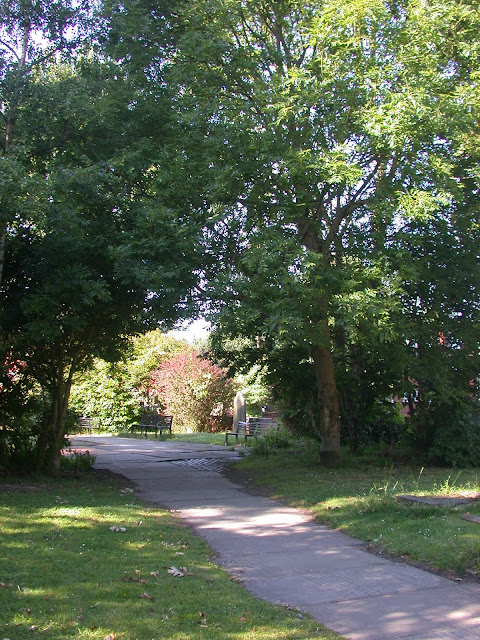
Today most of us think of Chorlton green as an open space of grass ringed by trees but this was not how it has always been.

Before the turn of the 19th century it may have been much bigger and indeed for most of that century was not even open to the people of the village, having been enclosed by Samuel Wilton and not returned to public use until the 1890s.

And then for a great stretch of time remained without grass but did have a pretty neat water fountain.

The Green, circa 1900
The picture dates from 1906 when the Horse and Jockey was still just a set of beer rooms on either side of the main door, Miss Wilton’s outhouse still jutted out from the building and the space between the main entrance and the sweet shop was still a private residence.

I have always liked the lamp which stands on the green, with its hint of Narnia.

And back in the May of 1986 I can remember walking past it in the early evening and coming across a string quartet playing around its base.  Today people would just take it in their stride mutter something about it being typically Chorlton, but back then it struck me as the promise of things to come.

Which later that night with the defeat of the Conservative candidate and the election of the first Labour Councillor it  indeed seem to herald something new.

But being a historian I have to own up to the fact that the following year the Conservatives were back but they were on borrowed time, and 1987 marked the final year that a Conservative would be elected from Chorlton to the Town Hall.

The year before may have been the first string quartet on the green but it has not been the last.

The drinking fountain, circa 190o
I have to say I prefer the grass but lament the loss of the fountain.  

First it lost its cups and then vanished sometime in the 1920s or 30s.  To my mind that was a loss.  Public fountains are wonderful places to meet people, spend time chatting and just having a drink on a hot day.

Once it would have been the village pump which offered all three and which on hot summer days had the added bonus of a place the kids could play.

Now there is a lot more history to explore in the photograph of the fountain but I rather think I will leave that for another time.

To which Michael Wood has added, "My recollection is that the fountain on the rec was located centrally outside the shelter, as on the attached snip from the georeferenced maps website showing OS 25” 1892-1914 series.  

It was the same design as was used in Chorlton Park near the tennis courts, a perfunctory iron structure with domed hoods over the outlets, operated by a button on top -  nothing like the elaborate ornamental feature on the Green.  Can’t find an image at the moment, but I could draw one!  

The Rec, 1914
They must have been a common municipal feature in their time, but by the mid-sixties they were semi-functioning or defunct. "

And I hope he does, as it is I never knew about the bandstand.

Location; Chorlton

Pictures; the Rec very early on a Tuesday morning from the collection of Andrew Simpson and the drinking fountain on the green, circa 1900, from the Lloyd Collection

*District Councils, Manchester Guardian, September 10th, 1897

**Public Recreation Grounds at Withington, Manchester Guardian, May 18th, 1896

***Breaking News ……….. the Rec on Beech Road is officially opened, https://chorltonhistory.blogspot.com/2020/04/breaking-news-rec-on-beech-road-is.html


Thursday, 16 July 2026

A history of Chorlton in just 20 objects number 11 ....... the Lych Gate and Jubilee 1887


 A short series featuring objects which tell a story of Chorlton in just a paragraph and  a challenge for people to suggest some that are personal to their stories. They are in no particular order, and have been selected purely at random.

The Lych Gate on the green at the entrance to the old parish graveyard is an iconic image of Chorlton but dates only from the old Queen’s Jubilee in 1887.  It was paid for by the banker Cunliffe Brooks and is a very visible if now forgotten quarrel between those who favoured the new church on the corner of St Clements and Edge Lane, and the traditionalists who still worshipped on the site where the first chapel had been built in 1512.  I could have chosen anyone of a number of images of the gate but have chosen this one by Peter Topping, whose work is on display around Chorlton and can also be seen at https://www.facebook.com/paintingsfrompictures

Pictures; © Peter Topping 2012

Monday, 25 May 2026

If you go down to the graveyard today …. You’re sure of a big surprise* …..

 Well, “a big surprise” may be overstating the experience but yesterday I came across these stone setts.

Those mysterious stones, 2026
It’s an odd discovery given that I have alternatively walked through and sat in the old parish graveyard for over four decades.

They appear just to the north and west of the entrance to the old parish church.

Often, they are hidden under a mix of mud and leaf detritus, and I suppose are not that interesting, especially when set against the stone inscriptions of the surviving gravestones.

Once before the 1980s make over there were 362 of them ranging from austere and plain slabs to grand monumental records of lives lived out in Chorlton-cum-Hardy.

But with the landscaping of the graveyard came a decision to dispose of most of them, leaving just a handful dotted around the gardens.  The fate of the majority is unclear, but I suspect they ended up as hard core in some motorway.

And with their departure was lost the records of so many of our residents who lived here in the 18th and 19 centuries. Apart from the scandal of destroying the memories of people whose relatives had invested time, money and emotion in recording their lives, there is that simple observation that so much of our history has been lost.

But setting that aside there is the mystery of this stretch of stones.

I wondered how long they had been there, and whether they were original dating from the 19th century into earlier.

I will have walked through the place long before the makeover, but I can’t remember seeing them.

And I suppose they may have been part of the landscaping especially as they appear to include a feature which looks to have been a space for a tree, now long since gone.

Gravestones and inscriptions, 1976

A similar pattern of stones appears around the memorial to PC Cook that policeman who was shot in the line of duty. His death was commemorated by an elaborate monument which was removed and is now in Preston, leaving the present stone slab which is faced with the same sets.

Looking back at the plan of the original 362 gravestone, our mystery spot was inhabited by four headstones of which only one has survived the cull.  This is to John, Margaret, James and John Renshaw who were interred between 121 and 1844.  

The Renshaw family, 2010
Alas those commemorating the Guy, Rogers, Lobley, Horsefield  and Heywood families no longer exist, and with them go the stories of Ann Guy who died aged 81Gertrude “infant daughter of William Henry and Georgina Rogers 8 months, 14days and great granddaughter f the above” and "Louisa Mary [also] daughter of William Henry and Georgina Rogers” who died at 15 months in the August of 1869.  Or Thomas who was the “son of Thomas and Elizabeth Gilmore” who died on July 21st 1870, just 2 months old.

Now set against these lost stories of grief, my stone sets don’t amount to much, but it would be fun to know who thought they should be placed here close to the church entrance.

There is a scheme of planting dating from April 1977 from Recreational Services Department of Manchester City Council which suggests that our spot was for either Lonicera Pileata “an unpretentious ever green plant” or Cytisus praecox a “flowering deciduous shrub”.

But which ever it was it has long gone along with the gravestones that occupied its place.

Location; Chorlton graveyard

Pictures; Chorlton graveyard, 2026, 2010 from the collection of Andrew Simpson and the plan of the churchyard, Register Of Grave Descriptions, St Clement’s Old Churchyard, Chorlton Green,1976, RG 37/99, City Engineer and Surveyor, Town Hall, Manchester

*Teddy Bears Picnic,  Jimmy Kennedy, 1932


Sunday, 24 May 2026

At the chippy on the green with Mrs Jones and "Chippy Madge"

Now I am always fascinated by those pictures which call up a rich seam of memories that cross the generations.

And this one pretty much does just that.  We are inside Chorlton Green Supper Bar sometime in the late 1960s courtesy of Bob Jones.

Just a few years later it would be one of my regular haunts and later still the chosen chippy of my lads.

And I will not be alone in remembering that tiny room with the tiled counter and steamed up windows with the bright lights and promise of something good to eat.

Even now nothing is quite like going into a chip shop on a cold winter’s evening.

It starts with that wall of heat and then the distinctive smell, along with the noise of the chips in the deep fryer and the rustle of paper.

And there is also the conversations which are a mix of the humorous, the mundane and usually a little of the village gossip.

Of course most of what is said might well be repeated over the counter of the newsagents and in the pub but waiting in line for your supper offers up plenty of time to listen to what is being said and an opportunity to add your own contribution.

Now I am old enough to remember getting your chips in newspaper and then walking home on dark nights with that double pleasure which came not only from eating the chips but from holding the bag which kept your hands warm.

So Bob’s picture is just that bit special, more so because on the right is his mum and on the left “Chippy Madge.”

All too often photographs like this one get lost over time and with it go a tiny but important record of how things were.

And it is the little often trivial things, like the name “Chippy Madge” and “Blind Bob the Barber”, which say something about the time and the place.

The nicknames were rarely meant to be cruel and were just one of those things that you said.

Madge worked in the chip shop and her name was Madge so “Chippy Madge” it was, and more often than not there would be a raft of such names for everyone from the milkman to the chap who came round to sharpen your knives.

I may not get out as often these days or visit as many places but I rather think such names are no longer as common and that is a shame.

Picture; Mrs Jones and “Chippy Madge” circa 1960s courtesy of Bob Jones, and the Chorlton Green Supper Bar 1978 from the collection of Tony Walker.

Tuesday, 12 May 2026

The Lost Chorlton pictures ......... no 8. ......... giving the graveyard a make over

This was when the parish church yard got its last makeover.

But it will have been in the early 1980s and involved clearing away many of the old gravestones, and landscaping the area including picking out the footprint of the old church, which had stood on the site since 1800 and replaced an earlier chapel which dated back to around 1512.

I can’t exactly remember the old cluttered grave yard or when the makeover happened but the picture will date from the early 1980s soon after it had been completed, when the trees and bushes had yet to grow.

Location; Chorlton

Picture; the churchyard, 1981 from the collection of Andrew Simpson

Tuesday, 14 April 2026

"I had been bull ward in the bull ring, and once kept one of the gamest bulls in the country,” bull baiting on Chorlton Green

Now every so often you come across accounts of the bull baiting that went on in the township.  

The Bowling Green late 19th century
The stories usually appear on a slow week in one of the local newspapers and are nothing more than a reworking of one of the articles by the historian Thomas Ellwood.

Mr Ellwood wrote twenty-six articles during 1885 and 1886 and these were printed in the South Manchester Gazette.

Part of the value of them is that they drew on the memories of people who had grown up at the beginning of the 19th century and who could recall conversations from the generations before who had lived here during the late 18th century.

So building on Mr Ellwood and avoiding the easy route of plagiarism I dug deep into newspaper reports, census returns and the directories which provided confirmation of what went on in the township on the green over 200 years ago.

"Bull baiting was where bull was pitted against dog in a ring hemmed in by spectators. Our bull ring was situated in the centre of the village green.   The bull was fastened to a chain, about twenty yards long, which allowed him enough space to fight.

The dog’s tactic was to try and seize the bull by its nose but if the bull was well practised at the business, he would endeavour to get the dog on his horns, throw him high into the air and the fall would break his neck or back, but to avoid this, the dogs friends were ready to catch him, so as to break the force of his fall.  Eye witnesses often recalled seeing dead dogs which had been killed during the contest left in the ditches and hedge-rows.


The Horse & Jockey early 20th century
If the bull was slow or just not that good, the dog would not only seize him by the nose, but would hold on till the bull stood still, which was termed “Pinning the Bull”. I suppose to give the bull a chance only one dog was allowed in the ring at a time.

Contests were usually staged during the village wakes, and also at Easter and Whit Week.  Naturally the main sponsors for such events were the landlords of the Bowling Green and Horse and Jockey who had the most to gain from a gang of excited spectators outside their pubs.  

Not that they were alone in profiteering from the event.  The owner of the dog which successfully “Pinned the Bull” was awarded a prize and no doubt some went away the richer having bet on the winner.

There were those in the 1840s who could still remember the notable contests and spoke of the victorious bulls like “Young Fury”, son of “Old Fury” who was regularly brought and baited and the “bull men” like Edward Simmer, commonly known as “Ned” who afterwards was converted to a religious life, and finally became a Methodist local preacher.  


The Bowling Green late 19th century
Or John Cookson who at the inquest of Francis Deakin in 1847 had boasted that he “had been bull ward in the bull ring, and once kept one of the gamest bulls in the country.”  

But its popularity was on the wane and for some years it had all but died out before being revived by a butcher called James Moores, from Deansgate in Manchester.  Not that its revival was greeted by everyone.

There were those who had good reason to regret the appearance of James Moores and his bulls because as he travelled south from the city he brought hundreds “of men of the very lowest character to witness the proceedings.  

The sport, if that is what we can call it suffered another blow when Samuel Wilton enclosed the green in 1818 turning it into his garden."*

*Extract from THE STORY OF CHORLTON-CUM-HARDY, http://chorltonhistory.blogspot.co.uk/2011/11/the-story-of-chorlton-cum-hardy.html

Pictures; The Bowling Green seen from the east from the collection of Tony Walker and the southern side of the Hotel from Alan Brown's collection, both from the late 19th century and the Horse & Jockey from the Lloyd collection early 20th century

Sunday, 8 March 2026

Working women ......... stories for International Women's Day


Taking a break from The Queen and Pasley 1910
It is just one of those things.

The passage of time has made it certain that I will never know who this group of young people were.

The photograph dates from 1910 and the caption suggests that some of them worked for the Queen and Pasley Laundry on Crescent Road.

And it got me thinking about how their lives would pan out.

Of course the outbreak of the Great War would sweep all of them along and the young man in shirt sleeves would in all probability have volunteered or been called up.

But on International Women’s Day I was drawn to the group of young women.

They would all be in their late thirties or even older when they were able to cast a vote in a parliamentary election.

Their working lives might just stretch to something in town just 4 miles away but otherwise theirs was the laundry or perhaps domestic service.

For their mothers and grandmothers job opportunities were even more limited.

Before the 1850s many would have spent sometime in the fields, either working full time alongside other family members or during key moments in the year like sowing or harvesting.

Of course there was always domestic service which was the second largest source of employment in the township. Like the country as a whole it was mainly an occupation for single working class women. So in the township in 1851 there were 53 female servants, ranging from governesses to housekeepers cooks, maids and nurses.

Domestic service counted for 27% of the labour force of which 68% were woman and of these 81% were unmarried. By comparison just 22% of single women were engaged as washerwomen and laundresses.

But it was not much of an opportunity for local women. Only ten of the fifty three working as servants were born here and just another eleven were from neighbourhoods less than 5 miles away. Sarah Bayley was one of these.

She had worked for the Higginbothams’ at Yew Tree Farm in Withington during 1841 and later moved to work for Daniel Sharp on the Row. Those households with servants would have heard a mix of northern accents including those of Yorkshire and punctuated by voices from Derbyshire and far away Ireland.

Part of the reason for this was a concern that locally employed servants might be tempted to divulge family secrets which could fan out around the township and haunt the household’s reputation for generations.

It followed that anyone wishing to find employment was often forced to look outside the township. In some cases news of vacancies came from family members who were already employed in a household and in other cases from the help of local gentry or clergy who might know of vacancies or were prepared to actively search amongst their friends who might need a servant.

There were also the hiring fairs and newspaper adverts and the workhouse. But the hiring fairs may not have played much of a part in our local economy. Either way our servants came from far and wide.

Cleaning another’s home was not limited to domestic servants. Mary Hesketh made a living as a char woman, which was paid by the week and required her to visit on a daily basis. It was a job which allowed those who were widowed or single a means of providing for themselves.

Taking a break from The Queen and Pasley 1964
So for Mary who was 60 and living alone, charring was an important source of income. Ten years later none of the char woman at the end of March 1851 were married. Most were single in their twenties and living at home.

For many married working women the alternative here in the township was to wash other peoples’ clothes, either by attending at the customer’s house or washing them at home.

There were 23 of them and most were married with some of the younger ones working alongside their mothers. They were by and large concentrated along the Row, up by Lane End and in a cluster by the Royal Oak in Renshaws Buildings.

Adapted in part from The Story of Chorlton-cum-Hardy, Andrew Simpson, 2012, https://chorltonhistory.blogspot.com/2011/11/the-story-of-chorlton-cum-hardy.html 

Picture; by the parish graveyard, 1910 from the Lloyd collection, remaining pictures from the collection of Tony Walker

Wednesday, 25 February 2026

The Lost Chorlton pictures ......... no 6. ......... across the village green

I doubt that anyone will remember the corner shop across the green when Mr Unsworth sold his meat from the place, and at present I don’t know the history of the shop from 1911 till 1969.


In that year it was J McNicholls, the hairdresser and a little under a decade later I got my haircut by Bob who ran the shop.

Sometime in the 1980s or later Bob sold up and moved to Norfolk.

Location; Chorlton

Picture; the shop, 1983, from the collection of Andrew Simpson

Thursday, 18 December 2025

A familiar scene of Chorlton Green .............. with a few twists

Now at first glance, this appears a run of the mill picture of Chorlton Green with the lych gate, parish church yard and the pub in the distance.

Look a bit closer and there is still a telephone kiosk at the head of the lane, the church yard has yet to have its makeover and the United Servicemen’s Club was still selling pints.

We are on the green in the late 1970s or early ‘80s and it would be a full thirty years and a bit before the village school would be converted into residential properties.

The small housing development along Finney Drive was not more a than a decade old and the large barn which once belonged to Mr Higginbotham the farmer and which was on our right was still used by the building firm of Walkers.

Which just leaves me to say that the little lane behind the telephone kiosk will be as old as the church yard which dates back to the 16th century, and had you strolled down it at any time from the 18th century into the 19th  it would have taken you  past a farm and its out houses to the pond beside the old Bowling Green which a series of landlords rented out to gentlemen anglers.

Later after the pond vanished it was still used as a cut through and at one time was known by Marion's children as the Bumpy Way.

Location; Chorlton

Picture; Chorlton Green circa 1978 from the collection of Andrew Simpson

Sunday, 14 December 2025

Two parks .....a recreation ground ..... the stolen village green ..... and the Mersey Valley ... now that's our new book

 The story of Chorlton’s open spaces has yet to be told, and with that story will come heaps of memories.

Alexandra Park, 1937

And prompted by those two thoughts, Peter and I have embarked on the our next book which will explore the stories of all our open spaces from the Rec on Beech Road, to Chorlton Park, Alexandra Park and that large open piece of land out by the Mersey.

Chorlton Park, circa 1930s

Along the way we will take in Chorlton Green which was stolen by Sam Wilton sometime in the early 19th century, and only returned to the village after the death of his last daughter in the 1890s..

Added to this we will include a chapter on the bowling greens as well as the fields and market gardens when Chorlton was still a rural community.

We are particulary pleased that my old friend David Bishop has agreed to write the chapter on the Meadows.  

The Meadows, 2019

David is a well known botanist who regularly is asked to speak on a range of topics related to his work and recently addressed an American University.  

He was in at the beginning of the project to turn the neglected area of land by the river into the Mersey Valley, and in fact started exploring the area soon after the sewage works had closed down in the 1970s.

There will be those who question the inclusion of Alexandra Park, but both our families have used the facility over the years, and I bet lots of Chorlton people also have fond memories, so it’s in the book.

Nor will we stop there because we could also include people's gardens, providing of course they would be happy to show them off, once a year when Chorlton proud gardeners open their gardens to the public.

The Meadows, 1979
And that just brings me to the request because there will be lots of people with their own stories, and pictures which we would like to include., and of course those gardens. 

These can be sent as a comment to the blog, or to the Facebook sites, Chorlton History, and Glad to be in Chorlton, or by phone to me on 0161 861 0105.

So to start you all off.  There was a barrage balloon of the Recreational Ground, Chorlton Green once had a drinking fountain, The Meadows regularly hosted winter skating and Chorlton Park was built with a civic theatre.

The lost drinking fountain, Chorlton Green, circa 1900

Location; Chorlton and a few bits beyond

Picture; Sunday in Alexandra Park, 1937, from Manchester, heart of the Industrial North, Manchester Chamber of Commerce, 1937, Chorlton Park circa 1930s, and the lost water fountain on Chorlton Green, circa 1900, the Lloyd Collection, and the Meadows in 2019, and 1979, from the collection of Andrew Simpson


Wednesday, 12 November 2025

A pub, an inscription, and the start of a detective story …… with a confession

I remain intrigued by the discovery at the Bowling Green Hotel of an inscription which looks to have the date 1698 carved into it.

The inscription, 2020
The story was  posted this week, with the speculation of a link between that 17th century inscription and the bowling green, coupled with an appeal to crowd fund for improvements to the green.

It is a fascinating find and could push the story of the site back a century from the conventional assumption that the first pub was opened in the1780s and takes us back to what might have been the first dwelling on the site.

According Thomas Ellwood who wrote a series of articles on the history of Chorlton-cum-Hardy which were published in the winter of 1885 and the spring of the following year, “The oldest inn in the centre of the village  is the Bowling Green Hotel, adjoining the old church – the usual situation for a village public house.


The old Bowling Green Hotel. date unknown
Formerly there stood here one of those ancient wood and plaster dwellings.

The present house was erected about a century ago.  It was first a farmhouse and hostelry combined and belonged to the Egertons of Tatton, but is now owned by Mr. Wm Roberts, the well-known brewer.

Edward Mason was the person who obtained the first licensee of the house, the business afterwards being continued by his son Edward, who was also a land surveyor.  The tenants following were George Whitelegge, William Partington, Charles Chambers,  A. P. Philips, and Edward Richards.  The tenant at present is James English.  There is a bowling-green connected to this inn.

A pond formerly existed on the plot of land bounded by the green behind, and the Chorlton brook, and had a small island in the centre.  This was let during the tenancy of Edward Mason, jun to a gentleman for fishing, but on the making of the main sewer through the village by Lord Egerton, it was drained and filled up.”

Now, Ellwood’s account is fascinating, not least because he drew on the memories of those who had lived in the township all their lives, and would in turn have called up the memories of their parents and grandparents, which might well take us back to the time King George lost the American colonies.

The old Bowling Green Hotel, date unknown
To these we can add the records from the Rate Books which list the owners, and the occupants of our building, starting with the earliest surviving entry which was for 1844.  The records confirm Mr. Ellwood chronology of owners and landlords and offers updates for when they took over the pub.

But what also comes out from those records, is that the first reference to a bowling green only comes in 1862, along with the first refence in the books to the name the Bowling Green Hotel which appears twelve years later.

Of course, history is messy, and the records as ever throw up conflicting evidence.

So, while both the Tithe map of 1845 and the OS map of 1854, show the pond there is no indication of a bowling green. That said the earlier map does list the pub as the Bowling Green Inn, which would suggest that there was indeed a bowling green to the east of old pub.

Ken playing the green, 1979
Frustratingly Mr. Elwood did not elaborate on the bowling green, although he did go into some detail on the green associated with the Horse and Jockey and a later one on the corner of Cross Road and High Lane, recording that “Bowling has always been popular in Chorlton, the well conducted greens being attended solely for healthy exercise and recreation”.

Adding “The village can boast of no fewer than six bowling greens, three in connection with the hotels, and three maintained by subscription. ……… The game may be indulged in by the public at the Lloyd’s Hotel, the Bowling Green Hotel and the old inn at Jackson’s Boat”, [with] another bowling green connected with the Chorlton Reading Rooms, [Beech Road] where the working men of the village assemble”.***

At which point I was tempted arrogantly to conclude that the Bowling Green Hotel’s link to a very old bowling green was unlikely, but history may prove me wrong.  John Lloyd in his book on the history of Chorlton-cum-Hardy commented that “the reputed date of the Bowling Green  Inn is 1693”which comes close to our inscription.****

To which can be added the assertion that “Crown green bowling of a sort is actually recorded in 1600 being played at the Bowling Green Hotel in Chorlton”.*****

Looking towards the Bowling Green, date unknown
Now that reference to 1600 will have to be followed up, but intriguingly, Olive Donohue, who is the secretary of the Chorlton Bowling Club has other sources which show a connection back to the 17th century.

All of which means that this story may have plenty more surprises to come, and along the way, confirm that simple observation that you should never make definitive assumptions about events in the past because the evidence can leap out of the shadows and bite you on the bum.

In the meantime I will finish with that crowd funding appeal, from the club’s Facebook site, "It’s our intention to conduct a crowdfunding campaign ahead of the start of next season (2021), but in the meantime here’s our banking details, in case anyone feels like making a donation. The green itself is in urgent need of some TLC, and grass seed, fertilizer, new sprinklers, etc. can be quite costly".******

Location; Chorlton

The new Bowling Green, 1978
Pictures; The old Bowling Green Hotel, date unknown, from the collections of Allan Brown, Tony Walker,and the Lloyd Collection and Ken playing the green in 1979

*Elwood, Thomas, Inns, Chapter 23, The History of Chorlton-cum-Hardy, April 17th, 1886, South Manchester Gazette.

**George Whitelegg[e] 1841-1859, William Partington, 1859, 1868, Charles Chambers, 1872-3, Edward Richards 1874-1884, James England, 1884, owners, Egertons up to 1859, William & Elizabeth Partington, 1859, Charles Chambers 1872, William Roberts 1874

***Elwood, Thomas, Bowling Greens Chapter 26, The History of Chorlton-cum-Hardy, May 17th, 1886, South Manchester Gazette.

****Lloyd John, The Township of Chorlton-cum-Hardy, 1972, page 60

*****Cheshire County Bowling Association, Centenary Souvenir Booklet, 1910-2010, Cheshire County Bowling Association

****** Bowling Green Hotel Bowling Club, Crowd Funding Appeal, Bank sort code: 20 26 20 (Barclays, Chorlton) Account no: 6019 2988

Sunday, 12 October 2025

Our Lych Gate .... and thieves in the night

Our newly restored Lych Gate is the victim of a bunch thieves who wander in the night.

Just now l recieved a call from David who was  visiting his sister here in Chorlton.

And while she was describing how this iconic part of Chorlton had been recently renovated and restored he noticed that Burglar Bill had taken some of the lead from the roof.

Our three City Councillors have been messaged and Cllr John Hacking and Cllr Mathew Benham  have reported it to the city council

Of course l can't be sure that these creepy crawly slidy creatures of the night ripped the lead in the dead of dark but its the sort of thing they do. 

Location; Our Lych Gate

Picture; our Lych Gate, 2024, from the collection of Andrew Simpson

*The Lych Gate, https://chorltonhistory.blogspot.com/search/label/The%20Lych%20Gate

Thursday, 2 October 2025

History on the corner of Chorlton Green ….. chips ..... flowers .... and pasta

 I am a great fan of "floral affair" on Chorlton Green which is the go-to place if you want to shop locally for fruit and veg as well as other groceries and of course flowers.

floral affair, 2025
Added to which I think it has the largest range of pasta in Chorlton.

Some will remember that for a while the shop was occupied by an antiques business around 2012 to 2014.

And before many will have fond memories of the place as a fish and chip shop which stretches back to at least 1909 

Back then it was run by William Richardson who was listed simply as “fried fish dllr”.

During my visits it was the "Chorlton Green Supper Bar" and we have a wonderful picture from Bob Jones of Mrs Jones and “Chippy Madge” doing the business of offering up fish suppers.

And I will not be alone in remembering that tiny room with the tiled counter and steamed up windows with the bright lights and promise of something good to eat.

Mrs Jones and "Chippy Madge", undated
Even now nothing is quite like going into a chip shop on a cold winter’s evening.

It starts with that wall of heat and then the distinctive smell, along with the noise of the chips in the deep fryer and the rustle of paper.

And there is also the conversations which are a mix of the humorous, the mundane and usually a little of the village gossip.

Of course most of what is said might well be repeated over the counter of the newsagents and in the pub but waiting in line for your supper offers up plenty of time to listen to what is being said and an opportunity to add your own contribution.

Chorlton Supper Bar, 1978
Now I am old enough to remember getting your chips in newspaper and then walking home on dark nights with that double pleasure which came not only from eating the chips but from holding the bag which kept your hands warm.

So Bob’s picture is just that bit special, more so because on the right is his mum and on the left “Chippy Madge.”

All too often photographs like this one get lost over time and with it go a tiny but important record of how things were.

And it is the little often trivial things, like the name “Chippy Madge” and “Blind Bob the Barber”, which say something about the time and the place.

The nicknames were rarely meant to be cruel and were just one of those things that you said.

Madge worked in the chip shop and her name was Madge so “Chippy Madge” it was, and more often than not there would be a raft of such names for everyone from the milkman to the chap who came round to sharpen your knives.

Inside floral affair, 2025
I may not get out as often these days or visit as many places but I rather think such names are no longer as common and that is a shame.

I rather wonder if Mr. William Richardson had a nickname, but then despite his occupancy of the place at the start of the last century, he also held down other jobs.  

In 1901 he described himself as a “general warehouseman” and a decade later as a “Domestic Gardener” and later still as a coal carter a job he was still engaged in at the start of the Second World War.

I suspect the fish and chip business was a sideline, which was run by the whole family.

Dave at floral affair, 2025

It wasn’t the first business to operate from the site because in 1903 the shop was listed as a greengrocer which of course is a nice lead back to floral affair which in this age of supermarkets and online deliveries is a local gem.

I have yet to discover just when the building was constructed, but there is a presence of a property on the site in 1881.

But that offers up a mystery because the rate books suggest that this was owned and occupied by the Wilton family which I ad always thought was part of the complex which is now the Horse and Jockey.

The pub got a license in 1793 and was only one of four cottages facing the green.

So more to find out.

Location; Chorlton Green

Pictures; floral affair, 2025, from the collection of Andrew Simpson, Chorlton Supper Bar, 1976, Tony Walker,  Mrs Jones and “Chippy Madge” from the collection of Bob Jones, undated