Showing posts with label Manchester Halls. Show all posts

Saturday, 2 June 2018

Clayton Hall remembers Ancoats Dispensary ....... today

Now I spent a bit of time thinking of some clever introduction to the Hall’s new exhibition which runs on three Saturdays in June and July.


I began by dredging up memories of lessons I had taught on the more gruesome operations performed in the early 19th century, then fell back on the dreadful state of public health well into the middle of the last century, and the great advance which was the National Health Service.

But instead I decided just to feature the poster advertising Remembering Ancoats Dispensary at Clayton Hall.

For more information contact, Clayton Hall on Facebook or email via info@claytonhall.org 

Friday, 25 May 2018

Hough End Hall reveals a few more bits of its history

Hough End Hall dates back to the late 1590s, and has been a posh home for the landed gentry, a farm house for 250 years, more recently was a restaurant and briefly a set of offices.

Hough End Hall in 1849
Despite that long history there is very little left.  The grand staircase now resides in Tatton Hall, while the old wooden ceiling beams had been encased in pretend oak beams and then hidden under a false ceiling.

Added to which some of the exterior suffered from what was described as unsympathetic restoration in the 1960s and the upper storey has been closed off for at least half a century.

So, it is not a happy tale and one which in the 1920s could even have been a story of demolition to make way for what is now Mauldeth Road West.

Upstairs, 1964
Today there are a dwindling number of people who can talk about the building when it was still part of a farm, a few more who will have memories of playing in the place when it was empty and more who dined and danced the night away when it was a successful restaurant.

But by the time people ate their steak dinners, and listened to live music both the ground floor and the first floor had been gutted and were just two open spaces.

I do have a series of pictures in the collection which features in stories of the Hall. *

They include the garden and the last family who lived there, along with detailed plans commissioned by the Egerton family in the 1930s, but nothing of the interior features.

And as these things go I suspected I would never come across any evidence other than anecdotal of what the inside was like.

All of that has changed with a remarkable set of photographs which have been added to the City Library’s collection of images.**

The roof space, 1964
"The Town Hall Photographer’s Collection is a large photographic collection held in Manchester City Council’s Central Library archives, ranging in date from 1956 to 2007.

The collection consists of tens of thousands of images, covering the varied areas of work of Manchester Corporation and latterly, Manchester City Council.

The photographs were taken by staff photographers, who were tasked to document the work of Corporation/Council departments and, in doing so, captured many aspects of Manchester life and history, including significant changes to the Manchester landscape.

The collection includes many different formats from glass negatives, to slides, prints, CDs and even a couple of cine films.

What is especially exciting is that the majority of these images have never before been available in a digital format and therefore have only ever been seen by a handful of people.

Looking out through the roof space, 1964
A team of dedicated Staff and Volunteers are currently working on the systematic digitisation of the negatives held within the collection."**

And that brings me to the Hough End Hall pictures, which appear to have been taken on March 25 1964, possibly as the building was passing out of the hands of the Bailey family to a developer and they may have been taken as part of the process of determining the Hall’s future in relation a planning applications.

Some show the upstairs rooms minus the fireplaces, others the roof space and others again a staircase up to the lost second floor.

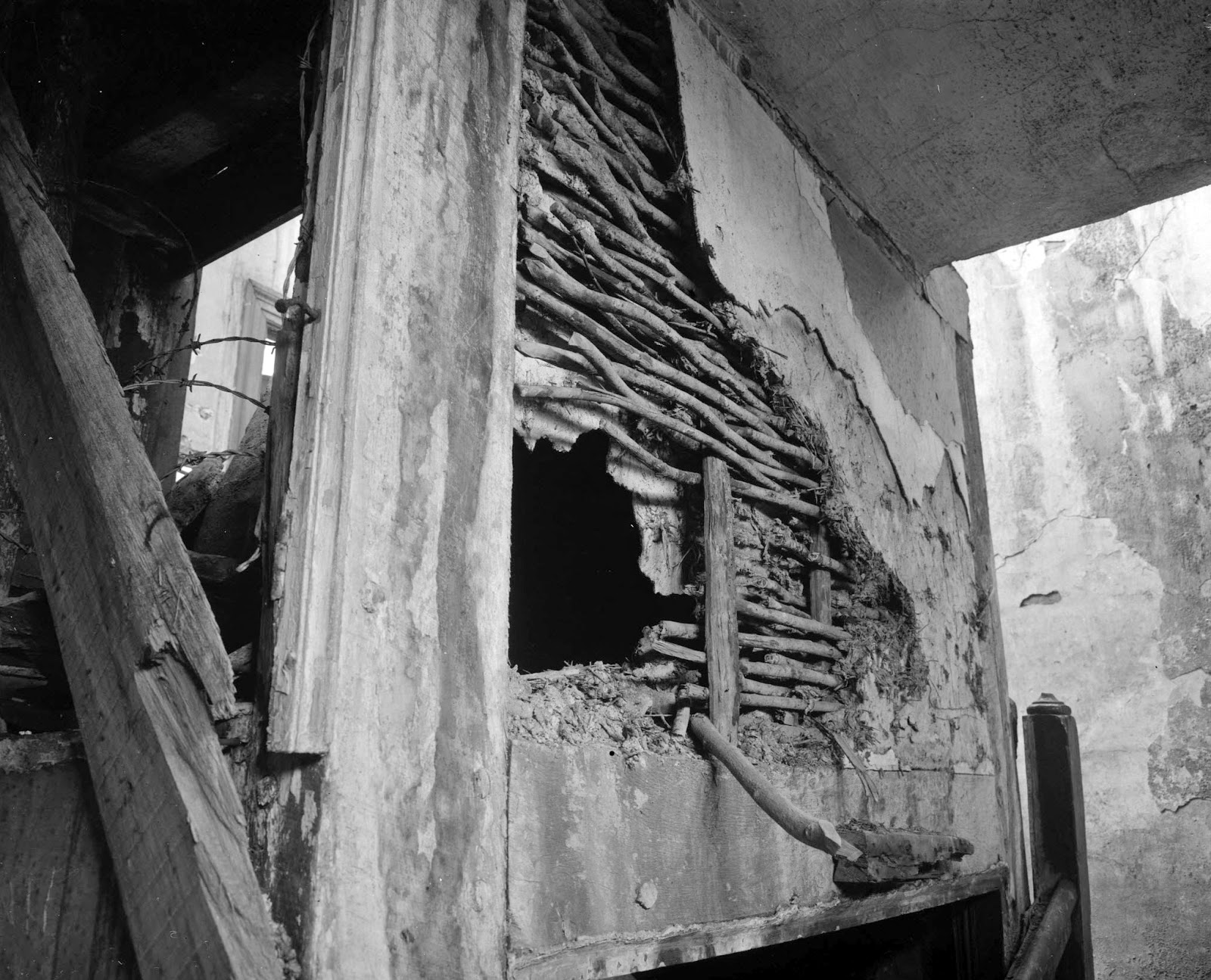
Wattle and daub wall, 1964
This now hidden floor was once home to some of the staff who worked the land when Hough End Hall was at the centre of a 250 acre farm.

My own favourite is a picture which shows one of the original wattle and daub interior walls which I guess must date back to the late 16th century when the Hall was built.

All of which just reinforces that old observation that the past is never fixed and there is always something new waiting around the corner to offer up a fresh bit of the story.

Location; Hough End Hall, as was Withington

Pictures; Hough End Hall in 1849, from The Family Memoirs, Sir Oswald Mosley, 1849, interior of the Hall, March 1964, an upstairs room, 19640758, in the roof space 1964 0743 and the wattle and daub wall, 1964 0759, https://www.flickr.com/search/?user_id=55918222%40N02&text=hough%20end%20hall&view_all=1


*Hough End Hallhttps://chorltonhistory.blogspot.co.uk/search/label/Hough%20End%20Hall

**Manchester Archives+ Photos, Hough End Hall, https://www.flickr.com/search/?user_id=55918222%40N02&text=hough%20end%20hall&view_all=1


Saturday, 19 May 2018

The Hall, the tram and a story of a discovery

Now I like the way Heather discovered Clayton Hall.

"The Old Lady" ..... Clayton Hall, 2018
By her own admission she knew nothing of the place, but one day saw it from the window of the tram and resolved to find out more.

That involved getting off the tram at the metro stop and wandering the short distance across the New Road, through the small park, and over the moat to the Hall.

And she told me she wasn’t disappointed at breaking her journey.

As many will know this gem, dates from the 15th century with alterations made over the next two centuries and was enlarged in the 18th century.

It was restored in 1900 and is now lovingly looked after by the Friends of Clayton Hall, who call the building “the Old Lady”.*  They manage the excellent museum which is housed in the building, host regular Open Days and offer a service to schools to come and learn about our past.

And they also mount exhibitions of which the most recent was on Bradford Colliery, which stood nearby and only closed in the 1960s.

These exhibitions are more than static displays and the Friends welcome visitors to recount their own memories as well as contributing photographs and other memorabilia.

The recent “Clayton Hall Remembers Bradford Pit" generated a rich seam of stories and documents from people who either worked there, or lived nearby, and when the material is collated it will be stored at the Hall with copies going to the Local History Library in Central Ref.

Peter was impressed with the Hall and the work the Friends do so decided to paint “the Old Lady” and I rather think it is a fine painting.

All of which just leaves me to say that Heather joined the Friends, and can be seen on Open Days along with Kay and the other Friends, welcoming visitors and sharing the history of the Hall and of Clayton.

Painting; Clayton Hall, © 2018 Peter Topping,
Web: www.paintingsfrompictures.co.uk
Facebook: Paintings from Pictures https://www.facebook.com/paintingsfrompictures

*Clayton Hall, http://www.claytonhall.org/

Tuesday, 8 May 2018

Clayton Hall reveals a few of its secrets .......

Now my old friend Ron told me that this is his favourite picture of the collection he took on Saturday of the Hall.

Clayton Hall, 2018
And I have to agree.

Ron and I have known each other for a few years and he often sends me some fine pictures as well as examples from his extensive picture postcard collection.

So I was pleased that we fell across each other at Clayton Hall and what’s more he shared these two photographs of the building which dates back to the 15th century, with additions from the next three centuries.

And as much as I admire the first of the two, the second fascinated me, because it shows the original roof in the oldest part of the hall.

For centuries it was lost to the gaze of most people, but in the course of the renovation of the building, the Friends decided to make a feature of what had been an access point into the roof.

Looking into the Hall's past, 2018
And so the wooden panel has been replaced by glass and the rest as they say is a picture by Ron and an opening onto the past.

Look closely and in the V shaped of the roof space is a section of the old wattle and daub wall covering.

This is a revelation for me, because despite writing about wattle and daub, this is the closest I have ever come to the stuff.

So a first for me and a thank you to Ron.

Leaving me to say that the the Hall is open on the first and third Saturday of each month, from 11am to 4pm, is free to visit and there are history talks at 12 and 2, and according to the web site, “group visits can be booked for a minimum of 10 people. 

We are happy to arrange a date and time on days or evenings when we are not already open to the public.   

The same applies for school visits. Information and bookings via info@claytonhall.com“*

Location; Clayton

Pictures; the Hall, 2018 from the collection of Ron Stubley

Tuesday, 1 May 2018

Going back for seconds ........ Clayton Hall and that fascinating exhibition

Now we did the current exhibition on Bradford Colliery in April, but it was so good I am going again, for what is the last outing of the exhibition this Saturday.

But Tina is off to see the family in Italy and so I suggested to Peter that he and his wife Linda join me.

Peter and I have collaborated on five books, various installations, and lots more, with him “painting the pictures and me telling the stories”.

So with the promise of a painting of Clayton Hall and a tram trip from Chorlton to the stop outside the hall, it’s an adventure to look forward to.

Kay who is one of the Friends of Clayton Hall tells me that since the exhibition has been open they have accumulated more pictures, more stories and more memories from visitors.

And that is how I like my history ......... ever growing, and for anyone who wants to add their stories they can by contacting info@claytonhall.org of Facebook

Location; Clayton Hall


Pictures; scrapbook picture, courtesy of Lynn Blinkhorn

Sunday, 22 April 2018

At Clayton Hall ..... yesterday, sun history and a special exhibition

Now I finally got to visit Clayton Hall yesterday, just 40 and more years after we lived off Grey Mare Lane, which is just round the corner.

Since then I would pass it on the bus and more recently on the tram as I sped through Clayton and on to Ashton-Under-Lyne.

But yesterday was a fine day for a visit and neither of us were disappointed.

We had wanted to see the exhibition on Bradford Colliery which has been available to the public on the Hall’s open days during April, leaving people just one more opportunity as the last for this exhibition will be on May 5.

Along with photographs, maps and plans, there were plenty of vivid accounts of working at the mine, and the team were busy collecting additional memories and stories from some of the visitors.

And along with that exhibition there were the permanent ones in the rooms of the Hall recreating life as it might have been for a well off family in the 19th century.

The Friends of Clayton Hall are all volunteers and their enthusiasm shone through during their explanation of the Hall’s history.

Like all such groups, they are keen to encourage people with an interest in Clayton or the Hall to join them.

All of which just leaves me to admit that my pictures are not the most showy, but as the team have promised me pictures of the front of the hall along with the Bradford exhibition I thought I would concentrate on the back.

That way, when you go you will have the stunning views, which come with a delightful garden and the stone bridge over the moat which will in the fullness of time be filled again with water.

The Friends have a packed summer ahead, with lots of school visits, and new exhibitions including one on the Great War.

Location; Clayton

Pictures; the rear of the Hall, 2018, from the collection of Andrew Simpson

Saturday, 21 April 2018

Today .......Clayton Hall Remembers Bradford Pit

Now if you missed the first of Clayton Hall remembers Bradford Pit, you can catch it again today or on May 5, when the doors of this splendid old building are open again for two more open days.

Kay Symcox told me that the first event back on April 7th had been a great success.

Amongst the visitors were a number of ex Bradford miners, who "by chance, had all worked at BP around the same time and knew the same people

All of the memories that I have collected from facebook or personally from visitors will be added to the Manchester Archives held at Central Library when our exhibition has finished and  we will be keeping everything that I have collected, so that visitors to the Hall can browse through after the exhibition has finished

Did I tell you that I discovered that my paternal grandfather worked at the pit during WW1?


He died before I was born and none of my family knew!

And for any one who wants to add their stories they can by contacting info@claytonhall.org of Facebook

And for those like me me who live on a tram line there is a metro stop outside the Hall.  Perfect.

Location; Clayton Hall

Pictures; scrapbook picture, courtesy of Lynn Blinkhorn

Saturday, 7 April 2018

Clayton Hall Remembers Bradford Pit .... one to do today

Now this is one I want to go to.

Today, and April 21 and May 5
We lived in the shadow of Bradford Colliery for a year and bit.

Strictly speaking I am not sure the shadow of the winding gear ever fell across our bit of Butterworth Street and sometime during the year we lived there the colliery structure was demolished.

We occupied one of the six fireman’s flats in the old Mill Street Police Station complex.  We looked out on Grey Mare Lane Market with Fort Beswick as a backdrop.

Our flats were the only properties owned by Manchester Polytechnic and were rented out to students who were married.

Not for us those luxurious apartments in the leafy suburbs of south Manchester, but Butterworth Street suited us fine.

The Ashton-Under-Lyne Reporter, 1966
We only had to cross the road to get to the market, the station was just a short walk away on Pottery Lane and for the last summer we were there I had a job at the SGB yard hard by Ashbury’s Railway Station.

The colliery had closed years before we arrived, but the winding gear was still there and like the rest of the surrounding landscape, we took it for granted.

And then one day it was gone.

We had both left in the morning, but in the evening it had vanished.

Like many memories I can’t put a date on its demolition, and I can’t even be sure it had all come down in one day.

And that is another reason for visiting the exhibition, because I know I can go online and do the research, but how much more fun to get the facts along with the stories and pictures that have been contributed by people who worked there or like us lived in its shadow.

Added to which it is not too late to add your stories and photographs, by contacting Clayton Hall  via info@claytonhall.org 

Or come along on the three open days which will be April 7, April 21 and May 5, between 11am and 4pm.

And for those like me me who live on a tram line there is a metro stop outside the Hall.  Perfect.

Location; Clayton Hall

Pictures; courtesy of Kay Symcox

Monday, 12 February 2018

The Clayton Hall stories ....... no 2 “the gem in the east”

Now if you ever plan to motor east, travel my way on the route that’s the best ...... all the way from Piccadilly to Clayton.

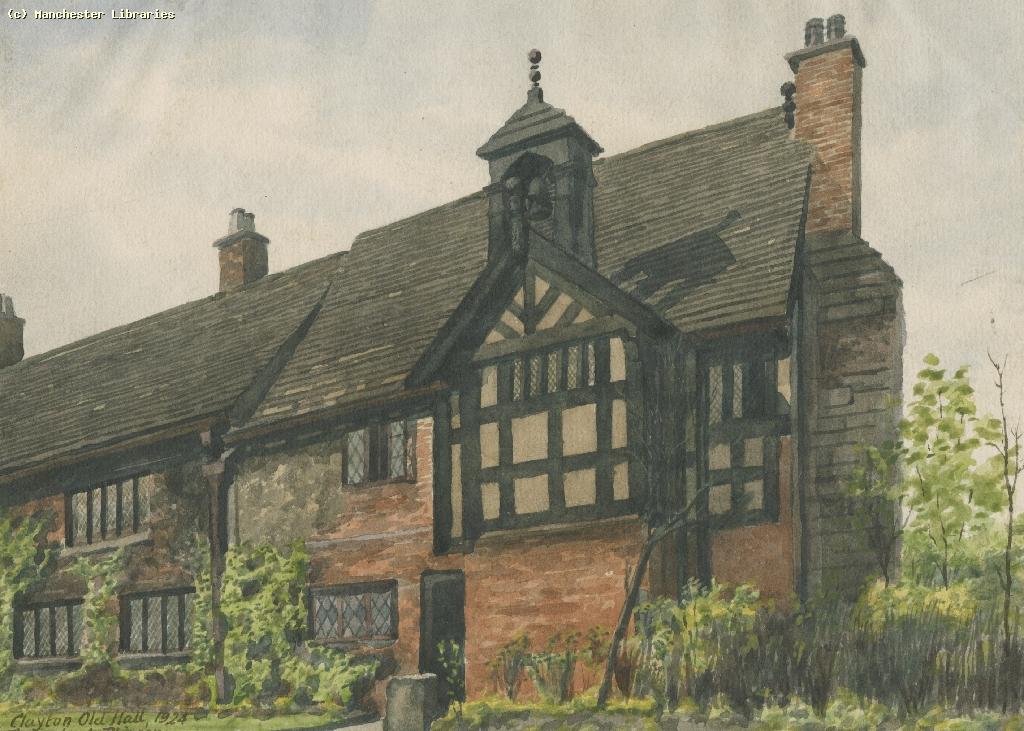
The Hall in 1924
Well I know that it is never going to make a line to a song, but for those who haven’t taken the bus or better still the tram from town to Clayton you are indeed missing something, because there at the end of the journey is that gem of the east which is Clayton Hall.

I wrote about it yesterday and today there is more.

My old facebook friend Kay Simcocx tells me that “the hall is open on the first and third Saturday of each month 11am-4pm, is free to visits and there are history talks at 12 and 2.

The tea room serves home-made soup and cakes  and gluten free can be made available, if notified in advance. 

We also have a Memory Lane cafe on the first Monday of each month, from 10am-12:30pm which is also free to attend.

Visitors can chat and reminisce, and bring along their photos, newspaper cuttings or memorabilia to share and we have our Memories room and Clayton Hall/ Local History room open.


The Hall in 1944
More info can be obtained by messaging me on the Clayton Hall Fb page, or emailing Lynn via info@claytonhall.org

Group visits can be booked for a minimum of 10 people. 

We are happy to arrange a date and time on days or evenings when we are not already open to the public. 

The same applies for school visits. Information and bookings via info@claytonhall.com

We also offer history talks at clubs etc. which includes a slideshow presented by Beryl Poole.”

There is a metro stop directly opposite, which means there is no excuse for not travelling east to the hall they call a gem.

Location Clayton

Pictures; the hall in 1924 from a water colour E A Phipson, m80216 and in 1944 from the City Engineers Department, m78904, courtesy of Manchester Libraries, Information and Archives, Manchester City Council, http://images.manchester.gov.uk/index.php?session=pass

Sunday, 11 February 2018

The Clayton Hall stories ...... no. 1 the kitchen range

I last went to Clayton Hall sometime in the 1970s when were living in Ashton Under-Lyne and depending on the bus we took from Manchester would pass the place.

But now since it has reopened I have every reason to return, especially as it’s directly opposite a tram stop and I do love travelling on the tram.

Added to this my friend, Kay, who is one of the team responsible for the museum inside Clayton Hall has sent over some fabulous pictures of the restored kitchen range.

She told me that “here is the range that we bought off eBay when we were setting up the museum. It came from Wales, in pieces, without instructions.

My mum, Lynn, and another co-founder, Shirl, managed to install it, after a couple of tries and a bit of head-scratching.

The pictures show i with a new mantelpiece, really looking the part. 

You can see the slop stone on the right. The ironing board was donated by my neighbour. It had layers and layers of padding and an asbestos mat. 

Another fix-up job and it does the job nicely. The little maid was donated by me and is my daughter.

The original team included Kay Simcox, her friend Lynn  Blinkhorn and Shirley Hughes, Pauline Owen and Alma Smith, who sadly died.  We five co-founded the museum and did most of the work ourselves”.

Now that has to be a good story, and will be followed by more.
Clayton Hall is in the east of the city, and is directly opposite the Clayton Hall metro stop.

More info can be obtained by messaging Kay on the Clayton Hall Fb page, or emailing Lynn via info@claytonhall.org

Location; Clayton Hall

Pictures; courtesy of Kay Simcox 


Tuesday, 10 February 2015

Has Hough Hall in Moston a future?

Now I have gone looking for news on the plight of Hough Hall in Moston.

It was not a building I knew much about and only briefly came across it while doing some research on another story.

It is a listed Grade II building and dates back to the 16th century beginning life as a farmhouse and more recently was used for commercial purposes.*

And judging by Andy Robinson’s pictures it has not fared well in the last few years.

Back in 2005 there was a flurry of interest when the then owners signalled they wanted to sell the property for £200,000, and there was a push by the Friends of the Hall to raise the cash.

But today it is still sitting forlorn and empty and I suspect even more in need of tender care and attention.

It had been according to the Manchester Evening Newsscheduled for demolition in the late 60 or early 70s under a Compulsory Purchase Order but was saved.”**

So I went looking for news of the place.

The same article had reported that there had been a one off Hough Hall Festival held around 1972 and in 2005 there had been quite a bit of local activity focusing on raining awareness for the campaign to buy the Hall.

Since then I could only come across references in the Corporation’s online planning site for temporary car parks in 2009 and the erection of alley gates four years earlier.

All of which is a shame because as early as 1999 research posted on ancestry revealed a rich history

“It is thought it may have been built by George Halgh (sometimes spelt
Haugh). George lived there.

It was owned by several people over the years. Sometime in the early 1880s it was bought by Robert & John Ward who were two brothers who had both been born in a cottage off Kenyon Lane, Moston, Manchester. Robert & John had a successful textiles business in Manchester.

It was described as a black and white half timbered house.

In 1961 an article was written which stated that the house had been put to all kinds of use in recent years and had become run-down.

It had been a doctors surgery, used for the manufacture of lipsticks, and at the time the article was written in 1961 it was being used as a sanitary-ware storehouse and the gardens as a coal and builders yard
combined.

In 1968 another article states that the hall was in Hough Hall Road and in very bad repair. It also says that in front of it at that time stood the Moston Lane Infants School and behind the Hall was the recently
built Moston College of Technology."***

So Hough Hall has slowly been neglected for a more than a century and it is a wonder it is still with us.

Which just begs the question of for how much longer do we have this rare piece of Tudor history in Moston?

Pictures; Hough Hall 2015 from the collection of Andy Robertson

* British Listed Buildings, http://www.britishlistedbuildings.co.uk/,  Hough Hall, Manchester, http://www.britishlistedbuildings.co.uk/

** Save Hough Hall MEN may 28 2005, http://www.manchestereveningnews.co.uk/news/local-news/save-hough-hall-1147451

***Hough Hall, Moston,  Delwyn McKenzie, rootswebb ancestry.co.uk, http://archiver.rootsweb.ancestry.com/th/read/LANCSGEN/1999-01/0917753427