I won’t be the only one in Chorlton who is fascinated by the lost roads of Chorlton.
Some just changed their name, but others have vanished completely.
And one of those is Cardiff Road which was off Longford Road.
 |
| Cardiff Road, 1937 |
It consisted of 12 two up two down properties and dates from sometime after 1901 and had but a short life.
So, while it doesn’t appear on the 1901 census, it is on a street directory two years later and crops up on various historical records until 1939.
It is a place I have written about but never really dug deep into its story.
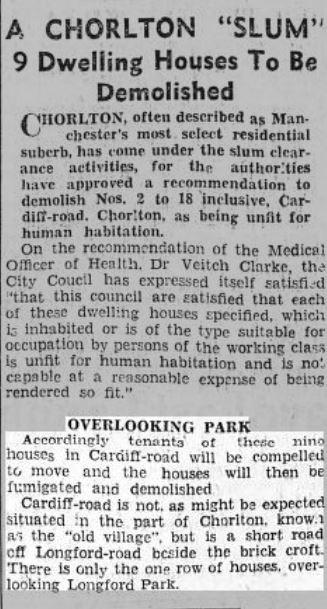
But today I have redressed that omission, mainly because of a press cutting sent over by Chris Geliher who added "Hi Andrew. Came upon this clipping from the M/c City News 16/7/37. Thought you might be interested on the off chance that you haven't already seen it”.
%20brickworks.jpg) |
| Cardiff Road, 1907 |
According to the Manchester City News the Corporation had approved the “recommendation to demolish nos. 2-18 , inclusive Cardiff-road, Chorlton, as being unfit for human habitation”, adding that Dr Veitch Clarke, the Medical Officer of Health for the City Council had pointed out that the houses were “not capable at a reasonable expense of being rendered fit” to live in.*
Now I would dearly like to know who had built the properties and who rented them out, if only to search for similar “rundown” houses that the landlord was responsible for in Chorlton. Alas the Rate Books that can be accessed online stop in 1900, and there appears at present no other reference to ownership in the historic records.
But looking at the census return for 1911 there is much to shudder at, not least because some of the properties were incredibly overcrowded.
At number 20 Annie Elizabeth Wilson shared the house with her eight children ranging in age from 20 down to 5, while at 24, Mr. Devine and his wife lived with four children, a nephew, a sister in law and two lodgers.
 |
| Cardiff Road, 2015 |
Perhaps most shocking is the census return for number 8 which revealed two families inhabiting the one house, consisting of one family of six and another of 4.
At present there is no way of knowing just how poorly built the properties were, but their very short life suggests that they were not the best in the housing stock of Chorlton-cum-Hardy.
Indeed, they back onto our own brick works which might offer up a possible landlord.
A decade on in 1921 there was still evidence of overcrowding in almost all of the four roomed houses and severe overcrowding in two.
 |
| Cardiff Road, 1911 |
What is in interesting from both the 1911 and 1921 census returns is that few of the inhabitants were linked to the brick trade, and only one man in 1921 was directly employed at the brick works and he described himself as unemployed.
Others worked for the grocery chain Twfords in Chorlton, two were employed by Manchester Corporation, one was a carter, and another was a warehouseman for J. R. Smith on Ducie Street in town.
All of which leaves me with that opening sentence from the newspaper report which proclaimed “Chorlton often described as Manchester’s most select residential suburb has come under the slum clearance activities for the authorities”.
So despite the detractors who shout that Chorlton has become a “twee place” to live, there were those who thought it so over eighty years ago. Didsbury please take note.
Location; Chorlton
Pictures; A Chorlton “Slum” 9 Dwelling Houses to be Demolished, Manchester City News, July 16th, 1937, courtesy of Chris Geliher, Cardiff Road, 1907 from the OS map of Manchester and Salford, 1907, and in 2015 from the collection of Andy Robertson
*A Chorlton “Slum” 9 Dwelling Houses to be Demolished, Manchester City News, July 16th, 1937


