Showing posts with label St Clement's Church. Show all posts

Wednesday, 26 August 2026

On finding Miss Wright of Chorlton .............. unlocking a bit more of our history

464 Wilbraham Road, home to Miss Wright circa 1900
Now Miss Wright of Chorlton has been found.

She was and continues to be a clue to the story of the Girls Friendly Society and the Chorlton-cum-Hardy Church Institute which have featured in stories over the last few days.*

The Chorlton-cum-Hardy Church Institute was based for a while in one of the big houses in St Clements Road and the Girls Friendly Society met there during the early decades of the last century.

In 1928 Miss Wright was the President of the G.F.S. and I always knew that if we could find her we would come to know more about both the society and the Institute.

And yesterday Sandra Hapgood came up with Miss Wright’s story which came to light in the 1934 St.Clement’s church magazine in which “she is mentioned as Branch President Miss Wright of 464 Wilbraham Road (now the RBS)

The Acting Branch President was Mrs Evans of 99 Claude Road [and] in 1934 they met every Thursday in the New School (St. Clements) 7.40 - 9.45pm.”

It may also be that the short description of the "G.F.S" in the magazine was actually written by Miss Wright.

"The long, light evenings have gone, so it was with a certain amount of pleasure that we turn to meetings indoors for our recreation and instruction.

During October, on Thursday evenings, G.F.S members will commence their various activities, including musical drill, country and ballroom dancing, ping-pong and other games, needlework - and chatting by the fire.

The evening of Thursday, October 18th, has been reserved for a Lantern Lecture, to which an invitation has been extended to all. Details of the lecture will be announced nearer the date."**

Looking down Wilbraham Road, circa 1900
Sandra adds "it is signed M.I.W and I thought we had Miss Wright's initials but sadly not. 
M.I.W is Miss Wilson the headmistress of the Infant school at that time.”

Now all of that helps with the Institute which was the home of Mr and Mrs Crowhurst in the 1890's who ran a “Ladies School” there and which may have been rented out to the church by its owner William Batty around 1900.

The house was still listed as a club in 1934 but as the new school had been built on St Clements Road some at least of the events that were hosted there had moved across the way.

All of which for me is a fascinating little bit of our local history more so because it is a bit that now sits very much in the shadows.

So I shall go looking again for Miss Wright, Mrs Evans and the others who will tell me more about the Institute and the G.F.S., which just leaves a thank you to Sandra.

Picture; the corner of Wilbraham and Barlow Moor Roads and Miss Wright’s house, circa 1900 from the Lloyd Collection

*The Girls Friendly Society, http://chorltonhistory.blogspot.co.uk/search/label/The%20Girls%20Friendly%20Society

**St Clement’s Church Magazine, 1932, courtesy of Sandra Hapgood

Tuesday, 25 August 2026

Searching for the Girls’ Friendly Society in that big house on St Clements Road in 1911

At a church garden party, date unknown
Now I would dearly like to know lots more about the Girls’ Friendly Society or for that matter the night a chap from the Town Hall came to talk on the sanitation in Manchester to a selected group of earnest young men

Come to think about it I would just love to know all I can about the meetings that went on at the Chorlton-cum-Hardy Church Institute which hosted a whole shedful of activities which were run by St Clement's Church.

I  had no idea that the Institute existed and it was only while I was looking for something entirely different on Whitelow Road that I came across a reference to the club on an 1934 map.

And with a bit of digging out of the shadows came the Chorlton-cum-Hardy Church Institute which offered a whole range of entertainments and serious events to the parishioners of St Clement's during the early decades of the 20th century.

It was there by 1911 and possibly a full decade before and may have continued until the 1920s.

Just possibly in the garden of the Institute
At the time St Clement's did not have a church hall and so used eight of the rooms in the house leaving three for Samuel Holt and his wife Christina who in 1911 were described as the caretakers.

During that period it offered a whole range of activities from sewing clubs to lectures and according to Ida Bradshaw was pretty much used during the day and the evening.

All of which brings me back to the Girls’ Friendly Society which was a means by which young women, some of whom may have been servants and living away from home could meet and make friends.

Here in Chorlton most homes employed just the one domestic servant who was expected to carry out all the duties of maintaining the house and had little spare time, so I rather think our Friendly Society must have been a life line for some of them.

Sun and strawberries
And I expect some of them went on the one trip I know the Institute organised to Southport in a charabanc.

Of course much of the documentation will have been lost but there may be an odd newspaper story or photograph and perhaps even a stray letter which makes reference to the Institute.

The house dates from around 1881 and was the property of William Batty who rented it out to various tenants of which Mr and Mrs Crowhurst are the most intriguing.

Thomas Messenger Crowhurst described himself as an “artist, art teacher and landscape painter" while his wife ran a “Ladies School” from the house.

Mr Billing and Miss Attwood, 1913
And it may be when they vacated the property Mr Batty offered it to the church.

All of which opens lots of avenues of research possibilities starting with Mr and Mrs Crowhurst, and Mr Holt the caretaker, and Mr Edgar Taylor who in 1910-11 was the Secretary.

He was an accountant, lived on Park Road and may yet yield up some information.

After all we do have one wedding which took place at the church in 1913 and as Miss Vivien Horsfall Attwood was reported as being from a popular and well known family she may well have spent time at the Institute..

Speculation perhaps but worth following up.

Added to which there are the newspapers which might carry stories of events and perhaps even names which could take us even further.

And it may be that a photograph I had long thought was in the grounds of the church could be in the garden of the Institute.

So I rather think we have not heard the last of the Chorlton-cum-Hardy Church Institute.

Pictures, a garden party, date unknown, and Mr Hugget Billing and Miss Vivien Horsfall Attwood  A Chorlton Wedding, the Manchester Courier, April 17 1913, from the collection of Sally Dervan

Monday, 24 August 2026

Looking for the ghosts amongst the parish gravestones ……..

Now, anyone who has taken a stroll through the old parish graveyard of St Clement’s will agree that it is pleasant spot.

The old parish graveyard, 2012

It is sandwiched between the village green to the north and the Bowling Green to the south and offers up a selection of benches to sit and just enjoy the moment.

Added to which there is the history of the place, which starts with the footprint of the church and continues with a collection of gravestones, which record those who were buried here.

The church yard, circa 1870-1880
The earliest dates from 1748 and the last to 1903, and in between there are many whose names are familiar to me.  

Some were at the posh end of the community, but most were from families who made their living from the land, either as tenant farmers, agricultural labourers or in trades related to farming.

What might surprise the casual visitor is that those gravestones are just a fraction of the number which once crowded into the graveyard.

In total there were 345 such monuments, from the simple headstone to elaborate structures, and many held multiple internments.

Those 345 have yet to fade from living memory and are supported by a large number of photographs dating back into the late 19th century and as late as the 1970s.

Just how many people were buried here is difficult to say, and while an estimate can be made from the inscriptions on the gravestones, that will be a conservative estimate, given that some graves were reused over the centuries.

Samuel and Sarah Nixon, 2012
The documentary evidence for this reuse is there in the newspaper reports of the “Great Burial Scandal" which first became official in 1881, when a group of Ratepayers, petitioned the Home Office with their concerns.

Chief of which was that “it is now difficult to tell where there is any land left for new graves, [and because] so many internments have taken place there is not 2ft of earth between the coffin and the surface.”*

There were also lurid tales of existing gravestones being broken up and thrown into the midden of the Bowling Green Hotel to allow new ones to be erected and worse still of bones and skulls appearing and being transported away in wheelbarrows.

The graveyard, 1976

Much more was revealed at the official Government inquiry opened by the Home Office in the November of 1881. 

One witness spoke of “human bones .... knocking about the highway. Only that morning a jawbone with teeth in had been picked up.” 

There were also past sextons who reported the difficulty in finding space to place a coffin and the ever-present danger of unearthing past burials. William Caldwell described how he regularly “disturbed human remains in digging” and once before he “could get down to any depth I smashed into another grave, and I was flooded by liquor and human remains.” **

All of which is an introduction to the Register of Grave Inscriptions of St Clement’s Old Churchyard, Chorlton Green.***

Register of Grave Inscriptions, 1975
It is a slim document running to just twenty pages but contains details of all 345 gravestones.  Alas some are illegible, but there are enough to offer up a comprehensive picture of those that lived here from the mid-18th century through to the end of the following century.

And when combined with the smaller list from the Wesleyan Chapel along with the parish records of baptisms, marriages and burials it is possible to build a picture of the township.

It is a booklet I keep coming back to and one that can still shock me, like the inscription for the Swarbrick family that records that George and his wife Harriet, buried seven of their children between 1817 and 1836.  

The youngest Elizabeth died just two months after she was born, while William was seven years old.  Their parents had been born in the late 18th century and would live on till 1871 and 1874, although by then they were no longer living here.

There is more but that is for another day.

Suffice to say that the inscriptions were collected in the 1970s, in advance of the landscaping of the former graveyard, and sadly the loss of most of the historic gravestones.

Plan showing the original headstones, 1975

The bodies had already been removed in the 1930s.

But we do have a plan of where the original headstones which will allow us to to revisit the final resting places of so many of our residents. 

Location; Chorlton-cum-Hardy

Pictures; the graveyard, 2012, and headstone of Samuel and Sarah Nixon, 2012, from the collection of Andrew Simpson, the grave yard, circa 1870s-1880s, from the Lloyd Collection, in 1976 from the Journal, and cover and burial plan of Register of Grave Inscriptions of St Clement’s Old Churchyard, Chorlton Green

*The Great Burial Scandal, https://chorltonhistory.blogspot.com/2020/03/the-great-burial-scandal.html

 **From the Chorlton Ratepayer Association submission  to the Withington Local Board of Health January 12th 1881, and references from the Manchester Guardian 1881-86, Manchester City Council Town Clerks’ Papers Re Closed Burial Grounds 1930, reports in the dig by Angus Batemean

*** Register of Grave Inscriptions of St Clement’s Old Churchyard, Chorlton Green, RG 37/99 Archives and Local History Library, Manchester Central Reference Library


Sunday, 23 August 2026

The Great Burial Scandal

The Great Burial Scandal is a story and I have to thank Ida Bradshaw for picking up on the old references and unearthing the awful truth.


And it is a pretty gruesome one which is difficult to comprehend as you walk through the old parish graveyard on a warm spring day.

 But back in 1881 it was according to some so full that “it is now difficult to tell where there is any land left for new graves, [and because] so many internments have taken place there is not 2ft of earth between the coffin and the surface.”*

There were also lurid tales of existing gravestones being broken up and thrown into the midden of the Bowling Green Hotel to allow new ones to be erected and worse still of bones and skulls appearing and being transported away in wheelbarrows.

Much more was revealed at the official Government inquiry opened by the Home Office in the November of 1881. One witness spoke of “human bones .... knocking about the highway. Only that morning a jawbone with teeth in had been picked up.” 

There were also past sextons who reported the difficulty in finding space to place a coffin and the ever present danger of unearthing past burials. William Caldwell described how he regularly “disturbed human remains in digging” and once before he “could get down to any depth I smashed into another grave, and I was flooded by liquor and human remains.”


Now given that the first parish church had been opened in 1512 it should perhaps not be surprising that the place teemed with the dead. As the Reverend Booth admitted, while the burial records only dated back to 1753 he had come across a headstone from 1660, and confirmed “that the burial ground had been enlarged three times.” Moreover “the interior of the church was filled with graves and the worshippers, Sunday by Sunday, knelt in the dust of their fathers.”


Some of just how crowded the place had become can be got from comparing the picture taken in 2008 and that of 1860, both of which are looking south to where the church was sited.

Medical opinion increasingly turned on the heath issue which was compounded by the rapid growth in the population of the township.

But the real scandal seemed to be that the local church authorities had continued to bury the dead in the church with the present sexton denying that there was a problem and the Reverend Booth being critical of the evidence of previous sextons. Despite plenty of evidence that for a decade or more finding new spaces was difficult.

Of course we should temper our shock and disgust a little and remember the practice of removing old burials to accommodate new was a traditional practice.

 Also I do have some sympathy with the argument made out by Reverend Booth and some correspondents to the Manchester Guardian that for those with family plots there was a real link with wanting also to be buried in the parish church.

But the Home Office Inspector was “satisfied that the churchyard is exceedingly full and that you want an order for the closing of the churchyard and the only thing to talk about is the exceptions.”

The following year this was carried out with the proviso that where families had an existing grave an internment could go ahead providing that the graves could be opened to a depth of five feet without exposing coffins or disturbing human remains.

Finally in 1930 the remains were exhumed and reburied in Southern Cemetery, which I suppose should have closed the story were it not for the discovery of some body parts during the archaeological dig in the late 1970s and early 80s but that is another story.

Pictures from the collection of Andrew Simpson 2008, and the Lloyd collection circa 1860


*from the Chorlton Ratepayer Association to the Withington Local Board of Health January 12th 1881

References from the Manchester Guardian 1881-86, Manchester City Council Town Clerks’ Papers Re Closed Burial Grounds 1930, reports in the dig by Angus Batemean

Saturday, 22 August 2026

From green fields to gas works, the Reverend William Birley’s change of parish in 1859


In 1859 the Reverend William Birley had left Chorlton where he had been for seventeen years exchanging the small rural living for one in the  in the heart of Salford.  

This was St Stephens* and it was surrounded by rows of terraced housing which hid smaller houses and dark courts as well as the gas works, timber yards, iron works and cotton factories .

To the west and north the area was cut off by the river and to the east by the railway.

The contrast between the two places could hardly be starker.  During the day there was the noise from the countless factories, mills and foundries, while at night the clunk of shunting railway wagons and the whistle of steam locomotives carried over the roof tops.  Added to this was the all pervading smell from the gas works and the ever present pall of smoke from countless domestic fires and factory chimneys. **

But this was just the outward appearances of a hard and grim parish.  In the area bordering the church most were engaged in manual occupations.    Many of these were best described as pauper trades,

“for the wages can never enable a man to rear a family in independence.  Street sweepers, night soil men and policemen, handloom weavers and cotton dyers, hawkers, strikers in foundries, minders of planning and drilling machines, railway porters and the whole range of labourers, ....their wages varying from 12 to 18s [60p-80p] per week.  Deduct from this highest sum of 2s 6d for rent and how can a man keep and clothe himself, wife and four or five children on the remainder?”***      

These were also physically demanding jobs which could be dangerous.

Nothing perhaps prepared the casual visitor to the scene in the gas works as the men cleared the coke from the ovens and transported the red hot material on hand waggons, or the noise, dust and repetitive labour of the spinning room of a mill.
Perhaps it was the wish to bring a message of religious hope to such a place which motivated William Birley.

After all the income at St Stephens’s was £145 a year which was just £42 more than he had received in income from St Clements’ in the township.****    His sense of duty had also led him to sit as a Poor Law Guardian while still living in the township and later became an Inspector of schools for the county.*****

He was comfortably well off having described himself as of independent means at the 1841 census, held shares in a number of railway companies and was a director of at least two companies.  

He chose to live some distance from his parishioners in Leaf Square.  This was a pleasant and elegant spot separated from Greengate and St Stephen’s by a double loop of the river, and further isolated by the Manchester, Bolton and Bury Canal, and the Lancashire and Yorkshire Railway.

Looking out from his windows he had an uninterrupted view of the delightfully laid out square, and across open land to the river and Peel Park beyond.  Only the railway and canal could be said to act as mild blots on what was otherwise a fine vista.

Moreover his neighbours were drawn from the same genteel class.  They included a property owner, retired solicitor, fellow cleric, an iron merchant and those on independent means.      As would be expected all had a variety of servants, housekeepers, cooks and governess’s to ease their comfortable lives.

True there were nearby examples of industry in the form of cotton and flax mills, a dye works and brewery but these were surrounded by open land and houses with large gardens.   Even the rope walks which were some distance away between the square and the railway could not have been said to distract from what was a pleasant place.

St Stephen’s, it has to be said was more impressive than our own church in the township.  It was made of plain brick, dated from 1794 and was reckoned by contemporary observers to be comfortably fitted, containing three galleries and an organ.   All of which made it bigger than ours and with its tall classical tower and two floors it stood out from the village church William had previously preached in.***

But then it was set in the middle of Salford, with a timber yard running alongside the graveyard and a  foundry at the back of the church.   Just across the road towered the gasworks and a little further away was the rope works.

There is more on William Birley, the book. The Story of Chorlton-cum-Hardy, http://chorltonhistory.blogspot.co.uk/2011/11/the-story-of-chorlton-cum-hardy.html

Pictures; St Clements Chorlton-cum-Hardy, from the OS map of Lancashire, 1841-53, and St Stephens in Salford & Leaf Square, from the OS map of Manchester & Salford, 1844-49, courtesy of Digital Archives, http://www.digitalarchives.co.uk/

*Duffield, H. G., The Strangers Guide to Manchester 1850, 29, , The church was demolished in 1962 and the site is now a small park between Trinity Way and St Stephens Street.

**In the 1861 census these comprised the enumeration districts of numbers 7, 8, 9 , and 10, where the occupations included labourers, warehouseman, textile workers, foundry workers, laundresses, and porters

*** Watts, John, The Facts of the Cotton Famine, Simpkin, Marshall & Co, Manchester 1866, page 99, Google edition page 120

****Lewis, Samuel, A Topographical Dictionary of England, S Lewis & Co Vol 1& 3 1840

*****He held shares in the Birkenhead, Lancashire and Cheshire Junction Railway and the Fleetwood, Preston and West Riding Junction Railway [Preston Guardian December 24 1846], and  was a director of the Socttish Amicable Life Assurance Society [Manchester Times Saturday February 17 149], and the Manchester and London Life Assurance and Loan Association [Manchester Times Saturday March 12 1853],

Friday, 21 August 2026

Touching our history 18th century silver from the old parish church


It is for me one of the most exciting things about crawling around in the past and it is when you get to touch something you have written about.

It is as if the very act of holding it in your hands links you to every other person who has ever picked it up.

Now over the course of the last few years I have come across many documents, pictures and things which came my way as I wrote the book*.

And as I promised to run stories about how the book was written this seemed a good moment to start.

The first is  the silver tankard donated to the church in the 1730's and used and seen by congregations in the old parish church until well into the 20th century.

The second is the minute book of the meetings which ran the township during the 19th century.

They cover the period 1839 through to the 1850s and document who was appointed as the officers including the constable, those responsible for the highways and assessing the rates as well as decisions on how our money should be spent.  There in the handwriting of Edward Smith are the names of the men who sat in the old school house on the green and carried out the business of local government.

I suppose it is a little daft but each time I use the book I am conscious that perhaps only three or four other people have turned its pages since it was written 160 years ago which is a great shame because here are the voices of the committee trying to grapple with the mundane and the deadly serious.

In 1850, James Higginbotham argued that because the services of the constable had not been called on during the year before “there should be no Constable returned for appointment this year.”  

And when the decision was repeated in 1853 it was as James White said because “the Township is sufficiently protected by the County Constabulary that there be no special constables returned.” It was a decision which must have sat uncomfortably with many who reflected that the previous decades had been marked by all manner of crimes and disturbances.

And only went to underline the serious loss of money from the Committees' own accounts just two years earlier.


* The Story of Chorlton-Cum-Hardy
http://chorltonhistory.blogspot.co.uk/search/label/A%20new%20book%20for%20Chorlton

Picture; of the tankard from the collection of Andrew Simpson, 2011


Thursday, 20 August 2026

Lost stories from Chorlton’s graveyard ………

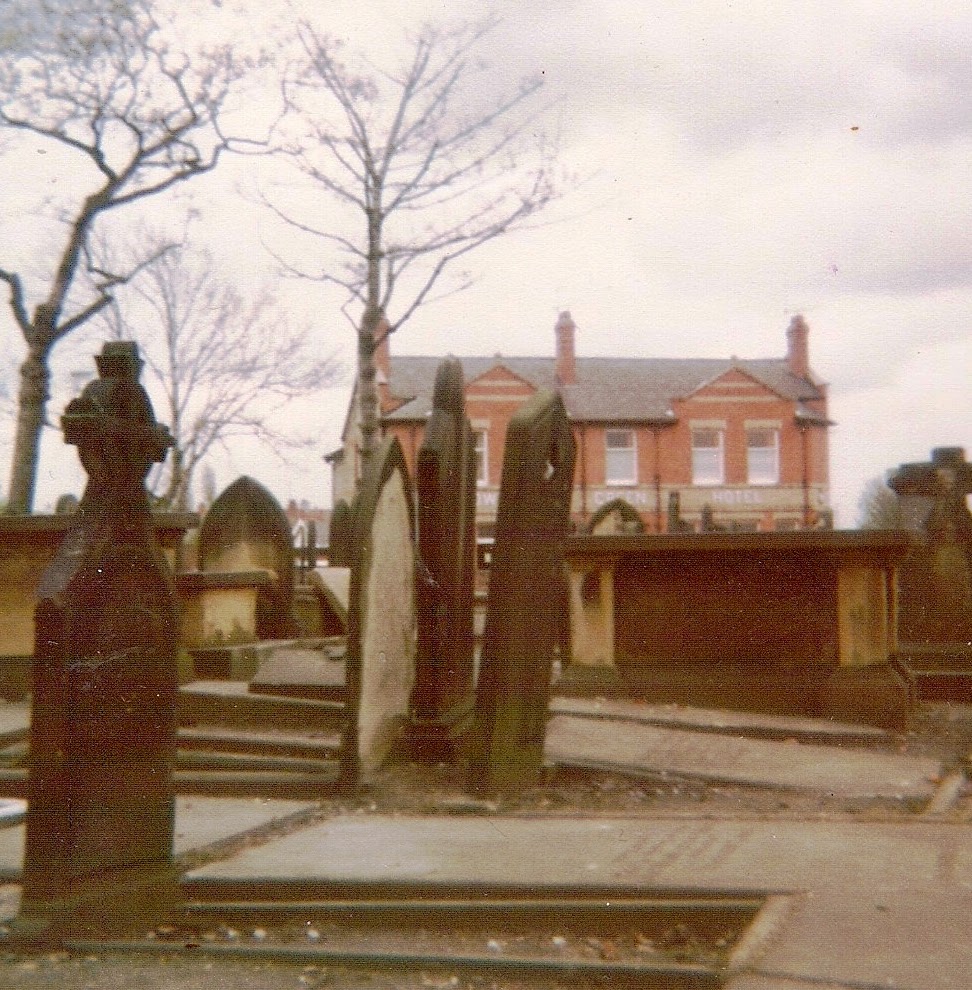
 I am looking at a picture of our own parish graveyard sometime in the late 1970s and it records a scene which has long gone.

When the gravestones were numerous. 1979
Many of the gravestones would be removed during the make over which turned a neglected and forlorn spot into a pleasant recreational area.

In total there had once been 361 monuments to those who had been buried in the graveyard, but only a few survived the rest are lost to us.

And that of course is a terrible loss, both for the descendants of those who were interred here and also to the historian wanting to uncover Chorlton’s past.

Because here had been buried the people of plenty, along with the less wealthy, ranging from farmers, tradesmen to the families of farm labourers.

The Stopford family, 1979

The earliest recorded burials date from the mid-1700s with the possibility there may have been some from the previous century.

We do have the parish burial records along with an inventory made in 1975 of the 361 gravestones, but that will never be the same as standing in front of them and reading not just the names but also the messages that were left.

The Isherwood family, 1979
Like that of William Barlow Stopford who “fell asleep in Jesus” aged just 23, who was buried with his father who was 31 when he died and William’s brother Frank who died on November 14th just 19 months old. 

Sadly, their gravestone is one of the missing ones, along with that of the Isherwood family, whose gravestone records the names of six, two of whom died at 8 and 14 months.

In time I will go looking for their stories but for now all I have are pictures of their gravestones and the locations of where the two sat.  The Stopford’s rested just east of the lych gate and was the first you would encounter on entering the graveyard while the Isherwood plot was one of six graves that rested against the south wall of the church.

I wish I had taken more on what must have been a spring day in 1979, but soe far I have only turned up the two images amongst the 1500 or negatives which I am slowly digitalizing.

There may be more but at present that is it.

Location; the parish graveyard

Pictures; lost scenes from our parish graveyard, 1979, from the collection of Andrew Simpson


Thursday, 23 July 2026

A Chorlton wedding in the April of 1913 and a tiny mystery

I doubt I would ever have got to know about Mr Hugget Billing and Miss Vivien Horsfall Attwood if it weren’t for Sally’s wedding photograph.

The couple were married at St Clements Church in Chorlton-cum-Hardy on April 16th 1913, and on that Wednesday the Manchester Courier was on hand to record the event which according to the paper was “crowded.”

And I think that may have been down to Vivien’s father who was a journalist and newspaper editor.

As such he will have been well known, added to which the family had lived in Chorlton on Cavendish Road from at least 1901 and so I guess there would have been plenty of local well wishers.

Mr Herbert Huggins Billing was a salesman who had been born in Rusholme, lived in Ancoats and in 1911 was residing in Longsight.

The couple settled in Chorlton and lived at 42 Claude Road.  Vivien died in 1930 and Herbert Huggins fourteen years later.

In time I will delve deeper into their stories.  I know they had two daughters and just before his death Vivien’s father was living opposite them at number 55 Claude Road.

Of course all such research runs the danger of becoming intrusive especially if there are direct living relatives and so I am minded to concentrate on what their lives might tell us about Chorlton and Manchester during the first half of the 20th century.

The records of how much all three left when they died reveal something of their financial background and a future hunt will tell us which paper Vivien’s father edited, and in time I might solve the little mystery of why her parents and her husband are all buried in Southern Cemetery but she is missing from the family plot.

That maybe because she died at Oakmore in Cheshire but I can’t be sure.

That said even I have to own up to a little curiosity and wonder why Miss Attwood gave her age as 28 in 1913 when she was in fact 31.


Picture; A Chorlton Wedding, the Manchester Courier, April 17 1913, from the collection of Sally Dervan

Thursday, 16 July 2026

A history of Chorlton in just 20 objects number 11 ....... the Lych Gate and Jubilee 1887


 A short series featuring objects which tell a story of Chorlton in just a paragraph and  a challenge for people to suggest some that are personal to their stories. They are in no particular order, and have been selected purely at random.

The Lych Gate on the green at the entrance to the old parish graveyard is an iconic image of Chorlton but dates only from the old Queen’s Jubilee in 1887.  It was paid for by the banker Cunliffe Brooks and is a very visible if now forgotten quarrel between those who favoured the new church on the corner of St Clements and Edge Lane, and the traditionalists who still worshipped on the site where the first chapel had been built in 1512.  I could have chosen anyone of a number of images of the gate but have chosen this one by Peter Topping, whose work is on display around Chorlton and can also be seen at https://www.facebook.com/paintingsfrompictures

Pictures; © Peter Topping 2012

Monday, 29 June 2026

A postcard and a memory of our declining rural past

This remains one of my favourite pictures of the old church.

 It was taken sometime before September 1904 but could have been at any time after 1837 when the two side aisles were added.

 The cottage to the right was there by the beginning of the 19th century if not before while the roof of Higginbotham’s farm house behind it was at least fifty years older.

And it was a view that would soon be lost forever. Within six years the old Bowling Green Hotel just out of sight on the right would be demolished and replaced by a new pub which would obscure our view of the church entirely.

 It is still a rural scene and bits of farm equipment are littered around the picture and reminds me that here we were on the edge of the village which were cultivated as meadowland.

But for me what adds to the picture and makes it unique is the message on the back. In an age when a postcard sent in the morning could arrive in the afternoon postal messages remained the quickest and cheapest easy of communicating with friends and relatives.

In this case the offer by Mrs Wood of Manchester Road to help at the harvest festival decorations at the old Church on Saturday was “gladly” accepted. It had been sent on the Wednesday afternoon of September the 21st and would have fallen through the door of Manchester Road for teatime or certainly by the following morning.


Harvest festivals were still a real part of the life of our community at the beginning of the 20th century and ones which celebrated the end of a successful year on the land.

 There may have been fewer people who relied on farming in the township but there were still enough for a bad harvest to spell hardship and perhaps even ruin.

Mrs Wood’s husband had been born into a farming family and his father had farmed at Red Gates till his early death in 1902 aged just 52. Red Gates did not long survive his death and in the next few decades more of the farms which dated back to before the 19th century closed.
I am indebted to Carolyn Willits who lent me the post card and gave me permission to use it.

Lcation; Chorlton

Picture; the old Church, Chorlton-cum-Hardy, 1904,  from the collection of Carolyn Willits

Friday, 26 June 2026

Mr Gratrix's clay pipe lost in our garden in 1845

The pipe found in the garden, 2014
It is not much of a piece of history but I found it in our front garden which makes it special and takes me back to sometime in the 19th century.

It is a bit of clay pipe and was probably thrown away by some one working this bit of land, or by someone passing along what was then called the Row.*

It is even just possible it came from night soil brought in from Manchester to spread on the fields of Chorlton.

'Like any time in history some of the most revealing clues to how people lived are contained in the rubbish they threw away.  Across the township one of the most common items to resurface is the humble clay pipe.

Found in the parish churchyard, 1980
Usually they are broken and often turn up on their own, although sometimes a whole batch has been unearthed over a period of time all quite close together.

They were the pipe of the working man, and some working women.  

Inexpensive, easy to make and made in huge quantities, they are a true example of a throw away product.  

They were smoked in the home, in the pub and at the work place.  

The evidence from sites in some of the poorer parts of London show that the owners smoked heavily.**

Clay pipes come in many different sizes, some with long stems and decorated bowls and date from anytime from the 17th through to the 20th century.  The last clay pipe manufacturer in Manchester only ceased trading in 1990.

The most interesting pipe to come back out of the earth was found in the archaeological dig of the church in the 1980s.  It can be dated to between 1830 and 1832, and may have been bought to commemorate the coronation of William IV.  


The William IV pipe, 1830-32
It bears the inscription “William IV and Church” around the rim and is highly decorated with the royal coat of arms flanked by a lion on one side and a unicorn on the other.  

It is also unusual because it was found in one of the graves inside the church.  

The final burial in the grave was that of Thomas Watson aged 54 in 1832.  

There are those who might well imagine the pipe being placed alongside the coffin of Thomas Watson in imitation of the ancient practice of placing grave goods alongside the departed.  

The less romantic will counter with the obvious observation that it was the casual act of one of the grave diggers.  

Either way it is unusual for the bowl to survive.   More commonly it is the stem which is turned up and even these are found as fragments.


Detail of the pipe
Clay pipes were never expected to last.  At best they might survive for a few weeks and in many cases just days.  But then they were cheap.  

Very little has been published on the price of pipes but adverts dating from 1799 have unglazed ones selling at 2s 6d [12½p] a gross.  Just over 130 years later the 1930 Pollock catalogue was selling them at 4s [20p] a gross.  Longer pipes did cost a little more but these were not the choice of the working man in the fields.  

Shorter pipes could be smoked while working and it is these that turn up in the fields around the township.'***

So I wonder about my bit of pipe.

I would like to think it belonged to Samuel Gratrix who was farming this bit of Egerton land in the 1840s, but chances are it was discarded by someone passing along the Row, or worse still dropped into a privy somewhere in Manchester, only to make its way with a cart load of night soil along the Duke's canal to Chorlton.

But that along with Mr Gratrix and his field belong to another story.

Pictures; clay pipe, 2014  from the collection of Andrew Simpson, and other pipes from the report on the Archaeological dig conducted by Dr Angus Bateman during 1980-81


*The Row or Chorlton Row is now Beech Road

** Pearce, Jacqui, Living in Victorian London: The Clay Pipe Evidence, 2007, Geography Department at Queen Mary, University of London

***from the Story of Chorlton-cum-Hardy,   http://chorltonhistory.blogspot.co.uk/2011/11/the-story-of-chorlton-cum-hardy.html

Tuesday, 12 May 2026

The Lost Chorlton pictures ......... no 8. ......... giving the graveyard a make over

This was when the parish church yard got its last makeover.

But it will have been in the early 1980s and involved clearing away many of the old gravestones, and landscaping the area including picking out the footprint of the old church, which had stood on the site since 1800 and replaced an earlier chapel which dated back to around 1512.

I can’t exactly remember the old cluttered grave yard or when the makeover happened but the picture will date from the early 1980s soon after it had been completed, when the trees and bushes had yet to grow.

Location; Chorlton

Picture; the churchyard, 1981 from the collection of Andrew Simpson

Thursday, 19 March 2026

The old church on the green in 1933

This is one of my favourite pictures of the old parish church.

It was taken by F. Blyth and appeared in A Short History of Chorlton-cum-Hardy written by J. D. Blyth in 1933.

Now at present I don’t know whether J.D. Blyth was the father or brother of the photographer, and both remain shadowy figures.

The text is drawn from the work of the late 19th century historian Thomas Ellwood and pretty much repeats the earlier work word by word.

Not that there is anything wrong in that.

Mr Ellwood’s work had been published as a series of newspaper articles between 1885 and 86 and while some of them reappeared in church magazines during the early 20th century I rather think that that by 1933 they were less well known.

That said it is the three photographs that draw you into the short history, and this is partly because we do not have many floating around from the 1930s.

This one of the church was taken from the south and it shows off some of the detail which is often missing from other pictures.  The side aisles were added in 1837 around the time that two Arnot stoves were installed for heating and the flue and chimney of one of them is just visible behind the spire.

The church had just another seven years of working life because it was closed in 1940 and demolished in 1949.

The grave stones remained in place until the area was landscaped in the early 1980s and many of the headstones taken away.

Picture; the parish church from the south, 1933, by F. Blyth, from A Short history of Chorlton-cum-Hardy by J.D. Blyth, 1933

Sunday, 4 January 2026

A parish magazine ..... a heap of parochial news ..... and Mr. Lascelles's superior wall tiles ...... Chorlton 1903

Now by chance and with the help of Ida Bradshaw, I am back in 1903, trawling the pages of the March edition of the St Clement’s Parish Magazine.

There will be those who mumble that it is a journey which yields little, but not so.

Contained in its 20 pages are a mix of parochial news, some uplifting stories, accounts of the early Christian Church, and advice for children, along with  biblical questions, a hymn for missionaries and a problem for Draught players.

All of which are fascinating, but a century and a bit on, it is the adverts littered through its pages that make the magazine, a time machine.

In all there are eleven, some advertising national branded goods, but most from local tradesmen, including the butcher R. A. Cooper at 25 Barlow Moor Road, specializing in "Corned Beef and Pickled Tongue", and promising “family orders promptly attended to” and William Mellor, Carting Contractor and Coal Merchant, from 1 Hardy  Avenue whose “Coal Delivered in Bags".

Added to these was Thomas Birrell who was a “Joiner and Builder and General Repairer of Property” with a workshop on the “The Green near the Old Church”, “Estimates given for Greenhouses”.

But the one which drew me in was Geo. E. Lascelles “Dealer in Fish, Game, Poultry, 34, Wilbraham Road, And At Hobson Hall Poultry Farm Egerton Road, Speciality; New Laid Eggs, Farm Fed Chickens, Ducklings, Turkeys, Guinea Fowls Best of Everything at Lowest Possible Prices”.

Now what makes Mr. Lascelles just that bit ahead of his fellow advertisers is that his shop has already featured in several stories recently.

No 34 will be known to many as the home of Shareen Fashions, which supplied school uniforms, and  much more at decent prices, by a family who were always most helpful.


And it was during the alterations by the new owners that I spotted some beautiful period tiles.

Given that they were of fish and poultry I assumed they were put there by Mr. Worthington Brice who was listed as a fishmonger at the property in 1909.

But now I am not so sure, given that George Lascelles was doing the business with fish, chickens, ducklings, and much more six years earlier.

All of which may seem a very nerdy preoccupation, and I have to concede it is, but in the process it all adds to the story of where we live.

Location; Chorlton

Pictures; extracts from the St Clement’s Parish Magazine, March 1st, 1903, courtesy of Ida Bradshaw, and poultry tiles, 2019, from the collection of Andrew Simpson

Tuesday, 16 December 2025

Down in the parish churchyard by Chorlton green in 1976

Well having almost exhausted the collection of images on Chorlton in the 1980s, I think it’s time to wander back another decade.

We are in the parish graveyard in 1976 and I have to say despite walking through the place many times I have no recollection of it looking like this.

And I pretend to be a historian.

Still looking back through the back catalogue the place was like this in the 1970s and as you would expect plenty more from before.

So I shall leave you with Lois’s picture of the graveyard just before it was cleared and landscaped, but if you want more follow the link.*

Picture St Clement’s churchyard in 1976, from the collection of Lois Elsden

*St Clement's Church
http://chorltonhistory.blogspot.co.uk/search/label/St%20Clement%27s%20Church

Monday, 24 November 2025

Just 47 years ago in the village churchyard


Our parish churchyard in the April of 1978
It is just 47 years since this picture of our old parish church yard was taken.

And yet it is so far from the knowledge or experience of many in Chorlton that it might as well have been taken in 1878 rather than 1978.

And it is one of those odd things that despite having frequently walked past the crowded jumble of grave stones I have no recollection of the place looking like this.

Nor of the attack on the gravestone of Police Constable Cock who was murdered on August 1st 1876.  According to the local newspaper* “ the small headstone on the already battered, iron-railed grave in the old St Clements’s churchyard near Chorlton village green has been torn from its retaining screws by vandals or thieves attracted by the historic tablet.”

P.C.Cock's headstone, Preston, 1980
The original six foot high headstone which included the old Lancashire Constabulary crest was moved to Preston in 1956.

Now the murder is fairly well known and still crops up from time to time in stories of Chorlton.

At the time the understandable wish to get a quick conviction led to the arrest of William Hebron who was found guilty in the December but the death sentence was commuted to life imprisonment.

Which was all to the good given that just over two years later Charles Pearce who had a history of petty theft confessed to the murder of the policeman.

Looking back at the picture I continue to be surprised at the state of the place.  Leaving aside the vandalised graves you have to admit that it’s more than a little neglected.

Some of the headstones have been lift to tilt and those on the ground are uneven.

This is all the more shocking when back in 1847 an official inspection reported that the church and the graveyard along with the headstones were well kept and the grass mown regularly.

But this had been when there was still a church here and when people made their way down from the north entrance to worship in a church which dated back 149 years.

It had been built in 1800 on the site of an earlier chapel, survived the opening of a rival church on the corner of St Clements and Edge Lane and only closed in 1941 when frost damage made it almost impossible to hold services there.

Overturned headstone, April 1978
After that it lasted just another eight years succumbing to persistent attacks by vandals and was eventually demolished.

Not long after our picture was taken Angus Bateman and a team of people undertook two archaeological digs of the site and a little later the area was landscaped.

Now I remain ambivalent about that.  Certainly something needed to be done, and it is now a nice place to sit, but many of the gravestones were taken away and lost and the few that remain were not all returned to their original resting place.

And so the memorial stone to P.C.Cock is now situated close to the lytch gate which is some distance from where he was buried.

Does it matter?  Well yes I think it does.  Not only are the surviving headstones in the wrong places but the actual records of so many of the people who were born worked and died in the township are lost forever.

Their names and the often poignant inscriptions are no longer there to read and so it is almost as if they never were.

Looking north in 1978
Now I am not religious but I do think such memorials are important.  As historian I know they are, as indeed they are for anyone who has links with Chorlton.

And to underline that thought recently I met a descendant of the Reverend Booth who presided over services in the parish church for thirty-three years.  She was thrilled that his headstone had survived and paid for its restoration.  To her it was a very tangible link to her past family.

Nor is that quite the end.  For the gentleman in the picture is Mr Fred Casson who was verger of the church from 1930 till it closed in 1941.

He knew the church when it was still a lively and important part of the community and reflected on the struggle to maintain graveyard.  “Manchester City Council now look after the graveyard. They do a lot of repair work but every time workmen finish one job vandals smash something else.  It’s a losing battle.”

Looking north in 2009
Today by and large the place is vandal free and it is pleasant place but I rather think I would like it as it was, even if it meant coming down and helping make good from time to time.

And there I shall leave it.

Picture; from The Journal Thursday April 13, 1978, the Loyd collection and the collection of Andrew Simpson

*Vandals wreck memorial to famous murder, The Journal Thursday April 13, 1978

Saturday, 30 August 2025

Snaps of Chorlton No 6 the parish churchyard before the landscaping, 1976

An occasional series featuring private and personal photographs of Chorlton.

We are in the parish graveyard in 1976.  I have to say despite walking through the place many times I have no recollection of it looking like this.  And I pretend to be a historian.

Location; Chorlton


Picture; from the collection of Lois Elsden


Wednesday, 13 August 2025

Three Forgotten Graves .... another story from Tony Goulding

This memorial to Helen Richmond Cox is one of three situated alongside a boundary wall of the old St. Clement’s churchyard in Chorlton-cum-Hardy. 

 Memorial to Helen Richmond Cox

All three are to a greater or lesser extent obscured by vegetation. Not that any actually mark their remains nor even the site of their graves. 

All the bodies in the graveyard were exhumed in 1930 and reinterred in Southern Cemetery then in the 1980s when Manchester Council decided that graveyard was in a hazardous state and needed to be landscaped, most of the memorials were removed then either destroyed or haphazardly replaced. 

Esther Floweth’s memorial
Some were laid flat to form a pathway with others replaced as ornamental features.    

One of the other gravestones records the birth and death of another child, Esther Floweth, who died on 1st March 1868 aged just 5 years and 9 months. The third is of Anne Ormrod, who was 80 years old when she died on 9th June 1867 while visiting her daughter on that forgotten road of Chorlton-cum-Hardy, Lloyd Street.

None of these three burials were of a parishioner of St. Clements. Although Ann Ormrod was residing in the parish when she died, she was a native of Bolton, Lancashire. 

Helen Richmond Cox hailed from Stretford, and Esther Floweth lived in Hulme, Manchester. This is not at all unusual, as of the 841 burials recorded in St. Clement’s burial register between 1st January 1851 and 31st December 1876 only 320 show their “abode” as Chorlton-cum-Hardy. 

This comprises just 38% of internments.  However, closer examination reveals that with the expansion of the township’s population the trend from1860 onwards was for a gradual increase in the percentage of “local” burials.

Ann Ormrod’s gravestone
While many of those buried who were not residents of St. Clement’s parish were from neighbouring  townships of Didsbury, Withington, and Stretford the majority were from further afield. Hulme and to a lesser degree Chorlton-on-Medlock were the main areas although, Ardwick, Pendleton, and Salford also featured. There was even a small number whose homes were given as much further away in places like Blackpool and Everton!

The large number of non-resident burials obviously made a substantial contribution to the pressure which forced the Home Office to close the graveyard (1) following an enquiry on 25th November 1881.

It is impossible to know the motives involved in these choices to inter a loved one in Chorlton-cum-Hardy, but it is fun to speculate. One reason could be antagonism towards their local vicar leading them to worship in St. Clement’s. 

It could be a combination of the desire, with the industrial spread of Manchester during the middle of the 19th century, for a more idyllic place to bury loved ones offered by the still rural Chorlton-cum-Hardy and the opportunity for some extra revenue for the parish the burial fees would provide. 

Finally, it has been suggested that in some instances there was either no local church or one with a very limited if any graveyard. Some also will have had relatives buried in St. Clement’s. This was the case with Maria Birley of Southport, Lancashire, the widow of Rev. William Birley who had been appointed St. Clement’s first Rector on 17th February 1843 and served in that post until December 1859. (2)     

In this category also is the burial of Frederick Cope on 26th February 1874 whose home address was by far the most distant. After a successful career as a wine merchant in Manchester, when he resided for a time at Oak Bank, Chorlton-cum-Hardy, he retired to his birth county, Warwickshire, viz, Campion Lodge, Leamington. Following his death there on 19th February 1874 his coffin was brought north, and he was interred in the same grave as his wife Elizabeth and two of his children Emily Simms and Frederick Adam (3)

To conclude, like Ann Ormrod, one of the Blackpool residents, William Hughes, was also a visitor to the area. In his case after attending a sale in Manchester he intended to call at Barlow Hall hoping to get a position there and to look-up some old friends in the area he knew from his previous work as a coachman at the Hall, for Sir William Cunliffe Brooks. 

Barlow Hall - 1910
The unfortunate man was “found drowned” that being the verdict of the inquest into the circumstances of his death held at Jackson’s Boat on 17th December 1864.

The matter was widely reported in the press as he was found in “The Moat” a pit in the garden of the home of a prominent banker Conservative M. P. and a Baronet!

Pictures, Barlow Hall – 1910 by Jenny Wylie http://www.british-history.ac.uk/image.aspx?compid=41427&filename=fig99.gif&pubid=288, others from the collection of Tony Goulding.

Notes: -

1) The order prohibited the opening of new graves and only allowed burials of those with a family plot and only if there was sufficient depth to adequately cover the coffin. The final burial was that of Thomas Caleb Butcher on 25th February 1916. (Blog story 22nd August 2020).

2) Rev. William Birley had become an inspector of schools and was the Rector of St. Stephen’s in Pendleton, Salford when he died on 27th July 1865, he was interred in his previous parish’s graveyard. Interestingly the entry in the burials register of St Clement’s shows that his abode was first entered as Chorlton-cum-Hardy before being amended to Pendleton.

3) Both of Fredericks children buried in this grave died young. His daughter, Emily Simms was just 13 years old when she died in April 1846.  Frederick Adam, his only son, died in a tragic suicide when he shot himself in the evening of Friday 1st July 1853. (Blog story 24th October 2015)