Showing posts with label Barlow Moor Road. Show all posts

Tuesday, 7 July 2026

A history of Chorlton in just 20 objects number two ........ the tram terminus 1928


A short series featuring objects which tell a story of Chorlton in just a few paragraphs and  a challenge for people to suggest some that are personal to their stories.

I have chosen the tram terminus sometime around 1928.  Trams took the township out of the era of the horse drawn coach into the 20th century.  In 1903 the route from Belle Vue via Brooks’ Bar and Upper Chorlton Road was extended to West Point at Seymour Grove and four years later was extended again to Lane End,the junction of Sandy Lane and Barlow Moor Road. And in that year of 1928 Manchester trams carried 328 million passengers on 953 trams via 46 routes and along 292 miles of track.  We had indeed become part of the city.

Picture; from the Lloyd collection


Sunday, 5 July 2026

Renshaws Buildings in Martledge


Even I have to admit that this bit of road and kerb stone is not the most exciting picture of Chorlton and yet it is all that is left of Martledge that part of the old township which ran from the four banks down to the library.

All this week I have been writing about the place and today I want to focus on the building which ran along the side of this bit of road.  It was a block of six or maybe 12 dwellings and was variously known as New Buildings or Renshaws Buildings.

It was set at right angles to what is now Barlow Moor Road and in its time must have looked the part. It had a large impressive gable end and despite being farm cottages dominated this part of Martledge.

The block was owned and may have been built by John Renshaw sometime before 1832.  He was a market gardener living in a farm house on the Row* who also owned a number of cottages around the township.  Some at least would have been wattle and daub structures but Renshaws Buildings were made of brick.

Now I can be fairly confident that they predate 1832 because they are listed as part of his property qualification which entitled him to a Parliamentary vote in the newly reformed House of Commons.

And it maybe that they represent the first building boom here in Chorlton in the 1840s and 40s by speculative tradesmen who wanted to cash in on the population increase or maybe just the desire of local people to live in a house made of brick rather than wood, mud and straw.


It is unclear how many units there were but the evidence from the census and the old maps suggests that they were one up one down back to back dwellings.  By the beginning of the 20th century part of the block had been converted into commercial use and just before their demolition this bit was a garage.

They came down sometime in the 1920s or 30s to make way for the present Royal Oak pub.  I wish we had some written memories of what they were like but sadly we don’t.  On the other hand we do have a few photographs from the late 19th and early 20th centuries along with details of who lived there from the 1840s and the rents they paid, but for all that it is back to the book where you can see Barris’ reconstruction picture of Renshaws Buildings in more detail.  It is based on a number of the photographs and maps and we are looking at it from the west, as if were heading into the township from Manchester.  The kerb stone and narrow road are hidden on its eastern side.

*Today this is Beech Road and his home was on the site of Ivy Court facing the Rec

Pictures; from the collection of Andrew Simpson and Barri Sparshot

Saturday, 4 July 2026

History on display today ... the Chorlton event not to miss ..... at 11 am at the Co-op on Barlow Moor Road

 History comes in all shapes and sizes and none more so than the Hardy Lane Co-op store here in Chorlton which is just a tad short of celebrating its 100th birthday.

The Hardy Lane Co-op, 1966
That in itself would be worth commemorating, given that the Co-operative Movement was at the heart of providing good quality food and other products at affordable prices with the bonus that its members received a share of the profits in the form of a dividend on all their purchases.

It is a retail model which was already offering an excellent deal before the Rochdale Pioneers opened their successful shop.

At its zenith the movement had shops, factories, and ships providing families with all they could want from food, furniture, clothes and holidays as well as banking and a funeral service.  

It was organised through Co-operative Societies and for many households it was the place you went to for everything.

Household HintsCo-operative Wholesale Society, undated

And so embedded were the societies in the lives of working people that many can recall their “divi” number which customers proffered up every time they bought something.

R.A.C.S token, undated
We were in the Royal Arsenal Co-operative Society which was a vast organization covering all of south London and into the Home Counties, and like other societies had both a political and educational wing through which it promoted the ideals of co-operation and a host of events designed to enhance cultural activities and international understanding.

And here in Manchester was the headquarters of the movement centred around Balloon Street.

What marked out the retail arm of most of the societies were the meeting rooms above the shops which could be hired for community use.

All of which brings me back to the Hardy Lane Co-op which is one of only a few shops which still have a functioning meeting space.

Over the last 97 years its room has hosted everything from the Chorlton and Manley Co-operative Women's Guild to the Woodcraft Folk, meetings of the Co-operative and Labour Parties to cinema nights and Whist events.  

Co-op products, undated
As such it has been at the centre of the community it was opened to serve.

Now I have already written about the Chorlton and Manley Co-operative Women's Guild.*

Yet to be written is the story of Barbara Castle’s visit.  She was a  British Labour Party politician who was a Member of Parliament from 1945 to 1979, making her one of the longest-serving women MPs in British history.  

And with that story should be an account of the Woodcraft Folk’s activities and the many events held to promote Co-operative products and the underlying principles of the Co-operative Movement.

But I will close with the story of the tea trolley.  

It was an essential part of any meeting and would be trundled out at many of the meetings I attended there.  It was not as old as the tea urn or the big brown tea pot but old enough to have clocked up plenty of events.

That tea trolley, 2012

And I suppose in its way is a symbol of all those meetings going back almost a full century when the great business of the day stopped for light refreshments including Co-op tea and co-op biscuits.

Co-op tea, undated
Just leaving me to announce that Chorlton Civic Society in partnership with the Co-operative movement will be unveiling a plaque at the store to commemorate the historic role of the meeting room to the community.**

The ceremony will be on Saturday July 4th at 11 am.

Location;

Pictures; Barlow Moor Road, 1966, courtesy of Manchester Libraries, Information and Archives, Manchester City Council, R.A.C.S., token undated from the collection of Andrew Simpson, remaining images from the collection of Lawrence Beedle http://images.manchester.gov.uk/index.php?session=pass

* On small things history turns …. commemorating the Hardy Lane Co-op https://chorltonhistory.blogspot.com/2026/06/on-small-things-history-turns.html

** Blue Plaque for Hardy Lane Co-op Store https://chorltonhistory.blogspot.com/search/label/Blue%20Plaque%20for%20Hardy%20Lane%20Co-op%20Store


Friday, 29 May 2026

Looking out from Barlow Moor Road in the summer of 1960

There is a singular lack of images of Chorlton during the middle decades of the last century.


Look through the collections and you can find plenty of fine examples of what the township looked like during late 1800s and early 1900s.


Most are from commercial photographers who sold their work on to picture postcard companies, and never missing an opportunity also took plenty of photographs of individual streets, which they then offered up to residents for “a knockdown price”.

But by the 1950s the golden age of picture postcards was drawing to a close, just as cameras became cheaper and more readily available, which ushered in “the snap”.

The snap was usually a very personal image, sometimes a little out of focus and in most cases consigned to a photo album, or the back of a cupboard.


Sometimes the odd one gained pride of place on a fridge or notice board, only to fade with the years and become “tired” from much passing around.

All of which brings me to a set of sketches made by my friend Ann of the Chorlton she knew back in the 1960s.

Ann grew up on Barlow Moor Road at what is now 523 , and as part of various art projects she sketched some of the rooms in the house as well as view out across the back garden.

And include three of Chestnut Avenue, which were made in the summer of 1960 and included “The first house on the right which was an Opticians, when I lived at 523”.

Location; Chorlton

Pictures; Chestnut Avenue, August 1960, from the collection of Ann Love


Wednesday, 27 May 2026

523 Barlow Moor Road back in 1961

The Stables, 1961
The recent past is a time I take for granted. 

I guess for some of us this is because it really doesn’t seem history.

I was born in 1949, grew up in the 1950s and 60s, came to Manchester in 1969 and began full time work in 1973.

Those decades and the next two are still vivid and familiar periods and I don’t count them as the past, and yet they are and we did do things differently then and this is the starting point for some new stories.

Back in 1961 my friend Ann lived on Barlow Moor Road in one of those large houses facing Chestnut Avenue.  This was number 523 and it was also where her father ran the family undertaker’s business.

The rear of 523 Barlow Moor Road, 1964
At the time Ann was still at school and regularly recorded the house and surrounding streets in a series of pictures for her art classes.

“The ground floor plan was quite unusual, in that there was a very large room on the right at ground level. 

The rest of the house was raised up about 6 feet, so there were steps at the front, back, and inside, above the basement, which stretched under the whole house.

In the garden there were the old stables at the end of the garden which my Dad used as a workshop to make the coffins, and also doubled as a garage.  

Previously it had been numbered 66, and before that 52.”

Looking out on Chestnut Aveneu, 1961
Like so many of our bigger house which has survived being demolished this one has been converted into flats with an extension added at the rear.

I am hard pressed now to remember it as it was which is why I am so pleased that we still have Ann’s painting and line drawings of the property.

They are almost the only record of this bit of Barlow Moor Road from the period and remind me of how things can change without us even noticing.

Over the next few weeks I shall be featuring more of Ann's pictures and it occurs to me that there may be plenty more photographs, paintings and drawings of Chorlton which it would be nice to include.

Pictures; 533 Barlow Moor Road, 1961, © Ann Love

Tuesday, 26 May 2026

Growing up in Chorlton in the 1940s at 523 Barlow Moor Road

Now 523 Barlow Moor Road still stands today although with additions at the rear it has become a property of multi occupancy.

But for most of the 20th century and a bit of the late 19th it was a family home and during the 1940s and 50s it was where my friend Ann grew up.

And as you do I asked her to write about the place, and here,  spread over two parts is her account of one house in a Chorlton we have now pretty much lost.


"523, Barlow Moor Road was a large detached house, set back from the road, with a small front garden, planted with deep red rhodedendrums

The house had four floors, which included attics and cellars, each with at least four rooms.

As both my parents worked from home, and I was an only child, this left me plenty of time to explore the house and garden.


At the side of the house was an old conservatory, and there were several old sheds, and stables which my Dad used as a workshop and garage.

On wet days, I would wander round the house, sometimes venturing up to the attic (Quite a scary place) where there were rooms full of interesting things.

One of my Uncles had tried to set up a business repairing bicycles, and there were frames, and wheels hanging on one wall.

The rest of the room was like a laboratory, with jars, bottles and chemicals laid out on benches..

I spent many happy hours mixing powders and liquids, watching things fizz, but as he'd been trying to make cosmetics, nothing exploded.


Another room was full of furniture, trunks full of clothing and clocks, which I would wind up until they no longer worked.

The third room was used to store old paintings and prints that my grandfather had bought at auctions, plus many old urns and other containers full of ashes, which had never been collected.

My father, as was his father before him, was an undertaker. They made all their own coffins from planks of wood, which were stored in the cellar.

When they were needed, Dad and Grandad would carry the wood down the garden to the workshop, where my Dad would cut it to size,and bend the sides to shape, by scoring the wood and steaming it, holding it in place with clamps.

He would then attach the bottom and sides with nails and glue, which he made in a little 'kettle' from horse bones.

When I was small, Grandad would tell me that they made boats, and he and my Dad would carry me up the garden in the coffins.I thought that was great fun.

There was another large workshop in the house, where my Dad would paint a layer of tar on the inside of the joints of the coffin (to prevent leakage) and my mother would then line the coffins with kapok and cheap taffeta."

© Ann Love, 2014

Pictures; the house in the 1950s, and drawings of the interior and exterior from the collection of Ann Love

Tuesday, 19 May 2026

Chorlton Office, a pair of boots and a bus stop ................

This is one of my favourite pictures of Chorlton in the 1960s which comes from  George Cieslik’s collection.

I do like those images of the not so distant past, when much of what you can see is almost like today, but not quite.

And this one is no exception.

There in the distance is the old cinema, and in front, the building which over the years has had many different uses, from doctors’ surgery to a café, an antique shop and more recently a DIY centre and discount store.

Back in the 1940s it was still a residential property and out of the blue a few years ago someone contacted me with the story of when they lived there.

The keen observer will spot that the church on the corner of Barlow Moor Road and Sandy Lane had yet to be demolished, while the parade of shops opposite the cinema had yet to lose their stone ornaments.

But for me it is the very little details that make this photograph so fascinating.

It starts with the building which is now the home of diving club but back then was still the Chorlton Office and looks little different from when it was opened in 1915 as part of the terminus for the Corporation trams.

And that raises the question of just when the cast iron and glass veranda was spirited away.

And then for me there are the tiny personal things, starting with the old bus stop sign, with the Corporation logo, which was still in use when I washed up in Manchester in 1969 and the boots the woman beside the lamp post is wearing. 

They will have had a zip up the front, were made of felt with rubber soles, and an imitation fur lining, and were the bees’ knees back in 1962.

Others of my generation will single different things out, from the Belisha Beacons to the Morris Minors, and some like me will remember how the cab of the white lorry looked so modern when compared to others on the road.

And that is, other than to thank George for another slice of 1960s Chorlton.

Location; Barlow Moor Road

Picture; Barlow Moor Road, circa 1962 from the collection of George Cieslik

Wednesday, 6 May 2026

Living at 523 Barlow Moor Road in the 1940s

I am back with the memories of my friend Ann who grew up in a big house on Barlow Moor Road in the 1940s and 50s.

Her parents ran an undertaker’s business and along with descriptions of the house there are some wonderful insights into the work they did

"Like most houses in the 1940's, there was no central heating, and in winter, the only room which was warm was the kitchen. 

This was heated by the 'Range' a small open fire, which heated an oven, and a top oven for pans, and was covered in dark blue tiles. 

There was a trivet to stand the heavy cast iron kettle, and a coal scuttle which needed refilling several times a day, which meant going down the cellar for buckets of coal.  

Each side of the Range was fitted cupboards, and my Mum had her sewing machine in front of the window. 

She had trained as a dressmaker, and had worked in Manchester making and altering dresses, before she was married, and then had become a housewife’, as women did in 1928. 


She told me she had altered a dress for Tallulah Bankhead, (A famous actress at the time) and that it hadn't been cleaned, and smelt of sweat.

Entertainment at the time was the wireless, or the piano, or having friends round to play cards.

There wasn't a sink in the kitchen, but there was a small room at the side called a scullery, where the washing up was done. We didn't get a washing machine until about 1957, so all washing was done by hand, except for large things, like sheets and tablecloths. 

Our Laundry No was 1971, which incidentally became the year of our marriage.


Each Saturday evening at 5-o-clock, there had to be absolute silence, whilst my Dad checked his football pool results. He won 100 pounds one week, and bought my Mum a fur coat.

The workshop at the side of the house was the only room on ground level – all the other rooms were about 6ft above, and were reached by steps at the front and the back. 

There was a door from the driveway which led to a short passage, one side of which had a glazed partition, with the workshop to one side.

This was where Dad would varnish, or wax polish the coffins. Wax polishing was only done on the more expensive coffins, as it was very time consuming, and required several layers of wax being applied and rubbed in, until my Dad was satisfied with the finish. 

Then my Mum would line the coffins with kapok and taffeta.

When business was quiet, Dad would make spare coffins in different sizes, which could be stored in the cellar. They were stacked against the walls, and were perfect for playing hide and seek when my cousins came over to play.  

The door from the driveway was used for deliveries – we had bread, and meat delivered, once or twice a week.


The bread was from bakers opposite the Lloyds Hotel, but the butcher, called Frank came from  Heaton Mersey.

The internal stairs led up to a short corridor with two doors, one leading to the kitchen, and another, with stained glass panels led to the hallway.

In the hall were two doors which led to the front rooms, and a short passage, with a room under the stairs, called the pantry. This just held all the extra china that we used when we had visitors. 

My father had a box which held a most peculiar implement – he had been on a course to embalm bodies, (preserve them) and the box held a sort of pump to remove the blood and replace it with embalming fluid. I can't remember it ever being used, but it sat on a shelf in the pantry.  

The two front rooms were called the dining room, and the lounge. Just to differentiate them I think.

The lounge was used as a billiard room when I was very young, and had a full sized billiard table, but when my grandfather re-married when I was about seven, it must have been sold. and we used the room in the evenings, and when friends came my mother used to play the piano. I had lessons, but didn't get very far, I was much more interested in drawing.

The 'dining room' was used when people came to make arrangements for funerals. There was a large oak table covered in a brown chenille cloth with a fringe, and a carved oak sideboard.

Dad would take down details of the kind o funeral that was required and organize everything.

From the laying out of the body, the type of coffin, the white gown which covered them, the nameplate and brass handles, contacting a minister to take a service, the cemetery or crematorium for the disposal of the body, hiring of the hearse and cars, bearers to carry the coffin (usually the drivers of the hearse and cars) obituary notices in the newspapers, and finally a meal for those who had travelled a long way, often at the Southern Hotel."

© Ann Love, 2014

Pictures; by Ann Love

Tuesday, 5 May 2026

Views from a Chorlton window …… sixty years ago

Yesterday I was looking out on Barlow Moor Road in the summer of 1960 in the company of Ann Love.


Now given that Ann lives in France, and I was in London in that summer of 1960, in the strictest sense we couldn’t be together, but she has shared with me some of the pictures she made.


Having sketched the interior of her home along with the roads around Chorlton, she took to capturing the view from a back bedroom window, across the garden  of her home at 523 Barlow Moor Road.

The images are now with the passage of sixty years quite unique given that what was her garden is now a car park. 

Location; Chorlton

Pictures; 523 Barlow Moor Road, 1960, from the collection of Ann Love

Monday, 4 May 2026

523 Barlow Moor Road, captured in a moment in time in 1960

Now I am back at 523 Barlow Moor Road where my friend Ann Love lived during the 1950s and 60s.

It is still there today but has undergone conversion into flats.

Over the last few months Ann has been sharing her memories of growing up in the house providing a vivid account of everything from the kitchen range to her bedroom along with some wonderful sketches of both the inside and exterior of the house.

And now along with more stories her husband has produced a series of detailed models of the property which perfectly create a large Chorlton house in 1960.

"The basement, or cellar as we used to call it, was reached by a door and steps from the kitchen.

It was always cool, and an ideal place for storage.

Half way down the steps was a wide shelf, where cold meats were kept, on a large platter, then continuing down, there were five rooms.

Firstly there was the coal cellar, this could also be reached by a door on the side of the house next to the workshop.

Once or twice a year the coal cart would arrive, with sacks of coal, the cart would stop in the drive, and the coal man would lift the sacks of coal from the cart and empty them down through the doorway into the cellar.

 We would have to count the sacks s they were emptied, because once the coal was in the cellar, it was just a big heap. The coal men were covered in soot from carrying sacks of coal all day.

All through the winter coal would have to be carried up from the cellar in buckets to keep the range in the kitchen alight.


Under the Dining room was a storage area for food – there was a meat safe, with wire mesh to keep out the flies, and jars and big earthenware bowls with preserves, and preserved eggs in isinglass.

The small room under the hall was full of shelves of tinned goods, corned beef and salmon, and pickles.

Under the lounge were coffins, standing on end, which Dad had made during quiet periods, in case of flu epidemics, and bad weather in winter. 

They were in a variety of different sizes, and good places to play when my cousins came over to play hide and seek!

Under the kitchen was where the planks of wood were stored, before being carried down the garden to be made into coffins. When the house was on fire, this could have been a real problem if it had caught fire."

© Ann Love

Models; Howard Love 2014


Thursday, 30 April 2026

Looking for a ball of wool, a lb. of apples and much more on Wilbraham Road

I doubt that any one born before 1980 would ever think that the stretch of Wilbraham Road from Albany down to Manchester Road would be populated by a string of fast food outlets, bars and charity shops or that Quarmby’s, Dewhurst’s and Meadow’s would have vanished like snow under a winter sun.

It’s not an original idea I know, but in the space of two decades much traditional retailing has gone.

I miss it, but I recognize that that way of shopping has pretty much gone, and the arrival of the bar culture has at least kept the shops from staying closed.

What follows are two pictures taken some time in the 1950s into the 1960s, of the businesses on Wilbraham Road and Barlow Moor Road.

I could write more, having explored the history of some of the shops, and made comment on the road signs and bus stops, but I won’t.  

However, the challenge is there for anyone what can to trawl their memory and offer up some memories of the shops, or better still some pictures.

Location; Chorlton

Pictures; Wilbraham and Barlow Moor Road’s, circa 1950s/60s. from the collection of Dave King

Monday, 27 April 2026

That house beside Malton Avenue that everyone remembers

Now this is one of those buildings with a history and almost everyone you talk to will remember it as everything from a doctor’s to a cafe and to an office.

It is on the corner of Barlow Moor Road and Malton Avenue and was built sometime after 1910 when the area was redeveloped.

It had once been part of the estate of the Holt family whose extensive garden ran from the corner of Beech Road along Barlow Moor Road down High Lane almost to Cross Road and then across back to Beech Road.

When the last of the family died in 1908 their large house was demolished, the trees along the eastern side of the garden were cut down and the Corporation used a stretch to build the tram terminus while the rest became houses, shops and the Palais de Luxe cinema.*

Sadly until now I had not come across much more about the place, and then out of the blue Douglas wrote to me asking about the cinema.  He “lived in the detached house right next to the cinema, on the corner of Malton Avenue and Barlow Moor Road, no 477, so the cinema wall formed one side of our garden. I went to the Burnage High School for Boys and also the Wilbraham School of Music in High Lane.”**

And all of a sudden the building was given a new lease of life as a place which was a home.

Now in the fullness of time I hope that Douglas will share more memories of number 477, the cinema and life on Barlow Moor Road in the 1940s

*A forgotten photograph, ............ the Palais de Luxe in 1928
http://chorltonhistory.blogspot.co.uk/2012/03/forgotten-photograph-palais-de-luxe-in.html 
from the series Chorlton cinemas, http://chorltonhistory.blogspot.co.uk/search/label/Chorlton%20cinemas

**Douglas Cook, www.whitedownmusic.co.uk
Picture; 477/483 Barlow Moor Road, 1959, A.H.Downes, m17516, courtesy of Manchester Libraries, Information and Archives, Manchester City Council, http://images.manchester.gov.uk/index.php?session=pass

Tuesday, 24 February 2026

A ghost cinema and a family home ……. Barlow Moor Road …. 1962

There will be plenty of people who instantly recognise the scene.

We are on Barlow Moor Road, and for many the large impressive building with its tiled faced will bring back memories of the cinema.

For this was the Palais de Luxe, which was opened in 1914, changed its name to the Palace around 1946, and closed  eleven years later.

After which the building was owned by Radio Rentals, and then sometime before 1969 it was taken over by Tesco and traded as such, until 1974.

This I know because of a reference in the planning records which record “Continuance of use of radio and television service centre as supermarket”.


Now given that it was already trading as a Tesco store, I think this might have been the moment when it was sold on to Hanburys, which was a chain of stores across the north which had its origins, when Jeremiah Hanbury opened a small store in 1889 in Market Street, Farnworth, selling butter and bacon.

Forty years later the business was bought by Bolton wholesale grocers E.H. Steele Ltd, and in 1997 the 31 Hanbury’s stores in the north west were acquired by United Norwest Co-op.

But for many it will always be the picture palace, and carried the distinction of being our first purpose built cinema, having seen off the  Chorlton Pavilion and Winter Gardens on Wilbraham Road, which in turn had done for the Picturedrome on Longford Road.


I missed it by just 20 or so years, but have written about it over the years along with all the Chorlton picture houses, and even uncovered the remains of the plaster features above the screen which still survived in the upstairs area of the former supermarket.*

And there will also be many who can reel off the various retail businesses which inhabited the building to the left, and which was once home to Douglas Cook who lived there in the 1940s and remembers, “living in the detached house right next to the cinema, on the corner of Malton Avenue and Barlow Moor Road, no 477, so the cinema wall formed one side of our garden. I went to the Burnage High School for Boys and also the Wilbraham School of Music in High Lane.”

And that I think is enough for now.

Location; Chorlton

Picture a ghost cinema and a family home, 1962-3801.4, courtesy of Manchester Libraries, Information and Archives, Manchester City Council, http://images.manchester.gov.uk/index.php?session=pass and Hanburys shopping bag, courtesy of Catherine Brownhill


Tuesday, 10 February 2026

Barlow Moor Road, Mrs Helen Burt and the postcard makers of Chorlton


It all began with this picture postcard and ended with a chance discovery.

The picture is remarkable enough but not an uncommon one of Barlow Moor Road some time in the first years of the 20th century or maybe even earlier.

To our right is the church and on the left what were still private residences.

The appearance of a photographer is still a bit of novelty judging by the way the three workmen are staring back at him.

Two have paused from pulling the hand cart while the third stands behind his ladders. In the distance is a policeman and even further away a tradesman’s cart.

Like many of these early pictures it has been taken on a summer’s morning when the light was good and there were fewer people about.

All of which makes it a magic moment captured when Barlow Moor Road was still a quiet and elegant place to live.

And that really might have been all there was to say.

A photograph which captures one of those moments taking us back to 1904 when the card was sent or perhaps even earlier.

But of course that isn’t all there is.  On the reverse is an enigmatic message which leaves the romantic and the detective in me wandering down countless avenues of speculation.  Chris had “arrived here safely.  Mr and Mrs W [were] here [she] was having a good time and Joe was married on Fri to Mrs P.  Don’t say anything.”

Now how could you not ponder on that, and in the fullness of time weave all sorts of stories?  But the historian in me stops short of such unhistorical thinking after all as Mr Gradgrind of Hard Times reflecting on teaching children reminds me “Facts: nothing else will ever be of any service ...... This is the principle on which I bring up my own children, and this is the principle on which I bring up these children.”

And yes there is one fact and it is that the card was published or perhaps taken by H Burt of Chorlton.  I checked the directories for a photographer by the name of Burt and even pondered on whether he might have been a newsagent or stationer.  After all the Lloyd family who ran the post office on Upper Chorlton Road sold their own postcards. But it led nowhere.

The only Burt was Harry Trevethhan Burt who opened his family business in Chorlton in 1895 and traded from the shop on Wilbraham Road until 2011.  His is fascinating story not least because he was a farmer’s son from Sussex who’s farther farmed 130 acres of land.  Harry trained at Kendal and Milne’s in Manchester before opening his own shop here in Chorlton.  There will be many who have fond memories of that shop.

But it is the fact that the Burt name appears on the postcard which interests me and looking through the collection I discovered a number which variously had “Published by Mrs H. Burt, Chorlton-cum-Hardy” or “H Burt Stationers.”

Helen Burt was the wife of Harry and described herself as a “Stationers shopkeeper” on the 1901 census.

So while Harry was building a family business which would last a century Helen was marketing postcards from just across the road from 1903 and most likely 1901.

All of which makes perfect sense but was something I had never clocked and in turn led me to look more closely at the small print on the back of the cards.

And here alongside the big companies were other names like the Lloyd family and Baylis, photographers of 49 Wilbraham Road and 26 Edge Lane as well as  W. A. Cooper of Chorlton-cum-Hardy and Harold Clarke of 83 Clarence Road.

Now a part from Harold Clarke who was working in the 1920s and 30s all the others come from that early pioneering period of photography. And there is really something exciting in discovering just how many people were engaged capturing the images and selling them on.

All of which leads me to conclude that a whole new avenue of research has opened up all thanks to Helen Burt and her postcard of Barlow Moor Road.  And that is not all because Helen I now discover was another of those traders who offered a private lending library and that opens up even more Chorlton history.

Location; Barlow Moor Road

Picture; from the Lloyd collection and St Clements Bazaar Handbook for 1928


Saturday, 31 January 2026

On a warm sunny afternoon on Barlow Moor Road, sometime before 1939


I like the way that old postcards can reveal our past in many different ways.

It’s every much as good as a detective story.

You start with the picture, move on to the postmark and the message and if you are very lucky may learn something from the manufacturer.

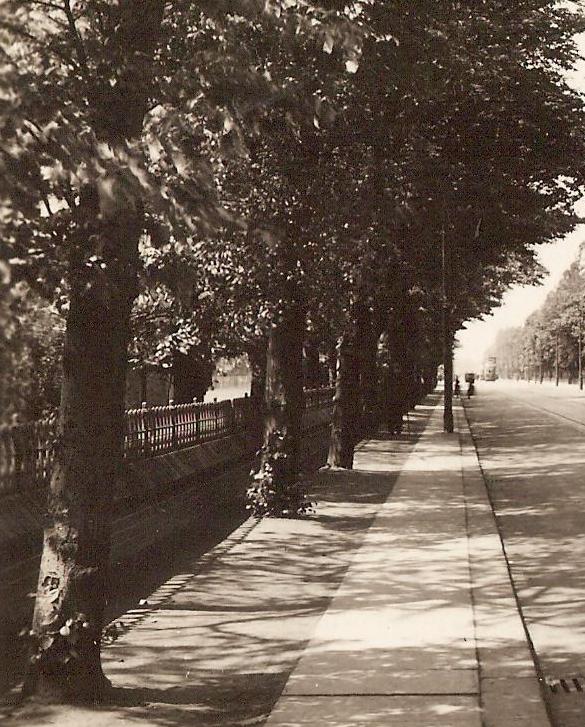
So here we are on Barlow Moor Road, sometime before May 1939, and judging from the trees perhaps on a sunny afternoon during the summer of the year before.  The trouble with these postcards is that the image may date back even earlier and will have been reissued over the years.

This one was taken by Harold Clarke of 83 Clarence Road Chorlton, and may have been part of a series issued by Lilywhite Ltd, of Brighouse, in Yorkshire.

There are 21 of his photographs in the Greater Manchester County Records collection dating from 1926 through to 1934 and some from 1926 carry a serial number close to the one in the picture.

Any way enough of the clever stuff and back to Barlow Moor Road on that sunny summer afternoon.  There is as ever a remarkable lack of traffic, with just a few cyclists a stationary hand cart, a couple of trams and what might be either a lorry or a coach away in the distance.

It looks to be afternoon judging from the shadows and the presence of the two school girls and it is scene which has pretty much vanished.

True the right hand side of the road looks familiar enough but the corresponding wall, railings and trees on the other side have long gone.

But having said that they were only demolished some thirty years ago when the road was widened and eventually the slip road onto the Parkway was constructed.

I will remember standing here waiting for a bus into town.  In the summer with the trees and the open land beyond that stone wall this was a pretty pleasant place to wait.

Nor am I alone in thinking so, because Lily writing on the back commented on how they had all enjoyed walking “under the shade of these trees.”

She lived on Withington Road and posted the card with its “Loving birthday greetings” on May 2nd, catching the 6.o’clock collection confident that it would arrive at 39 St Luke Street, Barrow in Furness for the following morning.

And it is still there today.

As is 83 Clarence Road, Chorlton where Harold A Clarke lived.

Although in the case of Clarence Road it is now Claridge which is the one that runs from Manchester Road over Oswald Road and into Peveril Crescent thereby offering up one last intriguing fact.

For here is another of our lost roads, or more accurately one of our renamed roads.

In 1911 there were three Clarence Roads.  There was our own as well as one in Longsight and another in Withington.

So not bad for one postcard.

Picture; from the Lloyd collection, date unknown

Friday, 30 January 2026

Stories from our Co-operative past ………… no. 1 Chorlton and Manley Park Women’s Guild

1948
For years this banner took pride of place on a wall in the Committee Rooms above the Hardy Lane Co-op store on Barlow Moor Road.

In those quiet moments during meetings I would stare at the banner and ponder on its history.

I can’t date when the banner was made but according to Lawrence Beedle the photograph was taken during the Chorlton and Manley Park Women's Guild 25th Annual Party.

At the meeting the "Freedom of the Branch" was presented to Mrs. Lomas the Secretary and Mrs. Scott for being associated with the Guild for a quarter of a century.

The cake was presented by Mrs. Mayo who received a cake stand for her services.

And it is well worth remembering that that making the cake would have been a real challenge, given that in 1948 when the event happened, food was still being rationed.

Circa 1986
The banner which is blue is now held by the People's History Museum in their banner archive.

It has stitching on a royal blue background.

The Co-op Hall has since it was opened been a venue for meetings of the Labour Party, the Co-op Party, along with Chorlton and Manley Park Women's Guild, the Woodcraft Folk and has regularly been used as committee rooms.

And as ever, soon after the story went live, Dave King sent me these two certificates which belonged to Alice and William Lomas who were his grand parents, commenting, "Mrs. Lomas was my grandmother and she  lived at 21 Provis Road.  "She was something big in the Mothers Union and a Teetotalers organisation. 

Mrs. Lomas is awarded the Freedom of the Branch, 1947
Her husband was William (Bill) Lomas who was a builder/plumber. I have included his certification picture  .

Alice is the lady in your picture holding the knife, and the 1947 certificate was when the Co-op was on Beech Road and the one on Manchester Road next to the Royal Oak was relatively new".

And for now that is it, but given Mr. and Mrs. Lomas's involvement in the Co-operative and Labour Movements  I think with David's help there will be much more to come.

William Lomas, 1917


To which Lawrence has added, "Chorlton & Manley Park was a Women’s Co-Op Guild founded 1922 and Barlow Moor was a Mixed Guild founded 1931. Both had different banners and met in different co-op halls. The 1986 picture with you, Tom, Dave Black is at a Labour Party meeting- it might be a selection or shortlisting meeting.

I’ve not looked at the local Co-Op Guild history for years but am now inclined to write a small article about them with some photos for your blog.

I have a box of old 78 rpm records rescued from Hardy Lane before a refurbishment. They had gramophone nights and hired a record player from the Co-Op head office".

Research; Lawrence Beedle

Location; Chorlton

Picture; of the banner and the presentation, supplied by Lawrence Beedle the Manchester & Salford Herald Co-Operative Herald January 1948 page 21 and some of the Co-operative Party, circa 1986, and two certificates for Alice, and William Lomas, 1947 & 1917 courtesy of  Dave King

Thursday, 29 January 2026

Shops I have known

I can’t even remember when I took this photograph but it wasn’t that long ago.

Like all these types of shops there was a wonderful collection of anything and everything ranging from under a £ to a tenner.

In the pursuit of a washing line I came across a pink plastic embossed flower vase, mounds of household goods and of course that picture of New York Bridge in the early morning.

It provided cheaper versions of things and more often and not things which were unavailable in the supermarkets.  Its passing was quickly filled by other such shops and now in the last month a new You and Me has opened up beside the bus station.

Not that it has always been a shop.  Back at the beginning of the 20th century it was the home of Mrs Margaret Barber and her six children.  In those days it was a fine 11 roomed house facing out on to Maple Avenue.

But some time during the mid century the extension was added and it became a shop.

Now I will set myself the job of digging out just what Harvey’s were selling in the May of 1959 when A.H.Downes took his photograph and I guess it continued for sometime before becoming You and Me.

And for those who regularly pass the spot they too will have seen it transform into different furniture shops.

Pictures; from the collection of Andrew Simpson, Information and Archives, Manchester City Council, and from a series taken by A.H. Downes in May 1959,  m17594, Courtesy of Manchester , Information and Archives, Manchester City Council