Showing posts with label Didsbury in the 1900s. Show all posts

Tuesday, 12 May 2026

Didsbury’s own brass band …… a story waiting to be told

Now, I may be wrong, but I don’t think there is a history of Didsbury’s own brass band.

The Didsbury Brass Band, 1985-1986
Of course, like all such bold statements I wait the angry letter pointing out a title and a publication date for a long-forgotten book.

I know they existed and have trawled and have found references in the local press along with a list of some of the competitions they performed in.

But so far, I have come across only one  picture of them performing to the public.  which was at the Didsbury Show in either 1985 or 1986.

Tantalizigly there is another photograph of a band from the Coronation Procession of 1911 which snaked its way through the township as part of the festivities.  But alas it is of the Alexandra Brass Band Lancashire and Yorkshire Railway Co.

That said I bet our band was there.

I am not surprised at its existence, after all many of our twinships supported brass bands.

In Chorlton there had been a band from the 1820s which only folded in 1945, and along with others the Stalybridge Brass Band had marched to Peterloo in 1819.

The Alexandra Brass Band, 1911
I suspect the Didsbury band started pretty much like Chorlton’s with a small group of likeminded men coming together and playing at religious and secular events.  

In the case of Chorlton that band was reliant on local financial help and donations from rich benefactors, although this didn’t stop James Axon making a drum for his brother John which proved too big to get out of the house.

The development of the railway network during the second half of the 19th century made it possible for bands to travel out of their villages and participate in regional and nation al competitions which were eagerly reported by the media.

So far the earliest reference I have to the Didsbury band comes in 1874 when the Didsbury and Barlow Brass Band took part in a procession with St Chad’s, of York Street which was part of the annual Procession of Roman Catholic Schools.

Parading in 1911
The band was also on hand eight years later when Daniel Adamson the “chairman of the Provisional Committee to promote the construction of Manchester Ship Canal obtained a hearty welcome from the inhabitants of Didsbury on his return from London. Triumphal arches had been erected in his honour, and others erected on the way to his residence as well as one in the carriage drive leading to his house.  

He was met at Didsbury railway station by the Didsbury brass band, which immediately struck up with ‘See the conquering hero comes”.**

And this was followed up by a repeat when Mr. Adamson returned to Didsbury in the summer of the following year after the Ship Canal Bill had been passed.

But just what they made of the failed local gathering to welcome William Gladstone to Didsbury has not been recorded.  

He was due to arrive at the railways station after a meeting in town and then proceed to Ford Bank where he was staying the night.  The newspaper reported "that the inhabitants of Didsbury gathered at Didsbury station.  The members of the local Liberal Club had made extensive preparations to escort Mr. Gladstone to Ford Bank.  A brass band was in readiness, and upwards of 100 members of the club were waiting with torches, [but] unknown to everyone Mr. Gladstone had driven by road and that he had unobserved, passed through the village about the time his special train arrived” at the station with him not aboard.***

With the Band, 1985-1986

Not that this disappointment was a setback for the band who performed at the annual celebrations of Lifeboat Saturday in 1903 and 1904, and later entertained visitors to the Didsbury Flower Show of 1908 and the Didsbury Agricultural Show in 1931.

And in between and after they are listed at 20 competitions from September 1875 to December 1986.***

At which point the references cease and the database listing their appearances concludes with “This band no longer exists”.

Didsbury music in Didsbury, 1985-1986
But I am confident that there will be more.  

There are other Brass Band sites which I have used in the past and as 1986 is not that long ago, there will be people who remember the band and those who played in that band.

We shall see.

Picture; The Alexandra Brass Band Lancashire and Yorkshire Railway Cofrom the Souvenir of the Coronation Festivities Held at Didsbury, June 22nd 1911, Fletcher Moss and at the Didsbury Show, courtesy of Nobby Dicks

*Procession of the Roman Catholic Schools, Manchester Guardian, May 30th, 1874

**The Manchester Ship Canal Bill, Manchester Guardian, May 26th, 1884

***Mr. Gladstone, December 4th, 1889

****Didsbury Band Competions,  https://www.brassbandresults.co.uk/bands/didsbury 

Wednesday, 8 April 2026

On this day in 1911 ……….on Wilmslow Road

Now, I know exactly where we are on Wilmlsow Road, and I know exactly when we were there.

Walking the Coronation, 1911
And this is because the crowds passing in front of us were part of Didsbury’s contribution to the celebrations to mark the coronation of King George V, on June 22nd  in 1911.

The picture was part of a collection which appeared in the Souvenir of the Coronation Festivities Held at Didsbury, June 22nd, 1911, by Fletcher Moss.

As to the location, the clue is in the name of the shop keeper who was John Thomas Ashworth whose stationers’ shop was on the corner of Wilmslow Road and King Street which is now known as Kings Lynn Close.

Looking on, 1911
Like many such shops he operated  a private lending library, and with a view to advancing his business, he has chosen not to pull down the blinds, leaving the contents of the windows to be seen by all who chose to look in.

And I rather think that is him looking down at the procession.

He was fifty years old, had been married to his wife Betsy, for seven years, and had been trading from the shop since at least 1901.

We will never know where his wife was at the moment the picture was taken, but next door, the Jones family appear to have invited a heap of people.  Mr. and Mr. Jones ran a fruit and veg shop, and lived with their grownup son Percy, who was a clerk in the Manchester Shipping Warehouse.

Wimlsow Road and Kings Lynn Close, 1967
It would be tempting to speculate on who the invited guests were, but perhaps it is enough, that on that day we have identified some of the spectators.

And to those who are confused or doubt where we are, here included in roughly the same spot in 1967, which just leaves everyone to wander down to Kings Lynn Close and marvel at the transformation.

Location; Didsbury,

Pictures, Wimlsow Road, from the Souvenir of the Coronation Festivities Held at Didsbury, June 22nd 1911, Fletcher Moss, and in 1967, "Courtesy of Manchester Archives+ Town Hall Photographers' Collection", https://www.flickr.com/photos/manchesterarchiveplus/albums/72157684413651581?fbclid=IwAR35NR9v6lzJfkiSsHgHdQyL2CCuQUHuCuVr8xnd403q534MNgY5g1nAZfY

*1911 census, Enu 04 42, & 40, Didsbury,  South Manchester, Lancashire

Sunday, 7 December 2025

Barlow Hall, a court case and the promise of a park for Chorlton and Didsbury on the banks of the Mersey

It was one of those stories that you uncover by accident and will require lots more research but that won’t stop me beginning the tale.

Now I had been crawling over the Manchester Guardian looking for references to the opening months of the Great War and amongst other things there was a series of articles about the Corporation’s intention to buy the Barlow Hall estate and turn it into a park.

Lord Egerton had signalled his wish in the April of 1914 to sell the land for £50,000, which the Manchester Guardian reported “works out at more than a £150 an acre [and which] at present brings in an income of about £900 a year.  

The Parks Committee, in addition to inspecting the property, have had it valued at £30,800, or about £95 an acre.  

Their advisor in arriving at this figure took into consideration the fact that nearly 300 acres of the land is low lying, which raises difficulties in the matter of drainage and limits its usefulness, except of course, for such purposes as farming, recreation, and sewage treatment.”*

Added to which the Egerton estate reserved “the rights of drainage for the adjoin high land at present draining into the lower levels; provision for a quarter of the cost of maintain the river banks and certain restrictions affecting the use of the land for building, advertising and sewage purposes.  On the other hand, 

Lord Egerton would provide an entrance road, 80ft wide from Barlow Moor Road to Barlow Hall; a right of way, 50ft wide from Hardy Lane, Chorlton and an entrance to the land from Darley Avenue, in West Didsbury.”

Now there was opposition with letters to the Manchester Guardian, but at a small meeting of the Chorlton-cum-Hardy Ratepayers Association a decision approved the purchase but the members present were concerned about the impact on the Golf Club whose links was owned by the Egerton estate and would be part of the purchase.

Despite the cost the Parks Committee decided to recommend the purchase to the Council in the September with Alderman Harrop arguing that this was a good deal particularly as it meant the acquisition of Barlow Hall for £25,000.

And that is as far as I have got although thee are also some fascinating glimpses into the life of the Hall when it was still the residence of Cunliffe Brooks which came from a high profile court case in 1900-01 which centred around the attempt of his widow and daughter to prove that his main domicile was Scotland, but that is for another time.

Pictures; Bluebell Wood, Barlow Ley, circa 1900, and west front of Barlow Hall, circa 1900 from the Lloyd Collection

*The Proposed South Manchester Park, Manchester Guardian, April 30, 1914

Monday, 24 March 2025

Looking for pictures of Didbury’s oldest cinema

The cinema on Elm Grove was Didsbury’s oldest picture house and it saw out all its rivals.

The Tudor in 1959
In its time it had many names from the Didsbury Picture House, and the Didsbury Theatre through to the Tudor which it adopted in 1951 and retained till its closure in 1967.

And there will be many in Didsbury who will remember it as the Tudor and may even recall that they were there on the last night on August 12 when it showed Julie Christie in Fahrenheit 451.

By then it had outlived the bigger and more showy Capitol on School Lane which had opened in 1931 with a blaze of publicity as the Union and was partially destroyed by a fire the following year, reopening in 1933.*

Advert 1914
The Tudor was always the smaller neighbour.

It was open for business by 1913 when it was called the Bijou Electric Theatre, seating 350 and run by H Merryweather.**

Looking at the picture from 1959 it may be that the cinema went through either an extension or rebuild.

And that just leaves me to make an appeal for pictures if the Tudor cinema or better still when it was the Bijou.

Location Didsbury

Picture; Elm Grove, 1959, J F Harris, m2333, courtesy of Manchester Libraries, Information and Archives, Manchester City Council, http://images.manchester.gov.uk/index.php?session=pass and advert, from The Kinematograph Year Book, 1914

*The Golden Years of Manchester Picture Houses Derek J Southall, 2010

** The Kinematograph Year Book Program Diary and Directory 1914

Wednesday, 12 March 2025

A history of Didsbury in just 20 objects number 7 ........... a country lane

The story of Didsbury in just twenty objects, chosen at random and delivered in a paragraph.

Lapwing Lane, circa 1914
I could have chosen any of Didsbury's country lanes, but this one I like, because the house on the right featured in an earlier story*, and it hints at the transformation of Didsbury from small rural community to a suburb of Manchester.  We are on the corner of Wilmslow Road, looking west along Lapwing Lane.  The house dates from 1896, and to the south there are still just fields, but this small spot of the township would soon be built over.

Location; Didsbury

Picture; Lapwing Lane circa 1914

*The house, a field and the stories of Mr. Nathan Slater and Henry Hawkins ……… 174 years of Didsbury’s past, https://chorltonhistory.blogspot.com/2019/06/the-house-field-and-stories-of-mr.html


Sunday, 9 March 2025

A history of Didsbury in just 20 objects number 4 ........... the postcard and the flying machine

The story of Didsbury in just twenty objects, chosen at random and delivered in a paragraph.

In the June of 1911 young Bertha Geary aged just 13 of School Lane heard history and wrote to her friend “We saw the flying man on Tuesday night fly over head.  Beaumont is his name.  I wish you could have seen him.  It made such a noise.” He was André Beaumont and he was one of 30 competitors in the Daily Mail Circuit of Britain Air Race in 1911. Flying in a Blériot XI he was the first to complete the course which was no mean achievement as many of the aircraft either failed to take off or crashed along the way.

Picture; the postcard sent by young Bertha from the collection of Paul O’Sullivan

Wednesday, 14 February 2024

Casa Italia ….. a jar of Brylcream, and a row of cottages …….. Didsbury across a century

The great fun of historical research is you never quite know what you will turn up.

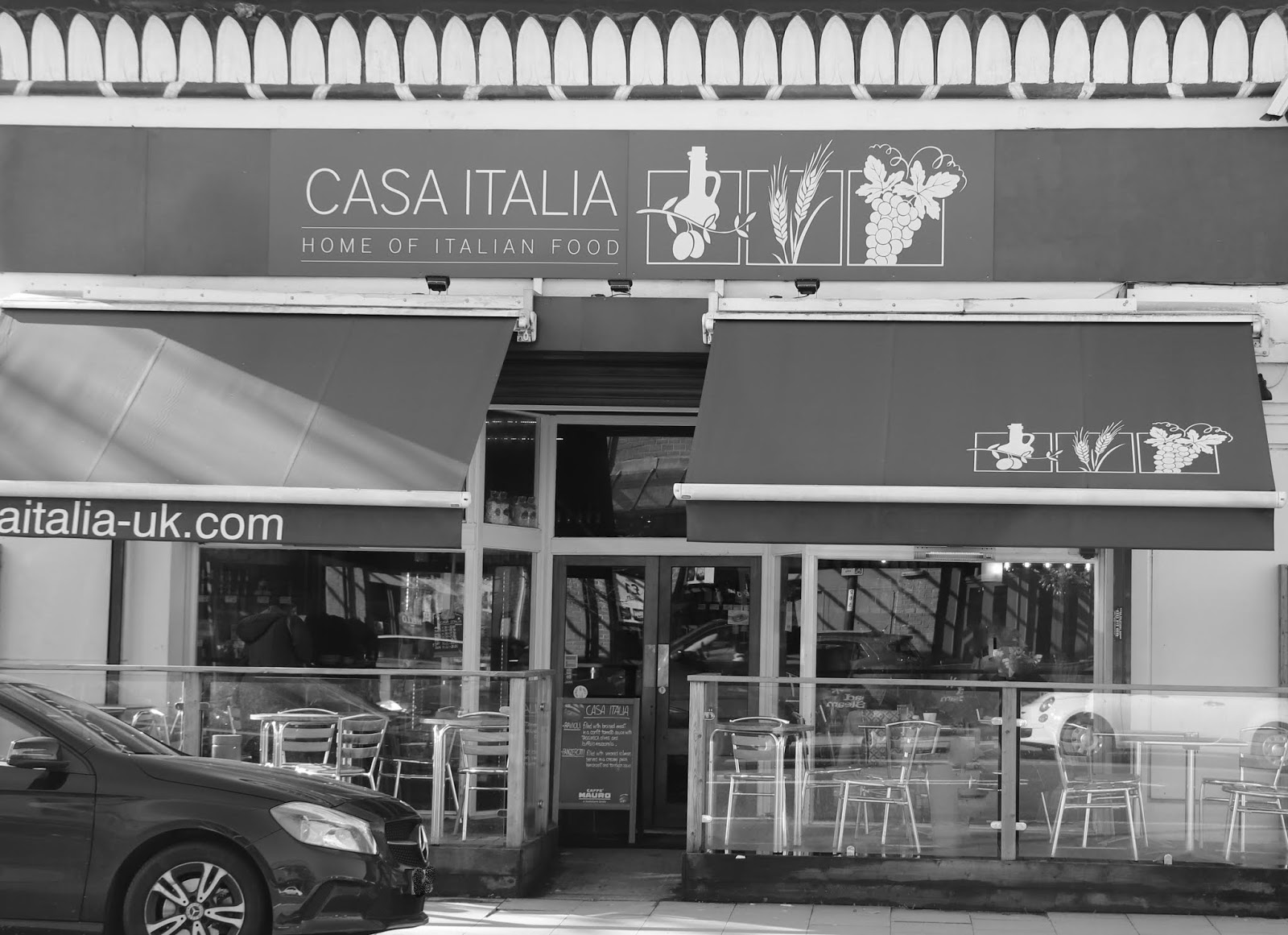
Casa Italia 2020
So here I was last Saturday back in Didsbury trying to get a picture of Casa Italia without a car getting in the way, and failed yet again.

Why Casa Italia? Well I like I the restuaraunt, and it has proved to be the only place locally that stocks Nocino.*

But enough of such stuff, and instead it is the history of the building I want to explore.
Just when it stopped being a Carrington’s and became the Casa Italia I have yet to find out but I know that back in 2014 I might just have been able to get my Nocino here from this branch of the Carrington empire.

Chritian Reading Room, 1959
I will have passed the building countless times during the 1970s and 80s, and I gave it little attention.

I do remember that one side was a Christian Science Reading Room, while the other half was a Gents Hairdressing Saloon, which as well cutting hair and selling that certain package “for the evening sir”, had jars of Brylcream.

Now you have to be of a certain generation to remember Brylcream, with its distinctive smell and its ability to hold hair in place.  It was one of those products that was a bit of a right of passage, because you only started to use it  in your teens.  Out had gone the toy trains, comic annuals and instead there was the full tilt pursuit of fashion, music, and going on a date.

My flirtation with the stuff didn’t last long, but for a short while it and Old Spice were part of getting ready to go out.  The downside was the smell and the greasy marks it left on furniture, and in my case the comments of one early girlfriend, appalled at what it did to her hands after fondly running her fingers through my hair.

Hair curs and Brylcream, 1959
It was I now know an emulsion of water and mineral oil stabilised with beeswax and it  is still available today.  Alas those who know me, will smile at the thought that I once had hair and might choose to use the stuff.

Back in 1969 the owner of the hairdressers was a Mr. T Smith and the shop had been dispensing Brylcream, hair cuts and much more a decade earlier.

In time I will go looking for just when it ceased to do Brylcream, haircuts, and for that matter when the building was constructed.

At the turn of the century the site had been a row of cottages which were still there in the 1920s.

But at some point these were replaced with our building, which is quite distinctive with that frieze at roof level.  Look very closely and it is just possible to pick out that the design is a series of identical flowers in full bloom.

F. Lees, bird seed and Spratt's
Decades of paint have now obscured the finer details but they are still there.

And what is even more fascinating is that there was another block further north along Wilmslow Road, on the corner with what is now North Street.

It was not as substantial as ours but it had the same design below the foor and may have been by the same architect.  In 1959 it was occupied by F. Lees who described himself as a “Seed Dealer” in the directories but whose shop front announced that here was Didsbury Pet & Garden Stores ….. The Shop for Spratt’s.”  Offering dog food and bird seed in “packets and Bags”

Those cottages, 1906
All of which just leaves me to plunge into the census returns and explore the occupants of those cottages who in 1901 included a certain Mr. William Wrightman who described himself as a cab driver and ten years later was running the Station Hotel on the corner of Wilmslow Road and what is now North Road.

As ever, there is more , but that is for another time.  In the meantime I shall book my time into Central Ref to trawl the directories to discover just when our floral adorned shops were built.

And a thank you to andy Robertson who trawled his copy of the 1969 Directory.

Location; Didsbury

Pictures; Casa Italia, 2020, from the collection of Andrew Simpson, the same block in 1959, J.F. Harris, m42647, and that other block on the corner of what is now North Street, in 1959, J.F. Harris, m42644, courtesy of Manchester Libraries, Information and Archives, Manchester City Council, http://images.manchester.gov.uk/index.php?session=pass, and the row of cottages circa 1906

*Nocino is a wonderful liqueur from the Emilia-Romagna region in northern Italy, and is made from unripe green walnuts, rivaled only by Lemoncello.

Wednesday, 21 December 2022

When young Bertha Geary heard history in the summer of 1911

I am looking at a postcard of Didsbury sent in the summer of 1911.

But the scene is not as important as the message on the back, for Bertha Geary aged just 13 of School Lane has heard history.

“We saw the flying man on Tuesday night fly over head.  Beaumont is his name.  I wish you could have seen him.  It made such a noise.”

He was André Beaumont and he was one of 30 competitors in the Daily Mail Circuit of Britain Air Race in 1911. Flying in a Blériot XI he was the first to complete the course which was no mean achievement as many of the aircraft either failed to take off or crashed along the way.

So to him went the £10,000 prize awarded to a man whose real name was Lieutenant Jean Louis Conneau of the French Navy.

All of which today we take for granted but was pure magic and wonderment to young Bertha, after all the persistent buzzing of the aircraft’s engine above her head was something new and I guess louder than anything she had yet encountered.

The streets were still dominated by the horse drawn vehicle, few had telephones, and radio as a form of mass entertainment was still in its infancy.

So hers was a generation which would embrace profound changes, and this drew me towards Bertha Geary.

She was born in Prestwich in 1898, and her father described himself variously as a school keeper and general labourer.  One of her elder sisters worked as “children’s milliner” and the other made “children’s costumes.”

There the trail goes quiet for Bertha, because if she married I can find no record, nor of when she died but she did leave one clue and that was her address on the postcard.

It is a simple but vital clue which allowed me to track her family on the street directory for 1911, establish a surname and search the census for that year.

Her story and many others appear in Didsbury Through Time by Andrew Simpson and Peter Topping.

Picture; Bertha’s postcard from the book Didsbury Through Time

Didsbury Through Time is available in Didsbury from Morten’s Bookshop on Warburton Road, Didsbury, and of course from all other bookshops.

* E.J. Morten Booksellers, 6 Warburton Street, Didsbury, Manchester M20 6WA,
Telephone: 0161 445 7629, Email: morten.booksellers@lineone.net

Wednesday, 7 September 2022

The day Mr Jackson captured the kerfuffle on Hardman Street in 1913

We are in Didsbury in 1913 and Mr Jackson has been recording the ebb and flow of people and traffic up and down Hardman Street.

At first glance I thought we were dealing with a sequence of potographs taken on the same day and despite the presence of two carts and what might be the same people they are more likely to have been taken on different days.

That said the two together capture perfectly a morning in Didsbury in 1913.

Hardman Street connected Wilmslow Road with William Street, and both  pictures are looking east down towards William Street away in the distance.

The butcher’s shop cannot have long been open when the pictures were taken because the shutters are still down and some of the people look as if they are on their way to work.

In the second something is amiss, and whatever it is has brought the customers and the shop keeper out of the shop.

The obvious answer may be something to do with the coal wagon and the handcart as they passed each other.

The attention of the delivery boy to our left and the man on our right are both drawn to that coal man who has stopped and looks directly at the camera.

There were coal yards at the bottom of Hardman Street and at the top opposite our shop so I guess street congestion was a fairly common event.

I am tempted to suggest a chain of events but that would be to drift into idle speculation and nothing good comes of that.

Pictures; Hardman Street in 1913 by J. Jackson, m21852 & m21851 courtesy of Manchester Libraries, Information and Archives, Manchester City Council, http://images.manchester.gov.uk/index.php?session=pass

Thursday, 21 July 2022

The Manchester pawnbroker and his fine cottages in Didsbury ….. doing the essential walk and making it historic .... no. 5

This is Warburton Street in Didsbury, and if you should care to walk it, it won’t take long.

Warburton Street, 2020
In fact, it will be but a matter of moments to walk its entire length from Ogden Street to Wilmlsow Road.

In happier times that short walk would have lasted a tad bit longer if you had called in to Morten’s the Booksellers, followed by a meal in the restaurant next door, and finishing at the two  gift shops which are positioned at either end of the street.*

Warburton Street, 1911
The row of shops looks old, and as you do I decided to peel back their stories.

In 1911, those same properties were home to “Jn Crompton & Sons, paint stores", at number 2, William Richardson, platelayer at number 4, and Mrs. Emma Smith at number 6, who was listed as “householder”, and was a launderess, while finally at number 8 was Mr. Schofield who was a “night soil man” who worked for Manchester City Council.

While on the opposite side there lived a gardener, a hairdresser, two labourers along with the stables of the Midland Railways.

All of which is a neat cross section of the working resident of Didsbury, and by extension of the occupations of many who lived in Manchester.

Four decades earlier and those occupations were rooted in the land with a mix of agricultural labourers, and gardeners, along with a charwoman and domestic servant to cater for the wealthier.

Warburton Street and Hardman Street, south of the National School, 1845
But with a nod to the future one man described himself as “winder in a cotton factory” and another as "a grocery porter.”

Go back another twenty years to 1851 and along with those agricultural workers there were two of Didsbury’s last cotton weavers.

The census returns for the middle decades of the 19th century show that families were large, with anything between five to six people crammed into what were just two up and two down properties.

And using the Rate Books it is possible to track back and find not only the tenants but also the landlords.

In 1911 the entire south side of Warburton Street which consisted of our five houses, along with Hardman Street and Ogden Street were owned by a Charles Haynes who took home £147 from just these streets.

Mr. Haynes's stamping ground, 1851
In time I shall go looking for him, but for now I am content to explore the life of his father, Richard Haynes, who was born in 1802, married Harriet Farrington in 1821, aged just 19, and by 1848 was operating as a Pawnbroker at 30 Pump Street which was off London Road.

For the next decade and more he plied his trade on Pump Street and also Minshull Street, before moving to Didsbury.

A move which in part might have been motivated by his growing property empire, which he may have built.

Pump Street, 1850
Just when that was is as yet unclear.

The first entry in the Rate Books for Warburton Street is 1849, but they appear on the tithe map four years earlier, and Mr. Richard Haynes was in business by 1841, so he might well have accrued enough capital to sink his money into property.

And nothing quite surprises me about the man, because back in 1841 he is listed as a baker working from Back Acton Street, which was off Pump Street and ran parallel with London Road.

Just when he escaped the city and the murky world of pawnshops is unclear, but by 1861, he and Harriet are at number 3 Hardman Street, in a house which commanded fine views of the fields all the way down to Didsbury House, with the added bonus that his growing property empire was just a minute’s walk away.

Hardman Street with Warburton Street and the National School, 1854
And so assured was he of his new position in Didsbury society that he described himself as a “Proprietor of Houses”, and all reference to him in Manchester is absent from the records.

Location; Didsbury

Pictures; Warburton Street, 2020, from the collection of Andrew Simpson, Back Pump Street, 1851, from Adshead’s map of Manchester, 1851, and Hardman Street, 1854, from the OS map of Lancashire, 1854, , courtesy of Digital Archives Association, http://www.digitalarchives.co.uk/


*Orchard Interiors & Gifts 2, Warburton Street, No. 4 Dine & Wine, 4 Warburton Street, E.J. Morten Booksellers, 6 Warburton Street, Harriet and Dee, Cards and Gifts, 8 Warburton Street

Monday, 2 May 2022

Southern Cemetery ….. a house in West Didsbury …….. and a certain Jeanne Vignot of á Neuilly-sur-Seine

I am the first to admit that speculating on the relationship between a Jeanne Vignot in France and the mystery resident of Clyde Road , is both unhistorical and unlikely to take you anywhere.

But the romantic in me wonders just why aJeanne received this picture postcard in the January of 1908, and what she thought of being sent a photograph of a cemetery, even if it was the impressive Southern Cemetery.

In time I might go looking for Jeanne, but for now, because it is easier I will go for the person who sent it.  The clue is on the postcard in the form of the sender’s address, which is 93 Clyde Road.
The house is still there today and is one of a pair which as then goes under the title of Kinloss Villas, and dates from 1882.

But here is the problem, I know who was there in 1901 and who was there eight years later, but for now pinpointing the residents in the year the card was sent still alludes.

That discovery will have to wait for the next visit to Central Ref and a trawl of the directories for 1908.

Suffice to say in 1901 it was the home of Mr. and Mrs. Hale, their four children and two servants.

By 1909 it is occupied by Mr. and Mrs. Amirayan, but they have proved quite elusive.  I know he was a “Manager of Exports” and in 1929 had offices at 29 Princess Street, and that his wife and daughter had traveled from Australia and Japan in the 1920s, but apart from one official record from 1939, I can’t find much else, and that much else extends to no census records.

So it remains a but of a mystery, but nature and all historians abhor a mystery so I shall plug on to find the identity of the person at 93 Clyde Road and a possible connection with France.

Location; West Didsbury

Picture postcard. Southern Cemetery, 1908 from the collection of David Harrop

Saturday, 18 September 2021

Coming to you in Didsbury …….. a barrel of Taylor Eagle’s best bitter. ….. by steam lorry

The brewey's; steam wagon
Now if you had been walking in the vicinity of the Royal Oak or the Station sometime just before 1914, you might have seen the steam lorry of Taylor Eagle delivering beer to our two pubs.

The brewery was founded by Joseph Taylor in 1849, registered in February 1888 and was sold in 1924 to a company which retained 60 pubs and was acquired by Marston, Thompson and Evershed Ltd in 1958.*

Now, it is easy to fall into the trap of speculating on the origin of the name Eagle in the title, and I wish there were something bizarre about how it came to be included.

But alas it is nothing more exciting than that the brewery was situated on Eagle Street, although later it was listed on Lloyd Street and Burlington Street which almost adjoins it.  It was here by 1863, and was advertised as “Taylor, Joseph, ale & porter brewer Eagle Brewery, Lloyd Street, Burlington Street, Oxford Street, Chorlton on Medlock”.

The full description
Mr. Taylor does appear to have prospered, because thirteen years earlier, he didn’t qualify to be listed in the trades section as a brewer and only appears in the alphabetical listings of the directory as “brewer 12 Calder Street”, and “beer retailer 25 Brownhill Street”, both in Salford.

It is a measure of just how modest his two enterprises were back in 1850, that neither Calder Street nor Brownhill Street were significant enough to be included in the directory.

 Nor does he show up in the historic records. 

In 1851, a Joseph Taylor is recorded as a pauper in the Salford Workhouse, while a second was living in Prestwich, was 73, and on “private means”, neither of which is he.

So, the search will go on, but in the meantime, I do have a map showing the brewery in 1893, a couple of beer bottles bearing the company name, and of course the ongoing mystery of where to find Mr. Taylor.

And a later steam engine
But, for all those who like lists, I do have a full list of the pubs owned by Taylor’s Eagle Brewery.  Most are in Manchester, with a few in Salford and others in faraway Altrincham, Knutsford, Timperley and Urmston, but the company had two in Didsbury, of which the second was the Station, but that is a story in another chapter.

And to compliment that list my old friend Bob Potts offered up an even more fascinating list of pubs and the year they obtained their first license covering the city centre, and the surrounding areas including Didsbury.

For the record, Bob  produced a fine book on the pubs of Hulme and Chorlton on Medlock. **

His records offer up a date of 1847 for its first license, and I wonder whether our Mr. Taylor on a visit out from Salford set about persuading the beer keeper at the Royal Oak to give up making his own beer and turn instead to Mr. Talyor’s “superior ales and porters”, which I am the first to accept is silly speculation.

And that is it.

Location; Didsbury

Picture; Taylor Eagle Brewery Steam Wagon, circa 1914 GMC Records, courtesy of Manchester Libraries, Information and Archives, Manchester City Council, http://images.manchester.gov.uk/index.php?session=pass  and a later steam lorry, 1980 from the collection of Andrew Simpson


 ** Potts, Bob The Old Pubs of Hulme and Chorlton-on-Medlock, 1997


Saturday, 6 February 2021

Mr Walter Mather, hospital orderly and his fascinating vesta case

This is a vesta case which was used for carrying matches.

They date from the 1830s and became particularly popular at the end of the 19th century and the early 20th, which fits perfectly with this one, which belonged to Mr Walter Mather.

The inscription records that he was awarded the case “in recognition of services at Woodlawn Hospital, 1914-19”.

Woodlawn was a Red Cross Hospital for men from the armed services recovering from wounds and illnesses.

It is a place I have written about quite extensively. *

It had been a private residence before the Great War and was handed over by its owner to the Red Cross for the duration of the conflict.

It was still there in Didsbury until relatively recently and there are those who have told me they knew the building when it was a private school.

That part of its history has yet to be revealed, and along with it, I hope we will discover more about Mr Mather.

According to the Red Cross records he joined the organisation in August 1916 and was living at 7 Clifton Avenue Fallowfield.

I have yet to find him in a census but the street directories for the early 1900s list numbers 5 to 11 Clifton Avenue as the Fallowfield Nurseries with a Walter Mather the proprietor and a Miss Elizabeth Cookson at number 5.

So the clues are there, and in time we should know more about him, his service at Woodlawn and perhaps about Miss Cookson.

We shall see.

In the meantime I remain fascinated by vesta cases, which were designed as a safety measure given that vesta matches when left together had a worrying and dangerous tendency to rub together and self ignite.

Pictures; the vesta case from the collection of David Harrop and the photograph of  Woodlawn courtesy of Rob Mellor

*Woodlawn,  https://chorltonhistory.blogspot.co.uk/search/label/Woodlawn


Monday, 28 September 2020

Peeling back the story of Tripp’s Corner on Barlow Moor Road

Looking down Barlow Moor Road to Tripp's corner, 2015
Now I wonder how many people still refer to this strip of shops on Barlow Moor Road as Tripp's Corner.

John Tripp was a grocer from Swansea in Wales who bought the plot of land stretching back from Palatine Road along Barlow Moor Road and built this parade of shops and houses.

Now one source suggest a date of 1910 for the purchase and development of this spot, but the census returns have John and his wife living there by 1881 and still there twenty years later.

Mr Tripp's shop and Post Office, 1906
His shop sold groceries, lent books and contained the post office.  His daughter ran the post office and may also have run the lending library.

I suspect that Tripp's Corner no longer trips off as many tongues as it would have done half a century and more ago but it is a perfect example of how popular names take root and defy even the planners whose alternative place names never quite catch on.

So Chorlton Cross for most people is the Four Banks which makes perfect sense given that there is one on each corner.

Mr Tripp's shop, 1878
And go back into history and for most of the 20th century it was known as Kemps’s Corner after Harry Kemp’s chemist shop which is now the HSBC.

In the same way the spot where Barlow Moor Road meets Sandy Lane and High Lane was for centuries called Lane End which made even more sense given that until recently this was Barlow Moor Lane.

Although for some it would also be Brundrett’s corner named after Mr Brundrett who ran his grocery shop roughly facing High Lane.

Mr Tripp's shop, 1880
I came across the story of Mr Tripp while writing Didsbury Therough Time and can remember feeling pleased that I had pushed back the date of his presence on Barlow Moor Road.

But like so many pieces of historical research I left a bit of the story undone and it took Andy Robertson to unearth the missing part.

He had wandered down and recorded that parade of shops on a December afternoon in 2015 and then went back to the digital archive and found an all most identical set of pictures from a century ago, but in the process discovered Mr Tripp’s earlier shop from where he had been trading in 1878.

At Tripp's Corner, 2013
And in the space of a few pictures called up Mr Tripp’s start in a more humble premise, the move to the grander building we know now and finally to his expansion into the next door shop.

All of which just leaves me to point you in the direction of Didsbury Though Time with its fine set of paintings of Didsbury by Peter Topping, along with a mix of old and new photographs and more than a bit about the lives of the people who lived behind the doors.

It was written in the autumn of 2014 and published in December of that year.

Pictures, looking towards Tripps’s Corner from the series West Didsbury, 2015 by Andy Robertsosn and by degree Mr Tripps shop in 1878, W J Cotsworth, m56084 , 1880, W J Cotsworth, m56085 and in 1906, courtesy of Manchester Libraries, Information and Archives, Manchester City Council, http://images.manchester.gov.uk/index.php?session=pass


*Didsbury Through Time, Andrew Simpson & Peter Topping, 2014

Saturday, 5 September 2020

On School Lane buying the fish and chips in 1911

We are on School Lane and the year is sometime around 1911 and I am drawn to the people in the picture. 

I doubt that we will ever be certain who the woman staring back at us is but I rather think it will be either Mrs Martha Meredith who ran “the Supper Bar (Fish and Chips)” at number 1 School Lane or Ellen Tennant who was the wife of George Tennant the butcher from number 3.

And if pushed I think it will be Martha who at 36 described herself as a widow with a 14 year old daughter and shared her home with her brother in law, Mary Ann who she employed as a servant and John Wilson the boarder.

Alas the children’s identities are lost to us but they will be local and must have been drawn from their homes by the presence of the photographer.

The properties are still recognizably the same and by one of those odd coincidences just one hundred and eight years after our picture was taken number 1 is still a fish and chip shop.

Despite the passage of just over a century it is still possible to recognise the scene today.

Not long after this picture was taken young Bertha Bertha Geary aged just 13 of School Lane has heard history. “We saw the flying man on Tuesday night fly over head.  Beaumont is his name.  

I wish you could have seen him.  It made such a noise.”

He was André Beaumont and he was one of 30 competitors in the Daily Mail Circuit of Britain Air race in 1911.

Flying in a Blériot XI he was the first to complete the course which was no mean achievement as many of the aircraft either failed to take off or crashed along the way.

But that is for another story.

The image comes from a collection  Didsbury through Time, by Peter Topping and Andrew Simpson.

Pictures; from Didsbury through Time.

Thursday, 3 September 2020

In Didsbury ……… uncovering the story of the war memorial

Now like many people I have passed the war memorial in Didsbury countless times.

The War Memorial, date unknown
Occasionally I have stood in front of the names and pondered on the stories behind each of the men recorded there, but until today I have never wondered about the people responsible for its erection in July1921.

There were fourteen of them listed as on the Committee, and they were, John T Seale, Rupert C Samuels, James Clayton Chorlton, James Frederick Motorhead, Thomas William Evans, Frank Taylor, G. Biddle, F. Merrill, C. B. Owen, J Davenport, Councilor E. D. Simon, George Edward Crowe, T Malloy and R Bramwell

Of the fourteen, eight have come out of the shadows, and their backgrounds throw an interesting light on how such committees were constituted.

One was a doctor, one a surveyor, one was employed by Manchester Corporation and the remaining five were manufacturers, and all by 1921 were in their late 50s and into their sixties.

George Biddle and Frank Taylor both had sons who died in the war and were commemorated on the memorial, and interestingly of the eight, these were the two men who were not professionals or manufacturers.

Order of Service, 1921
In time I might be able to track down the minutes of the Committees meetings along with a list of subscribers, but for now I have a picture postcard of the memorial sometime in the 1920s or the following decade and the Order of Service for the unveiling. *

From the order of service, we have the committee names along with the men commemorated, the list of hymns sung and the dignitaries who were invited to the event.

Added to these there is a newspaper account of the unveiling from the Manchester Guardian which reported that Lord Derby led the service, speaking of how “the memorial would show for all time that the comrades and friends of those who died were mindful of them and hoped that by revealing what a sacrifice of life war meant the memorial might be a deterrent against future war”.**

I doubt I would ever have gone looking for the story of the memorial, if that Order of Service hadn’t surfaced recently.

It was acquired by my old friend David Harrop and until I find the minutes of the committee it serves as all we have on how the memorial came to be and the day of its unveiling.

The document consists of 10 pages, detailing the address, the hymns and men commemorated, and begins with a dedication to “The memory of the sacred dead of this village who, having left all that was dear to them endured hardships, faced dangers, and finally paid the supreme sacrifice in defence of our King and Country”.

Location; Didsbury

Pictures; Didsbury War Memorial, undated, and Order of Service, 1921, courtesy of David Harrop


*Didsbury War Memorial, Unveiling Ceremony, July 2, 1921

**A Didsbury War Memorial, Manchester Guardian July 4th, 1921