Showing posts with label Crested China. Show all posts

Saturday, 6 December 2025

Posting a letter in Woolwich …….. a little bit of fun and a challenge

Now here is a bit of our history, and for those who will always be Woolwich not Greenwich, this will have a special place.

I am looking at one of those bits of crested porcelain, which everyone buys at some point.

 Usually they are an impulse purchase on a wet day at the seaside and after a period on the mantle piece they get consigned to the back of a cupboard, and finally to a charity shop, and on the way acquire at leas one chip.

When I was growing up they  would fascinate me, and later in my teenage years I dismissed them as tacky.

But now, as I enter my seventh decade I am drawn back to them, and in particular those produced during the Great War when the ceramic companies switched to war time themes, turning out china tanks, ambulances, and battleships, all with a coat of arms of a different city, or town.

All of which brings back to the postbox, for which I don’t have a date, but could be anytime from 1900 when the borough was created, to its demise and its merger with Greenwich.

There are still some lingering bits of the old borough around, in the form of the coat of arms, on park gates, proudly announcing our connection to the Royal Arsenal.

And that might well be the challenge for everyone, to find and post them.

But for now I have this one from the collection of David Harrop.

Location; Woolwich


Picture, ceramic crested posted box, Woolwich, date unknown, courtesy of David Harrop

Friday, 3 October 2025

A tank, a souvenir, and the soldier far from home in Woolwich

Now the romantic in me would like to think that George Davison bought one of these as a souvenir for his wife Nellie and their son Duncan.

The Woolwich Tank, circa 1918
He was in the Royal Artillery and was stationed in Woolwich during the Great War, first in 1915 and then again in 1917, and 1918 while they were living in Manchester.

That said Nellie spent time with him in “digs” in Ireland and Woolwich so it is very possible that she would have come across this piece of crested china, and took it home from London.

Pieces like this were very popular during the Great War and were turned out in their thousands.

The coat of arms of Woolwich
The porcelain companies, seeing the potential of war souvenirs switched from models of Blackpool Tower and Ann Hathaway’s cottage to tanks, battleships and ambulances.

They turned out identical ones, with just the name of a different town or city and coat of arms to distinguish them.

Sometimes in their zeal to market across the country they got it wrong, so while you could have bought an ambulance or tank with Manchester’s coat of arms, you could also have bought a model battleship, despite the fact that there was no such ship in the Royal Navy during the conflict.

The Davison's, 1916
Our Woolwich tank is in perfect condition, and bears the name Shelley China, which was a Staffordshire pottery company founded in 1862, only ceasing as an independent business in 1966.

What I particularly like about this one is that it has been acquired by my old friend David Harrop, who is the also the custodian of the George Davison collection which is a fascinating archive of letters, personal documents and pictures, spanning the period from George’ birth in 1886, through to his war service and into the 1950s.

Mr Davison was killed on the Western Front in June 1918, but his wife continued to add to the collection throughout a big chunk of the century.

And what makes the collection just that bit personal for me, is that he appears in the book I wrote about Manchester and The Great War, but more than that he was at one point in 1918  living just down from our family home on Well Hall Road prior to embarkation for France.*

This I know because we have his will he made out in March 1918, witnessed by a Mr Drinkwater who lived on what is now the old Well Hall cinema.

And in a letter to Nellie he refers to her stay at the house which was just minutes from ours.

Nor does the connection end there, because before he married Nellie, he lived in Chorlton-cum-Hardy just a short walk from where we live now.

And while there, at Barway House on Edge Lane he wrote a series of courting letters to Nellie.

Shelley China
All of which makes the tank and the story very personal.

When David told me he had the tank the message just said “Tank coming home” and while it is not going back to Woolwich it will be joining the George Davison collection, and was  pride of place in a major exhibition to mark the end of the Great War, which was on show at Central Ref from in 2018.

Location; Woolwich, Manchester

Pictures; the Woolwich Tank, circa 1918, George Davison, his wife Nellie and son Duncan, 1916 from the collection of David Harrop

*Manchester Remembering 1914-18, Andrew Simpson, 2017, the History Press, 

Saturday, 9 September 2023

When the Great War came to Chorlton ..........

I have become fascinated by those miniature porcelain pieces which were produced during the Great War.

They continue to come on to the market despite the passage of a over a century and their propensity to have been chipped, broken, or just thrown away.

They were turned out in their thousands and will have resided on mantlepieces, glass cabinets and other “special” places.

The porcelain companies, seeing the potential of war souvenirs switched from models of Blackpool Tower and Ann Hathaway’s cottage to tanks, battleships and ambulances.

They turned out identical ones, with just the name of a different town or city and coat of arms to distinguish them.


Some I guess were bought on the spur of the moment, perhaps as a reminder of a loved one serving in the armed forces, or as a quiet but determined statement of patriotism while others will have been presents

Many of the pieces were just general reminders of the war, like a tank, an ambulance or a battleship, but sometimes we get the name of a ship.

But until now I have never come across  apiece which was produced specifically for Chorlton, but here we are.

And while the lettering is unclear this miniature of a shell was produced for Chorlton-cum-Hardy.

It may never have actually been sold here but I would like to think that it was, and graced a mantelpiece, or the china cabinet somewhere in the township,

Location, Chorlton-cum-Hardy

Picture porcelain miniature of a shell, circa 1914-1918, from the collection of David Harrop

Thursday, 6 July 2023

The little reminders of the Great War ........

 I have become fascinated by those miniature porcelain pieces which were produced during the Great War.

They continue to come on to the market despite the passage of a over a century and their propensity to have been chipped, broken, or just thrown away.

They were turned out in their thousands and will have resided on mantlepieces, glass cabinets and other “special” places.

The porcelain companies, seeing the potential of war souvenirs switched from models of Blackpool Tower and Ann Hathaway’s cottage to tanks, battleships and ambulances.

They turned out identical ones, with just the name of a different town or city and coat of arms to distinguish them.

Some I guess were bought on the spur of the moment, perhaps as a reminder of a loved one serving in the armed forces, or as a quiet but determined statement of patriotism while others will have been presents

Many of the pieces were just general reminders of the war, like a tank, an ambulance or a battleship, but sometimes we get the name of a ship, like this one of the HMHS Anglia, which was a hospital ship.

My Wikipedia tells me was a steam ship requisitioned for use as a hospital ship during the First World War. On 17 November 1915 she hit a mine laid by the German U-boat, UC-5. n 17 


HMHS Anglia “was returning from Calais to Dover, carrying 390 injured officers and soldiers. At around 12:30 pm, 1 nautical mile (1.9 km) east of Folkestone Gate, HMHS Anglia struck a mine and sank in fifteen minutes. 

The nearby torpedo gunboat HMS Hazard helped evacuate the passengers and crew. Despite the assistance of the nearby collier Lusitania, 134 people died in the sinking. 

In October 2014, there were calls for the wreck of the ship to be designated a war grave and protected under the Protection of Military Remains Act, 1986".

What makes the piece a little more remarkable is that on one side it carries the additional inscription, “Great War 1914-1918 The German Fleet Surrendered 14 Warships November 21st, 1918”.*

And not to be outdone I threw in the Scarborough ambulance.


Picture; miniature porcelain pieces, circa 1914-1918, from the collection of David Harrop

*HMHS Anglia, https://en.wikipedia.org/wiki/HMHS_Anglia

Monday, 17 January 2022

The tank, …….. a piece of porcelain …. and the auction house

Now, I don’t pretend to be an expert on military history and certainly not the development of the tank during the Great War.

A Mark 1 tank, 1916
But my Wikipedia tells me that the first tank to go into combat with the British army was the “The Mark I, [which] entered service in August 1916, and was first used in action on the morning of 15 September 1916 during the Battle of Flers-Courcelette, part of the Somme Offensive”

And no doubt soon after the battle this small piece of porcelain rolled off the production lines and arrived in shops across the country to be snapped up.

I have long been fascinated at the swift way porcelain companies made the transition from making figures of Blackpool Tower, Anne Hathaway’s Cottage and heaps of other “tourist memorabilia, into war time models of tanks, ambulances, planes, and ships.

"The British Tank" circa 1916
And to guarantee sales the companies added a transfer with the name and sometimes the coat of arms of the places where the pieces were marketed.

What is also remarkable is the way so many of them have survived and survived in very good condition.

This one was acquired by my old “posty” friend David Harrop who tells me it comes from Capes Dunn, who are “an established fine art auctioneer, [who have] operated in The North West and Lancashire since 1826, providing auctions and valuations for private and professional clients”

City of Carlisle, circa 1916
David added that they were based on Charles Street off Oxford Road, and I rather think there is another story here.

But for now I shall leave it at that, reflecting that stories of the Great War come in many different forms, and wonder on just why the tank carried the name Creme-De- Menthe.

I suspect we might be dealing with an adverting promotion.

We shall see.

Answers  on the back of a beer mat or any other suitable alcoholic connected piece of memorabilia.

Location; the Great War


Pictures; ceramic Mark 1 tank, circa 1916, from the collection of David Harrop, and An early model British Mark I "male" tank, named C-15, near Thiepval, 25 September 1916. The tank is probably in reserve for the Battle of Thiepval Ridge which began on 26 September. The tank is fitted with the wire "grenade shield" and steering tail, both features discarded in the next models, courtesy of the Imperial War Museum

*British heavy tanks of World War I, https://en.wikipedia.org/wiki/British_heavy_tanks_of_World_War_I

**Capes Dunn, https://www.capesdunn.com/

Monday, 27 December 2021

What souvenir did you buy in the Great War?

Now I remain fascinated by those small porcelain figures from the Great War.

They were made by companies who specialized in tourist knick knacks, including key rings, models of places like Blackpool Tower, Ann Hathaway’s Cottage and heaps of other porcelain things.

Often, they included a place name and could be found in seaside resorts and tourist centres up and down the country.

And when the Great War started those same porcelain companies switched to making objects associated with the conflict, ranging from tanks, ambulances and aircraft to bull dogs and battleships.

Not to be outdone, the companies also added the names of towns and cities to the objects, and the public bought them in their thousands.

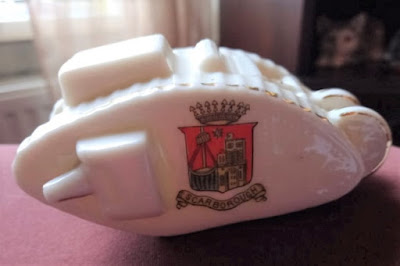
What of course always surprises me is how many of them have survived in perfect condition, and so it is with this one of a tank from Scarborough.

I am indebted to David “posty” Harrop who has a vast collection of these porcelain figures along with lots of memorabilia from both world wars as well as a huge collection of Post Office material.

To some the figures may seem a peripheral aspect of that war, but they do show the willingness of the population to be engaged in the conflict, and to have treasured them long after peace had returned.


That said the companies did sometimes get it wrong, like the model of the battleship HMS Manchester, which David has in his collection.  It is a lovely figure, made all the more interesting because during the war there was no battleship of that name.

Still it hasn’t stopped David giving it pride of place in his permanent exhibition of wartime memorabilia at the Remembrance Lodge in Southern Cemetery.

Location, 1914-18

Picture; porcelain figure of a tank, circa 1916-1918, and HMS Manchester, circa 1914-18, from the collection of David Harrop


Tuesday, 2 February 2021

Celebrating all things French and British ...... the Exhibition of 1908

It’s curious how you come to uncover little bits of our history.

A souvenir of the event, 1908

Now I was well aware of the 1904 Entente Cordial between Britain and France, which cemented good relations between the two countries, while at the same time settling possible disputes over our Imperialist designs on Egypt and France’s in Morocco.

The Machinery Hall, 1908
But what I knew nothing about was the joint exhibition held in London four years later.  It lasted from May to the end of October, attracted 8 million visitors, and covered an area some 140 acres including a lake and a series of buildings al painted white.

These included two colonial villages, one of which was Irish and the other Senegalese.

What drew me to the story was another of those crested pieces of china from the collection of Fred Page.  I have become quite a fan of these, mass produced porcelain models which often carried the name and coat of arms of British towns and cities.

Palace of French Applied Art
I first came across the “war ones” sold as souvenirs during the Great War, but I knew they had an earlier history and ranged from models of Blackpool Tower to Ann Hathaway’s cottage.

And here is one from the collection of Fed Page.

In 1908 the china companies would have been working overtime turning souvenirs as was the picture postcard industry.

The rest is for you to find out.

Location; London


Pictures; crested china souvenir of the Franco British Exhibition, 1908, from the collection of Fred Page and the Palace of Applied French Arts, produced by Tuck 8 Sons, 1908, courtesy of Tuck DB Postcards,  https://tuckdb.org/history

Thursday, 14 January 2021

“Doing her bit” …… the porcelain munitions worker

 Of all the memorabilia commemorating the work of munitions workers during the Great War, this has to be one of favourites.


 It bears the mark Carlton China and was made and sold in Rochester.

 And with an eye to profits the company would have sold the figure across the country substituting the name and coat of arms of Rochester for a heap of different places.

 The market for crested china with a war theme, was an undoubted winner, and ceramic figures of tanks, battleships and ambulances vied with those of wartime nurses, British bull dogs and aircraft.

 After the war to these were added miniature porcelain war memorials, by which time the industry had begun to return to its prewar models featuring seaside resorts, touristy buildings, and key rings.


many of these have appeared on the blog.*

 Location; the Great War

 Picture; “Doing her bit”, circa 1915-1918, from the collection of David Harrop

 *Crested China, https://chorltonhistory.blogspot.com/search/label/Crested%20China


Friday, 20 November 2020

The Stockport battle tank .....

Now this is the story of the Stockport battle tank.

I can be fairly confident that it was made sometime after 1918 which could stretch to the following year.

After 1920 I doubt that there was as much interest in a piece of crested china with a war theme.

By then the country had put the conflict to rest and if the china companies were still churning out war pieces, the items would have been of war memorials like our own Cenotaph while the rest of the factory switched back to key rings, miniature replicas of Blackpool Tower and Ann Hathaway’s’ cottage.

But for the four years of the war, crested war china was everywhere from model tanks to aircraft and battleships.

And to make the piece just that bit more marketable, they were sold with the name and coats of arms of towns and cities.

So you could buy the Stockport tank and the Manchester tank along with HMS London, and HMS Liverpool.

Such was the headlong pursuit to turn out such collectables that one company produced a battleship carrying the name Manchester even though the navy had no such battleship during the Great War.

I had no idea just how many of these souvenirs were turned out but of course they one of the ways people at home could identify with the war and with a loved one who was serving in the armed forces.

This one belonged to David Harrop who has an extensive collection of crested china along with memorabilia from both world wars and the history of the post office.

But this one is the biggest and has that additional comment on the side about the signing of the armistice which I will make it just that bit different.

Location; Stockport

Pictures; the Stockport battle tank circa 1919, from the collection of David Harrop

Monday, 27 July 2020

A souvenir of Eltham ................ and a bit of a story

Now like lots of people I collect stuff, but unlike most I prefer to keep the collections digital.

That way there is no need to dust, no danger that you will damage the precious object and no chance that one day Aunt Ethel’s present will end up in the bin or sold on eBay.

It also means that you can collect other people’s favourite items and so share their pleasure.

All of which brings me to crested china which is the a general name for those porcelain “things” bought on holiday as a souvenir and carrying the name, badge or coat of arms of a town, city or seaside resort.

I can’t say I ever bothered with them until I came across a selection made during the Great War ranging from tanks, to battleships ambulance, and war memorials and the result was a series of stories.*

They were turned out in their thousands and each carried a different coat of arms.

It made perfect sense when the majority of people could no longer go on holiday as travel became restricted and ever more expensive.

This way the porcelain companies stayed in business, people still had jobs and the war effort and moral were boosted.

That said these three of Eltham from Mark Johnson have as far as I know nothing to do with the Great War, but they are Eltham where I grew up and that is good enough for me.

Although it would be nice to come across one of the Royal Arsenal.

Location’ Eltham

Pictures; crested China from the collection of Mark Johnson, date unknown

*Crested China,  https://chorltonhistory.blogspot.co.uk/search?q=crested+china


Thursday, 25 June 2020

Sharing "a cherished object from your past", another story from Tony Goulding

On Saturday 20th June I took part in a Zoom meeting as part of the  excellent, "Stories of Our Lives" project which aims to bring local people together to share their memories and thoughts on various themes and create a written record to be included in a Blog. 

The crested china
Last week's theme was "a cherished object from your past".   

I had trouble choosing an object to bring to the meeting, having so much clutter!

I finally opted for this tiny china replica of Teignmouth Lighthouse an item of "crested ware" produced in vast quantities in  the inter-war period.

This example is by one of the leading manufacturers W.H. Goss and carries the crest of "Redditch", at that time a town in North Worcestershire famous for needle manufacturing and now a much larger "new town" for Birmingham commuters.

As Redditch was the home town of my maternal Grandmother I have long associated this article with memories of her, however, the introductory meditation on Saturday rekindled a memory of seeing it in my mother's glass-fronted display cabinet in which was kept the family's "posh" china tea set only to be used for special visitors.
       
Interestingly in recent years as I have studied my family history involving several trips to Redditch and Worcestershire's county record office in Worcester the artefact has acquired another layer of significance.

It can now evoke more personal memories.

One of my visits to Worcester coincided with my 50th birthday and I spent that day watching a cricket match Lancashire v Worcestershire at the iconic New Road cricket ground in the shadow of Worcester Cathedral; something I had always wanted to do.

New Road Worcester
On another occasion I visited Redditch and journeyed further to Withybed Green on its outskirts where my grandmothers Childhood home was located.

Calling in a pub for lunch I got chatting with the landlady who informed me, when she knew of the reason for my visit that one of her regulars with the same name as my grandmother's maiden name was also engaged in family history research and might shortly be calling in.

Unbelievably he called in as I was just about to leave (in fact we very nearly missed each other). He was a very nice man and showed me around the local churchyard where my Great-grandfather and other family members are buried and provided contact details of another relative who I later contacted and visited overnight on a further fact garnering expedition.

Tony Goulding © 2020

Pictures; crested ware, from the collection of Tony Goulding, New Road , Worcester, By Stephen McKay, CC BY-SA 2.0, File:New Road Worcester - 3 - geograph-891443.jpg - Wikimedia Commons.https commo

Tuesday, 9 July 2019

To be bombed once is unfortunate, but twice that’s personal ……. a story from Ramsgate

I like the way that a story comes back and takes off on another journey of discovery.*


This time it is about those crested pieces of porcelain which were produced in their thousands from identical moulds, with just the application of a transfer coat of arms and a name to mark them out as Ramsgate, rather than London, Blackpool or Great Yarmouth.

They have featured a lot over the years on the blog, and in particular those made during the Great War, when the china companies swapped from reproducing Blackpool Tower or Buckingham Palace to war time themes. 

They ranged from tanks, battleships, and ambulances to aircraft and zeppelins.

And it is of zeppelins, that neatly brings me back to that earlier story when there two zeppelin raids on the same place in May 1915 and again in June 1917.

That must have felt very personal, but someone in the porcelain company saw the upside of the two Zeppelin raids, and never one to miss out, the producers or the retailers at Imperial Bazaar had the idea of adding on the base of each piece, the legend, “Souvenir from the Imperial Bazaar Albion Hill Ramsgate Twice wrecked by Zeppelins May 17 1915 and June 17 1917”.

All of which made these bits of unremarkable china something very special.

And yesterday Duncan Prebble shared a piece he had just acquired, and never being one to miss an opportunity I got permission to reproduce the piece.

What makes this one even more interesting, is that it dates from 1919, two years after the second bombing, pointing to that very simple economic truth, that if you have a good marketing theme, continue using it.

So far I haven’t uncovered a press report on the specific raids, but the Manchester Guardian was full of German airship attacks which were often driven off by the RAF.

That said, there will be someone with access to the local newspapers who can offer up a detailed news story.

Until then I shall just leave you with this “souvenir” of aerial bombardment and a thank you to Duncan.

Location; Ramsgate


Picture; “Souvenir from the Imperial Bazaar Albion Hill Ramsgate”, 1919 from the collection of Duncan Prebble


*That Zeppelin raid on Ramsgate ..... not once but twice and the porcelain cat and Teddy, https://chorltonhistory.blogspot.com/2018/05/that-zeppelin-raid-on-ramsgate-not-once.html


Friday, 19 April 2019

A Mancunian pilot and plane from the Great War ….. stories of porcelain


We are a full century and a bit on from the Great War, and I find it remarkable that so much of the ephemera from that conflict has survived.

Leaving aside the big stuff, like tanks, aircraft and memorials, it is the little things like postcards, letters and pictures along with medals which have survived in large numbers.

In the usual run of these things many would have been lost, destroyed, or so damaged that they were eventually discarded.

Now I know these items once counted in thousands, but the passage of over 100 years was never going to be kind to many of them.

And of these it is the crested porcelain figures which I would have thought were most likely to have been doomed.

Afterall they are fragile, easily chipped or broken and so should not have survived in such great numbers.

All of which brings me to this fine example, which I rather like.

It belongs to my old friend David Harrop and arrived at his home today.

His crested china collection includes everything from bull dogs, battle ships, tanks and ambulances, but this is the first aircraft I have seen.

The porcelain companies had switched with the outbreak of war to making themed war pieces and with an eye to sales added the crests of towns and cities, making the pieces just hat been more attractive and novel.

It worked up to a point but in the case of the battle ship HMS Manchester it fell short of reality, because during the Great War the Royal Navy had no such ship in service.

Still I doubt that commercial interests or that of patriotism was ever going to get in the way of delivering a piece of war porcelain which would sell we…

Picture; crested chine aircraft, circa the Great War, courtesy of David Harrop


Sunday, 19 August 2018

Throwing the grenade .............

Of all the items of crested china in David Harrop’s collection this one must be one of the most poignant.

It shows a British soldier in the act of throwing a grenade, and that makes this “action” piece stand out as something different.

At the time I guess it evoked a range of emotions, from the pure patriotic through the school boy fascination for action, to the melancholy reflection of a mother, father of wife of just what their loved one was doing.

And it is different from the other wartime collection of crested china I have seen, which include tanks, ambulances and battleships with the odd bull dog and even a Zeppelin.

So an interesting piece which throws a bit more light on how the Great War impacted on everyday lives.

Location; the Great War

Picture; crested china, circa 1915-18 from the collection of David Harrop.

Tuesday, 3 July 2018

Of porcelain bathing huts, big boots and seals ....... with of course a story

Now I am quite a fan of crested china.


These are the small porcelain objects often bearing the name and even the coat of arms of the town, city or village where they were purchased.

Not that I was always such a devotee.

With the arrogance of youth I dismissed them out of hand which was silly, because they are superb examples of our popular culture, dating back into the 19th century, and shed a light on our past.

And that is how my fascination for all things crested and porcelain began when I was writing about Manchester and the Great War, and came across some fine examples.*

From there I went back into my own past, and remembered some of the pieces that sat on our mantelpiece, none of which have now survived.

So I was very pleased when Fred Page got in touch, and told me about his parent’s collection which included items from the Great War, along with a selection made more recently.**

One of my favourites must be the one from Wallington of what looks like an old fashioned bathing hut, the sort that allowed bathers at the sea side to get into the water without the look walk along the beach.

And as you do I went looking for Wallington and found four, one in Hampshire, a second in Hertfordshire, another in the London Borough of Sutton, and a final one in Northumberland.

Of these the most promising was a village in Hampshire, part of the borough of Fareham. It is situated between Portsmouth and Southampton near where the River Wallington enters Portsmouth Harbour and so I guess is the closest we will get to the sea.

Not that we should be over tied to accuracy because the porcelain makers turned out the pieces in vast numbers and to distinguish a piece and make it attractive to a passing tourist or resident they carried those place names.

And there wasn’t always a direct match between the porcelain figure and the place.

So during the Great War one company marketed a battleship with the name of Manchester, to mark it out as against similar ones named after other cities.

The only problem was that during that war the Royal Navy didn’t have a battleship called Manchester.
Still it is a fine piece.  In time I will follow up on the other two pieces in the story, but for now that is it.

Location; everywhere

Pictures; crested china courtesy of Fred Page

*Manchester Remembering 1914-18, Andrew Simpson, The History Press, 2017 and A new book on Manchester and the Great War, https://chorltonhistory.blogspot.com/2018/06/a-tank-souvenir-and-soldier-far-from.html 

**Of porcelain nurses, the odd tank and the battleship which showed up in landlocked Paisley, https://chorltonhistory.blogspot.com/2018/06/of-porcelain-nurses-odd-tank-and.html

Wednesday, 13 June 2018

Of porcelain nurses, the odd tank and the battleship which showed up in landlocked Paisley

Now there is only the flimsiest of connections between the nurse from Southend-on-Sea, the Great War tank and the Dreadnought battleship, sold in the shops of Paisley in Renfrewshire.

And that is that, they are all fine examples of crested china and belonged to the parents of Fred Page.

But that is enough to induct them into the Crested China Hall of Fame.

They are in perfect condition and along with the porcelain sailor, zeppelin airship and pre-war milk jug from the Franco Anglo Exhibition of 1908 have added to my collection.

Although in my case it is just the image, not the real thing.

Each will have its own story, which has now been lost, and I wonder what those stories were.

They may have been bought as an act of patriotism, or as a present and some like the sailor and the Dreadnought may have had a direct connection with a loved one serving in the armed forces.

I should ask Fred how his parents acquired them, or if they were passed down to him.

I have written extensively in the blog on the subject of crested china and add a fresh story every time I come across one.

So, for now that is it.

Location the Great War

Pictures; crested china figures of a nurse, tank and Dreadnought battleship from the collection of Fred Page

Monday, 11 June 2018

Making a souvenir of a Zeppelin ........ and other interesting things from the Great War

Now nothing surprises me about the companies that made crested china during the Great War.

When hostilities broke out they switched from producing peacetime models of Blackpool Tower and Ann Hathaway’s cottage to pieces with a war theme.

They range from tanks and ambulances to battleships and Red Cross Nurses with more than a few variations on the British bulldog.

And somewhere I guess after the first air raids on British cities, Alexandra China decided to produce a model of a Zeppelin.

It comes from the collection of Fred Page whose parents collected crested china, and who kindly shared pictures of the war time ones.

Along with the Zeppelin, are a tank and a nurse carrying the coats of arms of Southend-On-Sea, a sailor from Moretonhampstead, and a Dreadnought battleship from Paisley.

Those with a sound knowledge of geography will instantly smile at our sailor and the battleship.
Moretonhampstead is a small market town on the edge of Dartmoor and is landlocked while Paisely in Renfreshire is a long way from the sea.

And while Paisley was the centre of a textile industry, took heavy losses during the Great War and has a population of 77, 000, Moretonhampstead has just 1, 703 people.

All of which points up to the appeal and demand for these war time pieces many of which can still be bought today at reasonable prices.

As for our zeppelin I went looking for Alexandra China and have yet to find a description of the company, but there are plenty of their crested china for sale, covering the years of peace before the Great War and during the conflict.

So over the next few weeks I shall be returning to Fred’s collection, leaving me just to thank him for sharing.

Location the Great War


Pictures, crested china model of a Zeppelin and a sailor, from the Great War, courtesy of Fred Page.

Thursday, 7 June 2018

Another from the Great War ....... for the collection

Now I collect crested china from the Great War, but ever being a cheap skate I leave it to my old friend David Harrop to actually purchase the items.

He then sends me a photograph and I add that to the electronic collection.

Through his generosity, I can now count up to thirty bits of porcelain, ranging from a battleship, to an ambulance several tanks and umpteen various other bits and pieces.

Some are identical and are only distinguished from each other by the name of a town or city.

That name often comes with the coat of arms of the place, thereby making it easier to sell the identical tank or ambulance across the country to the residents of Manchester, Liverpool and in this case Scarborough.

Location; Scarborough

Picture; the Scarborough tank, circa 1917 from the collection of David Harrop

Tuesday, 29 May 2018

That Zeppelin raid on Ramsgate ..... not once but twice and the porcelain cat and Teddy

Now I am absolutely convinced that someone in the Imperial Bazaar saw the upside of the two Zeppelin raids on their premises at Albion Hill in May 1915 and June 1917.

Nor were they alone as the series of picture postcards issued sometime after the May 1915 raid testifies.

I have seen four postcards which show the shop, some of the damage, a group of bystanders and four policemen holding up the remains of the bomb cases.

I suppose given the absence of the wireless, and television and the infancy of the film industry, picture postcards were the most immediate way of telling the story, with the added advantage that they could be sent all over the country and beyond.

By contrast these crested pieces of porcelain cost more and would never have the same visual impact as the cards.

They were produced in their thousands from identical moulds with just the application of a transfer coat of arms and a name to mark them out as Ramsgate, rather than London, Blackpool or Great Yarmouth.

But never one to miss out, the producers or the retailers at Imperial Bazaar had the idea of adding on the base of each piece, the legend, “Souvenir from the Imperial Bazaar Albion Hill Ramsgate Twice wrecked by Zeppelins May 17 1915 and June 17 1917”.

All of which made these bits of unremarkable china something very special.

I would like to have shown the picture postcards, but they may remain copyright, because although the original copyright will have long ago expired, there may be issues with the four examples I have seen which are the property of an individual.

Location; Ramsgate


Pictures; crested porcelain circa 1917, from the collection of David Harrop