Showing posts with label Oswald Road. Show all posts

Sunday, 26 October 2025

Mrs Crump of Chorlton-cum-Hardy and a piece of broadcasting history

Now this is another of those stories which has much more to offer.

Back on January 1 1947 Mrs Elsie May Crump appeared on Woman’s Hour which had first aired three months earlier in October 1946.

According to the synopsis of that day’s edition which was described as
“a daily programme of information, entertainment, and music for the woman at home “  and sandwiched between  James Laver on ' Why do men dress like that'; Ruth Drew , Jeanne Heal , and Guilfoyle Williams on ' Answering Your Household Problems'; there was” Mrs. Elsie May Crump on What I think of Woman's Hour after three months ' “

And of course the participation of Mrs Elise Crump was something that just had to be followed up.

She described herself as a working woman who worked in her husband’s butcher’s shop.

Now that shop was nu 24 Oswald Road on the corner with Nicholas and according to the directories the business is listed under her name from 1935 to 1969.

The shop is no longer a butcher’s shop but was still selling meat in 1980 under the name of Arnold's, and that of course is an invite to anyone who knows more about Mrs Crump and that shop to send in their memories and perhaps even a picture.

I do have one picture of her taken during the January programme but copyright prevents me from publishing it until I have asked the BBC so for now all I can offer up is an entry in the 1946 telephone directory.and one of Andy Robertson's pictures.who when I asked if he had a photograph of the place went out an hour ago and took this one in the rain.

Now that is a pretty good example of updating a story.

So there you have it a bit of Chorlton’s history along with a big bit of broadcasting history.

Picture; extract from telephone directory, 1946, courtesy of ancestry.co.uk, and the shop from the collection of Andy Robertson, 2014

Additional research by Andy Robertson

Tuesday, 5 March 2024

To ice skate or watch a movie? …….Chorlton in 1914

Now this is a picture of our own ice rink, here in Chorlton.

The Chorlton Ice Skating Rink, 1907
It was located on the corner of Longford Road and Oswald Road and is a place I have long been fascinated by and have written about. *

During the early decades of the last century ice skating was a popular past time and newspapers like the Manchester Guardian regularly reported on just when it would be possible to glide and slide on the ice and where across the city there were sites available.

In the December of 1908 the Manchester Guardian announced “There was skating in Manchester yesterday at Broughton Park” and went on to list alternatives at "Drinkwater Park, Bell Vue, Withington and Chorlton, along with Lindow Common near Wilmslow and Buxton where “there was good ice [as well as] several exposed waters on the Derbyshire side. **

Skating on the Meadows, 1914
Two years later the same newspaper reported that “The skaters were out betimes yesterday.  

The 14 degrees Fahrenheit of the night put the finishing touch on the Manchester waters and made the ice come almost up to the advertisement that recommended it ‘perfect ice’ and ‘safety guaranteed’…… with no sheet of water of any size missing from the list.  Chorlton Meadows, Sale, Belle Vue, Broughton and Drinkwater Water parks, all frozen.  

In prices one may choose between the humble ‘tuppence of Chorlton to exalted two shillings of Broughton Park, but it is only fair to Broughton to add that, in the event of the ice holding, the 2s ticket lasts the week out”.***

And the prices tell us all we need to know about skating on the Meadows, which was the preserve of the tenant farmers who rented land close to the Mersey.

But of course, outside skating is determined by the vagaries of the weather, and even in a time which was perhaps seasonally colder than today the window was short.

Manchester Ice Palace, 1986
Which led to the construction of indoor stadiums, of which the first in the City was the Manchester Ice Palace on Derby Street in Cheetham.  

It opened in the October of 1910 and was the largest indoor rink in Britain with a capacity of 2000, seated and standing.****

All of which is fine but runs into the buffers when matched against our own Chorlton Skating Rink which seems to have dated from sometime after 1905.  

The building does not appear on the OS map of 1907 which was a surveyed two years earlier but is referred to by a “H” who sent a picture postcard of the rink on January 17th 1907 to Albert, adding that  “This is a photo of Chorlton’s Skating Rink.  I had a dust on it on New Year’s Day and it is OK”.

The Chorlton Ice Skating Rink, 1907, painted in 1946
Which seems to be confirmed by a local artist who painted the building in 1946 from another picture postcard dated 1906.

That it was well established by 1909 is further confirmed  by listings in the newspapers advertising skating shows and hockey matches between Chorlton and rival teams.

So, on October 20th of that year, for the price of 6d you could have seen “Professor Hurst the Great Trick Skater” and the following night cheered on Chorlton as it played Ashton. 

At present the early business history of the place is fragmentary.

I know that in 1910 it is referred to as the Chorlton Rinkeries when it was the venue for the Chorlton-cum-Hardy Amateur Gardeners’ Society which held it annual show there on August 13th, but regularly was also described as the Chorlton Ice Rink.

On the Meadows, 1914
The Chorlton-cum-Hardy Ice-Skating Company only came into existence sometime between 1910 and 1911, but in 1912 A George Alfred Barker “applied for the transfer to himself of the music and dancing license of the Skating Rink, Oswald Road”.

All of which suggests that our building was branching out into new areas of entertainment, a journey which was to end in it showing films.  

In 1914 it was listed as the Longford Picturedrome in the Kinematograph Year Book Program Diary and Directory.  

It could seat 600 and its proprietor was a James Morland. Sadly that is all we have and the listing did manage to substitute Street for road in the address. 

And in the same way George Alfred Barker is little more than a name.  I know he was born in 1864, lived with his wife on Hampton Road from at least 1901 and described himself as a “Bank Clerk”.

I have yet to find out if he was a director of the company or if he was involved when the company was wound up in 1916.

What we do know is that the building went up for sale by auction in the February of the previous year.  It was described as “Timber built SKATING Rink.  The building is substantially built, lofty, and well lighted, stands on a sound brick foundation, and is built entirely of well-seasoned timber, the beams being the best Belfast trusses.  It is fitted throughout heating apparatus, electric light fittings, excellent maple floor, ante rooms, cloakrooms, lavatories, cafĂ©, exit doors, and passages each side 10ft wide.  Frontage of 115 ft to Longford Road, and 320ft. to Hartley and Oswald Roads.  The site contains 5,951 square yards or thereabouts, and is held on a yearly tenancy expiring June 1915, at a rental of £130, which can either be terminated or renewed”.*****

The Ice Rink, 1907
There was an expectation that it might appeal to “Cinema and Circus Proprietors, Entertainers, and others”.

But it seems its days as a centre of entertainment were over, and by 1935  the site was filling up with houses, which are still there today.

Just why it failed is unclear.  Perhaps the Great War had a part to play or maybe its rival the Chorlton Pavilion on Wilbraham Road proved a popular venue.  

It had started as a Variety Hall and Gardens, but also became a cinema and in 1912 underwent alterations. 

Chorlton Pavilion and Winter Gardens, circa 1906
Or our cinema audiences might have preferred the purpose built Palais de Luxe Picture House which opened in 1914 and was conveniently sited close to the new Chorlton Tram Terminus.

And the years just before and after the Great War were a time of cinema mania.

The Manchester Guardian in 1919 wrote that "No form of indoor amusement or recreation can show such a phenomenal growth as the kinema, [adding] that some twenty million people in the United Kingdom visit the moving picture show once a month .... and in Manchester despite building difficulties cinemas new picture houses are being opened".*****

The jury is out, but I am sure I will return to our skating Rink and Picturedrome.

The Palais De Luxe cinema, circa 1928
Leaving me just to thank Richard Bond and Chris Griffith who provided some additional research.

Location; Chorlton

Pictures; The Chorlton Ice Rink, 1907 from the collection of Chris Griffiths,  The Manchester Ice Palace, 1986, from the collection of Andrew Simpson, Skating on Chorlton Meadows from the Manchester Courier, 1914, “Chorlton Skating Rink (later the Picturedrome” J Montgomery, 1946 m80132, courtesy of Manchester Libraries, Information and Archives, Manchester City Council, http://images.manchester.gov.uk/index.php?session=pass Chorlton Pavilion and Winter Gardens, circa 1906, from the Lloyd Collection, and the Palais De Luxe cinema, circa 1928, Charles Ireland, GD10-07-04-6-13-01 courtesy of East Dunbartonshire Archives 

*Chorlton and Ice Skating, https://chorltonhistory.blogspot.com/search/label/Chorlton%20and%20ice%20skating

** Skating in Manchester, Manchester Guardian December 29, 1908

***Manchester Waters Busy with Skaters, Manchester Guardian, January 28, 1910

****Ice Palace Derby Street Cheetham Manchester, Architects of Greater Manchester 1800-1940, https://manchestervictorianarchitects.org.uk/index.php/buildings/ice-palace-derby-street-cheetham-manchester

*****Sales by Auction, Manchester Guardian, February 6, 1915

******Local Amusements, Manchester Guardian, December 8th, 1919

Friday, 19 May 2023

When a kind offer opens a heap of knowledge about how we lived in Chorlton

A while ago I revisited a story about that former chapel on Oswald Road which is now a private residence.

It sits back from the road half hidden by a variety of foliage and has had a connection with various denominations for decades.

One of its residents kindly allowed us in when Peter and I were writing our Chorlton and Didsbury church book, which to be more accurate also includes a Temple, a Mosque and a Synagogue.

This former chapel has struck me as an odd building which is positioned at an angle to the road and backs on to a garden wall. 

Its present owners told us that back in 1902 it had been “a workshop for packaging and distributing top hats which were made in a factory in Withington”.

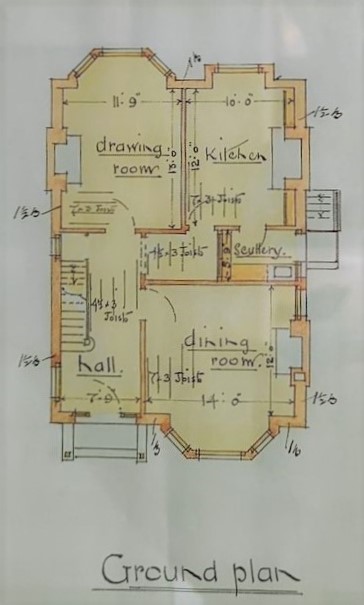
And yesterday in response to a story, Jayne Brayley got in touch to say, that “I saw your post today about the church on Oswald Road. We moved into the house next door a couple of years ago and we have an original architect drawing of the house from February 1902 and the building next door, which you've identified as a church.

 The plans label it as an office and I believe it was built at the same time as the house as part of a single property. I'll send you a picture to help any further research”.


Now the house was built for an Oliver Wood who had a commissioned the architect S. Groocoock of Brookfield Avenue, and his plans are dated to 1902.

The house must have been built sometime during the following year, and looking at the plans it was a fine property stretching over three floors, including  5 bed rooms, a bathroom, box room, and  a dinning room, drawing room and kitchen with scullery.


All of which is what you would expect, but as ever it is the less glamourous part of the house which in this case were the cellars which offers up the interesting.

The middle room was the coal cellar with access from the side of the property vis a small coal door and shute. 

The other areas included a larder at the foot of the stairs and a large space given over to the wash cellar, which had a large copper.

A copper was used to wash the clothes and consisted of a metal tub in a brick lined unit with a space underneath for a coal fire.  The proximity of the coal cellar nearby made the replenishing of the fire a less arduous task and the location of the copper close to the front of the house and to a drain was essential.

I don’t know but I suspect the floor would have gently sloped towards the front of the house allowing excess water to drain away.

The wash room was by far the largest in the cellar and would have had space for a mangle and a washing line where the clean clothes could be hung during inclement weather.

But there is no evidence that the family employed servants, so it is equally likely that they sent their washing out to one of the commercial laundries of which there were plenty in Chorlton, or alternatively employed a washerwoman to come in and do the job.

The presence of the larder at the foot of the cellar stairs meant that food might keep longer in the cooler conditions below ground and its location close to the stairs meant that it was less of a journey back and forth to the kitchen.

That said a time and motion survey would have found fault with a kitchen which involved quite a traipse from the ovens to the dining table, via the kitchen entrance and the draughty hall.

I have to reflect that the absence of a resident servant meant that the family were either modern enough to have seen to themselves or employed daily servants who left at the end of the day for their own homes somewhere in Chorlton.

Well, we shall see or though I doubt we will ever know.

As for the Wood family, Mr Wood and his son described themselves as Foreign Stamp Dealers which may explain the need for an office.  Not that Mr. Wood senior had always dealt in stamps.  

Back in 1881 he gave his occupation as a sailor and in 1901 was in manufacturing.

Nor is that quite all, because there appears a mismatch in the census returns and marriage records.

So the 1911census records that Mrs. Wood was 17 when she was married, having her eldest son at 18 which conflicts with  her marriage certificate which offers up a date of 21.

Leaving me just to thank Jayne for providing me the plans and setting me off on a journey.


Location; Chorlton

Pictures; original architect drawing’s, 1902, from the collection of Jayne Brayley


Tuesday, 26 October 2021

The missing Oswald Road houses ……..a request ……. and an outrageous advert

There will be someone who remembers the terrace of houses on Oswald Road, which included number 94.

Oswald Road, 1907
I should do but I don’t.

Nor can I put to mind when they were demolished and eventually became the landscaped area beside the Field of OS.

I started pondering on when they vanished after someone contacted me asking what had happened to 94.

They appear on the OS map for 1894, and are still there on the OS for 1952, and I expect were knocked down in the late 1970s or early 1980s.

And here enters Peter Topping into the debate, because Peter did what I didn’t do and looked up the Chorlton Bomb maps.  These were compiled by the City Council and showed just where bombs fell in the city during the war.

Using the OS map of Manchester & Salford for 1933-34, direct hits were indicated by "red circles for fire bombs; blue circles for high explosives; pink shading for damaged buildings; red shading for demolished buildings; green marks: line mines, indicating bomb damage by the Luftwaffe during the Blitz”.

And our house had its own bomb circle, leading Peter to conclude this was one of the properties the Luftwaffe accidentally hit on its nightly trips out, which played out to his assertion that Hitler wanted to destroy Manchester City’s ground because he “was an ardent Manchester United fan”.

Now this might surprise some but the logic was explored in his book “Smile Dammit Smile !!! Chorlton”, which was published in 2020 and presented a lighted hearted version of the news.*

It was based on the publication Billy’s Weekly Liar, which was a spoof broadsheet sold in Blackpool before and just after the last world war.

So I rather think, we should be careful of Peter’s interpretation, not least because our house received not a high explosive bomb, but an incendiary device, which would explain why it was still there in 1952

That said I admire Peter’s determination to readjust history for the purpose of making us smile.

Location; Oswald Road

Picture; Oswald Road from the 1907 OS map of Manchester & Salford

*“Smile Dammit Smile !!! Chorlton”, Peter Topping, 2020, Hitler’s MUFC Takeover Bid, pages 104-105. The book  is available from http://www.pubbooks.co.uk/ or Chorlton Book shop


Monday, 18 February 2019

The lost photograph ..... the mystery of Chorlton’s Ice Rink ... and the walk through our past on Sunday

Now here is a story which has been a long time in the making.

It concerns our own Chorlton Ice Rink which stood on the corner of Longford and Oswald roads.

On Jan 17 1907, “H” wrote to Albert, that “This is a photo of Chorlton’s Skating Rink.  I had a dust on it on New Year’s Day and it is OK”.

I first came discovered, it when I came across a painting by J Montgomery who painted the place in 1946 from a photograph dated 1906

He referred to it as “Chorlton Skating Rink (later the “Picturedrome”).

But until this week the original photograph was lost, but I rather think this may be the one Mr Montgomery used.

The building belonged to the Chorlton Skating Rink which was wound up as a company in 1916, but its time as a cinema was limited to just Montgomery’s reference to the Picturedrome.

In 1914 it is listed as the Longford Picturedrome seating 600 and its proprietor was a James Morland.

Sadly that is all we have and the listing did manage to substitute Street for road in the address.

There was a Mr Moreland living in Old Trafford just a few years earlier but that is it.

It may be the competition with its close rivals proved too much.
The Chorlton Theatre and Winter Garden had opened in the early years of the 20th century as a variety hall and doubled up as a cinema, while in 1915 a purpose built picture house had opened on Barlow Moor Road.

The combined competition may just have proved too much or it might have been the  war that finished it off.

Either way you can find out lots more on Sunday when we walk our past and call in at the site of the Chorlton’s Ice Rink.

The walk which is part of Chorlton Book Festival, will start from the the Library on Sunday November 18 at 2 pm and take about an hour, after which we will relax in The Edge Theatre, Manchester Road.

Beverley from the library service informs me that “tickets are £7.50 including soup and a roll at the Dressing Room cafĂ©, The Edge Theatre, Manchester Road, M21 9JG after the walk. 

Booking is essential for this popular event. 

Please visit Chorlton Library or call 0161 227 3700.

Walking Chorlton's Past, Sunday 18 November 2 - 4pm"

Location; Chorlton

Picture: The Chorlton Ice Rink, 1907 from the collection of Chris Griffiths and cover from The Kinematograph Year Book Program Diary and Directory 1914

*Chorlton Book Festival, November 16-24, https://www.chorltonbookfestival.co.uk/


Wednesday, 24 January 2018

To tarmac or not ......... that is the question in Chorlton this evening

Now there has been a flurry of comments across the social media platforms about the resurfacing work that is going on a pace across Chorlton.

And as ever to adapt President Abraham Lincoln, you can please all the people some of the time and some of the people all the time but you cannot please all the people all the time.

So in the space of a few days we had those pinning for the lost of the stone setts and calling for the council to “leave our streets alone” to those who couldn’t abide the prospect of riding a bike or driving their car over the wibbly wobbly surface.

Added to which some people called them cobbles which they are not and no one picked up on the debate in the 19th century as to whether stone of wooden blocks would be better.

I do remember Dad coming home with wheelbarrows of the wooden variety lifted from the street round the corner and using them as fuel for our kitchen stove.

And this just left Andy Robertson to go out and photograph Oswald Road yesterday, and then remembering that there is a picture of Longford Road from the Lloyd Collection which regularly appears on the blog dating back to the early 20th century.

Enough said.  Compare and contrast, answers on an old fashioned postcard, please.

And to start you off ...... anyone spot the litter?

Location; Chorlton

Pictures; Oswald Road, 2018, from the collection of Andy Robertson and Longford Road circa 1900 from the Lloyd Collection 

Monday, 7 August 2017

Chorlton by night nu 1 ............. Oswald Road School

Now this is one of those pictures which needs me to add very little.

We are looking across at Oswald Road School pretty much as it has looked for a century.

Andy Robertson took the image on an early evening at the end of November.

Just over to our left and out of shot is the library opened in 1914 and the snooker hall.


Picture; Oswald Road School, November 2014, from the collection of Andy Robertson

Tuesday, 4 October 2016

Modern buildings in Chorlton ............. nu 1 Oswald Road School

Now back in 2014 Andy Robertson took a series of pictures recording the new build for Oswald Road School.

At the time it generated some discussion about the style of the building set against the obvious need for more space and an extension which was fit for the new century.

Yesterday Andy was back with this image, and that in turn made me think of just how many new buildings have gone up around Chorlton in the last year.

All of which is I think the start of a new series.

Location; Chorlton

Picture; Oswald Road School, 2016, from the collection of Andy Robertson

Wednesday, 27 January 2016

Back with Mrs Elsie May Crump, a bit of broadcasting history and Chorlton

Now I am pleased that a lot more people are going to read about Mrs Elise May Crump and her part in a little bit of broadcasting history.*

In October 1946 she had appeared on the first broadcast of Woman’s Hour and three months later was invited back to reflect on how it had all gone.

She described herself as a working woman who found it difficult to listen regularly because she assisted her husband in their butcher’s shop on Oswald Road.

And as you do I went looking for a story and along the way I asked for anyone who knew her and quick as a flash my old friend Bob Jones came up with this picture which he is fairly confident is Mrs Crump.

There will be others I am sure who also remember Mrs Crump and so it seemed a perfect story for the Chorlton edition of Community Index.**

 And having submitted the story Linsey the editor turned up a snippet from a newspaper on the other side of the country reporting on Mrs Crump’s appearance on the wireless.***

I dare say that there will be other snippets of her broadcasting debut just waiting to be discovered and while as yet they remain hidden I am confident that as the Community Index drops through the letter boxes there may be fresh discoveries.

And that is all I want to say for now.


Pictures; Mrs Elsie May Crump, from the collection of Bob Jones, and the advert for Mrs Crump’s shop, 1928 from the St Clement’s Souvenir Handbook of the Church Bazaar, 1928 

* Mrs Crump of Chorlton-cum-Hardy and a piece of broadcasting history, http://chorltonhistory.blogspot.co.uk/2016/01/mrs-crump-of-chorlton-cum-hardy-and.html

**Community Index, http://communityindex.co.uk/

***A Chorlton Woman's Hour, https://view.publitas.com/community-index/2016-02-community-index-chorlton-around/page/28-29

Saturday, 14 November 2015

A century and a bit of offerring bread and cakes at 127 Oswald Road ..... from James Lawton to the Phoenix Deli

Now I am back on Oswald Road thinking of the house Mr and Mrs Lawton occupied in the January of 1911.

127 Oswald Road, 2012
It was a story I featured a few days ago and had begun with Peter’s painting of the Phoenix Deli.

And as you do I went looking for the history of the site.

I am now pretty sure that Mr and Mrs Lawton were the first residents of 127 Oswald Road and by one of those nice twists they were in the business of baking bread and cakes not so far away from what the Phoenix now does just a century and a bit later.

127 Oswald Road, 2015
In between there were of course a succession of different shops but as Andy’s photograph shows by 2012 Craft Delicious were making cakes and other fancy things to eat.

So what goes round comes round.

Pictures; 127 Oswald Road in December 2012 from the collection of Andy Robertson

The Phoenix Deli, 127 Oswald Road, Manchester M21 9GE, 0161 22 4990

e: :info@thephoenixdeli.co.uk
w: www.thephoenixdeli.co.uk

Opening times Monday-Friday 7.30 - 3 pm Saturday 8.30 - 2.30 pm


Painting; The Phoenix Deli © 2015 Peter Topping

Web: www.paintingsfrompictures.co.uk

Facebook: Paintings from Pictures https://www.facebook.com/paintingsfrompictures

Wednesday, 11 November 2015

The Phoenix Deli and a little bit of history

I went looking for Mr James Lawton today but sadly so far I have only found the one reference to him at 127 Oswald Road in 1911.

Today it is the Phoenix Deli but back then it was Mr Lawton's bakery and I rather think he would have been its first resident because the south side of Oswald Road dates from no earlier than 1909 and just a few doors down there is a stone plaque with the date 1907.

Had Mr Lawton stood on the site of his house just a year earlier he would have had an almost clear view across the fields as far as Longford Hall while just beyond Longford Brook there was the slightly less attractive brick works.

But within just a short time the developers had covered this side of the road with houses which would have offered up lots of new customers for his bread and cakes..

I don't yet know how long it remained a bakery but by 1969 it was listed as Jayvee Ltd, hairdressers' sundries and more recently Eat in 2008 and Craft Delicious four years later.

So the Phoenix Deli comes with a bit of history and a walk down Oswald Road will reveal a mix of the purpose built shops like the Market on the corner of Nicholas Road and other corner retail outlets which may once have been residential but were converted into shops by enterprising individuals.

Now given that Oswald and the long roads of Nicholas, Newport and Longford are just a bit of a walk away from the main shopping parades a convenience store on the next corner makes perfect sense especially if all you want is a pint of milk or a packet of biscuits.

Of course what we nip out for has changed so instead of a tin of corned beef and packet of instant mash it might well be fresh pasta, virgin olive oil and a loaf of ciabatta bread.

But I like the idea that what was once a bakery in 1911 is now a deli which just leaves me to find out all of the businesses that flourished at 127 which according to Shirley who ran it as a hairdressers for 14 years, "there was a dog parlour, arty trinket shop, sandwich shop and then an Asian Craft shop that sold tea."

Most have pretty much gone on unrecorded which is why I am pleased Peter has painted the Phoenix Deli for his series “A Moment in Time” which sets out to record how Chorlton is changing and is unique in that he has chosen to paint pictures rather than take photographs.

Since he began the project in 2010 some of the places have been redecorated, others have changed hands or no longer exist.

And that just leaves me to wish he had been outside 127 back in 1969.

Additional research Andy Robertson

The Phoenix Deli, 127 Oswald Road, Manchester M21 9GE, 0161 22 4990
e: :info@thephoenixdeli.co.uk
w: www.thephoenixdeli.co.uk
Opening times Monday-Friday 7.30 - 3 pm Saturday 8.30 - 2.30 pm

Painting; the Phoenix Deli © 2015 Peter Topping

Web: www.paintingsfrompictures.co.uk

Facebook: Paintings from Pictures https://www.facebook.com/paintingsfrompictures

Sunday, 25 January 2015

A year in the story of Oswald Road School

Now anyone who missed that short series on Oswald Road School’s new building, this is for you.*

Just over a year and a bit ago Andy Robertson started recording the construction of that new bit of the school.

At the time I had mixed feelings wondering whether it would detract from the style and appearance of the old school but fully accepting that schools are about children and have to adapt to meet growing intake and changes in how they are taught.

I wasn’t alone in experiencing those thoughts but I suspect in a few years such considerations will have been forgotten.

So for those who have already forgotten the start of the build or for that matter its completion in September 2014, here are two that Andy took pretty much at the beginning and finish of the project.

And it highlights the important work Andy has done to record how where we live continues change.

Which just leaves me to make that simple appeal for more photographs from our past, be they picture postcards, snaps of granny in the back yard or stylized portraits from the studio of the professional photographer.

Pictures; Oswald Road School in the January and September of 2014, from the collection of Andy Robertson

*Oswald Road, http://chorltonhistory.blogspot.co.uk/search/label/Oswald%20Road

Thursday, 28 August 2014

Down at Oswald Road School, with a new term and a new building

Now it is that time of year again, and as August runs its wet course September will arrive with that “Back to school” theme.

It will be there in every supermarket you walk into, be uppermost in the minds of many young people and of course exercise the last minute preparations in homes across the city.

And down at Oswald Road school the new extension is having the finishing touches put to the interior.

Like many people I have been watching the progress since the middle of the year when the ground was first broken and the steel skeleton was being bolted together.

Much of that progress has been recorded by Andy Robertson who has been diligently photographing the stages of its construction and his work is one of those textbook examples in how how it should be done.

All too often we just take for granted the passing of one building and the creation of another, and that is a shame.

I would love to have seen Beech House which stood on the corner of Barlow Moor Road and Beech Road when it was being built in the early 19th century and later when it was pulled down sometime in 1909.

But that was not to be, so all credit to Andy who I hope will publish all the images in the fullness of time under the title.

And I rather like his own heading "hard hat on a cool tin roof" which came with for the last batch of pictures pictures.

Pictures; Oswald Road School, August 2014, from the collection of Andy Robertson

Thursday, 31 July 2014

Down at Oswald Road School on a July day, capturing another changing moment

Now the skill of recording events which will mark a moment in history can be just good luck.

For many photographers it will be that they were there with a camera just as the event unfurled.

A few minutes earlier or later and that event would have been lost.

Now in the case of Andy Robertson who took these pictures of Oswald Road School the images come from a keen knowledge of what is going on in Chorlton and a determination to record the changes as they happen.

And in doing that he is following a small group of local photographers who diligently took pictures across the township in the 1950s and 1960s.

These are now in the city’s image collection, and are a powerful record of what Chorlton was like.*

And I hope Andy will in the fullness of time pass his onto the local studies library.

In the case of the school he has recorded the building of the new extension and now the demolition of the old one.

Like all good pictures that capture a point in time, it is sometimes the one most people miss that says it all.

So here amongst the bulldozer, and broken bits of building is that pile of classroom furniture and other things which for me sums up just what as going on.

Now that for me is what a camera should be for.

Pictures; Oswald Road School, July 2014

*Manchester Local Image Collection, http://images.manchester.gov.uk/index.php?session=pass

Sunday, 16 February 2014

A new school extension, back on Oswald Road a month later

Now I have to confess that I didn’t think when I posted a story about the new build down at Oswald Road School it would cause a flurry of debate.*

But that is what happened, and essentially the rift fell between those who were unhappy at the new development obscuring the view of the old Board school and those who pointed out that the extension was badly needed and would offer our children a 21st century school.

I must admit I am torn between the two.  I love old Board schools but am aware that the demand for new school places has to be met.

So for now I shall reflect that the debate on the need for new schools is not new and goes back over 170 years.

In the meantime Andy Robertson was back on Oswald Road to capture the stairs going in.

Picture; courtesy of Andy Robertson

*Changing Chorlton, on Oswald Road in January 2014  http://chorltonhistory.blogspot.co.uk/2014/02/changing-chorlton-on-oswald-road-in.html

Wednesday, 12 February 2014

Changing Chorlton, on Oswald Road in January 2014

We are on Oswald Road watching as the new build goes up beside the old school.

The picture was taken by Andy Robertson in a series which could well be titled Changing Chorlton.

It reminds me of the need to snap away and capture some of the township before it has changed unrecognisably.

But I have to throw my hands up and admit I didn’t do my bit.

Buildings which have stood in Chorlton for a century and more and which I have written about were demolished by the developers or written off by the city planners and sadly their passing was not recorded by me.

So Andy’s pictures are important not only because of their value for the future but also because they allow us to compare the past with now.

The new build is a direct result of the squeeze on school places and that has an echo in the past.

Even before we voted to join the city in 1904 there were calls for to expand the existing schools.
The old school on the green had been rebuilt in 1879 and less than two decades later plans were submitted for an extension.

The plans came to nought when the new school on St Clements Road was built in 1901 and this in turn was followed by the annexation of what had been Tom Mosytn’s School of Art on High Lane and then by further new buildings into the 1920s.

That said I do wonder at the longevity of that new build.  All glass and steel it may be but I somehow doubt it will last as long as its brick counterpart well over a century old, and still a fine example of a Board School

All of which brings me back to that simple observation that you can never have enough pictures of Chorlton.

Pictures; from the collection of Andy Robertson