Showing posts with label Eltham Palace. Show all posts

Thursday, 22 January 2026

That remarkable painting of Eltham Palace .........

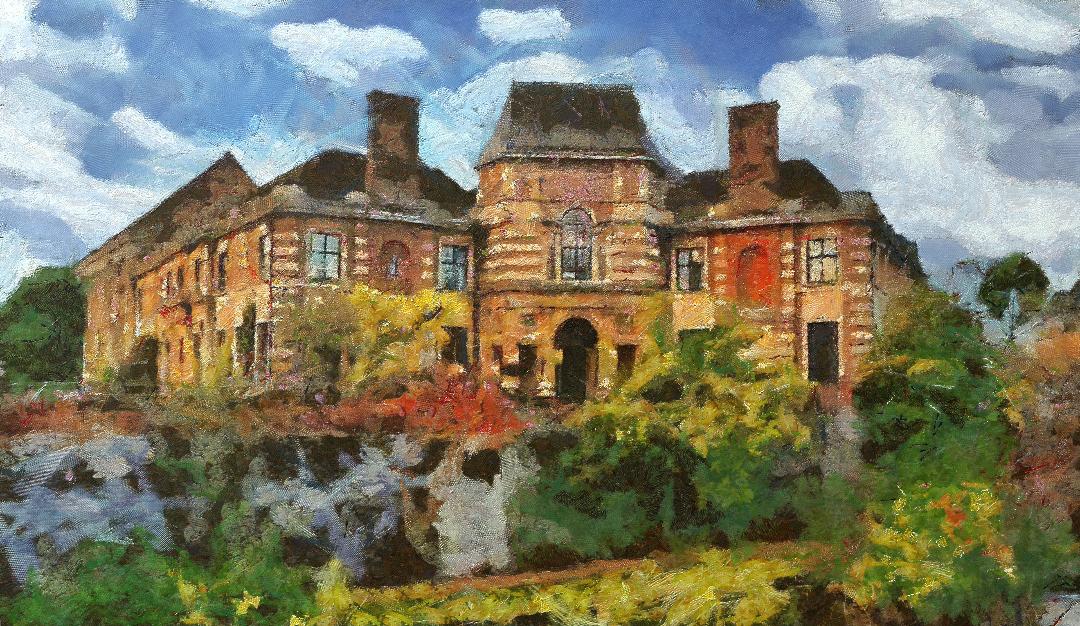
I like this water colour of Eltham Palace by my old friend Peter Topping.

The painting, 2025
Like many people I continue to be fascinated by Eltham Palace along with the Tudor Barn, its more humble companion just down the road.

So, if you grew up in Well Hall and were interested in history then these two old buildings were special.

Back in the 1960s the Palace was only open on Thursdays and Sundays which meant timing a visit to the school holidays or a Sunday.

But admission was free and from May to October the doors were open from 11am to 7pm and in the winter from 11am till 4, which gave plenty of scope to wander the Great Hall and indulge in shock and awe, made all the more so when I discovered the Palace's history and its place in Shakespeare's plays.

The guide book, 1958
All of which meant I could often be found on Thursday afternoons standing below the great wooden roof letting my imagination roll away.

Later still as I became less interested in the doing's of royalty and more in the lives of those who worked to keep the posh people happy I started to explore what it meant to be a kitchen servant, a laundry woman or the man in charge of the cole house.

Not an easy piece of research but I was helped by a delightful little book from the Ministry of Works published in 1958 for one shilling which acted as the "Official Guide-book [to] Eltham Palace Kent" 

Not that the author "D.E. Strong, M.A., D.Phil, formerly Assistant Inspector of Ancient Monument" gave any time in his description to our kitchen servant,  laundry woman or the man in charge of the cole house, but in the back of the book there are two plans based on the work of John Thorpe, who was the Elizabethan surveyor.

And there amongst all the important state rooms are the places that kept the Palace working, from the Slaughter House, Cole House, Pastry, Spicery and "My Lord's Butry"

The plan, 1958, based on the two Elizabethan plans

Too which I can add that series of fine line drawings of the Palace in a state of decay in the 18th century when it was a home to cows and other live stock which appear from time to time on the blog.

All of which is a far cry from Peter's painting made all the more remarkable because he is from Preston, has lived in Manchester for half a century and only knows of the palace's existence because I wax lyrical about the place on cold winter evenings in the Horse and Jockey, that Inn on the Green.

And just as Peter left Preston, I left Well Hall for Manchester in 1969,but still miss Eltham, its Palace and the Progress Estate where I gew up.

So much so that everyso often Peter comes up with another painting of home.* 

Painting; Eltham Palace, Peter Topping www.paintingsfrompictures.co.uk

Pictures; Plan and front cover from Eltham Palace Kent, Ministry of Works Official Guide-book, 1958

*Painting Well Hall and Eltham, https://chorltonhistory.blogspot.com/search/label/Painting%20Well%20Hall%20and%20Eltham


Tuesday, 20 January 2026

A little bit of Manchester in Eltham Palace

Now I do miss Eltham, it was where I grew up and it is a place I was very happy.

But at the age of 19 I went north following a girlfriend who had started a course at Manchester Polytechnic, which on reflection was not the best way for me to choose a degree course especially as she left for London just three months later.

The Sentry, 2007
I stayed and the city has been my home ever since and I do think of it as home, but like all ex pats I have never forgotten Eltham and in particular Well Hall.

All of which made the discovery that one of the City’s war memorials was replicated in miniature and sits on a table in the study of Eltham Palace a source for thought.

I came across it recently while working on the new book.*

The original was commissioned by S & J Watts to commemorate those who worked for the company and died in the Great War.

The memorial was erected  in 1922 in the main entrance of the company’s building on Portland Street.

The Sentry is a bronze sculpture, which stands in an arched niche just inside the building and faces a marble plaque commemorating the dead.

It depicts the sentry standing on duty, and was commissioned from the British sculptor Charles Sargeant Jagger who also designed the Royal Artillery Memorial at Hyde Park Corner, London.

Eltham Palace, 1961
And to my surprise and pleasure there is a small version of the figure in the study of Eltham Palace, where it was displayed by Stephen Courtauld, who like Mr Jagger was a member of the Artists' Rifles.

So there you have it a little bit of Manchester in the heart of Eltham.

But I can’t close without a reference to the building which holds the orginal statue.

This  is the  large, Victorian Grade II listed building known as Watts Warehouse.

It opened in 1856 as a textile warehouse for the wholesale drapery business of S & J Watts, and was the largest single-occupancy textile warehouse in Manchester.

Today the building is part of the Britannia Hotels chain.

Watts Warehouse, 1973
One source has referred to its ornate style as being typical of
the extravagant confidence of many Mancunian warehouses of this period, but the Watts Warehouse is notable for its peculiarly eclectic design. Designed in the form of a Venetian palazzo, the building has five storeys, each decorated in a different style – Italian Renaissance, Elizabethan, French Renaissance and Flemish – and roof pavilions featuring large Gothic wheel windows.

The interior was similarly lavish in its decoration, with a sweeping iron cantilever staircase, balconied stairwell, and mahogany counters for displaying merchandise.”*

And that makes it a sort of palace.

Location, Manchester and Eltham in London

Pictures; the Sentry, Cnbrb, 2007 Wikipedia Commons, Eltham Palace, from Eltham Palace Ministry of Works Guide Book, 1961and the Watts Warehouse, 1973, m56859 , courtesy of Manchester Libraries, Information and Archives, Manchester City Council, http://images.manchester.gov.uk/index.php?session=pass

*A new book on Manchester and the Great War, http://chorltonhistory.blogspot.co.uk/search/label/A%20new%20book%20on%20Manchester%20and%20the%20Great%20War

** Watts Warehouse, https://en.wikipedia.org/wiki/Watts_Warehouse

Monday, 19 January 2026

A lost Eltham Palace ........... nu 3 Eltham Palace from the north west

Now I have decided to run a few pictures of what Eltham Palace looked like in the 18th and 19th centuries.

It had long been abandoned as a home for royalty and its grand days were thing of the past.

The occasional tourist up from London called in along with an interested artist keen to capture its former splendour but that was about it.

All very different from now, and a prelude to more stories of the building and its history.*

But in the meantime here then over the next few days are the Palace as you might have seen it during the early 19th century, all taken from that wonderful book on the history of Eltham published in 1909.**

Picture; Eltham Palace from the north west from an old engraving, from The story of Royal Eltham, R.R.C. Gregory, 1909 and published on The story of Royal Eltham, by Roy Ayers, http://www.gregory.elthamhistory.org.uk/bookpages/i001.htm

*The Story of Eltham Palace, http://chorltonhistory.blogspot.co.uk/2014/04/the-story-of-eltham-palace.html

** The story of Royal Eltham, R.R.C. Gregory, 1909 and published on The story of Royal Eltham, by Roy Ayers, http://www.gregory.elthamhistory.org.uk/bookpages/i001.htm

Sunday, 18 January 2026

A lost Eltham Palace nu 2 .............. The Banqueting Hall in 1782

Now I have decided to run a few pictures of what Eltham Palace looked like in the 18th and 19th centuries.

It had long been abandoned as a home for royalty and its grand days were thing of the past.

The occasional tourist up from London called in along with an interested artist keen to capture its former splendour but that was about it.

All very different from now, and a prelude to more stories of the building and its history.*

But in the meantime here then over the next few days are the Palace as you might have seen it during the early 19th century, all taken from that wonderful book on the history of Eltham published in 1909.**

Picture; the Banqueting Hall West end, from an engraving in Archeologica 1772, , from The story of Royal Eltham, R.R.C. Gregory, 1909 and published on The story of Royal Eltham, by Roy Ayers, http://www.gregory.elthamhistory.org.uk/bookpages/i001.htm

*The Story of Eltham Palace, http://chorltonhistory.blogspot.co.uk/2014/04/the-story-of-eltham-palace.html
** The story of Royal Eltham, R.R.C. Gregory, 1909 and published on The story of Royal Eltham, by Roy Ayers, http://www.gregory.elthamhistory.org.uk/bookpages/i001.htm

Saturday, 17 January 2026

A lost Eltham Palace nu 1 ................ The Banqueting Hall

Now I have decided to run a few pictures of what Eltham Palace looked like in the 18th and 19th centuries.

It had long been abandoned as a home for royalty and its grand days were a thing of the past.

The occasional tourist up from London called in along with an interested artist keen to capture its former splendour but that was about it.

All very different from now, and a prelude to more stories of the building and its history.*

But in the meantime here then over the next few days are the Palace as you might have seen it during the early 19th century, all taken from that wonderful book on the history of Eltham published in 1909.**

Location; Eltham, London

Picture; The Banqueting Hall used as a stables from an old engraving, from The story of Royal Eltham, R.R.C. Gregory, 1909 and published on The story of Royal Eltham, by Roy Ayers, http://www.gregory.elthamhistory.org.uk/bookpages/i001.htm

*The Story of Eltham Palace, https://chorltonhistory.blogspot.com/search/label/Eltham%20Palace

** The story of Royal Eltham, R.R.C. Gregory, 1909 and published on The story of Royal Eltham, by Roy Ayers, http://www.gregory.elthamhistory.org.uk/bookpages/i001.htm

Friday, 29 August 2025

Mr. Topping paints Eltham Palace …..

 Now, I maintain, and I maintain most strongly that you can never have enough paintings of Eltham Palace.

Growing up in Well Hall with the Pleasaunce and the Tudor Barn, that magnificent medieval Palace was always a counter attraction.

True in the 1960s you could only gain access on a Thursday but that was enough and as a kid with a vivid imagination my day would be spent with a host of kings, and barons down to the cooks and servants who waited on. 

Even then I was well aware that had I been in the Palace in the Middle Ages I wouldn’t be giving the orders, instead it would be my task to fetch, obey and generally be the dogsbody.

And then our Jill moved into a house nearby with views up to the Palace and as the book says, “my cup runneth over”.*

All of which made the Palace a perfect topic for a Topping painting and like New York I just had to repeat it.

Location; Eltham Palace

Painting;2024 © Peter Topping Paintings, from Pictures from an photograph by Liz and Colin Fitzpatrick 2015.

Saturday, 12 July 2025

The history of Eltham in just 20 objects ........Nu 4, a royal palace and another book

The challenge is to write a history of Eltham in just 20 objects which are in no particular order, and have been selected purely at random.

Anyone who wants to nominate their own is free to do so, just add a description in no more than 200 words and send it to me.

Now I don’t intend to write about the history of our royal palace, which is so much part of Eltham’s past other than to acknowledge its importance to the area.

Instead I want to highlight a book written all about it by Roy Brook and published in 1960.

It is now out of print but copies can be picked up relatively cheaply which is how I got my copy.

It is more than just the story of the Palace provinding information and maps on Eltham's development.

Picture; cover of the book

Friday, 6 June 2025

Down at Eltham Palace in the summer of 1958

Now I am back at Eltham Palace, a place that first captured my imagination back in 1964 and continues to do so.*

This is the cover to the 1958 Ministry of Works Official Guide-book price One Shilling.

It runs to just 14 pages with four photographs and a map, and of course is a little bit of history in its own right.

When I first wandered around the Hall I don’t think what I saw would have been so different from what the guidebook described.

Now fifty-eight years on I am not so sure.  It has been a long time since I have been there and the Army Education Institute have long gone.

So for no particular reason other than I have the book, here are some of the pictures from that guide and the fun will be deciding if anything you see has changed.

Great Hall from the south, 1958

I can still remember standing under that great timber roof in the hall.

Since then I have come across pictures of the hall from the 18th century when it was used for cattle.

And read about the painstaking work of restoration undertaken in the 1930s.

So I know that next time I am back in Eltham I shall make every attempt to visit the Palace although even here times have moved on.

Roof of the Great Hall, 1958
Back in 1958 the Great Hall was open only on Thursdays ans Sundays from 11 a.m. to 7 p.m. during May to October, and 11 a.m. to 4 p.m. from November to April and admission was free.

Today it will cost you £10.20 if you an adult, £6.10 if you are under 15 but it will be open Sunday to Thursday 10 till 5 in the afternoon.

Pictures; from Eltham Palace, Kent, Ministry of Works, 1958


Monday, 24 March 2025

Another side of Eltham Palace …….. the Courtauld rooms

Now, I grew up with Eltham Palace, and delighted in that walk over the bridge and into the grounds.

Virginia Courtauld's bedroom
And for me, steeped in medieval and Tudor history, the attraction was always the Great Hall, which my imagination filled with the good and the great doing what the good and great always do.

Later I wondered about the more important people who toiled in the kitchens, washed the huge amounts of bed linen and attended to all the needs of the powerful.

But the buildings where all the work was done have long gone, and history did not see fit to record the lives of the servants and agricultural workers.

In the same way I chose to ignore the later years of the Palace when the monarchs and their advisors and friends had moved on, and the building was reduced to near ruin, fit only for storing hay and livestock.

Virginia Courtauld's bathroom
Nor did I really take much interest in the Courtauld’s who acquired the lease of the Palace in 1933, restoring the Great Hall and adding a new building which became their home for eleven years.

And that was my loss, because the Art Deco interior is stunning.

So, I am indebted to Jeremy Harrison who sent me a selection of photographs of some of the rooms, including Virginia Courtauld’s bedroom and bathroom.

There will be many who like me left Eltham a long time ago and may have missed the Courtauld contribution to our Palace, and so with that in mind I intend to return to the 1930s Art Deco building, courtesy of Jeremy.

Location; Eltham

Pictures; the Courtauld Rooms of Eltham Palace, 2018, from the collection of Jeremy Harrison

Sunday, 23 March 2025

Wandering down Court Yard letting the magic wash over you

When I was growing up the area around the Palace was a pretty magical place.*

Of course the old hall was only open at certain times but that just meant you were forced back to wander down Court Yard and King John’s Walk which let your imagination soar in all sorts of directions.

Back then the history of the half timbered buildings were unknown to me but you could tell that they belonged to a time when the Palace was an important part of any Kings travels around London and beyond.

So with just a bit of historical license it was easy to people them with the great and the good along with the not so good and a whole raft of servants who worked long hours for little reward and have passed out of history.

Now they and the gates into the Palace along with Court Yard and St John’s Walk are regularly photographed and Chrissy and Jean have taken some fine ones over the years which they have been kind enough to allow me to use.

But working on the basis that you can never have enough pictures of Eltham here are two taken by our Elizabeth and Colin one Sunday at the end of October.

And what I like about them is that each offers just a glimpse of this old part of where we live allowing my imagination full reign to conjure up stories of who lived and worked there and just what they said to each other as they watched the sunlight play on the water.

Pictures; around Eltham Palace, October 2015, from the collection of Elizabeth and Colin Fitzpatrick

*Eltham Palace, http://chorltonhistory.blogspot.co.uk/search/label/Eltham%20Palace

Wednesday, 1 November 2023

The story of Eltham Palace

Cover of the book
“Two generations ago Eltham was a quiet Kentish village where time had almost stood still.  

The narrow High street wound its way up the hill from the parish church, past the Congregational Church, and Sherrard House on the left, which faced the Grey Hound Inn, and then passed the old smithy, the old ‘Cage’ or ‘Lock Up,’ Love Lane and Dobson’s Pond on its way on towards Maidstone.

Gone were the stagecoaches, but a sign on the corner of Court Yard pointed in the direction of Mottingham, and indicated that the sounds of Eltham station were a mile away, and would not normally be heard.

The Dover Road lay to the north, almost parallel with the Kentish Road running through our village, and for centuries the tranquillity of the countryside had been disturbed only by travellers journeying to and from the Continent.

It was along these roads that Wellington’s men had marched to meet the French at Waterloo and Cromwell’s men to meet the men of Kent in an earlier period.

It was the Dover Road along which the Romans invaded England before they crossed the Thames at London and which was later familiar to Chaucer and Charles Dickens alike. It crossed what was to become Shooter’s Hill, and still serves as a boundary of the manor and parish of Eltham.

The Banqueting Hall, 1909
The slumbers of the ancient ruined place were disturbed only by its immediate occupants, and a few learned antiquarians, who took a sentimental interest in it.”*


Now as the start of a history of Eltham I don’t think the opening paragraphs of The Story of Eltham Palace can be beaten.

It was written by Captain Roy Brooks while he was stationed at the Palace with the Royal Army Education Corps in 1959 and was a full half century after that other book on Eltham’s history was published by R.R.C. Gregory in 1909.

Neither is now in print but it is possible to still get copies of The Story of Eltham Palace.

When the hall was a stable, circa 1840
The chapters suggest a straight chronological romp through the Palace’s history but in the middle of the book there is a section which “tries to reconstruct a picture of the palace as it was in its heyday.”

Added to there are maps diagrams, and photographs and a short history of the Royal Army Education Corps.

So whether you try to get a copy from the local library or like me track one down on the internet it is well worth the effort.

All of which just leaves me to puzzle over the story of the man.

And with the help of Huddersfield Local History Group** I tracked him down.

I knew he had been born in Huddersfield but that was about it, so from the back of his book on "The Story of Huddersfield" by Roy Brook, published in 1968, comes this.

"Roy Brook was born in Huddersfield in 1928. His parents are Huddersfield folk, as were his forebears. 

He was educated at Huddersfield College, and the town was his home until 1946. He gained his B.A. in History at University College, Bangor, in 1949, and was made M.A. (Wales) in 1964. 

He qualified as a teacher at the University of Leeds in 1953. 

He is also as Associate of Woolwich Polytechnic in mechanical engineering, and is a lecturer in Further Education for the London Borough of Bromley. 

He joined the Royal Army Educational Corps in 1949, and is still a serving officer with the rank of Major, responsible for the training of Teachers in Further Education for the Army. 

He has written "The Story of Eltham Palace", published in 1960 for the R.A.E.C.


Major Brook is married, with three children. He is a versatile amateur musician and has travelled widely in the Far East and Australia in the course of his career. 

He now lives in South East London."

So a story that began in Eltham and wended its way north to Huddersfield has returned to the south east.
That said I recommend the Huddersfield Local History Group which has a lot to offer anyone interested in local history.


*The story of Eltham Palace, Roy Brook, 1960

**Huddersfield Local History Group http://huddersfieldhistory.wordpress.com/huddersfields-history/

Pictures; cover of the book, the Banqueting Hall in 1909, the banqueting Hall when it was used as stable circa 1840 from The story of Royal Eltham, R.R.C. Gregory, 1909 and published on The story of Royal Eltham, by Roy Ayers, http://www.gregory.elthamhistory.org.uk/bookpages/i001.htm and the Palace in 2013 from the collection of Jean Gammons, and cover from The Story of Huddersfield, by Roy Brook,  1968

Saturday, 14 August 2021

Pictures of Eltham I wish I had taken ................ down by the Palace

You can never get enough pictures of Eltham and so here is one from Ryan which he sent up to me yesterday.

For those of us who left Eltham a long time ago pictures like this one are a link with where we grew up and a reminder of what we left behind.

And in the same way it will act as a reminder for lots more people of what is on their doorstep.

Now this should be the point where I wax lyrical about the Palace and the surrounding buildings, but I regularly do that so instead I will leave you with the image.

Picture; down by the Palace, 2014, Ryan Ginn

Tuesday, 7 May 2019

Eltham Palace and Eltham People, revisiting a story

Now all too often when you come across books on Eltham Palace they concentrate quite rightly on the building, its history and the people of plenty who occupied the place.

All of which is fine but begs the question of what impact did the Palace have on Eltham?

After all some of the food that graced the fine banqueting tables will have been grown by local farmers and more than a few of the servants who washed cleaned and maintained the gardens might have gone home to a cottage near the High Street.

And then over its years as an empty shell surely a few of our children acting out a dare will have wandered through its grounds?

The stories of these little people do not get into the history books, so I am pleased that the Eltham Society published Eltham Palace and Eltham People which goes a little way to redress that omission.*

It came out in 2003, was reprinted in 2008 and is still available from the Society.**

Here there are chapters on the Palaces’ relationship with Eltham as far back  as 1086 along with events held in the Hall and grounds in the 19th century and the connection with the Courtauld family and as they say much More.

*Eltham Society, http://chorltonhistory.blogspot.co.uk/search/label/Eltham%20Society

** Eltham Palace and Eltham People, £2.50 [members] £3.00 [non members], Eltham Society Publications, http://www.theelthamsociety.org.uk/publications.php

Saturday, 9 June 2018

Back at Eltham Lodge, courtesy of Captain Brooks and his book on Eltham Palace

I am back with the Story of Eltham Palace by Roy Brook and what a treasure trove is here.

For a start it is not just about the Palace and the royal residents who lived there but also an account of the many people who visited it and left their mark on the place and the surrounding area.

One of these was Sir John Shaw who became tenant of both the Palace and its grounds in 1663 and who went on to build Eltham Lodge.*

The Shaw’s continued to live there until 1820.  During the next 19 years it was the home of Lord Wynford, Lady Crewe and Lord Rivers and from 1840 was occupied by Benjamin and Anna Wood.

He was a banker and politician.  He died in 1845 and Mrs Wood continued to live there until her death in 1889.

The chapter on the house contains a fine plan of the ground floor.

Now I have never wandered through its doors so it is interesting to get a sense of what the place was like.

The house faced north and even now the first glimpse of the property as you walk towards it is pretty impressive.

And beyond that front door was the hall and off to the left the parlour. There were two separate staircases in the centre of the house and the breakfast and dining rooms were at the rear facing south over parkland.

“The windows were originally stone mullioned, but the stone was replaced by sash-bars in the time of George II.  

The flat roof probably had a balustraded roof gallery as its central feature when originally built.

Most of the ceilings on the ground floor and first floors are richly modelled with ornament of seventieth and eighteenth century floral design. The parlour on the ground floor has high walls richly decorated with Rococo plaster-work containing the portraits of Roman emperors.

On the first floor the Grand Parlour on the south side originally contained six Flemish tapestries, of scenes from classical mythology.”**

And as you would expect it attracted visitors one of whom was the diarist John Evelyn who recorded in his diary in July 1664 that

“went to Eltham to see Sir John Shaw’s new building; the place is pleasant if not too wet, but the house is not well contrived especially the roof, and the rooms too low pitched; the orangery and aviary handsome and a very large plantation.”

And if you want more there is always Mr Brook’s book or perhaps a visit to the Lodge.

Pictures; from the cover of the Story of Eltham Palace, and exterior and interior of Eltham Lodge from the collection of Jean Gammons.

*Eltham Lodge, http://chorltonhistory.blogspot.co.uk/search/label/Eltham%20Lodge

Tuesday, 24 March 2015

Eltham Palace ......... the latest book ..... reviewed by Sue Hurley*

Now I like it when people write for the blog and so here is a review of the latest book on Eltham Palace by Sue Hurley

I lived all my young life in Eltham, and had the honour of having a view from my bedroom window of a part of a royal Palace, which I knew very little about.

I found out a bit about the lovely building as I grew up and admired it every day as I walked up King John’s Walk and along Court Road to catch the bus to school.

The stunning Eltham Palace captured my heart and I have always felt a closeness and warmth towards the place and a need to know more.

One of the books I have stumbled across is just simply called ‘Eltham Palace’ by John Priestley.* The author has been fascinated by Eltham Palace and it’s history since he was stationed there while serving in the army nearly 60 years ago.

This comes across in the way the book is laid out and written with a warm affection.

It covers the history of the Palace over three and a half centuries, between the reigns of Edward 1 and James 1.

It is richly illustrated and follows important moments in the building’s history, tracing the Palace from it’s medieval and Tudor beginnings, through the tournaments and festivities, the links with Henry V111 and Wolsey (very prominent of the moment with Wolf Hall just aired on tv) the decline of the Palace and the Civil War and the very sad destruction in the 17th Century.

The Palace was rescued from demolition in 1828, although in a state of much needed repair, as it was damaged even more by the gale of 1827, but major repairs were started by the Society for the Protection of Ancient Buildings.

More major repairs took place in 1912-1914 and the book takes you through not only all necessary work, but all the costs and some amazing photographs.

When the Courtaulds paid for more restorations in 1935, they employed top craftsmen and after three centuries of decay brought Eltham Palace back to it’s full glory.

The book is a mine of information and you can get lost in the history of the Palace. It can whisk you back to early Lancastrian times where Henry 1V spent ten of his 13 Christmases, Tudor times and a time when Queen Anne Boleyn and Princess Mary quarrelled there, a visit from Mary 1 in 1556 when she stayed there for a month much due to its recent repairs and good condition and the meetings of the Tudor privy council where the topics of France and Spain were discussed.

The book is a vivid and in-depth work of interest to locals and historians, full of Eltham Palace’s rich royal heritage and architectural history.

© Sue Hurley 2015

*Eltham Palace, John Priestley 2008, the History Press