Showing posts with label Sally Dervan. Show all posts

Saturday, 2 August 2025

Rational Rationing down at the gas showrooms with Miss Arscott of Whalley Range in 1940

Now this is one of those little bits of history which deserves to be brought out and explored.


It is another advert from my friend Sally who unearthed it from a back edition of the Manchester Evening News and dates from January 1940.

At first glance it is just a trailer for a cooking demonstration, but there is much more.

We are of course at the beginning of the Second World War and the country is once again coming to terms with food rationing, hence the very practical title of “RATIONAL RATIONING.”

The speaker was Dr. C. Arscott who was headmistress of Whalley Range School.

She had overseen its opening in 1939 and would be still be in post decades later.*

And Dr. Arscott was assisted by a team of cookery demonstrators who will have been familiar with the gas showrooms and similar events from before the war.

Manchester Corporation as part of the campaign to promote both the use of gas and electricity had hosted regular demonstrations during the 1930s.

So there you have it.

Picture; from the Manchester Evening News, January 1940, courtesy of Sally Dervan

*I am, yours sincerely, Miss Christine Arscott.... a story from Sally Dervan, http://chorltonhistory.blogspot.co.uk/2015/06/i-am-yours-sincerely-miss-christine.html

Monday, 10 February 2025

Taking up the new craze of Glider Skating down at the Gliderdrome on Barlow Moor Road in 1939

I wonder if there is anyone who was in the former Chorlton Palais on Barlow Moor Road in 1939 and joined the fun that was Glider Skating.

The dance hall had been renamed the Manchester Gliderdrome and the event was billed as 'the modern ballroom craze that is sweeping Europe"

For those keen enough to roll up there were "free skates and tuition" with sessions which lasted all day into the evening and for anyone who wanted just to watch Spectators were charged 6d to “See the Happy ‘Gliding’ Fans.”

Now with some research it should be possible to track down how long the craze lasted.

So the search is on to find anyone who was there.

In the meantime it adds a bit more to the story of the Chorlton Palais which went on to become a string of nightclubs before finally closing to make way for a fast food outlet.

It had opened in the 1920s as the Chorlton Palais de Dance.

My friend Ida remembers it from the mid 1960s when "it was always busy" and Adge  told me that "we went to the Princess Club ('the Prinny') on a regular basis in the late 60'/early 70's, it was always rocking! 

Saw some great acts there inc' Ben E King Emile Ford and Long John Baldry amongst others. 

It was always packed to the rafters and, at the end of the night, the last song was always "Hi Ho Silver Lining", everyone in the place joined in (all well lubricated) I can see and hear it now in my head. It was also the place I had my first dance and snog with my (now) wife."*

And years later I was there when it had morphed into  Valentines and later Ra Ra’s

Picture; Gliderskating, Manchester Evening News, 1939 courtesy of Sally Dervan
Princess Ballroom, R.E.Stanley, May 1959, m17616, courtesy of Manchester Libraries, Information and Archives, Manchester City Council, http://images.manchester.gov.uk/index.php?session=pass


*When you could see Tom Jones, Ben-E-King, and Dell Shannon in the Princess on Barlow Moor Road, http://chorltonhistory.blogspot.co.uk/2015/10/when-you-could-see-tom-jones-ben-e-king.html

Sunday, 12 May 2024

Wilfred Pickles, the Chorlton Repertory Theatre Club and a whole new set of stories

Now you have to be a certain age to remember Wilfred Pickles, Mabel and Have Ago.


For most of us this will be at the edge of our growing up and will forever be linked to the Light Programme  the wireless and the catcphrases, "How do, how are yer?" "Are yer courting?" "What's on the table, Mabel?" and "Give him the money, Barney."

In 1954 it transferred to the television under the title “Ask Pickles.”

I can’t remember much about the show but I know it was very popular with a weekly audience of over 20 million, and featured ordinary people who were the sort you stood at the bus stop with, listened to in the shops and could be your friends.

That made it very different from the at TV show “What’s My Line" with its panel of well bred well behaved people with their plumy voices.

So I am not surprised that the Chorlton Repertory Theatre Club would ask Mr Pickles to be their President.

Over the years there were plenty of amateur dramatic groups in Chorlton and as early as 1910 one was listed in Kemp's Almanack and reflected the fact that as the township grew many of these were the “middling people” with jobs that allowed them time at night to explore all sorts of cultural and sporting interests.

Where many of these groups performed is lost, but some will have used the Public Hall which was part of the Conservative Club and others may acted out their dreams in church halls.

So Sally’s find is quite a find and while I don’t yet have a date it opens up a whole exciting new set of stories and will I hope set memories running and perhaps will also stir up comments on Mothers Pride.

Well we shall see.

Location; Chorlton-cum-Hardy

Picture; advert for the Chorlton Repertory Theatre Club, date unknown, from the collection of Sally Dervan

Wednesday, 17 May 2023

“If you go into the woods today, you’re sure of a big surprise”........... looking for that air raid shelter in Parrs Wood

Now I know there will be someone who will remember the air raid shelter on the Gateway Estate which was built “12 feet below Kingsway.  Accommodating 120 people the shelter cost £800 to build and had a concert room, whist and bridge parlour, and lounge.”*

According to the Manchester Evening News “the shelter club was the idea of Mr William Ponsford who was a builder [and] in the dugout which is fitted with steel doors there is a piano and a radio-gramophone.  

One room has accommodation for dancing.  Gas-proof ventilation is installed [and] the shelter has two dug-out entrances and back exit and many of the tenants are already using the shelter as a social club.”

On one level it strikes you as a jokey little piece which even today has a charm overlaid with hints of Dad’s Army, but of course that is to take away the very real danger of bombing raids.

For me it is there in the description of those steel doors and the gas proof ventilation, this was after all a time when we could not be sure that gas would not be used as a weapon.

It was so potent a concern that it had led to the issue of millions of gas masks and warnings about going out without one.

And given that fire bombs and one high explosive device did fall on Parrs Wood Mr Ponsford was right to make the effort more so given the devastation that fell from the skies the following December.

All of which leaves me to ponder on what happened to that shelter.  Sally who found the piece tells me that the Gateway Estate was behind the pub, so I await the memories and stories of the Parrs Wood shelter to bubble to the surface.

Pictures; from the Manchester Evening News, January 1940, courtesy of Sally Dervan


*THEY CAN DANCE IN A RAID, Manchester Evening News, January 1940

Tuesday, 20 July 2021

Trenches in Piccadilly ............ a New Use for the Old Infirmary Site June 1917

Looking across to the old Infirmary site, date unknown
Now Piccadilly Gardens continues to excite a wealth of feelings from those who miss the old sunken gardens and have no love for that concrete slab to those who dwell on the seedy last days of the old park and point out that in these cost cutting days the present space is pretty low maintenance.

Of course before 1914 there were no gardens just the site of the Royal Infirmary which when it was demolished left a debate on what to do with the site.

It took a few years before the Corporation decided that this was a perfect place for a park in one of the busiest parts of the city.

This much I knew but what I didn’t know was that in the June of 1917 according to the Manchester Evening News the Red Cross “found a practical use for the old Infirmary site in Piccadilly ....[turning] it into a miniature sector of the Western Front.


Manchester Evening News, June 1917
The front line trenches and their equipment are said to be perfect in every detail.  There are grim touches of realism here and there, - like the torn and tattered heap of clothing nearthe terrible barbed wire entanglements to represent a dead Boche.  Some rare and valuable war relics may also be seen, including some fine specimens of enemy guns.

With infinite labour the trench diggers who were the convalescent soldiers from Heaton Park, have passed right through the heavy masonry and substantial brickwork of the old Infirmary foundations.”

There is no record of what the "convalescent soldiers from Heaton Park" thought of the task and I have yet to dig deeper to discover what the public made of the “miniature sector of the Western Front” in the heart of the city.

But once they had explored the trenches they could go on to visit the adjoining museum which “was wonderfully interesting.”

All of which just begs the question of why the display was produced.

Given that it had been produced by the Special Effects Committee of the East Lancashire branch of the Red Cross I suspect that along with its propaganda value it was linked to the organisation’s campaign for volunteers and funds.

I do know that Heaton Park had had its on set of trenches which were open to the public and no doubt so did other parts of the country.

Pictures; the site of the Infirmary, date unknown from the collection of Rita Bishop and Trenches in Piccadilly ............ a New Use for the Old Infirmary Site June 1917,  the Manchester Evening News from Sally Dervan

*Now I know what Father was doing in the Great War ...... trenches in Heaton Park in 1916, http://chorltonhistory.blogspot.co.uk/2014/02/now-i-know-what-father-was-doing-in.html

Monday, 15 April 2019

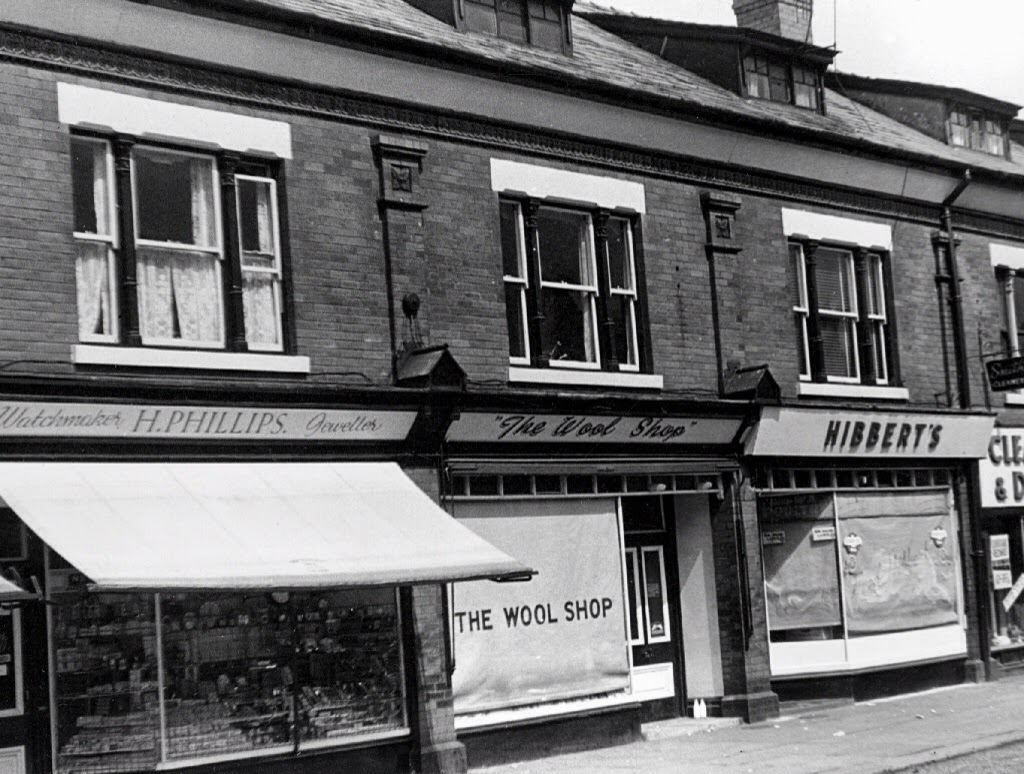
At the wool shop on Burton Road ....... another story from Sally Dervan

I have my own "Wool Shop” memories of the one on Burton Road, West Didsbury. 

The buuton tin
I think it was owned by a brother and sister, but it was usually the lady who served us.

The shop door had a bell, and it would sometimes take quite a while for anyone to come out of the back of the shop. We would stand there very politely, and not speak or touch a thing until the proprietor appeared.

I loved the wool shop, both my mum and nana were very keen knitters and what they knitted (at the time these memories are from) was usually for me.

I wouldn't always be the wearer of what they knitted even if it was for me, because they also knitted for the whole army of dolls that I owned!

The wool shop did have a particular smell, and one that was familiar to me as the daughter of a carpet shop owner, because the smell was proper wool, not nylon stuff

On Burton Road
Before we bought the wool, we needed the pattern. The patterns were in a whole shelf full of binders at the side of the counter.

Each pattern was in a plastic sleeve and I used to like the slapping noise that the patterns made as we flicked through them.

I remember the glass counter in the shop that was full of buttons. I had a fascination for buttons that has always stayed with me.

Even now, if you put a tin of buttons in front of me I can sit for hours looking through them. Old buttons each have their own story and I remember my Mum and Nana would reuse buttons, so if clothes were being discarded.

Then the buttons would come off and be saved for putting onto something else. I could easily be wearing a cardigan as a child with buttons that had come from one of my mum’s cardigans when she was the same age.

A young Sally with buttons and Father Christmas
Actually buying new buttons was a rare treat, but if we were buying buttons as well as wool then we would select them through the glass counter as if they were jewels, and the wooden tray would then be slid out from the counter for the buttons to be more closely inspected.

I remember some really fancy little buttons, lambs, bunches of roses and even some that were shaped like little post boxes that went on one of my brothers cardigans in the 1970s.

To my shame I must report that, when I was very small, most if the buttons on my clothes were the size of saucers.

This was because of one attempt by me, witnessed by my nana, to shove a stray button up my nose. It took years for me to win back that trust! I have a very early photo of me, trying to escape from Santa's knee at Lewis' - the buttons tell their own tale!

© Sally Dervan

Pictures; from the collection of Sally Dervan and Nos 238-240 Burton Road, 1962, J F Harris, courtesy of Manchester Libraries, Information and Archives, Manchester City Council, m09736, http://images.manchester.gov.uk/index.php?session=pass

Thursday, 7 February 2019

Pictures from a Manchester Square ……… Happy New Year

Walking through one of our historic squares can be a pretty neat way of seeing the history of the city.

And when it is the same square at about the same time every day then you have got yourself a project.

All you need is a camera, and the patience each week to record the same spot, and the rest as they say is Sally’s Pictures from a Manchester Square.*


So having caught the half finished giant pig in St Ann's Square a few days ago, here is the finished thing, which prompted Sally to add "He's a complete pig".

It is part of the preparations for the Chinese New Year.

The pig is the symbol for wealth and if you were born in 1959, 1971, 1983, 1995 and 2007, this is your Chinese animal, in honour of the animal there will be a giant art installation in St Ann’s Square, of which Sally’s picture hints at what is to come.

Along with it, there is a golden dragon in Exchange Square, the promise of the Lion Dance in Market Street on Saturday and the parade from Albert Square to China town on Sunday.

And so not to leave him out Sally added the Dragon in Exchange Square.

Location; St Ann’s Square

Pictures; the art installation, in St Ann’s Square, and the Dragon in Exchange Square, 2019, from the collection of Sally Dervan


*Pictures from a Manchester Square, https://chorltonhistory.blogspot.com/search/label/Pictures%20from%20a%20Manchester%20square

Wednesday, 6 February 2019

Pictures from a Manchester Square ……… the Year of the Pig

Walking through one of our historic squares can be a pretty neat way of seeing the history of the city.


And when it is the same square at about the same time every day then you have got yourself a project.

All you need is a camera, and the patience each week to record the same spot, and the rest as they say is Sally’s Pictures from a Manchester Square.*

So here is the first, and I bet there will be other’s joining in the project, but for now here are two of Sally’s which she posted with the caption of “Pig in progress 😊 St Ann's Square this morning in preparation for Chinese New Year”.

The pig is the symbol for wealth and if you were born in 1959, 1971, 1983, 1995 and 2007, this is your Chinese animal, in honour of the animal there will be a giant art installation in St Ann’s Square, of which Sally’s picture hints at what is to come.

Along with it, there is a golden dragon in Exchange Square, the promise of the Lion Dance in Market Street on Saturday and the parade from Albert Square to China town on Sunday.

Leaving me just to wait for Sally’s next progress picture ………. no pressure then.

Location; St Ann’s Square

Pictures; the art installation in progress, in St Ann’s Square, 2019, from the collection of Sally Dervan

*Pictures from a Manchester Square, https://chorltonhistory.blogspot.com/search/label/Pictures%20from%20a%20Manchester%20square

Monday, 25 June 2018

Living in Sibson Road, more from the lives of those who lived in Chorlton in the 1930s

Another story from Sally Dervan

This story starts with me looking through a box of old photographs and finding a photo of my nana and grandad sat under the pier at Blackpool.

The funny thing is, in almost every one of my childhood memories, my Nana always comes as "one of a pair" but the other half of the pair was not usually my Grandad.

My Nana and her sister Lily were as different as chalk and cheese, despite this, in later life they spent most of their time together. Their bickering was constant and their outlook on life, poles apart.

Lily was anxious, a "worrier” where my nana was practical, down to earth and seemed to shrug off problems.

As a child , my mum was very fond of "Auntie Lil " she would turn to her rather than to her own mother for comfort and a sympathetic ear , knowing that my Nana would be very likely to tell her to "shape herself " rather than  give a hug or any sort of comfort .

Two very different people who had some spectacular rows but always supported each other when life dealt them a bad hand.

At certain times in their lives, one would prove to be just what the other needed.

All though they lived most of their lives in Manchester, the sisters were actually born far from there, in Coolfin Street, Belfast, Northern Ireland.

Lily (or Eliza Jane as she was christened) was born in 1908 and my Nana, Ethel in 1910.

When they were young children they moved with their parents and four brothers and sisters, "over the water” to Manchester, where their father, Fred, had obtained a position as an overseer of a commercial laundry. The family lived in a "two up two down" house in Thompson Street Levenshulme, with their mother Minnie supplementing the family income by working alongside her husband as a laundry assistant.

In 1930 when she was 22, Lily met David Ridgway at a dance. David was a clever young man, from Flora Street in Hulme, similar back to back terraced housing to Lily's home in Thompson Street.

The pair were about to take a step up, David got a good job and on their marriage in 1931, they settled into semi detached suburbia, buying a house off Sibson Road in Chorlton.

This spacious semi with a long back garden must have seemed like heaven to Lily after the sooty streets of Levenshulme. Lily set about the task of "homemaking” with enthusiasm.

One of her first purchases being a pair of matching fireside chairs .Their brown upholstery and elegant “Art Deco" curved wooden arms made them both stylish and comfortable.

I have no doubt that Lily and David envisaged many happy hours sat either side of the fire in their chairs in the years to come.

Sadly that image of domestic bliss was never to be, with the advent of war; David joined the Royal Air Force Volunteer Reserve, progressing to Pilot Officer.

Tragically, David was shot down and killed, over France on 16th September 1943, aged 35 and his remains laid to rest far from home, in Pont Audemer Communal Cemetery in France.

Lily remained in the Chorlton home they had shared together until her death in 1998, aged 90. I remember their house fondly from childhood, always neat and tidy with a kitchen pantry that was as cold as any modern fridge, and a white duck as vicious as any guard dog that lived in the back garden.

And in the little used front parlour, the room kept "for best" stood two fireside chairs.

© Sally Dervan

Pictures; from the collection of Sally Dervan

Saturday, 13 January 2018

Ms Margaret Barclay of Chorlton and her ordeal in the snow

Now I wonder what happened to Ms Margaret Barclay of Hartington Road in Chorlton.

In the January of 1939 "she went for a ramble across the Yorkshire moors during which she collapsed in the snow.

She was carried five miles by five young men of the Manchester Social Club, taking turns to the George and Dragon at Woodhead.”

Sadly I have no idea how it all turned out.  Apparently she stayed the night after a doctor had “decided she was not fit to be moved” and according to her father “she has lost the use of one of her legs.”

So I went looking for and turned up nothing.  The family were at the Hartington House in the December of 1939, and included Mr and Mrs Barclay and three children ranging from Majorie aged 29, Eva 25 and Ronald who was 18.

But there is no reference to Margaret.  She could of course have got married and moved away but I have yet to find a record of her marriage or her death.

All a bit of a mystery but the details will come out in the wash at some time.

I also went looking for the Manchester Social Club but that also has drawn a blank but rambling and cycling were very popular in the 1930s with many young people and there will be a mention of it somewhere in a local paper.

So I shall just conclude with the one listing for the family which was contained in the 1939 Register.

The Register contains the names, addresses and occupations of everyone in England and Wales in 1939 and was used as the basis for rationing, identity cards and the National Health Service just under a decade later.

That in itself makes it a very important document but more so because it will be another six years before the 1921 census is published.

Added to which there is a gaping hole in what will be available given that the 1931 census was destroyed and the 1941 census was never taken.

And that is all I have to say for now.

The house on Hartington is till there but all other references to the family are still to be found.

There are plenty of pictures of the George and Dragon which as you would expect was on a pretty remote spot facing the reservoir, but as all are copyright I will leave you to go looking for them.

Picture; news item from the Manchester Chronilce, January, 30, 1939, courtesy of Sally Dervan

*Manchester Courier, January 1939

Saturday, 23 September 2017

Mrs Gaskell's Baths, under the Imperial Buildings on Oxford Road

Here courtesy of Sally Dervan is an intriguing story. 

No visit to the theatre is complete without buying a programme.

Manchester theatregoers in the 1930s, 40s and 50s would settle into their seats and flick through their programmes before the performance began.

Maybe an advert in the programme would direct them to their next source of entertainment and fun?

The Gaskell family were hoping that would be the case.

Nestled between adverts for Affleck and Browns, Rolls Restaurant and Clifton’s Chocolates there was a regular advert for “Gaskells Baths”

Gaskells were offering swimming and diving lessons and Turkish and medical baths, all under the supervision of Peggy Gaskell.

The watery delights were offered “ under “ something else as well , because Gaskells Baths, including a heated pool , were actually under the Imperial Buildings , just on the other side of the railway bridge from the Refuge Buildings on Oxford Road.

A reporter from The Guardian Newspaper in 1959 experienced a sauna at Gaskells. He spent seven minutes in the sauna and commented that “it sweeps the filth of Manchester out of one’s pores“He also reported that Peggy Gaskell told him that Gaskells was, at that time, the only sauna in the country outside London.

As well as swimming and saunas, Gaskell’s offered treatments for obesity, rheumatism and sciatica

By the 1950s the adverts for Gaskells included a hairdresser on site. Presumably the lethal combination of swimming and steam left the ladies in need of a little help before they stepped back out into the hustle and bustle of Oxford Road.

In  the mid 1960s the adverts for Gaskells on Oxford Road seem to have disappeared.

A newspaper article from the MEN in 2005 might hold the clue to the other venture that may have been keeping Peggy Gaskell busy.

The report marks the death of “Manchester’s First Lady of Business” It told the story of Peggy Gaskell who opened Manchester’s first outdoor swimming pool, The Galleon at Didsbury, in 1936.

The report says that Peggy was running the Galleon until she was well into her 70s and she stayed a picture of health until her death, aged 93.

What are the chances of two people with the same name, both being involved in opening swimming facilities that were remarkably pioneering and ahead of their time?

I can’t find anything to confirm for sure that the two Peggy Gaskells are one and the same- but if they are not, I will eat my swimming hat....!

© Sally Dervan, March 2014

Pictures; from the collection of Sally Dervan

Monday, 2 January 2017

Dolly and her Zebra ................. at the Longford in Stretford this January 78 years ago

Now when you spend your time writing about the past sometimes you know pretty much when to let the story tell itself.

So here we are at the Longford in Stretford with Dolly & her Zebra.

It was billed as a stage show for the family with “Stars of Radio and Circus” and in the January of 1940 who could compete with that?

And the fact that it is 1940 means that it was the stars of the wireless who were the attraction including Less Allen who was  a Canadian saxophonist and vocalist popular in Britain during the 1930s, Dominic Roche and my own favourites Clapham and Dwyer who were a comedy duo through out the 1920s in to the 40s and were once banned by the BBC for six months from the Light Programme for a risque joke.

According to one source after a page of their script went missing the two ad-libbed with

"What’s the difference between a champagne cork and a baby?” asked Clapham. When Dwyer replied that he didn’t know Clapham retorted: “A champagne cork has the name of the maker on it”*

All of which was a long way in the future when Dolly and her Zebra took to the stage of the Longford.

And that is about all I have to say unless of course someone volunteers a memory of the event.

Pictures;advert for the Longford, January 1940, from the collection of Sally Dervan

* Clapham and Dwyer, https://en.wikipedia.org/wiki/Clapham_and_Dwyer

Tuesday, 29 December 2015

Pictures from a time after Christmas 2015 .......... part 1 on an empty tram to town

Now usually the tram from Didsbury to town would be crowded with all the seats full and only standing room from Lapwing Lane onwards.

But today of course is different because we are in that funny time between Christmas and New Year when more and more people have the full week off.

It is something I have already reflected on today elsewhere but an an empty tram is worth commenting on especially as it passed through Chorlton.*

Once and not to long ago the day after Boxing Day would be a pretty normal event and only teachers and children and those who had earned the time off would be staying in bed or watching the procession of office and shop workers heading for the bus.

And in the same way before its closure Chorlton Railway Station would have seen its fair share of commuters bound for Central Station and a shedload of offices and shops across the city.

So I like the idea that as Sally's almost empty tram passed through Chorlton she thoughtfully recorded the empty platform.

I of course was at home with a coffee and the first emails of the day.

Not that I make any value judgement just the observation that today my friend Sally has had the tram to herself.

Pictures; on the 7.40 tram from Didsbury, courtesy of Sally Dervan

*Of a time between Christmas and New Year .............. Lausanne Road 1958, http://chorltonhistory.blogspot.co.uk/2015/12/of-time-between-christmas-and-new-year.html

Sunday, 14 June 2015

I am, yours sincerely, Miss Christine Arscott.... a story from Sally Dervan

Another story from Sally Dervan.

As an ex pupil of Whalley Range High School ( I attended in the 1970s )

I was delighted to come across a collection of old school magazines from the late 1930s and early 1940s.

This interesting little bundle included a programme from the opening of the current school on Wilbraham Road in July 1939.

As I expected, they gave me a charming insight into school life.

I was interested to see the old school buildings on Withington Road and Burford Road Whalley
Range.

The school was founded in 1891 and came under the direction of Manchester Education
Committee in 1908.

The school building on Withington Road was called “Britannia” and the building
on Burford Road was “Alder House”.

The school had a third site on Upper Chorlton Road where “Crimsworth“ was used to teach children aged 6 to 11 years.

Crimsworth took boys as well as girls
but only the girls could remain with the school for their education after the age of 11.

Seeing the old school buildings is interesting, but there is one thing about the history of the school that shone like a diamond from the pages of the magazines.

The Headmistress at that time, Miss Christine Arscott really did love her job, her school, and its pupils with a passion.

Miss Arscott, born in Fulham on Christmas Day in 1887, had moved as a very young child to her mother’s birthplace of Manchester after the death of her father.

She became headmistress at Whalley Range in 1928.

As the editor of the school magazines, her contributions gave a great insight into her dedication as a teacher and her devotion to the school.

Moving all of the pupils aged over eleven into a new building on the eve of the Second World War sounds like a challenge.

They moved just in time. In the Christmas Blitz of 1940 their beloved former school building “Britannia” was almost completely destroyed.

The girls from Whalley Range were evacuated to the Rossendale Valley for a period of 4 months and were educated at Bacup and Rawtenstall Grammar School (Miss Arscott went too – and she comments that the slipper factories
were well worth a visit!)

Miss Arscott comments in the 1941 magazine that she was in constant fear for the safety of the new
school building on Wilbraham Road

“Every morning of the raid periods, as I reached Wilbraham Road on the 80 bus, I used to brace
myself for the possible sight of our new school in ruins, but it was spared serious damage and it is
now very much alive with around 500 girls”

The magazines I have are filled with stories by the pupils of the school. The young children at Crimsworth tell a story about sailing an imaginary boat on the Manchester Ship Canal. Miss Arscott was with them on this imaginary trip and told them all about warehouses and things they might expect to see if their journey was real.

A group of older girls, who had expressed an interest in nursing, tell us that Miss Arscott took them on a trip to Booth Hall Hospital so they could see for themselves what this career path might offer them

An inspirational teacher, steering the school through a period of war and upheaval

Miss Arscott never married and died in 1966 aged 78, she lived in Darley Avenue, Chorlton

© Sally Dervan

Pictures; from the collection of Sally Dervan

Sunday, 8 February 2015

Baguley Crafts .......keeping busy at the sanatorium, another story from Sally Dervan

In the late 1960s, when I was at primary school, I used to get an afternoon off once a fortnight to go to Baguley Chest Clinic (Wythenshawe Hospital). 

As a childhood asthma sufferer, it was thought that I needed regular physiotherapy to help my chest. I have very vivid memories of white coated physiotherapists putting me on a table that tipped head downwards and then bashing and shaking my chest and back to make me cough.

Although it sounds a bit of an ordeal, I actually remember it as quite a funny experience, (I used to get told off for giggling when I was supposed to be coughing) and it got me off school for the afternoon as an added bonus.

Another side benefit of my asthma was that it got me out of drinking the dreaded school milk  (because dairy products were then thought to be bad for asthmatics ) I hated milk , especially after it had sat on a school radiator for half a morning , so being banned from drinking it was a real treat !

From memory, the chest clinic I attended at Baguley was in one of the old EMS "huts”. The huts were built during WW2 at what was then Baguley Sanatorium, to help them cope with the war wounded.

The Baguley Sanatorium was opened by the Withington Urban District Council, as a hospital for the treatment of infectious diseases in 1902.

In 1912, Baguley Sanatorium was given over entirely to the treatment of Tuberculosis, with the treatment of other infectious diseases transferred to Monsall Hospital.

It was thought that the clean air of countrified Baguley would act as a tonic to sufferers from the smokey city of Manchester.

Many of the activities at the Sanatorium were carried on outdoors to take full benefit of the fresh air.

Patients on the road to recovery were encouraged to take part in therapeutic activities and to be out in the open air as part of their treatment, these included outdoor exercise and games, helping on the sanatoriums own farm and working in the patients workshop .

Because some of the sanatorium patients would be in hospital for months or even years, I imagine they were glad of these diversions, each day must have been really long.

Sadly, some patients at the sanatorium would never recover. Tuberculosis was a mass killer that was only really brought under any sort of control when streptomycin was discovered in the 1940s.

Many families lost someone to this awful disease and others would find that their life's ambitions were lost forever because of the lasting effects debilitating illness they had suffered from for so long.

A book by Robert Price Davies gives insight into the day to day lives of the people who were treated at the Sanatorium. I was not surprised to find that, despite the strict rules and regulations and the day to day sadness that the staff and patients must have encountered there is a general feeling that patients here “just got on with it” 

This comes as no surprise to me, as I have spent a long time working with people who have lived through the first half of the last century, with wars and all sorts of other hardships and greatly admire their stoicism and fortitude.

Occasionally when you have an interest in history, you find something that offers you an extra bit of insight into something you thought you already understood. When reading about the workshops and activities at the sanatorium, I had presumed that the patients made things for themselves, or as gifts for relatives and friends.

I was reading a Manchester City Council Yearbook from 1936. The book listed the events and achievements of the city in that year.

The yearbook also contains a number of advertisements from local companies, amongst these; I found a little insight into how enterprising the managers of the Sanatorium were.

The advert for "Baguley Crafts” tells us that there was some forward thinking around. Selling some of the items produced by the patients obviously allowed them to buy materials to sustain this therapeutic activity.

I would also like to think that the existence of "Baguley Crafts” meant that someone at the Sanatorium understood the value of boosting a person’s morale , when they might otherwise be at their lowest ebb , by demonstrating that something they had produced was desirable and by showing them that they still had valuable skills .

Having the ambition to finish a project and to see it on sale will have played a crucial part in helping patients look forward, rather than back, and allowed them to remain positive on the difficult road to recovery. Another example of this generation of people finding a silver lining for almost every cloud.

© Sally Dervan

Pictures; courtesy of Sally Dervan

Thursday, 29 January 2015

Bringing out the board from the glory hole.... another story from Sally Dervan

Sally is a regular contributor to the blog and also has a wonderful collection of images of Manchester from the past.*

This photo of my mum, in her ballet dress, aged about five, is one of a number of dance related photos of her that I used to enjoy looking at when I was a child.

This one, taken at Oxford Road Studios in Manchester, is the only photo from that group that I still have.

It was a nice collection; all related to ballet and tap dancing triumphs when she was a little girl. The collection included some newspaper clippings where my mum (sometimes alongside her sister Hazel) would be shown putting on a show or winning a prize.

The collection was proudly maintained by my Nana, who kept the memories safely in a shoe box and would bring them out at my request.

The newspaper clippings had been carefully glued to a cardboard backing to help them withstand the years of re reading and reminiscing.

As a talented seamstress with two daughters close in age, my Nana was kept busy producing outfits for her dancing girls and I remember the photos showed a whole range of clever and inventive costumes.

All of these produced at a time when resources were scarce and old clothes were not discarded but adapted and made into something new and a bit special.

When I was born in 1964, with her dancing days by then just a memory from childhood, my mum gave up her secretarial job and stayed at home to look after me.

In common with many young people of her generation, there was no question of my mum and dad immediately getting "a place of their own" so we lived for a few years at my Nana and Granddads house on Princess Parkway , close to the Mersey Hotel .

I was born in the back bedroom of that house, and some of my earliest childhood memories are from there.

Our house had just two rooms downstairs, the front living room and the big back kitchen with the downstairs toilet in a little passage by the back door.

There was also the "glory hole”, the cupboard under the stairs that housed a variety of weird and wonderful objects and was often visited because it was also home to the bucket of coal for the fire in the front room.

There was one Item that lived in the glory hole that always made me smile when I saw it.

A large board that had been kept in there for years, it was kept specifically for tap dancing on, so that my mum and her sister couldn't be blamed for damaging the kitchen linoleum when they were kids.

As an adult, my mum would sometimes bring this board out and attempt to show me a few steps. Her talents far outweighed mine; I was more interested in sticking my nose in a book.

Nevertheless, I loved to watch her feet as she danced and I think these experiences explain my lifelong love of dancers such as Syd Charisse, Rita Hayworth and The Andrews Sisters, (who, although much better known for their singing were also a mean trio of tappers !)

Although I could only watch my Mum and wonder, talent can sometimes skip a generation and my own daughter has studied Musical Theatre to Masters Degree level and includes ballet and tap in her range of skills.

In the early 1970s, I remember feeling a sense of pride when neighbours had house parties and the floor would be cleared for my mum and dad to jive.

On one occasion, I remember a neighbour’s mantelpiece also being cleared, of ornaments, as their living room was really a bit cramped, not much bigger than the board from the glory hole, and certainly too small for the enthusiasm of this jiving duo!

© Sally Dervan

Pictures; from the collection of Sally Dervan

*Sally Dervan, http://chorltonhistory.blogspot.co.uk/search/label/Sally%20Dervan

Sunday, 8 June 2014

Murder and Bodysnatching in Northenden in 1902 ..... another story from Sally Dervan

Now I always look forward to stories from my friend Sally.

At 8am on the morning of 21st February 1902, shots rang out at Bradley Gate, Royle Green Road, Northenden.

The occupant of Bradley Gate , Mr John Dyson, a 33 year old solicitor had been shot dead in his bed by his former butler, Augustus Frederick Cotterill .

Cotterill ran down the stairs and out through the garden at Bradley Gate brandishing two pistols.

Two of Mr Dysons male servants followed him as he made his way down Longley Lane towards Northenden station.

The police also gave chase and shot at Cotterill, wounding him in the stomach and leg.
Cotterill slumped against an oak tree on Longley Lane and then shot himself in the head.

He was found to be carrying two pistols and 68 cartridges.

Cotterill had been dismissed by Mr Dyson 18 months previously.

The 1901 census shows Cotterill down on his luck and living in the Stockport Union Workhouse, he apparently had made a very meagre living since being dismissed by working as a part time waiter.

The newspaper reports of the crime say he was aged 70.

The workhouse records show his age as 78.

Cotterill had been dismissed by Mr Dyson because his "vindictive temper had been a by-word in the district." 

Cotterill had gained the nickname of "old Kruger"  because of his pro- Boer sympathies and just before his dismissal he had been reprimanded for ruining Mafeking Day Celebrations by hoisting his wife's black shawl from a window at Bradley Gate!

After the police shoot out and Cotterill's death his body was taken to a stable near Ford Lane.

So strong was local feeling against him that his body was dragged from the stable by a group of inebriated locals with the intention of throwing it in the River Mersey.

The task proved too much for them, so they left his body sat up on the village green where it scared a courting couple half to death before being hurriedly buried by the post box in the wall at St Wilfred’s church by local police officers.

Pictures; a newspaper report from the Manchester Chronicle, 1902, the house just before it's demolition in 1959, St Wilfred's Church, 2014


Saturday, 24 May 2014

“a smell box” donkey stone, and memories of our recent past, a new story from Sally Dervan

We all love to tell a story, especially if we think we have a really good one.

In my work with older adults I meet many people with fantastic stories to tell.

The danger is, that within your circle of friends, it doesn’t take long before everyone has heard your “story“ and a repeat  performance of “ during the war “ may be met with a groan or a long sigh.

A younger person will often miss the value of stories told by previous generations.

In my case, I now cherish the family stories that were told to me as a child, even though I may have yawned when I listened to them for the “umpteenth” time as a kid. I really wish that some of the people who told me the interesting bits of their lives were still around so I could ask more questions

For those of us with an interest in history, people’s stories are simply fascinating.

At a recent event at Wythenshawe, I was asked to represent the organisation I work for by offering leaflets and information that might benefit the carers of people with Dementia.

It is easy to walk past a table full of leaflets,(I have seen a lot of people do that before) so we decided to put together an eye catching table full of memories next to the leaflet table and to encourage people to come and tell us some of the things their families may have grown tired of listening to.

The table contained old photos of Wythenshawe, old advertisements, vintage magazines, a donkey stone, old buttons, marbles, games and books.

There wasn’t a thing on the table that didn’t prompt some sort of memory from a passer by.

Some people sat for a while and gave us a lot of detail , others looked , made a comment and moved on , but everyone left us with a smile on their face , either because the memories were good ones , or because it was good to have a chance to tell the story to fresh and interested ears.

One of the items on the table was a “smell box.“ This is a wooden box with 13 little bottles inside .

Each bottle contains a different smell that can magically transport you back to another place and time. The smells include things like Germolene, The Dentists Surgery, Fresh Cut grass, Blackpool Rock.

It’s amazing where a smell can take you, even today, and more than 25 years since she died I only have to smell Yardley face powder or “4711” perfume and I am back with my Nana.

Memory is a fascinating (and sometimes frustrating!) thing but so valuable to us.

Several years ago we took some of the older people from our Day Centre to the Tower Ballroom at Blackpool .It’s a stunning place and full of memories for some of our older people.

A ballroom dancing display was in full swing. I sat there fascinated, but I wasn’t watching the dancers, I was watching the slippered feet of a very frail lady in a wheelchair. I hadn’t known she was a dancer; her Alzheimer’s disease had made her speech muddled at times. Luckily, her feet remembered all of the steps and were executing them almost perfectly on the footrests of her wheelchair as the dancers glided by.

There is more than one way to have your story heard...

© Sally Dervan
 
Pictures; from the collection of Sally Dervan