Showing posts with label Manchester Pals. Show all posts

Friday, 6 August 2021

A personal way to remember the Great War ..... and the mystery of Harry Dale

The Great War has long passed out of living memory.

Receiving the message, 1915

The politicians who took Europe into that conflict and then prosecuted it, had pretty much all died by the end of the Second World, and now so have the men and women who were actively engaged on the battlefields, in the hospitals, and on the Home Front, as are those who were children during those four years.

They have left a vast set of memories, photographs, and heaps of other memorabilia which together with official documents help contribute to our understanding of the event and how people coped with it.

Tip-Top Tipperary Mary, date unknown

And today I am looking at a photograph album of picture postcards from the period.

They were acquired “blind” by my  friend David Harrop, and as well as offering up a snapshot of what the troops were sending home, give an insight on the person who collected them and placed them in the album.

We will never now know who that person was, but as many of them have a religious aspect I think we can begin to get an understanding of their character.

Some of the cards are sentimental, some a tad mawkish, and others express feelings shaped by the fighting. 

So, Tip-Top Tipperary Mary, features a ghostly figure of Mary looking down on a dying Irish soldier, while the Rosary likens the object to a “string of pearls” which are counted over and over again “everyone a part”.

Others are more direct like the Chaplain tending British War Graves, while two soldiers look on lost in their own personal reflections.

And then there is the posted message to a Mrs. Tavernor of 1 St Mary’s Road, Moston.

From Harry Dale, 1915

It was sent by Harry Dale and is dated July 14th 1915.  The card was one of those issued by the British Army consisting of a series sentences about the postee, from “I am quite well” to “Letter follows at first opportunity” to “I have received no letter from you {lately, for a long time}”

Leaving the servicemen to delete the sentences which were not applicable,  and add only a date and signature, with card instructing the sender that “Nothing is to be written on this side except the date and signature of the sender. Sentences not required may be erased.  If anything else is added the postcard will be destroyed”.
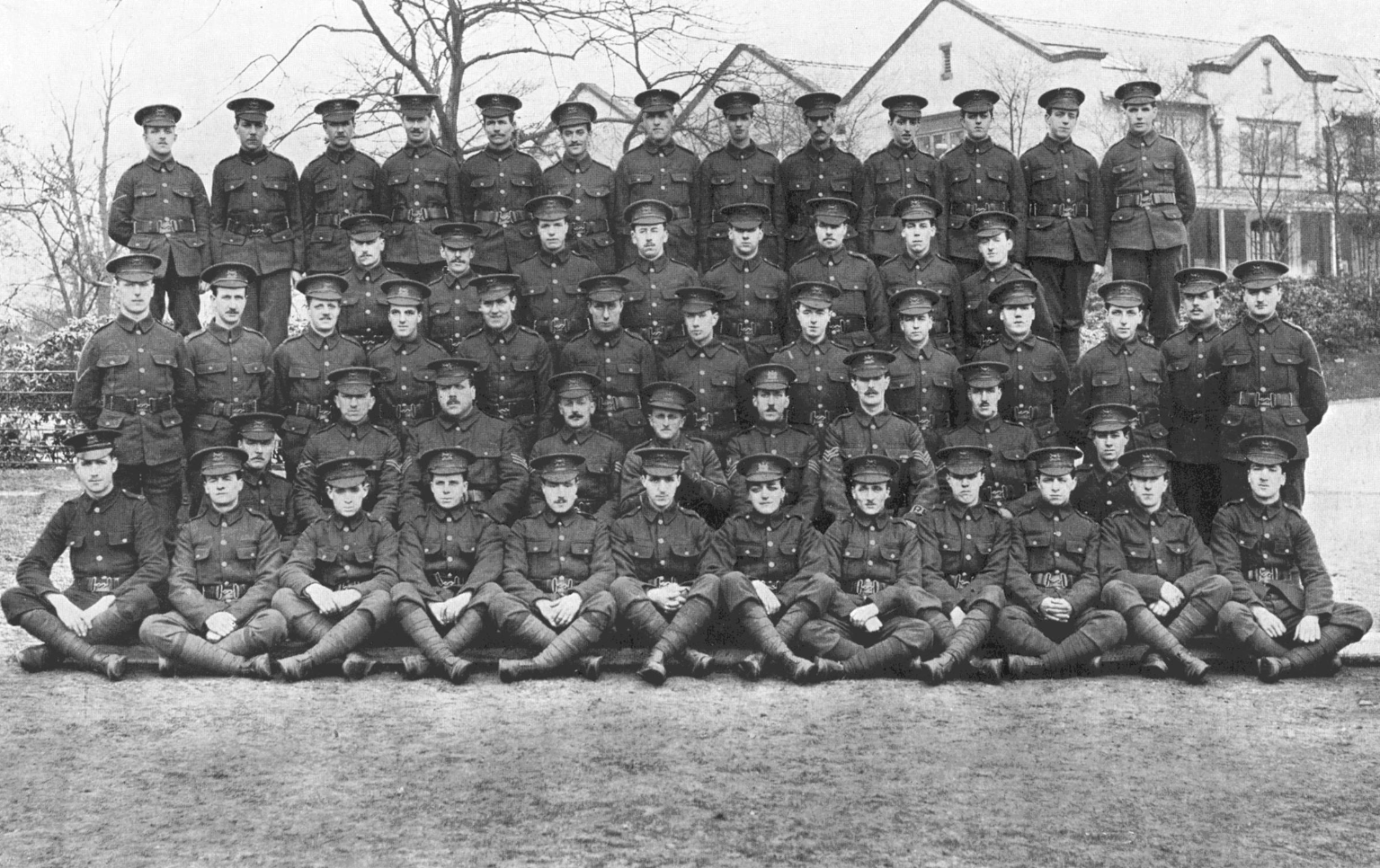
17th Battalion Manchester Regiment, circa 1914-15

As it happens we know a bit more about Harry Dale, who was killed at Gallipoli in July 24th 1915, aged just 18.

Four years earlier he had been living with his parents and siblings at number 9 St Mary’s Road, and described himself as a clerk, which may mean he was the Charles Dale, who is recorded on the Manchester Pal’s Roll of Honour as serving in Platoon XI of the 17th Battalion of the Manchester Regiment.

I can’t be entirely sure because Mr. Dale appears to have favoured different variations of his given name.

The album, date unknown

On the census returns and at his baptism at the Methodist Chapel in Newton Heath, he is listed as Charles Harrison Dale, while the military records at his death have him as Harry Dale, and he enlisted as Charles.

But I will just have to check the deployment of the 17th Battalion, just to check it was at Gallipoli in 1915.

But I can't think Charles had enlisted before 1914, as he was only 14 in 1911. 

So, not perhaps the biggest mystery of the Great War, but none the less one of those little intriguing ones from that long forgotten picture postcard album.

Chaplain tending British War Graves, date unknown

Location the Great War


Pictures; picture postcards from a photograph album, date unknown, from the collection of David Harrop, and Platoon XI, 17th Battalion of the Manchester Regiment, Manchester City Battalions Book of Honour, 1916


Thursday, 13 August 2020

Lives revealed from the Great War ........... Cyril and Mabel Bowman of Atwood Road Didsbury

The Victory Medal of Mr Bowman
I am looking at the Victory Medal which was awarded to Cyril Hopwood Bowman, who enlisted on September 3rd 1914 and came through the Great War.

Now there is nothing exceptional about that, many did including five of my immediate family.

But the thing about those who went off to fight is that all too often we never delve too deep into their lives before or after that conflict.

In part that is because the media and many historians have focused on those who never came back, whose lives were cut tragically short and became the Lost Generation.

And yet many more did return, settled down, lived long and productive lives and while they may never have forgotten the war put it behind them.

I don’t know how far Cyril Hopwood Bowman managed to readjust to civilian life.

After all until yesterday I knew nothing of him, his wife or his life before the Great War.

It was the news that my friend David Harrop had acquired Mr Bowman’s Victory Medal that set me off looking for the story of this one man.

Cyril Hopwood Bowman was born in Pendleton in 1885 and when war broke out in 1914 he was working as a bank clerk for the Lancashire and Yorkshire Bank.

C Company, 17th Manchester Regiment, date unknown but circa 1914-16
He enlisted on September 3rd 1914 and joined the 2nd City Battalion of the Manchester Regiment.

The 2nd City Battalion or the 17th Manchester’s was one of those new units made up from the hundreds of white collar workers who joined the Colours at the outbreak of war.

In November 1915 he was posted to France and apart from a short break two years later he remained on the Western Front where he was wounded and was finally demobbed in March 1919.

War Memorial, Didsbury, circa 1959
And there is much more for he was one of the 40% of First World War soldiers whose military records survived the Blitz of 1940-41.

And so we know he was 5 feet 7 inches tall, weighed 114 lbs, had brown eyes black hair, and had a ruddy complexion.

Laid bare in the same documents are his full medical history, a letter from his mother asking that he be considered for clerical duties after he had been wounded and undergone a serious operation for a recurrent health problem and his service on the Western Front.

In 1917 he had married Mabel Frost also from Pendleton and also born in 1885, and as you do I became intrigued by their courtship.

He lived in Pine Road Didsbury and she on Atwood Road and after  the war they settled down in what had been her family home.

So had they known each other for a long time, were they members of the same church, or debating society or had they met on the way to work?

And there for the moment their lives become vague. Mr Bowman died in 1954 and Mrs Bowman four years later.

I thought they may been buried in Southern Cemetery but there are no records of their internment or cremation in any of the city’s cemeteries and at present I have no idea whether they had children or whether he returned his old occupation of bank clerk.

Roll of Honour, the Lancashire & Yorkshire Bank
That said he can be found on the Roll of Honour of the Lancashire and Yorkshire bank which lists him as having worked at the Portland Street branch.

And we also have a photograph of C Company but as yet I cannot identify Mr Bowman so while I have gone looking for a man who will be 35 when the picture was taken I have so far drawn a blank.

The Lancashire & Yorkshire Bank, 133 Portland Street, circa 1900
But then just maybe someone who remembers him from when he lived in Atwood Road may be able to help and in the meantime I think I will venture down to those two houses in Didsbury, and check out 133 Potland Street where he worked in 1914 which was just on the corner with Oxford Road.

All of which just leaves me to thank David who set me off on the search and to wait for when Mr Bowman’s medal goes on display in his permanent exhibition of Great War memorabilia at the Memorial Hall in Southern Cemetery.

It is a wonderful collection of material including photographs, medals, postcards and letters along with official documents and the many other items.

Pictures; Victory Medal from the collection of David Harrop, C Company, 17th Manchester Regiment, date unknown, Manchester Regiment City Battalions, 1914-16, and Lancashire & Yorkshire Bank, Roll of Honour courtesy of The Manchester and Lancashire Family History Society, War Memorial and Library from the series, Didsbury, Lilywhite, issued by Tuck & Sons, 1959, courtesy of TuckDB http://tuckdb.org/history and detail of Portland street showing 133 Portland Street, from Goad's Fire Insurance Maps, circa 1900, courtesy of Digital Archives Association, http://www.digitalarchives.co.uk/

Sunday, 21 June 2020

Stories of the Manchester Pals ..........


Now I am rereading Manchester Pals by Michael Steadman, which is a detailed account of the formation of the Manchester Pals battalions.*

James Callahan of the 8th City Battalion
In just a short few months from August into November 1914, the city raised eight Pals battalions.

The idea was rooted in the belief that men would more readily join up if they could remain with their work companions or the friends they had grown up with.

As a recruitment plan it worked, but in the carnage that followed the great battles of 1916 and 1917 on the Western Front it proved a disaster for small tight knit communities, which experienced the loss of so many young men in the space of a few months.

But in the euphoria following the declaration of war that grim outcome was unforeseen by those who flocked to “join the colours”.

Men like William Eric Lunt from Chorlton who enlisted in the September of 1914 aged 19 and was posted to the 8th Battalion and my friend Joe’s dad who served in the same unit, as well Private Sidney Bone of Withington who was badly wounded on the first day of the Somme, and died aged just 24 in 1920.**

Bit by bit their stories are coming out of the shadows, and Mr. Stedman’s book offers up a context to their service.

An embroidered silk postcard, circa 1914-18
Along with a detailed description of the experiences of each of the battalions, he describes the city on the eve of this great conflict, along with how those who enlisted and survived made their way in the years of peace that followed the end of the war.

Now a full century and a bit after the outbreak of the Great War when all the combatants have died, it is easy to treat them as just a piece of history.  And leafing through the books and photographs they appear as either eager young men in ill fitting uniforms or frail individuals relying on walking sticks or wheelchairs.

But that is to forget that for most of those who came back, they had a full life ahead, and those war time experiences were but a short interruption to a life of gainful employment and raising a family.

It is sobering to think that when I was born my grandfather who served on the Western Front was just 53, his brothers were only a tad older, and my two uncles who were both in the Black Watch, were even younger.

I remember all of them as vital, energetic, and amusing men, who had long lives ahead of them but never spoke of their war service.

All of which makes Mr. Stedman’s book such an important contribution to our understanding of what those members of my family and thousands of others went through.

 Pictures; cover from Manchester Pals, embroidered postcard of the Manchester Regiment from the collection of David Harrop, and Mr. Callaghan courtesy of Joe Callaghan

*Manchester Pals, 16th, 17th, 18th,30th, 21st, 22nd & 23rd Battalions of the Manchester Regiment A History of the Two Manchester Brigades, Michael Stedman, 2004

**James Callaghan, https://chorltonhistory.blogspot.com/search/label/James%20Callaghan, William Eric Lunt, https://chorltonhistory.blogspot.com/search/label/Private%20William%20Eric%20Lunt  Private Sidney Bone of the Great War, https://chorltonhistory.blogspot.com/search/label/Private%20Sidney%20Bone%20of%20the%20Great%20War

Wednesday, 10 June 2020

A history of Withington in 20 stories …....no. 6 ….. The Withington Four

The two world wars left  their impact across the country in damaged buildings, interrupted lives, and above all in the loss of loved ones.

The graves of Private Bone and Flight Cadet J. Barber, 2020
After the Great War, monuments were commissioned and paid for by local subscription to honour those who went and in particular those who never returned.

And with the end of the Second World War, the same communities added a second list of names.

Most of those who died on active service are buried where they fell, but some who died later from wounds they sustained in the fighting or from other causes were interred in private graves.

Such are the Withington Four who lie in St Paul’s Church on Wilmslow Road in Withington.

Sergeant J.G. Hammond, 2020
Three date from the Great War and the fourth died in 1945.

I came across them by chance, while researching the story of Private Sidney Bone, who grew up in Withington, enlisted in the Seventh City Brigade of the Manchester’s in the November of 1914 and died six year later of wounds he received at the Battle of the Somme.*

He is buried alongside the wall separating the church yard from the Rectory, and beside him is gravestone of J. Barber, “Flight Cadet”, who died on December 3rd, 1918.

And not far away are the graves of Private G.W. Andrews of the King’s Shropshire Light Infantry who died on September 22nd, 1919 and Sergeant Joseph Geoffrey Hammond of the Royal Air Force Volunteer Reserve, who died on January 2nd, 1945.

So far their stories are incomplete, and what there is is patchy, and needs mush more research.

I know that Sergeant Hamond was a wireless operator and was a member of No. 150 Squadron which in 1945  flew Lancaster bombers.

Flight Cadet J.H. Barber, 2020
Flight Cadet J. H. Barber  was with R.A.F. 5th Training Depot Station at Wyton in Cambrideshire, and his family lived on Cross  Street in Didsbury.

Which leaves G.W. Andrews who remains the most elusive of the four.  I know he was 27 when he died in 1919, and that his father is listed as Harry Andrews of Manchester, but apart from his regiment which was the King’s Shropshire Light Infantry, that is it.

Not much I know for men who fought for the country and paid the ultimate sacrifice, but it is a start, and I have every confidence that their stories will be added to.


Location; Withington

Pictures;. gravestones of the Withington Four, from the collection of Daniel Daly


Monday, 8 June 2020

Private Sidney Bone of Withington ………… wounded in 1916, and buried in St Paul’s

Yesterday with the help of Kim I came across a bit more of the story of Private Sidney Bone, who lived in Withington, was wounded during the Battle of the Somme in July 1916, and was buried four years later in St Paul’s Church, in Withington.

Private Sidney Bone, 2020
I knew that he had enlisted in the November of 1914  in the 7th City Battalion of the Manchester Regiment, and as such was one of thousands of young men who volunteered in the first few months of the war.

The records show that he was discharged from the army on October 12th, 1917, and died in Broughton House of his wounds on November 2nd, 1920.

Broughton House had been opened in 1916 to care for disabled servicemen who “through paralysis, wounds and amputations will never be able to follow any trade or occupation.  They must receive special care and constant attention which could not always be provided in their own home.  Most of these men will be entirely dependent on the ministrations of others, even more so than the ordinary home for incurables”*

And that was pretty much it, other than he had described himself as an “Office boy for a Bleacher works” in 1911.

But at that time a search of firms connected with the textile industry listed in the Manchester City Battalions Book of Honour, 1916 drew a blank, and I reasoned he might have sustained his injuries at Third Battle of Ypres in 1917.

 Bronze Plaque, Private Sidney Bone, 1919
But his battalion had been transferred to Italy in the November of that year and given the fearsome treatment it had received a year earlier at the Battle of the Somme I rather doubted, their participation at Passchendaele.

Leaving me just to make a not that I should research the war diaries of the battalion.

And as so often happens a fresh bit of the story pooped up in the form of a comment from Kim McMahon-Thompson, who had discovered a newspaper clipping from the  Manchester Evening News Saturday July 15th  1916

"Dangerously wounded by shrapnel Private Sydney Bone of the Manchester Pals is in hospital at Rouen. 

He was employed by Messrs Latham & Wilson, Indian House, Whitworth Street. His parent live in Hill Street, Withington’”.

The news clipping placed Private Bone at the battle of the Somme which had begun in the July of 1916.

Wilson, Latham, & Co, Roll of Honour, 1916
The 7th Battalion were part of the attack on Fricourt, on the first day of fighting and received heavy casualties.

 Of the 796 men engaged on that day, 472 were casualties, and the battalion was withdrawn from the fighting on July 3.**

St Paul's Church, 894
So Private Bone will have received his dangerous shrapnel wounds during those first few days and will have been treated in a field hospital before arriving at Rouen on July 15th.

The same newspaper account offered up one other piece of information which was that  before enlisting in 1914. he had worked for Latham and Wilson.

A search of both the Roll of Honour and the directories revealed that Wilson, Latham and Co, were Merchants located on the First floor of India Houses on Whitworth Street.

I doubt I will ever know how many staff were employed by the firm, but the Roll of Honour records that eleven of them joined up, with five enlisting in the Manchester’s.

In the fullness of time I think I will go looking for all of the ten who left with Private Bone, but for now it is enough to have got a little closer to the young man who died at the young age of 24.


Pictures; gravestone of Private Bone, 2020, from the collection of Daniel Daly, Book of Honour, 1916, the Bronze plaque of Private S Bone, from the collection of David Harrop,Wilson, Latham, and Co Roll of Honour from The Book of Honour, 1916,  and St Paul's Church, Withington, 1894, from the OS map of South Lancashire, 1894, courtesy of Digital Archives Association, http://digitalarchives.co.uk/ 

Additional research, Kim McMahon-Thompson

*Disabled Soldiers Progress of the East Lancashire Scheme, the Manchester Guardian, October 20, 1916

**The Twenty Second Service Battalion of the Manchester Regiment, http://www.themanchesters.org/22th%20batt.htm

Wednesday, 21 August 2019

Signaller Thomas Roberts of the 17th Manchester’s and a postcard from Heaton Mersey

I never tire of those old picture postcards which ask “can you pick out our house?”

Didsbury Road, 1915
I just think that in one sentence they bring you a little closer to the people who sent and received the card, even if it is difficult to know which house is referred to.

All of which is fine but as Heaton Mersey is pretty much unknown territory to me I won’t even go to the census record and try to track Mr Henshall and match it with the picture.

Instead I shall ponder on “Signaller Thomas Roberts no 8818, 17 Batt Manchester Regiment” who in the December of 1915 was in France with the British Expeditionary Force.

"Best wishes .... and a victorious, safe  and speedy return" 1915
Now finding him in the historical records has been difficult and there are a number of possible candidates who fit the bill.

But I travel in hope because I know he will have enlisted in the September of 1914 when the 17th Battalion was raised from men working in the city’s offices and warehouses.

The 17th was the second of the City’s Pals Battalions and was recruited in just two days on September 2nd and 3rd 1914, spent time in training at Heaton Park and by early November of the following year were in France.


And that is where Signaller Roberts was when his postcard arrived from Heaton Mersey although at present there is not much more on him.

Men of  A & B Company, 17th Manchester's 1914
He  appears in the list of men serving in the Pals Battalions which records that he was in Company A, Platoon 1 of the regiment and there is a photograph of men who did not make it into their respective company pictures but I doubt we will ever be able to identify him from the group.

That said he does appear also in the Manchester Employers Roll of Honour for 1914-16.

There is a Thomas Roberts who had been employed by the Manchester Ship Canal Company and another at Charles Macintosh and Co Ltd.

But as there are a total of twenty-six men listed as either Thomas Roberts or T Roberts the Ship Canal and Charles Macintosh can only be a guess.

But it is a start

Location; Heaton Mersey, Manchester

Pictures postcard Heaton Mersey 1915 and details from Manchester City Battalions Book of Honour, 1914-16 courtesy of David Harrop


Tuesday, 12 September 2017

The Manchester Pals .............. lives from the Great War revealed

Men of the First City Battalion, the 176h Manchester's in Heaton Park, 1914
I have wondered about the fate of these eight men sitting in Heaton Park in the September of 1914.

They were part of the First City Battalion which was the 16th Manchester’s and was the first of the Manchester Pals’ battalions formed at the outbreak of the Great War.

In all there were eight such battalions which were created during August and November of 1914 and which  had already been preceded by three service battalions raised at the Regimental Dept at Ladysmith Barracks in Ashton-Under-Lyne.*

Now much has been written about the rush to enlist at the beginning of the war and the sheer speed and enthusiasm is reflected in the completion of the first four city battalions by mid September.

Lord Derby had reiterated his call for the formation of a “Pals Battalion” in Liverpool on August 27th and the following day leading Manchester industrialists and local figures met in the city’s Town Hall and resolved to raise a battalion of men drawn from the clerks and warehousemen of the city and to carry the name of the Manchester Clerks and Warehousemen’s Battalion.

Embroidered postcard, date unknown
The rest can be read in that excellent account of the Manchester Pal’s Regiments by Michael Stedman along with a brief summary in  The Manchester Regiment, at the Long Long Trail**

Suffice to say that 10,000 men enlisted in the Manchester Pals of whom 4,776 were killed.

And so instead I want to return to two who survived.

One of these was 36 years old Cyril Hopwood Bowman who enlisted on September 3rd and was a bank clerk with the Lancashire and Yorkshire Bank at their Portland Street branch.

We have his full military records, a photograph of him with C Company of the 17th Manchester’s and much more.  But despite knowing that he settled down in Didsbury after the war where he died in 1954 followed by his wife four years later I have drawn a blank with finding his family.

Not so young James Callaghan of the 8th City Battalion who also survived the war and was the father of one of my friends.  His son Joe has eight photographs of Mr Callaghan in uniform and a collection of stories his father told him of active service during and after the war.

Mr Callaghan of the 8th City Battalion, date unknown
Together the stories of these two men not only provide a vivid account of their experiences but also personalise a conflict which with the passage of time often just becomes focused on those who died on the battlefields.

Perhaps in time I might yet get to discover the identities of the eight in Heaton Park and and their stories but in the meantime I shall return to Mr Bowman and Mr Callaghan.

And not long after I posted the story Tim contacted me with this, "Hi Andrew, The camping party isn't 16th Bttn in Heaton Park. Shoulder tab may be 7th. Also dress uniform wrong and they had navy uniforms in Sept 14.  Cheers Tim."
.

Which is one in the eye for the chap who put the caption on the orginal postcard.

Pictures; First City Battalion, the 16th Manchester’s in Heaton Park, from the collection of Bob Potts, embroidered postcard of the Manchester Regiment from the collection of David Harrop, and Mr Callaghan courtesy of Joe Callaghan

* The First City Battalion, the 16th Manchester Regiment, the 2nd City Battalion, 17th Manchester Regiment, the 3rd City Battalion, 18th Manchester Regiment, the 4th City Battalion, 19th Manchester Regiment, the 5th City Battalion, 20th Manchester Regiment, the 6th City Battalion, 21st Manchester Regiment, the 7th City Battalion, 22nd Manchester Regiment, the 8th City Battalion, 23rd Manchester Regiment, the 11th 12th, 13th Manchester’s

**Manchester Pals, 16th, 17th, 18th,30th, 21st, 22nd & 23rd Battalions of the Manchester Regiment A History of the Two Manchester Brigades, Michael Stedman, 2004,  The Manchester Regiment at the Long, Long, Trail, http://www.1914-1918.net/mancs.htm

***Manchester Pals, http://chorltonhistory.blogspot.co.uk/search/label/Manchester%20Pals


Saturday, 20 December 2014

Snapshots of the Great War nu 3 ........... the Manchester Pals

Now I don’t have a date for the picture but it’s of a young James Callaghan of the 8th Battalion of the Manchester Regiment.

He was one of almost 10,000 men who enlisted in the eight Manchester Pals battalions which were formed in the first few months of the Great War.

The day after Lord Liverpool called for the formation of a Pal’s battalion in Liverpool, Manchester followed suit.

He had spoken of the need for "a battalion of pals, a battalion in which friends from the same office will fight shoulder to shoulder for the honour of Britain and the credit of Liverpool.“

In the early days the authorities couldn’t keep pace with the numbers wanting to join up.

Of the almost 10,000 who enlisted 4,776 were killed.

In recognition of the commitment and sacrifice made during the Great War the People’s History Museum has an exciting programme of events to accompany their changing exhibition A Land Fit for Heroes which runs till February 2015.*


Picture; James Callaghan, date unknown courtesy of Joe Callaghan and embroidered picture post card from the collection of David Harrop

*A Land Fit for Heroes, http://www.phm.org.uk/news/a-land-fit-for-heroes-events-programme/

Monday, 18 August 2014

A book on the Manchester Pals by Michael Stedman

Now I may be looking in the wrong place, but I can’t find much for the general reader on Manchester and the Great War.

Cover f the book
In the fullness of time I shall plunge into the Ref and start reading the newspapers of the period and pickup on the diaries and letters of those who lived through the conflict but before all of that I wanted a broad picture of our city during the war.

The gap has been partly filled by Manchester Pals by Michael Steadman, which is a detailed account of the formation of the Manchester Pals battalions.*

Unlike its near neighbour, working-class Salford, Manchester proved able to raise eight Pals battalions. Initially, these battalions were composed of middle-class men who experience before the war years was within the commercial, financial and manufacturing interests which formed the foundations of Edwardian Manchester's life and prosperity.

Manchester was undeniably proud of its pals battalions; that the area was capable of raising.""**

Now I am only a third of the way through but it is my sort of history book drawing on the contemporary accounts of the men who volunteered along with a fine set of photographs.

Embroidered postcard
Here too is a clear description of the city on the eve of the Great War including the grand commercial centre with its towering offices and exchanges, the mean and grim working class areas just a few minutes from that affluence and an account of the growing confrontation between labour on the one side and the powerful people of plenty on the other.

Added to this we get a sense of just how the Pal’s battalions were such a powerful force in drawing young men to the Colours in the first few months of the war.

Mr Callaghan
Men like William Eric Lunt from Chorlton who enlisted in the September of 1914 aged 19 and was posted to the 8th Battalion and my friend Joe’s dad who served in the same unit.

Bit by bit their stories are coming out of the shadows and so I welcome Mr Stedman’s book which is giving a context to their service.

So as I get to the half way mark I shall return with more from the book.

Pictures; cover from Manchester Pals, embroidered postcard of the Manchester Regiment from the collection of David Harrop, and Mr Callaghan courtesy of Joe Callaghan

*Manchester Pals, 16th, 17th, 18th,30th, 21st, 22nd & 23rd Battalions of the Manchester Regiment A History of the Two Manchester Brigades, Michael Stedman, 2004

**Michael Stedman.  http://www.michaelstedman.co.uk/?manchesterpals

***William Eric Lunt a soldier of the Great War, http://chorltonhistory.blogspot.co.uk/2012/06/william-eric-lunt-soldier-of-great-war.html