Showing posts with label Neil Simpson. Show all posts

Monday, 27 July 2026

Hardy Farm ............ the picture I have never seen before

Now there are not that many pictures of Hardy Farm and that is a shame.

I included one of the most well known in the book on Chorlton but always cast around for more.*

During the writing of the book I became familiar with some of the farmers who lived there in the 19th century and collected stories from some who knew it from their child hood in the 1940’s and 50’s.

But the memories are fading and it will soon be a full half century since it was swept away for the ill fated UMIST sports scheme.

That said this picture brought back memories for  my friend Marion Jackson who remembers Hardy Farm.

“In my childhood the shed where the cows were milked was to the right. In front was a yard and further back to the right the orchard where the pigs were.


The track went down in front and then through the hawthorn hedges to Jacksons Boat.

I so loved my Sunday visits here with my father in the 40s. This was on his route to work in Sale from Withington by bike. Everything that my beloved father found interesting he showed to me.

This was a special favourite; I guess it reminded him of home in Cork. I used to look at the posh houses in South Drive as we cycled....guess where I lived for a happy 30 years? What a lovely life I have had.”

And that is all I have to say other than a thank you to Marion for sharing her recollections .

Picture; Hardy Farm, 1966, courtesy of Manchester Libraries, Information and Archives, Manchester City Council, http://images.manchester.gov.uk/index.php?session=pass

*The Story of Chorlton-cum-Hardy, Andrew Simpson, 2012, https://chorltonhistory.blogspot.co.uk/2011/11/the-story-of-chorlton-cum-hardy.html


Monday, 29 June 2026

Lost and forgotten streets of Manchester nu 92 ...... Cannon Court

Cannon Court has tidied its act up  a lot since I first stumbled across it in 1969, soon after I arrived in Manchester.

1967
I remember it as one of those places which  was a bit shabby, rather neglected, and not much of an advert for the city.

Of course now I rather wish it was still like that given than many of the other interesting alleys, courts and narrow streets have been swept away.

The last time I was down there it was clean, tidy and less interesting than I remembered it.

But perhaps I am being a little picky and unreasonable given that visitors to the Cathedral, might just not want to pick their way past old boxes, overflowing dustbins and crates of empty bottles.

So I shall leave it you to judge, using an image of Cannon Court, pretty much as I left it in the 1960s, and today, all bright and pristine.

2017
Circa 1900
So far so good ........... and now for the correction, because I never clocked the name of the alley back in 1969, and when I revisited it this week one map called it Hanging Ditch, so I followed suit.

Only to be corrected by two people who pointed out that historically this was Cannon Court, and there on my own copy of Goads Fire Insurance was indeed the name Cannon Court.
So thank you for the two who were more vigilant than I.


Location; Cannon Court

Pictures;  Cannon Court, 1967, "Courtesy of Manchester Archives+ Town Hall Photographers' Collection", https://www.flickr.com/photos/manchesterarchiveplus/albums/72157684413651581?fbclid=IwAR0t6qAJ0-XOmfUDDqk9DJlgkcNbMlxN38CZUlHeYY4Uc45EsSMmy9C1YCk and in 2017 from the collection of Andrew Simpson, and Hanging Ditch and Cannon Court, circa 1900, from Goads Fire Insurance map, courtesy of Digital Archives Association, http://digitalarchives.co.uk/

Saturday, 9 May 2026

Just how much we forget …………….. Manchester ……. 1964

When you live in a place, it is easy to miss how it is changing.

This is Piccadilly in 1964, and I can remember going in all of those shops and standing at that bus stop.

More than half a century on, I can’t now tell you where we were going from that  bus shelter, or just when the buildings and their occupants changed, or for that matter whether I prefer the scene now or then.

Location; Manchester

Pictures; Manchester Piccadilly, 1964, 1964-0386 "Courtesy of Manchester Archives+ Town Hall Photographers' Collection"

Friday, 8 May 2026

So this is 1968 and we are looking up towards St Peter’s Square

I have to admit it is a scene which is very familiar and like all good pictures from the past I seem to remember it as monochrome.

Of course that doesn’t make sense but as hard as I try I can’t picture it in colour.

It is just one of those things.

And there will be plenty of others who instantly recognise the scene, even down to the fashionable dress and hairstyle of the young woman on the right.

The picture come to light through a new project which Neil Simpson tells me is “the Town Hall Photographer's Collection Digitisation Project, which currently is Volunteer led and Volunteer staffed is in the process of taking the 200,000 negatives in the collection dating from 1956 to 2007 and digitising them.

The plan is to gradually make the scanned images available online - initially on the Manchester Local Images Collection Website".*

And almost a century later I was pretty much on the same spot and chose to replicate the shot.

Of course at the time I had no idea that someone back in 1968 had stood where I was and taken a picture.

I bet even then the photographer would have had to be careful of the traffic while I had a clear run given that back in 2016 the road was closed as the finishing touches were being made to the tram line in readiness for the Second City Crossing.

Today I wouldn't dream of standing in the middle of the road, taking my time and then taking a picture.

The trams pass that spot with a frequency that means at best I might just get a shot in but I doubt it and that as they say is progress.

Still at least I can turn in a bright colour image.


And that just leaves you to record the differences.

Location Manchester


Picture; of looking towards St peter’s Square, 1968, courtesy of Manchester Libraries, Information and Archives, Manchester City Council, http://images.manchester.gov.uk/index.php?session=pass and almost the same spot in 2016 from the collection of Andrew Simpson


*Neil Simpson, Manchester Local Images Collection Website, https://www.flickr.com/photos/manchesterarchiveplus/sets/7215766350511542

Wednesday, 6 May 2026

The image that defined the North

And not just the north but of working class communities across the country.

This scene is, I think Lower Byrom Street, but I could be wrong.

Location, Manchester, 1963

Picture; on the step, Manchester, 1963, Courtesy of Manchester Archives+ Town Hall Photographers' Collection, https://www.flickr.com/photos/manchesterarchiveplus/albums/72157684413651581?fbclid=IwAR35NR9v6lzJfkiSsHgHdQyL2CCuQUHuCuVr8xnd403q534MNgY5g1nAZfY

Tuesday, 5 May 2026

Lost on the streets of my city

Now one of the advantages of a misspent youth is that I am fairly familiar with the streets of Manchester.

From 1969 for three years as a student at the College of Knowledge on Aytoun Street I wandered the city between lectures.

Back then the library was for the studious and so after Mr Wilson’s lecture on contemporary Soviet Government and before Mr Ripley on the Chartists or Trevor Thomas on Andrew Marvel I was off exploring my adopted home.

It took me to the Art Gallery and the Ref along with the Town Hall, the warren of streets that is now the Northern Quarter and down to the very unfashionable Castlefeld.

That said the knowledge is a bit frozen in time and I didn’t really get back to looking for the historic the interesting and the bizarre until the start of the last decade.

But despite that knowledge, the maps, and the street directories this image has defeated me.

The picture come to light through a project which Neil Simpson tells me is “the Town Hall Photographer's Collection Digitisation Project, which currently is Volunteer led and Volunteer staffed is in the process of taking the 200,000 negatives in the collection dating from 1956 to 2007 and digitising them.

The plan is to gradually make the scanned images available online - initially on the Manchester Local Images Collection Website".

I think we are on West Mosley Street which was sandwiched between Cooper Street and Mosley Street and vanished sometime before now.

I am fairly confident that there will be lots of theories and if we are lucky the answer.

In the meantime I will ask my friend Andy to look up his 1969 street directory and try to identify the firm on the board above that white building.

We shall see.

Location Manchester

Picture; of Manchester, 1968, courtesy of Manchester Libraries, Information and Archives, Manchester City Council, http://images.manchester.gov.uk/index.php?session=pass 


Monday, 4 May 2026

Walking out on Oxford Street ............ 1966

I won’t be alone in remembering these buildings.


We are at the top of Oxford Street where it joins St Peter’s Square, and of the four buildings captured by the photographer on a drab day in 1966, all have gone.

Some went a long time ago, others more recently.

So, while the grimy looking one, home to Boots and which faced across the Cenotaph to Central Ref, was still there in 1969.

I remember gazing across it from the steps of the library but can’t quite remember when it was demolished for Elisabeth House which in turn was torn down for One St Peter’s Square.

More recently its neigbour, on the corner of Mosley Street and the square which many admired has been lost for that stark, and very bright building which is Two St Peter’s Square.

On the opposite side of Mosley Street, the properties on the left of the picture went became the peace Gardens and are now part of the space which includes platforms for the Metro and the reallocated cenotaph.

All of which just leaves me with the picture itself with its ghostly like figures caught in mid stride, and that sign for the restaurant “The Egg and I” which I never visited but which will be remembered by some.
Location; Oxford Street, Manchester

Picture; Oxford Street, 1966, Courtesy of Manchester Archives+ Town Hall Photographers' Collection,  https://www.flickr.com/photos/manchesterarchiveplus/albums/72157684413651581?fbclid=IwAR35NR9v6lzJfkiSsHgHdQyL2CCuQUHuCuVr8xnd403q534MNgY5g1nAZfY

Sunday, 3 May 2026

Knocking down bits of Wilbraham Road .... in the summer of 1963

Now the next time you are in the Co-op on Wilbraham Road, spare a thought for the buildings that once stood on this spot.

They consisted of two tall residential properties, which like their neighbours stretching up towards Whitelow Road had been converted into shops with living accommodation above.

Our two were replaced by the building rising from the ground in 1963.

And for a long time I had just taken for granted that the whole modern block of shops had been built at the same time.

But not so, as the picture indicates, and taking a walk down Wilbraham Road from Brundrettes Road, it is possible to see the change in design and date.

So you learn something new, all the time.

Location; Chorlton

Picture; Wilbraham Road, 1963, Courtesy of Manchester Archives+ Town Hall Photographers' Collection,  https://www.flickr.com/photos/manchesterarchiveplus/albums/72157684413651581?fbclid=IwAR35NR9v6lzJfkiSsHgHdQyL2CCuQUHuCuVr8xnd403q534MNgY5g1nAZfY

Saturday, 2 May 2026

The 42 from the Refuge Building …..a furniture shop, Wimpy Bar, and a shed load more …..1967

Now, with the passage of a full half century, it is the detail you forget.

I stood at the bus stops outside the old Refuge Building for years, and never gave much thought to the building opposite.

Back then it was just a furniture shop, and as I was a first year student on a grant, living in a series of drab and worn out  bed sits I gave Shaw’s Furniture shop scant attention.

And likewise I don’t think I ever went in the cinema round the corner, or took a train from Oxford Road Railway Station, and gave no attention to the features of the Refuge Building behind me.

It would be years before I went in to the former furniture shop, and only after it had become the Cornerhouse which was an art gallery, cinema, bookshop, bar and café, with superb views up Oxford Street, and some pretty interesting films which you would never see at the Odeon.

Likewise my discovery of the railway station with its wonderful 60s entrance would be delayed for a few years, and instead I fastened on the Oxford Road Corridor from town to Withington.

Which also meant that the hospital opposite Shaw’s, along with the kiosk which announced “You Are Safe With The Oxford Rubber Goods” was just a blur from the window of the 42.

Nor do I think I ever went in the Wimpy, which has over the decades changed its name and the food on offer.

And now, Shaw’s is No. 70, the Refuge Building is a hotel, and the kiosk became Euronews, although last time I passed it all seemed closed up.

But I still use Oxford Road Station and marvel at that entrance.

Location; Manchester

Pictures; Shaw’s, and the Wimpy, 1967, "Courtesy of Manchester Archives+ Town Hall Photographers' Collection", https://www.flickr.com/photos/manchesterarchiveplus/albums/72157684413651581?fbclid=IwAR35NR9v6lzJfkiSsHgHdQyL2CCuQUHuCuVr8xnd403q534MNgY5g1nAZfYand Oxford Road Railway Station, 2009 from the collection of Andrew Simpson

Tuesday, 28 April 2026

The lost grocery shop on London Road ........ 1960


Now, for me, these images perfectly capture  that time when I was growing up.

And I suspect it will be the same for many others who were also born n the late 1940s, and for whom these pictures  will chime in with their memories of a changing Britain.

There were the empty bombsites, the drab tired looking buildings, and plenty of horse drawn vehicles.

But many of those bombsites were car parks catering for the growth in car ownership, new and exciting consumer products were becoming available at affordable prices, and above all there was a sense of optimism about the future.

So, here we are, on the corner of London Road and Buxton Street with the grocery store of P. Prole, where the promise of the future was edging out the past.

At first glance, the shop front could quite easily pass for one from the turn of the century.  

The tiles, the signage and the metal fitments look dated, but the poster in the window extolling the power of Stergene “To wash away the shadow of nylon” is accompanied with that elegant looking woman wearing the height of fashion.

While just a few doors down, the empty site has become a secondhand car business, where a 1956 Vauxhall Cresta is on offer for £475, making the Black Bentley look decidedly ancient.  

And for those who like period detail, the Cresta is advertised with a “heater” and the Bentley has been given new tyres, leaving just the odd shaped Morris van lurking in the background.

But despite the signs of modernity, the buildings and the area have seen their best.  

The upstairs floors of the shop have long been abandoned, the glass in some of the windows needs replacing, while the roof and gutters look in a sorry state.

Just when it and its neighbours were demolished I have yet to discover, but demolished they were.
The space it inhabited was replaced by what was one a telecom building and is now a hotel.

You can still walk along Buxton Street, but alas access to it is now via a car ramp which passes under the hotel, and the site of P. Prole’s grocery store is marked by a locked  hotel door.

Location; London Road, Manchester

Picture; The shop with a story, J Prole’s grocery store, corner of London Road and Buxton Street, 1960,Courtesy of Manchester Archives+ Town Hall Photographers' Collection,  


Saturday, 18 April 2026

The picture I wish I had taken …………….under the Mancunian Way in 1967

This is one of those pictures I wish I had taken.

We are at the official opening of the Mancunian Way on May 5th, 1967, which was a Friday, and I suspect that accounts for the number of children in the crowd.

Doing the ceremonial bit, was the Prime Minister Harold Wilson, who was accompanied by the Lord Mayor, Mrs. Nellie Beer, O.B.E., J.P., and because they are on the plaque, Councillor S.C. Rimmer, Chair of the Highways Committee, his deputy, Councillor Ken Franklin, the Town Clerk and representatives from City Engineers and Surveyors, along with those from the construction firms.

But what captures your attention, is the crowd.

It may have been small compared to some events, but it is a busy picture, with lots going on, from the serious looking faces of some of the adults, to the mix of emotions from the young people, including the girl distracted by something. and the lad beside her clearly “off script”.


And yes, that does look like the actor Jack Howarth who played Albert Tatlock in Coronation Street, for almost a quarter of a century.

What is also interesting is that this does have an element of the “staged crowd”, from the children let out of school, to the group of young men and women, who may be Council staff, or equally likely were Labour Party members drafted in to support the Labour Prime Minister

And then there are the rest who seem a cross section of local residents.

But however, contrived the scene might have been, there is no doubting that the photographer caught the moment, perfectly.

Location; Under the Mancunian Way

Picture; Capturing the moment, 1967, Courtesy of Manchester Archives+ Town Hall Photographers' Collection, https://www.flickr.com/photos/manchesterarchiveplus/albums/72157684413651581?fbclid=IwAR35NR9v6lzJfkiSsHgHdQyL2CCuQUHuCuVr8xnd403q534MNgY5g1nAZfY

Friday, 17 April 2026

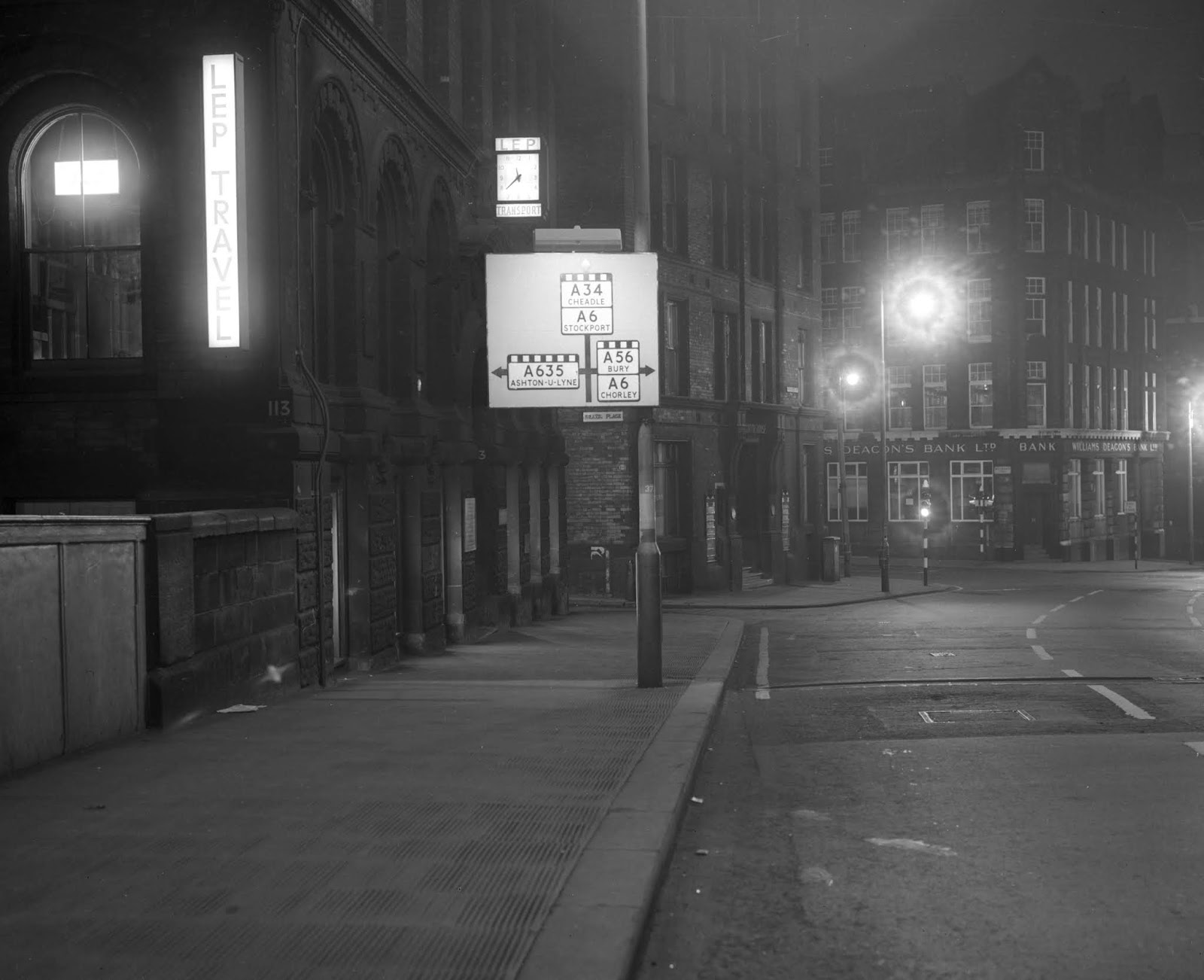
Just before midnight on Princess Street …………1963

This is one of those pictures I wish I had taken.

We are on Princess Street approaching Whitworth Street, and given that it’s almost midnight the streets are empty.

I like the effect of the streetlamps, which along with the absence of people and vehicles makes for a very atmospheric scene.

Of course, the buildings running down from 113 to Whitworth Street have long gone, although they survived until relatively recently, after which the site was an empty plot for ages.

But when I first came across the picture last year, the plot was being developed with speed, with the boards promising “Luxury City Centre Living”, with the name Manchester Square.

Location; Princess Street


Pictures; Princess Street, 1963,  "Courtesy of Manchester Archives+ Town Hall Photographers' Collection", 
https://www.flickr.com/photos/manchesterarchiveplus/albums/72157684413651581?fbclid=IwAR35NR9v6lzJfkiSsHgHdQyL2CCuQUHuCuVr8xnd403q534MNgY5g1nAZfY


Thursday, 9 April 2026

The Manchester of soot lined buildings which oozed confidence

Now this is the Manchester of my youth.

I say youth but I was just turning 19 and many of the old Victorian and Edwardian buildings were still around.

They were soot covered and some had become very neglected but they oozed confidence and they were Manchester.

Of course Mr Hitler and Derek the Developer had done for many of them but there were still enough left to impress me when I walked the city streets in between lectures in the late 1960s and early ‘70.

It would be easy and a little cheap to mourn the passing of many of them which I suspect had been uncomfortable places to work when they were built.

And those modern developments do express that same mix of assertive self confidence and commercial drive.

This one on the corner of Princess Street and Mosley Street fascinates me.

I can’t now remember if it was still standing when I arrived and the site would later become the Peace Gardens before becoming the new home for the Cenotaph.

It was there by the late 19th century offering office space upstairs while the downstairs was occupied Alexander Thomson who were stationers, R.S Bayley who traded in cigars and on the corner Mr Sinclair who was a tobacconist in 1911.

Not much had changed by 1968 when our image was taken.  There was still the same range of small shops, and the one that caught my eye which was the “Wallpaper Shop”.

I doubt that such a shop would have much of a future in the city centre today.

And this last comment I have had to modify given the comment below from a someone who points out that there is a very impressive store on Deansgate.

The picture come to light through a new project which Neil Simpson tells me is “the Town Hall Photographer's Collection Digitisation Project, which currently is Volunteer led and Volunteer staffed is in the process of taking the 200,000 negatives in the collection dating from 1956 to 2007 and digitising them.

The plan is to gradually make the scanned images available online - initially on the Manchester Local Images Collection Website".

And that only leaves me o include one I tool earlier from the Art Gallery looking out almost on the same spot.

Now what ever I have already said about liking grimy Victorian and Edwardian buildings I have to say that what they have done on the corner of Princess Street and Mosley Street is just so much better, affording a fine view of the entrance to the Town Hall.

But that last comment will no doubt be challenged.

We shall see.

Location Manchester


Picture; of Princess Street, 1968, courtesy of Manchester Libraries, Information and Archives, Manchester City Council, http://images.manchester.gov.uk/index.php?session=pass and looking at almost the same spot in 2015 from the collection of Andrew Simpson

*Neil Simpson, Manchester Local Images Collection Website, https://www.flickr.com/photos/manchesterarchiveplus/sets/7215766350511542

Tuesday, 7 April 2026

Coffee…… a bag of coal ….. and a new TV channel ………. Didsbury 1967

I think this might be the last in the series of Didsbury in the 1960s.

I say that but I am sure it’s a promise I won’t keep.

This picture from 1967 is one of my favourites from the collection and features a building whose story I keep coming back to.*

For now I shall reflect that I doubt many of those sipping their coffee on Costa will know that the corner plot was once occupied by the National Coal Board, or that the distinctive ghost sign on the gable end was hidden under a layer of black paint.

What really caught mu interest was BSM Radio with its advert for BBC 2.

This was after all 1967, and until the arrival of BBC 2, we had just the two channels, which were black and white.

The first colour transmission I saw weas the following year, when in London at least BBC 2 broadcast live coverage of Wimbledon in colour.

Just how many of those passing along Wilmslow Road on that winter’s day had BBC 2 is unknown, but I doubt it will have been that many.

And in the same vein I wonder just who remembers Price’s the bakery shop, BSM Radio or Distinctive Fashions, which is now also part of Costa Coffee?

Location; Didsbury

Picture; Wilmslow Road, 1967, Courtesy of Manchester Archives+ Town Hall Photographers' Collectionhttps://www.flickr.com/photos/manchesterarchiveplus/albums/72157684413651581?fbclid=IwAR35NR9v6lzJfkiSsHgHdQyL2CCuQUHuCuVr8xnd403q534MNgY5g1nAZfY

Monday, 6 April 2026

Admiring the simplicity of Didsbury Library ……… 1963

It’s been a while since I have been in the library and had quite forgotten the simplicity of the design.


It was built in fulfilment of a promise made when Didsbury, along with Burnage, Chorlton, and Withington, voted to join the City in 1904.

That said it would be another 11 years before Didsbury’s residents got their new Library, but when it was finished it was a brand-new Library, fit for a new century and replaced a small municipal library which had opened in 1908.

While it’s outside was in the words of its architect “'designed in the fifteenth century gothic style with tracery windows and emblems of Science, Knowledge, Literature, Music and Arts and Crafts in stone distributed over the building.” *

Internally it belonged to the 20th century with electric light which “was designed to allow the public free access to the shelves, browsing and reading areas. The walls were tiled to dado height, the floor cork carpeted and the oak furniture, fittings and partitions cost £600”.

But it wasn’t the first library, because back in the May of 1854, a more modest venture was opened in the National School.

It was the work of a group of wealthy residents and “the inauguration meeting was held in the schoolroom, which is to be used for the library and reading room and is well adapted for the purpose being lighted with gas and well ventilated.  The stock of books in the library at present is not large, but they are well selected, and there are ample funds for the purchase of more when needed”. **

The subscription had been “fixed as low as possible, - a penny a week, - in order to diffuse the benefits of the institution as widely as possible”.

And as befitted the age, more than a few speakers at the opening meeting took the moral high ground, with one asserting that the library would act as a counter to the “the public house which was the resort only of those who had no other enjoyment”.

While another “referred with regret to the fact that ‘Roderick Random’ was the most read book in the noble Free Library of Manchester and while admiring the humour of the author he feared the book was perused for its  objectionable features, and he advised them to purge their library of anything injurious to the morals of the people”.

Location; Didsbury

Picture; Didsbury Library, 1967, "Courtesy of Manchester Archives+ Town Hall Photographers' Collection", https://www.flickr.com/photos/manchesterarchiveplus/albums/72157684413651581?fbclid=IwAR0t6qAJ0-XOmfUDDqk9DJlgkcNbMlxN38CZUlHeYY4Uc45EsSMmy9C1YCk

*The Didsbury Library, Manchester Guardian May 17th, 1915

**Opening of Didsbury Library and Institution, Manchester Guardian, May 17th, 1854

Friday, 3 April 2026

When the Rec had a bowling green ………..

Now, I don’t remember the bowling green on the Rec, by Beech Road, but lots of people over the years have talked about it.

I have always thought it was on the south side of the Rec, close to Wilton Road, but not so.

It occupied a space in the north west corner, and this I know because I am looking at the OS map for Beech Road, dated 1956.

I know the bowling green was not in the original plan for the Recreational Ground and had disappeared by the 1970s.

Just when it was deemed no longer a recreational asset will be down to people’s memories and a trawl of subsequent maps.

And back then there was that other bowling green beside Cross Road, it became the car park for the Irish Club.

All of which leaves me to wait for comments of those who remember the bowling green on the Rec and when it disappeared.

Location; Chorlton

Picture; detail from the OS map for south Chorlton, 1956, "Courtesy of Manchester Archives+ Town Hall Photographers' Collection", https://www.flickr.com/photos/manchesterarchiveplus/albums/72157684413651581?fbclid=IwAR0t6qAJ0-XOmfUDDqk9DJlgkcNbMlxN38CZUlHeYY4Uc45EsSMmy9C1YCk 

Sunday, 29 March 2026

Don't get me on the subject of wool shops ...........

Now I belong to a generation that was dragged round wool shops as a child.

My mum, her friend and later my sisters all knitted and so the trip to the shop was a regular part of my Saturdays.

It started with the knitting pattern, went on to an endless discussion about the colour of the wool and finished with walking home with loads of the stuff.

Then there was the smell.

Wool shops had a distinctive smell, which was a sort of warm perfume smell which followed you home and stayed where ever mother was knitting.

There was something else about the wool shop which for years I couldn’t quite work out what it was, and then recently it came to me, it was always so very quiet, as if there were secrets about knitting that could only be uttered in a low almost conspiratorial way.

Ours was a traditional wool shop. The wooden shelves which reached to the ceiling were made of a deep dark wood which shone in the sunlight and were heaped high with wool.

 And then there were the wooden and glass counters which today you only see in shops pretending to be old. Through the glass top you could see more wool and all sizes of knitting needles.

So the day Mrs Rogers announced that she was going to try out a knitting machine it was if she had admitted to multiple affairs over the preceding twenty years.

I wouldn’t mind but it wasn’t even that she was going to buy one; all she wanted to do was try it out.

 But that marked her out as a flighty thing who would soon be buying a Christmas cake instead of making one and no doubt had already used custard powder and meat spread.

Nor did the torture of the wool shop stop there. Once home the wool had to be wound into balls, which could be only done using the back of a chair but usually involved me having to stand with my arms outstretched and the wool was pulled from me and went into balls.

So I suppose I chose to ignore the wool shop on Wilmslow Road, and then it had gone.

And in memory of that wool shop and many others I shall leave you with this classic pattern from our Jillian who collects them, in the hope that she will knit me a balaclava.

Location; Wilmslow Road,

Picture; Wilmslow Road, 1967, Courtesy of Manchester Archives+ Town Hall Photographers' Collection, https://www.flickr.com/photos/manchesterarchiveplus/albums/72157684413651581?fbclid=IwAR35NR9v6lzJfkiSsHgHdQyL2CCuQUHuCuVr8xnd403q534MNgY5g1nAZfY
and knitting patterns, 1930-1970 from the collection of Jillian Goldsmith

Friday, 27 March 2026

Brand new Manchester ……….. replacing the hole in the ground …. 1960

Now I always like to dig deep, trawling the historic records to support a picture.

But this time I rather think I will just leave it at the image, and instead let everyone going looking for what they want.

It is 1960, and the new look Manchester is about to rise from the ground in front of the bus depot.

Nine years later I would sit in the Milk Bar in that parade of shops opposite the buses, enjoy the view from the restaurant of the Hotel Piccadilly, and look at the three buildings that occupied the site while walking through the old gardens.

Location; Manchester

Picture; Brand new Manchester, 1960, "Courtesy of Manchester Archives+ Town Hall Photographers' Collection", https://www.flickr.com/photos/manchesterarchiveplus/albums/72157684413651581?fbclid=IwAR0t6qAJ0-XOmfUDDqk9DJlgkcNbMlxN38CZUlHeYY4Uc45EsSMmy9C1YCk 

Thursday, 5 February 2026

In Albert Square with dirty buildings and bus stops ……………1956

This is Albert Square in 1956, and while it would be a full thirteen years before I discovered it, the scene in front of us was pretty much the same.

Except of course for those soot blackened walls which were the product of a century of coal fires and other industrial pollution.

Not that Manchester was alone in this.  As a child playing in the local parks in Peckham, I could get pretty dirty from climbing the trees which like the buildings were caked in the stuff.

But when I arrived the Town Hall had just undergone a clean up.  And not before time.  The interior of the Town Hall had been cleaned in 1925, and although the Council in 1964 estimated it would cost £25,000 the project was delayed.

I am not quite sure why there was a time lapse, but Ian Nairn in an article for the Guardian in 1965,  had called for caution arguing that “such action could ruin the stone of many British buildings”, and asserting that some “town hall and stations have gone jet black, covered with a crystalline  deposit which sparkles in the sun and seems to defeat the gloom by annexing it to a deeper darkness”.*

Adding that in uncleaned these public buildings could “become lustrous pools of darkness in grime-free cities, appreciated for their innate qualities and freed from any moral taint of being ‘dirty’ or ‘clean’”.

It didn’t however seem a popular idea, and most people I met back in 1969 were very pleased with their newly cleaned Town Hall.

Whether they were equally happy after Albert Square was closed to buses and was no longer used as a car park is unknown to me.

But I suppose it must have taken a wee bit of adjustment, and that takes me back to the picture which offers up other fascinating details, like the presence of a J. Lyons Tea Room across the square, or the partial cleaning of the Northern Assurance Buildings.

There is more to discover but that I will leave for now.

Location; Manchester

Picture; Albert Square, 1956,Courtesy of Manchester Archives+ Town Hall Photographers' Collection,  https://www.flickr.com/photos/manchesterarchiveplus/albums/72157684413651581?fbclid=IwAR35NR9v6lzJfkiSsHgHdQyL2CCuQUHuCuVr8xnd403q534MNgY5g1nAZfY


*Think before you wash! Ian Nairn, The Guardian, June 27, 1965

Sunday, 25 January 2026

Walking the Thames

Now I am the first to admit it’s a bit of a silly title but that is exactly what my friend Neil did, once under the river at Woolwich and then again at Greenwich.

It’s not my chosen way of leaving Woolwich for that other place, but Neil had never seen either of the foot tunnels and so it was an adventure.

I have to say that these are adventures I no longer want to do.

I prefer the ferry where I can see where I am going and know that the water is below me and not above me.

I still have vivid memories of that old illuminated sign at the Wapping and Rotherhithe  Underground Stations  announcing  “Men working on Pumps” when I used the Tube regularly in the 1960s to know that over is better than under, a feeling enhanced by one visit to Easington Colliery.

Kay’s father who was Chief Mechanical Engineer at the pit thought I would be interested in seeing how generations of the Baxter family had made their living.

There was no way I could say no to my future father in law, although a mile down and three miles out under the North Sea I wish I had done so.

I last walked the walk when I was ten and have never done the journey since.
I do remember it was exciting.

The floor slowly sloped down there was that echoing sound of your footsteps and the point where the other exist came into view.

So that is it.  I have thanked Neil for his pictures, which have made me a tad homesick but not enough to do that walk.

Location; London

Pictures, the foot tunnels, April 2017 from the collection of Neil Simpson