Showing posts with label Salford in the 1850s. Show all posts

Saturday, 22 August 2026

From green fields to gas works, the Reverend William Birley’s change of parish in 1859


In 1859 the Reverend William Birley had left Chorlton where he had been for seventeen years exchanging the small rural living for one in the  in the heart of Salford.  

This was St Stephens* and it was surrounded by rows of terraced housing which hid smaller houses and dark courts as well as the gas works, timber yards, iron works and cotton factories .

To the west and north the area was cut off by the river and to the east by the railway.

The contrast between the two places could hardly be starker.  During the day there was the noise from the countless factories, mills and foundries, while at night the clunk of shunting railway wagons and the whistle of steam locomotives carried over the roof tops.  Added to this was the all pervading smell from the gas works and the ever present pall of smoke from countless domestic fires and factory chimneys. **

But this was just the outward appearances of a hard and grim parish.  In the area bordering the church most were engaged in manual occupations.    Many of these were best described as pauper trades,

“for the wages can never enable a man to rear a family in independence.  Street sweepers, night soil men and policemen, handloom weavers and cotton dyers, hawkers, strikers in foundries, minders of planning and drilling machines, railway porters and the whole range of labourers, ....their wages varying from 12 to 18s [60p-80p] per week.  Deduct from this highest sum of 2s 6d for rent and how can a man keep and clothe himself, wife and four or five children on the remainder?”***      

These were also physically demanding jobs which could be dangerous.

Nothing perhaps prepared the casual visitor to the scene in the gas works as the men cleared the coke from the ovens and transported the red hot material on hand waggons, or the noise, dust and repetitive labour of the spinning room of a mill.
Perhaps it was the wish to bring a message of religious hope to such a place which motivated William Birley.

After all the income at St Stephens’s was £145 a year which was just £42 more than he had received in income from St Clements’ in the township.****    His sense of duty had also led him to sit as a Poor Law Guardian while still living in the township and later became an Inspector of schools for the county.*****

He was comfortably well off having described himself as of independent means at the 1841 census, held shares in a number of railway companies and was a director of at least two companies.  

He chose to live some distance from his parishioners in Leaf Square.  This was a pleasant and elegant spot separated from Greengate and St Stephen’s by a double loop of the river, and further isolated by the Manchester, Bolton and Bury Canal, and the Lancashire and Yorkshire Railway.

Looking out from his windows he had an uninterrupted view of the delightfully laid out square, and across open land to the river and Peel Park beyond.  Only the railway and canal could be said to act as mild blots on what was otherwise a fine vista.

Moreover his neighbours were drawn from the same genteel class.  They included a property owner, retired solicitor, fellow cleric, an iron merchant and those on independent means.      As would be expected all had a variety of servants, housekeepers, cooks and governess’s to ease their comfortable lives.

True there were nearby examples of industry in the form of cotton and flax mills, a dye works and brewery but these were surrounded by open land and houses with large gardens.   Even the rope walks which were some distance away between the square and the railway could not have been said to distract from what was a pleasant place.

St Stephen’s, it has to be said was more impressive than our own church in the township.  It was made of plain brick, dated from 1794 and was reckoned by contemporary observers to be comfortably fitted, containing three galleries and an organ.   All of which made it bigger than ours and with its tall classical tower and two floors it stood out from the village church William had previously preached in.***

But then it was set in the middle of Salford, with a timber yard running alongside the graveyard and a  foundry at the back of the church.   Just across the road towered the gasworks and a little further away was the rope works.

There is more on William Birley, the book. The Story of Chorlton-cum-Hardy, http://chorltonhistory.blogspot.co.uk/2011/11/the-story-of-chorlton-cum-hardy.html

Pictures; St Clements Chorlton-cum-Hardy, from the OS map of Lancashire, 1841-53, and St Stephens in Salford & Leaf Square, from the OS map of Manchester & Salford, 1844-49, courtesy of Digital Archives, http://www.digitalarchives.co.uk/

*Duffield, H. G., The Strangers Guide to Manchester 1850, 29, , The church was demolished in 1962 and the site is now a small park between Trinity Way and St Stephens Street.

**In the 1861 census these comprised the enumeration districts of numbers 7, 8, 9 , and 10, where the occupations included labourers, warehouseman, textile workers, foundry workers, laundresses, and porters

*** Watts, John, The Facts of the Cotton Famine, Simpkin, Marshall & Co, Manchester 1866, page 99, Google edition page 120

****Lewis, Samuel, A Topographical Dictionary of England, S Lewis & Co Vol 1& 3 1840

*****He held shares in the Birkenhead, Lancashire and Cheshire Junction Railway and the Fleetwood, Preston and West Riding Junction Railway [Preston Guardian December 24 1846], and  was a director of the Socttish Amicable Life Assurance Society [Manchester Times Saturday February 17 149], and the Manchester and London Life Assurance and Loan Association [Manchester Times Saturday March 12 1853],

Saturday, 27 June 2026

Lost and forgotten streets of Salford nu 58 ................. Booth Street

Now Booth Street is just what you would expect of one of those twisty little streets off Chapel Street which make their way down to the river.

Unless you have business down there I doubt that you would give Booth Street a second glance.

Today there are a few apartments along the stretch and that is pretty much it.
Back in 1850 the street directory lists just five addresses, starting with Mary Farren, shopkeeper at number 5, George Lord, mechanic at number 12, Daniel Gaskil who was an overlooker at 20 and John Blomeley next door who also an overlooker and finally the firm of James Aspinal Turner & Co, cotton spinners.

There were plenty more properties along with a closed court and a timber yard, but none of the residents of these were worthy or wealthy enough to get a mention in the directory.

Booth Street, 1849
Of course the turnover of occupants in this bit of Salford would have been high and indeed just a year earlier at the bottom of Booth Street there was the Eagle Roller and Spindle Works who likewise is missing from the 1850 list of businesses.

Still there were always the pubs.  On the corner of Booth and Chapel Street there was the Punch Bowl, while back down on Barlow Croft you could have ordered a pint at the Lord Nelson , while heading in the opposite direction there was the Royal Oak and finally starting on the corner of Blackfriars Street there was the Saddle Inn and the Crown.

Now I suspect that both Mr Gaskil and Blomeley who lived on the west side of the street could have worked at James Aspinal Turner’s but it is just speculation as is the notion that they may have been regulars in the Punch Bowl.

But armed with their names I shall in time go looking for them on the census returns  and that will also offer up the names and lives of some of the others who lived on Booth Street.

And that is all for today, but I shall be visiting  the streets on either side over the next few days.

Location; Salford 3

Picture; Booth Street from the collection of Andrew Simpson, and Booth Street in 1849 from the OS for Manchester & Salford, 1842-49 courtesy of Digital Archives Association,  http://digitalarchives.co.uk/

Thursday, 21 May 2026

Lost and forgotten streets of Salford nu 5 ............ what you find on Blackfriars Road

I am always fascinated by those narrow little passageways which hold the promise of all sorts of dark stories.

Passageway, 2016
Now this one has no name, and leads to Harding Street which today just gives access to a car park under the railway arches from Salford Approach.

So our little passageway seems hardly worth a second glance, but not so.

Go back to 1849 and it led to a closed court called Nightingale Square which in turn took you on to Harding’s Buildings which was the original Harding Street.

Here could be found 23 properties some of which were back to back and a whole warren of alleys on either side.

All were lost with the construction of the new railway viaduct and Exchange Station in 1884.

All of which just leaves me to go looking for the two buildings that stood on either side of our passage.

These were the Salford Library and Mechanic’s Institution to the left and The Royal Archer Public House to the right.

Now I am pretty sure there will be someone who can point me towards pictures of the Library and offer up rich stories of its contribution to Salford life.

In the same way I am also confident that The Royal Archer will reveal something of its past/

This I suspect will start with the names of some of the landords and if we are lucky a date for its opening.

It was there by 1849 and may well be much older than that.  In 1851 it was run by Margaret Horton and with a name we may be able to find out more.

Sadly Harding's Buildiings and Nightingale Square were not considered important enough for inclusion in the directories.

But Margaret Horton should be on the 1851 census and by following the streets from her pub it might be possible to come across both Harding's Buildings and Nightingale Square and in turn uncover the people who lived there.

We shall see.

To which Alan Jennings has added "You mention the Royal Archer, It can be traced back to about 1779 when Samuel Chantler opened an Alehouse called the Black Bull, In 1812 it was listed as the Robin Hood, occupied by Robert Armstrong, After Margaret Houghton the landlord was Thomas Callow in the 1860s. The pub stood on land owned by the Earl of Derby, and it was acquired by the Corporation when the new Blackfriars Road was being planned. In 1873, Thomas Sykes was the tenant and he applied to transfer the licence to a new Royal Archer Hotel which was being built on Lower Broughton Road, the transfer was eventually granted a few years later. I hope that this helps, Andrew."

Thank you Alan.
Location; Salford

Pictures; passageway on Blackfriars Road, 2016 from the collection of Andrew Simpson, and the area in 1849, from the OS for Manchester and Salford, courtesy of Digital Archives Association, http://digitalarchives.co.uk/

Friday, 12 December 2025

The bridges of Salford and Manchester ....... nu 1 Blackfriars Bridge sometime in the 1850s

Now of course it does really depend on which way you cross the bridge.

But I am not a pedant.

And I am not inclined to add anything more, save to say it is another by the artist Mr C W Clennell who strolled into Salford from Manchester sometime in the 1850s and this was the result.

So far I have come across four of paintings featuring Salford.

And that is al I am going to say.

Location; Salford

Picture, Blackfriars Bridge, C W Clennell, , m77146 courtesy of Manchester Libraries, Information and Archives, Manchester City Council, http://images.manchester.gov.uk/index.php?session=pass

Saturday, 26 April 2025

Lost and forgotten Streets of Salford Nu 3 .......... Clowes Street

Of the threes streets that stretch from Chapel Street down to the river Clowes Street has fared the worst.

Clowes Street, 2016
True, at the bottom there are some new blocks of flats overlooking the Irwell but the rest is at present a plot of open land waiting development on one side and a car park on the other.

Back in 1850 there were a shed load of properties including some closed courts, the Barley Sheaf pub and the Eagle Foundry.

And the occupations of the street included, a book keeper, beer retailers, skewer maker, button turner, hat box maker and engineer along with a smallware manufacture and Stiffener.

That said not everyone seemed worthy of a mention on the street directory, and quite a few houses are not listed.

Added to which there is the fascinating fact that nine people are recorded at number 21.  All of were male and single.

And as I promised yesterday in the fullness of time I will go looking for the census returns to find out more about Peter Pennington, bookkeeper, Thomas Schofield , beer retailer, Henry Sutcliffe, button turner.

Clowes Street, 1849
Of course nothing stays the same, and that open space will be developed. I might even check out the planning applications to see what will take the place of those small back to backs and closed courts.

Location; Salford 3

Pictures; Clowes Street, 2016 from the collection of Andrew Simpson and in 1849 from the OS for Manchester & Salford, 1842-49 courtesy of Digital Archives Association, http://digitalarchives.co.uk/

Thursday, 29 June 2023

Leaving Salford part 3 ................... a new life and looking back

This will be the last of the stories on the Hampson family who left Salford for Canada and a new life sometime after 1849 and is part catch up on how their lives turned out and a reflection on what is left of the Salford they knew.

Railway posted, date unknown
James Hampson was born in 1816 and married Sarah Tildesley in December 1838 at the Parish Church of Eccles.  In 1841 he described himself as a cotton dyer and in that year was living in Pendleton.  Sarah’s father was an engineer and both James and his father were cotton dyers.

Before the 1850s the process still relied on natural dyes using the flowers, berries, leaves, barks and roots of plants and herbs.  As such the work would not have been as dangerous as it was to become with the introduction of chemical dyes.

But it must still have been very uncomfortable.  James would have constantly been exposed to hot and cold water and dyes which left his hands stained different colours.

The family lived on Ashton Street within a few minute’s walk from cotton mills, a dye works and a coal mine with the newly built railway and the slightly older canal close by.

Looking out from their home the Hampson’s would have been faced with a row of one up one down back to back houses which backed on to Miners Row.

Aston Street, Pendleton, 1848
Theirs might have been a slightly bigger house but the detailed 1848 OS map shows that their nearest water pump was some distance away.

Now bits of their new life in Ontario are still vague but their son Henry who had been born in 1839 worked on the railways, as did his son William.

William married Agness Beetham whose family were farmers from Albion which was just outside of Toronto.  Her family had settled in Canada in the early 19th century.

Which just leaves me to ponder on what is left of where they lived. 
Just a short 40 years after they left, their street had gone, replaced by a whole set of small terraced houses, and while by 1894 there were still textile factories close by I can’t say which he may have worked in or whether it still survived.

Pendleton, 1894
The railway is still there but he would be hard pressed to recognise the old Manchester and Bury Canal which ran alongside the Lancashire and Yorkshire Railway.

He may of course not given that much thought to Salford.  

Certainly my great aunt who left Britain in 1925 and married into the family pretty much left the old country behind. 

She returned only once in 1968.  

Her brother who had been migrated as a British Home Child nine years earlier came back only one on his way via a training camp to the Western Front in 1916.

Fastest to Canada, date unknown
But that is not quite the end.  Just as I finished the story my friend Neil Simpson sent over these wonderful railway posters which were produced by the Canadian Railway company and distributed across Britain.  

They will post date the Hampson’s journey but are similar to those being produced by steamship lines in the 1850s. 

Neil came across them during a week touring Ontario while taking the train from Toronto to Vancouver and spotted them on a railway station in Jasper.

So there you have it.  The Hampson’s never returned to Salford but there is lots of evidence that some at least who went out to Canada, Australia and New Zealand in the middle decades of the 19th century made the journey more than once.

Pictures; 1848 OS map for Lancashire, Salford, 1894 from the OS South Lancashire, 1894, courtesy of Digital Archives Association, http://digitalarchives.co.uk/ and railway posters from the collection of Neil Simpson


Sunday, 14 June 2020

Greengate as you have never seen it ................. sometime in the 1850s

Now there will be no one who remembers this bit of Greengate and I doubt there will be many who have seen this painting.

It is the work of C W Clennell who spent sometime in the twin cities during the 1850s when he painted railway stations, public buildings and churches.

There are 81 of his works in the Manchester Local Images Collection and two of these are of Salford along with one of Blackfriars Bridge and Victoria Bridge.*

I rather like them although some have commented on how they portray the darker side of Manchester ...... all gloom, chimney stacks and smoke.**

And certainly the ones quoted by the author deliver just such a grim impression of what another historian said was the “shock city of the Industrial Revolution.”***

But that is not what I see when I look at his Greengate, or for that matter some of the others.

That is not to say that Mr Clennell did root out the dirt and the grime but I haven’t come across a painting or a drawing of his that does.

Now that I know is a hostage to fortune and so I await someone to furnish the evidence of a run down terrace of back to backs or a tall and dark textile mill.

All of which I would welcome, because as it stands there isn’t that much about him.

Unless I have been looking in the wrong place history has been very unkind to Mr C W Clennell.

His father gets a write up in the National Biography and an obituary in the Gentleman's Magazine which ran across two pages, but not C W., who I am guessing was Charles Warren Clennell but that is a guess based on the fact that his grandfather was Charles Warren.**

Nor is that all because some of C W’s painting of Yorkshire were for a long time ascribed to his father.

So I shall I think spend the next few days showcasing his work of Salford and Manchester to rectify the story.

Location; Salford

Picture; Greengate, C W Clennell, 1850s, courtesy of Manchester Libraries, Information and Archives, Manchester City Council, http://images.manchester.gov.uk/index.php?session=pass

* Manchester Local Images Collection, http://images.manchester.gov.uk/index.php?session=pass

** Beyond the Metropolis: The Changing Image of Urban Britain, 1780-1880 Katy Layton-Jones  2016 page 42-43

***The Victorian City, Asa Briggs, 1963

**** Obituary; Luke Clennell, The Gentleman's Magazine 1840, https://books.google.co.uk/books?id=kgIVAAAAQAAJ&pg=PA437&lpg=PA437&dq=Charles+Warren+Clennell&source=bl&ots=771gK4Nyr3&sig=YU27VtPZpIwwei3xC4nM4XPKQOw&hl=en&sa=X&ved=0ahUKEwiv_fzwlIXQAhWHCsAKHWoADvk4ChDoAQgyMAc#v=onepage&q=Charles%20Warren%20Clennell&f=false

Friday, 8 May 2020

Lost and forgotten streets of Salford nu 59 ................. Fairbrother Street

Fairbrother Street, 2019
Now it would be very easy to miss Fairbrother Street.

Today it’s a small stretch of road running down from Ordsall Lane to the river, which is flanked by an industrial unit to one side and open land on the other which was  once a chemical works.

Those with long memories, will know that Fairbrother Street once continued on over Ordsall Lane to Taylorson Street, but long along this bit disappeared, along with the old Ordsall Board School and a row of residential property.

Looking across the development, 2019
But Andy Robertson, who was out on a jolly, was more interested in in the little remnant of Fairbrother Street which ran down to the river, where on the southern site side the land is being cleared for redevelopment.

Once this spot was home to the Ordsall Chemical Works which was established by 1854, and probably much earlier.

Andy speculated that the outline of the walls may offer up archaeological opportunities, and I must say before I begin researching, I thought we might be looking at the remains of some residential properties, which might throw light on how people lived in Salford during the 19th century.

Ordsall Chemical works, 1854
But not so, because  these are the remains of the chemical works, which looked out on the Egerton Mills which was opposite on the northern side of Fairbrother Street.

I shall go looking for news of an archaeological dig her, but for now gaze on Andy’s pictures of all that is left of the chemical works before it vanishes forever.

Location; Salford


Ordsall Chemical Works, 1894


Pictures; Fairbother Street, 2019 from the collection of Andy Robertson’s and in 1854 from the OS map of Lancashire, and 1894 from the OS map of South Lancashire, courtesy of Digital Archives Association, http://digitalarchives.co.uk/


Sunday, 11 August 2019

A first for Salford ........... Bailey’s Patent Steam Kettle as seen in Slater’s Directory of 1850

Now I don’t actually know if W H Bailey & Co of the Albion Works Regent Road Salford, were the first to make a steam kettle, but I would like to think they were.

Either way their claim was pretty impressive and came as a full page advert in Slater’s Directory for 1850.

Their machine offered  “HOT WATER for BREAKFAST or TEA for Works, Hotels, Steam Ships, Hospitals, Prisons , and Ayslums, ......... Direct from the Waterworks Main of from an Overhead Cistern”  

It was "CLEAN, SAFE, ECONOMICAL EXPEDITIOUS, INSTANTANEOUS IN ACTION.”

It came in two sizes.  The Nu 1 stood 4 feet in height  and costs £8 10s and the Nu 2 which was two feet taller,  was suitable for 500 men and was priced at £15.

And had I a mind to I could have seen them at work around Manchester and Salford at Johnson & Nephew, Bradford Iron Works, Topp & Hindley, 19 New Brown Street, Manchester and Robert Neill & Sons Builders Contractors, Strangeways as well as the firm’s “works and a great many more at home and abroad.

Location, Manchester & Salford

Picture; Slater’s Directory, 1850

*Salter’s General & Classified Directory and Street  Register of Manchester and Salford and their Vicinities, 1850.

Wednesday, 6 February 2019

Lost Breweries of Salford nu 1 ............ what a lot

Now I don’t know why I should be surprised at the number of breweries listed for Manchester and Salford in 1850.

The Cook Street Brewery, 2015
After all the twin cities had grown a pace in the previous half century and since the 1830 Beer Act pretty much anyone could set up as a brewer of beer.

All you needed was the price if the £3 for the license and the cost of the materials and you were away.

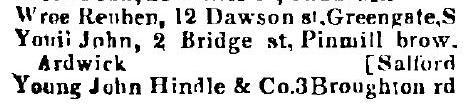
In all there were 86 listed in the directory for that year of which 22 were based in Salford.*

To these could be added the very small enterprises which were no more than a family and a front room, who made their own and served it directly from their own home.

In time I am minded to go looking for all 22, finding out something about who they were and how long they survived.  I suspect some will have gone within a decade while others lasted into the following century and a few who will still be familiar to some today.

So that is the task ahead.

And anyone is welcome to join in the fun, offering up their own stories along with pictures and memorabilia.

Two of the 22 Salford Breweries
In the meantime I shall close with the Cook Street Brewery building.

It was built in 1895 for the Chesters Brewery Company and taken over by Threlfalls in 1961.

According to that excellent pub site Pubs of Manchester, the brewery stands on the site once occupied by the "Blue Lion pub previously called the White Lion and Apollo, [which] was demolished to make way for the brewery." **

The grade II listed Salford premises have now been redeveloped into the Deva Centre, an urban business village.

And soon after I posted the story Alan came up with a correction, "something amiss here Andrew, the Brewery was already Threlfalls when I was a lad in the 1950's unless my memory fails me.

When we lived in Garden Lane,the smell of the hops brewing pervaded the area and mam would send me and my sisters to the brewery yard to buy coke left over from the brewing process because it was a lot cheaper than coal. 

We would drag a heavy wooden truck with large cast iron wheels the few hundred yards back home,although we were very poor and lived in abject poverty, my memories of that time are not at all sad....."

Location; Salford

Pictures; Salford, 2015, from the collection of Andrew Simpson

* Armitage Philemon, 5 Browning Street, Dix Alexander Mills, 18 New Bailey Street, Dover James , 93 Bury Street, Goodier & Atkinson, Albert Bridge Brewery, Gore Street, Harrison John and Co, Strangeways Brewery, Brewery Street, Strangeways, Howarth, William, Brierley Street, Pendleton, Hunstone, Alice S Springfield Lane, Joule Benjamin, 14 New Bailey Street, Lupton, & Adamthwaite, Cook Street, Lyth, Margaret “ Regent Street, Meakin & Webster, Ravald Street, Mottram, Richard Elliot Brewery Street, Rose, Henry, Oldfield Road Brewery, Oldfield Road, Threfall, JohnMayor, Greengate, Walker, John Worrall, Sandywell Brewery, Sandywell street, Greengate, Watkins, Mary Bank Street, Pendleton, Watson & Woodhead, Bolton Street, Wheater James Victoria Brewery Greenbank, Ravald Street, Wrow, Reuben, 12 Dawson Street, Greengate, , Young, John Hindle & Co, 3 Broughton Road

**Pubs of Manchester, Past and Present,  http://pubs-of-manchester.blogspot.co.uk/

Wednesday, 2 November 2016

Lost and forgotten streets of Salford ....... nu 39 New Bailey Street sometime in the 1850s

Now when Mr C W Clennell strolled into Salford from Manchester this was the result.

So far I have come across four of his paintings featuring Salford.

And that is al I am going to say.

Location; Salford


Picture, New Bailey Street, C W Clennell, , m77110 courtesy of Manchester Libraries, Information and Archives, Manchester City Council, http://images.manchester.gov.uk/index.php?session=pass

Monday, 15 August 2016

Lost and forgotten streets of Salford nu 2 ............ Barlow’s Croft

Barlow's Croft, 2016
Now I have to say if I lived on Barlow Croft back in the 1850s I might have been a tad miffed that my street didn’t get into the street directory.

After all we had a pub on the corner, named after the hero of Trafalgar, and a shedload of houses including a closed court as well as the Union Iron Works.

But then like all the unknown heroes of Trafalgar who never got into the history books the residents of Barlow Croft or Barlow’s Croft as it is now were clearly not worthy of a mention.

And that is a shame.  So later in the month I shall go looking for them on the census for 1851.

But for now we shall just have to settle for this picture taken a few days ago and a detail of the street from the 1849 OS map.

Barlow Croft, 1849
Of course there is always the Rover's Return on the corner, so named after that other pub with the same name, and which was the Lord Nelson, when some of our unknown residents may have sat and talked of naval histories and the price of fish.

Location; Salford 3


Pictures; Barlow's Croft, 2016 from the collection of Andrew Simpson and in 1849 from the OS for Manchester & Salford, 1842-49 courtesy of Digital Archives Association,  http://digitalarchives.co.uk/