Showing posts with label Chorltonville. Show all posts

Sunday, 17 May 2026

The photograph, a house on South Meade, and a mystery

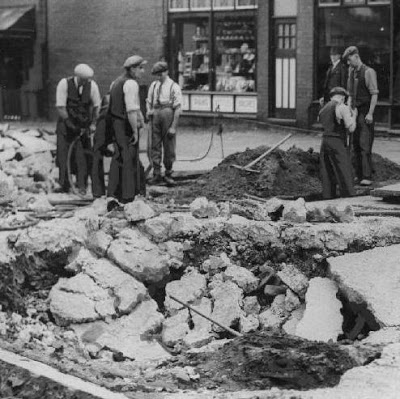
I am looking at a picture of a group or workmen outside a house on South Meade and at first glance there doesn’t seem to be anything unusual about what I am looking at.

The men represent a cross section of skills, ages and experience, and may well have posed for similar photographs across Chorltonville.

But I know exactly which house this was and have already begun to discover its history which starts with the simple fact that it has been occupied by only two families in the century and a bit since it was built.

And so, while we will never know the identity of the men staring back at us, we do have the deeds, as well as a collection of documents relating to its construction, which will help tell the story of this particular house.

The first family to move in was Mr. and Mrs. Jones.  In 1939 he described himself as a “Commercial Traveller in the Gas Industry”.

Everyone will find something interesting in the picture, with some focusing on the appearance of the men, the presence of the apprentice boy, and the flat caps and pipes.

The building contractor was Thomas Whiteley and a search might turn up something about the building firm, but I doubt that will extend to a list of employees.

For now, until Laura passes over its history for me to look over, we are left with the photograph of the workmen and the image of the house.

But for now, it is exciting that we are able to pin a group of craftsmen to one house sometime in 1911.

Leaving me just to ponder on Mr. and Mrs. Jones and a mystery which might be answered by those documents.

We shall see.

Location; Chorltonville

Picture; workmen outside South Meade, 1911, courtesy of Laura Hopkins

Special thanks to Laura, who kindly showed me the picture and has promised to lend me the house documents and to Jude who lives next door, and first told me about the picture.

Saturday, 16 May 2026

The case of the missing Domestic Servants ……………..

Now it is one of those received pieces of historical truth, that the age of the domestic servant peeked in the early years of the 20th century.

South Drive, circa, 1900s
Before that date, even the most modest of homes might boast a servant.

After the Great War, the rising cost of living, the advance of labour saving devices, and the growing expectations of “the servant class” combined to shrink what had once been a source of employment for many young people.

All of which I knew from trawling the census returns for Chorlton and many other places.

But I had never gone looking for the hard evidence, and then yesterday rising out of a discussion on a blog story about Chorltonville, I decided to test the idea, and to test it through the records of the estate.

A number of people had questioned whether the residents would have employed servants, given the size of the houses and occupations of those who lived in the properties.

As a project it had much going for it, because there are a limited number of households and they are grouped in a compact and defined area.

Chorltonville from the air, circa 1930s
In the April of 1911 eighteen households on South Drive returned the census form.*

The occupations listed were pretty much what you would expect for the estate, consisting of a high proportion who described themselves as “Commercial Travellers”, a couple of clerical workers, two employers, along with an actor, one manager, and one on “private means”.

Of these eighteen households, six employed a domestic servant, who lived in the home.  Not surprisingly two worked for the two employers, another for the one householder on “private means”, but the remaining there were employed who commercial travelers and a clerk.

It is of course a very limited survey, but what is interesting is that when compared to the 1939 Register which required every householder to supply basic biographical details for all the occupants, none of the six households employed a servant.

In their place comes that familiar term “unpaid domestic duties” or “housekeeper” which in each case refers to a wife,  which of course raises an interesting debate about the role married women.

Other than that, of the full eighteen, only one household listed an individual who was described as a “housekeeper”.

Which just leaves me to report that none of the original six who employed a servant in 1911 were still living in their house by 1939.

So, that is it, other than to say in a quiet time I shall go back to the historical record to push forward our knowledge of servants in the Ville.

Location; Chorltonville

Pictures; from the Lloyd Collection, circa 1900s-30s.

* 1911 census, Enu 11, Didsbury, South Manchester & 1939 Register

Friday, 15 May 2026

The insurance clerk, the travelling salesmen and Mrs Buxton from the USA ....... a bit of Chorltonville in 1911

Now every bit of Chorlton has its own story and Chorltonville is no exception.

South Drive, 1913
Most people will know it began as a bold venture to supply decent homes at affordable rents on a plot of farm land at the beginning of the 20th century.

There had been a modest pilot scheme which had been built behind Upper Chorlton Road, but the ‘ville was the big one.

The houses were built in record time and by April 1911 the first residents were showing up on the census for that year.

They were tenants rather than owners but within a decade the association had been wound up and the properties began to be sold off.

The estate has remained a popular place to live and many of my friends have passed through or chosen to settle and bring up their families in this quiet secluded place.

Something of its history has featured in our  book the Quirks of Chorlton-cum-Hardy* .

And with that in mind I went back to the records to see just what the demographic of the estate was like back at the beginning of the last century.

It is a big task and involves trawling the census returns street by street.  So far I have been looking at South Drive, and have covered just 39 homes, from numbers 1 to 65, and 2 to 22.  There are gaps which suggest some homes were vacant and I am fully aware that this is but a small sample but it’s a start.

The Tradesmen calls, 1913
What strikes you is the number of residents who gave their occupation as a commercial r travelling salesmen.
In all there were 14 of the 39 engaged in the job, along with a number of clerks, two shop keepers, two teachers and a University lecturer.

And what is particularly interesting is that some at least of these occupations reflect the new industries.

One of our salesmen was selling telephones, another electrical cables, and a third heating, ventilation and lighting, while Ms Vera Harris of South Drive was a typist.

But amongst all this “new stuff” there were the more traditional ways of earning a living of which domestic service featured highly.  Of our 39 residents, six employed a servant and one family had two.

It will be interesting to see how this small sample compares with the rest of the ‘ville and with the whole of Chorlton.  But that is a very big undertaking.  An earlier study suggested that in total 29 households in Chorltonville employed a servant.

So, for now I will just close with the reflection that a walk down South Drive in the April of 1911 would have been punctuated by a hosts of accents including more than a few from London, as well as the North East, a few from Northern Ireland and two from the USA and two more from Sweden.

All of which makes the place as cosmopolitan as it is today.

Location; Chorltonville

Pictures South Drive, early 20th century from the Lloyd Collection 

*The Qurks of Chorlton-cum-Hardy, Andrew Simpson & Peter Topping, 2017

Tuesday, 28 October 2025

A new history of Chorlton in just 20 objects number 6, the Garden Village 1911

Today I have chosen the Chorltonville booklet which was issued soon after the estate was opened on October 7 1911. It is a fascinating little publication which was subtitled A Garden Village of Better Planned Houses, and set out to show “how GOOD HOUSES could be built without philanthropy, and how an ESTATE could be developed on SOUND COMMERCIAL PRINCIPLES." The village was part of that Garden Suburb idea and aimed to provide decent affordable homes in pleasant surroundings. So the booklet offers pictures of properties, the facilities available and comments from both residents and the press.  All of which make it a fascinating piece of history.

Picture; front cover of Chorltonville, November 1912

Saturday, 28 December 2024

What did Chorltonville do in the last war?


South Drive, 1913
Now I always thought that Chorlton had by and large escaped the damage done to other parts of the city during the last war.

But that was not so and there is plenty of evidence that we got our fair share.*

Some of that evidence came to light in this edition of the Chorltonville News in the form of a compilation of extracts from the minutes of the Association for the war years.***

"In spite of its peaceful location, Chorltonville did not entirely escape the Second World War.  


Nell Lane, 1941
In June 1940 one of the estate workers, Pat Carly Jnr, was called up for military service and left.  An entry in 1944 records that he was then serving in Burma, and would like to take up his job “if he is spared to return”.  

Pat’s departure must have hit the family finances, because in July 1940 his father, also Pat Carly, requested a rise in his wages.  

The Committee agreed to an increase of three shillings and sixpence (about 18p) per week.  Mr Carly again applied for an increase in December 1941, due to war conditions.  

He was given an increase of four shillings (20p) per week, but granted it as a War Bonus – maybe so that it could be withdrawn after the war.

Also in 1940, the Committee was chasing up an application to Manchester Corporation for air raid shelters for the estate, “pointing out that no provision whatever had been made by the Corporation in case of emergency”.

Barrage Ballon on the Rec, 1941
Manchester’s Town Clerk was, apparently, not sympathetic.  He declined to provide the shelters, as the policy of the Corporation was to supply protection only for people caught by an air raid on the streets.  

The Clerk said that “each person who can afford to do so is expected by the Government to arrange for their own protection whilst they are at home”

The Committee accepted this decision, but protected their position by writing to the Corporation stating “that no responsibility can be taken by the Committee in the event of any unfortunate situation”.


The war evidently affected both finances and availability of people.  At the 1941 AGM, the Treasurer reported that the accounts were “as good as could be expected under current difficulties”, but still showed a deficit of over £37.  

The meeting voted a levy comprising a basic charge of 16 shillings, plus 3½d for each linear foot of frontage - under £1.50 for most houses.  

A deputy Auditor had to be found, as the elected Auditors were unavoidably absent.  The minutes do not say the reason, but one was still on “enforced absence” the following year, so presumably had been called up.

In May 1942 the Army erected Nissan huts behind Chorltonville alongside the cobbled lane by Brookburn School.  The Secretary wrote to the Royal Engineers (at Mayfield Rd in Whalley Range) asking whether the huts were for barrage balloons or gun emplacements, “as the Committee were most anxious that the presence of these things would render the Estate a target for the enemy”.

The Royal Engineers suggested he contact the balloon section, so the Secretary went to the local unit at the Recreation Ground in Cross Rd.  The corporal there had no knowledge of the huts and referred the Secretary to the Manchester RAF.  

The RAF replied with the enigmatic statement that the huts’ presence “does not increase the vulnerability of the estate to enemy air attack”.  The minutes do not say whether the Committee was reassured by this.

The Meade, 1913
The Committee was more successful in 1943, applying to the Corporation for extra street lights.  

Lamp posts were not in use because of the blackout, but they noted that the Corporation had introduced a modified form of lighting on some roads.  

They requested that these be introduced to Chorltonville, because of the danger to pedestrians using the roads and footpaths.  The Corporation agreed, and added dimmed lighting around the estate.

Interestingly, there is no note in the minutes recording either VE or VJ Day, but at the 1946 AGM, the Chairman tidily summarised:

“he spoke of the work of the past year, carried out under conditions as in the War, though happily the final Conflict had come to an end.  He continued that this Estate had been maintained under very fair conditions, and proposed that the levy stay the same.”

Pictures; Barage Ballon on the Rec, from the collection of Alan Brown detail from bomb damage at Nell Lane, 1940, courtesy of Manchester Libraries, Information and Archives, Manchester City Council, m09736, and pictures of the ville from the Lloyd collection

* http://chorltonhistory.blogspot.co.uk/search/label/Chorlton%20in%20the%201940s

** http://www.chorltonville.org/index.htm

*** reproduced courtsey of Chorltonville News

Wednesday, 9 August 2023

The Chorlton mysteries …….. which stubbornly keep their secrets

Sometimes despite a heap of research the stories just don’t come together.

Bomb damage, Manchester, 1941
And so, it is with a family of four who “were killed by enemy action in March 1941” and the mysterious link between a house in Chorltonville and the Nazi propagandist, Lord Haw Haw.

Both stories emerged from conversations during the week and in their different ways both seemed promising avenues of research.

The Smith family are buried in Southern Cemetery in the consecrated section T close to Barlow Moor Road, and a search of the City Council’s burial records list them as Eliza, Joseph, Ada and May.

I haven’t seen the grave yet, but Ed passed over the details and wondered where they may have lived.

I thought the bomb maps might offer up a location for their home, but that does depend to some extent on knowing where to look.

Barrage Balloon, 1940, Chorlton
Alas so far, I can’t find them on the 1921 census or the 1939 Register and while there is a reference to an Eliza Smith born in 1866, I can’t be sure this is her.

Nor do they appear in the list of dead killed on March 11th or the following day in one data base.*

Now given the confusion of war I fully accept that some records went missing, but it just ads to my failure.

And in the same way I haven’t been able to make a link between a house in North Meade and Lord Haw Haw, which was the was the “nickname applied to William Joyce, who broadcast Nazi propaganda to the UK from Germany during the Second World War. 

The broadcasts opened with "Germany calling, Germany calling", spoken in an affected upper-class English accent”. **

The possible link was suggested by one of our guests at the recent book launch, who said her mother had maintained that there was a connection between the house and the Nazi who had been an active Fascist in the 1930s before fleeing to Germany just before the outbreak of the war. ***

The census returns for 1921 and the 1939 Register threw up different people living at the property but as yet I can’t trace a connection to either the British Union of Fascists or to William Joyce.

The Meade, circa 1930
Nor so far I have come across a reference to Joyce in Manchester, despite trawling the Manchester Guardian, but then he was “Director of Propaganda for the British Union Of Fascists” and as such spoke at meetings around the country, so it is possible he appeared at a BUF meeting in the city or the surrounding area. ****

Now I not arrogant enough to suppose that just because I failed someone else will not be more successful, which lays down a sort of challenge.

But for now that is it, other than to record that Chorltonville appears unvisited by Goggle Maps which would have been a quick way of refreshing my memory of the said house on North Meade.

Chairs as weapons, Rotherham, 1936

So, we have all learnt something, apart from those residents of Chorltonville who already knew that Goggle Maps has not wandered down its leafy ways.

The Meade, 1913

Location; Manchester

Pictures; Blitz bomb damage, 1941, m08608, Fight at fascist Meeting, 1936courtesy of Manchester Libraries, Information and Archives, Manchester City Council,  http://images.manchester.gov.uk/index.php?session=pass barrage balloon on the Rec circa 1941 from the collection of Allan Brown, and the Meade, 1913, and circa 1930s from the Lloyd Collection

*Luftwaffe Over Manchester, The Blitz Years 1940-1944, Peter J C Smith, 2003, Neil Richardson

**Lord Haw Haw, https://en.wikipedia.org/wiki/Lord_Haw-Haw

*** The book …. some poems … a cake and the mystery of Lord Haw Haw in Chorltonville, https://chorltonhistory.blogspot.com/2022/11/the-book-some-poems-cake-and-mystery-of.html

****Fight at Fascist Meeting Chairs as Weapons, Manchester Guardian February 14th 1936


Wednesday, 5 May 2021

In the Chorltonville estate in the April of 1911

Chorltonville from the air 

It is always good when you call on other people’s research to tell a story so today I want to publish a snap shot of Chorltonville in 1911.

It “is an estate of 262 houses, located in the suburb of Chorlton in south Manchester. 

It was built in 1910-1911 as part of the garden village movement, and was originally intended as affordable rental housing for skilled artisans. 

Today the estate is almost entirely owner-occupied, with most roads, footpaths and green areas owned by a Board of Trustees on behalf of all house owners. 

An Owners' Committee has a brief to manage the day-to-day maintenance of Chorltonville.”*

It is a place I often write about and I am indebted to Isabel Wright who has given me permission to reproduce a snapshot of the place shortly after the estate was opened.  The original was published in the April edition of the Chorltonville Newsletter**

South Drive 1913
“At the time of the 1911 Census some eighty houses in the Ville were occupied comprising most of South Drive, one side of East Meade, The Thorns, and one side of South Gate. 

Presumably the rest of the estate was still being built. For me, the information contained in the census made fascinating reading about the first families to live here. 

Unsurprisingly a good proportion of residents were involved in the textile trade, including cotton goods merchants and shippers, a calico designer and a hat manufacturer. There were a number of commercial travellers, wine and spirit merchants, an actor, an architect, an essence expert, engineers, etc.

Places of birth were widely spread throughout the UK, but also some residents were born as far afield as New York, New Zealand, Sweden and one of the visitors on the day of the census was born in Russia. Only about half of the residents were from Manchester/Lancashire.


South Drive and the tradesman calls, 1913
Twenty seven of the homes had live in domestic servants mostly single young women in their late teens or early twenties. 

One residence had a live in domestic and gardener, and another a live in nurse. 

Many of these servants were not from the Manchester/Lancashire area, but had been born elsewhere in the country or Ireland, Sweden or the USA.

With thanks to Elizabeth Whiteley for transcribing the census information and creating a database. 

This makes the ville fairly typical of what had been going on in Chorlton since the property boom of the 1880s which saw the population of the township increase rapidly as the new professional and clerical classes were drawn into the area.

The attractions were fairly obvious given that we were close to the city centre and yet within minutes of the countryside.

The basis for this development had been laid with the coming of mains water in the 1860s followed by an effective sewage treatment plant in the 1870s and the railway in the 1880s.

And in 1904 we had voted to join the city which promised cheaper utilities’, a further extension of the tram network to include Chorlton and Withington and our own library.

Already the Lloyd and Egerton estates had seen the potential to sell off small parcels of land accepting an agreement from the developer to pay an annual chief rent instead of a lump sum.

This had the advantage that the landowners had a perpetual source of income which brought in more than if the land remained in agricultural use.

As the Manchester Evening News pointed out in 1901 a field earning as little as 50s an acre as farm land could command up to £30 an acre when offered for building.

The site of the estate in 1907
The arrangement had the added advantage that it freed up the developers capital to be used on building the houses, which once built and sold resulted in the transfer of the chief rent to the home owner.

Most of this new development occurred in what became known as “new Chorlton” in what had been Martledge, but the still relatively rural area to the east of the village and south of the brook was a perfect spot to build the Chorltonville estate.

It was situtated on the edge of the flood plain with open land to the east, south and west but was still only a short walk from the railway station and after 1913 even closer to the new tram network*.
http://chorltonhistory.blogspot.co.uk/2013/03/a-new-tram-service-for-chorlton-at.html

But that is a story others have written about and which has been featured in a number of publications including the Chorltonville centenary booklet.

Pictures; of Chorltonville from the Lloyd collection and detail of the site of estate from the OS map, 1907

* from Welcome to Chorltonville, http://www.chorltonville.org/index.htm

Thursday, 22 April 2021

In at the beginning …… Chorlton’s garden suburb …. and a puzzle

Now the story of  Chorltonville is pretty well known, and in essence is the story of a scheme to offer homes at affordable prices on what was still the edge of the countryside.

The Meade, 2018

The properties “were let at rentals of £24 a year and upwards and each tenant was a shareholder” and building was completed within two years.*

A whole raft of civic dignitaries had been invited to the opening day on October 7th 1911 and one of those who spoke was our own Mrs Jane Redford who was the first woman councillor elected in Chorlton.

She commented that the estate was “far removed from what was described as ‘brick boxes with slate lids,’ and as to the inside she was pleased to know that the rooms were bright, airy, and well ventilated, and provided with electric light (or gas if desired) and with gas for stoves and wash boilers.”**

Such was the praise for the new venture that the MP Mr. H Nuttall mused, “the curved roads and the houses of various designs in black and white make one feel almost that one was living in Elizabethan times”. ***

South Drive, circa 1912

All of which is well known, so today I shall explore the start of the project which comes in the form of the Memorandum and Articles of Association of Chorltonville, Limited, which dates from March 11th, 1909.

It is the standard legal document, laying out the names, addresses and details of the seven original subscribers, and the six directors, along with the objects of the company.

The capital was to be “Twenty-five thousand pounds, divided into three thousand ordinary shares of five pounds each, and two thousand preference shares of five pounds each”.**** 

Memorandum and Articles of Association, 1911

Five months later the capital of the company was "increased to £30,000 by the creation of 400 additional Preference shares of £5 each”.***** 

The directors were William Brewerton, James Herbert Dawson, James Evans, Charles Green, Thomas Hodgson Shillinglaw, and William John Vowels, who along with William Hammersley were also the original subscribers. Two of them were estate agents, one a “Shippers Manager”, another “a Provision Merchant”, and a Grocer and pawnbroker.

The Plan of Chorltonville Estate, date unknown

Added to this document there are a heap of other papers relating to one particular house on South Meade which show that the particular property was bought from Chorltonville Ltd in 1926 and remained in the possession of the owner until 1980 when it was bought by the present occupant.

Added to this there is a fascinating plan of the estate, detailing all the individual houses, the bowling green, tennis courts and children’s corner.

And the plan has one surprise for me, and that is the section of what we now call Brookburn Road which runs past the school and out onto the Meadows is listed as Altamont Road, and was bordered by the farm and eight cottages.

Altamont Road, date unknown

And here it all becomes a bit more complicated, because the directories show Altamont Road as Brook Road, but the number of properties do not match.  

The 1911 directory lists nine properties and the census return even more.****** 

 All of which is compounded by the census return for a decade earlier which does not record a Brook Road, but does include a Dean Lane. 

So, at the last hurdle of what I thought would be a paragraph rounding off the story we are presented with a whole new set of puzzles.

But history is messy, and the fun is trying to find the way through.

So, I shall just conclude by saying there is more on the story of Chorltonville, in the book The Quirks of Chorlton-cum-Hardy, which is available from  http://www.pubbooks.co.uk/ or Chorlton Book shop, 506 Wilbraham Road, Chorlton-cum-Hardy, Manchester M21 9AW 0161 881 6374


Location; Chorltonville

Pictures; The Mead, 2018, from The Quirks of Chorlton-cum-Hardy, South Drive, 1912, from the Lloyd Collection, Memorandum and Articles of Association, 1911, and plan, courtesy of Laura Hopkins

* Mr J.H. Dawson, Chorltonville, Opening of a New Garden Suburb, Manchester Guardian, October 9, 1911

** Mrs J. Redford, ibid, Chorltonville, Opening of a New Garden Suburb

*** Ibid, H. Nuttall, Opening of a New Garden Suburb, Manchester Guardian, October 9, 1911

****Memorandum and Articles of Association of Chorltonville, Limited, March 11, 1911

****ibid Memorandum, July 14th, 1911

*****Census Enu 11 154, Didsbury, South Manchester, 1911

Thursday, 16 January 2020

South Drive in 1913 and another of those postcards from Tuck & Sons

Now South Drive was still very new when Tuck and Sons featured it as one of their six postcards of Chorlton in the summer of 1913.

And like all six in the series it will be familiar to most of us, so instead I want to explore the reverse and in particular the reference to R. SOWERBUTTS, NEWSAGENTS STATIONARY & CIRCULATING LIBRARY CHORLTON-CUM-HARDY.

Robert Sowerbutts ran his business from 105 Manchester Road which is that parade of shops running back from Kensington Road to Ransfield Road.

The shop is there still there but will have gone through many hands and changes of business use.

But I am intrigued by Mr Sowerbutts, and I rather think he must have been an enterprising chap, given that as well as acting as a distributor for Tuck and Sons and running his newsagents and stationary business he had also advertised that he had a Telephone Call Office.

Nor was this all because like other newsagents and stationers he offered a private library, which of course has featured in the blog. **

There were plenty of them in the township from Mr Lloyd’s on Upper Chorlton Road, across to Manchester Road, Barlow Moor Road and Sandy lane and Beech Road.

And some of these also sold postcards for both the big companies or like Burt’s on Wilbraham Road marketed their own.

Pictures; South Drive, from the series Chorlton-cum-Hardy, issued by Tuck & Sons, November 1913 courtesy of TuckDB http://tuckdb.org/history

*Chorltonville, http://chorltonhistory.blogspot.co.uk/search/label/Chorltonville

**Chorlton’s private lending libraries, http://chorltonhistory.blogspot.co.uk/search/label/Chorlton%27s%20private%20lending%20libraries

Friday, 31 May 2019

Three for the ‘ville, number 1, the Sports Pavilion in the Recreation Area, circa 1914


I am in picture mood and over the next few days I want to return to Chorltonville and feature three more pictures of the place.

This was the Sports Pavilion in the Recreation Area not long after the ‘ville had been built.

 Like many projects of its kind the designers were keen to provide places of leisure and the sports pavilion offered both tennis and bowls.

I doubt now that we will ever discover the identity of the people in the picture.  Given that it was taken around 1914 even the young girl will now be dead.

And because this was a commercial photograph it is unlikely that it forms part of a treasured family album which might just offer up a name.

Still the young girl in the dark dress appears on a number in the collection and each case holding a tennis racket.

You have to admire the tenacity of our six 'ville residents, because judging by the leaves on the trees and bushes it must still be sometime in the spring.

But then we do get some nice weather in April and May, so perhaps they have taken advantage of just such a day.

Picture; from the Lloyd collection

Friday, 1 September 2017

Three for the ‘ville, number 3, ......... in the garden


Now I know there will be those who fail to see what there is in this picture of Claude Road from Brook Road sometime around 1914.

And if I am honest it is hardly a page turner, but then that is the point.  It is an ordinary scene of a bit of Chorltonville which was rarely photographed.

Like so many of these pictures of the period I am struck by the uniformity of the curtains at the windows of the houses.

The ‘ville is still fairly new and the trees have yet to grow to any size and the hedges are still dwarfed by the fence.

What does make the picture a little more interesting is that it is one of a commercial series and may originally have been produced with the hope that the residents along Claude Drive would buy a few copies.  This was pretty much standard practice.

It may even be that the photographer was the same man who trawled the ‘ville in the spring of 1913/14 taking a lot of pictures.  They were then either sold to different postcard companies or perhaps acquired by them.

Location; Chorlton

Picture; from the Lloyd collection

Tuesday, 29 August 2017

Chorltonville from the air


Chorltonville is is tucked away south of the Brook and was opened in 1911. 

This aerial picture dates from the 1920s when there were still fields close by.

 To the north are the farm buildings of Oak Bank Farm while at the bottom of the picture is the land stretching out to the Mersey.

Picture: from the Lloyd collection

Friday, 21 August 2015

Chorltonville and a milkman


Another picture of Chorltonville, South Drive and a milkman
Picture from the Lloyd collection

Saturday, 2 May 2015

Three for the ‘ville, number 2, delivering the shopping


We are on South Drive in the spring of 1914 sometime in the morning. 

This is still the time when even relatively humble families might expect the local shopkeeper to deliver, and so here is the delivery boy.

Unlike some of the tradesmen in the ‘ville who might be seen with their horse and cart, this lad has only a hand cart.


And judging by the empty basket has pretty much finished for the day.

Picture; from the Lloyd collection

Saturday, 5 April 2014

Looking in at Chorltonville


Many of my friends have moved to the “ville” over the years, and you can see why.

 The houses are comfortable family homes and the grass and tree lined streets can be still be a peaceful place. 

Most of the early pictures reflect this quiet estate.

 So I decided to choose pictures which showed the delivery men and tradesmen.

 Here on the Meade there was a flurry activity.

Long before internet gorcery shopping brought to the door, the shops of Chorlton were sending out their produce.

Picture; from the Lloyd collection

Friday, 28 December 2012

Exactly 100 years ago on Claude Road


It is another one of those pictures that needs few words.

It is exactly one hundred years ago that the commercial photographer stood in the middle of Claude Road up and took this picture.

In one sense it is remarkable how similar the same shot would look today, but I will leave you to ponder over the differences a century have made.

Picture; from the Lloyd collection 

Saturday, 28 July 2012

A picture a day ... North Meade early 20th century


A picture a day

During this week of July I have decided to feature a picture a day, drawn from the collections that span a century and more of Chorlton

Picture; from the Lloyd Collection

Tuesday, 28 February 2012

Horse drawn delivery vans, gas lights, coal fires and net curtains, North Meade 1914


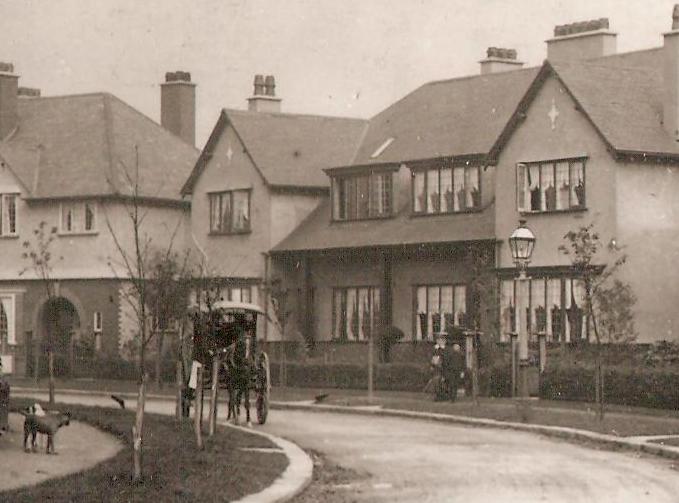
Here is another of those occasional pictures celebrating just over one hundred years of Chorltonville. It was taken not long after the “ville” had been built and is looking out from Claude Road along North Meade towards the Meade.

In some ways it is a scene that has not changed much. The trees have now matured and the passage of time has made it necessary to replace the wooden fences, but essentially it is almost the same.

But what it reveals is a world remote from our own. The horse drawn delivery vans of which there are two in the picture hark back to a time when local shops however local made house calls. So on this quiet day as one plies his way onto North Meade, another has taken to stop on the island, which would sit badly with the generations of residents who have told children off for playing on the grass.

Nor does it stop there. Behind those front doors there was gas lighting, coal fires and the regulation style window nets. And a total absence of cars.

The roads in the “ville” are narrow but then when no one had a car it didn’t matter over much. It was perhaps fortunate that in planning the front gardens the design allowed for a drive and garage to be added later in mid century.

Picture; from the Lloyd collection

Tuesday, 21 February 2012

Another side of Chorltonville

Another view of the Meade, what strikes me about this image from the 1920s is the degree of uniformity about the “Ville.”


Picture from the Lloyd collection