Showing posts with label Postcards and their history. Show all posts

Tuesday, 5 August 2025

In praise of the humble picture postcard …….

 It’s that time of year when stories of holidays would fall through the letter box onto the door mat.

Fishing boats, houses and a sea wall, Mousehole,2025
And leaving aside the saucy cards of inebriated vicars, busty women, and innocent shop girls, the postal service was full of picture postcards with scenes of seaside resorts and city centres.

The golden age ended I suppose in the 1960s, and pretty much has been seen off by pictures sent instantly by mobile phones at no cost.

By contrast sending an old-fashioned picture card today will cost 87 pence along with the price of the card and take days to arrive, and even longer if sent from some holiday destination in Greece.

A century and a bit ago a stamp cost next to nothing and with frequent collections and deliveries it was possible to tell your mum you were leaving on the morning train and be home by teatime.

Twisty street leading nowhere, Mousehole, 2025
Better still you could post early and arrange to meet up later in the day.

Now all of this I have written about heaps of time supported by a collection of picture postcards from the 1880s onwards.

So instead, here are four pictures I took last week, and with the help of technology tried to reproduce that golden mellow look that many picture cards seemed to have in the 1950s and 60s along with those blue tinged ones.

I even tried the really yellow look reminiscent of Eastman colour, but that was a step too far.

Of course, I could have gone for that washed out appearance which I suspect had more to do with the length of the time the cards had sat on those twirling stands in full view of direct sunlight.

And in keeping with the time, the selection ranges from the harbour scene and twisty street to the boring.

Leaving me just to offer up some from the collection spanning the Golden Age of the picture postcard which are available by following the link.*

The boring picture, Bristol, 2025

Two bikes and a heap of boats, Mousehole, 2025
Location; Mousehole, Cornwall, and Bristol 


Pictures; Capturing Mousehole and Bristol, 2025, from the collection of Andrew Simpson

*Picture postcards, https://chorltonhistory.blogspot.com/search/label/Postcards


Friday, 12 April 2024

Pictures with no stories ........ no 2 .... off in the Chara

I was way too young to have ever travelled on a “chara” but our dad drove one back in the late 20s and early 30s, and we have the pictures to prove it.

And here is another full of smiling holiday makers out on a trip.

There will be someone who can describe the type, make and date of the vehicle and perhaps even suggest a location.

Chara’s were often only brought out in the summer and placed on the chassis which at other times doubled up as a lorry transporting goods.

They were by all accounts pretty uncomfortable things to travel but that said they offered up the promise of fun and new places.

Sadly there in no date on the back or a hint of where our people were and not even a comment.

So that is it.


Location; unknown


Picture; from the collection of Ron Stubley


Friday, 29 September 2023

Deltiology …..... another story from Tony Goulding

I have recently become increasingly aware of just how much History can be revealed by the collection and studying of postcards otherwise, “deltiology”.(1)

Two postcards of East London of the Edwardian era

Margate Sands                           Great Yarmouth Pier    
The advance of literacy, a low cost and reliable postal service, with multiple collections and deliveries daily, combined with the yet very limited use of telephones led to the Edwardian era being the heyday of postcard sending

A collection of correspondence of this era between two or more addresses can reveal intimate minutiae of a family’s life.

A card recently received from a friend on holiday in Ireland
A second great source of postcards are those sent from seaside resorts and other holiday destinations., 

These “wish you here” type postcards began in 1894 after a change in Post Office Regulations, increased with the greater availability of leisure time and continue even in this day of E-mails and text messages. 

Other than some bills and “junk” mail, postcards are the only mail I receive regularly apart from Christmas. 

A sub-genre of these “seaside” cards are the saucy postcards produced in their millions from the early 1930s. 

It is interesting how these cards reflect social mores. 

Increasingly popular from the 1930s until changes in attitudes to sexual stereotyping in the 1970s led to their decline. Sales of this type of card dipped significantly during the early 1950s. 

Two Donald McGill “Saucy” postcards.
Several local councils, notably Cleethorpes in Lincolnshire, (2) deemed some of the cards obscene, seized them and had them destroyed. 

Encouraged by the government of the day who were concerned about declining standards, Donald McGill, a leading designer with over 12,000 card designs was prosecuted under the Obscene Publications Act (1857). 

After a trial in Lincoln in1954, he was found guilty and fined £50 with £25 costs. This resulted in a purge of these cards nationally. 

The 1857 Act was repealed and replaced in 1959 by a more liberal one with Donald McGill giving evidence before the House of Commons Select Committee charged with forming proposals for the new legislation. This and the advent of the “swinging sixties” led to a resurgence in the “saucy” cards.

“Paddy The Next Best Thing”, 1924

Postcards have also a long history of being used as a mode of advertising. Here is a typical example from the 1920s with The County Theatre, Reading, advertising the forthcoming production: “Paddy The Next Best Thing” week commencing Monday 11th February 1924 (3)
Hotels and restaurants have even offered to pay for the postage on such advertising cards.

The reverse side of postcards can also be of historical interest. Here are a couple of informative squares I have found recently in the "stamp" corner of two cards.

The U.S. Postage rates are of particular interest in that this is surely dated before the Cuban Revolution of 1st January 1959 after which relations between the United States and Cuba remained strained for more than five decades.


Finally, in closing this look at postcards it would be remiss of me not to give a nod to my maternal grandfather Arthur Harold Clarke who as a professional photographer during the inter-war years made his living by producing a series of Picture Postcards of the Chorlton-cum-Hardy area, examples of which regularly appear on this Blog.

Pictures; All from the collection of Tony Goulding.


Notes: - 

1) “Deltiology” derived from the Greek words “deliton” meaning a small, illustrated tablet or card and “logos” meaning a word, speech, discourse, or reason.

2)  There is a full report of this case in the Grimsby Daily Telegraph of 12th December 1951.

3) Details from the Reading Standard, Saturday 9th February edition.


Sunday, 14 August 2022

Friday, 12 August 2022

A little bit of gentle fun at the seaside in the 1930s ........ no 4 central heating

A short series reflecting on a bit of gentle fun from the seaside.


That said each of the four has something to say about the period in which they were sent.

But I will leave you to draw conclusions.

Location; at the seaside in Wales

Picture; courtesy of Ron Stubley

Thursday, 11 August 2022

A little bit of gentle fun at the seaside in the 1930s ........ no 3 the nice boy

A short series reflecting on a bit of gentle fun from the seaside.

That said each of the four has something to say about the period in which they were sent.

But I will leave you to draw conclusions.

Location; at the seaside in Wales

Picture; courtesy of Ron Stubley

Wednesday, 10 August 2022

A little bit of gentle fun at the seaside in the 1930s ........ no 2 Pinched

A short series reflecting on a bit of gentle fun from the seaside.

That said each of the four has something to say about the period in which they were sent.

But I will leave you to draw conclusions.

Location; at the seaside in Wales

Picture; courtesy of Ron Stubley

Tuesday, 9 August 2022

A little bit of gentle fun at the seaside in the 1930s ........ no 1 the Swank

A short series reflecting on a bit of gentle fun from the seaside.


That said each of the four has something to say about the period in which they were sent.

But I will leave you to draw conclusions.

Location; at the seaside in Wales

Picture; courtesy of Ron Stubley

Thursday, 14 July 2022

A little bit of gentle fun at the seaside in the 1930s ............. no 8 "Reminded of you"

A short series reflecting on a bit of gentle fun from the seaside.


Location; at the seaside in Wales

Picture postcards, Postcards and their history, Ron Stubley


Wednesday, 13 July 2022

A little bit of gentle fun at the seaside in the 1930s ............. no 7 "I'm Respectable"

A short series reflecting on a bit of gentle fun from the seaside.


Location; at the seaside in Wales

Picture; courtesy of Ron Stubley


Picture postcards, Postcards and their history, Ron Stubley

Friday, 6 August 2021

A little bit of gentle fun at the seaside in the 1930s ............. no 6 "the lady what does"

A short series reflecting on a bit of gentle fun from the seaside.


That said each  has something to say about the period in which they were sent.

But I will leave you to draw conclusions.

Location; at the seaside in Wales

Picture; courtesy of Ron Stubley

Thursday, 5 August 2021

A little bit of gentle fun at the seaside in the 1930s ........ no 5 "so shall we peep"

A short series reflecting on a bit of gentle fun from the seaside.


That said each of the four has something to say about the period in which they were sent.

But I will leave you to draw conclusions.

Location; at the seaside in Wales

Picture; courtesy of Ron Stubley

Tuesday, 1 December 2020

So what can you learn from a postcard?

This is not as daft as it sounds because over and above what you can see, picture postcards reveal a lot about how we lived and perhaps a little of what people thought, wanted and did.

So I have decided to start with this one which was posted recently on a site by my friend Sally.

We are on Deansgate on a busy week day and the year will be 1932 or just possibly a year or so before.

Now the giveaway will be the clothes and the cars.  People far more expert than me will be able to work out possible dates from the models on the road and with the help of the registration plate’s offer up more information.

Added to this a check of the street directories for Deansgate using the names above of the shops will also offer up ranges of dates.

And if we are lucky the clincher will be the postcard manufacturer, because the big companies produced lists of when their cards were first registered.

This one was from the Valentine Company and they were trading in picture postcards from 1897 and were taken over by John Waddington in 1963 by which time the heyday of the picture postcard was over.

But for us happily Valentine’s printed the code number which was part of a batch registered in 1932.

The actual photograph may be a tad older but not by much.

For cards which were sent through the  mail there is also the post mark on the reverse which will also close the gap in dating it but again a post card sent in 1933 might have been produced a year or more  before from a photograph which was even older.

And it is the reverse which also offers up much in the has been written, including how the sender was feeling what they were doing and even sometimes a comment on the events of the day.

My own favourite was a message from young Bertha Geary who in 1911 heard and saw the Flying Man who was competing in the Daily Mail Round Britain Airs Race, a competition that this French pilot won.

Equally in another card sent from Chorlton in the same year, there are references to a successful Conservative politician re-elected and news of strikes in a year beset with them

Sadly Sally’s card was not sent and so we have lost out on some of that detail, but it remains a fince picture of a busy summer’s day in the early 1930s, and for those who know Deansgate some of what you see is still there today.

Picture; Deansgate circa 1932 from the collection of Sally Dervan

Thursday, 9 July 2020

Pictures with no stories ........ no 5 .... two in Gale's Studios on Market Street

I like the idea that these two women have come out of the shadows, and for just a few minutes will be seen once more after perhaps a century and a bit.


I don’t know who they are or when the photograph was taken but I do know that they were in the photographic studio at 54 Market Street.

The studio belonged to Gales’ and this was one of their branches.

In time I will go looking for the company but in the meantime I can tell you that in 1911 the man taking the pictures was a Mr Wallace Allan.

Location; unknown

Picture; from the collection of Ron Stubley

Saturday, 22 July 2017

“The Canadians are holding their own” .......... and nor were they alone .......making a bob from the troops in the Great War

Now if you were far from home sending a regular picture post card was away of keeping in touch with the family.

Add caption
And over the four years of the Great War millions of cards must have been sent from army camps ships of the line and from all the battle fronts.

All of which will have been good news for the commercial postcard companies whose commercial considerations meant that when they had a good picture it would be daft not to use it over and over again.

Before the war this meant using the same comic image and altering the name of the seaside resort or in the case of Tuck and Son marketing the same Edwardian “belles” on a series of postcards changing only the city they were from and altering the rhyme extolling their beauty and charms.

So had you been in the south west you could have read “Of all the girls’ it’s nice to meet Torquay girls are hard to beat”, which had become “The prettiest girls it is well known Are mostly found in London Town” and had variations for pretty much everywhere else.

So when the Great War broke out what better than market a winning image with a different regiment.

All of which meant that the romantic card, “The Canadians are coming,” with its picture of a nurse in the arms of a soldier had with a stroke of a pen become “The Manchesters are ‘holding their own’ at Hayward’s Heath.”

Both cards were made by the same company and sold in the same area.

Our Canadian one was posted on September 12 1915 at to a young woman who lived at Norbury Park Farm in Surrey at 9.15.

The farm is still there and with a bit of detective work we may be able to uncover more about the young woman who received the card and along the way whether the Canadians were in the area the postcard was sent from.

We shall see.

Pictures; from the collection of Davis Harrop

*More of "Our Belles" from Tuck & Sons in 1908 and a bit of commercial sharp practice, https://chorltonhistory.blogspot.co.uk/2016/07/more-of-our-belles-from-tuck-sons-in.html

Monday, 13 June 2016

A little bit of history for just £1.28 ............ be the first to revive the picture postcard

Now I love technology.

I text, and use WHATSAPP, have a facebook and Twitter account and could be persuaded to use instagram but I am rather taken with the idea of the picture postcard.

And so is Peter Topping who has now produced a series of cards with images of Chorlton which are on sale for just 75p plus the cost of a second class stamp which is currently 53p.

All of which means that for the grand total of just £1.28 you can send a message to a friend with a picture of your choice.

No finding the image on your phone then downloading it and sending it before you added your message, and no chance that at the other end your friend, family member or complete stranger will erase the picture and lose it for good.

Instead the said picture postcard compete with personalized hand written comment will sit on the mantelpiece of the recipient for all to see marking you out as a thoughtful person who looks for originality.

And the selection of picture postcards now includes iconic scenes of Chorlton.

So not only will you get to revive a forgotten form of communication but will also share a bit of our history.

You are happy, the recipient will be happy and along the way the post person and the staff in the Post Office will also be happy and you get a trip to the post box thereby adding to your five walks a day.

The selection is available from Chorlton Bookshop which means that you will also have done your bit to shop responsibly and locally.

The alternative is a smiley face and miswritten bit or predictive text.

Pictures; reviving the picture postcard, © 2016 Peter Topping, Paintings from Pictures,

Web: www.paintingsfrompictures.co.uk

Saturday, 28 November 2015

The Wareham Women, a church in Oldham and a unique set of picture postcards sent home to Heaton Mersey

Greetings from Llandudno, 1907
Just occasionally you get the opportunity to pursue a story which you have no idea where it will end up but in the process reveals a fascinating insight into the lives of one middle class family at the beginning of the 20th century.

The story started as so many do with the news that my old friend David Harrop had acquired a set of picture postcards sent by the young May Winifred Wareham to her family.

I have yet to see them but I know that the collection includes cards sent from across Britain and as far away as Monte Carlo and includes a few which were originally taken as family snaps.

Now that alone will make them an interesting piece of social history but so is the story behind the young woman who sent them.

She was born in 1888 into a large family and is buried in the parish church yard in Heaton Mersey.

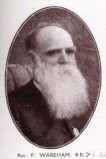
Her father was Frederick Wareham who became vicar of St Paul’s in 1877 and stayed until 1907 when he moved to St John’s in Heaton Mersey serving the community until his death in 1919.

Frederick Wareham circa 1900
So along with the postcards and the messages contained on the back there will be much to find about the lives of May, her parents and siblings and also the two churches which Frederick was associated with.

And it is with St Paul’s that I shall close for now because the church is in the process of restoring its west window which was made to honour his time in Oldham and that window will feature in later stories.

All of which just leaves me to say ............ watch this space.

Pictures; a picture postcard from Llandudno, 1907 from the collection of David Harrop and Frederick Wareham courtesy of St Pauls, Oldham

Additional research courtesy of St Paul’s Oldham, http://stpaulsoldham.org.uk/index.php

Friday, 5 June 2015

The Pardon Came Too Late .............. postcards from Holmfirth

I am intrigued by three picture postcards which I had at first assumed were produced during the Great War.

Each carried an image relating to the execution of a British soldier along with verses from a music hall song.

Now the image of the young soldier awaiting execution for cowardice or desertion is a powerful one and can still provoke debate about how the British army dealt with men who for differing reasons showed what some chose to call a “lack of moral fibre” and today we see as a symptom of combat fatigue.

In total 306 British and Commonwealth soldiers were shot during the course of the Great War and their names tended not to be recorded on the Rolls of Honour.

So these three cards drew me in

The idea that a company would issue these during the war seeded a tad off and the verses actually  predate the war having been written by Paul Dresser in 1891.

Mr Dresser was born in 1857 in Indiana and made his living from singing and song writing becoming very popular during the 1880s and 90s.

And that raises the possibility that these three were produced sometime before the war.

The clue might well be that they were made and issued by Bamforth & Co of  Holmfirth and these three carry the catalogue number 4829/2 so once I have found their catalogue it should be possible to date them.

At present and it is a long shot the company moved their film production to London in 1913 and these three all carry the imprint of Holmfirth and New York.

So maybe they are pre 1913, but that said the jury is still out but I bet there will be someone who can help.

And of course there was.  David tells me that the song sheets were published during the war as were the three postcards which ia an interesting take on attitudes to the war and leaves me wondering if a song sheet will turn up.

We shall see.

Picture; THE PARDON CAME TO LATE (1) & (3) Bamforth & Co, Ltd, date unknown, from the collection of David Harrop

Sunday, 18 August 2013

Raphael Tuck and Sons Ltd who sold postcards for most of the late 19th and 20th centuries.

The main Arsenal Gates, 1905
The picture postcard of the late 19th and 20th centuries remains a wonderful source for anyone interested in the past.

They covered everything from landscapes to individual houses and in the fullness of time the amusing and slightly rude seaside card.

At the most basic level they allow you to track how a place has changed, comparing a street in say 1900 with one today.

But for me it is also the messages written on the back which open up the world of our grandparents and great parents.

So from the trivial and mundane like a Christmas greeting or details of where and when to meet up there are the concerns for each other’s health and comments on politics and the current social issues.

Writing to mother
In one sent in 1911 there are comments about the election of a local Conservative councillor and the news that the factory is about to go on strike while in another a Gladys is keen to point out on the card where she lives and the progress on the redevelopment of an old estate close by.

The one opposite is the reverse of  the photograph and describes a young man's first day at the Royal Arsenal in Woolwich.

He reassures his mother he is fine describes leaving by "the big gat" and comments on the size of the place.

Like so many I have read the message is terse with the odd spelling mistake and was dashed off in a hurry.

I do puzzle at the absence of a stamp but perhaps it was one that just never got sent.

Outside the showrooms
And as you would expect there are collectors and sites dedicated to both selling the cards and furthering research on the companies that marketed them and the photographers who took the pictures.

All of which is a lead into a new series on those collectors and the sites they run.

I am starting with TuckDB which “aims to be the go-to reference for Tuck postcard collectors, historians or anybody who enjoys artistic paintings and photographs.”*

Raphael Tuck and Sons Ltd sold postcards for most of the late 19th and 20th centuries.

Theirs was a very big concern with offices across Europe and America and in 1883, were granted the Royal Warrant of Appointment by Queen Victoria and thereafter Tuck cards bore the message, "Art Publishers to Her Majesty the Queen".

The site is an extensive one which provides a history of the company and a free database of the cards produced.

I have to admit being lost for hours wandering across cities, rural landscapes and heading off across the world.

And inside the show rooms with all the gas appliances you could wish for
But as ever I was drawn back to the places which have always meant most to me.

Sadly there are few of Chorlton and those that are there are ones that crop up in most collections.  Of Eltham there are but three.

Happily as you might expect there are plenty of Manchester many of which I have never seen before and plenty that are a pure joy to look at.

But I will finish with another two from Woolwich which perfectly capture what makes these postcards so wonderful.  They are from the series on the South Metropolitan Gas Company and feature the interior and exterior of the shop at 36 Powis Street.

Not I grant you most zippiest of subjects but someone will have thought so at the time.  And looking at the same spot today I rather think the South Metropolitan Gas Company stole a march on what stands there today.

Added to the there is this wonderful view of the gas appliances on sale.

Pictures; Main Arsenal Gates & Road, July 25 1905,and the reverse & SHOW - ROOMS,- 36, POWIS ST. WOOLWICH, from a set entitled, London, SOUTH METROPOLITAN GAS COMPANY, un dated courtesy of TuckDB

*http://tuckdb.org/history