Showing posts with label Harold Clarke. Show all posts

Monday, 23 March 2026

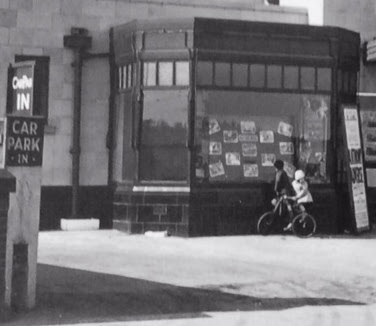
Standing in front of the Rivoli on Barlow Moor Road sometime in 1936

Now I can’t be certain when this photograph of the Rivoli on Barlow Moor Road was taken but given that the cinema opened in November 1936 and closed because of bomb damage four years later it will be sometime between the two.

And there are other clues to a possible date.

The first is the film Anthony Adverse which was released in the November of 1936 and will have been showing in suburban cinemas within the year.

It was a dreadful film based on an impossible plot heavy in morality and set in the late 18th and early 19th centuries.

That said it featured infidelity, a mistress of Napoleon and the remorse of a slave trader who turned away from “that odious traffic in human flesh” and was set in lush tropical surroundings and magnificent European palaces.

Added to which it had the young Olivia de Havilland who at the age of 20 was starring in her fourth film having already acted with Errol Flynn in Captain Blood and who within the year would star in The Charge of the Light Brigade and later still The Private Lives of Elizabeth and Essex and that all time weepy that was Gone With the Wind.

The film had also picked up four Academy Awards so I guess had we been here back then we would have gone along.

And that might have been the motive for Mr Clarke of 83 Clarence Road to take the photograph and add it to his portfolio of images he marketed as picture postcards.*

After all if you had seen the film or just visited the cinema you might just be prompted to pick this card out of all the rest next time you wanted to send a message which is what postcard manufactures banked on.

Commercial photographers with an eye to what would sell toured local streets taking pictures of individual houses and offering them to the residents and when that market dried up offered them to postcard companies.

In the case of Mr Clarke he did both, producing the cards with his imprint and selling them to the local shops, including Mr Lloyd’s on Upper Chorlton Road and Mrs Burt’s stationers on Wilbraham Road.

He was active during the 1920s and into the 30s and produced a series of book marks for the opening of Central Ref.
By 1940 he “re-located the family home and ceased making his living solely from photography as a 1944 wedding certificate shows him as an Inland Revenue clerk residing at 5, Keppel Rd.”**

But during his time as a commercial photographer he produced some fascinating pictures of Chorlton, of which this is one that I have never seen before.

And for all those who have debated the actual location of the cinema there is no doubting that Mr Clarke’s picture nails it firmly on the spot now occupied by K.F.C.

What I also like is the detail of the two kiosks on either side of the entrance and that the Rivoli is one of those new picture houses which have fully embraced the motor car as the cark park sign indicates.

So that pretty much is that.

Picture; the Rivoli circa 1936-40 from the collection of Peter McLoughlin

*Harold Clarke, http://chorltonhistory.blogspot.co.uk/search/label/Harold%20Clarke

**Tony Goulding, grandson

Saturday, 14 February 2026

Uncovering one of our local photographers, A H Clarke .............where local history met family history

Now I have been fascinated by Harold Clarke who was one of our local commercial photographers.*


Barlow Moor Road, circa 1926
During the 1920s and 30s he recorded many scenes of Chorlton and they are a priceless snap shot of the area.

This one was taken by Harold Clarke of 83 Clarence Road Chorlton, and may have been part of a series issued by Lilywhite Ltd, of Brighouse, in Yorkshire.

There are 21 of his photographs in the Greater Manchester County Records collection dating from 1926 through to 1934 and some from 1926 carry a serial number close to the one in the picture.

All of which is an introduction to a story written by Tony Goulding, who has contributed to the blog before.

“Your posts using postcards produced by A H Clarke re-kindled in me an interest in my family history. A  H Clarke was my maternal grandfather. 


Miss Clarke's ration book, 1939
I had previously searched in vain for 83, Clarence Road where my mother was raised, as her ration book shows. 

I had not noticed the name change to Claridge Roadd. 

On a recent walk past the house I realised how close it was to the old brickworks and remembered how my mother had told me how she used to get into trouble for playing around them and the clay pits.

My grandfather was born in Reddith, Worcestershire in 1889, the son of William who owned tobacconist/photographers on the High St. 

His mother Bessie was a member of the Woodfield family prominent in the town both as needle factory owners and in local politics. 

Arthur Harold became a professional photographer. 

In the 1911 census he is recorded as working as a photographer’s assistant in Hitchin, Herts. He later moved back to Redditch, then after the break-up of his first marriage in the early 1920's lived for a little while in Toxteth, Liverpool, where my mother was born in 1927 before settling in  Chorlton in about 1930.


Book marks Central Ref, 1934
He was obviously quite enterprising at this time as can be seen by these bookmarks he produced of the newly opened Central Library.

Sometime in the early 1940's he both re-located the family home and ceased making his living solely from photography as a 1944 wedding certificate shows him as an Inland Revenue clerk residing at 5, Keppel Rd. 

It must remain a matter of conjecture whether this change was for personal reasons or was due to economic pressure on the photographic trade by the advance in camera ownership and the decline in postcard usage as a result of the increased availability of telephones. 

Of course any such difficulties would be exacerbated by war time shortages, rationing, and restrictions.

Finally it is ironic that I haven't got any photos of my grandfather, who died  in 1952; two years before I was born ------a man who must have taken 10's of 1,000's of them in his lifetime.”

And so there you have it a little bit more of the history of those who recorded our history.

© Tony Goulding May 2015

Pictures; from the collection of Harold Clark, Barlow Moor Road, circa 1926, from the Lloyd Collection, and the ration book and book mark courtesy of Tony Clarke.

*Harold Clarke, http://chorltonhistory.blogspot.co.uk/2015/01/travelling-around-chorlton-in-1930s-in.html

Tuesday, 10 February 2026

Barlow Moor Road, Mrs Helen Burt and the postcard makers of Chorlton


It all began with this picture postcard and ended with a chance discovery.

The picture is remarkable enough but not an uncommon one of Barlow Moor Road some time in the first years of the 20th century or maybe even earlier.

To our right is the church and on the left what were still private residences.

The appearance of a photographer is still a bit of novelty judging by the way the three workmen are staring back at him.

Two have paused from pulling the hand cart while the third stands behind his ladders. In the distance is a policeman and even further away a tradesman’s cart.

Like many of these early pictures it has been taken on a summer’s morning when the light was good and there were fewer people about.

All of which makes it a magic moment captured when Barlow Moor Road was still a quiet and elegant place to live.

And that really might have been all there was to say.

A photograph which captures one of those moments taking us back to 1904 when the card was sent or perhaps even earlier.

But of course that isn’t all there is.  On the reverse is an enigmatic message which leaves the romantic and the detective in me wandering down countless avenues of speculation.  Chris had “arrived here safely.  Mr and Mrs W [were] here [she] was having a good time and Joe was married on Fri to Mrs P.  Don’t say anything.”

Now how could you not ponder on that, and in the fullness of time weave all sorts of stories?  But the historian in me stops short of such unhistorical thinking after all as Mr Gradgrind of Hard Times reflecting on teaching children reminds me “Facts: nothing else will ever be of any service ...... This is the principle on which I bring up my own children, and this is the principle on which I bring up these children.”

And yes there is one fact and it is that the card was published or perhaps taken by H Burt of Chorlton.  I checked the directories for a photographer by the name of Burt and even pondered on whether he might have been a newsagent or stationer.  After all the Lloyd family who ran the post office on Upper Chorlton Road sold their own postcards. But it led nowhere.

The only Burt was Harry Trevethhan Burt who opened his family business in Chorlton in 1895 and traded from the shop on Wilbraham Road until 2011.  His is fascinating story not least because he was a farmer’s son from Sussex who’s farther farmed 130 acres of land.  Harry trained at Kendal and Milne’s in Manchester before opening his own shop here in Chorlton.  There will be many who have fond memories of that shop.

But it is the fact that the Burt name appears on the postcard which interests me and looking through the collection I discovered a number which variously had “Published by Mrs H. Burt, Chorlton-cum-Hardy” or “H Burt Stationers.”

Helen Burt was the wife of Harry and described herself as a “Stationers shopkeeper” on the 1901 census.

So while Harry was building a family business which would last a century Helen was marketing postcards from just across the road from 1903 and most likely 1901.

All of which makes perfect sense but was something I had never clocked and in turn led me to look more closely at the small print on the back of the cards.

And here alongside the big companies were other names like the Lloyd family and Baylis, photographers of 49 Wilbraham Road and 26 Edge Lane as well as  W. A. Cooper of Chorlton-cum-Hardy and Harold Clarke of 83 Clarence Road.

Now a part from Harold Clarke who was working in the 1920s and 30s all the others come from that early pioneering period of photography. And there is really something exciting in discovering just how many people were engaged capturing the images and selling them on.

All of which leads me to conclude that a whole new avenue of research has opened up all thanks to Helen Burt and her postcard of Barlow Moor Road.  And that is not all because Helen I now discover was another of those traders who offered a private lending library and that opens up even more Chorlton history.

Location; Barlow Moor Road

Picture; from the Lloyd collection and St Clements Bazaar Handbook for 1928


Saturday, 31 January 2026

On a warm sunny afternoon on Barlow Moor Road, sometime before 1939


I like the way that old postcards can reveal our past in many different ways.

It’s every much as good as a detective story.

You start with the picture, move on to the postmark and the message and if you are very lucky may learn something from the manufacturer.

So here we are on Barlow Moor Road, sometime before May 1939, and judging from the trees perhaps on a sunny afternoon during the summer of the year before.  The trouble with these postcards is that the image may date back even earlier and will have been reissued over the years.

This one was taken by Harold Clarke of 83 Clarence Road Chorlton, and may have been part of a series issued by Lilywhite Ltd, of Brighouse, in Yorkshire.

There are 21 of his photographs in the Greater Manchester County Records collection dating from 1926 through to 1934 and some from 1926 carry a serial number close to the one in the picture.

Any way enough of the clever stuff and back to Barlow Moor Road on that sunny summer afternoon.  There is as ever a remarkable lack of traffic, with just a few cyclists a stationary hand cart, a couple of trams and what might be either a lorry or a coach away in the distance.

It looks to be afternoon judging from the shadows and the presence of the two school girls and it is scene which has pretty much vanished.

True the right hand side of the road looks familiar enough but the corresponding wall, railings and trees on the other side have long gone.

But having said that they were only demolished some thirty years ago when the road was widened and eventually the slip road onto the Parkway was constructed.

I will remember standing here waiting for a bus into town.  In the summer with the trees and the open land beyond that stone wall this was a pretty pleasant place to wait.

Nor am I alone in thinking so, because Lily writing on the back commented on how they had all enjoyed walking “under the shade of these trees.”

She lived on Withington Road and posted the card with its “Loving birthday greetings” on May 2nd, catching the 6.o’clock collection confident that it would arrive at 39 St Luke Street, Barrow in Furness for the following morning.

And it is still there today.

As is 83 Clarence Road, Chorlton where Harold A Clarke lived.

Although in the case of Clarence Road it is now Claridge which is the one that runs from Manchester Road over Oswald Road and into Peveril Crescent thereby offering up one last intriguing fact.

For here is another of our lost roads, or more accurately one of our renamed roads.

In 1911 there were three Clarence Roads.  There was our own as well as one in Longsight and another in Withington.

So not bad for one postcard.

Picture; from the Lloyd collection, date unknown

Sunday, 1 December 2024

Forgotten Chorlton ................. nu 1 on Wibraham in the 1930

Now Wilbraham Road and Edge Lane were popular locations for commercial photographers not least because of the many posh properties which stretched out on either side of these two roads all the way up from Stretford into Chorlton.

The canny photographer would not only sell the images to the postcard companies but would also have called in at each house featured in a picture offering up a print for a price.

This one was taken by Harold Clarke who lived in Chorlton in the 1920s and 30s and had a photographic business.

And as you do I have come to be quite fascinated by him and have not only written about his work on the blog but discovered that Tony Goulding who is a regular contributor is related to Mr Clarke.*

So as they say a small world, and for those who know this corner of Wilbraham Road and High Lane/Edge Lane the fun will be trying to spot the changes.

Location; Chorlton-cum-Hardy, Manchester

Picture; Wilbraham Road, 1930 from the collection of Mark Fynn

*Harold Clarke, http://chorltonhistory.blogspot.co.uk/search/label/Harold%20Clarke

**Mark Fynn, http://www.markfynn.com, 

Wednesday, 24 January 2024

Travelling around Chorlton in the 1930s in the company of Harold Clarke


Now I am not a great fan of those postcards which give you more than one scene.

It is true of course that you get more for your money, but the pictures are smaller and lack the clarity that you get with just the one image.

But if you can date the card you have a pretty neat snapshot of Chorlton and so it is with this one.  It was produced by Harold Clarke, who lived at 83 Clarence Road, which is now Claridge Road.

During the 1920s and 30s he took  photographs of both south and central Manchester.  Some he seems to have marketed himself and others were sold by commercial companies including our own Mrs H. Burt who ran a stationery shop on Wilbraham Road almost opposite the shop of H.T. Burt, “Gentleman’s Outfitter” which only closed a few years ago.

But always he made sure his name appeared on the cards, and with another eye to financial gain some of the scenes reappear on other collections.

The most popular being the two halls and the green.

My own favourite on this one is the image of the Baths on Manchester Road.  Photographs of this bit of Chorlton are quite rare and so it is a welcome addition.

If pushed for another it  would picture  of the junction of Barlow Moor and Wilbraham Roads.

There are quite a few of this spot at the turn of the last century and a few in the 1950s but this is the first to show in detail the houses along Wilbraham Road which were demolished to make way for the precinct.

There had been five of them similar to the ones further along.

Now the bank of course looks little different but it had been a private residence from at least the 1880s and would remain so until it became the bank and underwent a major remake which drastically altered the appearance of the ground floor.

It is still possible to read the name Sunwick on the stone gate post just to the right of where our picture finishes.
Now that is not quite the end of the story but that will wait for another day.

Picture; from the Lloyd Collection circa 1930s


Monday, 30 November 2020

In celebration of A. Harold Clarke …….. photographer of Chorlton

This is a picture postcard of the old chapel which predated the parish church on the green, and was taken from an original print which appeared in John Booker’s account of the chapels of Didsbury and Chorlton, published in 1857.*


But for once the story is not about the picture postcard but A. Harold Clarke who produced the card along with many others during the 1920s and 30s.

He is someone who I have written about on several occasions on the blog and who was also the subject of a biography by his grandson Tony Goulding.**

Mr. Clarke’s pictures of Chorlton pop up all the time and remain a wonderful insight into what the township was like in the decades after the Great War.


The real prize of course would be to find the catalogue of all Mr. Clarke’s postcards.

In the meantime I will just point out that someone got the date wrong for when the chapel was demolished, which was not 1760 but 1799.


But we can't blame Mr. Clarke for that.

Location; Chorlton-cum-Hardy

Picture; Former Parish Church, Chorlton-cum-Hardy, 16th century, A.H.C, 662, from the collection of Tony Goulding, donated by Linda Rigby


*A History of the Ancient Chapels of  Didsbury and Chorlton, The Rev, John Booker, 1857

** Harold Clarke, https://chorltonhistory.blogspot.com/search?q=harold+clarke


Saturday, 20 April 2019

The Life of Arthur Harold Clarke …. a photographer of Chorlton-cum-Hardy..by Tony Goulding


Typical example of my grandfather's work, with distinctive "AHC" number
Arthur Harold Clarke’s photographs and postcards continue to periodically appear on this blog.

As this man was also my maternal grandfather, I thought it was time I expanded his biography.
  
Arthur was born in Redditch, Worcestershire on 8th February 1889.  

His father, William Thomas, was the son of a miller from Knossington, Leicestershire, and his wife Betsie (née Woodfield)

Engraved pocket watch given to Arthur by his parents
His mother’s uncle William Woodfield, owned a factory making needles and fishhooks, and was prominent in local government – a onetime chairman of the town’s Urban District Council. 

William Thomas had been a master grocer in nearby Stoke Prior; Bromsgrove later opened a photographer’s shop at 47, Evesham St. Redditch after a spell working as a clerk in his uncle-in-laws business.
 
Arthur was an only child and spent his childhood in fairly affluent and loving home as indicated by these inherited artifacts.

The watch, engraved A token of love to our dear boy
Engraved pocket watch given to Arthur Harold by his parents on his 7th birthday

The inscription reads” A Token of Love to our dear boy Arthur Harold on his seventh birthday”

 The back of the watch is engraved with his name A.H. Clarke.

A 7th Wedding Anniversary gift from Arthur’s father to his mother – an anthology of love poems and prose “The Bridal Bouquet” by Henry Southgate.

 “The Bridal Bouquet” by Henry Southgate.
The Title Page: -

William Thomas’s Dedication: -
(The “First Flower of Folio 303” referred to is a long piece of prose entitled “The Good Wife Defined” 

It begins with the statement "A well-nurtured woman is a man’s best and truest friend” and includes the following piece of matrimonial advice 

‘You are not to proceed without her knowledge or advice. In many cases her opinion may be preferable to your own”

At the time of the 1911 census my grandfather was living at 84, Ickleford Road, Hitchin, Hertfordshire newly married to his first wife, Ellen Maries and working as a photographer’s assistant.

The couple soon returned to Redditch, however, as Ellen bore a son Eric Cyril on 27th November 1913 at 16, Melen Street of that town. This birth was followed by that of a daughter Cecilia Elaine on 25th September 1915.

The death of his infant son   towards the end of 1914 may have put a strain on Arthur and Ellen’s relationship.

For whatever the reason the marriage broke down and Arthur Harold met my grandmother Nora Janet Ross.

Avoiding the resulting scandal, no doubt (it was the early 20th century!) they left the small town and moved first to Liverpool in which city my mother Mary Teresa was born on 28th May 1927 at 27 Granby Street.

On my mother’s birth certificate my grandfather’s occupation is given as “photographer’s assistant”

Soon after the birth of my mother the family relocated to 83, Clarence (1) Road Chorlton-cum-Hardy where my uncle Denis was born in 1929.

The 1930, s appear to see an upturn in his fortune as Arthur was at this time working for himself producing postcards, many of which have been used on this blog.  

He also produced other photographic material such as this book mark of Manchester’s (then new) Central Library and undertook other photography work
 

After his divorce from Ellen, Arthur Harold was finally able to marry Nora, my grandmother at the Manchester register office on 22nd April 1944 by which time he had ceased working as a photographer (the reason being unclear) and was employed as a clerk with the Inland Revenue.

He remained in this job until his death during November 1953.

Arthur Harold was buried on 2nd December in a common grave I 1626 of the Roman Catholic section of Manchester’s Southern Cemetery.

 For the final 10-15 years of his life he had resided in this house at 5, Keppel Road, Chorlton-cum-Hardy.

 I make no apology for revisiting this man’s story as, perhaps because he had died shortly before my own appearance in 1954.

I have always seen him as a somewhat enigmatic figure, with his connection to the mystique of early 20th century photography and the ambiguity of his being a divorcee with two families who was also a staunch Roman Catholic convert who used to give public speeches promoting and/or defending Catholicism for The Catholic Truth Society.

Pictures; courtesy of Tony Goulding


NOTES
1) Now Claridge Road

Saturday, 9 February 2013

So where am I this time and when?


Now here is challenge with a difference.  

The post card was sent in the August of 1930, and was produced by our old friend Harold Clarke, Photographer, 83 Clarence Road, Chorlton-cum-Hardy.

He was responsible for a series of postcards.

The easy task is to name each of the buildings or sites and Mr Clark has made it easier by adding an identifying  letter for each image

The difficult task will be to list them again, this time in chronological order starting with the oldest and ending with the most recent.

I trust no one will cheat by downloading the card and enlarging it to read the titles under each picture that just wouldn’t be very Chorlton.

And those who want the super accolade could also explain the thinking behind the dating answers.

Yes I know it’s that working out type of answer, but you do have all of the weekend.

Of course there will be the clever ones of you who spend Saturday walking the streets of Chorlton looking each one up, and perhaps even taking a modern picture and posting them on the Chorlton History facebook site on the Sunday.

But there will also be a few and I know who you are who will give up after the third wine bar beckons you in along the trail.

Finally apologies to all those who read the blog but live faraway.

Picture; from the Lloyd collection