Showing posts with label Didsbury pubs & hotels. Show all posts

Sunday, 16 March 2025

A history of Didsbury in just 20 objects number 11 … .the plan of a pub

The story of Didsbury in just twenty objects, chosen at random and delivered in a paragraph or more.

I am looking at the plan of the lost Ring o’Bells, which stood the site of the Church Inn which in turn became the Didsbury Hotel.*

The plan is dated 1821 and formed part of the sales transaction by which Mr. Bethell bought the Ring o’Bell,s which he later demolished for his new pub which he called the Church Inn.

The name, the Ring o’ Bells goes back a long time and was a venue for the annual election of the township’s constable, was used by various Friendly Societies and once for a short while was used to hold a suspected criminal.

Added to which like many public houses it was occasionally used for the public sale of local properties.  In 1822 “at the house of Mr. Bethell, the Ring o’Bells in Didsbury the valuable estate of Mr. Lawrence Walker of Heaton Norris”, was for sale, along with several parcels of land, and “an excellent DOUBLE and SINGLE PEW, in Didsbury Chapel.  The large pew is subject to an annual payment of £1.1s and the other of 10s”. **

The same adverts provide a clue to as when the Ring o’Bells became the Church Inn, because in 1830 the sale of the home of Mr. Leech was offered up as “a Desirable Country Retreat” to be sold “at the house of Samuel Bethell, the sign of the Church Inn, Didsbury”.***

Location; Didsbury

Picture; map of the Ring o’Bells and surrounding area

* Plan of the Ring o’Bells, 1821, DCB 1595/36/8, Cheshire Archives and Local Studies, http://www.cheshirearchives.org.uk/home.aspx 

*Valuable Estate in Didsbury To Be Sold by Auction, Manchester Guardian, September 14th, 1822

***Desirable Country Retreat Manchester Guardian, May 1, 1830

Saturday, 8 March 2025

A history of Didsbury in just 20 objects number 2 ........... the polling book …. 1836

Now most people will know that there was a time when few people could vote in elections, but I am always taken aback by just how few that was.

Didsbury in 1853
Here in Didsbury, the total population who were over the age of 21 in 1841, was 1,789, but those entitled to cast their vote in Parliamentary elections amounted to just 52, and of course all the 52 were men.

Added to which 30% of those electors, didn’t even live in Didsbury.

Now this I know because of the Poll Books, which are a list of voters entitled to vote by virtue of a property qualification.

They are a wonderful resource, providing the name of each elector, where they lived, the nature of their qualification and the location of that property.

And for good measure, the entry also provides the name of who lived in each property, many of whom were tenants, which extends our knowledge of who was resident in Didsbury in the year the register was compiled.

% of electors living in Didsbury in 1836
And that is very important, because apart from the census returns, there are few documents which offer up the names of people who were not either wealthy or in trade.

The first census to record individual names, was the 1841 census and while there are parish records for births deaths and marriages, these can be fragmentary, and early directories, tend only to list the “people of plenty”.

So, with names of even the humblest, it is possible to visit the rate books and search for both owners and tenants, and that will yield how much they paid in rates, as well as the estimated rental value of the property.  These rate books were compiled every year and so it is possible to track the movements of an individual tenant or property owner around Didsbury.

And that is particularly useful given that the time between each census was ten years, and many street and trade directories are not inclusive.

There is of course the tithe record, which lists who owned the land, who rented it, its value and it's use.  It also came with a map, which makes it easy to plot where people lived, but these were one off exercises.

The Didsbury Hotel, once the Church Inn, circa 1860-70
So, our Poll Books are a fascinating insight in to Didsbury, more so because in an election year they also record how people voted.

This was after all, a time before the secret ballot and how you voted was seen by everyone who attended on the day of the election and was recorded for everyone to read..

Alas our Poll Book dates from 1836, a year when there were no Parliamentary elections, so I cannot find the voting preference of Samuel Bethell who interests me because he was for a time the owner of the Church Inn which sometime after 1855 was renamed the Didsbury Hotel.

He also owned the smaller beer shop known as the Prince Albert, which stood roughly on the corner of Millgate and Wilmslow Road.  The Church Inn had a rateable value of £74 which was matched by its near competitor the Old Cock, but was far ahead of the Prince Albert which paid just £14.

That shouldn’t be a surprise given that in the 1850s, the Prince Albert appears to have been run by John Arnold who was also a blacksmith and the beer shop may well have been a secondary venture.  So far, he has proved elusive and is not on either the 1841 or ’51 census, and while there is a John Arnold on the Poll Book for 1836, I do not think this is he.

Detail of the Didsbury Hotel, 1860-1870
But there are 73 names on the Poll Book which pretty much opens 72 more investigations which in turn may tell us a lot more about Didsbury back in 1836.

And along the way I might also uncover more about Mr. Bethell, who according to one Didsbury historian “acquired squatter’s rights over the space [in front of the Church Inn] by enclosing it with boundary stones sometime between 1821 and 1855 and treating it as his own”. **

In so doing he will have deprived the villagers of an open space, leaving me to reflect that such a dastardly act may also have led him to watering down the beer.

But that may just be one scurrilous accusation too far.

We shall see.

Location Didsbury

Pictures; Didsbury showing the Church Inn and Old Cock, 1853, from the OS for Lancashire, 1841-53, courtesy of Digital Archives Association, http://digitalarchives.co.uk/ and the Didsbury Hotel, formerly the Church Inn, 1860-70 from the Lloyd Collection

*Poll Book, 1836, Didsbury, Southern Division of the County of Lancaster, page 62-63

** A History of Didsbury, Ivor R. Millon, 1969, page 25

Thursday, 4 January 2024

Looking for the Didsbury street they stole ……

Well, a bit deceptive as the street in question is still there it’s just its name they stole.

Northgate Street, 2021
All of which will prompt the party poopers to exclaim “what an outrageous and silly bit of nonsense”.

And so it is, although that said there is a serious story here which revolves around the comprehensive city-wide policy of eliminating certain street names which I guess was to do away with duplications.  

I suppose it has always gone on, but I know that in the 1960s and 70s plenty of old names vanished.

Many of them were in Chorlton, but now I have come across the first in Didsbury and it was North Street which ran off Wilmslow Road close to the clock tower.

North Street, 1957

Today it is Northgate Street and for anyone still a tad puzzled as to where it is, just look for the Station pub which remains a delightful little place to pass the time.

The Station on North Street, 1959
I first came across it in 1978 on a night spent in the company of John Cordwell who lived in Wolseley Place, and always maintained that he was the man who shouted out “Judas” at the Bob Dylan concert in Manchester in 1966.  

John and I had worked together at a high school in Wythenshawe, and while I had stayed, he moved on to a post at Didsbury College of Education.  

We kept in touch, and more than once squeezed into the pub which at weekends was always heaving.

Just when John confided the Dylan story to me, I have long ago forgotten, and if I am honest I only half believed him, given that he did recount amusing and sometimes impossible tales, which were always  told with a slight smile and a twinkle in the eye, as if to say challenge me if you dare. 

That Dylan concert, 1966
Moreover, while I knew him as John, many of his older friends knew him as Nigel, and later still I rather think he reverted to Nigel.

It is a memory I long cherished and just when I began to think that I had dreamed it up, the confirmation came in an article in the Independent by Andy Kershaw, leaving me to tell friends that not only had I known the man that shouted out Judas to Bob Dylan, but it predated the national revelation by thirty years.

And that takes me back to Mr. James Edward Smallpage who was confident that his new beer shop on the corner of Wilmslow Road and North Street would be a success.

It started selling beer in 1879, and with an eye to the future, was directly opposite the new railway station which opened in the January of the following year.

And by 1881 it was trading as the Station Hotel, which rather cornered the market in railway names, given that his two nearest rivals were the Wellington and the Dog and Partridge.

He might even have adopted the name earlier, but sadly the rate books for the years 1880-81 for Wilmslow Road are missing.

North Street, and Wilmslow Road, undated
Before his entry into the world of beer, he was variously a cashier, and clerk and later reverted to this occupation, having given up the Station Hotel in 1885.

Thereafter the Station Hotel had a series of owners and managers and in 1911 the man pulling the pints was a William Wrightman who was 45 years old and a widow, who shared the pub with an Annie Elizabeth Robinson who described herself as “housekeeper”.

Cabs and people looking towards North Street, undated
Now this maybe the same William Wrightman who is listed as a cab driver at 40 Wilmlslow Road, which was just a few doors down the road in the row beside Saints and Scholars and is now the small open piece of land adjoining the library.

The romantic in me has often speculated on the relationship between Mr. Wrightman and Ms. Robinson.  

Both were from Lincolnshire and she was working as a cook in one of the big houses on Wolseley Place, a decade earlier, so their paths could have crossed many times.

She may even have encountered him in the cab office which stood directly opposite the railway station and the Station Hotel.

And after a few pints of Marstons in their old pub my imagination runs to the idea that he might be one of the figures caught in an old photograph of the railway station and the cab shelter.

And that is pretty much it except to own up that the search for North Street was not prompted by me, but by a request from someone who looking for what is now Northgate Street.

I wasn’t alone in offering up an answer, nor was I the first but I was the one with time on my hands to go looking for a story, and as you do found heaps of them.

In time I will trawl the rate books and find out when the houses fronting the street were built and maybe pick one to explore the histories of its occupants.

For now, I will leave you with the revelation that in 1921 the five properties on the southside were occupied by a mix of people including a clerk, salesman, engineer, florist, and “Crumpet Baker” along with the woman who described herself as “Domestic at the Poor Law Guardian Rhodes Memorial Homes”, which I suspect I will have to revisit.

As well as that outrageous plug for the book on Didsbury Pubs, available from www.pubbooks.co.uk

Location; Didsbury

Pictures; Northgate Street, 2021, courtesy of Google maps, North Street, 1957, from the OS map of Manchester and Salford, 1957, the Station 1959, m42646, courtesy of Manchester Libraries, Information and Archives, Manchester City Council, http://images.manchester.gov.uk/index.php?session=pass, and Wilmslow Road undated

Friday, 4 November 2022

Changing Didsbury …….. the bits we miss

 Now, we are all familiar with those old images of Didsbury stretching back into the last century and beyond, and the fun is comparing them with the same spot today.

Pub and restaurant, 2022,
It is something that publishers and historians go in for in a big way with titles like Then and Now, Old and New, and Times Go By.

All of which is fine but doesn’t always capture the last few decades.

After all when you have lived through those times it is easy to become blasé about what has changed around you.

And that is the subject of a short series predicated on the idea that we quickly forget the name of the bar or restaurant which occupied the site of that new Italian and which played a big part in our lives only a few years before.

It was Peter’s idea who on passing the Ye Old Cock reflected on the small restaurant next door.

I can remember it as an up market steak restaurant, and ate there when it was an off shoot of Dimitri’s around 2012.

But never really worked out why it changed its name to Olive and Vine but still advertised itself as Dimitri’s.

And last time I passed it was Jajoo, Indian Street Food.

Leaving me just to remember that back in 2008 it had been The Didsbury Village Restaurant.

Of course you can indulge yourself and slip ever backward, peeling away the decades.

But 20 or so years is perhaps enough.

The pub, 1954
And that makes a nice contrast to the Old Cock which has been a pub for a long time and I mean a long time.

It was already quite ancient when it hosted the Wakes events back in 1825.

So back to Peter who thought the series might not just focus on changes across the last few decades to two buildings, but also point out how one had stayed the same and the other had changed a lot.

Which is true of the Old Cock and its small neighbour. 

The pub has always had that name, and always offered up "beer and cheer" while its friend has had different names, and served different cuisines..... and the really oldies will remember when it wasn't a restaurant.

Olive & Vine in the summer
All of which is fine but does rather ignore that annoying little fact that the pub underwent a massive interior transformation, which saw all the intimate little rooms vanish to be replaced by a large open space.

But I shall ignore that development.  After all why let a bit of reality get in the way of a story, and just conclude that according to Peter  "The pub has always had that name, except for a brief moment in the early 1900s, when the ‘e’ in ‘Olde’ was dropped, while its neighbour  was the Welcome Cafe in 1928"

And then as sometimes happens, just after the story went live, Dimitri Griliopoulos, the owner of Dimitri's in town and Olive and Vine, replied with "Very sad to have given up Dimitris in Didsbury. 

8 months closed due to Covid was a big nail in a coffin, after 8 years hoping to make a financial success. 

The name Olive and Vine was to show that it was a slightly different style to Dimitris in town. 

Last time I passed it looked like the new owners also had trouble keeping going. 

Appeared closed ,

PS I worked at the Steak & Kebab restaurant there in the 1980s."

Along with the comment came some fine pictures which I just had to use.

Olive & Vine in the snow
So the postscript takes us full circle to Peter's original idea of presenting and informing the residents of Didsbury with a bit of the townships recent past

Location; Didsbury

Painting; Ye Olde Cock Inn and Jajoo @ 2022, Paintings from Pictures*

Picture; The Old Cock, 1954, from Didsbury Through Time, Peter Toping, & Andrew Simpson, 2013, and Olive and Vine, undated courtesy of  Dimitri Griliopoulos

*Dimitri's, https://www.dimitris.co.uk/


Wednesday, 27 July 2022

The lost Didsbury pub …………

It was the pub which progressed from being a hotel, went on to have a connection with a snooty fox and ended its days as the Mersey Lights.

The Mersey Hotel opened on November 30th, 1939 and was an impressive place which according to the Manchester Evening News was a “modernistic and scientifically built hotel, with “a futuristic design”, but also reflected “the spirit of the past”, with its half-timbered exterior and grand entrance.

Inside, the hotel was divided into several rooms including a Lounge, Smoke Room and smaller areas, which were decorated with paneled walls and murals.

And in a nice touch of recognition to the “workmen who for the last 12 months have been building the premises”, Groves and Whitnall, who had spent £40,000 on its construction, “arranged that the workmen, including, foreman, joiners, carpenters, bricklayers, plasters, plumbers and other artisans shall have the honour of declaring this magnificent new hotel officially open”.*

We might find this a cynical marketing ploy, but I like to think it was genuine, and as the advert proclaimed, “The Opening Ceremony … performed by the Craftsmen who built it”, represented “A Pageant of Labour”.

A full forty years later I occasionally called in for a drink , and would sometimes be tempted to stay on for the big show, for like many of these big interwar pubs, the Mersey offered live entertainment, which had included, Little and Large, Les Dawson, Bernard Manning and Freddie and the Dreamers.

It is a little surprising today to realize that the Mersey, along with the Princess Club, in Chorlton, the Golden Garter in Wythenshawe and pubs like the Princess on the Parkway attracted many of the top entertainers of the 1960s and 70s, including the Drifters, Bob Monkhouse, Billy J Kramer, Lonnie Donegan and Tom Jones and plenty more.

In later years, Mersey Hotel became the Snooty Fox and later still the Mersey Lights.

At which I have to confess that to write more about this lost pub will only get me into trouble with Peter Topping who co-wrote our book Manchester Pubs The Stories Behind the Doors Didsbury

So I shall just tell you that it is available from us at www.pubbooks.co.uk

Location; Didsbury

Pictures; courtesy of Sally Dervan  


*The Mersey Hotel, Princess Parkway, West Didsbury, Opens Tomorrow Noon, The Manchester Evening News November 29th, 1939

Friday, 20 May 2022

The Prince Albert …….. one of the lost Didsbury pubs

The discovery of the Prince Albert was and remains a big surprise.  

Prince Albert, 2020
It stood on the northern side of Wilmslow Road, facing that modern block of flats located between Millgate and Kingston Road, and seems to have had a short life.

Like many beer shops it may have been a response to a period of unemployment or hardship or was run as a sideline to another business.

In the late 1840s and into the next decade, the Prince Albert was managed by a John Arnold who was a blacksmith and worked the smithy alongside the beer shop.

In the great pecking order of alcoholic establishments, the Prince Albert was pretty low down.  Its ratable value in the 1850s, was just £14 compared to the Didsbury Hotel and Old Cock which were both rated at £73.

It will have in all probability been just a room, and the beer may have been dispensed from the kitchen through a hatch.

For those who remember the Collier’s Arms by Hartshead Pike on the Ashton and Oldham border, just such a practice was how the landlady offered up her beer.*

Didsbury, 1853
Given its size and location I suspect it will have been frequented by agricultural labourers and passing itinerant traders, for who the Didsbury and Old Cock were too grand.

And, for perhaps a decade it was for those in the know, the first drinking place along the main road from Parrs Wood into the village.

Location; Wilmslow Road

Picture; Prince Albert…. That other Albert, in Albert Square, 2020, from the collection of Andrew Simpson,  Didsbury , 1853, from the OS for Lancashire, 1841-53, courtesy of Digital Archives Association, http://digitalarchives.co.uk/

Monday, 28 February 2022

The Fletcher Moss ……… once the Albert and once a railway pub

The beer house which became the Albert and then the Fletcher Moss and had been owned by a railway company.
The Albert, 1970

The Fletcher Moss was not always thus named, and many will remember it as the Albert when it was a more modest pub, still divided into small intimate rooms.

It appears to date from 1869, when a William Armett who had a number of properties on William Street took a chance on the 59 years old Joshia Bethell to run a new beer shop in one of his houses.

And that was the start of the Albert Inn which took its name from the nearby street, and later became the Fletcher Moss, as a reminder of that interesting character who gifted his home as a museum to the people of Didsbury.

But there has been much written on Fletcher Moss, and so instead I shall stick with Joshia Bethell who was born in 1811 when Didsbury was still a small rural community. He will have been old enough to have remembered the rejoicing at the news of Waterloo, celebrated the coronation of the old Queen in 1837, and watched as the first railway train arrived in the township in 1880.

And his early life reflects that old rural Didsbury.  In 1841 he gave his occupation as “joiner”, a decade later as “coachman” and in 1861 as a “gardener”.  But with an eye to the future and his advancing age in 1869 he took up the job as beer keeper at the new Albert Inn.  That said, either because the beer shop was not yet paying its way, or because he was a cautious man, he chose to describe himself on the 1871 census as “Gardener and beerkeeper”.

The Albert, 1959
A decade later all seemed well and he was officially recorded as “a publican”, by which time his landlord status had changed and from 1879 if not a little earlier he was a tenant of the Midland Railway Company who had bought up the land on either side of the proposed new railway track.

In that portfolio of purchases came William Street, and no doubt Mr. Bethell reflected with his customers on the changes the new railway would bring to Didsbury, offering those who could afford it a swift route into the heart of the city, or out to the Peak District and the south.

As exciting as that might have been, the downside was a rise in the estimated annual rent and rates bill  due on the Albert, which rose by an extra 5/- in rent and 2/6d in the rates levied on the property.

The Fletcher Moss, 2013
Of course, we will never know just what Joshia Bethell made of that rise, the coming of the railway, or what he might have said about the Albert becoming the Fletcher Moss. But I think we can be certain Joshia knew of Fletcher Moss and may even have met him.  Afterall the family had moved back to Didsbury from Cheetham Hill and later moved into the Old Parsonage which along with the gardens and recreation ground were donated to the city in 1919.

It was a generous gift and I like the idea that countless customers might reflect on the history that the pub has to offer up.

And if you want to read more about Didsbury’s historic and much loved pubs, then there is no better book than our recently published, Manchester Pubs The Stories Behind the Doors Didsbury, Peter Topping & Andrew Simpson, 2019.  Available from www.pubbooks.co.uk and local bookshops.

Location; Didsbury

Pictures; The Albert, 1970, A. Dawson, m49142 and 1959, J.F Harris, m50611, courtesy of Manchester Libraries, Information and Archives, Manchester City Council, http://images.manchester.gov.uk/index.php?session=pass and the Fletcher Moss, 2013, © Peter Topping


Saturday, 18 September 2021

Coming to you in Didsbury …….. a barrel of Taylor Eagle’s best bitter. ….. by steam lorry

The brewey's; steam wagon
Now if you had been walking in the vicinity of the Royal Oak or the Station sometime just before 1914, you might have seen the steam lorry of Taylor Eagle delivering beer to our two pubs.

The brewery was founded by Joseph Taylor in 1849, registered in February 1888 and was sold in 1924 to a company which retained 60 pubs and was acquired by Marston, Thompson and Evershed Ltd in 1958.*

Now, it is easy to fall into the trap of speculating on the origin of the name Eagle in the title, and I wish there were something bizarre about how it came to be included.

But alas it is nothing more exciting than that the brewery was situated on Eagle Street, although later it was listed on Lloyd Street and Burlington Street which almost adjoins it.  It was here by 1863, and was advertised as “Taylor, Joseph, ale & porter brewer Eagle Brewery, Lloyd Street, Burlington Street, Oxford Street, Chorlton on Medlock”.

The full description
Mr. Taylor does appear to have prospered, because thirteen years earlier, he didn’t qualify to be listed in the trades section as a brewer and only appears in the alphabetical listings of the directory as “brewer 12 Calder Street”, and “beer retailer 25 Brownhill Street”, both in Salford.

It is a measure of just how modest his two enterprises were back in 1850, that neither Calder Street nor Brownhill Street were significant enough to be included in the directory.

 Nor does he show up in the historic records. 

In 1851, a Joseph Taylor is recorded as a pauper in the Salford Workhouse, while a second was living in Prestwich, was 73, and on “private means”, neither of which is he.

So, the search will go on, but in the meantime, I do have a map showing the brewery in 1893, a couple of beer bottles bearing the company name, and of course the ongoing mystery of where to find Mr. Taylor.

And a later steam engine
But, for all those who like lists, I do have a full list of the pubs owned by Taylor’s Eagle Brewery.  Most are in Manchester, with a few in Salford and others in faraway Altrincham, Knutsford, Timperley and Urmston, but the company had two in Didsbury, of which the second was the Station, but that is a story in another chapter.

And to compliment that list my old friend Bob Potts offered up an even more fascinating list of pubs and the year they obtained their first license covering the city centre, and the surrounding areas including Didsbury.

For the record, Bob  produced a fine book on the pubs of Hulme and Chorlton on Medlock. **

His records offer up a date of 1847 for its first license, and I wonder whether our Mr. Taylor on a visit out from Salford set about persuading the beer keeper at the Royal Oak to give up making his own beer and turn instead to Mr. Talyor’s “superior ales and porters”, which I am the first to accept is silly speculation.

And that is it.

Location; Didsbury

Picture; Taylor Eagle Brewery Steam Wagon, circa 1914 GMC Records, courtesy of Manchester Libraries, Information and Archives, Manchester City Council, http://images.manchester.gov.uk/index.php?session=pass  and a later steam lorry, 1980 from the collection of Andrew Simpson


 ** Potts, Bob The Old Pubs of Hulme and Chorlton-on-Medlock, 1997


Sunday, 23 August 2020

Outside the Wellington Inn at Didsbury posing for the camera sometime after 1865


Today I am in Didsbury  outside the Wellington Inn and it is sometime after 1865.

Now I can be fairly certain about the date because 1865 was the year the Manchester Carriage Company was formed from a merger of the two bus companies serving the city and neighbouring townships.

The larger was owned by the Greenwood Company and brought over 500 horses and 33 omnibuses to the merger, while what had been McEwen’s City Omnibus Company contributed the routes to Bell Vue, Rusholme, Longsight and Didsbury.

It is one of those wonderfully staged pictures which says much about the novelty of photography at the time.

They stare back at you with that mix of curiosity and arrogance, and not a woman amongst them.  But for me it is the solitary figure inside that captures my interest.  Had he seen it all before or was just too shy or too indifferent to what was going on?

And just as I can be certain that the date is after 1865 I can be equally sure that it can be no later than 1895 when the old Wellington Inn was torn down and the present large property was built.

It stands on the corner of Wilmslow Road and Barlow Moor Road and there has been an inn here for a long time.

Earlier in the 19th century it had been known as  the Grey Horse and had a bowling green at the rear on the land which is now the library.

In the 1970s it became the Cavalcade and has undergone yet a new name change.

Now the picture and the story was originally posted last year and at the time I thought it was in Withington, but in the course of researching the new book, Didsbury Through Time last year  I realized my mistake.

This is a tad embarrassing because I had chosen to ignore the caption on the postcard which referred to Didsbury.

But when you get it wrong there is no harm in admitting it.

Location; Didsbury, Manchester


Picture; from the Lloyd collection


Saturday, 15 August 2020

The man in the Didsbury pub ….. stories behind the book no.1 …. the silly tale

So, there we were in the Crown, researching the new book on Didsbury books, which as Peter often says is a hard ask, but someone must do it.

The Crown, 2019
And in the course of taking a series of pictures and getting to know some of the pub’s stories we came across the chap who told us we were wasting our time, "because the book on the history of Manchester pubs has already been done and done well".

There were “two of them”, he told us with a slight hint of pity in his voice, “about your age and the book was about the city centre pubs.  It tells you all about the history of each one”.

None of which was a surprise to us, given that we are the two who wrote the one on the 78 iconic Manchester pubs, followed it up with the pubs and bars of Chorlton-cum-Hardy, and now are doing the same for Didsbury.

Nonplussed by the revelation, our chap went on to tell us some of our own stories.

We listened with interest, corrected him on a detail or two, laughed at his very funny joke, and then wished him a goodbye and hoped to meet him again, as we left to move on to the Royal Oak, where minutes later we met him again.

He agreed to the photograph and the rest as they say is the story.

Now, there is nothing better than falling across your readers, especially when they shower you with praise for a book, which is well researched and written, profusely illustrated with period maps and photographs and has a fine collection of original paintings.

I am of course too modest to want to bathe in the reflected glow of such comments, but will merely make that appeal for stories, pictures, and memorabilia of all thinks Didsbury pubs.

You can leave a comment here on the blog or contact us through facebook and twitter.

All of which just leaves me to talk about the history of the Crown which in 1911 was run by Mr Albert Eggleton, who was a widow, but to say more would be to trespass on the new book, and that would never do.

The Crown in 1974
But, those interested in the place, may want to check out the architecture of the building which has undergone some changes over the years.  The clue is here in this 1974 photograph, of which more much later.


Location; Didsbury

Pictures; the chap in the Crown, 2019, from the collection of Peter Topping and the Crown in 1974, J H Black, m42083, courtesy of Manchester Libraries, Information and Archives, Manchester City Council, http://images.manchester.gov.uk/index.php?session=pass

Tuesday, 7 July 2020

That pub on Palatine Road ……… with a bit of its history

Now, the Greenfinch pub rather dominates the corner of Palatine Road and Lapwing Lane.

It was  once a school for ladies, whose Principle was Miss Aurelia Hahnel.

She was busy expanding the minds of her students from 1878 to sometime between 1909 and 1911, by which time she was in her mid-sixties and may have decided that that was enough teaching for anyone.

The property was owned by the Midland Railway Company who seem to have bought it from a William Eastwood Green and looks to have been built in 1870.  Mr. had an extensive portfolio of property in the area including the White Lion.

Aurelia Hahnel’s father was Austrian, and he is listed variously as a merchant, chemist, and baker.  He died in 1900 in Boston in the USA and appears from the records to have been absent from the family from at least 1881.

It may just be that he was away during the years of the census, but that said, as yet Miss Aurelia is also absent from the 1861, 1871 and 1891 census records.

And for those who like a bit more history, one source records that it was once built as consulting rooms or small hospital by a doctor, for two of his daughters who failed to qualify”. *

I suspect this may refer to Mr. Thomas Ashton Goodfellow who as a GP, was living with his family in the property in 1911, but somewhere the story has lost something, because Mr. and Mrs. Goodfellow had three sons the eldest of which was just 8 in 1911.

The family appear still to be in the property when our doctor died in 1937.


Picture; the Greenfinch, from Manchester Pubs The Stories Behind the Doors Didsbury, Peter Topping & Andrew Simpson, 2019.  Available from www.pubbooks.co.uk and local bookshops.


*WHAT?UB, https://whatpub.com/pubs/MAS/4207/greenfinch-west-didsbury

Friday, 5 June 2020

The Station ……. Mr Smallpage’s new enterprise on Wilmslow Road

This is the Station which was opened in 1879 by Mr. James Edward Smallpage, who was confident that his new beer shop on the corner of Wilmslow Road and North Street would be a success. 

He began his business just one year before the new railway station  opened in the January of 1880

And by 1881 it was trading as the Station Hotel, which rather cornered the market in railway names, given that his two nearest rivals were the Wellington and the Dog and Partridge.

He might even have adopted the name earlier, but sadly the rate books for the years 1880-81 for Wilmslow Road are missing.

Before his entry into the world of beer, he was variously a cashier, and clerk and later reverted to this occupation, having given up the Station Hotel in 1885.

Thereafter the Station Hotel had a series of owners and managers and in 1911 the man pulling the pints was a William Wrightman who was 45 years old and a widow, who shared the pub with an Annie Elizabeth Robinson who described herself as “housekeeper”.

Now this maybe the same William Wrightman who is listed as a cab driver at 40 Wilmlslow Road, which was just a few doors down the road in the row beside Saints and Scholars and is now the small open piece of land adjoining the library.

The romantic in me has often speculated on the relationship between Mr. Wrightman and Ms. Robinson.  Both were from Lincolnshire and she was working as a cook in one of the big houses on Wolseley Place, a decade earlier, so their paths could have crossed many times.

She may even have encountered him in the cab office which stood directly opposite the railway station and the Station Hotel.

But for the rest of this story and the Station's connection with Bob Dylan you will have read our new book on Didsbury's pubs.

Location; Didsbury

Pictures; the Station, 1959, m42646, courtesy of Manchester Libraries, Information and Archives, Manchester City Council, http://images.manchester.gov.uk/index.php?session=pass

Tuesday, 2 June 2020

Are you in our Didsbury pubs book?

In the Greenfinch with the Didsbury Dozen pub crawl, 2019
Now, that is not such an outlandish question, because in the course of producing the book which tells the stories of 49 Didsbury pubs and bars, Peter photographed a lot of people who were enjoying a pint, a meal or just a chat with friends.

 And some of them have come back to us to say that they would like to buy the book on the strength of appearing in it.

 One chap’s son bought him the book and having read it cover to cover bought six more because he and a friend were in the Fletcher Moss story.


Looking down from the Stairs at Saison, 2019
Nor is this peculiar to the Didsbury book, because while researching our first book on the iconic 78 city centre pubs we encountered a group out on their own beer survey.

All five were CAMRA members and two were from Scotland.  They consented to be in the book, and a few months later came up to us at CAMRA’s beer and cider festival in  Manchester Central and bought the book, because not only were they in it, but they had enjoyed looking at a copy a friend had just purchased.

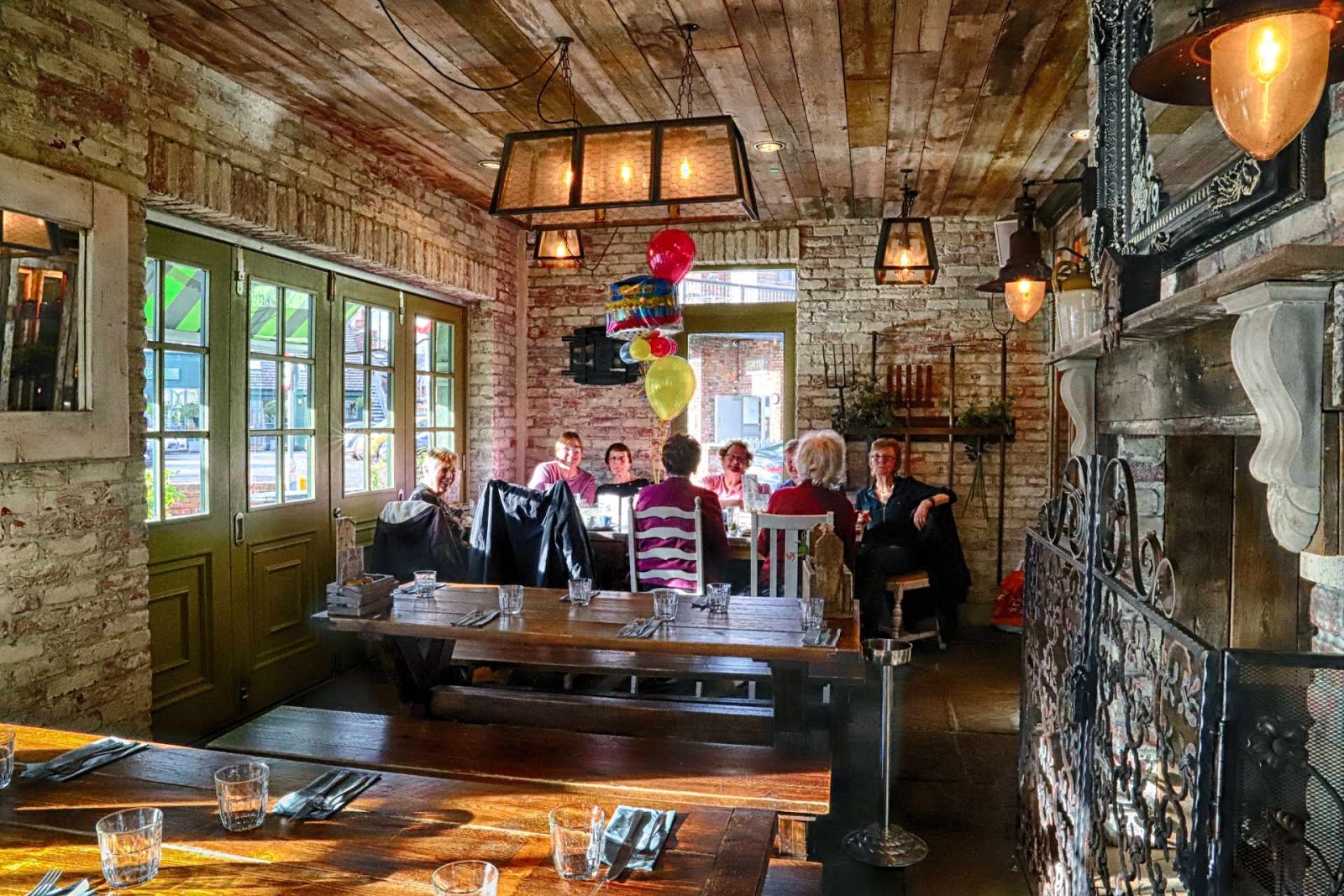
The birthday bash at Botanist, 2019
Not to be out done, the following year, back in Manchester Central at yet another CAMRA beer and cider festival, we met up again, only to have our two Scottish friends recommend the book to the group they were with.

All of which takes me back to the Didsbury pubs book, which came out in the summer, already has had an official launch at Didsbury Beer Festival, where yet again, someone bought the book on the strength of their presence in the publication.

So if you are curious as to whether you are in it, or just want a good read about Didsbury's pubs and past, along with acquiring some of Peter's fine paintings,  you can  buy the book from us at www.pubbooks.co.uk

And just to draw you in there are plenty of stories, A new book on Didsbury pubs and bars at, https://chorltonhistory.blogspot.com/search/label/A%20new%20book%20on%20Didsbury%20Pubs

Location; Didsbury


Pictures; happy customers in Didsbury's pubs and bars from the book, Manchester Pubs - The Stories Behind the Doors - Didsbury, 2019

Saturday, 30 May 2020

The lost pub on the edge of Didsbury ............. the Kingsway Hotel

I suppose most of us rather like to think of our pubs as cherished old things, which have survived the test of time, having seen off world wars, depressions and two Brexit debates and votes.

1959
And certainly when Peter and I came to write our new book on Didsbury‘s pubs and bars, we were confident that the majority would have clocked their first century and a bit and some like the Old Cock and the Didsbury Hotel could trace their origins back beyond the time that King George lost the American colonies.

But of course, there is a big chunk of the township which owes its existence to the inter war housing boom of the 1920s and 30s.

Out in East Didsbury and onto Burnage and Withington, private developers and the Corporation built new homes, and with these came schools, churches, a cinema and a clutch of brand-new pubs, like the Gateway and the Parrs Wood Hotel.

1995
These two we fell on with abandon, and because we could, we crossed the border into Burnage, and described The Mauldeth Hotel and the Kingsway, reasoning that many in Didsbury might well have traveled to the two for a change of scene, or perhaps a romantic tryst.

These were pubs built for the motor car age with carparks, and an eye to coach parties.

And like the cinemas of the period, the pubs were large, plush and designed to be places of comfort.

2019
Sadly, both The Mauldeth and the Kingsway had closed before we wrote the book.

I had first noticed the To Let sign on the Mauldeth Hotel back in 2014., and while it stayed there into the following year it later closed, reopening as a children’s nursery.

The Kingsway closed in 2018, and I did wonder its fate.

But how that wondering is over, because a few days ago Tony Kelzo posted three pictures of the demolition of the pub.

2019
I haven’t yet checked with the City Council’s planning portal to see what might go up on the site, but rest assured something will.

Leaving me just to mention the book again, Manchester Pubs The Stories Behind the Doors Didsbury, which neatly recounts the history of 49 pubs and bars, across Didsbury and Withington as well as the lost ones.

Together they help tell the story of how these areas changed over time.


The book is available from us at www.pubbooks.co.uk 

Location; Burnage

Pictures; The Kingsway in 1959, H W Beaumont, m49830, again in 1995, M Luft, m47481, courtesy of Manchester Libraries, Information and Archives, Manchester City Council, http://images.manchester.gov.uk/index.php?session=pass and the Kingsway in June 2019, from the collection of Tony Kelzo


Monday, 25 May 2020

Stepping back into Didsbury's past at the Old Cock in 1954

We are in Didsbury by the Old Cock Inn and the year is 1954.

Just twenty or so years later I would use it as a dinner time haunt, but by then it had changed almost beyond recognition.

The shop and the garage doors had gone and  that magnificent porch by the front door reduced in size.

Go back another fifty years and those garage doors didn’t exist instead the shop extended across to the end of the building.

All of which makes this photograph a nice period piece.

In the distance just popping above the tree line is what was once the chapel for the Methodist college but which had long since been converted into a library and lecture rooms first for the Methodist students and then for those young men and women training to be teachers.

The car parked outside clearly dates the picture as does the partially hidden sign for Emergency Water Supply.

The letters EWS could be found all over the city and date from the last war when extra water might be needed to fight fires during an air raid and when the water mains had been damaged.

Most have long since been painted over or have faded with age and when I went looking for this one it too had gone.

It might still have been there in 1974 but I can’t remember, that said I can date the picture to 1954 because it was one of a series produced by the Valentine Company in that year and while the photograph might be a tad earlier it won’t be much.


Location; Didsbury


Picture; the Old Cock in 1954